
Our readers keep the lights on and the weekend projects moving. As an Amazon Associate, I earn from qualifying purchases.
Specs are compiled from manufacturer listings and verified buyer reviews and can change over time — please confirm the key details on the product page before buying.
A tennis ball machine that costs a fortune is not the only way to get real solo practice. The real goal on a budget is finding a machine that feeds balls consistently, survives regular use, and minimizes setup time. This guide compares five machines across very different price tiers so you can see exactly where your money goes and which trade-offs actually matter.
I’m Rikta — the founder and writer behind FitlyFast. This guide is built by comparing the manufacturers’ published specifications and the patterns across verified customer reviews, so you get each pick’s real strengths and trade-offs instead of marketing spin.
We break down capacity, speed, portability, and real owner feedback to help you choose the right budget tennis ball machine without wasting money on features you’ll never use.
Our Picks at a Glance

How To Choose The Best Budget Tennis Ball Machine
On a budget, you are trading features for reliability. The cheapest machines can still be great if you pick the right priorities, but a few specs decide whether a machine becomes a training partner or a frustrating paperweight.
Ball Speed vs. Your Skill Level
Speed is measured in mph, and it directly changes what you can practice. Beginners rarely need more than 30 mph — a gentler feed gives you time to set your feet and focus on form. Advanced players need the higher ranges to simulate real rally pace. There is no point paying for 75 mph if you cannot react to 20 mph yet.
Hopper Capacity and Session Flow
The hopper is the basket that holds balls before they feed into the machine. A small hopper means you hit for a few minutes, then spend the same time picking up balls to reload. Look at capacity alongside speed — a machine that holds only 25-30 balls will interrupt your rhythm constantly, no matter how fast it launches.
Portability Weighs Into Motivation
A heavy machine that is awkward to lift will stay in the garage. Check the package weight and whether the design includes wheels or a carrying bag. The difference between a 4 kg machine you can sling into a trunk and a 16.92 kg unit that needs two hands is the difference between practicing weekly and practicing never.
Quick Comparison
| Model | Best For | Max Speed | Hopper Capacity | Weight | Amazon |
|---|---|---|---|---|---|
| Furlihong 3819BH★ Best Overall | Beginners learning strokes | Up to 30 MPH | — | 4.01 kg | Amazon |
| Furlihong 3807BHOscillation Pick | Solo practice with oscillation | Adjustable L-H | 25-30 balls | 6.83 kg | Amazon |
| Spinshot Lite | Junior and intermediate players | — | Just over 50 balls | 16.92 kg | Amazon |
| Nisplay N1 | Topspin and backspin practice | Max 68 MPH | 80+ balls | 26 lbs | Amazon |
| TENNIIX Basic | App and voice-controlled training | Up to 75 MPH | 100+ balls | 18.7 lbs | Amazon |
In‑Depth Reviews
1. Furlihong 3819BH Portable Tennis Ball Machine
The featherweight entry point that gets beginners swinging while staying affordable.
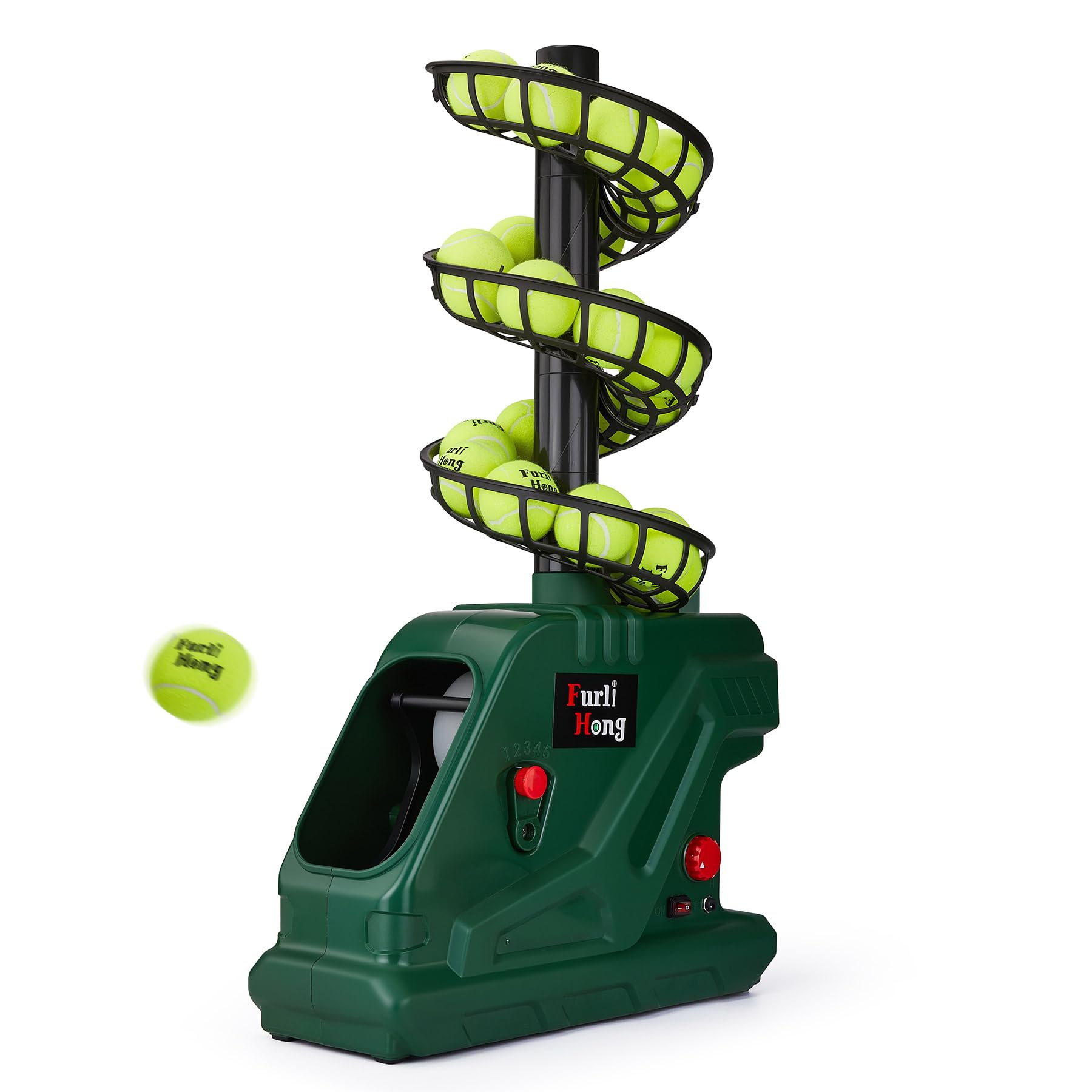
You can carry this machine to any court without breaking a sweat because it weighs just 4.01 kg — the lightest in this guide and about a quarter of the Spinshot Lite’s 16.92 kg. Its 5 angle settings (forehand, backhand, flat, slice, and volleys) let you target specific strokes, so you can practice your backhand without chasing every ball.
The 2 power levels and 4 serve intervals let you control the rhythm of your session. A short gap between balls is great for quick reactions, while a longer gap gives you time to reset and focus on clean form. The machine tops out at 30 mph, which is ideal for learning fundamentals — beginners get a forgiving pace, and advanced players can sharpen timing without chasing fast balls.
Quality is what owners praise most here, with that aspect drawing the most positive feedback by far. The machine runs on 8 D batteries or a power bank, which means you can train away from an outlet. The catch is that ball fuzz builds up inside and needs regular cleaning — and some buyers report balls getting stuck, so keep the machine vacuumed between sessions.
What wins people over
- Extremely portable at 4.01 kg — easy to carry to any court
- Simple controls: 5 angles, 2 power levels, 4 feed intervals
- Flexible power via 8 D batteries or a power bank
What to watch
- Ball fuzz builds up and requires regular vacuuming
- Some owners mention balls getting stuck in the feed
- A few units show weak launching power from the start
Reach for this if: you are a beginner or casual player who wants a cheap, portable machine for regular stroke practice at a gentle 30 mph pace.
Look elsewhere if: you need high-speed feeds or a large hopper for long, uninterrupted sessions.
2. Furlihong 3807BH Tennis Ball Machine with Triangular Base
A sturdy base and a swinging head that simulates a real hitting partner moving you around.
The standout here is the automatic up and down swing launch port. A quick button press locks the launch angle wherever you want it, and the machine also oscillates left and right — so you can train moving shots, not just standing-still feeds. It sits on a triangular iron base that keeps things stable during heavier hitting, which matters more as you ramp up speed.
Speed is adjustable from low to high, making it flexible for all levels. It runs on both batteries and an AC adapter, which is convenient if you train close to an outlet. Owners find it excellent for solo practice, with the random mode delivering a genuinely good workout — and it is light enough to move around thanks to the included carrying bag.
The recurring gripe is the hopper: it holds only about 25-30 balls, so you will be refilling frequently. The machine measures 22 x 22 x 38 inches — that is more than twice the height-and-footprint of the compact 3819BH at 9.5 x 18.5 x 35.4 inches. One owner noted the launch can be inconsistent and the angle may drop after 15-20 minutes on battery, which points to the power source struggling under load.
Best feature: the 3-axis movement (left and right, plus up and down) that makes solo practice feel like a real rally at a very accessible price.
Honest limit: a tiny hopper that interrupts your flow with frequent refills, and a carry bag that is not built for heavy use.
3. Spinshot Lite Tennis Training Machine Basic Model
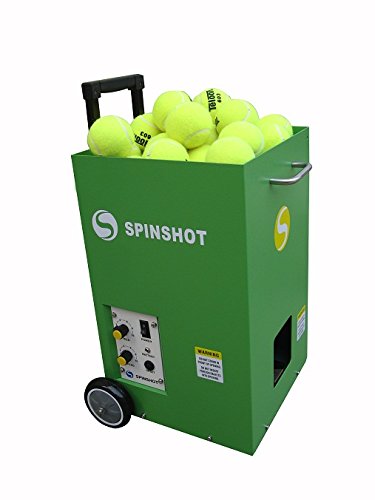
A compact, cordless trainer that is the go-to for junior players building consistent strokes.
This is marketed squarely at intermediate players and juniors, and the reviews back that up — beginners and juniors are the ones it suits best, which is the most-praised aspect of the machine.
Battery life runs about 2 hours cordless, which makes it genuinely portable — owners say it is light enough to pop in a trunk without help. The oscillator is built in, adding movement to your feeds without any extra attachment. Multiple speeds and heights let you adjust the challenge as you improve.
The honest catch is that it is not adjustable enough for advanced players, and the ball capacity still creates downtime. The machine measures 19.69 x 11.81 x 11.81 inches but is the heaviest in this list at 16.92 kg — a big jump from the Furlihong 3819BH’s 4.01 kg. One owner described hitting for 15 minutes, then spending 15 minutes picking up balls to reload, so pair this with a ball hopper for real session flow. The battery compartment also lacks a buffer, so the battery wriggles around inside.
Why it stands out
- Just over 50-ball hopper gives longer rallies than budget picks
- ~2-hour battery life for real cordless portability
- Built-in oscillator for moving feeds
Who it isn’t for
- Advanced players will run out of adjustment range
- Heaviest pick here at 16.92 kg despite compact size
- Battery compartment lets the battery shift around
Best match: juniors and improving beginners who want a quality cordless machine with a larger hopper and don’t mind the heavy carry.
skip it if: you are an advanced player needing precise spin control or fine-tuned speed ranges.
4. Nisplay N1 Portable Tennis Ball Machine

A dual-motor aluminum build that adds real topspin and backspin to your solo sessions.
This is the machine to reach for if you want to practice spin. The dual motor design shoots balls end to end with a feed interval of every 1-9 seconds, and the spin control adjusts topspin and backspin at different levels — something the budget Furlihong machines simply cannot do. It launches up to 68 mph with elevation from 0 to 50 degrees, which covers everything from flat feeds to high lobs.
The build quality is a big part of the appeal. It is aluminum, weighs 26 lbs, and owners describe it as well-made and reliable — with the available ball quality drawing the strongest praise. The external lithium battery runs 4+ hours and is easy to charge and transport separately. Oversized wheels and a 3-foot folding handle let you tow it over grass, gravel, and curbs.
The 80+ ball hopper beats the Spinshot Lite’s 50ish capacity, giving you longer intervals between pickups. The trade-offs? Some owners say the max speed figures are a bit optimistic, and the machine can slide or rotate during hard launches — the plastic handle supports limit tilt adjustment to 10 degrees. The towing wheels are also described as quite small for rougher terrain.
Why it wins: adjustable topspin and backspin at this price point is rare, and the external battery keeps you training beyond a single session.
The caveat: it can shift position on the court during powerful launches, so set it on a stable surface.
5. TENNIIX Basic Tennis Ball Machine
A smart robot that listens to voice commands and runs drills through an app.
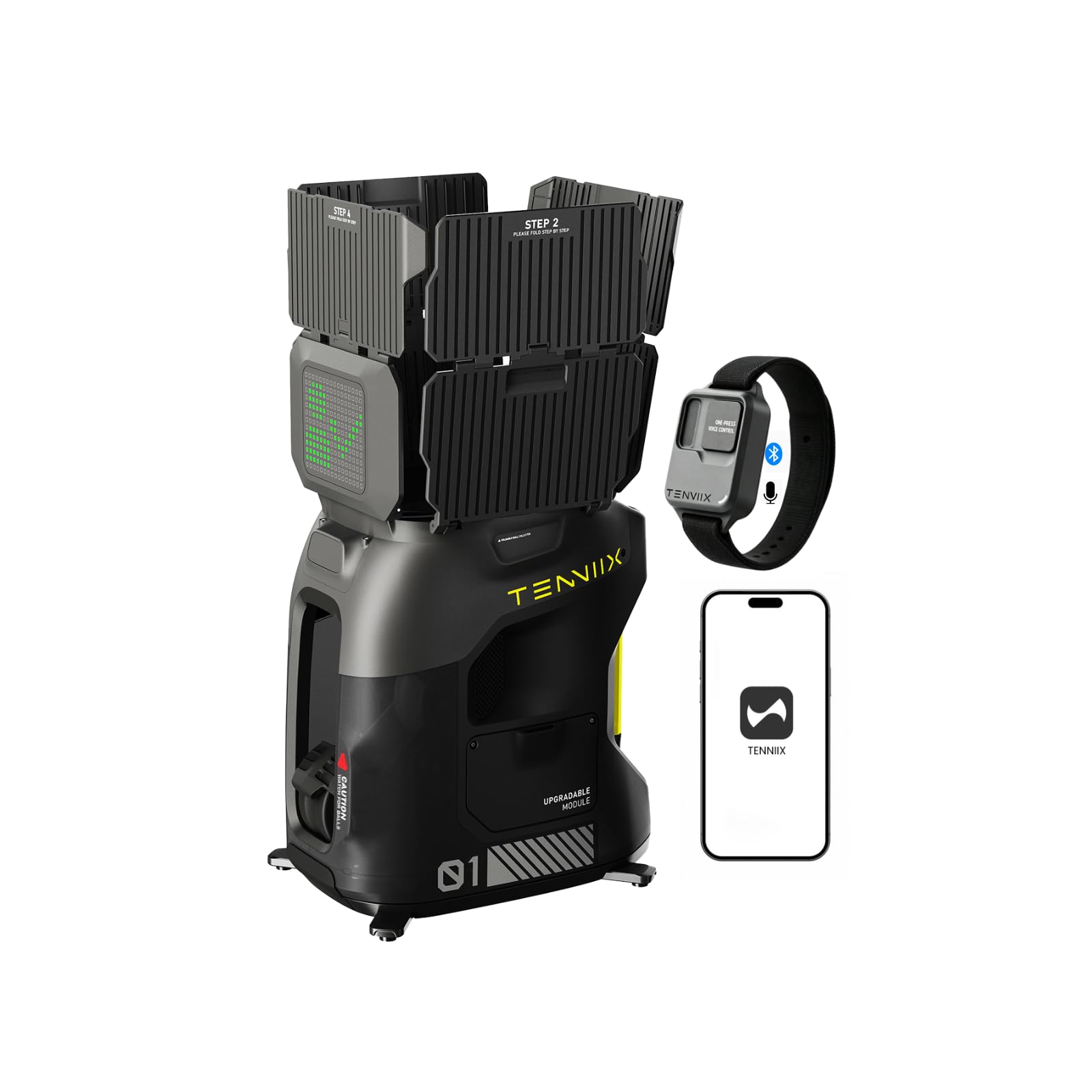
This is the most feature-packed machine on the list, and the headline is the control system. Bluetooth 5.2, WiFi, a microphone, and a speaker support 46 direct voice command keywords — you can adjust speed, spin, feed timing, and drills without walking back to the machine. A wireless wrist controller keeps Start, Pause, Reset, and Test Ball at your fingertips, and the app fine-tunes every parameter with over 1,000 unique ball combinations.
You can toss it in any trunk because it folds to 15.4 x 10.7 x 17.6 inches and weighs 18.7 lbs (8.5 kg) with ergonomic non-slip handles. The removable battery gives you up to 4 hours of practice or 1,800 shots per charge, so you can train without hunting for an outlet. Its dual-wheel system fires balls up to 75 mph — the fastest in this guide — and the 100+ ball capacity outpaces every other machine here, meaning fewer pauses to reload.
The training modes are a big draw. There are 9 shot patterns covering baseline, half-court, volley, overhead, topspin, backspin, moon ball, and hand-toss, plus a Match Mode that simulates rallies in 6 styles with NTRP presets L1-L3. The catch is a minimum 5-second delay between patterns in some modes, which interrupts rhythm — and there is no wheel system, so you carry it rather than tow it. When the balls are clean and dry, consistency is solid.
What makes it special
- Voice commands and app control keep you in your hitting rhythm
- 100+ ball capacity and 4-hour battery for long sessions
- 9 shot patterns plus 6 Rally modes for varied drills
What to know
- 5-second minimum delay between patterns disrupts flow
- No wheels — you carry an 18.7 lb unit to the court
- Clean, dry balls are required for consistent feeding
Ideal for: tech-savvy players who want app-driven drill variety and voice control without a hitting partner.
Not for: purists who want a simple dial-and-go machine with no app learning curve.
Understanding the Specs
Ball Speed (MPH)
This is how fast the machine launches the ball. A 30 mph feed is forgiving and great for beginners learning footwork and timing. A 68-75 mph feed simulates real match pace and suits experienced players. Choose speed based on your level, not the biggest number — a machine that out-runs your reaction time is useless.
Hopper Capacity
The hopper is the basket that holds balls before they feed into the launch wheels. Bigger capacity means more consecutive hits before you reload. A 25-30 ball hopper gives you short bursts, while a 100+ ball hopper keeps you hitting for minutes at a time. For solo practice, capacity directly controls how much time you spend playing versus picking up balls.
FAQ
What is the best budget tennis ball machine for a complete beginner?
How many balls do I need for a budget ball machine?
Can a budget tennis ball machine help me improve my groundstrokes?
Do budget tennis ball machines jam easily?
How long does the battery last on a budget machine?
Is a machine with oscillation worth the extra money?
Can I use a budget ball machine for topspin and backspin practice?
What is the difference between a 30 mph and a 75 mph ball machine?
How portable do budget tennis ball machines need to be?
Why does my ball machine launch the first ball too high?
Final Thoughts: The Verdict
For most buyers, the budget tennis ball machine winner is the Furlihong 3819BH because it pairs a friendly 30 mph top speed with real portability at just 4.01 kg, and its 61 ratings skew heavily positive on quality and value. If you want moving feeds that simulate a real rally, grab the Furlihong 3807BH for its oscillating launch port. And if you want spin plus app-driven drills without paying premium prices, the Nisplay N1 is the one to reach for.
How We Picked
We do not accept paid placement. Every pick is matched to a real buyer and a real use-case; we do not hands-on test units.
Sources & Methodology
Specifications: manufacturer listings and product documentation. Review insights: verified customer reviews, as of August 2026. Pricing: not shown on this page (it changes often); check the current price via the retailer link.
As an Amazon Associate, FitlyFast earns from qualifying purchases. This does not affect which products we feature.