
Our readers keep the lights on and the weekend projects moving. As an Amazon Associate, I earn from qualifying purchases.
Specs are compiled from manufacturer listings and verified buyer reviews and can change over time — please confirm the key details on the product page before buying.
Thickness planers turn rough, cupped, or twisted lumber into smooth, dimensionally perfect boards — the difference between a wobbly shelf and one that sits flat. But if your budget stops well short of the pro-shop names, you need a machine that delivers the finish without the price tag. This guide cuts through the noise to find the planers that actually earn their keep on a budget.
I’m Rikta — the founder and writer behind FitlyFast. This guide is built by comparing the manufacturers’ published specifications and the patterns across verified customer reviews, so you get each pick’s real strengths and trade-offs instead of marketing spin.
If you want a machine that straightens and smooths lumber without emptying your wallet, you’ve come to the right place — here is our guide to the best budget thickness planer for your workshop.
Our Picks at a Glance

How To Choose The Best Budget Thickness Planer
A thickness planer does one simple thing — it shaves a board down to a uniform thickness — but the build quality and features determine whether the result is a smooth, ready-to-sand surface or a chattery mess. Here are the specs that separate a good budget planer from a frustrating one.
Cutterhead Type: Straight Blades vs. Spiral Inserts
A straight-knife cutterhead uses long, full-width blades. They are cheap to replace and easy to sharpen, but they make more noise and can leave a rougher finish on figured woods. A spiral (helical) cutterhead uses small, staggered inserts — each one takes a tiny cut, producing a much quieter, glass-like finish. The trade off is cost; spiral planers cost more upfront.
Motor Power and RPM
Amps matter, but so does the cutterhead speed (RPM). A 15-amp motor is the standard for benchtop planers and will handle most hardwoods if you take light passes. The real question is how many cuts per inch the cutterhead delivers at its max feed rate; more cuts mean a finer surface. A planer that spins at 10,000 RPM with a three-knife head will give a different finish than one that spins at 23,500 RPM with two knives.
Snipe Control
Snipe is the deeper cut at the leading and trailing ends of a board, caused by the rollers tilting the board as it enters or exits. Budget planers handle snipe differently: some rely on a locking carriage, others on longer infeed/outfeed tables to support the board. A four-column carriage lock — like the one on the DEWALT — is the most effective mechanical fix. With any planer, using an extra sacrificial board to “push” the workpiece through can also help.
Quick Comparison
| Model | Best For | Cutterhead | Motor | Snipe Control | Amazon |
|---|---|---|---|---|---|
| VEVOR 13″ Planer★ Best Overall | Raw speed on pallet wood | Two-knife | 15 A / 23,500 rpm | Extended tables | Amazon |
In‑Depth Reviews
1. VEVOR Thickness Planer, Two-Blade, 13″ Width Worktable Benchtop Planer
The 23,500 RPM monster that chews through oak pallets without complaint.
You get the fastest cutterhead speed in this list — 23,500 rpm — which gives you a finish finer than most two-knife planers at that price. Boards up to 13 inches wide and 6 inches thick fit through the VEVOR. The 35 inches of total table length (using pull-out extensions) supports longer stock so it does not sag. The 15-amp motor delivers 2000W, enough to plane hardwoods if you take light passes.
Buyers report it is “excellent for planing oak pallet boards” and that there is “almost no snipe at ends until below 7/16″.” The two-knife solid steel cutterhead is hardened to HRC55-60 (a hardness rating on the Rockwell scale) for durability. A built-in 20-amp overload protector cuts power automatically if the current spikes. A few owners note the dust collection is mediocre and that the blades are not sold in 2-packs, but the overall impression is a rugged, capable machine for the price.
It weighs 54 pounds — 6 pounds lighter than the WOODERS planer (60 pounds) — so it is easier to move onto a benchtop. The cast iron bed keeps it steady during cuts.
What wins people over
- Blistering 23,500 rpm cutterhead speed for smooth finishes
- Handles 13-inch wide boards and 6-inch thick stock
- Extended tables give 35 inches of total support
- 20A overload protector adds safety
The trade-offs
- Dust collection is poor, needs a shop vac
- Replacement blades not sold in 2-packs, which is inconvenient
- Requires patience on hardwoods — light passes and cooling breaks
Reach for it if: you process a lot of reclaimed pallet wood or rough lumber and want the fastest cutterhead speed at this price.
A note on the dust: the vacuum port works but the chip ejection is not as tidy as more expensive planers — plan to connect a shop vac.
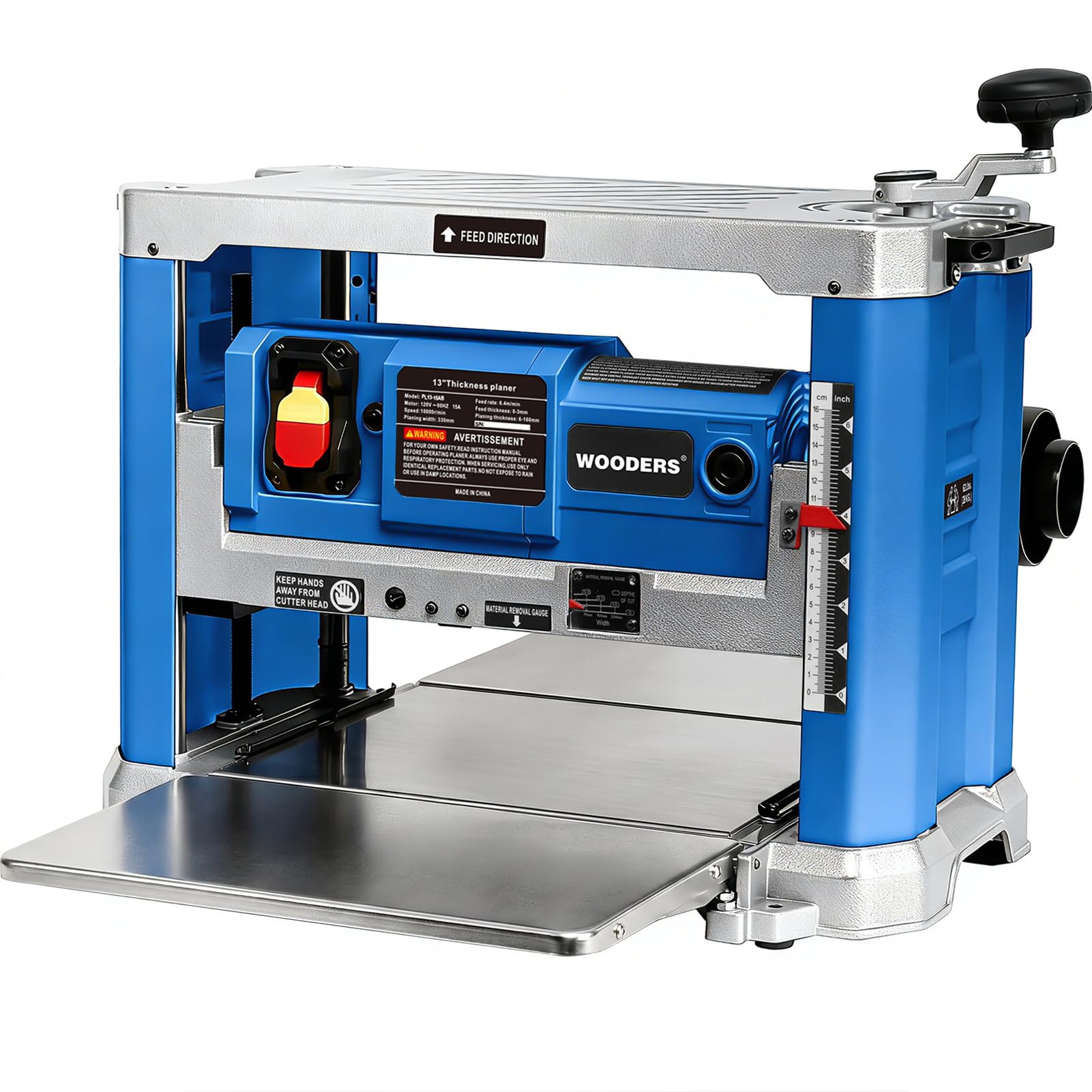
2. 13-Inch Benchtop Thickness Planer, 15A Wood Planer with 4 HSS Blades
This WOODERS planer targets a specific buyer — the older or physically limited woodworker who needs power without joint strain. You get an oversized depth adjustment crank and a high-visibility height indicator (showing 0 to 1/8 inch) that makes setting cuts easy on the hands and eyes. It planes boards up to 13 inches wide and 6.3 inches thick with a 15-amp all-copper motor spinning at 10,000 rpm.
The dual-edge cutterhead pairs with an tune infeed/outfeed structure designed to reduce snipe. Buyers — often buying it as a gift for a spouse — describe it as “great value” and say they are “very happy with it.” One long-time owner replaced a 30-year-old Craftsman with this unit and noted the price reflects its capabilities, calling out weak infeed rollers and unresolved snipe as the main head-scratchers. The package includes two extra HSS double-edged blades in a storage box, plus a dust port for vacuum connection.
At 60 pounds, it is heavier than the VEVOR (54 pounds) — 11% more weight — which helps dampen vibration but makes it less portable. The cast iron blade shaft and rugged frame keep it planted during heavy cuts.
Who it fits: hobbyists and senior woodworkers who want a stable, heavy planer with easy-to-read depth settings and simple blade swaps.
The fit note: the infeed rollers feel weaker than pricier alternatives, and snipe is not fully eliminated — sacrificial boards help.
3. WEN PL1303 15-Amp 13-Inch Three-Blade Benchtop Thickness Planer

The three-blade cutterhead that makes 30,000 cuts per minute for a finish you barely have to sand.
The WEN PL1303 is the crowd favorite because its three reversible SK5 blades (model BP133K) deliver 30,000 cuts per minute at a feed rate of 26 feet per minute. More cuts per square inch means a finer surface — owners confirm “the 3 blades ensure super smooth cuts.” It planes boards up to 13 inches wide and 6 inches thick, with a depth-adjustable cut from 0 to 1/8 of an inch per pass.
It is lighter than the DEWALT DW734, and compares well on finish — one reviewer noted it handles end grain well and produces minimal snipe. The main ergonomic hiccup is the dust chute, which is hard to install and blocks the outfeed tray storage. A few owners reported a plastic feed thickness gauge breaking after a few weeks, but WEN support reportedly replaced it quickly. The motor is 15 amps, same as the VEVOR, but at a lower cutterhead speed — the three blades compensate by giving more cuts per inch.
At 28.25 inches deep, 20 inches wide, and 24 inches tall, this planer takes up noticeable bench space — 26% more depth than the 22.4-inch WOODERS unit. Factor that in if your shop is tight.
What stands out
- Three reversible blades give a super smooth, chip-free finish
- 30,000 cuts per minute at 26 ft/min feed rate
- Budget-friendly price with strong customer support
The quirks
- Dust chute is fiddly to install and blocks tray storage
- Plastic thickness gauge can break, though WEN replaces it
- Not as quiet as spiral cutterhead planers
Who it is for: anyone who wants a near-sanded finish straight off the planer and likes the idea of reversible blades that extend sharp life.
Look elsewhere if: you need a compact footprint or prefer a spiral cutterhead for ultra-quiet operation.
4. Hoteche 10-Inch Benchtop Planer and Jointer Combo with Stand

A two-in-one space saver that tries to do it all — jointer and planer in a single heavy package.
The Hoteche combo is an intriguing idea for small shops: a 10-inch jointer (a machine that flattens one face of a board) and a thickness planer in one machine with a stand, weighing in at 85 pounds. The jointer table measures 37.3 inches by 10 inches, and the planer table is 10.6 by 12 inches. The 13-amp motor spins at 9,000 rpm with a feed speed of 6 meters per minute — a rotational speed 2.6 times slower than the VEVOR’s 23,500 rpm. It accepts boards up to 10 inches wide, a narrower limit than the 13-inch competitors.
The honest assessment: the concept is strong — a few owners call it “great addition to home workshop” and say pallet boards come out “like expensive finished boards.” But the execution is bumpy. Multiple owners mention confusing assembly instructions with grainy photos, missing parts, and the need to partially disassemble the machine to switch between jointer and planer modes. One owner said bearings failed after planing roughly 200 boards. The fixed outfeed table reportedly has no adjustment, which is a problem for jointing accuracy.
At this price point, the dual function is the value proposition, but the assembly headaches and quality-control stories make it a cautious recommendation. This is for the buyer who sees the potential and is comfortable troubleshooting assembly on their own.
The case for it: a single footprint that does both jointing and planing, saving shop space and providing a stable 85-pound platform.
The honest caveat: the instructions are the weakest link — several owners found them frustrating or incomplete — and the quality control is inconsistent.
5. Cutech 40700H 12½-Inch Spiral Cutterhead Benchtop Planer with Tungsten Carbide Inserts
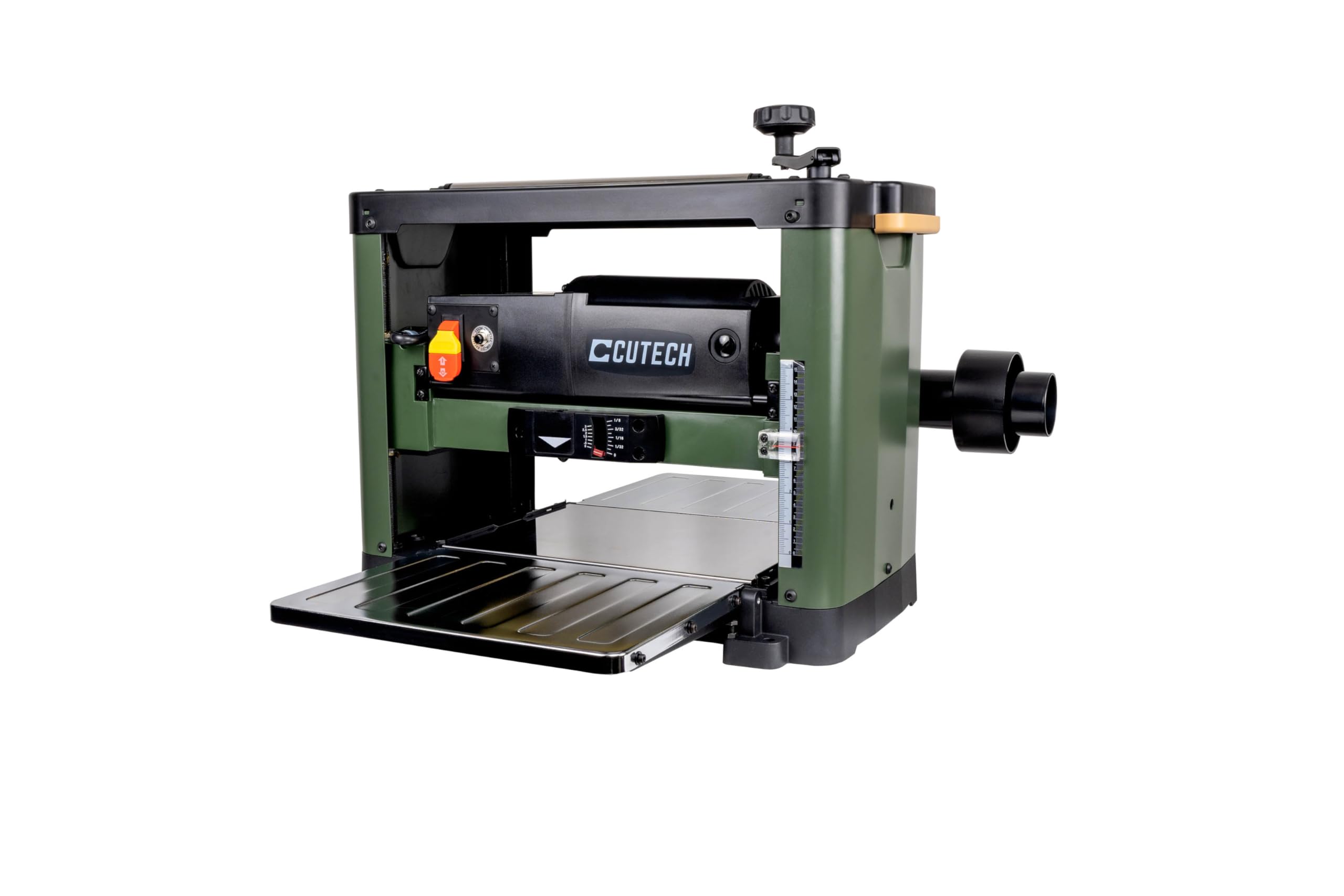
The spiral cutterhead that delivers a whisper-quiet, glass-smooth finish with tungsten carbide inserts.
The Cutech 40700H is your entry point into spiral cutterhead territory. Its cutterhead has 6 rows holding staggered tungsten carbide inserts — two-sided inserts that sit in perfect alignment and resist skewing. The spiral design means each insert takes a tiny cut, producing a finish so smooth that owners say they need almost no sanding. The noise level is noticeably lower than straight-knife planers; one owner who upgraded from a 20-year-old Delta called it “much quieter.”
The snipe minimizer uses four lead screws and a patented coupling design — no extra locking step needed. The depth-of-cut indicator on the front shows exactly how much you are removing. Board return rollers on top let you send boards back to the front without walking around the machine. It handles up to 12.5 inches wide, which is slightly narrower than the 13-inch models, but the trade-off is the superior finish quality.
Owners are unanimously positive in their feedback, praising the smooth cut and minimal snipe. One owner — restoring a 100-year-old home — called the radial blades “a must have” for reclaiming trim boards. The spiral cutterhead also draws the lowest amp load compared to straight-knife designs, meaning less strain on your circuit.
What makes it special: the spiral cutterhead with tungsten carbide inserts is the defining feature — quiet, precise, and long-lasting inserts that rotate for double the life.
Who should skip it: if you routinely plane boards wider than 12.5 inches, the 13-inch straight-knife planers are a better fit.
6. WEN PL1326 15-Amp 13-Inch Spiral Benchtop Thickness Planer
A 13-inch spiral cutterhead at a price that undercuts the big-name competition by half.
The WEN PL1326 is the spiral-cutterhead balance: it gives you the quiet, clean-finish advantages of a helical design (using 26 staggered and rotatable HSS, or high-speed steel, blades) while keeping the 13-inch width that the Cutech lacks. The 15-amp motor spins at 10,000 rpm with a 26 feet per minute feed rate — the same feed speed as the PL1303 but with a smoother spiral finish. It planes boards up to 6 inches thick. The onboard material removal gauge tells you exactly how deep each pass goes.
Owners consistently call the finish “butter smooth” and “like glass,” noting they need far less sanding time. The blades are easy to rotate and cheap to replace — one owner ran through “many oak pallets” before needing a rotation. Snipe is described as minimal, though some owners recommend using a sacrificial push board to eliminate it entirely. The dust collection works best with a 4-inch hose, and a few owners note the plastic dust port can crack under stress; WEN support is responsive by phone for replacements.
At this price, it is less than half what a comparable DeWalt spiral planer costs — a point owners frequently mention as the deciding factor. The trade-off is a brush motor that requires hearing protection and a machine that is louder than a premium helical unit.
Why it leads
- 13-inch-wide spiral cutterhead for smooth, quiet planing
- 26 rotatable HSS blades that are cheap and easy to swap
- Much lower price than comparable name-brand spiral planers
The downsides
- Brush motor is loud; hearing protection is a must
- Dust port can crack, though support handles replacements
- Snipe is minimal but still present; sacrificial boards help
Best for: woodworkers who want the quiet finish of a spiral cutterhead at 13 inches wide without paying spiral-cutterhead prices.
skip it if: noise level is your top concern (a brushless spiral planer would be quieter) or if you need more than 6 inches of thickness capacity.
7. DEWALT Benchtop Planer, 15-Amp, 12-1/2-Inch, 3-Knife Cutter, 20,000 RPM, Corded (DW734)
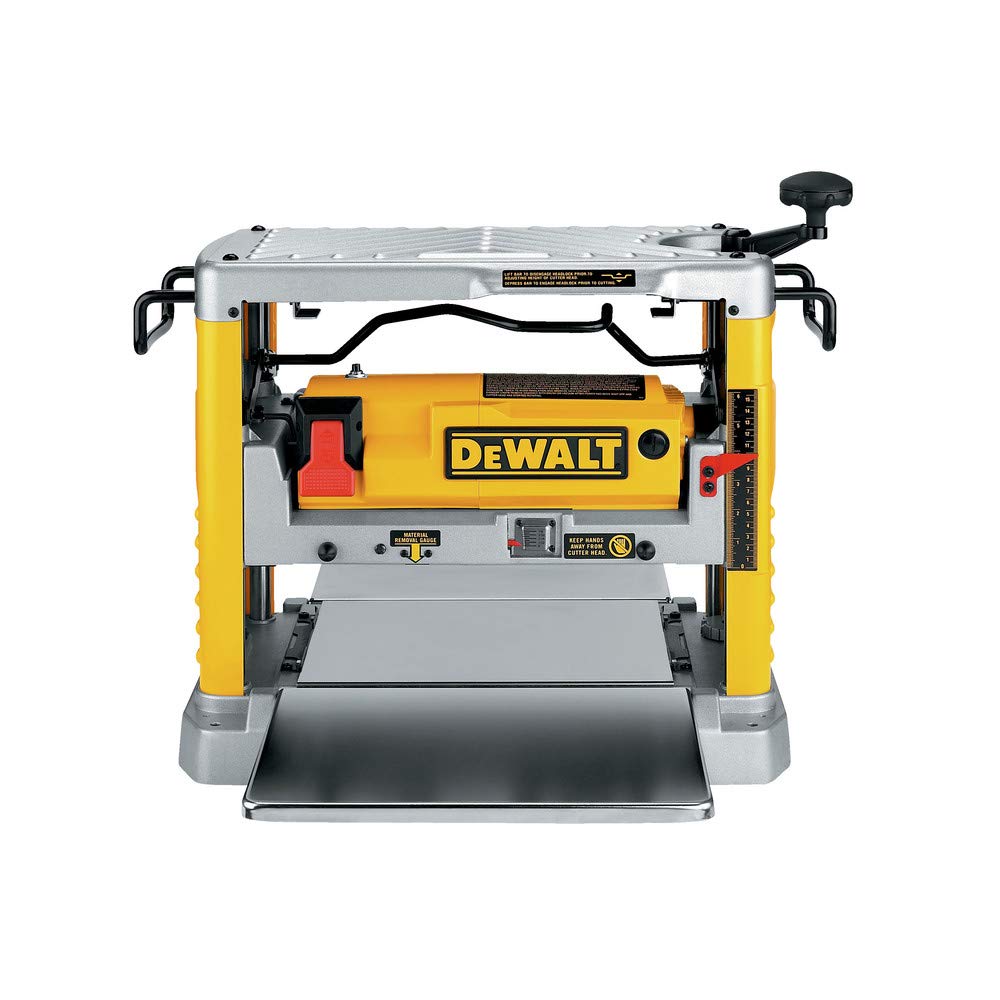
The shop standard that has been making boards smooth and flat for nearly two decades.
The DEWALT DW734 is the benchmark that other budget planers measure themselves against — and it makes a compelling case even at a premium price. The 15-amp motor pushes the three-knife cutterhead at 20,000 rpm (10,000 rpm at the cutterhead), producing 96 cuts per inch — one of the finest finishes of any portable planer. It handles boards up to 12.5 inches wide and accepts a maximum depth of cut of 1/8 inch per pass. The four-column carriage lock is the standout feature: it drastically reduces the movement that causes snipe, and owners confirm it delivers on that promise.
One reported 19 years of use with only a broken dust port tab. The disposable, reversible knives supposedly deliver 30% more knife life and swap out in about 20 minutes using alignment pins. The extra-long infeed and outfeed tables provide 33.5 inches of total material support, helping prevent board tipping. The turret depth stop lets you return to your most-used thickness settings with one turn.
The honest trade-off: the dust port works best with a 4-inch hose and can clog with standard 2.25-inch shop vac hoses — some shavings blow out the front. A few owners note the height gauge is slightly inexact, and recommend a Wixey digital readout for precision. But the build quality and part availability make this a long-term investment. It is a planer you buy once and hand down.
What makes it the benchmark
- Four-column carriage lock virtually eliminates snipe
- 96 cuts per inch for a smooth, glass-like finish
- Disposable knives with 30% more life and quick changes
- Proven longevity — many customers note over a decade of use
The price of pro performance
- Dust port clogs easily without a 4-inch dust collector
- Front chip blowback can be messy with a shop vac
- More expensive than the VEVOR and WEN alternatives
Reach for it if: you want a planer that will still be working smoothly in 15 years and you prioritize snipe-free boards above saving money.
Think twice if: budget is the primary constraint — the WEN PL1326 and VEVOR deliver impressive results for significantly less.
Understanding the Specs
Straight Vs. Spiral Cutterheads
A straight-knife cutterhead uses full-width blades that spin and chop the wood surface. They are inexpensive to replace and simple to sharpen, but they create more noise and can produce tear-out on curly or knotty wood. A spiral (helical) cutterhead uses a drum with many small inserts. Each insert takes a tiny shaving, so the cut is quieter and the finish is smoother — often requiring no sanding before finishing. Spiral planers cost more upfront but the inserts can be rotated to a fresh edge, extending their life significantly.
Cuts Per Inch and Feed Rate
This number tells you how many blade strikes happen on every inch of board as it passes through. More cuts per inch means a finer surface. A planer like the DEWALT DW734 delivers 96 cuts per inch, while a two-knife planer at a slower RPM might deliver half that. Feed rate (measured in feet per minute) determines how fast the board moves through — 26 ft/min is standard for benchtop planers. A slower feed rate gives the blades more time to make each cut, improving surface quality at the cost of speed.
FAQ
What is snipe and can I eliminate it on a budget planer?
Can a budget planer handle hardwoods like oak, maple, or walnut?
Which is better, a two-knife or three-knife planer?
Do I need a spiral cutterhead, or is straight-knife fine?
How important is weight in a benchtop planer?
What is the maximum board width I can run through a benchtop planer?
How often do I need to replace or rotate the blades?
Can I use a shop vac with the dust port, or do I need a dedicated dust collector?
Is a planer-jointer combo a good idea for a small shop?
Final Thoughts: The Verdict
For most hobbyists and small-shop woodworkers, the best budget thickness planer is the VEVOR Thickness Planer because it delivers the highest cutterhead speed (23,500 rpm) at a price that undercuts the competition, and it handles pallet wood and hardwoods alike without bogging down. If you want the smoothest finish with minimal sanding, the spiral cutterhead on the WEN PL1326 is the best value — a 13-inch wide spiral for less than half the cost of a DeWalt equivalent. And for buyers who demand snipe-free performance and near-indestructible build quality, the DEWALT DW734 remains the long-term keeper that budget planers aspire to beat.
How We Picked
We do not accept paid placement. Every pick is matched to a real buyer and a real use-case; we do not hands-on test units.
Sources & Methodology
Specifications: manufacturer listings and product documentation. Review insights: verified customer reviews, as of July 2026. Pricing: not shown on this page (it changes often); check the current price via the retailer link.
As an Amazon Associate, FitlyFast earns from qualifying purchases. This does not affect which products we feature.