
Our readers keep the lights on and the weekend projects moving. As an Amazon Associate, I earn from qualifying purchases.
Specs are compiled from manufacturer listings and verified buyer reviews and can change over time — please confirm the key details on the product page before buying.
Getting into TIG welding on a budget means you want a machine that can handle both steel and aluminum without the four-figure price tag of the big-name brands. The trick is knowing which features matter most — pulse control, high-frequency start, and AC balance — and which budget models actually deliver them reliably.
I’m Rikta — the founder and writer behind FitlyFast. This guide is built by comparing the manufacturers’ published specifications and the patterns across verified customer reviews, so you get each pick’s real strengths and trade-offs instead of marketing spin.
Whether you are repairing a car part in the garage or practicing beads on scrap aluminum, the right machine is out there; here is a breakdown of the best budget tig welder options that real owners have put to work.
Our Picks at a Glance
How To Choose The Best Budget TIG Welder
Picking a budget TIG welder is about separating the must-haves from the nice-to-haves. The biggest decision is if you need AC for aluminum or can get by with DC-only for steel. From there, you’ll want to look at features that directly affect how clean and easy the weld is, like high-frequency start and pulse control. The best budget TIG welder will give you the most control for the least money without cutting corners on safety or durability.
AC/DC Capability
If you plan to weld aluminum, you absolutely need an AC-capable machine. AC current cleans the oxide layer on aluminum, allowing the weld puddle to form properly. A DC-only welder simply cannot do this. Most budget AC/DC machines also include adjustable AC balance, which lets you fine-tune the cleaning vs penetration, giving you more control over the finished bead.
Pulse and Square Wave
Pulse TIG is a feature buyers rave about because it lets you weld thin materials like exhaust tubing or sheet metal without blowing a hole through them. The machine rapidly switches between a high peak current and a lower background current, reducing the heat that builds up in the material. A square wave output is the best option for aluminum because it switches polarity fast, creating a stable arc and strong cleaning action on the oxide film. These features are available on many mid-range and premium budget picks.
Duty Cycle and Amperage
A duty cycle tells you how long you can weld before the machine needs to cool down. For home and hobby use, a 200-amp machine with a 40% duty cycle at 200 amps is plenty. You rarely weld at full power for longer than a few minutes at a time. Higher amperage machines (250A) offer more overhead for thicker materials, but they add weight and cost. The best budget TIG welder for most people is a 200A unit with a strong duty cycle for its price.
Dual Voltage Flexibility
A machine that runs on both 110V and 220V gives you the freedom to weld in a standard garage outlet or step up to 220V for full power on thicker metal. Auto-sensing models detect the voltage and adjust automatically, which makes setup as simple as plugging it in. This is a very popular feature because it eliminates the need for a dedicated welding circuit in every space you work.
Quick Comparison
| Model | Best For | Max Amps | Weight | Key Modes | Amazon |
|---|---|---|---|---|---|
| HITBOX 200A 6-in-1★ Best Overall | Best Overall Value | 200A | 26 lbs | AC/DC TIG, Pulse, Stick | Amazon |
| TOOLIOM TL-200TPDual Voltage Champ | Dual Voltage Starter | 200A | 27.9 lbs | AC/DC TIG, Pulse, Spot, Stick | Amazon |
| Sunstac SS-250P/ACDCHigh-Amp Performer | High Amp Output | 250A | 29.9 lbs | AC/DC TIG, Pulse, Spot, Stick | Amazon |
| PowerArc 161STH | Stick & Small Shop | 140A (TIG) | 30.9 lbs | DC TIG, Pulse, Stick | Amazon |
| Bestarc TIG215P ACDC | Advanced Controls | 215A | 48.3 lbs | AC/DC TIG, Pulse, Square Wave, Stick | Amazon |
| YESWELDER TIG-200P ACDC | 7-in-1 Versatility | 200A | 31 lbs | AC/DC TIG, Pulse, Square/Triangle Wave, Spot, Stick | Amazon |
| ARCCAPTAIN TIG200PACDC | Beginner to Pro Growth | 200A | 42.7 lbs | AC/DC TIG, Pulse, Square/Tri Wave, Spot, Stick | Amazon |
| AHP AlphaTIG 203Xi | Top-Tier Duty Cycle | 200A | 69 lbs | AC/DC TIG, Pulse, Stick | Amazon |
| Weldpro TIG200-KT26 | Pre-Bundled Kit | 200A | 61.8 lbs | AC/DC TIG, Pulse, Stick | Amazon |
In‑Depth Reviews
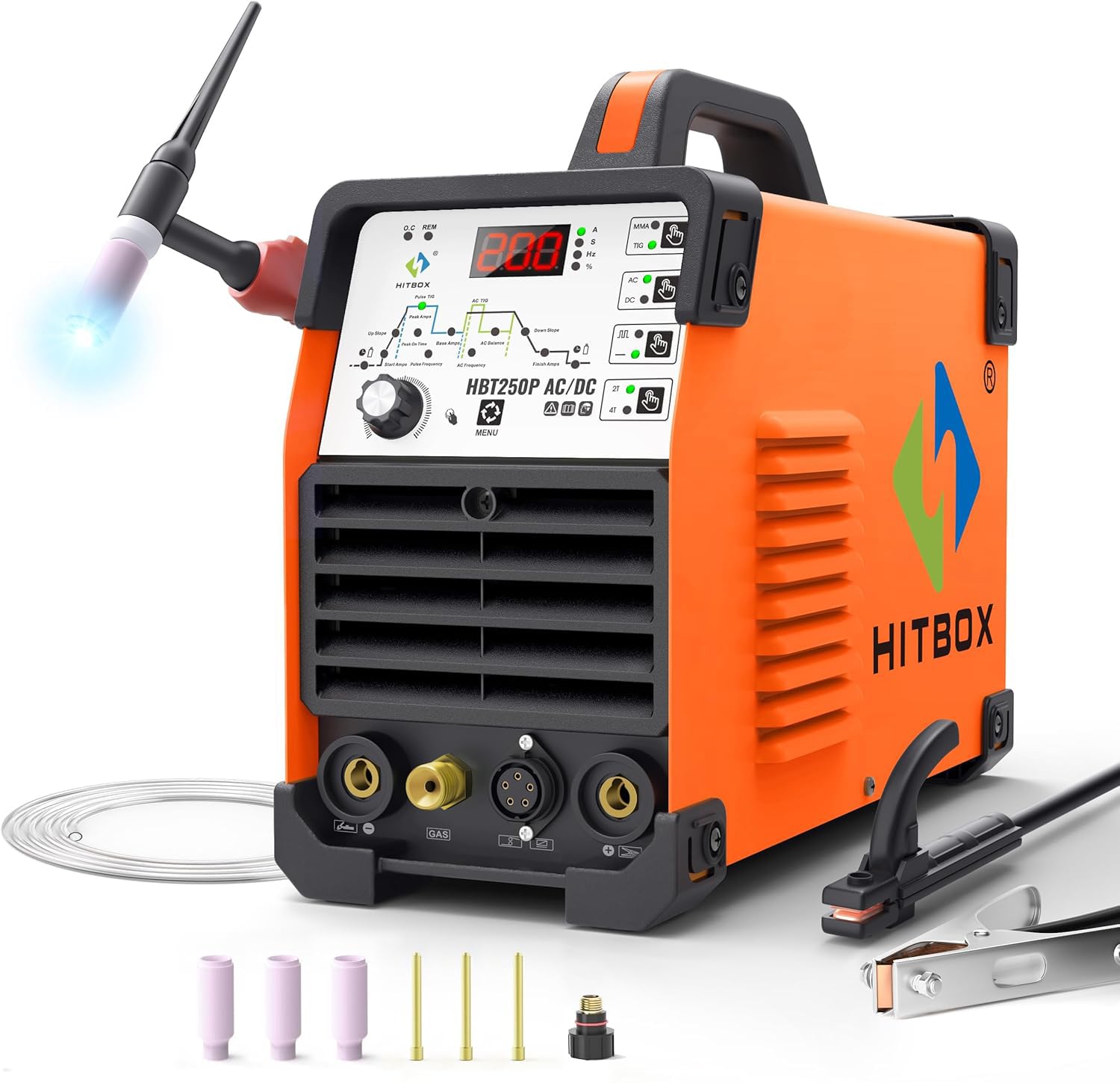
1. HITBOX 200A AC/DC TIG Welder 6-in-1
The lightweight workhorse that punches well above its price tag for home and hobby shops.
This machine gives you AC/DC TIG with pulse, high-frequency start, and a square wave — all the features you need to weld steel, stainless, and aluminum up to 1/4 inch thick. At just 26 pounds, it is significantly lighter than other 200-amp machines, making it easy to carry from the garage to the driveway. The 6-in-1 capability covers AC TIG, DC TIG, pulse TIG, and stick welding, so a single box replaces several functions.
What wins people over is the arc quality for the price — buyers report it is an “Excellent value AC/DC TIG/stick welder,” with a stable arc that runs smoothly on 220V. The 2T/4T modes reduce hand fatigue on long seams, and the adjustable down slope and finish amps help you end a weld without leaving a crater. The included 17-series torch is functional, and the dual-fan cooling system keeps things running during longer sessions.
The biggest recurring gripe is the included foot pedal — the display doesn’t show the peak current while you are setting it up, so you have to start welding to see where the heat is. Experienced owners recommend buying a separate pedal that shows live amperage. The ground clamp and stick stinger are also on the cheap side, but that is a common cost-saving measure in this price bracket.
What Owners Rave About
- Excellent arc quality and stable HF start on steel and aluminum
- Light enough at 26 lbs to move around a shop or take on the road
- Full pulse control and square wave make thin-material welding easier
The Honest Trade-Offs
- Foot pedal doesn’t show live amperage until the arc starts, making setup clunky
- Gas hose and ground clamp are noticeably lower quality than the rest of the machine
Reach for this if: you want the most capable all-around machine for under that can tackle aluminum, steel, and stainless while staying affordable.
Budget for a better pedal: the stock foot pedal lacks display feedback, so plan to upgrade it for -60 if you need precise current control.
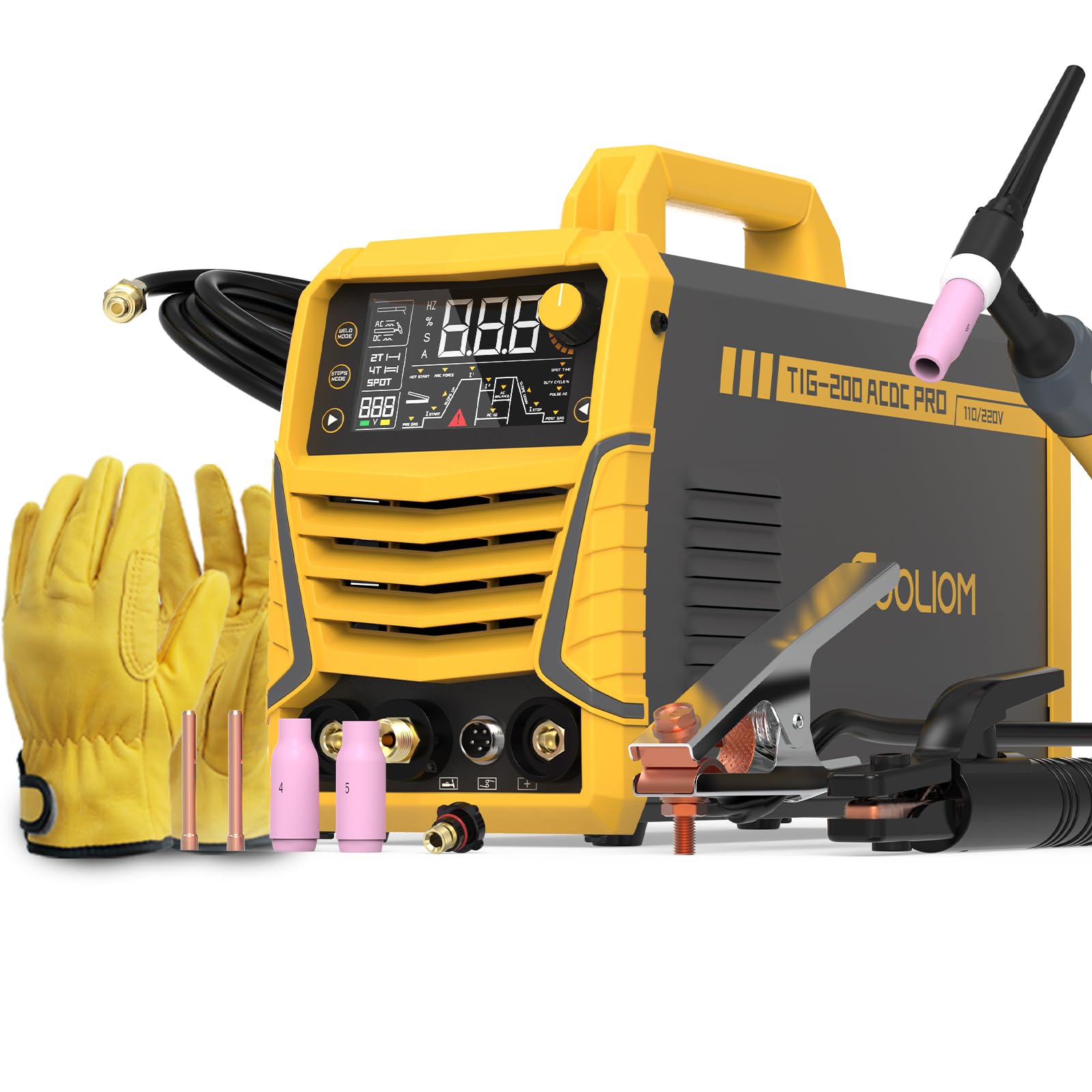
2. TOOLIOM 200A AC/DC TIG Welder with Pulse
A budget-friendly entry into AC/DC TIG that works right out of a standard 110V wall outlet.
The TOOLIOM packs 200A of AC/DC power into a 27.9-pound frame and includes pulse TIG, spot welding, and stick modes. The dual voltage auto-sensing is a major draw — you can plug into a 110V garage outlet for light work or switch to 220V to get the full 200A for thicker material. The large digital display screen makes it easy to read welding parameters even with a helmet on.
Buyers who got a good unit found it impressive on 1/4-inch 6061 aluminum after dialing in the settings, praising the lightweight build and adjustable controls. The fish-scale waveform (a pattern in the pulse that creates a stacked-dime look) helps produce visually appealing beads. A foot pedal (sold separately) is recommended by owners for real-time current control, especially on TIG work where you want to feather the heat.
The reliability data here is very mixed. A few reports describe the unit failing after about an hour of aluminum use, where the power output dropped significantly. Another common issue from the factory is a loose ribbon cable to the display screen, which is a simple fix (open the casing and reconnect it) but frustrating on a new machine. Because the sample size is small, this pick carries more risk than the more established models on the list.
Why It Appeals
- Auto-sensing dual voltage for easy setup on 110V or 220V
- Large, clear display shows real-time voltage and current
- Impressive aluminum performance when settings are dialed in
Watch Out For
- Several units have failed early — the long-term track record is unproven
- Display cable may arrive loose from the factory and need reseating
Best for flexible power needs: if you move between a home garage with 110V and a shop with 220V, the auto-switching here is a real convenience feature.
Think twice if: you need a machine you can trust for daily professional use — the mixed reliability feedback suggests it is better suited for light hobby duty.
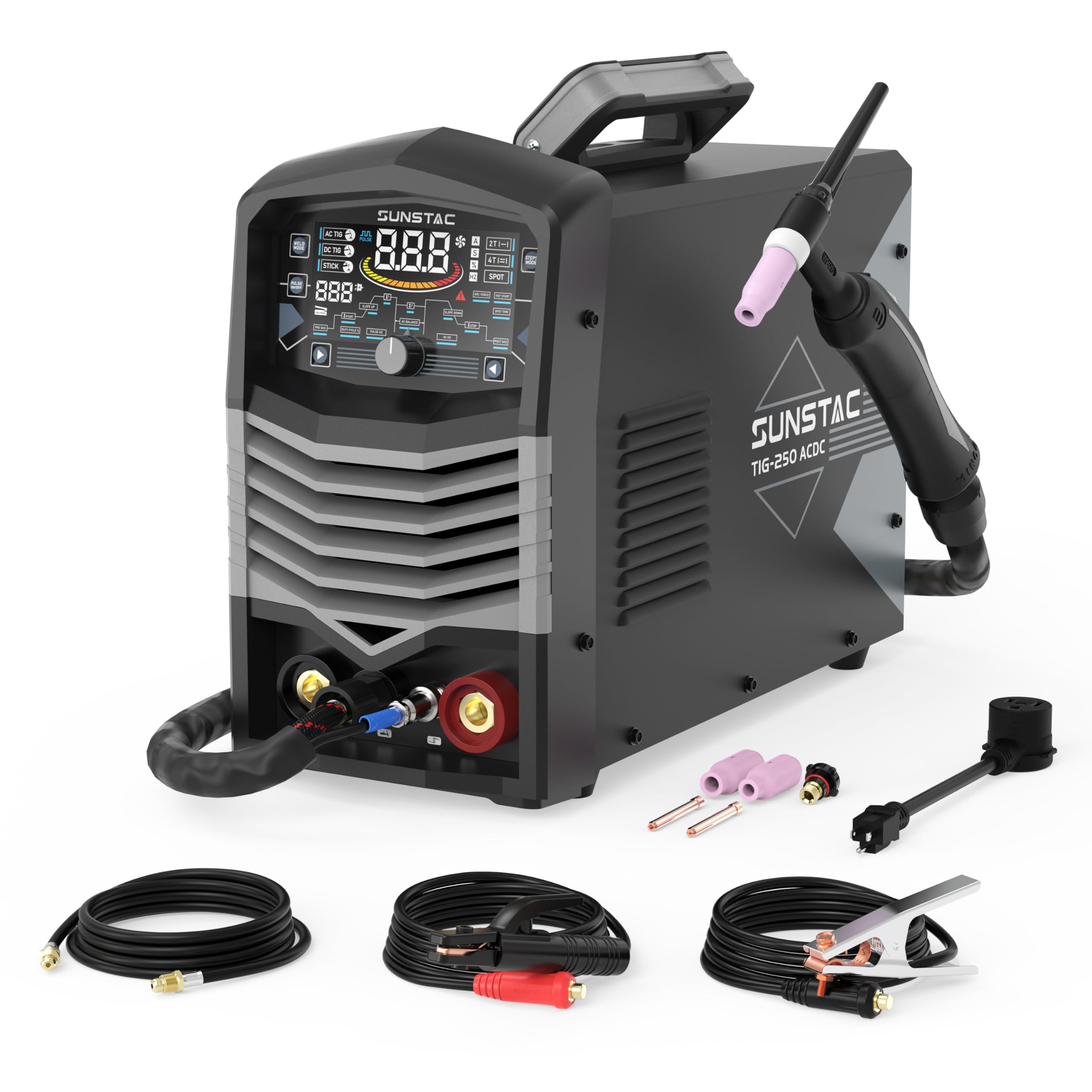
3. Sunstac 250A AC/DC Aluminum TIG Welder with Pulse
50 extra amps give this one the overhead to tackle thicker aluminum and heavy repair work.
Stepping up to 250A puts the Sunstac in a different class than the 200A competition, even though it weighs only 29.9 pounds. It runs on dual voltage (110V/220V) and includes a full LCD screen that replaces the simpler LED panels found on cheaper machines. The LCD digits stay readable even with a welding helmet on, and the built-in parameter saving function remembers your last settings between sessions — a time saver when you return to a project.
Performance is the most praised aspect here, and for good reason. Owners confirm the machine handles 1/4-inch aluminum on 220V with ease, and one ironworker recommends it specifically for aluminum boat repairs, gas tanks, and handrails. It also runs 6010 rods well in stick mode, which is unusual for a compact inverter — 6010 is a cellulose rod that most small machines struggle to maintain. The AC/DC TIG functions include pulse and spot modes, giving you precise control on thin materials.
The downsides are consistent across many reviews. The factory instructions are nearly useless, and the ground cable is a bit short at standard lengths. Several owners mention that a button can stick on the control panel, requiring a power cycle to clear it. The manufacturer’s support has also been described as inconsistent, sometimes helpful and sometimes disappearing entirely.
What Stands Out
- 250A output provides more headroom for thick aluminum and heavy plate
- LCD screen with parameter memory saves your settings between jobs
- Runs 6010 rods smoothly, a rare skill for a budget inverter
Areas to Note
- Sticky control buttons reported by several owners — may require a return
- Poor instruction manual and short ground cable are common complaints
Reach for this if: you need to weld thicker aluminum (above 1/4 inch) and want the extra amp headroom without jumping to a premium price tier.
Keep the receipt handy: button quality issues and hit-or-miss customer support mean you should order from a retailer with a good return policy.
4. PowerArc 161STH Dual Voltage TIG/Stick Welder

A DC-only machine built for stick welders who want a clean TIG option for stainless steel.
This is the pick for you if aluminum is not on your list. The PowerArc 161STH is a DC-only unit, which means it handles steel, stainless steel, and copper but cannot weld aluminum. What it does with DC is exceptional — owners say the stick mode is smoother than some Lincoln machines they have used, and it runs 6010, 6011, and 7018 rods without sputtering at low amps. The Voltage Reduction Device (VRD) is a real safety feature that lowers output voltage when you are not welding, reducing the risk of shock.
What buyers call out most is the performance. Customers note the TIG pulse feature produces welds comparable to a Miller MaxStar on thin stainless (20 to 14 gauge), and the machine has held up through 50 to 60 hours of use. The included accessory kit is generous: a 17-series air-cooled torch, argon regulator, adapter cords for both voltages, ground clamp, and stick holder all ride in a sturdy carry case. It runs on 110V for portability and 220V for full power.
The digital display is hard to read in direct sunlight, which is a genuine hassle if you work outdoors. The carry case is also described as flimsy compared to the welder itself. And because it is DC-only, you will be locked out of aluminum TIG entirely — that is not a flaw but a hard limit you must accept before buying.
Biggest Strengths
- Stick welding performance that rivals much more expensive industrial machines
- VRD safety circuit reduces shock risk when the gun is hot
- Comes with a full accessory kit including regulator and carry case
Hard Limits
- DC-only output means no aluminum welding at all
- Digital screen washes out in bright sunlight, making outdoor adjustments difficult
Reach for this if: you primarily weld steel and stainless as a hobbyist or small-shop owner and want a machine that excels at stick and DC TIG without premium pricing.
Look elsewhere if: you plan to weld aluminum in the future — you will need to step up to an AC/DC machine from the start.
5. Bestarc 215Amp AC/DC TIG Welder with Pulse
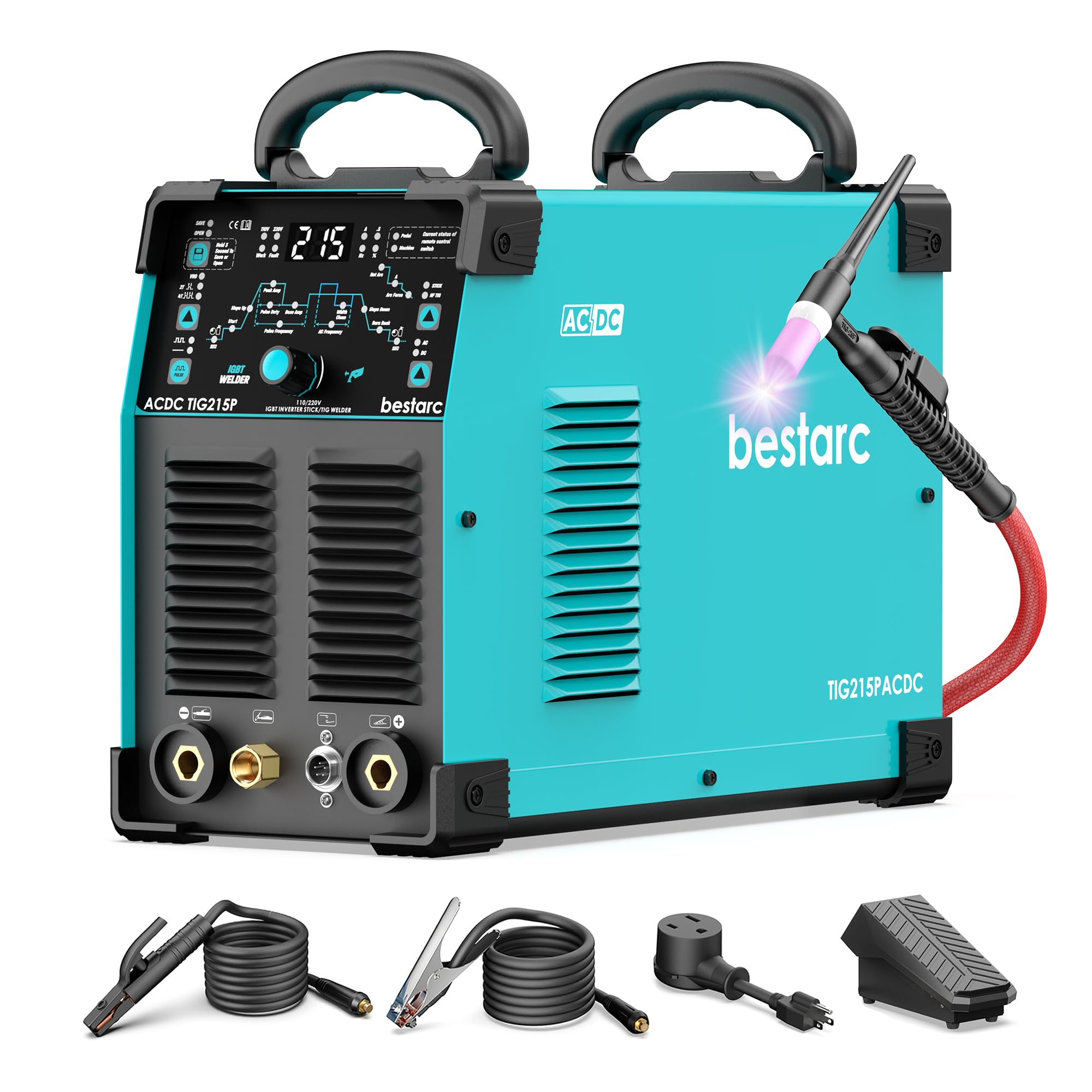
A feature-packed machine with memory presets that let experienced welders switch jobs in seconds.
The Bestarc TIG215P is a 215-amp AC/DC welder that covers AC TIG, DC TIG, pulse TIG, square wave AC pulse, and stick welding — six modes in total. Its standout feature is the memory function, which saves up to nine sets of welding parameters. If you frequently switch between a thin 16-gauge steel setup and a thick aluminum schedule, you can recall those exact numbers without dialing everything in from scratch. The included foot switch (a 5-pin pedal) is a welcome inclusion in this price class, saving you a to accessory purchase.
Buyers praise the intuitive front panel and the solid build quality. The WP-26 flex head torch is a durable upgrade over the basic torches on cheaper machines. Owners find the AC pulse and square wave produce clean beads on aluminum, and the pulse frequency adjustment helps control heat on thin metals. The down slope timer (gradually reducing current at the end of the weld) prevents craters and hot cracking, which new TIG welders find especially helpful.
The main complaint mirrors the HITBOX: the foot pedal’s amperage setting is not displayed on the machine screen. You have to start a test weld to see what current the pedal is asking for, which slows down the setup process. A few reviewers also note that the unit is heavy at 48.3 pounds — noticeably bulkier than the HITBOX or Sunstac. Also, no gas regulator is included, so factor that cost into your total.
Why It Stands Out
- Nine memory presets let you instantly recall settings for different materials and thicknesses
- Includes a 5-pin foot pedal and WP-26 flex torch, saving you accessory costs
- Down slope and post-flow controls help beginners finish welds cleanly
The Catch
- Foot pedal amperage readout is missing from the display, making setup a guessing game
- Heavy at 48.3 lbs — not the best choice if you need to carry it between job sites often
Best for the serious hobbyist or small fabricator: if you switch between materials regularly, the memory presets alone save enough time to justify the price.
A heavy trade-off: the 48-pound weight and lack of a gas regulator mean it is more of a workshop fixture than a portable tool.
6. YESWELDER 200A AC/DC TIG Welder with Pulse
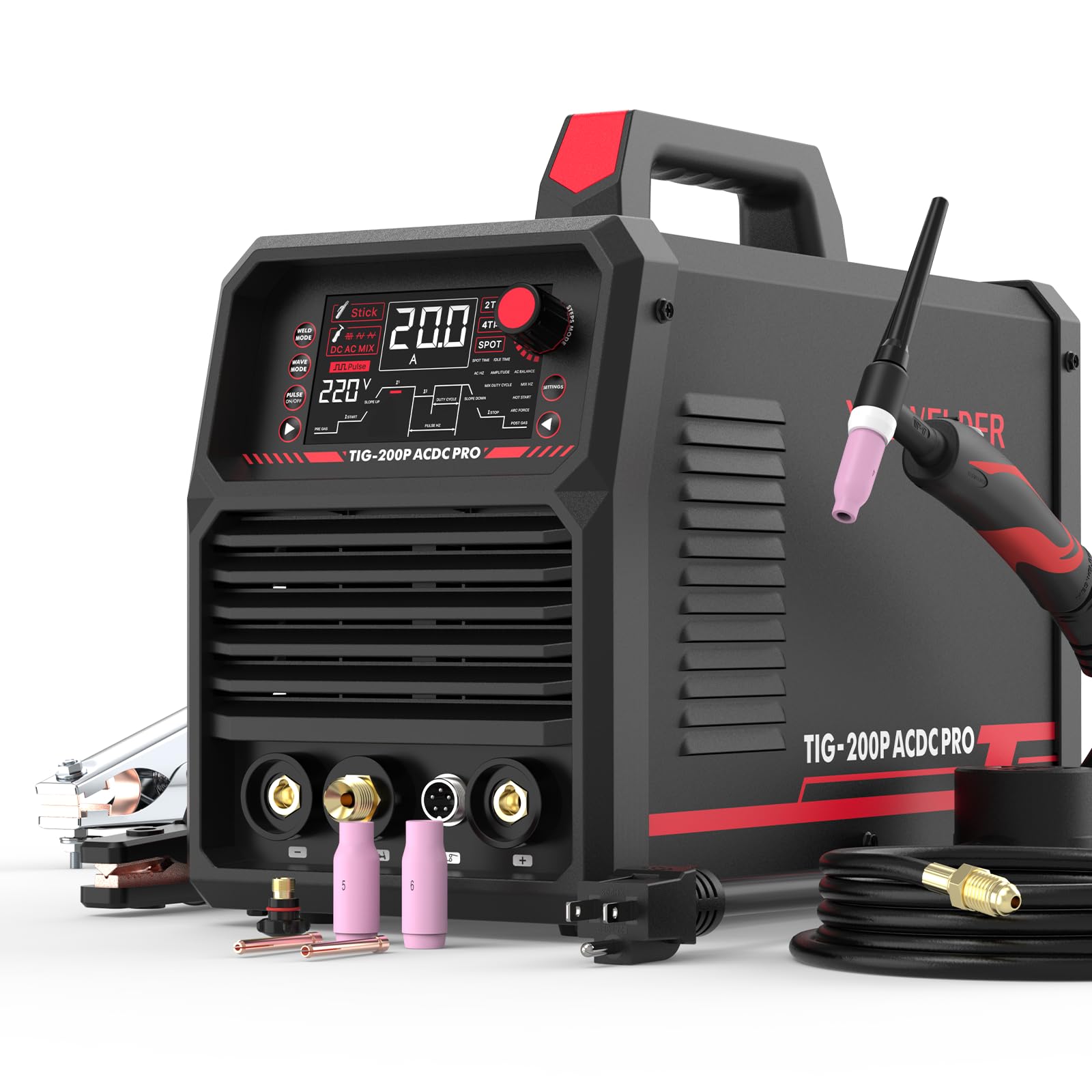
A mixed bag of potential — great features and good quality, but reliability is a roll of the dice.
YESWELDER’s TIG-200P ACDC packs seven welding modes into one chunky 31-pound box: AC TIG, DC TIG, AC pulse, DC pulse, square wave, triangle wave, and spot welding. The square wave and triangle wave options are note because they give you different arc characteristics for aluminum — square wave offers strong oxide cleaning, while triangle wave reduces total heat input, helping you weld thin aluminum without warping. The large LED display is crisp and shows all parameters clearly.
The build quality gets strong marks from owners. For the price point, the fit and finish feel substantial, and the HF start fires up consistently on both steel and aluminum. Owners who got a reliable unit find it works well for learning TIG on aluminum and is easy to set up straight from the start. The 220V adapter is included, so you can run it on a standard dryer outlet or a dedicated welding circuit.
The sticking point is reliability — it is the most-discussed aspect, and the feedback is mixed. Several reviewers point out that the machine works perfectly for months, while others say it arrived dead or died shortly after first use. A common fix shared by owners is adjusting the internal spark gap to 0.8mm if the HF start stops working. Another annoyance: the machine defaults to AC mode when powered on, even if you last used DC settings, so you have to remember to switch it every time you power up for steel.
What Works
- Seven welding modes including square and triangle wave for aluminum control
- Solid build quality and clear LED display for easy setup
- Includes 220V adapter for immediate full-power use
What Doesn’t
- Reliability is a known gamble — some units fail early or arrive dead
- Does not save the AC/DC mode between sessions, reverting to AC every time you power up
Consider it if: you want the widest range of waveform options for experimenting with aluminum welding techniques.
Proceed with caution: reliability is a major unknown, so buy from a seller with a solid return policy to protect yourself.
7. ARCCAPTAIN 200A AC/DC TIG Welder with Pulse

A beginner-friendly machine with professional-level control that grows with your skills.
The ARCCAPTAIN TIG200PACDC is a crowd favorite for good reason — it delivers full AC/DC TIG control, seven welding modes, and a build quality that feels solid without the heavy price of an industrial brand. It includes AC pulse, DC pulse, square wave, and triangular wave options, plus spot TIG and stick modes. The digital MCU control system gives you access to every parameter a serious TIG welder could want: pre-flow, up slope, peak current, base current, pulse frequency, AC frequency, and AC balance.
Performance and quality are tied as the most praised aspects. Owners consistently note the arc is smooth and stable from the first strike, and the AC balance and frequency controls produce “surprisingly clean” aluminum welds on 0.060-inch 5052 sheet. The triangular wave option is a real differentiator — it reduces heat input effectively, so thin metals are less likely to warp. The on-demand cooling fan (which only runs when needed) keeps the machine quiet during low-duty-cycle work. It runs on both 110V and 220V, with the dual voltage giving full power on 220V for thicker material.
The main trade-off is the proprietary XS12 connector for the foot pedal, which means you cannot just buy any standard pedal if you want to upgrade. The included pedal works fine but is described as bulky. The ground clamp is also reported to overheat on some units, though the manufacturer has sent replacement parts in those cases. A few owners mention that the machine can sometimes struggle to maintain consistent arc stability over long welding sessions at high amperage.
Standout Features
- Triangular wave option effectively reduces heat input on thin aluminum
- Full parameter control with digital MCU for truly fine-tuned welding
- Smooth, stable arc on both 110V and 220V with consistent HF start
What to Know
- Proprietary foot pedal connector locks you into the ARCCAPTAIN ecosystem
- Ground clamp quality is average — may need upgrading for heavy use
Best for the self-taught welder: if you want a machine that lets you experiment with AC balance, triangular wave, and pulse frequency as you learn, this is a natural fit that you won’t outgrow in a year.
Watch the pedal: you cannot swap in any standard foot pedal because of the proprietary connector, so keep that in mind for future upgrades.
8. AHP AlphaTIG 203Xi Amp IGBT AC/DC TIG/Stick Welder

The heavyweight champion for those who prioritize duty cycle and long welding runs over portability.
The AHP AlphaTIG 203Xi is a serious step up in terms of build and thermal performance. At 69 pounds, it is the heaviest machine on this list, but that weight comes with a 100% duty cycle at 155 amps. That means you can weld continuously at 155A without the machine needing a cooldown break — a huge advantage if you are running production parts or long repair seams. The 203Xi delivers a 60% duty cycle even at the full 200A, which beats most budget machines by a wide margin.
Quality is the single most-praised aspect, mentioned over 100 times by owners. The stick mode is described as the best many experienced welders have used — smoother than Miller, Lincoln, or Harbor Freight units. It runs 6011, 6013, 7018, and 308L rods in 3/32 and 1/8 sizes without hesitation. The TIG performance is on par with the Lincoln Square Wave, with a reliable HF start that lights the arc without touching the material. The included Nova foot pedal has a 25-foot cord, giving you plenty of room to position yourself comfortably. The 2024 model now uses an HV Start (electronic, solid-state simulated HF) that eliminates the need to manage a spark gap.
The ground clamp is the most common complaint — it is a cheap spring clamp that owners almost universally replace with a heavier unit. The foot pedal can slide on smooth floors, though attaching it to a board with skateboard tape is a simple fix. The 120V performance is limited (you cannot run over 3/32 rods on a standard circuit without tripping breakers), and the digital readout does not always perfectly match the actual output on 120V.
Top Grades
- 100% duty cycle at 155A means you can weld continuously without stopping to cool down
- Stick mode praised as smoother than name-brand industrial machines
- 3-year warranty and responsive tech support add real long-term value
Notable Snags
- Heavy at 69 pounds — definitely not a portable machine for job-site hopping
- Ground clamp is low quality and will likely need replacement immediately
Reach for this if: you do production repair work or long welding sessions where a high duty cycle is non-negotiable.
skip it if: you need a lightweight machine you can throw in the back of a truck — this one stays bolted to a cart.
9. Weldpro 200A AC/DC TIG Welder with Pulse
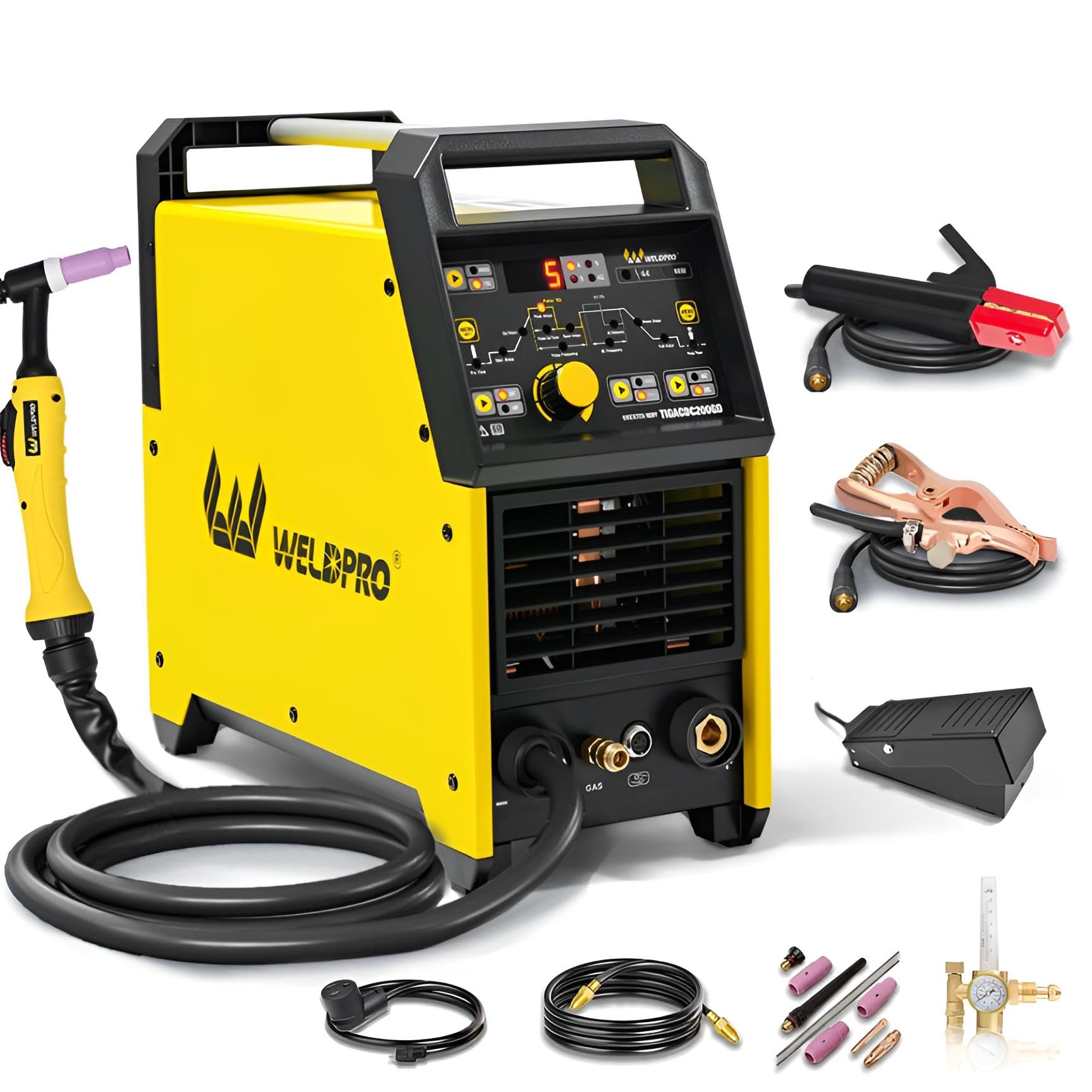
A premium bundle that includes a CK17 flex torch and foot pedal, ready to use right from the start.
The Weldpro TIG200-KT26 takes the guesswork out of stocking up on accessories. It ships with a CK17 flex head TIG torch (a well-regarded premium torch brand), a heavy-duty rocker foot pedal, a 300A ground clamp, a gas flow meter, and a complete starter kit of tungsten and ceramic nozzles. That is a parts bundle that usually costs to separately, making this the best value if you want everything in one box. The machine itself is a 200A AC/DC unit with five modes: HF AC TIG, DC TIG, AC pulse, DC pulse, and stick welding.
Experienced fabricators are genuinely surprised by the quality. Shoppers say it produces excellent beads on 16-gauge and 18-gauge stainless steel, with easy starts and fully adjustable upslope, peak amps, and downslope. The digital amperage knob is called out as a “great feature” by many. The foot pedal provides smooth, real-time current control, and the HF non-contact arc start reduces tungsten wear compared to lift-start. The dual voltage detection is automatic, so you can plug into any outlet without flipping a switch.
The torch does get very hot during extended TIG welding because it is air-cooled — that is physics, not a defect, but it is note if you plan long bead runs. A few owners mention the AC balance settings are opposite to what they are used to on Miller machines, requiring a mental adjustment when switching tools. The pressure gauge on the included flow meter has also been reported as inaccurate on some units.
Why It Shines
- Includes a premium CK17 flex torch and foot pedal — saves you + in upgrades
- Stable arc and easy starts on stainless steel and aluminum
- Automatic dual voltage detection for low-maintenance power connections
Minor Issues
- Work clamp spring is too tight and opens less than an inch
- Air-cooled torch gets very hot during long continuous welding sessions
Reach for this if: you want a turnkey kit with premium accessories and would rather not piece together a torch, pedal, and regulator separately.
One tweak needed: replace the work clamp early — the stock one is frustrating to attach to thick metal and will slow you down.
Understanding the Specs
Duty Cycle (The Real Limit)
Duty cycle is the percentage of a 10-minute period you can weld at a given amperage before the machine needs to cool down. A 40% duty cycle at 200 amps means you can weld for 4 minutes and must let it rest for 6. For home and hobby use, 40% at max amps is fine because you rarely weld continuously for more than a few minutes. If you plan to run production work, look for a machine like the AHP AlphaTIG that offers a 100% duty cycle at 155 amps, which lets you weld nonstop.
AC Balance and Frequency
For aluminum welding, AC balance controls how much time the current spends cleaning the oxide layer versus penetrating the metal. More cleaning (EN balance) removes more oxide but reduces penetration. AC frequency (measured in Hz) controls how fast the current switches between positive and negative. Higher frequency tightens the arc cone, making it easier to weld thin aluminum. These two adjustments are what allow a budget AC/DC machine to produce clean, strong aluminum welds if you take the time to dial them in.
FAQ
Can a budget TIG welder weld aluminum properly?
What is the difference between HF start and lift-start TIG?
Will a 110V outlet run a 200A TIG welder at full power?
What is pulse TIG used for?
How thick of aluminum can a 200A budget TIG welder handle?
Do I need a foot pedal for TIG welding?
What accessories do I need to buy separately?
Are budget TIG welders safe for home use?
Final Thoughts: The Verdict
For most buyers, the best budget tig welder to start with is the HITBOX 200A AC/DC 6-in-1 because it gives you AC/DC TIG, pulse, and square wave at a price that leaves room for gas, tungsten, and a better foot pedal. If you want the most complete kit right from the start with a premium torch and pedal included, the Weldpro TIG200-KT26 is the grab-and-go champion. And for high-duty-cycle work where you cannot afford downtime, the AHP AlphaTIG 203Xi is the machine that will keep welding long after the others have cycled into cooldown.
How We Picked
We do not accept paid placement. Every pick is matched to a real buyer and a real use-case; we do not hands-on test units.
Sources & Methodology
Specifications: manufacturer listings and product documentation. Review insights: verified customer reviews, as of July 2026. Pricing: not shown on this page (it changes often); check the current price via the retailer link.
As an Amazon Associate, FitlyFast earns from qualifying purchases. This does not affect which products we feature.