
Our readers keep the lights on and the weekend projects moving. As an Amazon Associate, I earn from qualifying purchases.
Specs are compiled from manufacturer listings and verified buyer reviews and can change over time — please confirm the key details on the product page before buying.
You want real, room-filling sound without emptying your wallet, and tower speakers are the classic way to get it. The catch is that the budget shelf is crowded with flimsy boxes that rattle and cheap drivers that scream at high volume. This guide cuts through the noise to find the floor-standing speakers that actually deliver crisp highs, solid mids, and bass you can feel—for sensible money.
I’m Rikta — the founder and writer behind FitlyFast. This guide is built by comparing the manufacturers’ published specifications and the patterns across verified customer reviews, so you get each pick’s real strengths and trade-offs instead of marketing spin.
Whether you are building a first home theater or upgrading a tired stereo, the best budget tower speakers hide in plain sight if you know which specs matter and which ones are just numbers on a page.
Our Picks at a Glance


How To Choose The Best Budget Tower Speakers
You don’t need to spend a fortune to get room-filling sound. A modest pair of budget tower speakers can beat a pricey soundbar if you make the right choices upfront.
Match the Amp to the Impedance
Every speaker has an impedance rating, usually 4 or 8 ohms, which tells you how much resistance it offers your amplifier. An 8-ohm tower like the Rockville is the easiest match for most home receivers, while a 4-ohm design often demands more current. If you are not sure your receiver can handle a 4-ohm load, stick with 8-ohm speakers for safety.
Look at RMS, Not Just Peak Power
Peak wattage is the speaker’s absolute maximum, a number it can hit for a split second. RMS is the continuous power it can handle safely for real listening. A tower rated 125W RMS is a more honest performer than one that only quotes a giant peak number, because RMS tells you how loud you can play without distortion.
Count the Drivers for Better Vocals
A 2-way speaker splits sound between a tweeter for highs and a woofer for bass. A 3-way adds a dedicated midrange driver, which makes voices and guitars sound more natural and present. If you listen to a lot of music or dialog-heavy content, a 3-way design is worth the small price bump.
Quick Comparison
| Model | Best For | Power (RMS) | Impedance | Drivers | Amazon |
|---|---|---|---|---|---|
| Rockville RockTower 68B★ Best Overall | Best Overall / Music | 125W | 8 ohm | 3-Way | Amazon |
| Elimavi Tower PairBest Value | Value Pair with Wire | 120W | 4 ohm | 2-Way | Amazon |
| Polk Monitor XT60Small-Room Star | Small Rooms / No Sub | — | — | Woofer + 2 Radiators | Amazon |
| Dayton Audio T65 | Ear-Level Tweeters | 150W | — | Dual 6.5″ | Amazon |
| Rockville RockTower 68C | Full-Range 3-Way Pair | 125W | 8 ohm | 3-Way | Amazon |
| Polk Audio T50 | Proven Crowd Favorite | — | — | Woofer + 2 Radiators | Amazon |
| Klipsch R-620F | Live Concert Energy | — | — | Dual 6.5″ + Horn | Amazon |
| Klipsch R-610F | High Sensitivity (94dB) | 85W | 8 ohm | Dual 6.5″ + Horn | Amazon |
In‑Depth Reviews
1. Rockville RockTower 68B Passive Tower Speaker
The crowd favorite that pairs a dedicated midrange with a silk tweeter for vocals that actually breathe.
This is the pick that keeps winning people over, and the reason is its 3-way layout: dual 6.5″ woofers handle the lows, a 6.5″ midrange driver carries voices, and a 1″ silk dome tweeter delivers smooth highs. Splitting the work across three drivers means nothing gets muddled, so dialog and vocals stay clear even when the bass is pumping. Buyers report the sound quality is the single most praised trait, and the MDF cabinet with a vented design adds weight and stability to the low end.
At 8 ohm and 125W RMS (500W peak), it is a friendly match for most home amplifiers, and the gold-plated 5-way binding posts accept banana plugs, spade terminals, or bare wire. That flexibility matters when your amp uses unusual connectors. The detachable grille is a nice touch, letting you show off the drivers or keep a clean, minimalist front.
The honest caveat is bass. Owners note the low end is not punchy on its own, and the tweeters and mids are the real stars; a subwoofer is what covers the deep bass. Paired with the right amp or EQ, owners mention the sound is fantastic, and some found the bass surprisingly strong even without a sub on a vintage 1970s receiver.
What Wins People Over
- Clear, detailed highs and mids that make vocals shine
- 3-way design separates bass, midrange, and treble cleanly
- 8-ohm impedance pairs easily with most receivers
- Gold binding posts accept multiple cable types
The Trade-Offs
- Bass is not punchy alone; a subwoofer is recommended
- Tallest budget towers but not the heaviest
Reach for this if: you want the best-balanced 3-way sound for music and movies and already have or plan to add a subwoofer.
Look elsewhere if: you need deep, room-shaking bass straight from the start with no sub.
2. Elimavi Floor Standing Tower Speakers Pair
A ready-to-run pair that arrives with speaker wire, so you can be listening in minutes.
Here is a two-speaker package that saves you the hassle of buying a pair separately. Each tower packs dual 6.5″ woofers for deep bass and a 1″ silk dome tweeter for crisp highs, running at 120W RMS. The frequency response spans 40Hz to 21kHz with a two-way crossover that keeps the sound balanced.
The best surprise is what is in the box. Customers note the pair even came with around 10 feet of speaker wire, so you can hook them up immediately without a trip to the store. Owners found they added nice depth and a little more power to an existing surround system, and the MDF cabinet keeps unwanted resonance down for cleaner audio.
The 4-ohm impedance is the thing to watch here. It demands more current from your amplifier than an 8-ohm speaker, so it is best paired with a receiver that can handle that load. Owners also note expectations should be curbed at higher volumes, where these struggle a bit, but they are very solid at lower to mid levels.
Perfect for: first-time buyers who want a complete pair with wire included and have a receiver that handles 4-ohm loads.
Not ideal for: loud, high-volume listening sessions where they run out of steam.
3. Polk Audio Monitor XT60 Home Theater Tower Speaker
The enclosed tower that gets real bass without a port, thanks to two passive radiators doing the heavy lifting.
This single tower from Polk uses a clever trick: a 6.5″ Dynamically Balanced Woofer plus two 6.5″ passive radiators that move air to produce bass without a port. That sealed design gives a tight, commercial-sounding low end that works well in stereo even without a subwoofer, which is rare at this level. Owners were impressed with the clarity and volume, some even calling the results mind-blowing.
It is Hi-Res Audio, Dolby Atmos, Auro 3D, and DTS:X compatible, so it slots into a modern home theater without drama. The rubber feet are designed for both carpet and hardwood, giving you stable placement options in any room. The timbre-matched Polk family means you can add a matching center or bookshelf pair later for a unified system.
Best fit: It shines in small to medium rooms at quiet to moderate levels where its bass output genuinely surprises.
The catch: It lacks output for very large rooms and loud volumes—simple physics for a sealed tower this size.
Choose this when: you want solid bass without a subwoofer and mostly listen in a small or medium room.
skip it if: you need to fill a large open space at high volume.
4. Dayton Audio Classic T65 Floor-Standing Tower Speaker Pair

A full-size pair standing over 39 inches tall so the tweeters land right at ear level when you sit.
Dayton’s T65 is built around a smart idea: a bass reflex cabinet that stands over 39 inches tall, precisely placing the tweeter at ear level for a more direct, detailed soundstage. Inside sit custom dual 6-1/2″ poly bass drivers that generate punchy bass, plus a 1-inch silk dome tweeter that reproduces treble without sounding harsh or abrasive.
At 150W RMS, this pair is ready for easy listening or serious partying, and the upgraded gold-plated binding posts accept high-quality banana plugs for clean signal transfer. Owners rave about the crisp, clear highs and bass that matches subwoofer output, with some noting an initial period where the bass feels too strong before settling in after a 30+ hour break-in.
Real-world read: Buyers found them a massive step up from old bookshelf speakers, and the wood finish drew compliments. As one owner put it, “Great sounding speakers absolutely worth the price.”
Worth knowing: They pair beautifully with vintage receivers, and the sound gets better as the drivers loosen up over the first 30+ hours.
Grab these if: you want ear-level tweeters and powerful bass handling in a pair of good-looking wood-finished towers.
Think twice if: you hate the idea of a break-in period before the bass balances out.
5. Rockville RockTower 68C Classic Home Audio Tower Speakers
The 3-way twin that owners say sounds like big-dollar speakers for a fraction of the spend.
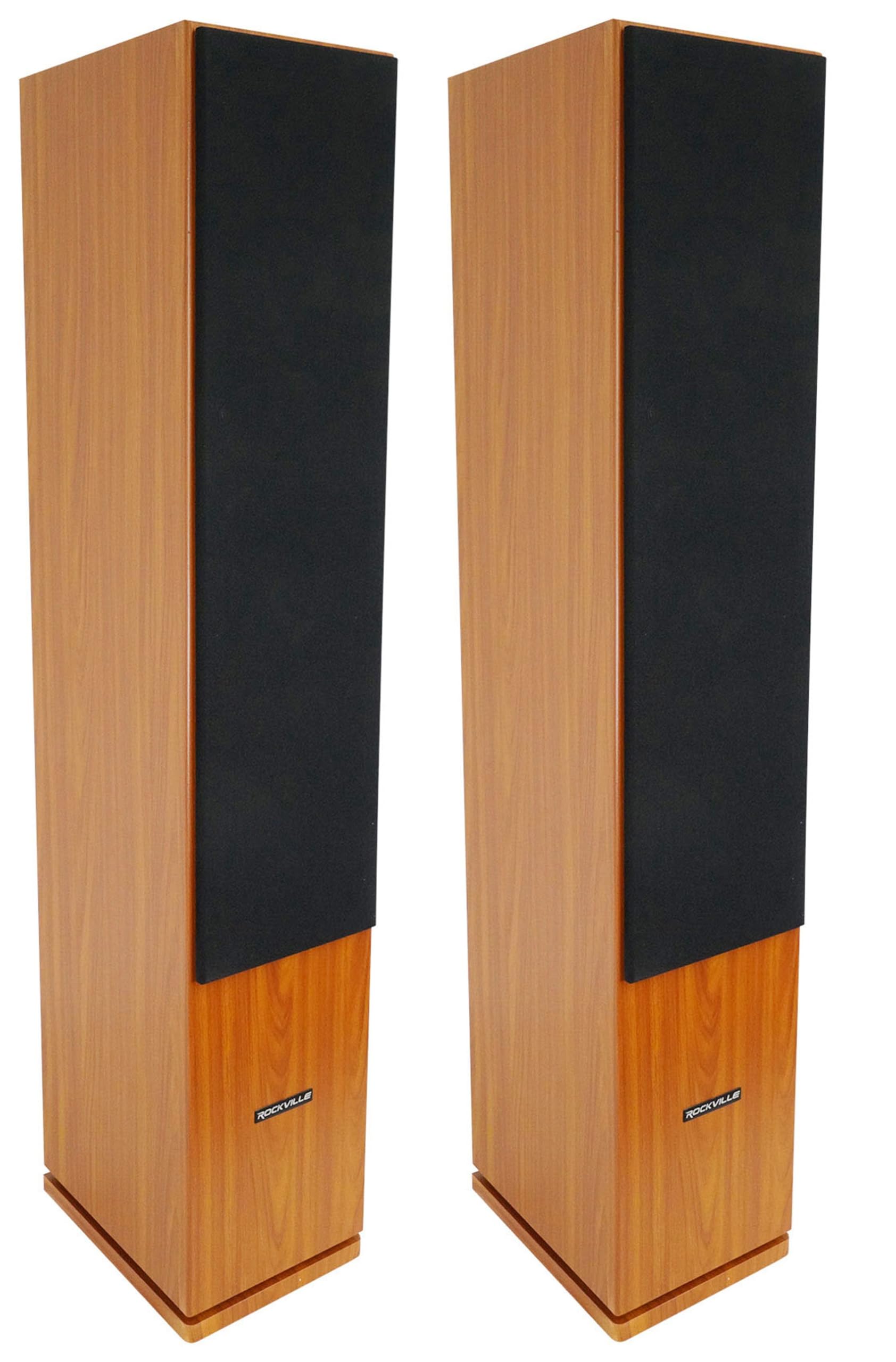
This 2-pack gives you a full stereo set with each speaker carrying a dedicated 1″ silk dome tweeter, a 6.5″ midrange driver, and dual 6.5″ woofers. It is the same smart 3-way architecture as the 68B but sold as a pair, rated at 125W RMS and 500W peak per speaker. The MDF cabinet with a vented design boosts low-end response, while the rubber surrounds add durability.
You get crisp, clean sound that owners say “sounds like big dollar speakers.” The frequency response spans 30Hz to 20kHz (so you hear deep bass and clear highs), and the 87 dB sensitivity (a measure of how efficiently they turn power into volume) means they work with most amps. The wood grain vinyl finish and removable grilles fit both traditional and modern rooms.
Owners say these are the best budget towers when paired with a good subwoofer. The 8-ohm design (a measure of electrical resistance) needs a bit more volume than some, and the cabinet uses thinner MDF (medium-density fiberboard) than premium brands. But with proper crossover settings and a 10-inch-class sub, reviewers point out they outperform the Polk T50 on mids and dialog clarity.
Best for: budget buyers who want a complete 3-way pair and already own a good subwoofer to handle the lowest bass.
Be aware: the look is rectangular, not the angled design in the photos, though owners still find them powerful.
6. Polk Audio T50 Home Theater Floor Standing Tower Speaker

The proven workhorse with thousands of happy owners and a reputation for beating its price class.
Polk’s T50 is the budget tower with the longest track record, featuring a 1″ tweeter, one 6.5″ Dynamic Balance driver, and dual 6.5″ bass radiators that push deep, easy bass into the room. It is a 150W design aimed squarely at home theater, and the passive radiators give you real low-end presence without needing a port on the back.
Setup is genuinely simple: connect the speaker wire to your AV receiver or stereo and you are done. Shoppers say crisp highs and mids with strong bass across the spectrum, and some found it held its own against speakers costing far more. It works well with vintage amps too—buyers have paired it successfully with a SONOS CONNECT:AMP (a network music streamer with built-in amplification).
Owner consensus: The thing everyone raves about is the value—buyers describe it as an excellent budget starter speaker that beats a soundbar with a center channel.
Fair warning: The passive radiators give basic bass, but an active subwoofer is still recommended for real depth. Owners also note it sounds best in small rooms and with a capable amp, not a cheap one.
Choose it for: a proven, reliable budget tower with a huge owner base and easy setup for your first home theater.
Keep in mind: you will want a subwoofer, and a decent amp, to get the full experience.
7. Klipsch R-620F Floorstanding Speaker with Tractrix Horn

The horn-loaded tower that brings live-concert energy into your living room.
Klipsch is known for its distinctive horn technology, and the R-620F puts a 90×90 Square Tractrix Horn over a 1″ Aluminum LTS tweeter, paired with dual 6.5″ Spun-Copper IMG woofers. The result is a crisp, efficient, and dynamic sound that owners describe as delivering live concert-level entertainment at home. The bass-reflex design uses rear-firing Tractrix ports to move air efficiently.
Owners playing EDM, rock, and classical all reported better sound than custom speakers costing 4x as much, and the towers are efficient enough to fill a room with authority. The angled feet tilt the drivers up slightly, which helps aim the sound at ear level. The draw is the combination of realism and value, with buyers calling it an amazing deal and praising the excellent sound quality at high volume.
What stands out: The horn-loaded tweeter delivers a fuller, bigger, more enveloping sound than typical budget bookshelf speakers, with movies sounding larger and music staying solid and clear.
The honest note: You need a receiver that lets you manually adjust crossover frequency to get the best out of these, and the included screws can snap easily—buyers recommend replacing them with wood screws.
Best for: music lovers who want that energetic, live-sounding Klipsch signature and have a receiver with crossover controls.
Skip if: you want a flat, neutral sound—the horn gives treble a distinct personality some find forward.
8. Klipsch Reference R-610F Floorstanding Speaker, Pair

A 94dB-sensitivity pair that gets loud easily, even from a modest amplifier.
This is the Klipsch pair that owners love for its efficiency. At 94dB sensitivity, these towers produce serious volume from very little amplifier power, making them a great match for vintage or low-wattage receivers. The 1″ Aluminum LTS tweeter with a 90 x 90 Square Tractrix Horn delivers crisp highs that improve dialog clarity, and the 8-ohm impedance works with most AV receivers.
Rated at 85W continuous and 340W peak with a frequency response of 45Hz to 21kHz, the R-610F fills a room without distortion. Owners were impressed with the realistic music reproduction and the look of the copper drivers and horns. Some even use them as rear surround speakers and reported a dramatic improvement in sound quality and bass over their old bookshelf speakers.
Owner take: The sound is crisp with or without a subwoofer, and the magnetic grilles give a clean look. One pair now runs with a vintage 40-watt stereo without issue.
The recurring gripe: the leg screws are cheap and can strip easily—buyers recommend swapping them for quality wood screws during setup.
Reach for these when: you want a high-efficiency pair that works great with a modest amp and can double as excellent rear surrounds.
Weigh this: they are heavy at 36lbs each, so setup takes some wrestling, and deep bass still wants a subwoofer.
Understanding the Specs
RMS vs Peak Power
RMS is the continuous wattage a speaker can handle safely for long listening sessions, so it is the honest number to match with your amplifier. Peak wattage is the absolute maximum for a split second and is mostly a marketing figure. A tower rated 125W RMS will play cleanly all day, while a speaker that only quotes peak power may distort when pushed.
Impedance and Your Amp
Impedance, measured in ohms, is how much resistance a speaker offers your amplifier. An 8-ohm speaker is the easiest load for most home receivers to drive, while a 4-ohm design demands more current. If your receiver is not rated for 4-ohm loads, stick to 8-ohm towers to avoid overheating or straining the amp.
The 3-Way Advantage
A 2-way speaker splits sound between a tweeter and a woofer. A 3-way design adds a dedicated midrange driver, which makes voices and guitars sound fuller and more natural. If you listen to a lot of music or dialog-heavy movies, a 3-way tower is worth the small price bump over a 2-way.
Sensitivity and Efficiency
Sensitivity, measured in decibels (dB), tells you how loud a speaker gets from one watt of power. A 94dB sensitivity speaker produces more volume from a modest amp than a less efficient design. This matters most if you have a vintage or low-wattage receiver, because a high-sensitivity tower can fill a room without needing a powerhouse amplifier.
FAQ
Do budget tower speakers really need a subwoofer?
What is the difference between 4 ohm and 8 ohm speakers?
Can I use tower speakers for music as well as movies?
What size amplifier do I need for budget towers?
How tall should my tower speakers be?
What is a passive radiator and why does it matter?
Can I use tower speakers as rear surround speakers?
How long do tower speakers take to sound their best?
What kind of speaker wire and connectors do I need?
Are two towers better than one plus a center channel?
Final Thoughts: The Verdict
For the majority of shoppers, the budget tower speakers winner is the Rockville RockTower 68B because its 3-way design delivers the best-balanced sound for the money, especially when paired with a subwoofer. If you want a complete pair with wire included and have a 4-ohm-capable receiver, the Elimavi Towers are a stellar value. And for buyers who want solid bass without a sub in a small room, the Polk Monitor XT60 is the one to reach for.
How We Picked
We do not accept paid placement. Every pick is matched to a real buyer and a real use-case; we do not hands-on test units.
Sources & Methodology
Specifications: manufacturer listings and product documentation. Review insights: verified customer reviews, as of August 2026. Pricing: not shown on this page (it changes often); check the current price via the retailer link.
As an Amazon Associate, FitlyFast earns from qualifying purchases. This does not affect which products we feature.