
Our readers keep the lights on and the weekend projects moving. As an Amazon Associate, I earn from qualifying purchases.
Specs are compiled from manufacturer listings and verified buyer reviews and can change over time — please confirm the key details on the product page before buying.
Bad audio ruins good video, but a budget wireless lavalier mic fixes it instantly. You hit record, the lighting is perfect, your framing is spot-on, and then you play it back — the sound is hollow, distant, or buried under the hum of a refrigerator or the wind outside. A budget wireless lavalier mic solves this instantly, without draining your wallet. The right one clips onto your collar and beams clean, close-up audio straight to your phone or camera, so your voice sounds like you are right there in the room with your viewer.
This guide compares manufacturers’ specs and verified customer reviews to reveal each pick’s real strengths and trade-offs. For most people, the ZealSound Mini Wireless Lavalier is the one to buy first — it gives you two mics, 33 hours of total battery, and clear 48kHz/24-bit audio that buyers call “better than expected” for the price.
You will find eight picks here, each with a specific strength. The ZealSound is the all-day dual-mic champion. The PQRQP works with cameras and headphones. The KUKIHO runs for 36 hours. The BOYA V30 lets you hear playback without unplugging. The Mini Mic Pro kills wind outdoors. The RIBIU is button-sized. The TXTUNE weighs 11 grams and charges your phone while you record. And the MAONO Wave T1 gives you app-controlled voice effects. Scroll down to see which one fits your setup.
Our Picks at a Glance

How To Choose The Best Budget Wireless Lavalier Mic
A budget wireless lavalier mic needs to do one thing well: make your voice sound clear without costing a fortune. The specs can feel overwhelming at first, but the choices boil down to a few key areas that directly affect your recordings.
Battery Life and the Charging Case
The mic itself might last 6 to 10 hours on a full charge, but the real number to look at is the total play time when you add the charging case. A case can double or triple your run time, turning a single mic into a day-long recording tool. If you film on the go, a case that also recharges the mics is almost essential.
Noise Cancellation Versus Natural Sound
Most budget mics include some form of noise reduction, often a DSP (Digital Signal Processing) chip that filters out background hum, fan noise, or wind. This is a lifesaver outdoors, but in a quiet room it can make your voice sound a little processed. The best picks let you toggle the noise reduction on or off, giving you control over the final sound.
Wireless Range and Connection Stability
The range tells you how far you can move from your phone or camera before the audio drops. A 70-foot range is plenty for a living room interview, while 328 feet gives you freedom for outdoor walk-and-talk videos. Keep in mind that walls and obstacles cut the range down, so more is safer for real-world use.
Compatibility With Your Device
Most budget wireless lavalier mics use a USB-C or Lightning receiver that plugs directly into your phone or tablet. Check whether the kit includes the right adapter for your device. Some mics are iPhone-only or Android-only, while others ship with both receivers in the box for maximum flexibility.
Quick Comparison
| Model | Best For | Total Battery Life | Wireless Range | Audio Specs | Amazon |
|---|---|---|---|---|---|
| ZealSound Mini Wireless Lavalier★ Best Overall | Two-person interviews on a budget | 33 hours | 328 ft | 48kHz/24-bit, 38 dB sensitivity | Amazon |
| PQRQP 3 in 1 Wireless Mini MicTop Performer | Solo creators needing camera compatibility | 20 hours | 328 ft | 48kHz/24-bit, 105 dB sensitivity | Amazon |
| KUKIHO Wireless LavalierLong Runner | Long shoot days with adjustable noise levels | 36 hours | 135 ft | DSP noise reduction, 360° pickup | Amazon |
| BOYA V30 Wireless Lavalier | Mobile creators who want playback without unplugging | 36 hours | 328 ft | 48kHz/16-bit, 80dB SNR | Amazon |
| Mini Mic Pro | Creators who shoot in windy conditions | 6 hours per mic (no case total listed) | — | ClearVoice noise cancellation | Amazon |
| RIBIU Wireless Lavalier | Discreet wearers wanting a button-sized mic | 16 hours | 100 ft | 42 dB sensitivity, DSP chip | Amazon |
| TXTUNE Wireless Lavalier DM16 | Lightweight daily carry for vlogging | 24 hours | 70 ft | DSP noise reduction, 11 g weight | Amazon |
| MAONO Wave T1 | Creators who want app-controlled voice effects | 30 hours | 328 ft | 48kHz/16-bit, 4-level AI noise cancellation | Amazon |
In‑Depth Reviews
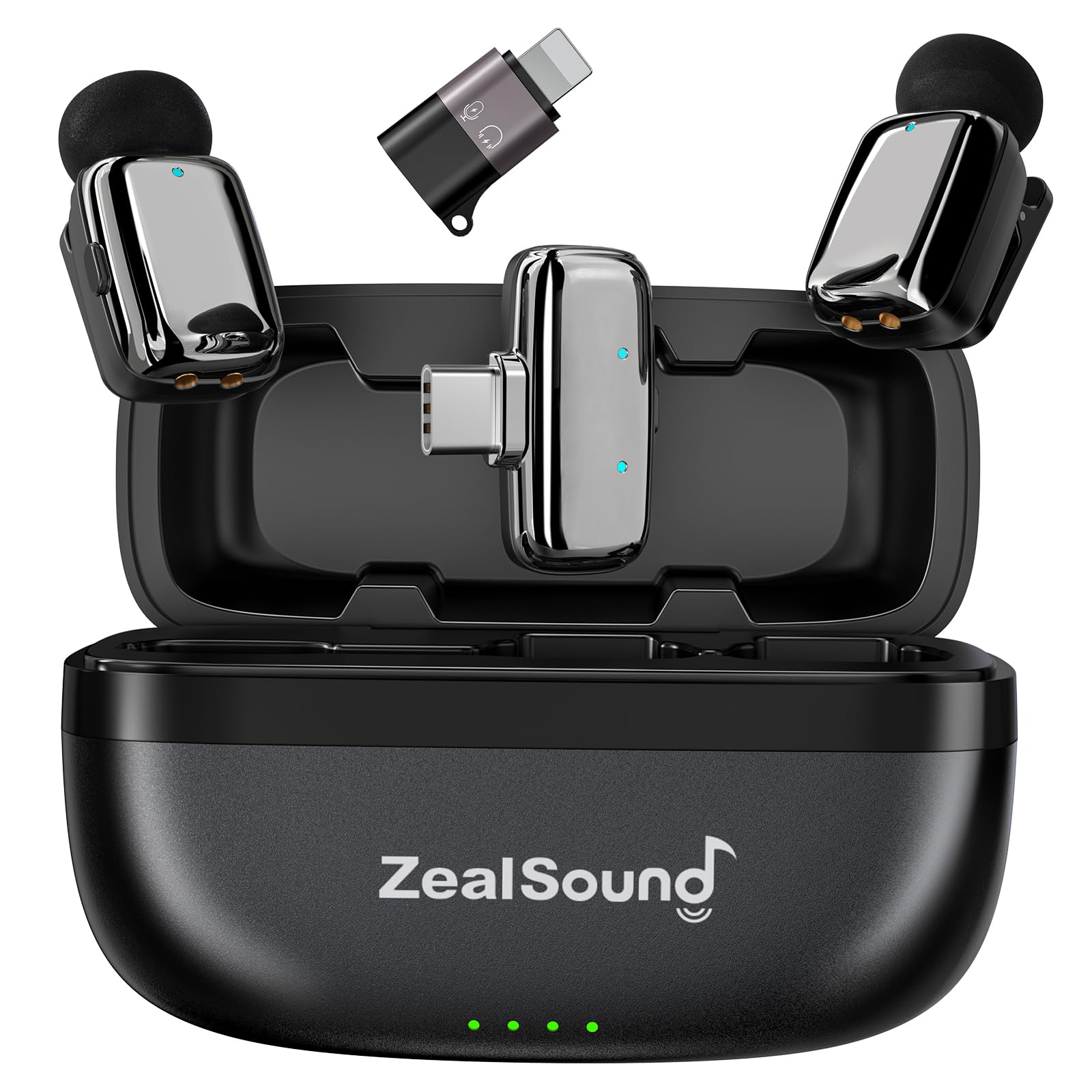
1. ZealSound Mini Wireless Lavalier Microphone
A dual-mic kit that keeps you recording all day without hunting for an outlet.
The ZealSound wins the top spot because it nails the two things a budget wireless lavalier mic must do: sound quality and runtime. It captures your voice at 48kHz/24-bit (high-resolution audio that preserves details like breath and tone) with a 360° omnidirectional pattern — meaning it picks up sound evenly from all around you, so you can turn your head without the volume dipping. The built-in noise reduction kicks in automatically, pushing wind, room chatter, and traffic into the background while your voice stays front and center. You can tap the transmitter to switch between Noise Reduction Mode for outdoors and Normal Mode for quieter indoor spaces, giving you real control over the final audio.
The battery performance is where this kit separates itself. Each transmitter runs for 6 hours per charge, but the charging case pushes the total to 33 hours — that is roughly 65% longer than the PQRQP system below, which manages 20 hours. The case itself fast-charges a mic in about 40 minutes, so you can rotate transmitters on a long shoot day. Buyers report solid performance even at 40 feet outdoors, with one noting the sound quality “was better than I expected paired to android phone.” The only recurring gripe is the logo on the transmitter — some owners flip the clip to hide it on camera. For the price, the total package (two mics, Lightning and USB-C adapters, foam windscreens, and a lifetime warranty according to the brand) is tough to beat.
Why It Wins
- 33-hour total battery life with the charging case covers full-day shoots
- Dual-channel setup lets two people record separate audio tracks simultaneously
- Three-level volume adjustment adapts to soft or loud speakers
The Trade-off
- Logo on the transmitter is visible on camera; owners flip the clip to hide it
- Occasional audio choppiness reported with very loud speech
Your best bet for all-day recording: Reach for this one if you need two mics, long runtime, and adjustable noise cancellation in a single kit. The visible logo is the main reason to look away if you need a completely clean on-camera appearance.
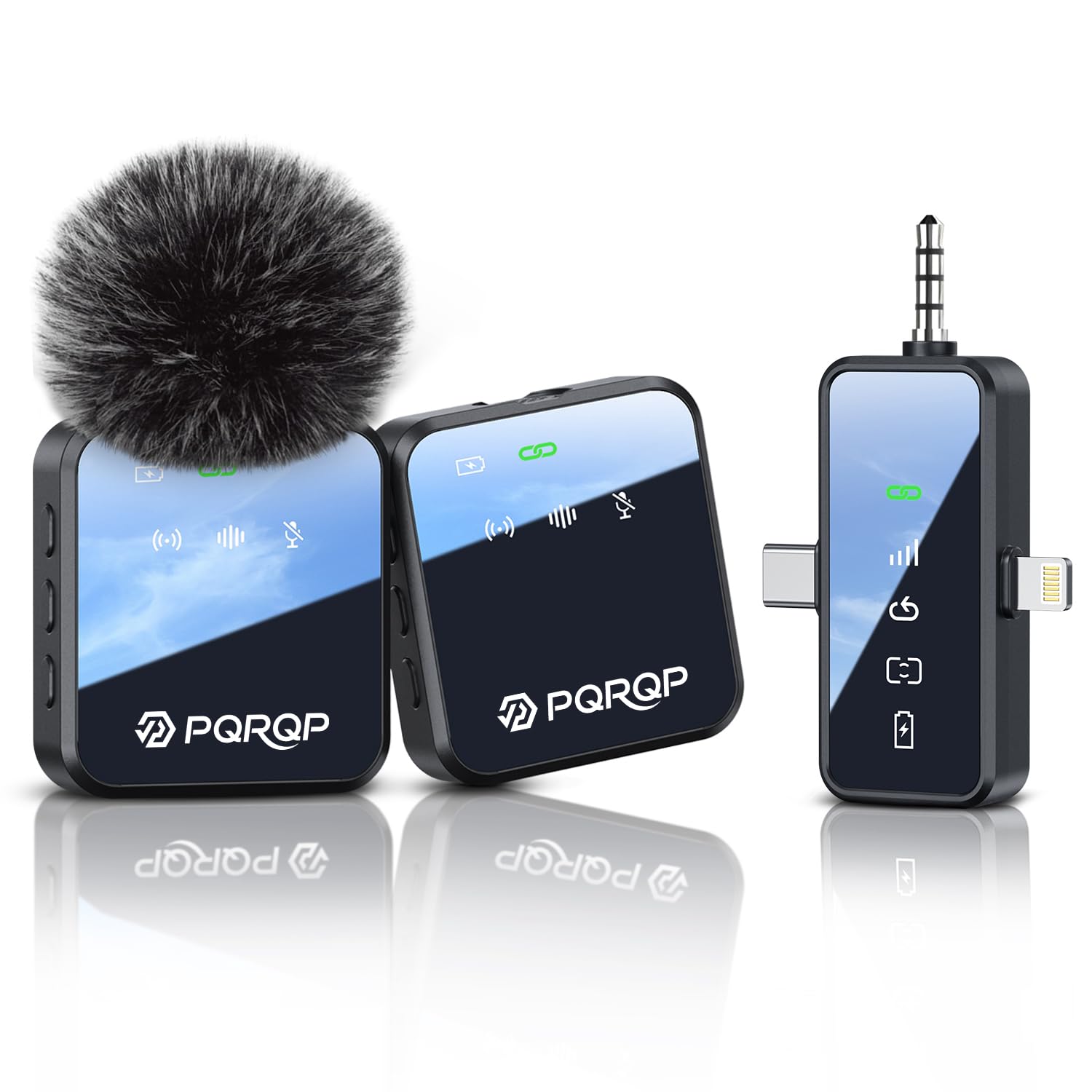
2. PQRQP 3 in 1 Wireless Mini Microphone
A high-sensitivity mic that works with cameras, not just phones.
The PQRQP is the only mic here that includes a receiver for camcorders and DSLRs in addition to USB-C and Lightning. That 3-in-1 compatibility makes it a standout for creators who swap between an iPhone for quick clips and a Sony or Canon for main content. The audio sensitivity sits at 105 dB — notably higher than the 38 dB of the ZealSound — which means it picks up quieter voices and softer details with less amplification needed, so a soft-spoken guest sounds clear without you cranking the gain. The built-in reverb and one-touch mute are practical extras for live-streamers or singers who want to add depth to their voice without post-production.
Where the PQRQP gives ground is battery life. The total 20-hour runtime across two mics (10 hours each) is workable for a full day but falls well short of the 33-hour marathon the ZealSound delivers. The 328-foot range matches the top-tier options, and the 48kHz/24-bit Hi-Fi audio keeps the recording clean and distortion-free. Buyers consistently highlight the quick pairing and stable connection at distance. The stored range and the inclusion of a stylish storage bag instead of a charging case are the two main downgrades from the ZealSound, but for camera users who need a universal fit, this is the strongest entry.
Standout Features
- Works with cameras via a 3.5 mm jack receiver, not just phones and tablets
- High 105 dB audio sensitivity captures softer voices cleanly
- Real-time audio monitoring via USB-C headphones lets you check levels on the fly
Limitation
- 20-hour total battery is lower than the 33-hour ZealSound kit
- No charging case — mics charge individually via USB-C cables
Best for hybrid shooters: If you switch between an iPhone, a laptop, and a dedicated camera and want one mic that works with all three, this is your pick. skip it if cable management and all-day power matter more — the ZealSound with its charging case is more convenient for long shoots.
3. KUKIHO Wireless Lavalier Microphone
Three adjustable noise-cancellation levels in a pocket-sized charging case.
The KUKIHO pushes the battery envelope further than almost anything at this price point, with a total run time of 36 hours between the dual transmitters and the charging case. That is enough capacity for a multi-day conference or a weekend of fieldwork without ever plugging in. The standout feature is the three-level adjustable DSP noise reduction — you can dial in light filtering for a quiet office or aggressive suppression for a busy street corner. That flexibility beats single-stage noise-canceling mics that force you into either all-on or all-off.
The range tops out at 135 feet in open areas, which is shorter than the 328-foot leaders but still plenty for a classroom, a living room, or a small stage. The 360° omnidirectional audio capture means the mic picks up your voice evenly even if you turn your head during a presentation. Buyers consistently note the instant pairing and crisp sound across TikTok, YouTube, and Zoom. The main compromise is the charging case itself — it keeps everything organized and topped up, but the overall design is slightly bulkier than the ultra-slim cases found on the BOYA or ZealSound kits.
Key Strengths
- 36-hour total battery life is the longest in this lineup
- Three adjustable noise cancellation levels adapt to different environments
- Dual-mic setup for two-person recording without sharing a single unit
One Caveat
- Wireless range of 135 ft is less than half the 328 ft offered by several alternatives
- Charging case is slightly bulkier than competing models
Ideal for long-form creators: Choose this if your recording days stretch past 12 hours and you want to dial in the exact amount of background-noise filtering your shoot needs. The 135-foot range means it is best for indoor or close-quarters use; the ZealSound or BOYA serve you better if you need to roam freely outdoors.
4. BOYA V30 Wireless Lavalier Microphone
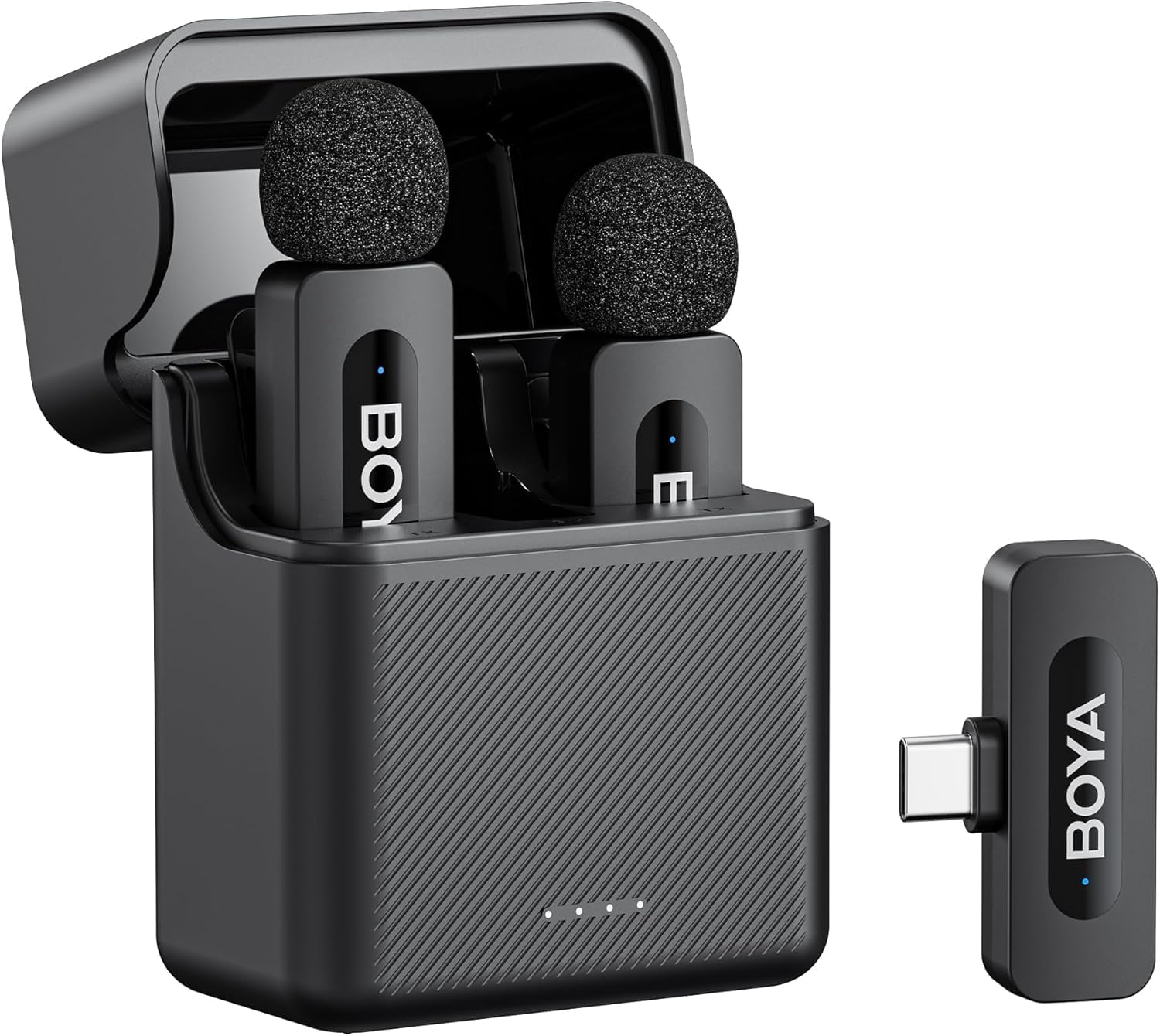
A dual-mic system that lets you monitor playback through your phone speakers without unplugging the receiver.
The BOYA V30 solves a specific annoyance that other mics ignore: once the receiver is plugged into your phone, you usually cannot hear audio playback unless you pull the receiver out. BOYA’s exclusive audio technology, according to the brand, lets your built-in phone speaker stay active even with the receiver connected, so you can review clips on the spot without fiddling with tiny plugs. The 36-hour total battery life ties the KUKIHO for the longest in the roundup, and the 328-foot wireless range matches the ZealSound and PQRQP for maximum freedom of movement.
The audio specs are solid for the price bracket — 48kHz/16-bit resolution with an 80dB signal-to-noise ratio (SNR, meaning the signal is 80 dB louder than the noise floor, so recordings stay clean) and a 120dB maximum sound pressure level (SPL), meaning it can handle loud environments without distorting. The dual-mode noise cancellation combines a one-click digital filter with a dense foam windscreen for wind and breath noise. Owners mention excellent voice clarity even with the mic tucked under a coat on a windy day. On the downside, the clip is tight and hard to open for users with larger hands, and the high treble response can emphasize sibilance (the sharp “s” sound) for some voices. For the price, the combination of playback convenience and extreme battery life makes this a strong mid-range contender.
Why It Stands Out
- Playback through phone speakers without unplugging the receiver
- 36-hour total battery matches the longest in this guide
- 120 dB SPL handles loud environments without audio breakup
A Consideration
- Clip is stiff and tough to open, especially for larger hands
- Bright treble can make sibilant speech sound exaggerated
Great for mobile editors: Pick the BOYA V30 if you frequently review footage on your phone while out in the field and want a long-range, long-life mic that does not get in your way. If de-essing in post annoys you, the high-frequency boost may require extra audio smoothing for some voices.
5. Mini Mic Pro (Latest Model)
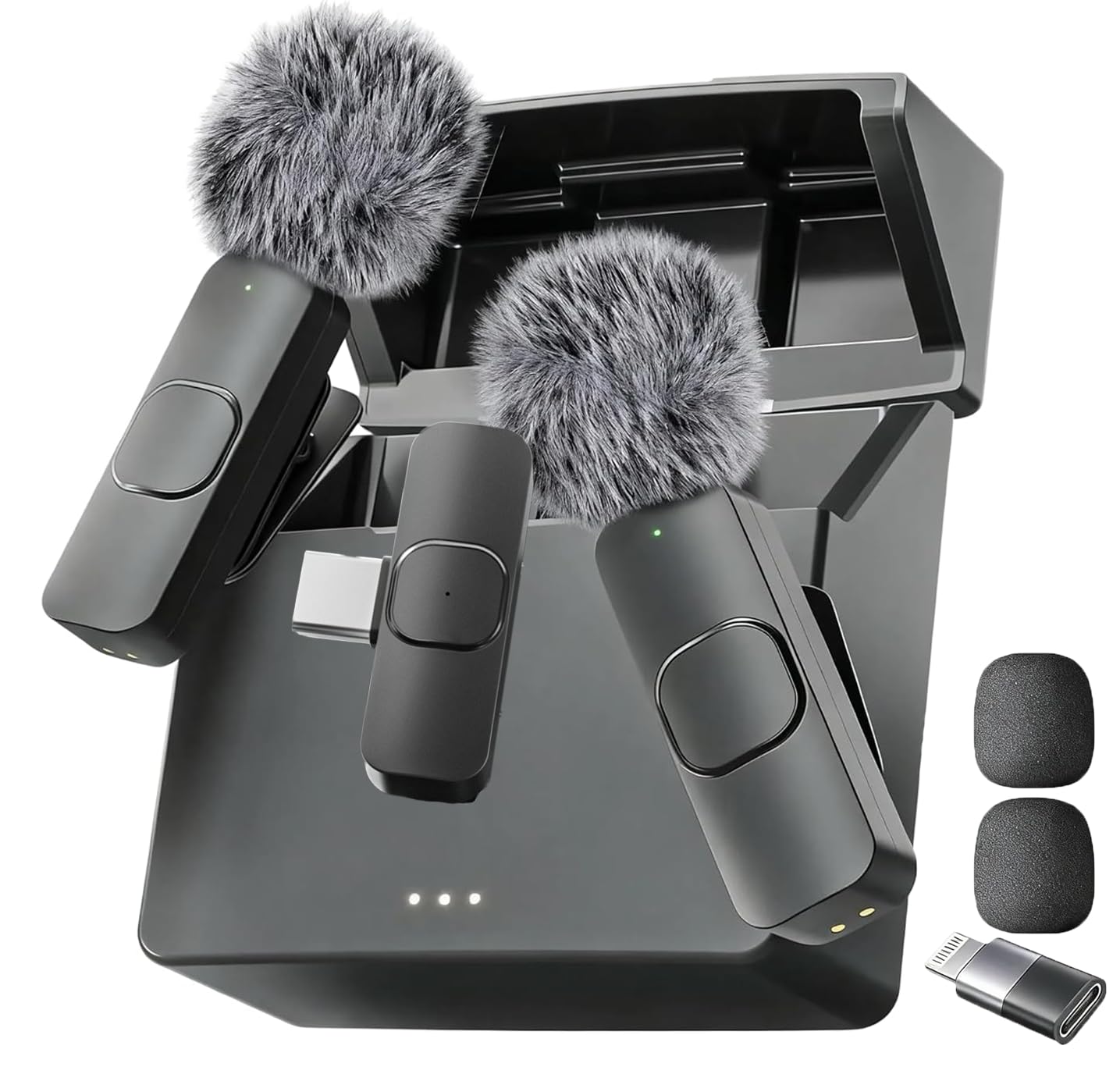
A rugged little mic that uses a furry dead cat cover to kill wind noise outdoors.
The Mini Mic Pro is built for creators who shoot outside. It ships with both a high-density foam windscreen and a dead cat (a fuzzy synthetic fur cover that breaks up wind pressure before it hits the capsule), which buyers confirm works remarkably well — one owner filmed on a windy Oregon beach and reported the mic “cut out all the wind but kinda kept the waves.” The ClearVoice noise cancellation handles background chatter and handling rumble, making this one of the best options for outdoor vloggers and street interviewers on a budget.
The trade-off is battery life. Each transmitter lasts 6 hours per charge, and the total battery with the charging case is not listed — that is lower than the 30+ hour kits from ZealSound, KUKIHO, and BOYA. The compatibility setup is solid, with both USB-C and Lightning adapters included so it works with iPhones and Androids from the start. A minor complaint some owners note is that the mic sponge cover is easy to lose. Overall, for creators who prioritize wind resistance above all else, the Mini Mic Pro delivers where many budget mics fall apart.
Best Features
- Dead cat wind cover and foam windscreen handle heavy outdoor wind
- Includes both Lightning and USB-C receivers for universal phone compatibility
- Charging case shows battery level and mics snap in magnetically
Downside
- Battery life per mic is 6 hours with no total case runtime stated
- Sponge cover is easy to misplace during transport
Reach for this if: You film outdoors regularly and have lost good audio to wind noise before — the dead cat cover is a genuine fix. Look at the ZealSound or KUKIHO if you need all-day battery without recharging between segments.
6. RIBIU Wireless Lavalier Microphone
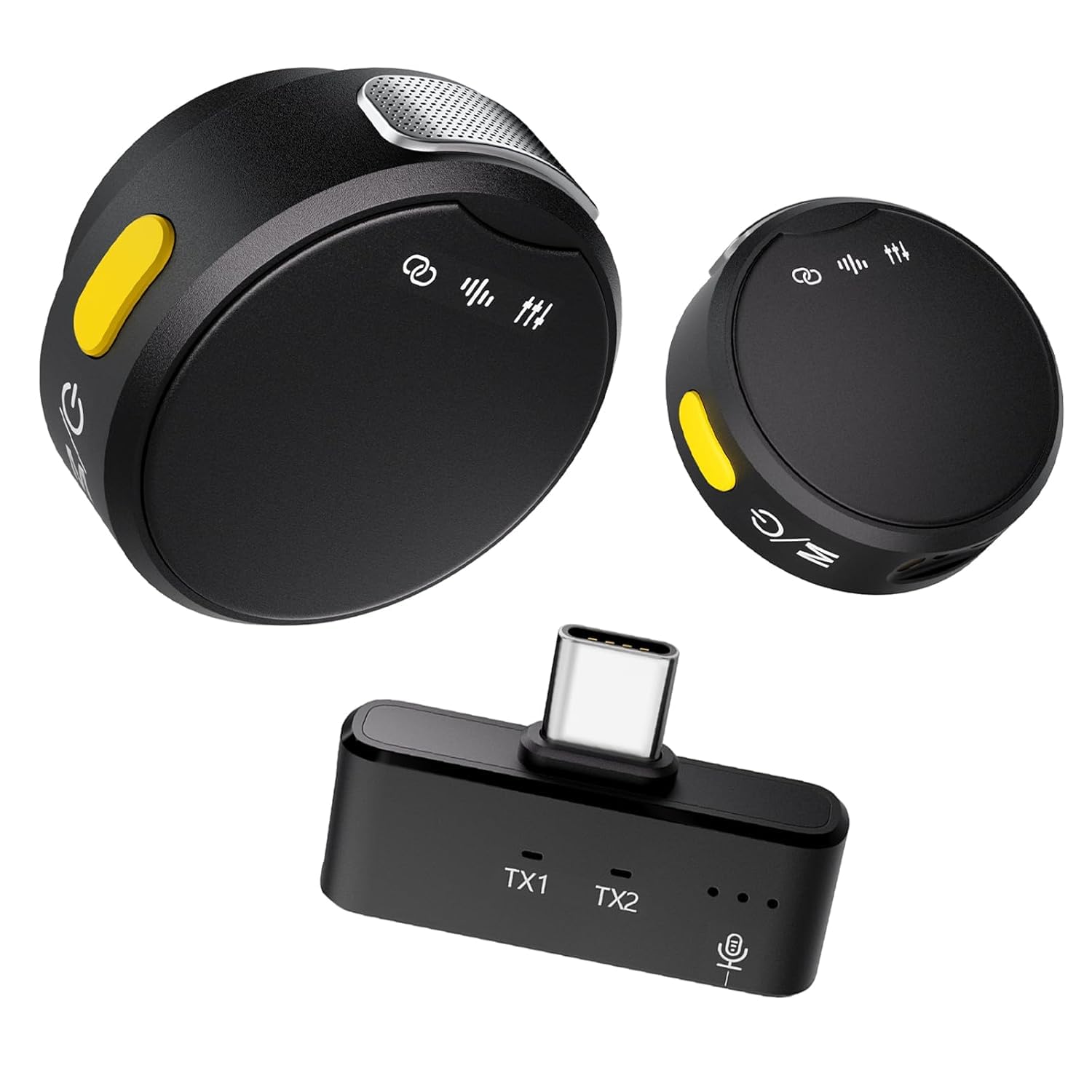
A button-sized transmitter that disappears on a shirt collar but still delivers pro-grade sound.
The RIBIU focuses on being discreet. The transmitter is genuinely tiny — about the size of a button — so it is barely visible on camera and comfortable to wear all day. The dual noise reduction combines a DSP chip (digital signal processing, which filters out consistent background hums like fans or traffic) and a premium windscreen for weather resistance. Buyers consistently praise the crisp, clear audio and the stable connection, with one calling it “the best One I’ve owned” for presentations and content creation.
The 16-hour total battery (8 hours per mic) is on the lower end of this list, but it still covers a typical work day. The 100-foot range is shorter than the 328-foot leaders, though for most indoor interviews and classroom use it is more than adequate. The kit includes only two windscreens and a USB-C receiver — no Lightning adapter is included, so iPhone users need to check compatibility first. A reverb mode adds depth for singing or narration, and the mute button cuts audio without powering the mic down. It is a focused, well-built option for creators who value invisibility over marathon battery life.
Why You Will Like It
- Extremely small transmitter — nearly invisible on a shirt collar
- Crisp, professional audio with strong DSP-based noise cancellation
- Reverb mode for singing and one-touch mute for quick privacy
Trade-off
- 16-hour total battery is well below the 30+ hour kits in this guide
- No Lightning adapter included — iPhone users may need a separate purchase
Best for stealthy on-camera wear: If you want the mic to disappear visually so the focus stays on you, the RIBIU is the pick. Choose the ZealSound or KUKIHO if you record all day without access to charging — the shorter battery may leave you searching for power mid-afternoon.
7. TXTUNE Wireless Lavalier Microphone DM16
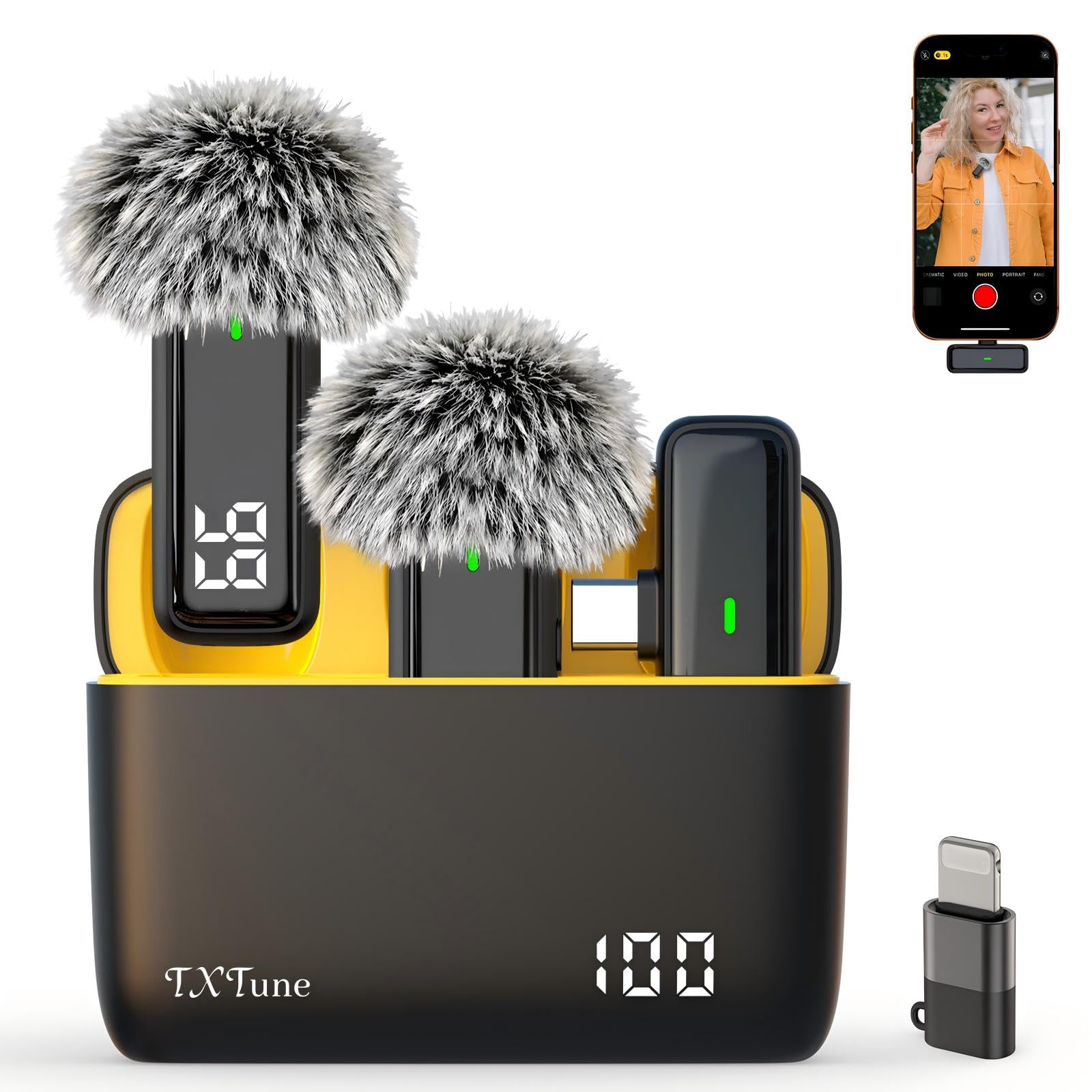
An 11-gram clip-on mic that lets you charge your phone while recording through it.
The TXTUNE DM16 is all about portability and convenience. Each transmitter weighs only 11 grams, so it is barely noticeable on a light summer shirt or a blouse. The receiver includes a USB-C charging passthrough, which means you can plug your phone’s charging cable into the receiver to keep the phone topped up during long recordings — a feature that content creators who live-stream for hours will appreciate. The total battery life hits 24 hours across the mics and the charging case, which is a solid middle ground between the shorter RIBIU and the marathon ZealSound.
The DSP noise reduction handles background hum and the included furry windshield helps outdoors, though the 70-foot range is the shortest in this guide. In practice, 70 feet is enough for a classroom, a stage interview, or an at-home podcast, but if you need to walk across a large outdoor set, you will bump into the limit. Buyers praise the sound quality for the price and the ease of setup — just plug and press the mic button. One owner noted the mics came with 66% charge from the start and charged to full quickly. The trade-off for the light weight and passthrough charging is that the plastic build feels less premium than the metal-accented ZealSound or the BOYA units.
Pros
- Extremely lightweight at 11 grams per transmitter
- Phone charging passthrough on the receiver keeps your device alive
- 24-hour total battery covers a full day of intermittent recording
Cons
- 70-foot range is the shortest in this comparison
- Plastic build feels less durable than pricier alternatives
Ideal for lightweight carry: If you want to slip a mic into a pants pocket and charge your phone while recording, the TXTUNE is your match. The 70-foot range means this is for indoor and close-up use; the ZealSound or BOYA roam much further if you need to move around an outdoor set.
8. MAONO Wave T1 Wireless Microphone
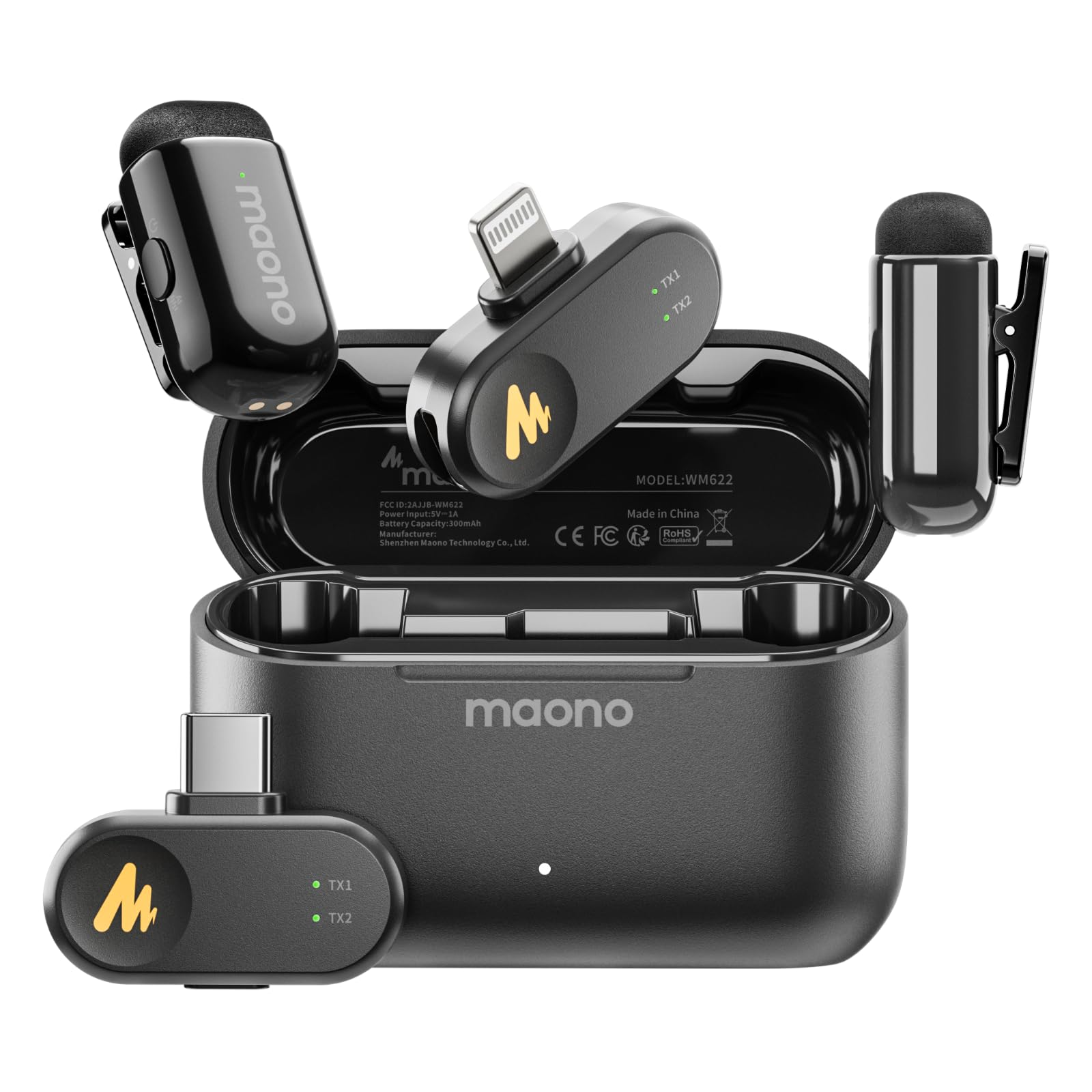
An MFi-certified mic that uses a companion app for voice filters and real-time noise adjustment.
The MAONO Wave T1 adds a software layer that no other budget wireless lavalier mic here offers. Through the Maono Link app, you can switch between 4 EQ presets (tone-shaping filters) and 4 voice-changing effects, plus adjust the noise reduction level and gain in real time. That is a big deal for creators who want to dial in a radio-like broadcast tone or a warmer interview sound without post-production. The MFi certification (Apple’s Made for iPhone standard) means the Lightning receiver is designed to work without compatibility warnings or overheating risks, which is a genuine concern with uncertified third-party accessories.
The audio quality is solid at 48kHz/16-bit, with a 30-hour total battery from the charging case. The 328-foot range matches the best in class. The 4-level AI noise cancellation is adjustable through the app, giving you fine-grained control over how aggressive the filtering is. However, the reliability and connectivity receive mixed feedback — some units have pairing issues that require a specific sequence (long press until the light flashes rapidly on both the receiver and transmitter). Buyers who get the pairing right report crisp sound, while a smaller group describe the unit as failing after a few uses. For the price, the app integration and MFi certification make it a powerful choice if you are willing to follow the setup instructions carefully.
Unique Strengths
- Maono Link app gives 4 EQ presets and voice-changing effects for creative audio
- MFi certified for safe, interference-free use with iPhones
- 4-level AI noise cancellation adjustable through the app
Potential Hurdle
- Pairing can be finicky — customers note needing to follow a precise sequence
- Some units have connectivity or reliability issues from the start
Ideal for app-savvy creators: You get voice filters and adjustable noise canceling without opening a DAW (digital audio workstation) — the MAONO Wave T1 is the most flexible option here. It is a better fit for iPhone users who trust MFi certification over the simpler plug-and-play of the ZealSound.
Understanding the Specs
Audio Sensitivity and Bit Depth
Audio sensitivity, measured in dB (decibels), tells you how much signal the mic picks up for a given sound level. A higher number means the mic is more sensitive and will capture quieter voices without needing to boost the volume later. Bit depth (like 24-bit versus 16-bit) describes the dynamic range — the gap between the quietest and loudest sound the mic can record without distortion. For voice-only content like vlogs and interviews, 16-bit is fine. If you plan to record music, room ambience, or layered audio, 24-bit gives you more headroom to edit without introducing noise.
Wireless Range and Obstacles
The advertised wireless range, usually given in feet, is measured in open line-of-sight conditions with no walls or bodies in the way. In real life, a 328-foot range might drop to 100 feet through two interior walls or outside with heavy foliage. A 70-foot range is comfortable for a small stage or a living room shoot. The important thing is to look for a range that exceeds your typical recording space, because the real-world performance will always be lower than the spec sheet number.
Noise Cancellation Types
Most budget wireless lavalier mics use a DSP (Digital Signal Processing) chip that analyzes the incoming audio and subtracts steady background noise like air conditioning, traffic rumble, or fan hum. Some mics offer multiple levels of this filtering. More advanced models add AI-based noise cancellation that can learn to differentiate between a voice and sudden sounds like a door slam. For outdoor use, a physical windscreen (foam or furry) is just as important as the digital chip because it stops wind pressure from hitting the mic capsule directly.
Charging Case vs Individual Charging
A charging case stores and recharges the transmitters when they are not in use, so you always pick up a full battery. It also keeps the mics organized. Some budget kits omit the case and ask you to charge each mic via a separate USB-C cable, which is less convenient for travel. The case battery capacity is measured in total hours, adding up the individual mic battery plus the case reserves. A case that adds 20+ hours of extra recording time is a major advantage for long shoots.
FAQ
What is the difference between a USB-C and a Lightning receiver?
Can I use a budget wireless lavalier mic with a camera?
How far can I move from my phone before the audio drops out?
Do I need an app to use a budget wireless lavalier mic?
Will a budget wireless mic work with my iPhone 15 or Galaxy S24?
Can two people use these mics at the same time?
How long does a budget wireless lavalier mic last on a charge?
What is DSP noise cancellation and do I need it?
Are budget wireless mics safe for my phone?
Can I record a video and charge my phone at the same time?
Final Thoughts: The Verdict
If you want one dependable pick, the budget wireless lavalier mic winner is the ZealSound Mini Wireless Lavalier because it delivers the best balance of sound quality, dual-channel flexibility, and 33-hour total battery life at an entry-level price. If you need a mic that works with cameras and offers real-time audio monitoring, grab the