
Our readers keep the lights on and the weekend projects moving. As an Amazon Associate, I earn from qualifying purchases.
Specs are compiled from manufacturer listings and verified buyer reviews and can change over time — please confirm the key details on the product page before buying.
Picking a budget wood router means deciding between raw power, precise speed control, and a kit that won’t fall apart on the second use. The right one trims edges and cuts slots cleanly; the wrong one can grab the wood and yank the tool from your hands. This guide cuts through the specs to tell you which of these affordable palm routers is worth your money and which one you should skip.
I’m Rikta — the founder and writer behind FitlyFast. This guide is built by comparing the manufacturers’ published specifications and the patterns across verified customer reviews, so you get each pick’s real strengths and trade-offs instead of marketing spin.
Here is what separates a safe, controllable trimmer from a frustrating one: the speed range, the motor’s amperage, and the depth adjustment system. That is what makes the best budget wood router a joy for DIY projects rather than a chore.
Our Picks at a Glance
How To Choose The Best Budget Wood Router
A palm router is a small, handheld tool with a spinning bit that shapes wood edges or cuts grooves. The trick is that cheap models often hide their weaknesses in the depth adjustment and the collet—the part that holds the bit—rather than in the motor’s raw power.
Focus on Speed Control First
A single-speed router spins at maximum RPM all the time, which can burn the wood or make the tool jump. A variable-speed dial lets you slow down for hardwoods and soft plastics. Look for a model with at least a few speed settings, and you will get smoother cuts with less tear-out.
Check the Collet and Bit Compatibility
Almost every budget palm router uses a 1/4-inch collet (the sleeve that grips the bit’s shaft). That is the standard for trim bits, so you will have no trouble finding replacements. Some kits also include a 3/8-inch collet, which broadens your options but is not essential for edge trimming.
Depth Adjustment Determines Accuracy
You need a base that adjusts smoothly and, crucially, locks in place. A knob that slips mid-cut will ruin a groove. Models with a rack-and-pinion system (a gear that moves the base up and down precisely) are easier to fine-tune than those with a simple twist ring that can jam.
Quick Comparison
| Model | Best For | Max Speed | Motor | Speed Settings | Amazon |
|---|---|---|---|---|---|
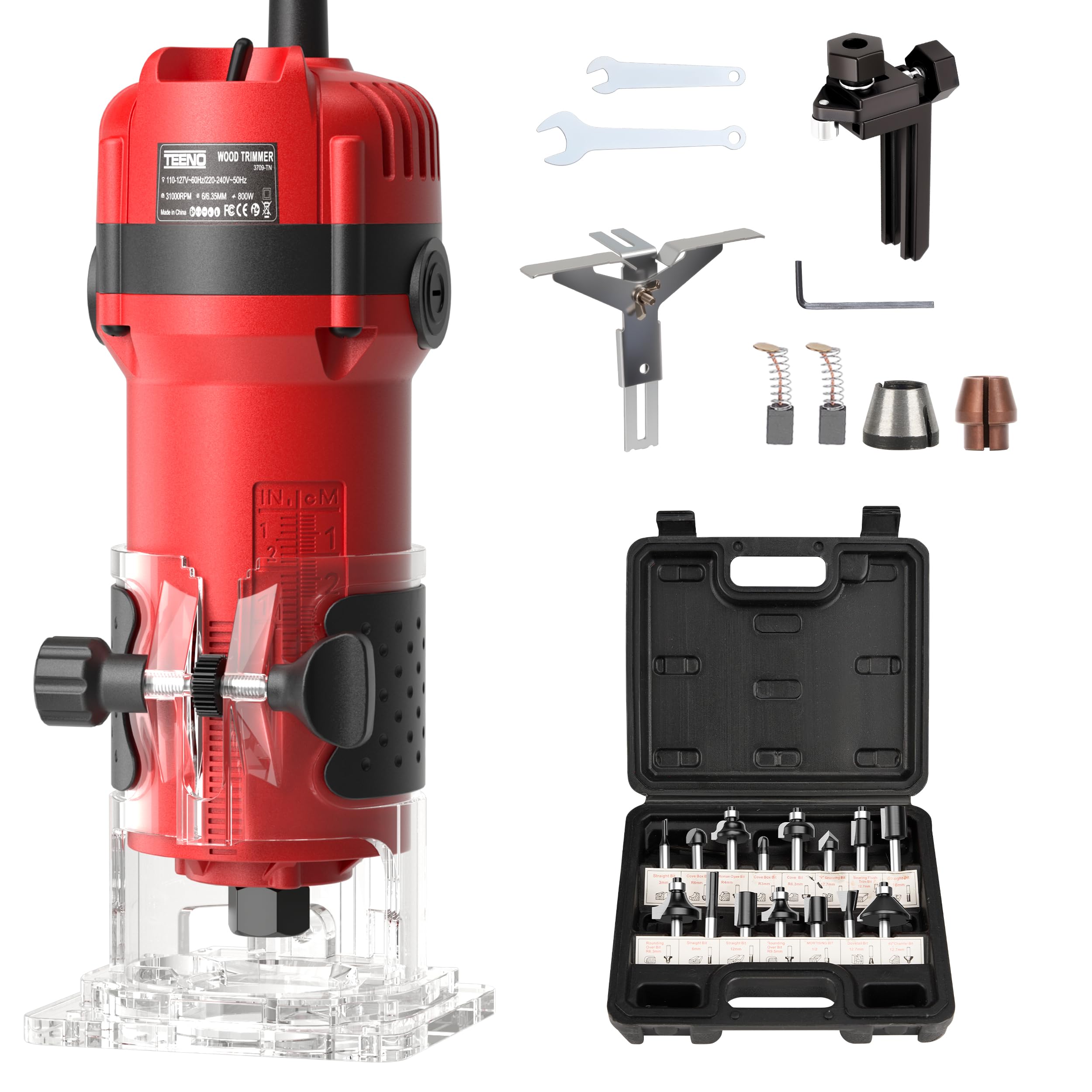
| TEENO 800W★ Best Overall | Complete starter kits | 31,000 RPM | 6.5 A | Single | Amazon |
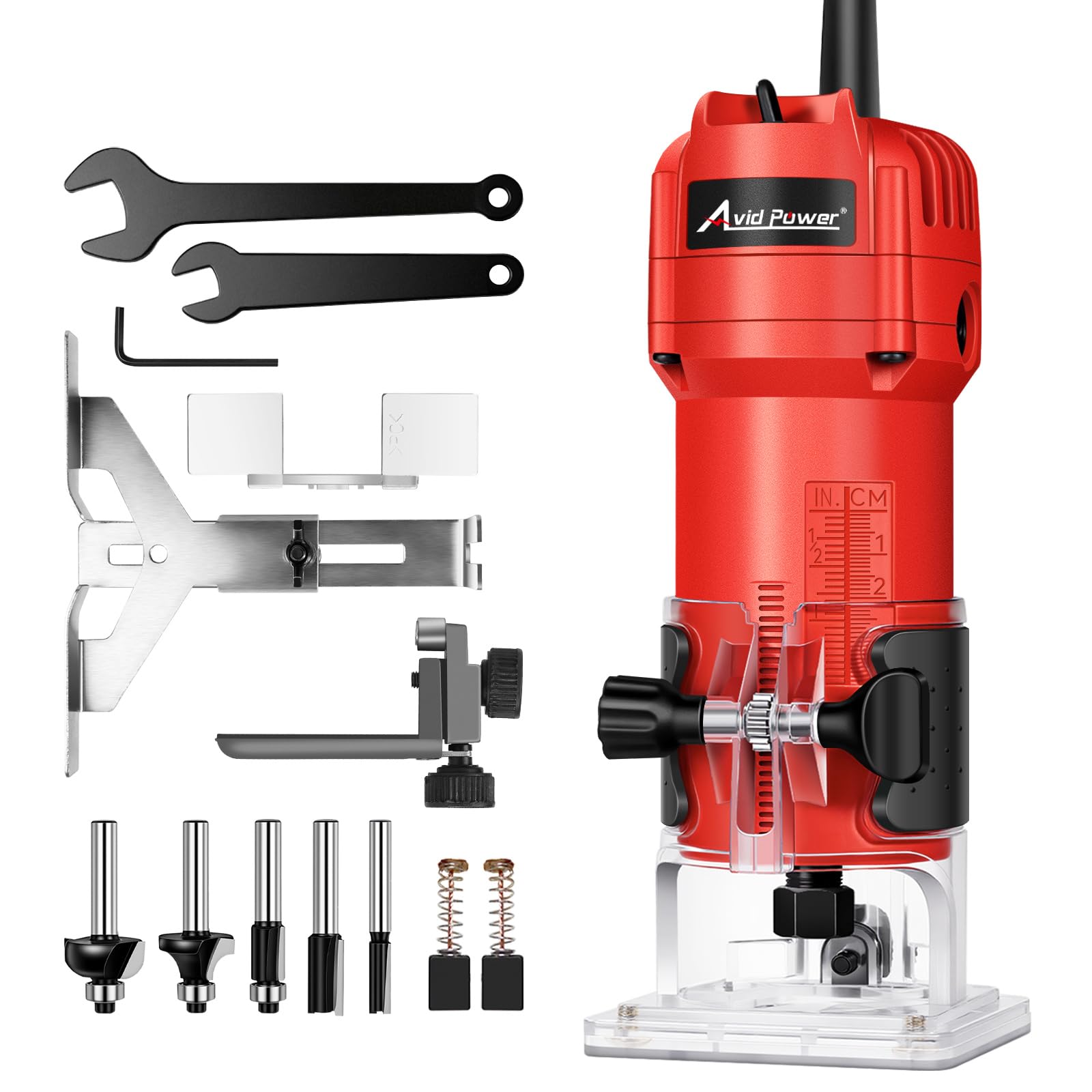
| AVID POWERSpeed Demon | High-speed trimming | 35,000 RPM | 5.3 A | Single | Amazon |
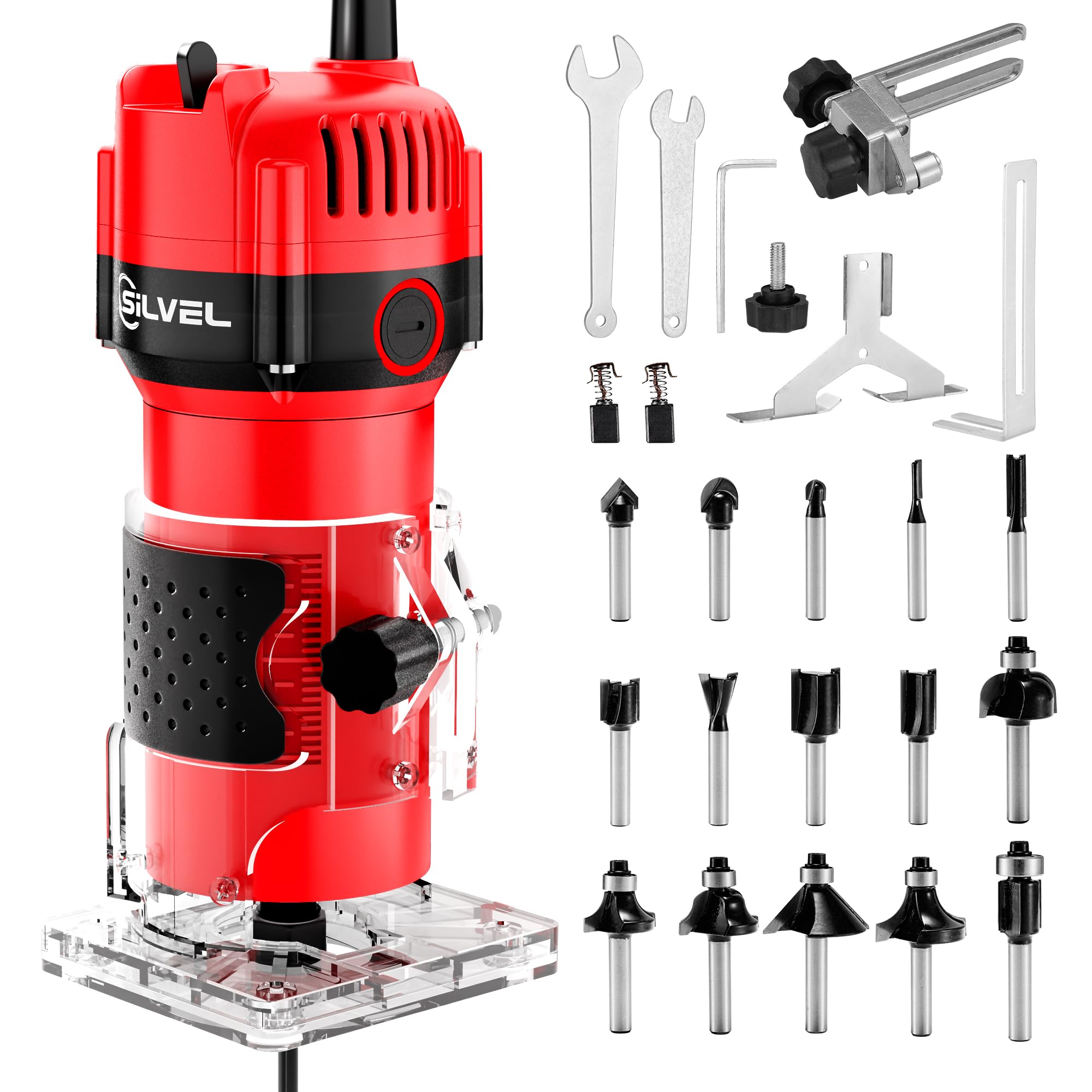
| SILVELSmall-Projects Star | Small projects | 30,000 RPM | 6.5 A | Single | Amazon |
| TEENO Aluminum | Material-matched speed | 32,000 RPM | 6.5 A | 6 | Amazon |
| WEN RT1460 | Smooth soft-starts | 30,000 RPM | 6 A | Variable | Amazon |
| TwoWin | Crafters and hobbyists | 30,000 RPM | 6.5 A | Single | Amazon |
| DOBETTER | Precision CNC work | 32,000 RPM | 6.5 A | 6 | Amazon |
| WORKPRO | Hardwood handling | 30,000 RPM | 6.5 A | 6 | Amazon |
In‑Depth Reviews
1. TEENO Wood Router
A complete kit with a 15-piece bit set that gets beginners trimming right away.
What wins people over here is the sheer value: you get a 6.5-amp motor that spins at 31,000 RPM plus a 15-piece set of 1/4-inch shank router bits, all in one box. That means you can start chamfering, grooving, and edge-planing right away without a separate trip to the hardware store for bits.
The rubber-covered transparent base keeps the tool steady in your hand and lets you see your cut line clearly, which is a real safety boost for beginners. Depth adjustment is tool-free—you turn a knob by hand—so switching between a shallow edge profile and a deeper groove takes seconds, not a search for a wrench.
You get a budget-friendly tool that owners say is perfect for small house projects—one even called it a “great kit for the beginner.” The catch is durability: a few reports of bits getting stuck after first use mean you should check the collet (the part that holds the bit) is clean and tight before each job. Compared to the AVID POWER below, this one runs at a slightly calmer 31,000 RPM versus 35,000 RPM, giving you more control on delicate work like trimming veneers.
What Makes It a Great Deal
- 15-piece bit set included in the box
- Tool-free depth knob for quick adjustments
- Transparent base gives a clear view of the cut
Where to Be Careful
- Bits can stick if the collet is not tightened firmly
- Single speed, so no fine-tuning for hardwoods
Reach for this if: you want a complete, ready-to-work kit for weekend DIY and light furniture repairs.
Look elsewhere if: you need variable speed for professional-grade hardwood work.
2. AVID POWER Compact Wood Router
A high-speed trimmer that finishes workpieces fast, but demands two-handed control.
This palm router spins its 5.3-amp motor up to 35,000 RPM, making it the fastest in this lineup and 17% quicker than the SILVEL’s top speed of 30,000 RPM. That turn of speed is exactly what you want for slicing through door hinge recesses and trimming laminate edges cleanly.
It comes with 5 router bits, a straight guide, a roller guide, and two wrenches for swapping bits, plus spare carbon brushes to extend the motor’s life. The rubber base grips well, and the air vent is designed to stop the motor from overheating during longer sessions.
Here is the honest trade-off: the adjustment ring is stiff and hard to move, and the fixed speed is genuinely fast—so fast that buyers report the router can jump if you are not holding it with both hands. The recommendation from experienced users is to clamp your workpiece down and use two-handed control, turning this into a safety note rather than a dealbreaker.
The Fast Lane: For quick, aggressive trimming where raw RPM beats fine control, this delivers on a budget.
The Fine Print: The lack of variable speed makes it a poor fit for delicate, slow passes on soft woods.
3. SILVEL Wood Router
A dependable workhorse for cutting slots and trimming edges on weekend builds.
This router pairs an 800W motor with a 6.5-amp draw, versus the AVID POWER’s 630W, giving it a noticeable edge when you are pushing through denser material. The 30,000 RPM top speed is plenty for edge profiling, and the included 15-piece bit set means you are not shopping for accessories on day one.
The transparent cover does double duty: it keeps flying sawdust out of your face while giving you a clear line of sight to the cutting edge. The straight guide is reinforced so it stays stable and does not deform under pressure, which keeps linear cuts accurate.
Owners mention it “cuts very well” and love the value, with one owner recounting how it handled cutting slots in a vinyl fence post for a privacy fence extension. The noise here is about longevity—the build quality gets mixed feedback, so treat it as a capable tool for occasional home use rather than a daily shop companion.
Best suited for: hobbyists and homeowners who need a reliable trimmer for occasional projects without spending premium money.
Think twice if: you plan to run it for hours daily, as the plastic build is not built for that abuse.
4. TEENO Aluminum Wood Router
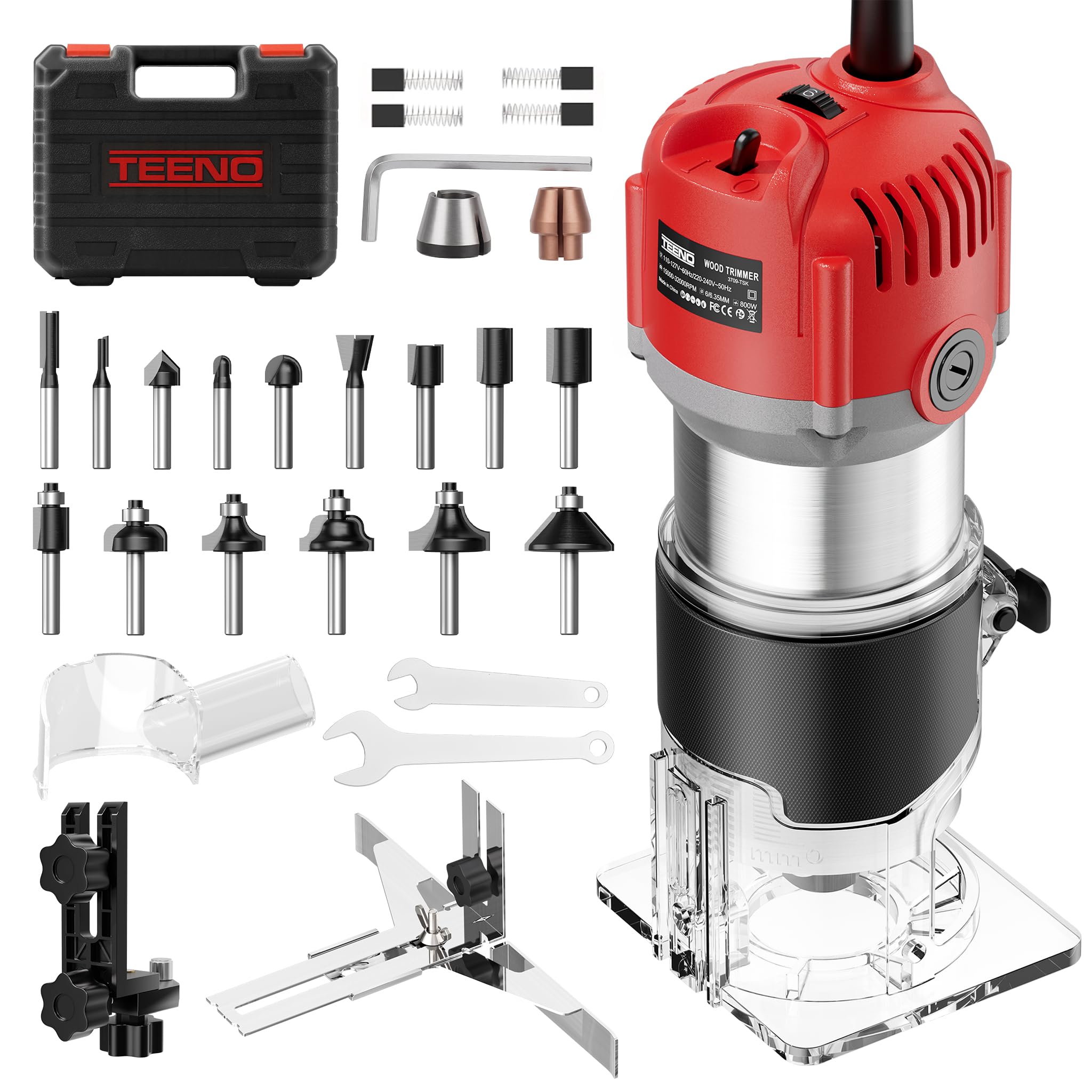
A metal-bodied router with six speed settings for material-matched control.
Unlike most budget palm routers that are single-speed, this TEENO model gives you a 6-level variable speed dial spanning 15,000 to 32,000 RPM. That lets you dial down for softwoods that would burn at full speed and crank up when you need aggressive material removal.
The aluminum motor housing is the other standout—it dissipates heat far better than the ABS plastic bodies on cheaper models, which helps prevent the motor from overheating during longer sessions. It feels solid in the hand, with a rubberized grip that cuts down vibration, and the depth scale is easy to read on the transparent base.
It also includes a 15-piece tungsten carbide bit set, three guides, a dust hood that connects to a standard shop vac, and both 1/4-inch and 6mm collets. Owners note the standard mounting holes fit universal router accessories, meaning you can drop it on an aftermarket router table. The main complaint is the instructions are lacking, leaving beginners to figure out the depth gauge on their own.
The Upgrades You Feel
- 6 variable speeds prevent burn marks on soft wood
- Aluminum housing dissipates heat and resists impacts
- Fits standard router table accessories
The Learning Curve
- Instructions are sparse for true beginners
- Depth gauge design takes getting used to
Grab it for: DIYers who want speed control and metal durability without jumping to a professional price point.
Skip it for: pros who need a finer depth adjustment system than a simple gauge.
5. WEN RT1460 Laminate Trim Router

A beginner-friendly trimmer with a soft start that keeps the tool and you in control.
The signature feature here is the soft-start motor: instead of slamming to full speed the instant you pull the trigger, it spools up gradually. That protect the motor and stops the router from kicking back, which is a genuine safety win for anyone who has never used one before.
Speed is fully variable from 12,000 to 30,000 RPM, and the adjustable base offers 1-5/8 inches of travel with a scale marked in 1/16-inch increments. For countertop trimming and laminate work, that precision lets you set a cut and trust it stays put.
You get surprising power for a 6-amp tool, with owners saying it handles solid hardwood without bogging down—one first-time user called it “easy to learn and use.” The trade-offs: it runs hot during extended use, and the collet (the bit holder) needs regular tightening to keep bits stable. It includes a guide fence and trim guide, though the accessories are basic—you may want to buy better ones separately.
Why Beginners Love It: The gradual start and clear depth scale make it the least intimidating router in this lineup.
The Heat Check: Give it rest breaks on long jobs to avoid overheating with lower-quality bits.
6. TwoWin Compact Wood Router

A lightweight trimmer with a heat-shielding handgrip for comfortable long sessions.
The standout detail on this 800W router is the handgrip that shields your hand from the motor’s heat—a small touch that makes longer trimming sessions far more comfortable. Weighing just 4.8 pounds with a 6.5-amp motor spinning at 30,000 RPM, it is easy to maneuver one-handed on lighter jobs.
It ships with 15 tungsten carbide router bits stored in a wooden organizer case, along with straight and trimming guides, wrenches, and carbon brushes. That wooden case is a nice touch for keeping your bits sorted by profile instead of rattling loose in a bag.
Buyers bought it for installing doors and report it has “plenty of power and is really smooth,” while crafters appreciate the varied bit selection. The honest weakness is the depth adjustment: the mechanism does not lock firmly in place, and the fence can drift from its exact position, so you need to re-check your setting before critical cuts.
Choose this for: door hanging, cabinet work, and craft projects where comfort and bit variety matter more than pinpoint depth precision.
Pass on this if: you need a rock-solid depth lock for repeatable production cuts.
7. DOBETTER Router Tool
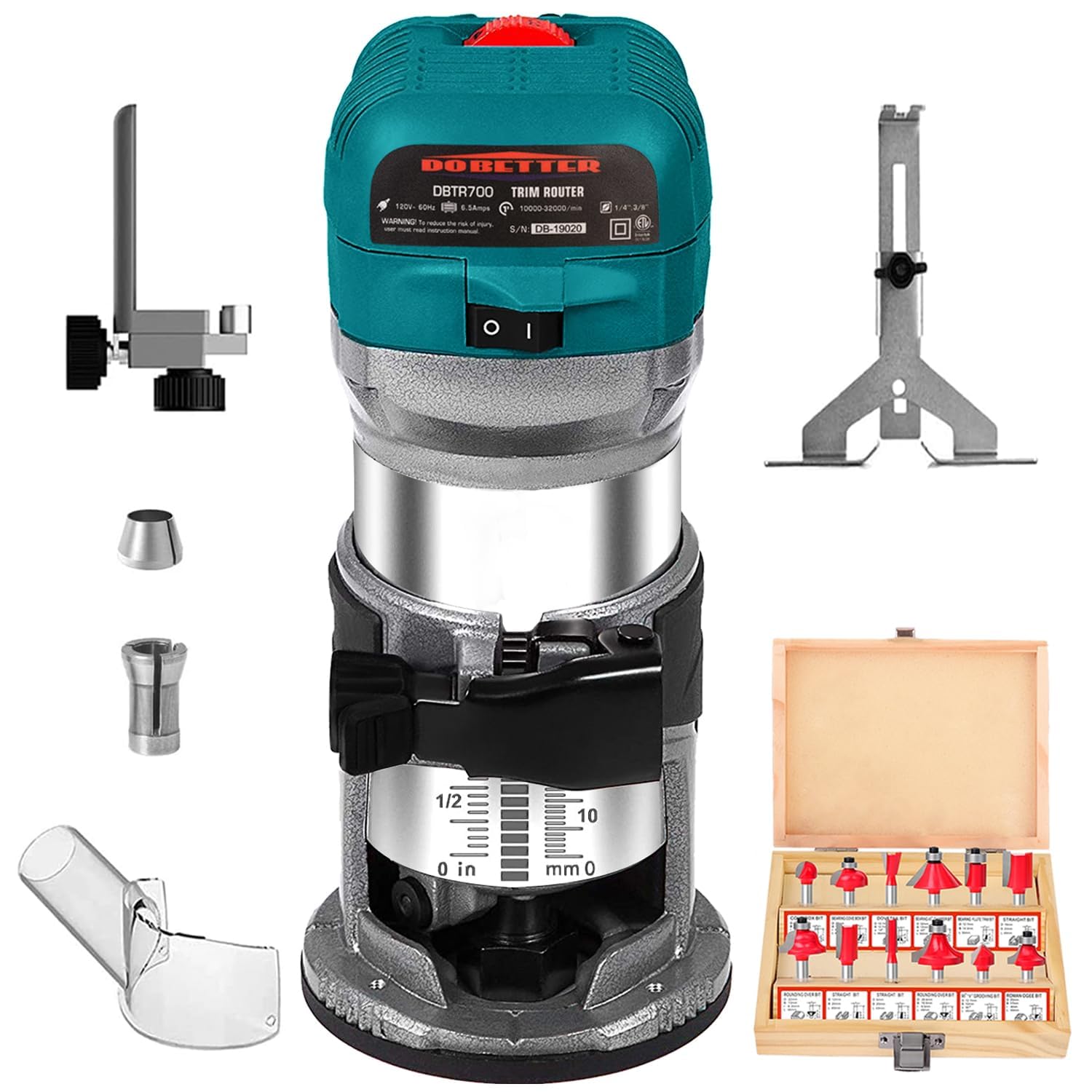
A CNC-friendly router with rack-and-pinion depth that stays locked cut after cut.
This is the pick for anyone mounting a router to a CNC machine or router table, because the rack-and-pinion depth adjustment locks in place and stays there. Owners emphasize “once you set the measurements, it stays there,” which is the hallmark of a precision tool rather than a toy.
The 6.5-amp motor delivers 1.25 horsepower across six variable speeds from 10,000 to 32,000 RPM, and the soft-start feature stops the tool from jumping in your hand. It comes with 12 router bits, a portable bag, edge and roller guides, a dust hood, and spare carbon brushes.
Guitar repairers and CNC hobbyists rate it highly for cutting soft and hard woods cleanly with minimal vibration. The bit-changing process is the weak point—the spring-loaded screw is awkward and requires removing the base—but the measurements hold true once set, making it worth the extra effort.
The Precision Advantage
- Depth stays locked once set
- Soft-start prevents kickback and jumping
- Six speed settings from 10,000 to 32,000 RPM
The Clunky Bit Swap
- Changing bits requires removing the base
- Included bits are usable but not top-tier
Ideal for: CNC setups, router tables, and projects where repeated cuts must match exactly.
Avoid if: you want quick, tool-free bit changes between every pass.
8. WORKPRO Compact Router Kit

The sturdy all-rounder that powers through hardwood without complaining.
Owners consistently describe this WORKPRO as powerful and well-made, with one noting it handles hardwood work with ease where cheaper tools struggle. The 6.5-amp motor is paired with six variable speeds from 12,000 to 30,000 RPM, giving you the range to match your material.
The rack-and-pinion depth adjustment is smooth, and the rubber-wrapped handles keep your hands comfortable during extended use. It is the only kit here that includes a template guide, which lets you follow patterns for repeatable shapes, plus both 1/4-inch and 3/8-inch collets for wider bit compatibility.
The slow-start motor is a hit with buyers—it “gives you time” instead of starting aggressively, which helps with control. A few owners note the included guide fence is a bit flimsy and the depth adjustment feels sloppy until you clamp it down, so use the scale for precision work rather than trusting the dial alone.
What It Does Best: Punches above its class on hardwoods, with a template guide that open up pattern work.
The One Complaint: The fence is weak—budget for a better aftermarket guide if you rely on it.
Understanding the Specs
Amperage and Horsepower
Amperage (A) tells you how much electrical current the motor draws, and horsepower (HP) measures its mechanical output. Higher numbers mean the motor can push through dense hardwoods without bogging down—so you can rout oak or maple without the bit stalling. For a palm router, 5.3 to 6.5 amps is the normal budget range, with 1.25 HP being the balance for solid wood work.
Maximum Rotational Speed (RPM)
Revolutions per minute (RPM) is how fast the bit spins. Higher RPM cuts faster but generates more heat, which can burn softwoods. That is why variable speed matters: you can drop to 12,000 RPM for plastics and soft pine, then crank up to 30,000 RPM or more for clean edge trimming on hardwoods. A single-speed router is fine for basic work but limits your control.
FAQ
What is the difference between a trim router and a full-size router?
Can I use a 1/4-inch shank bit in any of these routers?
Why does my router bit keep coming loose during use?
Is variable speed really worth paying extra for?
What does a soft-start motor do?
How do I know which depth adjustment system is better?
Can I mount these palm routers on a router table?
How long will a budget router last with regular use?
What is the best speed setting for trimming laminate or veneer?
Final Thoughts: The Verdict
If you want one dependable pick, the budget wood router winner is the TEENO Wood Router because it packages a strong 6.5-amp motor, a transparent tool-free depth base, and a full 15-piece bit set into one ready-to-work kit. If you want variable speed and metal durability, grab the TEENO Aluminum Router for material-matched control. And for precision repeatability on a CNC or router table, the DOBETTER Router is the one to reach for—it holds its depth settings and delivers clean cuts on hardwood.
How We Picked
We do not accept paid placement. Every pick is matched to a real buyer and a real use-case; we do not hands-on test units.
Sources & Methodology
Specifications: manufacturer listings and product documentation. Review insights: verified customer reviews, as of August 2026. Pricing: not shown on this page (it changes often); check the current price via the retailer link.
As an Amazon Associate, FitlyFast earns from qualifying purchases. This does not affect which products we feature.