
Our readers keep the lights on and the weekend projects moving. As an Amazon Associate, I earn from qualifying purchases.
Specs are compiled from manufacturer listings and verified buyer reviews and can change over time — please confirm the key details on the product page before buying.
Getting broadcast-quality audio for your podcast, stream, or home studio doesn’t mean you have to spend hundreds on a single microphone. The real trick is finding a budget-friendly XLR mic that delivers clear, warm vocals without picking up every fan hum and keyboard clack in the room. This guide cuts through the noise to find budget XLR mics that deliver professional sound without the professional price tag.
I’m Rikta — the founder and writer behind FitlyFast. This guide is built by comparing the manufacturers’ published specifications and the patterns across verified customer reviews, so you get each pick’s real strengths and trade-offs instead of marketing spin.
After digging through the data, these are the top performers you should consider when shopping for the best budget xlr microphone that won’t make your audio sound like you’re broadcasting from a tin can.
Our Picks at a Glance


How To Choose The Best Budget XLR Microphone
Picking the right entry-level XLR mic depends on understanding your room, your voice, and the gear you already own. A mic that sounds amazing in a treated studio can sound hollow and echoey in a bare bedroom. Here are the three things that matter most.
Dynamic vs. Condenser: Which Capsule Fits Your Space?
Dynamic microphones are the workhorses of live sound and podcasts. They are less sensitive than condensers, which means they naturally reject background noise like air conditioning, computer fans, and room echo. If you record in an untreated space — and most beginners do — a dynamic mic is almost always the better choice. Condenser mics capture more detail and a wider frequency range, but they also pick up every single sound in the room, which can be a problem unless your space is acoustically treated.
Polar Patterns: The Shape of Your Sound Capture
A cardioid polar pattern picks up sound from the front and rejects noise from the sides and rear. This is the standard for podcasting and streaming because it focuses on your voice and ignores the rest of the room. Some mics use a supercardioid pattern, which is even tighter and rejects more side noise but also picks up a small amount from the rear. For a single person at a desk, a standard cardioid is usually the safest and most forgiving option.
Impedance and Gain: Will Your Interface Drive the Mic?
A microphone’s impedance rating tells you how much signal it puts out. Lower impedance mics (around 150-300 ohms) are easier for most audio interfaces to power cleanly. Higher impedance mics (600 ohms and above) can sound fine but often require more gain from your preamp. If your interface is basic, look for a mic with lower impedance to avoid needing an extra booster like a Cloudlifter.
Quick Comparison
| Model | Best For | Type | Impedance | Frequency Range | Amazon |
|---|---|---|---|---|---|
| MAONO PD100★ Best Overall | All-in-one podcast starter | Dynamic | 600 ohm | 60–14kHz | Amazon |
| Neat Worker Bee IIMost Versatile | Detailed instrument & vocal recording | Condenser | 50 ohm | — | Amazon |
| Sennheiser XS 1Stage Ready | Live vocals & stage use | Dynamic | — | — | Amazon |
| sE Electronics V2 Switch | Rugged stage & talkback | Dynamic | 630 ohm | — | Amazon |
| FIFINE AmpliTank Tank3 | USB-to-XLR upgrade path | Dynamic | — | 50–16kHz | Amazon |
| Zoom ZDM-1 | Broadcast-quality spoken word | Dynamic | — | 50–18kHz | Amazon |
| beyerdynamic M 70 PRO X | Home office & voiceovers | Dynamic | — | — | Amazon |
| RØDE PodMic | Serious podcasting & streaming | Dynamic | — | — | Amazon |
| PreSonus PD-70 | SM7B alternative at a fraction | Dynamic | 350 ohm | 20–20kHz | Amazon |
In‑Depth Reviews
1. MAONO PD100 XLR Podcast Microphone
The complete starter kit that skips the guesswork for new podcasters.
This dynamic mic with a cardioid pattern focuses on your voice and ignores the room noise around you, which is exactly what you need for a clean podcast or stream. The built-in double-layer pop filter tames harsh “p” and “b” sounds, so you don’t need to buy extra gear right away. The frequency range lands at 60–14kHz, which is tuned for spoken word clarity rather than the extended highs a singer might want.
What really sets the PD100 apart is what comes in the box. You get the mic, a sturdy metal desktop stand with a thick circular base, a 2.36-inch rod extender to bring the mic closer to your mouth, and a 6.56-foot XLR cable. For someone buying their first XLR mic, this bundle removes the hassle of hunting down separate parts. The build is all metal, and the base includes built-in 5/8-inch and 3/8-inch threads, so it works with most standard mic arms if you upgrade your setup later.
Owners consistently call out the construction and sound quality. As buyers put it: “Very good product! Great construction. Awesome sound quality.” The crowd favorite here is the value — getting a full XLR kit with a metal body at this tier is rare. The only real trade-off is the 600 ohm impedance, which is on the higher side, meaning it may need a bit more gain from your audio interface than a lower-impedance mic would.
What Wins People Over
- Complete kit includes stand, cable, and extender — no extra purchases needed
- All-metal body feels durable and looks professional on a desk
- Built-in pop filter reduces plosive pops without an external accessory
The Honest Trade-Off
- 600 ohm impedance requires a preamp with decent gain to drive it cleanly
- Some owners note it benefits from a touch of EQ to really shine
Start here if: you want everything in one box — mic, stand, cable — and a metal build that feels like a real studio piece, not a toy.
Think twice if: your audio interface has weak preamps; the higher impedance means you may need to crank the gain more than you’d expect.
2. NEAT Microphones Neat Worker Bee II
A condenser mic that rivals pricier studio mics for under fifty bucks.
Unlike most picks on this list, the Worker Bee II is a condenser microphone, which means it captures a wider, more detailed frequency range than a dynamic mic. The proprietary 25mm medium diaphragm capsule and custom Class-A discrete electronics deliver an open, natural sound with a pleasing low end. Reviews describe it as rivaling microphones that cost three times as much, which is high praise at this price point.
At a 50 ohm impedance, it has a 12x lower impedance than the MAONO PD100 above, which means it is much easier for a standard audio interface to drive without extra gain. The cardioid pattern is tight enough to work in untreated rooms — buyers report using it 4 to 5 inches away at a 45-degree angle with minimal room echo. Weighing in at 1.7 pounds, it feels solid but lightweight compared to some of the tank-like dynamic mics on this list.
The value for money follows closely, with 10 mentions. The recurring note is that the included pop filter is nearly useless and should be replaced with an external one. This is a steal for people getting into recording, as one buyer put it: “Price to performance is 5 stars!”
Strengths That Stand Out
- Condenser capsule captures exceptional detail for vocals and acoustic instruments
- Very low 50 ohm impedance works well with basic audio interfaces
- Flat frequency response with natural low-end presence
What to Know Before Buying
- Included pop filter is poor quality and hard to remove; plan to buy a separate one
- Condenser design picks up more room noise than a dynamic mic in untreated spaces
Reach for this if: you record in a reasonably quiet room and want the extra clarity a condenser provides for both voice and acoustic guitar.
Look elsewhere if: your recording space is noisy or echoey — a dynamic mic will serve you better.
3. Sennheiser XS 1 Handheld Dynamic Microphone
German engineering in a handheld package that surprises everyone at the price.
The Sennheiser XS 1 is a handheld dynamic microphone built for live performance, karaoke, and public speaking. It features a cardioid polar pattern that rejects feedback from stage monitors and isolates your voice from crowd noise. At roughly 15.68 ounces, it feels substantial in the hand without being heavy, and the all-metal construction suggests it can survive the occasional drop.
One standout feature is the silent mute switch on the body, which lets you cut audio without a loud click traveling through the PA. The mic comes with a clip and a carrying pouch, so it travels well. Compared to the MAONO PD100, the Sennheiser is a traditional handheld form factor — 7.87 inches long — designed to be held, not mounted on a desk stand. It lacks the built-in pop filter of the MAONO, but the dynamic capsule naturally handles plosives better than a condenser would.
Quality is what wins owners over here — 20 buyers call it out, followed closely by value for money at 18 mentions. One owner was “shocked by the price,” noting a Sennheiser mic with mute capability for well under typical expectations. There is no hiss or hum in the signal, and the build feels premium. The only note is that it lacks the pronounced proximity effect some vocalists want for a fuller sound.
What Makes It a Winner
- Silent mute switch works smoothly without any audible pop in the signal
- All-metal body and clip feel durable enough for regular stage use
- Excellent handling noise rejection — no rumble when gripping the body
The Fine Print
- Less proximity effect than some competing dynamics, so vocals may feel less “big” up close
- No built-in windscreen or pop filter included beyond the basic grille
Grab this for: live gigs, karaoke nights, or any scenario where you need a reliable handheld that won’t pick up handling noise.
skip it if: your primary use is desk-based podcasting — a dedicated podcasting mic with an arm mount will be more convenient.
4. sE Electronics V2 Switch Dynamic Microphone
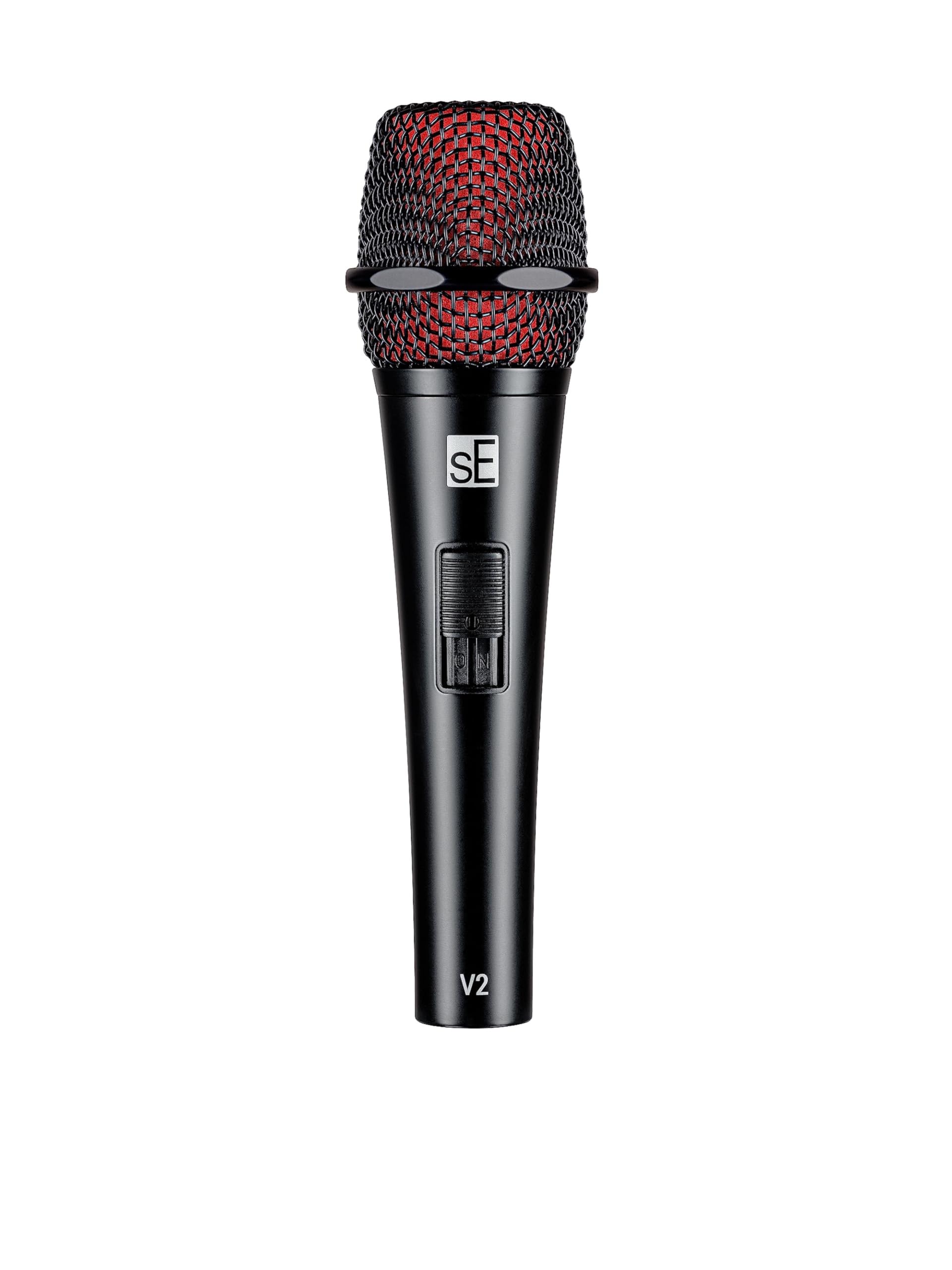
A supercardioid beast that shakes off room echo and keeps your voice front and center.
The sE Electronics V2 Switch is a dynamic microphone built for demanding live and studio environments. what separates it is the supercardioid capsule, which has a tighter pickup pattern than a standard cardioid. This means it rejects even more sound from the sides, making it ideal for loud stages, talkback roles, or any setting where isolation is critical. The all-metal housing and beveled spring steel grille are designed to withstand corrosion, dents, and rolling.
At a 630 ohm impedance, it sits on the higher side — similar to the MAONO PD100 — so your audio interface will need decent gain to drive it. However, the patented shockmount system inside the body does an excellent job of eliminating rumble and handling noise. The integrated on/off switch is silent, perfect for muting during panel discussions or between songs. It also includes a switchable internal windscreen to cut down on wind noise.
Sound quality gets 13 positive mentions, with owners praising its natural, transparent sound and excellent background rejection. As one buyer put it, “SM What?? 58 Who??” — a bold claim that this mic sounds better than the industry-standard Shure SM58 for a lower price. The build quality also earns high marks. The chief caveat is that handling noise can be apparent if you grip the body tightly, though careful mic technique solves that.
Built to Perform
- Supercardioid pattern offers superior off-axis noise rejection for loud environments
- All-metal build with spring steel grille is rugged enough for touring
- Patented internal shockmount keeps handling rumble out of the recording
One Thing to Watch
- 630 ohm impedance requires a preamp with solid gain headroom
- Some handling noise is transmitted through the body if not held carefully
Best for: stage use, talkback, or any scenario where you need maximum background noise rejection from a handheld dynamic.
Not ideal if: your audio interface has weak preamps — the high impedance may leave your signal too quiet.
5. FIFINE AmpliTank Tank3 XLR/USB Dynamic Microphone

The only mic here that lets you start with USB and graduate to XLR later
The FIFINE AmpliTank Tank3 is a dynamic cardioid microphone with a rare dual-connection design: it works with both USB and XLR. This makes it the perfect entry point for someone who does not yet own an audio interface but plans to buy one later. Plug it into your computer via USB-C today, and switch to an XLR interface tomorrow without buying a new mic. It delivers 24-bit/48kHz audio over USB, which is more than enough for podcasting and streaming.
The all-metal body protects the cardioid dynamic capsule, and the front-facing controls include a mute button, a headphone jack for zero-latency monitoring, and separate knobs for mic gain and headphone volume. The frequency response is 50Hz to 16kHz, which is slightly narrower than some competitors but still well within the human voice’s range for clear, warm spoken word. The audible noise floor is rated at a very quiet 20 dB, so the signal stays clean.
Build quality is the highlight here — owners consistently describe it as a “tank” with a sturdy metal construction and a sleek, minimal design. The mute button is a physical switch, so you won’t accidentally unmute yourself with a light touch. The only consistent note is that the headphone preamp on the USB side is a bit quiet; you may need to turn your headphones up more than expected.
Why It Stands Out
- Dual USB and XLR connections let you start recording immediately and upgrade later
- Physical mute button and independent volume knobs for gain and monitoring
- Very low 20 dB self-noise keeps the audio path clean
What’s Not Perfect
- Headphone output on USB mode is quieter than some competing USB mics
- Frequency range tops out at 16kHz, which is fine for voice but not for high-detail instrument recording
Perfect for: new streamers and podcasters who want a single mic that works with a computer today and a pro setup tomorrow.
Consider a pure XLR mic if: you already own an audio interface and don’t need the USB flexibility.
6. Zoom ZDM-1 Dynamic Microphone

Large-diaphragm dynamic sound that punches way above its weight for spoken word
The Zoom ZDM-1 is a large-diaphragm dynamic microphone with a supercardioid polar pattern, designed specifically for broadcast-quality spoken word. The large diaphragm gives it a smooth, rich character that is closer to the sound of a studio condenser than the thinner response of a typical budget dynamic. It handles high SPL (sound pressure levels) up to 135 dB without distorting, so it can handle loud vocals or close-up instrument miking without breaking up.
The all-metal body and grille are built for daily use, and the internal shockmount provides some isolation from bumps and handling noise. At 454 grams (about a pound), it feels solid but isn’t too heavy for a standard boom arm. The frequency response spans 50 to 18kHz, which gives it a bit more top-end air than the MAONO PD100, making voices sound slightly more open. The audible noise floor is rated at 78 dB, which is typical for a dynamic mic.
Sound quality is the top praise, with 49 owners calling it out, and value for money follows at 34 mentions. The recurring honest note is that the included windscreen is poor for plosives, and the mic picks up handling noise from desk vibrations if not mounted on a separate shockmount or boom arm. As buyers put it, the sound is “shockingly good” for the money, but you may want to budget an extra ten bucks for a better shockmount.
Biggest Strengths
- Large-diaphragm dynamic design delivers smooth, broadcast-style vocal tone
- 135 dB SPL handling means no distortion even with loud vocalists
- Internal shockmount reduces some handling noise right from the start
Real-World Caveats
- Handling noise is noticeable; a separate shockmount or boom arm is recommended
- Included foam windscreen does a poor job stopping plosive pops
Go with this if: you want a large-diaphragm dynamic sound for spoken word that rivals mics costing twice as much.
Think twice if: you don’t want to buy an additional shockmount — this mic really needs one to shine in a desk setup.
7. beyerdynamic M 70 PRO X Dynamic Broadcast Microphone

A flat, accurate broadcast mic that reveals every detail — for better or worse
The beyerdynamic M 70 PRO X is a dynamic broadcast microphone tuned for a flat, accurate frequency response with a slight upper-mid presence boost. This means voices sound clear and intelligible without the exaggerated bass of some broadcast mics. The integrated dual-layer pop filter and elastic shockmount come included, so you don’t have to buy extras. The supercardioid pattern offers tighter side rejection than a standard cardioid, which is useful in untreated rooms or noisy home offices.
The body is made from reinforced polycarbonate with ABS parts rather than full metal, which keeps the weight down to 16 ounces. At roughly 9.1 x 9.1 x 9.1 inches in box dimensions, the mic itself is compact and easy to position. The XLR connection is standard, and the microphone is tune for use with audio interfaces. One thing to note: it has a high-gain requirement similar to the Shure SM7B, so a basic interface may leave you wanting more volume without an inline preamp booster.
Sound quality is praised by 8 owners, with several noting its transparency and clarity for voiceovers. One buyer summed it up: “For that price this is an amazing deal.” The candid feedback is that the mic can be overly bright, exaggerating sibilance (harsh “s” sounds) on some voices. The included shockmount also receives mixed reviews — some wish it were sturdier for a dynamic mic this gain-hungry.
What Impresses
- Flat, accurate frequency response with upper-mid clarity for spoken word
- Integrated dual-layer pop filter and shockmount included in the box
- Supercardioid pattern provides excellent background noise rejection
What to Keep in Mind
- Requires a high-gain preamp or booster — basic interfaces may not drive it loud enough
- Bright voicing can exaggerate sibilance depending on your voice
Reach for this if: you need a flat, detailed voiceover mic and have a preamp that can deliver enough clean gain.
Consider a warmer mic if: your voice tends toward sibilance or you want a thicker, more bass-heavy broadcast sound.
8. RØDE PodMic Cardioid Dynamic Broadcast Microphone

The broadcast standard that proves heavy build equals heavy sound quality
The RØDE PodMic is a cardioid dynamic broadcast microphone purpose-built for podcasting and streaming. Its most notable physical trait is the sheer heft — at 937 grams (just over two pounds), it is the heaviest mic on this list by a wide margin. That weight comes from the all-metal construction and integrated yoke mount, which allows for easy positioning without needing a separate thread adapter thanks to the built-in dual 3/8-inch and 5/8-inch threading. The internal shockmount reduces knocks and vibrations, and a built-in pop filter tames plosives for natural voice reproduction.
Designed and made in RØDE’s facilities in Sydney, Australia, the PodMic is tune for use with the RØDECaster console line, but it works with any standard XLR interface. It has an audible noise floor of just 18 dB, which is impressively low and means the signal stays clean without hiss. The frequency response goes up to 20kHz, giving it a wider top end than many budget dynamics. However, like the beyerdynamic above, it requires a clean preamp with decent gain to reach its full potential — owners recommend at least 3/4 gain on a Focusrite Scarlett or similar.
Owners describe it as heavy-duty and delivering a rich, clear vocal tone with warmth and a presence boost at 9kHz. As one buyer put it: “For the money, you’re hard-pressed to find a better mic.” The only real complaint is the weight — some boom arms can’t hold it without sagging, so you may need a sturdier arm than the cheap ones that come in bundles.
Built to Last
- Extremely durable all-metal construction with internal shockmount and pop filter
- Integrated yoke mount with dual 3/8″ and 5/8″ threads works with any stand
- Warm vocal tone with a presence boost at 9kHz for clear, broadcast-ready sound
One Real Consideration
- At 937g, it is heavy — some budget boom arms cannot support it without drooping
- Requires a high-quality preamp to open up its full sonic potential
Best for: serious podcasters and streamers who want a tank-like mic that sounds broadcast-ready with the right interface.
pass on it if: your boom arm is lightweight or your audio interface has weak preamps — you will need both to get the best out of this mic.
9. PreSonus PD-70 Dynamic Vocal Microphone

Shure SM7B vibes at a fraction of the cost, with a tank-like build to match
The PreSonus PD-70 is a dynamic broadcast microphone that channels the look and sound of the legendary Shure SM7B for a much lower price point. It features a cardioid polar pattern for off-axis noise rejection and a tailored frequency response from 20Hz to 20kHz, which is the widest frequency range on this list. This means it captures the full audible spectrum — from deep lows to crisp highs — making it versatile for vocals, guitars, basses, and even drums. The included windscreen cuts down plosives without needing an external pop filter.
At a 350 ohm impedance, it sits in a balance — higher than the 50 ohm Neat Worker Bee II but lower than the 600 ohm MAONO PD100. This means it is easier to drive than the higher-impedance mics on this list, but it still benefits from a decent preamp. The build is exceptionally heavy and tank-like, with an audible noise floor of 80 dB. It works with any audio interface that has a microphone preamp, and no phantom power is required since it is a dynamic capsule.
Sound quality leads the praise with 19 mentions, followed by quality at 14 and value for money at 13. Owners consistently compare it to the SM7B, noting that after a little EQ tweaking, it “sounds nearly identical” to the industry standard that costs several times more. The candid feedback is that the mic has high handling noise — it is not suited for handheld use — and the fixed hard-mount design means you cannot attach a traditional two-sided bracket without an adapter.
Why It Rocks
- 20Hz–20kHz frequency range captures full vocal spectrum, from lows to highs
- 350 ohm impedance is easier to drive than many budget dynamics
- Tank-like build quality that sounds nearly identical to the Shure SM7B with EQ
Things to Note
- High handling noise limits it to mounted use — not great for handheld performances
- The fixed mount design may feel restrictive if you prefer a two-sided yoke bracket
Choose this if: you want that iconic SM7B broadcast sound without the expensive price tag and have a good boom arm ready.
Pass if: you need a mic for handheld use or live stage work — this one stays on the stand.
Understanding the Specs
Dynamic vs. Condenser
A dynamic microphone uses a moving coil and a magnet to convert sound into an electrical signal. It is less sensitive than a condenser, which means it picks up less background noise and room echo. This makes it the default choice for untreated rooms, live vocals, and podcasting. A condenser microphone uses a charged capsule that captures more detail and a wider frequency range, making it better for studio vocals and acoustic instruments, but it will also pick up every click, hum, and breath in your room.
Impedance
Impedance, measured in ohms, tells you how much electrical resistance the microphone presents to your audio interface. A lower impedance (around 150–300 ohms) is easier for most interfaces to drive to a healthy volume. A higher impedance (600 ohms and above) often requires more gain from your preamp. If you have a basic interface like a Focusrite Scarlett Solo, a low-impedance mic will sound louder and cleaner without needing an extra booster device.
Polar Pattern
A polar pattern describes the directions from which a microphone picks up sound. A cardioid pattern captures sound from the front and rejects it from the sides and rear — this is the standard for podcasting and streaming because it focuses on your voice and ignores your keyboard, fan, or room echo. A supercardioid pattern is even tighter, rejecting more side noise but picking up a tiny amount from the rear. A figure-8 pattern picks up sound from the front and rear equally, useful for duet interviews.
Frequency Response
Frequency response is the range of pitches a microphone can capture, measured in Hertz (Hz). The human voice spans roughly 80Hz to 8kHz. A microphone with a range of 60–14kHz can capture every detail of your voice, including the subtle harmonics that make it sound natural, while rolling off the extreme lows and highs that are mostly noise. A wider range like 20Hz–20kHz also captures room rumble and high-frequency detail, which is more useful for recording instruments than spoken word.
FAQ
Can I use an XLR microphone without an audio interface?
What is the difference between a dynamic and a condenser XLR microphone?
How important is the polar pattern for a budget XLR microphone?
Does a higher impedance microphone sound better?
Do I need phantom power for a dynamic XLR microphone?
Will a budget XLR microphone sound better than a USB microphone?
How close should I sit to a budget XLR dynamic microphone?
Can a budget XLR microphone work with a laptop or tablet?
What does the “cardioid” in microphone specs mean?
Do I need a pop filter for a dynamic XLR microphone?
Final Thoughts: The Verdict
If you want one dependable pick, the best budget xlr microphone winner is the MAONO PD100 because it bundles everything a first-time buyer needs — a metal body, a full desktop stand, an extender rod, and a 6.56-foot XLR cable — into one affordable package without sacrificing sound quality. If you want the most detailed vocal capture for a quiet, treated room, the Neat Worker Bee II condenser is an incredible value at its price. And for a rugged stage or talkback mic that rejects noise like a pro tool, the sE Electronics V2 Switch is the one to reach for. Whichever you choose, pairing it with a decent audio interface will open up the full potential of your new microphone.
How We Picked
We do not accept paid placement. Every pick is matched to a real buyer and a real use-case; we do not hands-on test units.
Sources & Methodology
Specifications: manufacturer listings and product documentation. Review insights: verified customer reviews, as of July 2026. Pricing: not shown on this page (it changes often); check the current price via the retailer link.
As an Amazon Associate, FitlyFast earns from qualifying purchases. This does not affect which products we feature.