
Our readers keep the lights on and the weekend projects moving. As an Amazon Associate, I earn from qualifying purchases.
Specs are compiled from manufacturer listings and verified buyer reviews and can change over time — please confirm the key details on the product page before buying.
A bunka knife’s flat cutting edge and squared-off tip make it the most precise tool you can own for push-cutting vegetables, trimming proteins, and slicing herbs without that rocking motion a chef’s knife forces you into. The real question is which steel, handle, and balance suit your actual prep volume — and how much maintenance you are willing to do.
I’m Rikta — the founder and writer behind FitlyFast. This guide is built by comparing the manufacturers’ published specifications and the patterns across verified customer reviews, so you get each pick’s real strengths and trade-offs instead of marketing spin.
Below are the five models worth your counter space in the competitive bunka knife category, ranked by how well they balance edge retention, daily comfort, and long-term durability.
Our Picks at a Glance

How To Choose The Best Bunka Knife
A bunka is defined by its nearly straight edge and a sharp reverse tanto (K-tip) point. That shape gives you easy push cuts and precise tip work, but it also demands that you match the steel and geometry to what you actually chop day to day.
Steel Type and Hardness
The core steel determines how long the knife stays sharp and how easy it is to re-sharpen. High-carbon stainless options like VG10 (around Rockwell 60-61 — a scale from soft to hard, with 61 being kitchen-knife territory) hold a fine edge reasonably well and resist rust. Premium powder steels such as SG2 (around Rockwell 63) push edge retention further but require diamond abrasives to sharpen properly. A harder steel also means a more brittle edge — you want to avoid twisting it through bones or frozen foods.
Blade Length and Height
Most bunka knives fall between 5.5 and 7 inches. A longer blade gives you more usable cutting edge — the flat profile of a 7-inch bunka actually delivers more edge contact than an 8-inch chef’s knife with a curved belly. A shorter 5.5-inch blade is more agile for detail work and fits smaller hands comfortably. Blade height at the heel — the back part of the blade near the handle — also matters: a taller blade gives your knuckles more clearance above the cutting board.
Handle and Balance
Look for a handle that stays secure when wet. Traditional wa-style (octagonal) handles suit a pinch grip, while Western-style handles with a bolster feel more familiar. Material choices like micarta (a dense, resin-infused fabric) resist moisture and fatigue better than basic wood, though they lack the natural warmth of burl wood or ebony. The balance point should fall near the heel or the pinch-grip area — a blade-heavy knife tires your wrist faster during long prep sessions.
Quick Comparison
| Model | Best For | Blade Length | Steel Type | Rockwell Hardness | Amazon |
|---|---|---|---|---|---|
| Enso HD 7″ Bunka★ Best Overall | Premium all-rounder with low maintenance | 7 Inches | 37-layer VG10 Hammered Damascus | 61 | Amazon |
| KOTAI Bunka Petty 5.5″Compact Workhorse | Compact precision for smaller tasks | 5.5 Inches | 440C Japanese Stainless Steel | 60 ± 1 | Amazon |
| MIYABI Artisan 6.5″ Bunka | Ultra-sharp laser edge for delicate produce | 6.5 Inches | SG2 Tsuchime Steel | 63 | Amazon |
| YOUSUNLONG CuMai 7″ Bunka | Show-stopping gift piece with copper damascus | 7 Inches | CuMai Copper Damascus Steel | — | Amazon |
| Enso SG2 7″ Bunka | Top-tier edge retention and craftsmanship | 7 Inches | 101 Layer Stainless Damascus with SG2 Core | 63 | Amazon |
In‑Depth Reviews
1. Enso HD 7″ Bunka Knife – Made in Japan – VG10 Hammered Damascus Stainless Steel
Our pick — over 4.5★ from 150+ verified ratings; the strongest balance of quality and price.
The balanced daily driver that holds its edge through a season of heavy prep.
The Enso HD uses VG10 steel at Rockwell 61 — a common kitchen-knife hardness that resists rust well — so you get months of sharp cutting on vegetables and boneless meat before needing a touch-up. One buyer reports that after six months of daily use, just 10 to 20 passes on a sharpening stone restored near-factory sharpness. The 7-inch blade is flat along most of its edge, which means more of the blade contacts the cutting board compared to an 8-inch chef’s knife with a curved belly — you get cleaner push cuts through onions and herbs. The blade is 2 inches tall at the heel, so your knuckles clear the board easily, and the knife weighs 7.1 ounces (202 g). The black canvas micarta handle has three stainless steel rivets and stays grippy even when wet. Made in Seki City, Japan, it comes with a lifetime warranty. The double-bevel edge (12 degrees per side) works for both right- and left-handed users. However, it is a thinner blade, so several buyers warn against using it on bone-in cuts — the edge can bend under lateral stress. It also weighs 7.1 oz (the Enso SG2 weighs 6.8 oz), so it feels slightly more substantial in hand.
Why it earns the top spot
- Proven VG10 edge retention with simple sharpening — 10-20 stone passes restores sharpness
- 7-inch blade has a longer usable edge than many 8-inch chef’s knives thanks to the flat profile
- Micarta handle with rivets stays comfortable during extended chopping, even for large hands
What to watch for
- Not built for bone-in cuts or frozen ingredients — thin blade can bend at the tang
- Weighs 7.1 oz, so it is slightly heavier than ultra-light alternatives like the Enso SG2 (6.8 oz)
Reach for this if: you want a durable, low-maintenance bunka that balances sharpness, comfort, and real-world longevity without needing diamond stones to sharpen.
Think twice if: you routinely cut through bones or semi-frozen meat — the thin edge and VG10 steel risk chipping under lateral force.
2. KOTAI Bunka Petty Utility Kitchen Knife – 5.5-inch Blade – 440C Japanese Stainless Steel
The nimble 5.5-inch bunka that brings a laser point to detail work.
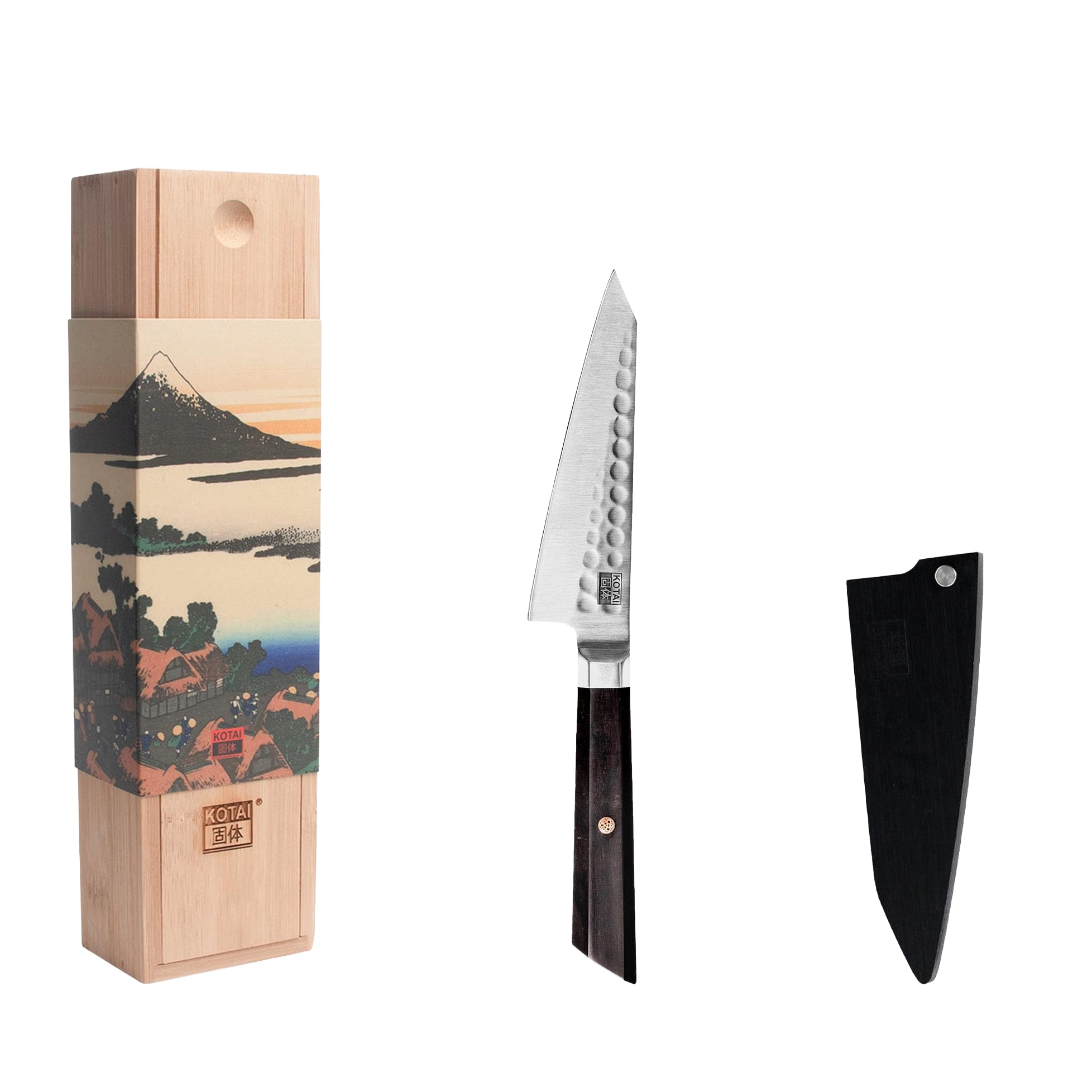
The KOTAI’s blade is 5.5 inches, while the Enso HD’s is 7 inches, so you get a lighter, more agile tool for trimming, peeling, and scoring. The 440C Japanese stainless steel is heat-treated to Rockwell 60 ± 1 — compared to the Enso HD’s VG10 at 61, which means it resists chipping well and is easy to sharpen with standard stones. The hand-hammered tsuchime finish creates tiny air pockets that reduce sticking on sliced ingredients like potatoes or carrots. The reverse tanto (K-tip) profile gives you a sharp point for detail work that a rounded chef’s knife cannot match. The full hidden tang runs through a hand-polished ebony wood handle, and the knife comes with a bamboo saya (sheath) and a bamboo storage box. Buyers report it arrives hair-splitting sharp from the start and that the compact size makes it their go-to for everyday slicing. The trade-off is that the 5.5-inch blade lacks reach for large ingredients — splitting a whole cabbage or carving a roast is cramped compared to the Enso HD’s 7-inch blade. The ebony wood handle is also less moisture-resistant than the Enso HD’s micarta over years of daily use.
Where it shines
- 5.5-inch blade is highly manoeuvrable for precise cuts, trimming, and peel work
- 440C steel at HRC 60 ± 1 resists corrosion well and is easy to sharpen
- Includes a bamboo saya and a premium bamboo storage box for safe storage and gifting
Where it falls short
- Blade is 5.5 inches (the Enso HD is 7 inches) — less reach for large vegetables and roasts
- Ebony wood handle is less moisture-resistant than micarta over years of daily use
Choose the KOTAI if: you do most of your prep on smaller ingredients and value a light, precise blade that slips into a tight space on the counter.
Look elsewhere if: you need a single do-everything knife for large produce, heavy chopping, or cutting through thick-skinned squash — the 5.5-inch blade runs out of reach.
3. MIYABI Artisan 6.5-inch Bunka Knife
SG2 powder steel honed to a 9.5-12 degree edge — cut first, ask questions later.
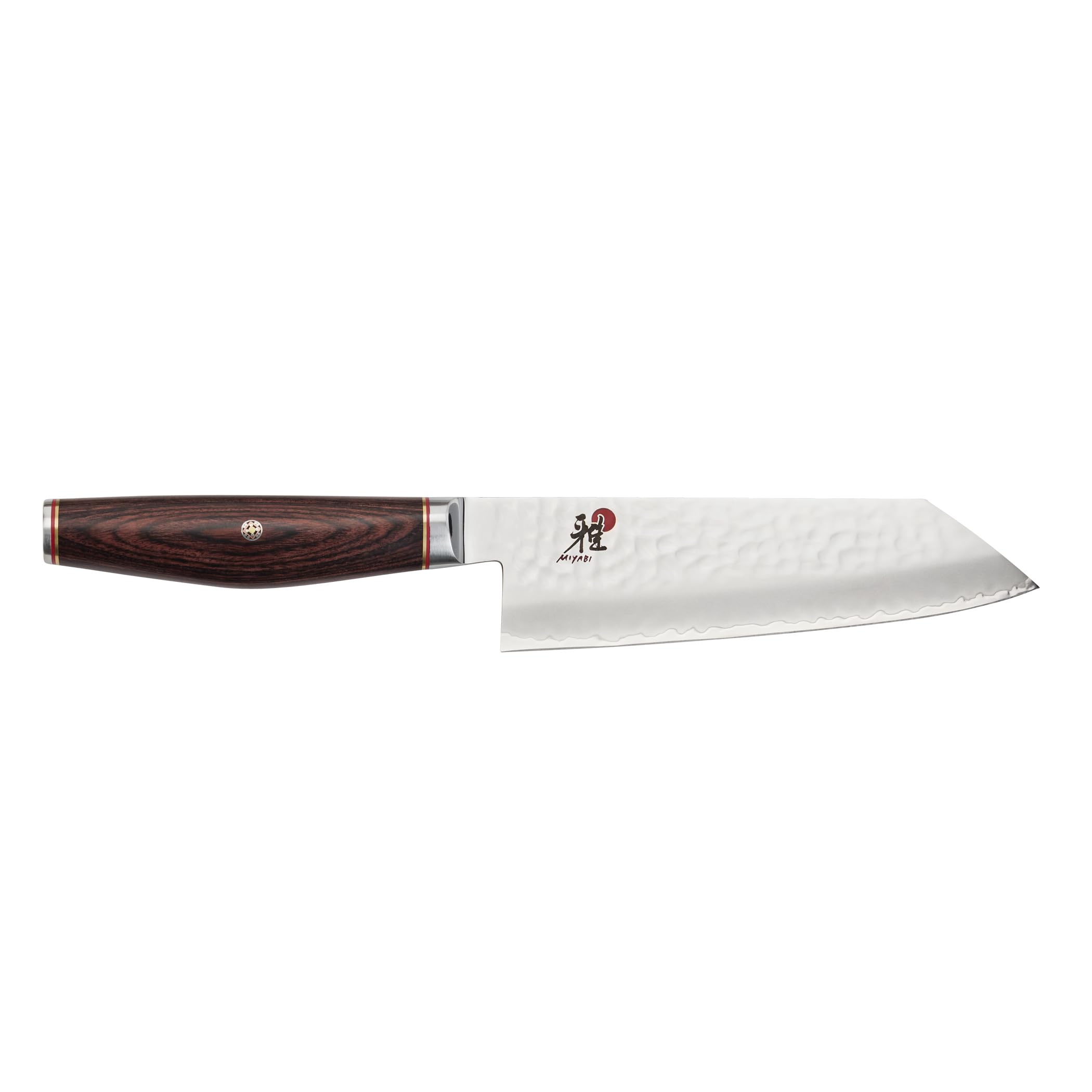
The MIYABI uses SG2 micro-carbide powder steel — a premium type of stainless steel made by a process that produces extremely fine, uniform particles — at Rockwell 63, compared to the Enso HD’s VG10 at 61. This means it holds a sharp edge longer, but it also requires diamond or ceramic sharpening stones because standard water stones struggle with it. The blade is hand-honed using the three-step Honbazuke process (a traditional Japanese sharpening sequence) down to a 9.5 to 12 degree bevel, which is thinner than the Enso HD’s 12-degree edge. That thinner edge gives you less resistance through dense vegetables like carrots. The hammered tsuchime finish reduces food sticking. At 6.5 inches, the blade splits the difference between the KOTAI’s compact 5.5-inch and the Enso HD’s 7-inch. One professional user notes the knuckle clearance is excellent for a knife this size. Several buyers with smaller hands praise the handle fit. The same ultra-thin geometry that makes it a precision tool also makes it fragile: you must not cut through bone, use only wood or soft plastic cutting boards, and avoid any twisting motion. Several buyers mention the edge is scary sharp and can chip on hard ingredients if used carelessly.
What makes it special
- SG2 steel at Rockwell 63 with a 9.5-12 degree edge for exceptional sharpness and edge retention
- Hand-honed three-step Honbazuke process; owners mention it glides through fibrous vegetables cleanly
- Hammered tsuchime finish reduces food sticking, and the handle works well for small hands
What to consider
- Fragile edge requires careful use — no bone, no hard boards, no lateral twisting
- Hard SG2 steel needs diamond abrasives to sharpen properly
This is the knife for: the home cook or professional who prioritises pure cutting performance on vegetables and boneless proteins and does not mind a more delicate tool.
skip it if: you need one knife to handle everything — this blade will chip if you hit bone or frozen ingredients.
4. YOUSUNLONG Bunka Chef’s Knife – Japanese Handmade CuMai Copper Damascus Steel – 7 Inch

Copper damascus forged into a 7-inch blade that looks like a museum piece and cuts like a pro.
The YOUSUNLONG uses a CuMai copper damascus forging process that incorporates brass and red copper into high-hardness steel. This creates one-of-a-kind vintage patterns — no two knives share the same look. The 7-inch blade is 7 inches long, while the KOTAI’s is 5.5 inches, so it handles larger cutting tasks more easily. Customers note it stays sharp with comfortable grip and good control thanks to the natural burl wood handle, which has a unique grain and a high density that makes it sturdy and durable. The knife arrives in an acacia wood box with a leather sheath. The blade weighs 6.4 ounces, which is 0.7 ounces lighter than the Enso HD (7.1 oz), so it feels more delicate in hand. The Rockwell hardness is not listed in the product data, so you cannot directly compare edge retention to the VG10 or SG2 models. One reviewer noted the blade looks different from the product photos — a common risk with handmade damascus patterns, since the exact etching varies per knife.
The standout features
- Unique CuMai copper damascus pattern — every blade has a one-of-a-kind forged look
- Comes with a leather sheath, acacia wood box, and natural burl wood handle for a premium unboxing
- 7-inch blade length suits larger cutting tasks better than the KOTAI’s 5.5-inch
Consider before buying
- No Rockwell hardness published — harder to predict edge retention vs VG10 or SG2 alternatives
- Damascus pattern varies per knife; the look may differ noticeably from the listing photos
Buy it for: the class-leading visual appeal and the complete presentation package — a knife you will want to display as much as use.
Think twice if: you need verifiable hardness specs and predictable edge behaviour — the Enso HD or SG2 are safer bets for long-term performance.
5. Enso SG2 Bunka Knife – Made in Japan – 101 Layer Stainless Damascus, 7″

SG2 powder steel wrapped in 101 layers — the sharpest daily tool in this class.
The Enso SG2 is the premium sibling to the Enso HD: same 7-inch blade length, same blade height of 2 inches, same 12.25-inch overall length, and same black canvas micarta handle. The big difference is the steel core: instead of VG10 at Rockwell 61, the SG2 uses SG2 micro-carbide powder steel at Rockwell 63 (63 vs 61). That means the SG2 holds its edge longer between sharpenings. One buyer who owns the Enso HD 16-piece set bought this SG2 Bunka to fill a gap in their collection and liked it so much they bought a second as a gift. The double-bevel edge is ground to approximately 12 degrees and works for both right- and left-handed users. The knife is handcrafted in Seki City, Japan, with a lifetime warranty. At 6.8 ounces, it is 0.3 ounces lighter than the Enso HD, which makes it feel slightly more nimble during extended prep. The honest trade-off is the price: it is the most expensive pick here. For home cooks who do not push a knife hard daily, the Enso HD delivers similar geometry and build quality for less money. The SG2 steel also requires diamond or ceramic sharpening stones; standard water stones struggle with it. One reviewer also mentions the knife is very thin and scary sharp from the start — they accidentally cut themselves while testing the initial edge.
Why it commands the price
- SG2 core at Rockwell 63 — best edge retention in this lineup; reviewers point out it cuts carrots like butter
- 101-layer stainless damascus cladding with a hand-engraved kanji and samurai crest
- Lifetime warranty and Seki City craftsmanship; one buyer bought two as gifts after their own purchase
The honest catch
- Highest price in the group — the VG10 Enso HD delivers similar geometry and build quality for less cost
- SG2 steel requires diamond or ceramic sharpening stones; standard water stones struggle
Go for the Enso SG2 if: you want the absolute best edge retention and are willing to invest in the right sharpening gear — it is the knife for the enthusiast who treats their kit like a craft.
Pick the Enso HD instead if: you want similar geometry and build quality but prefer a lower-maintenance steel that is easier to touch up with basic stones.
Understanding the Specs
Rockwell Hardness (HRC)
This number tells you how hard the blade steel is after heat treatment. A higher Rockwell rating (like 63) means the knife holds a sharp edge longer, but it also makes the steel more brittle — you need to avoid twisting through bones or frozen ingredients. Lower ratings (around 60) are tougher and less likely to chip but need more frequent sharpening. For most home kitchens, Rockwell 60-61 offers a balance of edge retention and durability.
Blade Profile and K-tip
The bunka’s defining feature is a nearly flat cutting edge that meets a sharp reverse tanto point (the “K-tip” or “reverse tanto”). This profile lets you make straight push cuts through vegetables without the rock-and-chop motion a curved chef’s knife requires. The flat edge also makes contact with the board along its entire length, so you get cleaner cuts through herbs and onions. The sharp tip is ideal for detailed trimming and scoring tasks.
FAQ
What is the difference between a bunka knife and a santoku knife?
Can I use a bunka knife for cutting through bones or frozen foods?
What is the best cutting board for a bunka knife?
How often do I need to sharpen a bunka knife?
Is a 5.5-inch bunka too small for general kitchen use?
Can I wash my bunka knife in the dishwasher?
What does the hammered (tsuchime) finish actually do?
Is a double-bevel knife better than a single-bevel knife like a traditional yanagiba?
Which bunka is best for someone with smaller hands?
How does the Enso SG2 differ from the Enso HD VG10?
Final Thoughts: The Verdict
If you want one dependable pick, the bunka knife winner is the Enso HD 7″ Bunka because it delivers proven VG10 edge retention, a balanced micarta handle, and lifetime-backed Japanese craftsmanship without needing diamond stones to sharpen. If you want the ultimate in edge longevity and a 101-layer damascus showpiece, grab the Enso SG2 7″ Bunka. And for cooks who value nimble precision for detail work and smaller ingredients, the standout is the KOTAI 5.5″ Bunka Petty.
How We Picked
We do not accept paid placement. Every pick is matched to a real buyer and a real use-case; we do not hands-on test units.
Sources & Methodology
Specifications: manufacturer listings and product documentation. Review insights: verified customer reviews, as of July 2026. Pricing: not shown on this page (it changes often); check the current price via the retailer link.
As an Amazon Associate, FitlyFast earns from qualifying purchases. This does not affect which products we feature.