
Our readers keep the lights on and the weekend projects moving. As an Amazon Associate, I earn from qualifying purchases.
Specs are compiled from manufacturer listings and verified buyer reviews and can change over time — please confirm the key details on the product page before buying.
A bushcraft saw is the difference between burning an hour of daylight wresting a deadfall and having a hot fire going before the sun drops. The best ones cut on the pull stroke, fold into a pack without snagging, and make you wonder why you ever carried a hatchet. This guide cuts through the noise to the nine folders worth your money, from featherweight pocket models to full-frame buck saws.
I’m Rikta — the founder and writer behind FitlyFast. This guide is built by comparing the manufacturers’ published specifications and the patterns across verified customer reviews, so you get each pick’s real strengths and trade-offs instead of marketing spin.
You need a bushcraft saw that matches the wood you cut and how you carry it, so we matched each model to the jobs it actually excels at.
Our Picks at a Glance

How To Choose The Best Bushcraft Saw
A saw earns its place in your pack by doing one job better than an axe: turning a log into firewood with minimal effort and zero risk to your shins. The trade-offs all come down to blade length versus cutting speed.
Blade Length and Cut Capacity
Longer blades move more wood per stroke, but they weigh more and take up pack space. A 21-inch blade handles logs you would otherwise split, while a 9-inch model is for kindling and small branches. Match the length to the wood you actually process at your campsite.
Tooth Geometry and Steel
Teeth per inch (TPI) tells you the cut’s speed and finish — fewer, larger teeth clear material fast on green wood, while finer teeth leave a smoother face. High-carbon steel like SK-5 holds an edge longer, and hardened teeth keep cutting far longer than untreated ones.
Folding Mechanism and Lockup
A saw that flops open in your pack is a hazard, not a tool. Look for a secure lock in both open and closed positions, and a frame that stays rigid under pressure. Some designs fold flat with the blade exposed, while full bow frames snap together in seconds.
Quick Comparison
| Model | Best For | Blade Length | Blade Steel | Weight | Amazon |
|---|---|---|---|---|---|
| Agawa BOREAL21★ Best Overall | High-volume firewood processing | 21 inches | Stainless Steel | 1.4 pounds | Amazon |
| Samurai KISI FC-240Best Value | Budget pull-cut power | 24 cm (9.5″) | High Carbon Steel | 8 ounces | Amazon |
| REXBETI 14-InchLong Reach Pick | Reaching into thick canopies | 14 inches | SK-5 Steel | 14.5 ounces | Amazon |
| Opinel Folding Saw | Ultralight pocket carry | 8 cm (3.15″) | Carbon Steel | 3.6 ounces | Amazon |
| LAGOM Folding Camp Saw | One-hand branch work | 11.4 inches | SK-5 High Carbon Steel | 0.35 kg | Amazon |
| Gerber Freescape | Flat-pack backpacking | 12 inches | — | 16 ounces | Amazon |
| Silky PocketBoy 130mm | Rapid small-branch cutting | 130 mm (5″) | Hard Chrome Plated Steel | 8 ounces | Amazon |
| Silky Gomboy Curve 240 | Premium all-around camp cutting | 240 mm (9.5″) | Black Nickel/Tin Plated Steel | 10.08 ounces | Amazon |
| Bahco Laplander 396 | Versatile trail and survival work | 9 inches | — | — | Amazon |
In‑Depth Reviews
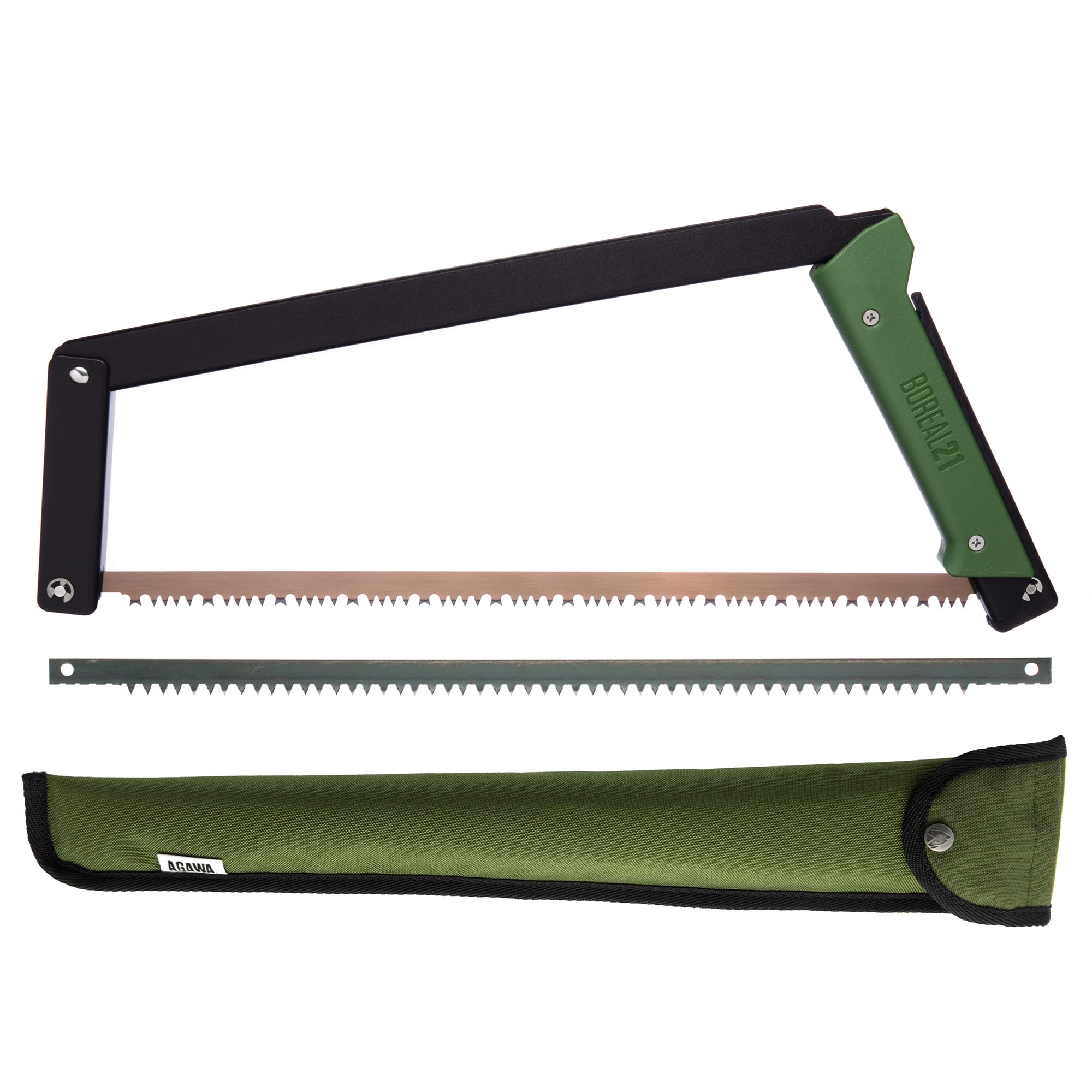
1. AGAWA BOREAL21 Tripper Kit
Our pick — over 4.5★ from 900+ verified ratings; the strongest balance of quality and price.
The full-size buck saw that unfolds in seconds and turns a log pile into a firewood stack without breaking a sweat.
This is the saw you reach for when dinner depends on volume, not just a few sticks. Its 21-inch blade is a full 50% longer than the REXBETI’s 14-inch model, so each stroke clears dramatically more wood — buyers report slicing through a 6-inch black oak log in under two minutes with the included Aggressive blade. The frame is high-strength anodized 6063 aluminum with stainless steel hardware, so it resists warping and rust through years of wet camp mornings.
The kit ships with two interchangeable blades — an All-Purpose medium-tooth option and the Aggressive blade favored by owners who want maximum bite — plus a nylon carrying case. At 18 ounces it is heavier than a simple folder, but the automatic blade tensioning and 3-hinged trapezium frame mean no loose parts to fumble with in the dark. The trade-off is a set of pinch points during assembly that has nipped at least one gloved hand, so open it deliberately.
Owners praise how comfortably it carries and how the case protects other gear on a bike or boat. It is priced as a serious tool, not an impulse buy, but the crowd favorite — 4.8 stars across 900+ owners — treats it as a permanent kit piece, and the included spare blade extends its life considerably.
What Wins Owners Over
- 21-inch blade makes short work of 6-inch logs — buyers time it under two minutes
- Two blades (All-Purpose + Aggressive) handle wet and dry wood
- Automatic tensioning means no loose parts to lose
What To Watch
- Assembly has two pinch points — one on the handle, one near the blade
- Heavier and pricier than simple lockback folders
The verdict: The undisputed firewood machine for campers, kayakers, and bikepackers who process real volume.
Think twice if: You only need kindling — at 18 ounces it is far more saw than an ultralight hiker wants.
2. Samurai KISI FC-240-LH Folding Curved Saw
A Japanese pull-cut saw that brings chainsaw-level speed to a 8-ounce package.
Owners mention chewing through a dried 6-inch diameter piece of wood in about two minutes, and one even claims it works better than a gas chainsaw for camp-scale work. The high-carbon steel curved blade with a 4mm tooth pitch is the reason — it bites aggressively on the draw and clears chips efficiently.
At just 8 ounces it is less than half the weight of the 14.5-ounce REXBETI, making it an easy addition to a survival bag or hiking pack. The rubber handle is comfortable enough for extended sessions, though some owners note it feels a bit plasticky. The honest caveat is durability: the build quality earns the most praise, but the feedback on toughness is mixed, with a couple of owners breaking the tip on hard use.
This is the saw for the hiker who harvests fallen wood along the trail and wants maximum cutting speed for minimum weight and money. The value proposition is so strong that even owners who replaced a broken tip came back for another one.
Speed per dollar: The best price-to-performance ratio on this list — a 6-inch log in two minutes for a fraction of premium cost.
The honest limit: The tip has snapped for a few hard users, so treat it as a sharp, fast tool rather than an indestructible one.
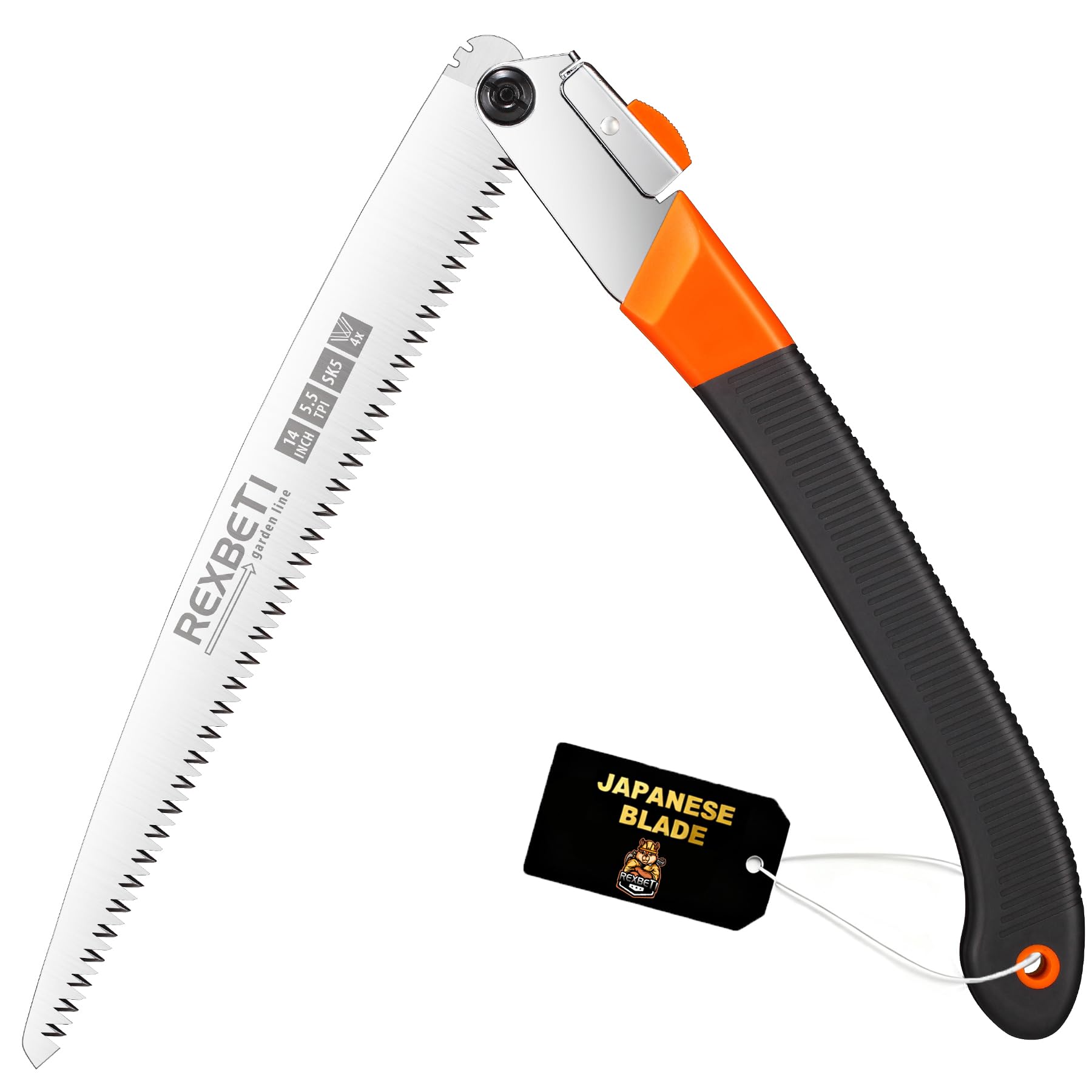
3. REXBETI 14-Inch Folding Pruning Saw
The long-arm specialist that reaches deep into brush and thick canopies for precision cuts.
That 14-inch SK-5 steel blade is the whole story here — it is built for cutting 7-to-10-inch diameter branches, and the extended reach lets you work deep inside a bush without shredding your forearms. The aggressive staggered teeth at 5.5 TPI with four cutting angles power through green wood smoothly, and buyers consistently say it cuts on the pull with very little effort. The 8-inch rubber-coated polymer handle keeps a firm grip even when your hands are wet.
At 14.5 ounces it is a mid-weight option, and the full tool stretches to nearly 28 inches when open. That makes it a better fit for yard work, trail clearing, and bushcraft than for ultralight backpacking. It is also the crowd favorite by volume — a massive pool of over 10,000 ratings at 4.6 stars — which tells you the mainstream campers and gardeners are consistently happy.
The notable caveat is that one owner snapped the blade clean while cutting a log due to binding — though they admitted it was partly user error. For occasional-to-moderate use it is excellent value; the very heavy user who torques the blade sideways will want a beefier frame like the Agawa.
Why It’s A Crowd Favorite
- 14-inch blade cuts 7-10 inch branches with one-hand control
- Staggered 5.5 TPI teeth cut smoothly on the pull
- Comfortable rubber-coated polymer handle in any weather
Know The Boundary
- Blade can snap if it binds and flexes under heavy torque
- Nearly 28 inches open — bulky for a small pack
Reach for it if: You clear trails, trim canopy, and cut firewood around camp and want one versatile long blade.
Look elsewhere if: You are an ultralight hiker — this is a yard-and-camp tool, not a pocket saw.
4. Opinel Folding Saw

A 3.6-ounce French classic that slips into a large pocket and still fells small trees.
This is the saw for the minimalist who refuses to dedicate pack space to a dedicated cutting tool. Weighing just 3.6 ounces (102 grams) with a 3.15-inch carbon steel blade, it handles branches under 8cm (3.15 inches) and earns its keep in a fishing bag or backpack. The beechwood handle carries the classic Opinel look, and the Virobloc safety ring — a stainless steel collar invented in 1955 — locks the blade both open and closed.
Buyers describe it as an heirloom-quality piece, and the build quality is the most-praised aspect. It cuts on the pull stroke, and owners advise easing pressure on the forward motion to avoid binding. The recurring gripes are practical: the blade sits low in the handle making it hard to open, and the carbon steel needs drying after wet use to avoid corrosion. A few tinkerers reshaped the handle for comfort.
Compared to the Aggressive 21-inch Agawa, this is the opposite end of the spectrum — a precision instrument for small jobs rather than a firewood processor. It is a tool you keep for decades, not seasons.
The soul: A beautiful, genuinely sharp heirloom folder that fits in a pocket and handles small branches with ease.
The catch: The Virobloc ring can be stiff, and carbon steel demands prompt drying after wet trips.
5. LAGOM Folding Camp Saw
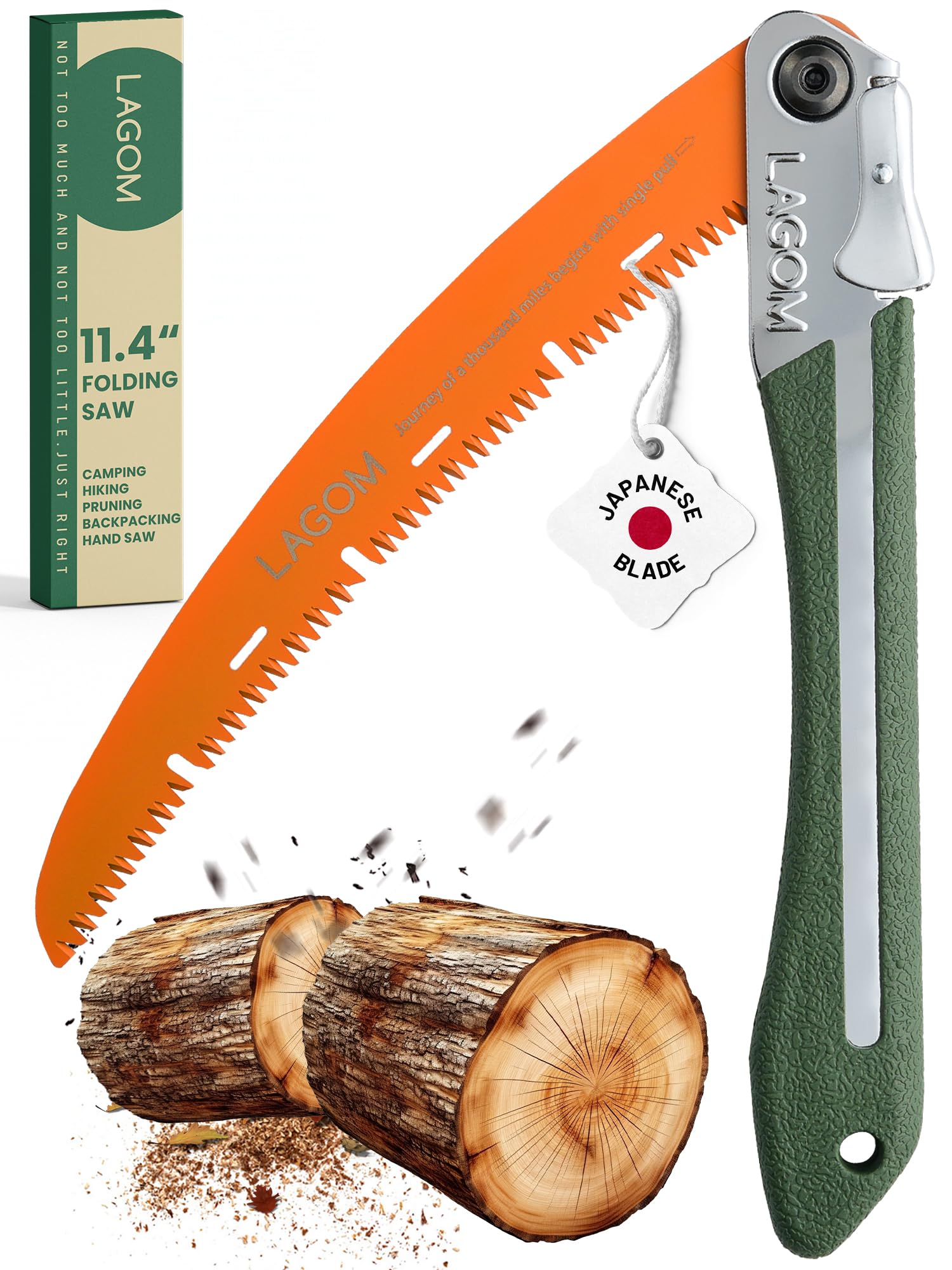
A made-in-Taiwan mid-size folder that balances premium feel with genuinely fast camp cutting.
Sitting between the tiny Opinel and the long REXBETI, this 11.4-inch curved SK-5 steel blade is a solid middle child for camp firewood and garden pruning. The curved shape and 7-tooth design cut on the pull, and customers note slicing through 6-inch logs with ease. The rubber handle is grippy, and the 3-gear lock holds the blade firmly open while working and safely closed in the pack.
Buyers who upgraded from cheaper models say the reinforced pivot — which extends along the handle — adds real durability, and the rust-coated blade resists the elements. At 0.35 kg it is heavier than ultralight folders, and owners note it is fine for home and camp but heavy for an ultralight hiking setup. The non-stick coating and chip-clearing design keep strokes smooth with less drag.
The main durability gripe, echoed in the feedback, is the tip snapping off for a few owners under hard use. For the camp chef and weekend gardener who wants one reliable mid-size saw, this is a strong pick that punches above its weight.
Balanced performer: A comfortable, sharp 11.4-inch curved blade that cuts 6-inch logs and feels more premium than its price suggests.
Not for ultralight: The reinforced build adds weight, and the tip has snapped for a handful of hard users.
6. Gerber Freescape Camp Saw
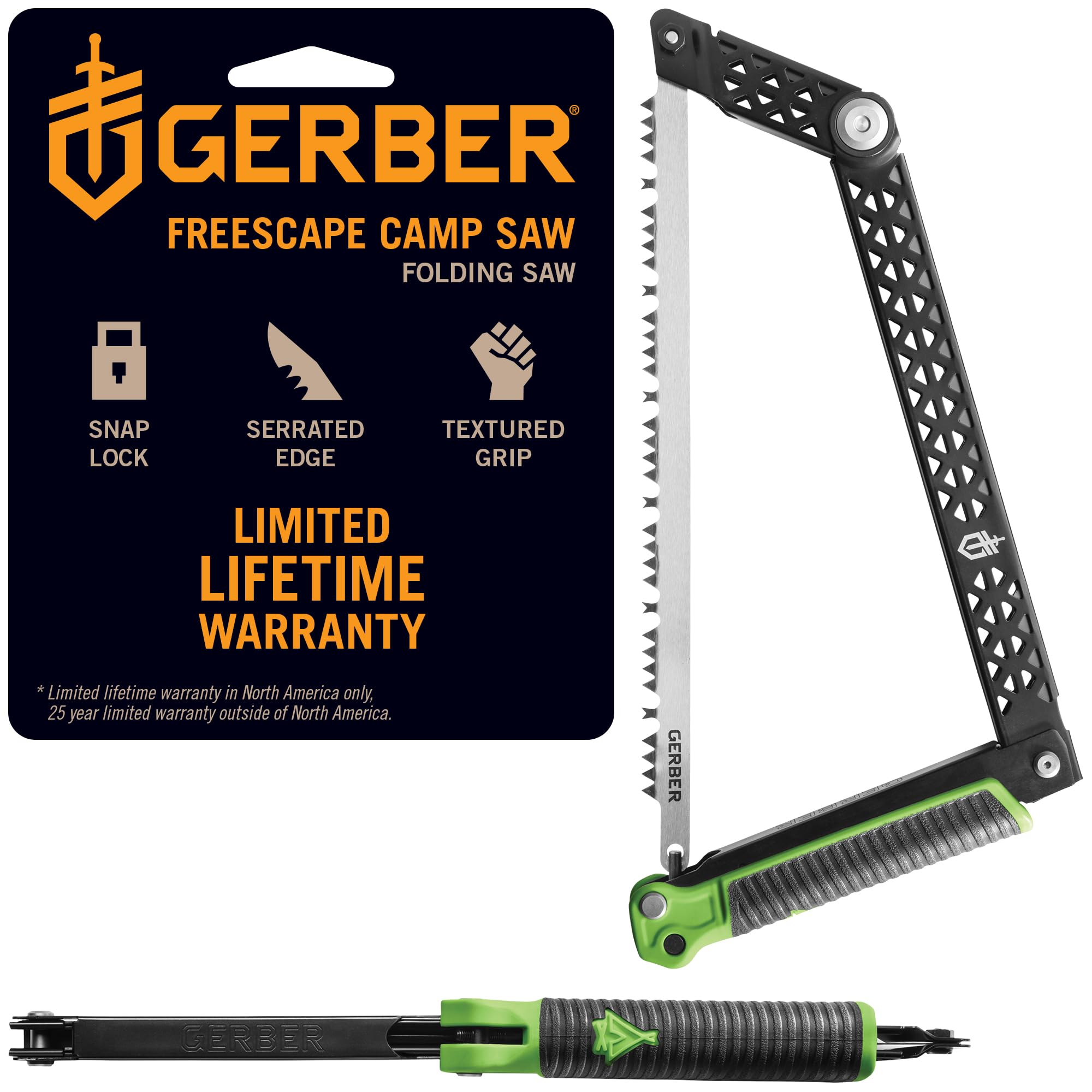
The clever folder that lays flat in your pack while delivering impressive bite on larger wood.
Gerber solved the folding-saw puzzle differently: instead of a simple hinge, this uses 4 pivot points so the 12-inch blade folds completely flat while staying assembled. That means no loose parts to lose, and a low profile in your backpack. The bright green accents make it easy to spot in a dark gear bin, and the textured rubber handle keeps a firm grip in wet conditions.
The fold-flat design boost the blade length for cutting larger diameter wood — reviewers point out working through an 8-inch tree in about 7 minutes, and it is consistently praised for cutting quickly without much effort on up-to-6-inch tasks. The quality and solid construction are the most-praised aspects, and buyers call it an essential backcountry camping tool that earns a permanent spot in the pack.
The one recurring note is that the belly of the blade cuts better than the tip, which can get stuck-prone, and a few users wish the included blade had more teeth per inch for less effort. At 16 ounces it is the heaviest simple folder here, but the flat profile makes it carry smaller than its weight suggests.
The Clever Bits
- Folds completely flat while staying assembled — no lost parts
- 4 pivot points boost cutting length on big wood
- Bright green accents for easy gear spotting
Trade-offs
- Tip of the blade cuts less aggressively than the belly
- 16 ounces is heavy for a non-bow folder
Best for: Backpackers who want a full-size capable saw that disappears into a flat pack pocket.
Who might pass: Ultralight hikers counting every ounce, and those who prefer a rigid bow frame.
7. Silky PocketBoy 130mm Professional

A 5-inch Japanese blade that cuts so fast owners call it weirdly satisfying to use.
Do not let the small size fool you — Silky’s curved blade with pull-cut technology is the fastest cutting speed available, roughly 15-20% faster than straight-blade PocketBoys. The 5-inch (130mm) blade with 6.8 teeth per inch handles branches up to 2.6 inches in diameter, and the impulse-hardened teeth stay sharp about three times longer than non-hardened teeth. It is a pocket rocket for small trimming and kindling.
Owners rave about the quality, sharpness, and how it cuts on the pull stroke instead of the push. One buyer has used it hard in tropical rainforests for years and reports it will not rust and stays sharp. It is the tool for the hunter who wants to quietly process small wood without announcing their position with an axe, and it is light enough at 8 ounces to live permanently in a pack. It comes with a hard plastic belt case.
The limitation is the 2.6-inch cut capacity — this is not a firewood processor. Compared to the 14-inch REXBETI, it is a fraction of the reach but dramatically faster per stroke on small diameter work. For the ultralight bushcrafter, it is the sharpest tool in the shed.
Speed demon: The 5-inch curved blade cuts 15-20% faster than straight versions and stays sharp three times longer.
Size limit: 2.6-inch cut capacity means it is for branches, not logs — bring a bigger saw for firewood.
8. Silky Professional Gomboy Curve 240mm Outback Edition

The gold-standard 9.5-inch folder that cuts 4-5 inch wood like butter and lives in your truck for years.
This is the saw that Silky fans call the fun forest companion, and it earns the premium price with a 240mm (9.5″) blade that is 1.4mm thick with 6.8 teeth per inch and a 4.7-inch cut capacity. The black nickel/tin plating coats the entire blade including the teeth, providing longer life and improved cutting performance. The Japanese Mirai-Me cutting technology uses 4 cutting angles for rip-cutting, cross-cutting, and slant cutting in one smooth motion.
Owners consistently report it cuts through 4-5 inch thick wood like butter, and they praise the arbor composite handle for excellent grip in wet, cold, and game-processing conditions. The compact size is ideal for a pack, and the sturdy blade lock keeps it secure. It is covered by Silky’s Limited Lifetime Warranty against defects in material and construction — a confidence you do not get from budget brands.
Some buyers consider it overpriced compared to cheaper folders, and one noted it works best on dry wood, though it handles young trees fine. Versus the 14.5-ounce REXBETI, it is lighter at 10.08 ounces and cuts faster per stroke, but the REXBETI has nearly twice the reach for canopy work. If you want the finest cutting experience in a midsize pack saw, this is it.
Why It’s The Benchmark
- Cuts 4-5 inch wood with minimal effort — “like a hot knife through butter”
- Black nickel plating protects teeth and blade for longer life
- Lifetime warranty against material defects
Fair Warnings
- Premium price that some call overpriced
- Best on dry wood; slower on green young trees
Reach for it if: You want the finest cutting folder money can buy and plan to keep it for a decade.
skip it if: Your budget says “good enough” — the Samurai KISI delivers 80% of the speed for a third of the price.
9. Bahco 9″ Laplander Folding Saw
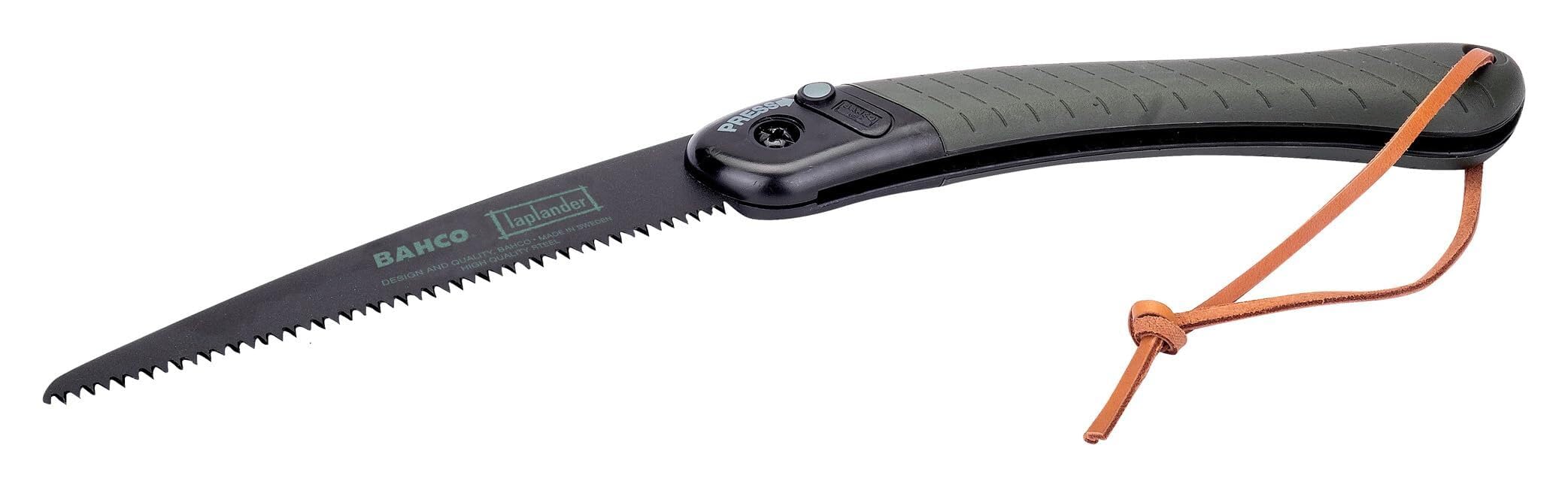
The multi-material survivor that cuts green wood, dry wood, bone, and plastic with one blade.
The Bahco Laplander is a legend in bushcraft circles, and the 9-inch blade with XT toothing at 7 TPI is built for fast, clean cuts through wood and brush. what separates it is versatility — it is rated for green and dry wood, bone, and plastic, making it a true multi-purpose survival tool. The rust-protected, low-friction coating boosts performance and longevity in wilderness conditions.
Owners call it the best folding saw they will ever own, praising how it locks both closed and open with a built-in safety lock. The two-component plastic handle provides a solid, non-slip grip in all weather, and the included leather strap adds carry convenience for one-handed use. It packs down small for gear bags, ideal for trail maintenance, field repair, or emergency survival situations.
The honest notes from owners: the black coating wears off quickly, and it is slower than a Silky Gomboy, snagging more often on certain cuts. But it excels on fresh wood and handles fist-sized branches with ease. Compared to the 14-inch REXBETI, it is a shorter, more packable tool that trades reach for versatility — the right choice when you need one saw for everything.
All-rounder: A 9-inch blade that tackles wood, bone, and plastic, with secure locks and a comfortable two-component grip.
The trade-off: Slower than premium Silkys and the coating wears fast, but the versatility is class-leading.
Understanding the Specs
Blade Length and Cut Capacity
Measured in inches or centimeters, this is the working part of the blade that actually contacts the wood. A longer blade like the 21-inch Agawa moves more material per stroke and handles larger diameter logs, while a 5-inch Silky PocketBoy maxes out around 2.6-inch branches. Match blade length to the wood you actually process — a backpacker making kindling does not need a buck saw.
Teeth Per Inch (TPI) and Tooth Geometry
TPI tells you how many teeth fit in one inch of blade. Lower TPI (like 5.5 on the REXBETI) means larger teeth that clear green wood fast; higher TPI (like 7 on the Bahco) leaves a smoother cut. Curved blades cut on the pull stroke, which is more efficient and requires less effort than pushing. Hardened teeth, like Silky’s impulse-hardening, stay sharp about three times longer than untreated steel.
Blade Steel and Coatings
High-carbon steels like SK-5 hold a sharp edge and are common in quality saws. Stainless steel resists rust but can be harder to sharpen. Coatings like black nickel/tin plating (Silky), rust-protective coatings (Agawa), and low-friction finishes (Bahco) extend blade life and reduce drag. Carbon steel blades like the Opinel require drying after wet use to prevent corrosion.
Folding Mechanism and Lockup
The way a saw folds determines its pack profile and safety. Simple lockback folders (Samurai, LAGOM) hinge at one point. Multi-pivot designs like the Gerber Freescape fold completely flat while staying assembled. Full bow frames like the Agawa BOREAL21 use a 3-hinged trapezium frame that unfolds in seconds with automatic blade tensioning. A secure lock in both open and closed positions is non-negotiable for safe carry.
FAQ
Which is better for bushcraft, a bow saw or a simple folding saw?
How big a log can a bushcraft saw actually cut?
Why do Japanese saws cut on the pull stroke?
Is it worth paying more for a saw with hardened teeth?
How do I prevent the blade from breaking or snapping?
Can a folding saw replace a hatchet or axe in camp?
What does TPI mean and how does it affect my cut?
How do I maintain a carbon steel saw blade?
Which saw should I carry for ultralight backpacking?
Is a longer blade always better for bushcraft?
Final Thoughts: The Verdict
For the majority of shoppers, the bushcraft saw winner is the Agawa BOREAL21 because its 21-inch blade and two-blade kit turn firewood processing into a fast, easy chore. If you want the best speed-per-dollar in a packable size, grab the Samurai KISI — it slices a 6-inch log in about two minutes for a fraction of the cost. And for the purest cutting experience with a lifetime warranty, the Silky Gomboy Curve 240 is the one to reach for.
How We Picked
We do not accept paid placement. Every pick is matched to a real buyer and a real use-case; we do not hands-on test units.
Sources & Methodology
Specifications: manufacturer listings and product documentation. Review insights: verified customer reviews, as of August 2026. Pricing: not shown on this page (it changes often); check the current price via the retailer link.
As an Amazon Associate, FitlyFast earns from qualifying purchases. This does not affect which products we feature.