
Our readers keep the lights on and the weekend projects moving. As an Amazon Associate, I earn from qualifying purchases.
Specs are compiled from manufacturer listings and verified buyer reviews and can change over time — please confirm the key details on the product page before buying.
Your office phone should feel like a professional tool, not a doorstop. The right landline system cuts down spam calls, keeps your voice clear, and works even when the power goes out — and this guide focuses on the corded models that actually deliver on that promise.
I’m Rikta — the founder and writer behind FitlyFast. This guide is built by comparing the manufacturers’ published specifications and the patterns across verified customer reviews, so you get each pick’s real strengths and trade-offs instead of marketing spin.
You can find the best business landline phones here, with honest reviews, key specs, and clear recommendations for your office setup.
Our Picks at a Glance


How To Choose The Best Business Landline Phones
Buying a business landline phone is about matching the system to your daily call volume, your space, and your tolerance for robocalls. The most expensive option isn’t always the best fit — a two-person office needs something very different from a growing team.
Decide how many lines you really need
Single-line phones handle one incoming call at a time, which is fine for a solo desk or a small home office. Multi-line systems (2-line, 4-line) let you handle several calls and put one caller on hold while you answer another — a must for any team where the phone rings constantly.
Check the call blocking muscle
Spam calls waste real time in a business. Some phones only block a short list of numbers, while others can pre-block robocalls or let you block a number with one press. If your office gets bombarded with nuisance calls, this feature is worth prioritizing over a fancy display.
Look for a power outage plan
A corded base station that runs on line power keeps you connected when the electricity fails, since the phone line itself still carries signal. Cordless handsets need their chargers, so they die when the power does — another reason a corded base is the backbone of a reliable office system.
Quick Comparison
| Model | Best For | Lines | Call Block | Auto Attendant | Amazon |
|---|---|---|---|---|---|
| Panasonic KX-TGF852B★ Best Overall | Best Overall | 1 | 1-Touch Button + 1K | No | Amazon |
| KerLiTar LK-P017BHeadset Ready | Call Center Headsets | 1 | Area Code Filter | No | Amazon |
| Panasonic KXTS880BSimple Desk | Simple Desk Use | 1 | No | No | Amazon |
| AT&T ML17929 | Two-Line Basics | 2 | No | No | Amazon |
| AT&T TL86103 | Cell + Landline Combo | 2 | No | No | Amazon |
| Motorola ML1000 | Growing Small Business | 4 | No | Yes | Amazon |
| VTech AM18447 | High-Volume Reception | 4 | No | Yes | Amazon |
| AT&T SynJ SB67158 | Law/Medical Offices | 4 | No | No | Amazon |
In‑Depth Reviews
1. Panasonic KX-TGF852B
Our pick — over 4★ from 750+ verified ratings; the strongest balance of quality and price.
The corded base plus two cordless handsets that finally silences the robocall deluge.
For a home office that needs both reliability and flexibility, this Panasonic system delivers. The corded base unit has a large tiltable 3.4-inch LCD screen (a display that shows caller ID and menus clearly) and one-touch dial buttons for numbers you call all day, while the two included cordless handsets let you take a call anywhere in the house or yard.
Call blocking is the real headline here. A large red button on the base blocks nuisance calls with one press, and the automated call block pre-blocks robocalls before they even ring. The built-in 2-way recording lets you capture business calls so you can confirm exactly what was agreed — no more guessing about details. It also answers calls by voice command and announces callers in English or Spanish.
Owners praise the overall quality and day-to-day reliability more than anything else. One buyer reports: “Excellent sound quality; call block effective—after ~30 blocks, spam calls reduced to a trickle.” The trade-off: some find the volume on the low side, and the cordless handsets’ battery life isn’t a strength either.
Why It Wins
- One-touch call block button plus pre-blocking of robocalls
- 2-way recording keeps a record of important calls
- Expandable up to 6 cordless handsets as you add staff
The Trade-Offs
- Speaker volume runs low for some ears
- Battery life on the cordless handsets gets criticized
Grab it if: you want dependable call blocking and the freedom of cordless handsets around a corded base.
skip it if: you need loud speaker volume, since a few owners found it too quiet.
2. KerLiTar LK-P017B
A call-center-style corded desk phone bundled with a headset for high-volume talkers.
If you live on the phone all day — telemarketing, customer service, or telehealth — this KerLiTar desk phone is built for your workflow. It ships with a monaural headset that has its own volume and mute controls, and it gives you three ways to answer: receiver, headset, or hands-free speaker.
The memory bank is generous for routine call management: 62 groups of incoming call memory and 16 groups for outgoing calls, plus 5 one-touch speed dial spots and 10 two-touch ones. A 5-level adjustable display contrast keeps caller ID readable, and an audio output jack records business calls for training purposes. An area code filter lets you block nuisance calls from specific prefixes.
Home-office work is the crowd favorite here, with buyers reporting “clear sound, caller ID, adjustable LCD, mute, volume; 3 answering modes (handset/headset/speaker) with indicator lights.” The honest caveat: build quality feels budget-tier, and the headset’s internal wiring is the weak spot — occasionally arriving with a broken wire. If you mostly use the headset, the fixed handset volume won’t bother you.
Best for: call-center operators who primarily wear a headset and need quick recall of recent numbers.
Think twice if: you need premium handset materials, since quality gets mixed feedback.
3. Panasonic KXTS880B
A no-nonsense corded desk phone that keeps things simple without the answering machine.
This Panasonic is a standalone corded phone for anyone who just wants a clear desk line without a headset system or an answering machine. It comes packed with the essentials: a hands-free speakerphone for quick team discussions, caller ID so you can screen before you pick up, and a navigation key with a visual ringer alert when the phone rings.
Owners praise the overall quality most, then the functionality — buyers single out the heavy base that stays put, 10 one-touch and 10 two-touch speed dials, a 50-entry phonebook, and music on hold for parking a caller. Setup takes around 20 minutes, and the speaker and LCD stay clear. Weighing 1.9 pounds, it’s noticeably sturdier than the 1.4-pound Panasonic KX-TGF852B above.
The catch is programming. A few buyers report the manual is inaccurate and the setup menus are unintuitive, requiring some trial and error to get the clock and features working. There’s also no answering machine and no DECT-6 wireless, so you’re tied to the cord — which is exactly the point for a reliable desk line.
Strengths
- Heavy, stable base that doesn’t slide around
- 50-entry phonebook plus 30 speed dial slots
- Music on hold for professional callers
Weaknesses
- Programming menus are confusing at first
- No answering machine built in
Reach for this if: you want a straightforward corded phone with generous speed dials and a stable base.
Look elsewhere if: you need an answering machine, since this model doesn’t have one.
4. AT&T ML17929
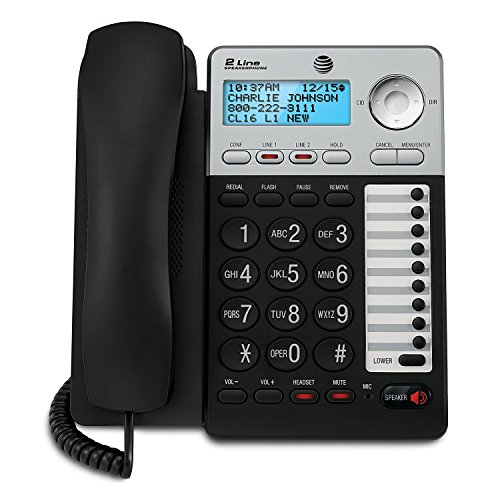
The two-line corded workhorse that keeps calling during a power failure.
For a small business juggling two active phone lines, this AT&T corded speakerphone is the classic choice. It supports two lines so you can put one caller on hold while you take another, and three-party conferencing brings a third person into the conversation.
A 100-name and number phonebook directory keeps your frequent contacts at your fingertips, and a hands-free speakerphone lets you multitask during calls. Because it’s corded and power-failure friendly, it keeps working even when the electricity goes out — a real lifeline for a business that can’t miss calls. It operates on multiple lines, making it a step up from single-line desk phones.
The loyalty here is striking — more than one owner has used this exact phone for over 20 years and bought a replacement after dropping and damaging the original. There is a vocal minority reporting screens that died within weeks and second lines that don’t ring, so check your unit quickly after delivery. It’s a dependable two-line basic when it arrives working.
The verdict: a trusted two-line corded phone for businesses that value power-outage reliability over frills.
The risk: quality control is inconsistent, so test the screen and both lines right away.
5. AT&T TL86103

The hybrid that blends your cell plan and landlines into one corded/cordless office system.
This AT&T system answers the modern office question: what if my business runs on both a landline and a cell phone? Bluetooth Connect-to-Cell pairs up to 2 cell phones and 2 landlines, so you can answer your mobile calls from the office handset — with or without an active landline service.
Coverage reaches up to 1,000 feet, and the digital answering system splits messages into 2 separate mailboxes, each holding 22 minutes of recording time — ideal for separating personal and business calls. Two built-in USB ports on the base charge your cell phones while you talk, and the corded base works in line-power mode during a power outage. You can even download up to 6,000 cellular phonebook entries onto the cordless handsets.
The standout praise is that the Bluetooth actually works with hearing aids — a rare compatibility that matters for many users. The recurring downside is the cordless handset signal, which gets garbled through floors and walls in larger homes. For a business that lives on a cell phone but wants a real desk phone experience, this is the bridge.
Highlights
- Bluetooth pairs two cell phones and two landlines
- Up to 1,000 feet of coverage
- 2 USB ports charge your phones at the base
Watch For
- Cordless handset signal weakens through walls
- Cordless handset itself isn’t Bluetooth-linked
Best if: your office runs on a cell plan and you want to answer it from a proper desk phone.
Not ideal if: you need strong cordless coverage in a multi-floor building.
6. Motorola ML1000
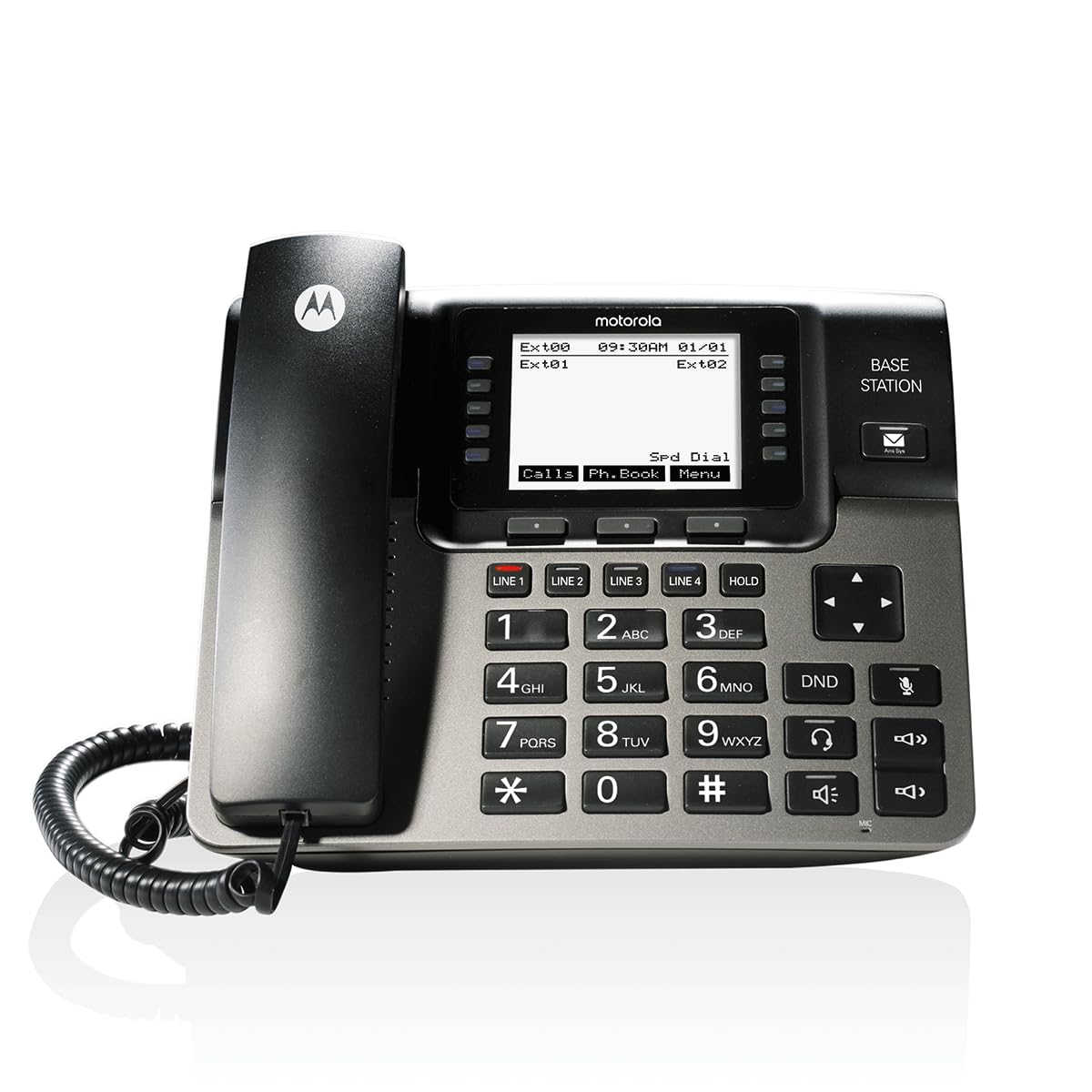
A 4-line base station with a built-in digital receptionist that routes calls automatically.
This Motorola base station is the brain of a complete small-business phone system. It supports up to 4 lines and expands to 10 wireless extensions (the ML1100 or ML1200 handsets), so you can start small and grow without replacing the base.
The built-in digital receptionist answers incoming calls and routes them to the right department — a feature normally found on much pricier systems. The 200-minute digital answering system stores up to 10 mailboxes with time and date stamps, and you can retrieve messages remotely. Setup is plug-and-play: one phone jack gets the whole system running, and wireless extensions don’t need extra wiring.
Owners describe it as a professional system that’s up and running in three minutes, and the speakerphone is strong enough to pick up sound from 10 to 15 feet away. The trade-off is a bulky footprint and a persistent “no line” alert for unused lines. Quality control occasionally misses — a few units arrive with dead handsets — so test each extension promptly.
Why it stands out: an auto attendant and 200-minute answering system at a price that undercuts traditional office systems.
The honest limit: it’s bulky for a small desk, and unused lines nag you with alerts.
7. VTech AM18447
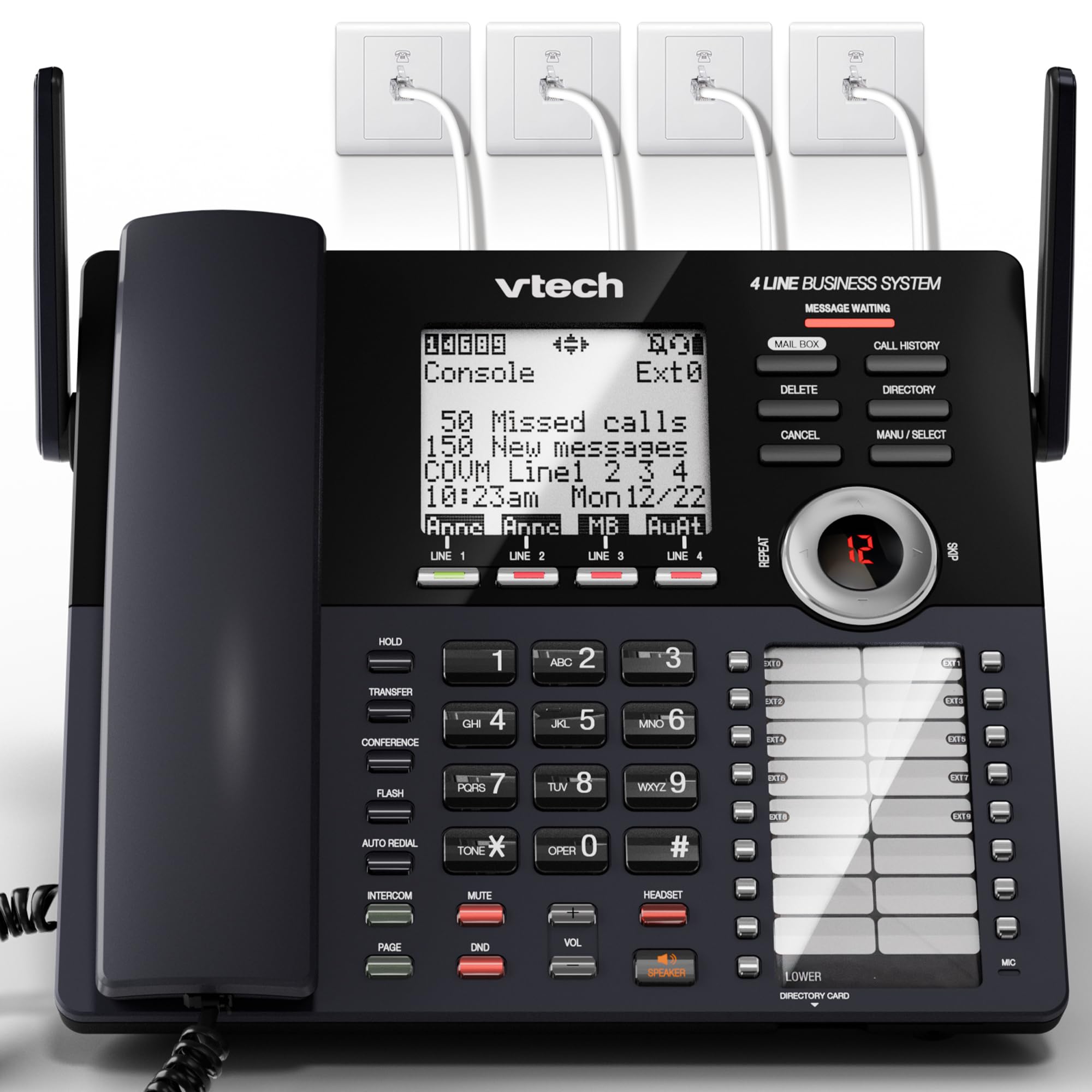
A 4-line receptionist system that answers, routes, and records — no IT wiring required.
This VTech console is the closest thing to a virtual receptionist for a small office. It connects to analog lines through a simple RJ11 jack, and cordless handsets or desksets pair wirelessly with one-touch DECT 6.0 technology — no professional wiring or assistance needed for setup.
Each of the 4 lines gets its own professional auto attendant that answers calls, offers company directory access, routes to extensions, and records voicemail. The digital answering system captures up to 180 shared minutes of incoming messages, announcements, and memos. A full-duplex speakerphone keeps conversations natural, and an extra-large display plus a 100-name phonebook and 32 speed dials cover everyday use. You can even customize music on hold through a 2.5mm jack.
Owners find it easy to set up, perfect for small businesses, and a genuinely effective robocall blocker on analog lines — callers must press a key to reach voicemail, which stops automated spam cold. The trade-off: the headset port runs quiet for the person wearing it, and stations run on battery. It’s best with a receptionist; without one, callers wait through several rings before the auto attendant picks up.
Strengths
- Professional auto attendant on every line
- 180 shared minutes of answering storage
- Excellent at blocking robocalls on analog lines
Limitations
- Headset wearers sound too quiet to callers
- Only 100 directory entries for a business
Best for: a small office with a receptionist that wants polished auto-answering on a budget.
Not for: single-line businesses without staff to manage the auto attendant.
8. AT&T SynJ SB67158

A DECT 6.0 4-line small business system that pros in law and medicine swear by.
This AT&T SynJ system is the premium-tier pick for offices where call clarity and ergonomics matter — think law firms and dental offices. It scales from 1 to 4 lines, supports multiple cordless handsets, and uses DECT 6.0 technology for long-range, interference-free calls.
The system works with the TL7600 and TL7800 cordless headsets, making it a strong fit for professionals who talk for hours. Owners mention it’s clear, intuitive, and ergonomic, with one law office calling it “simply superb” and cheaper than their previous Iwatsu system. The cordless range is genuinely impressive — one home office runs it two floors down from the base.
The honest concerns are durability and sound. Some customers note units breaking within three months, and a few say callers hear screeching noises — plus lines 3 and 4 occasionally stop working. The feature set also lacks polish: you can’t roll over line 1 to line 2’s mailbox when line 1 is busy, and voicemail doesn’t share across lines. It’s a professional tool with real quirks.
The high point: outstanding clarity and range for headsets in a professional office.
The caveat: durability reports are mixed, so confirm warranty coverage before buying.
Understanding the Specs
Line Count
The number of phone lines a system can handle at once. A 1-line phone handles a single call at a time, while a 2-line or 4-line system lets you juggle multiple calls, put one caller on hold, and answer another. If your office has more than one number or high call volume, multi-line is the way to go.
DECT 6.0
A wireless standard that connects cordless handsets to the base over a dedicated frequency, giving you clearer sound and longer range than older cordless tech. It also reduces interference from other devices like Wi-Fi routers. The signal stays strong across separate rooms or even outside, according to Panasonic.
Auto Attendant
A digital receptionist that answers incoming calls automatically and routes them to the right extension or mailbox. Instead of letting calls ring endlessly, it greets the caller with a menu. It’s a must-have for offices without a dedicated receptionist, ensuring every customer reaches the right person.
Call Blocking
The ability to stop unwanted calls before they reach you. Systems vary widely: some pre-block robocalls, others block announced callers, and some let you block numbers with one press of a button. If spam calls eat your day, this is the feature that saves you the most time.
FAQ
How many lines does my small business actually need?
Will a corded landline phone still work during a power outage?
What is DECT 6.0 and does it matter for business phones?
Can I use any headset with my business landline phone?
How does call blocking work on these phones?
What is an auto attendant on a business phone system?
Can I connect a cell phone to a business landline phone?
How long is the digital answering storage on these systems?
Can I record business calls on these phones?
What’s the difference between a corded and cordless business phone system?
Final Thoughts: The Verdict
For the majority of shoppers, the winner is the Panasonic KX-TGF852B because it pairs a corded base with two cordless handsets, one-touch call blocking, and 2-way recording — the complete office toolkit. If you want a system that bridges your cell plan and landline, grab the AT&T TL86103. And for a growing 4-line office that needs a digital receptionist, the VTech AM18447 is the one to reach for.
How We Picked
We do not accept paid placement. Every pick is matched to a real buyer and a real use-case; we do not hands-on test units.
Sources & Methodology
Specifications: manufacturer listings and product documentation. Review insights: verified customer reviews, as of August 2026. Pricing: not shown on this page (it changes often); check the current price via the retailer link.
As an Amazon Associate, FitlyFast earns from qualifying purchases. This does not affect which products we feature.