
Our readers keep the lights on and the weekend projects moving. As an Amazon Associate, I earn from qualifying purchases.
Specs are compiled from manufacturer listings and verified buyer reviews and can change over time — please confirm the key details on the product page before buying.
For a small business, the phone isn’t just a phone — it’s the first handshake with every customer. You need crisp call quality that makes you sound professional, features that stop spam calls cold, and a system that doesn’t require a degree in IT to set up. This guide sorts through the noise to find the phone that actually fits your workflow.
I’m Rikta — the founder and writer behind FitlyFast. This guide is built by comparing the manufacturers’ published specifications and the patterns across verified customer reviews, so you get each pick’s real strengths and trade-offs instead of marketing spin.
if you need a simple landline with a powerful call blocker or a full multi-line VoIP system for a growing office, you’ll find the best business phones for small business that dependably connect you with your customers every day.
Our Picks at a Glance

How To Choose The Best Business Phone For Your Small Business
Picking the wrong system means your team struggles with dropped calls or you pay for features nobody uses. Focus on these four decisions to get it right the first time.
VoIP vs Landline: Which Underlying Service Do You Need?
VoIP phones (like the Grandstream and Yealink picks) connect over your internet, giving you more lines and features for less money. Landline phones (like the Panasonic and AT&T options) run on traditional copper lines and work during a power outage. Your choice of phone must match the service you have or plan to get.
How Many Lines and Handsets Does Your Team Actually Use?
A single-line phone works for a one-person operation. Once you have two or three people who need to make and take calls at the same time, you need a 2-line or 4-line system. Most multi-line systems let you expand, so you can buy for today’s team and add handsets for tomorrow’s.
Call Blocking: The Feature That Saves Your Sanity
If your business line is public, robocalls will find you. Some phones block spam before it rings, others require you to manually blacklist numbers. The most effective systems use automated pre-blocking and let you add numbers with a single button push.
Expandability: Can It Grow With You?
The best business phones for small business won’t become obsolete when you add a new hire. Look for systems that let you pair extra cordless handsets or wired desksets without running new cables. DECT 6.0 technology is the standard for doing this wirelessly, keeping your office clean and flexible as you grow.
Quick Comparison
| Model | Best For | Lines / SIP Accounts | Type | Expandable To | Amazon |
|---|---|---|---|---|---|
| Grandstream GXP2135★ Best Overall | VoIP Multi-Line Desk | 4 SIP accounts | VoIP | — | Amazon |
| Grandstream GRP2612WBest Value | Wi-Fi VoIP Value | 4 SIP accounts | VoIP | — | Amazon |
| Yealink T54WTop Performer | High-End VoIP Desk | 16 SIP accounts | VoIP | — | Amazon |
| Panasonic KX-TGF852B | Landline Spam Defense | 1 line | Landline | 6 cordless handsets | Amazon |
| AT&T TL86103 | Bluetooth Cell Connect | 2 lines | Landline | 12 cordless handsets | Amazon |
| AT&T BL102-5 | Large Cordless Family | 1 line | Landline | 12 cordless handsets | Amazon |
| Panasonic KX-TGW420B | 4-Line Corded Base | 4 lines | Landline | 10 wireless handsets | Amazon |
| Motorola ML1000 | Auto Attendant Starter | 4 lines | Landline | 10 wireless extensions | Amazon |
| VTech AM18447 | Scalable PBX Replacement | 4 lines | Landline | 10 cordless stations | Amazon |
In‑Depth Reviews
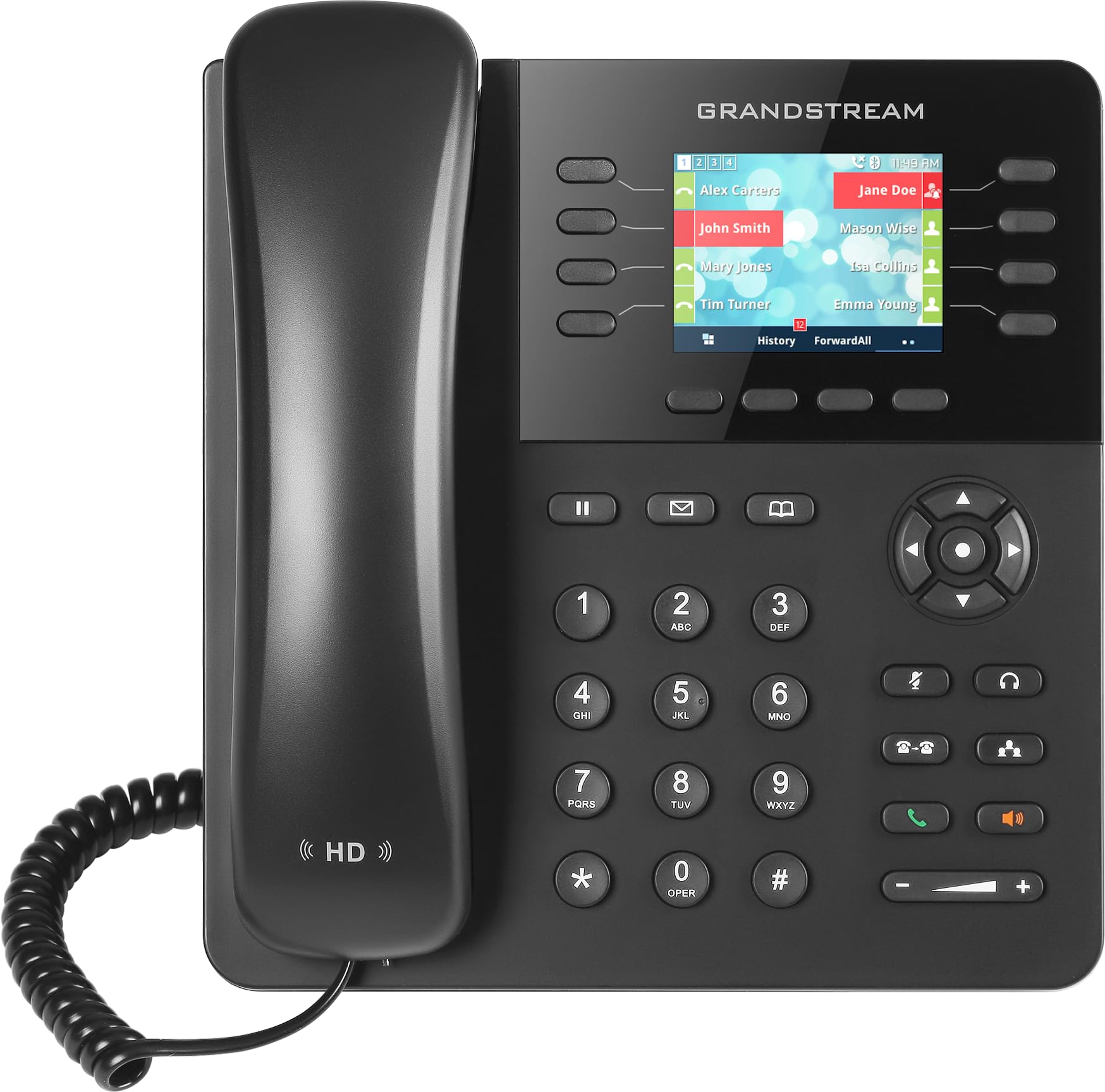
1. Grandstream GXP2135
Our pick — over 4.5★ from 250+ verified ratings; the strongest balance of quality and price.
The workhorse VoIP desk phone that delivers HD audio without the premium price tag.
Running a small business on VoIP? The Grandstream GXP2135 is the most reliable jack-of-all-trades you can buy. It gives you 4 SIP accounts (meaning four separate lines you can juggle), dual switched Gigabit Ethernet ports so you can daisy-chain your computer without losing network speed, and built-in PoE (Power over Ethernet — so a single cable delivers data and power, keeping your desk clean). Buyers report that buyers call it a “decent IP phone for the money,” with the bulk of the praise landing on its core phone quality and straightforward functionality.
The GXP2135 leans heavily into flexibility. You get 32 programmable BLF/speed-dial keys (BLF stands for “busy lamp field” — they light up to show you if a coworker is on a call). Built-in Bluetooth lets you sync a wireless headset or pair your mobile phone to access contacts. The HD audio on both the handset and the full-duplex speakerphone keeps your voice clear on both ends, which is the real test of an office phone. One catch: a few owners note the screen quality fades over time, so it is not the brightest display you will find, but it works well for daily calls.
The biggest trade-off? It is a wired-only VoIP phone — no Wi-Fi built in, so you must plug it directly into your network. If you need a cordless or landline system, look further down this list.
What Owners Love
- crisp HD audio on calls and speakerphone
- 32 programmable BLF keys for monitoring coworker lines
- Built-in Bluetooth for wireless headsets or mobile sync
A Fair Caveat
- Screen brightness can fade over time, per some long-term owners
- No Wi-Fi connectivity — must use Ethernet
- Some complex programming quirks for advanced users
Reach for this if: you use VoIP, need up to four lines, and want a durable desk phone with HD audio that doesn’t break the bank.
Think twice if: you need a cordless setup, landline support, or you rely on Wi-Fi for your office network.
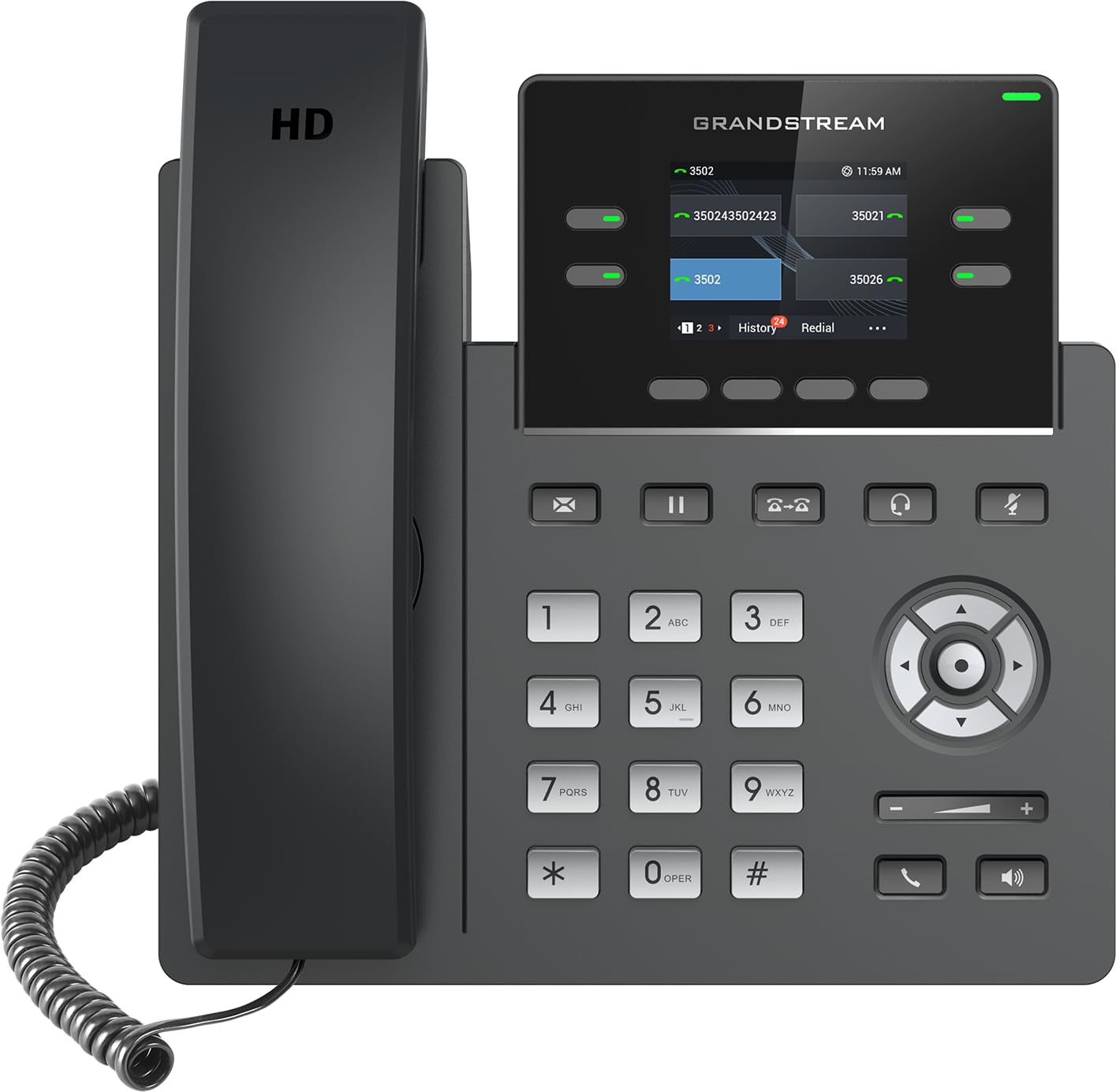
2. Grandstream GRP2612W IP Phone
A budget-friendly VoIP phone that skips the Ethernet cord and lives on Wi-Fi.
If running a cable to your desk is a hassle, the Grandstream GRP2612W is the cheapest way to add a reliable VoIP phone to your Wi-Fi network. It supports 4 SIP accounts and 4 multi-purpose line keys, and it includes built-in dual-band Wi-Fi (2.4GHz and 5GHz). To use Wi-Fi, you simply disconnect the Ethernet cable. Owners say the call quality is surprisingly good for the price, and the speakerphone sounds better than what you get on a typical smartphone.
The GRP2612W is built with enterprise-level security in mind — it has secure boot, dual firmware images so an update can’t brick the phone, and encrypted data storage. It also includes HD audio with wideband codecs G.722 and Opus, making voices sound natural and full. The adjustable stand and swappable faceplate let you brand the phone with your company logo, a nice touch for a professional office. However, the screen is a common criticism: the viewing angles are poor, and the display quality is not as sharp as pricier models.
Compared to the GXP2135 above, the GRP2612W is the right choice if your desk is far from a network jack. But it gives up the Gigabit Ethernet ports (dropping to 10/100 Mbps) and has fewer programmable BLF keys. It is a good trade-off for a cleaner desk.
Why It Wins
- Built-in dual-band Wi-Fi, so no Ethernet cable needed
- Excellent call quality and HD audio codecs
- Enterprise security features like secure boot
The Catch
- Screen quality is a weak point — poor viewing angles
- Only 10/100 Ethernet ports, not Gigabit
- Limited to 4 line keys with fewer programmable options
Best for: small offices where desks are far from the router and you want zero cable clutter at a low price.
skip it if: screen clarity matters to you for caller ID, or you need Gigabit network passthrough for your computer.
3. Yealink T54W IP Phone
The premium VoIP desk phone built for power users who juggle multiple accounts.
If 4 SIP accounts feel cramped, the Yealink T54W jumps to 16 VoIP accounts — a huge leap for a receptionist, project manager, or anyone routing calls across departments. It has a 4.3-inch color display that tilts for the perfect viewing angle, built-in Wi-Fi, and Bluetooth 4.2 for wireless headsets. Owners describe it as reliable and durable, with several reporting it has run for more than 5 years without issues, a serious vote of confidence for a daily-use office tool.
The T54W supports dual-port Gigabit Ethernet and 802.3af PoE (Power over Ethernet), which means you feed it power through the network cable and skip the wall wart. The ergonomic design with an adjustable display helps reduce glare during long calls. The included stand works with an optional BLF sidecar (sold separately), which attaches to the side of the phone to give you even more programmable line buttons. The downside is that the phone does not include a power adapter, so you must either use PoE or buy the adapter separately.
Compared to the GXP2135, the T54W is a true upgrade: a bigger screen, many more accounts, and better build quality. But at a higher price point, it is overkill if you only need a couple of lines.
Standout Strengths
- 16 SIP accounts handle high call volume easily
- 4.3-inch color adjustable display is sharp
- Built-in Bluetooth 4.2 and dual-band Wi-Fi
What to Know
- No power adapter included — you need PoE or buy one separately
- Wi-Fi setup via the keypad is tedious, per some owners
- Premium price compared to 4-line VoIP competitors
Perfect for: managers or receptionists who route calls across many lines and want a durable, high-resolution display.
Not ideal if: you only need one or two lines — you are paying for capacity you won’t use.
4. AT&T TL86103 2-Line Corded/Cordless System

A landline system that bridges your cell phone into one unified desk setup.
The AT&T TL86103 is built for small businesses that want to keep their landline connection but hate juggling a separate cell phone. Its key feature is “Connect-to-Cell” Bluetooth: you pair up to 2 cell phones (and 2 landlines) with the base station, and then you can make and receive calls from either line using the corded handset or the cordless handsets. The system covers up to 1,000 feet, so you can wander the office or warehouse without dropping a call.
The base station includes a large backlit display and big buttons that are easy to read and press. It has a digital answering system with 2 separate mailboxes (one for business, one for personal, for example), each with 22 minutes of recording time. Owners appreciate the functionality and ease of setup — the most-discussed positive features are the sheer number of options and how quickly everything works. You can also charge your cell phone on the base using the built-in USB ports. On the downside, the cordless handsets have weaker reception than the base, and sound quality gets mixed reviews in larger homes with strong Wi-Fi interference.
This is a hybrid king. It is the only system on this list that naturally merges your cell and landline into one workflow, which is a lifesaver if you prefer the feel of a desk phone but need your cell number to ring through.
What Stands Out
- Bluetooth pairs two cell phones and two landlines into one desk phone
- Up to 1,000 feet coverage and expandable to 12 handsets
- Dual answering machine mailboxes plus USB charging ports
Know This
- Cordless handsets have weaker signal vs. the base unit
- Bluetooth range can drop in split-level homes
- Sound quality is mixed in areas with strong Wi-Fi
Ideal for: owners who want one desk phone for both their landline and cell, especially in a small office up to 1,000 feet.
Not for: large buildings with thick walls that hurt cordless signal — stick with a fully corded system.
5. AT&T BL102-5 DECT 6.0 Cordless System

A five-handset cordless army that delivers unsurpassed range and kills robocalls.
The AT&T BL102-5 is the most popular cordless landline phone in its class, with tens of thousands of owners backing it up. You get five cordless handsets from the start, plus the ability to expand to a total of twelve handsets using just one phone jack — ideal for an office spread across multiple rooms. The DECT 6.0 digital technology provides excellent range and clarity, blocking interference from your Wi-Fi network. Owners say the call blocking is its standout feature, automatically screening out robocalls before they even ring.
Every handset has a full-duplex speakerphone, which means both people can talk at the same time without cutting each other off. The large 2-inch screen with high-contrast text and an extra-large lighted keypad makes dialing easy even in low light. The Audio Assist feature boosts incoming call volume, helpful for noisy workspaces. The main base answers calls with a digital answering machine that stores up to 22 minutes of messages. On the downside, the build quality feels cheap to some, and there is no Bluetooth connectivity — a feature the AT&T TL86103 above includes.
The TL86103 beats this system on Bluetooth cell integration, but the BL102-5 wins on sheer volume of handsets and raw range. It is the best choice if you need phones scattered across a large building.
Why It’s a Best-Seller
- Five handsets included, expandable to twelve from one jack
- Automated Smart Call Blocker stops robocalls before they ring
- DECT 6.0 delivers long range with no Wi-Fi interference
What It Lacks
- No Bluetooth — cannot pair your cell phone
- Plastic build feels less premium than older AT&T models
- Setup manual is overwhelming per some owners
Get this if: you need a multi-handset system right away — five phones cover most small offices or homes.
Consider another if: you need Bluetooth cell pairing; the TL86103 above handles that.
6. Panasonic KX-TGW420B 4-Line Corded Base Station

A traditional 4-line corded base station that expands wirelessly with Panasonic’s DECT ecosystem.
The Panasonic KX-TGW420B is a serious landline office phone system designed for a team of up to 10 people. The base unit is a corded desk phone with 4 lines, and you can wirelessly connect up to 9 additional Panasonic corded desksets or cordless handsets (sold separately) without any cables. It includes a digital answering system with up to 200 minutes of storage — generous enough for a busy week of missed calls.
Panasonic packs in features that matter for an office: 6-way conferencing so you can run small team calls, 2-way call recording to capture important conversations, music on hold for a professional queue experience, and a built-in Digital Receptionist (auto attendant) that answers and routes incoming calls to the right department. Owners note the setup is easy and the handset sound quality is great for a landline. The downside? You cannot change the ringtone or even the ringtone volume, which is a surprising omission — one owner said they struggled to hear it ring from the next room.
The VTech AM18447 below gives you a similar feature set with an auto attendant, but the Panasonic’s 200-minute answering machine storage is a differentiator for offices that rely heavily on voicemail.
What We Like
- 4-line support expandable to 10 wireless stations
- 200-minute digital answering system
- Built-in Digital Receptionist routes calls automatically
The Drawback
- Ringtone and ring volume are not adjustable — a surprising limit
- Speakerphone sound quality is mediocre
- Some owners find the line selector buttons confusing
Best for: a small office on landlines that needs a sturdy 4-line base with the option to grow without new wiring.
pass on it if: you need a loud, adjustable ringtone or you work in a space where the phone is across the room.
7. Panasonic KX-TGF852B Corded/Cordless System

A landline hybrid that gives you the clarity of a corded phone plus the freedom of cordless handsets.
The Panasonic KX-TGF852B combines a corded base unit with 2 cordless handsets, giving you the best of both worlds: the never-drops signal of a wired desk phone for your main station, and portable cordless phones for the warehouse or back office. You can expand up to 6 cordless handsets total, making it a flexible system for a small business that doesn’t need many lines.
What really sets the TGF852B apart is its call blocking. It has an Automated Call Block that pre-blocks robocalls, plus a Telemarketing Call Block that screens announced callers. There is also a big red one-touch Call Block button on the base that can block up to 1,000 numbers. Owners rave about the call blocking quantity and say setup is a breeze — the system effectively stops spam calls dead. The base has a large tiltable 3.4-inch LCD display that makes caller ID easy to read, and the two-way call recording is a practical feature for confirming business conversations.
If you compare it to the AT&T BL102-5 above, the Panasonic gives you the corded/cordless hybrid and superior call blocking at the cost of fewer handsets from the start (2 vs 5). Pick this one if the main desk phone gets the most use and call blocking is your top priority.
Why Owners Choose It
- Corded base + 2 cordless handsets offer flexibility without dropped calls
- Automated Call Block stops robocalls before they ring
- Two-way call recording for business conversations
One Trade-Off
- Only 2 cordless handsets included; expansion handsets sold separately
- Single-line operation only — no multi-line support
- Sound volume gets mixed feedback on handset
Perfect for: a small office that wants a solid corded main phone plus a couple of cordless extensions with top-tier spam blocking.
Not for: businesses that need multiple lines on the same system.
8. Motorola ML1000 4-Line Corded Base Station
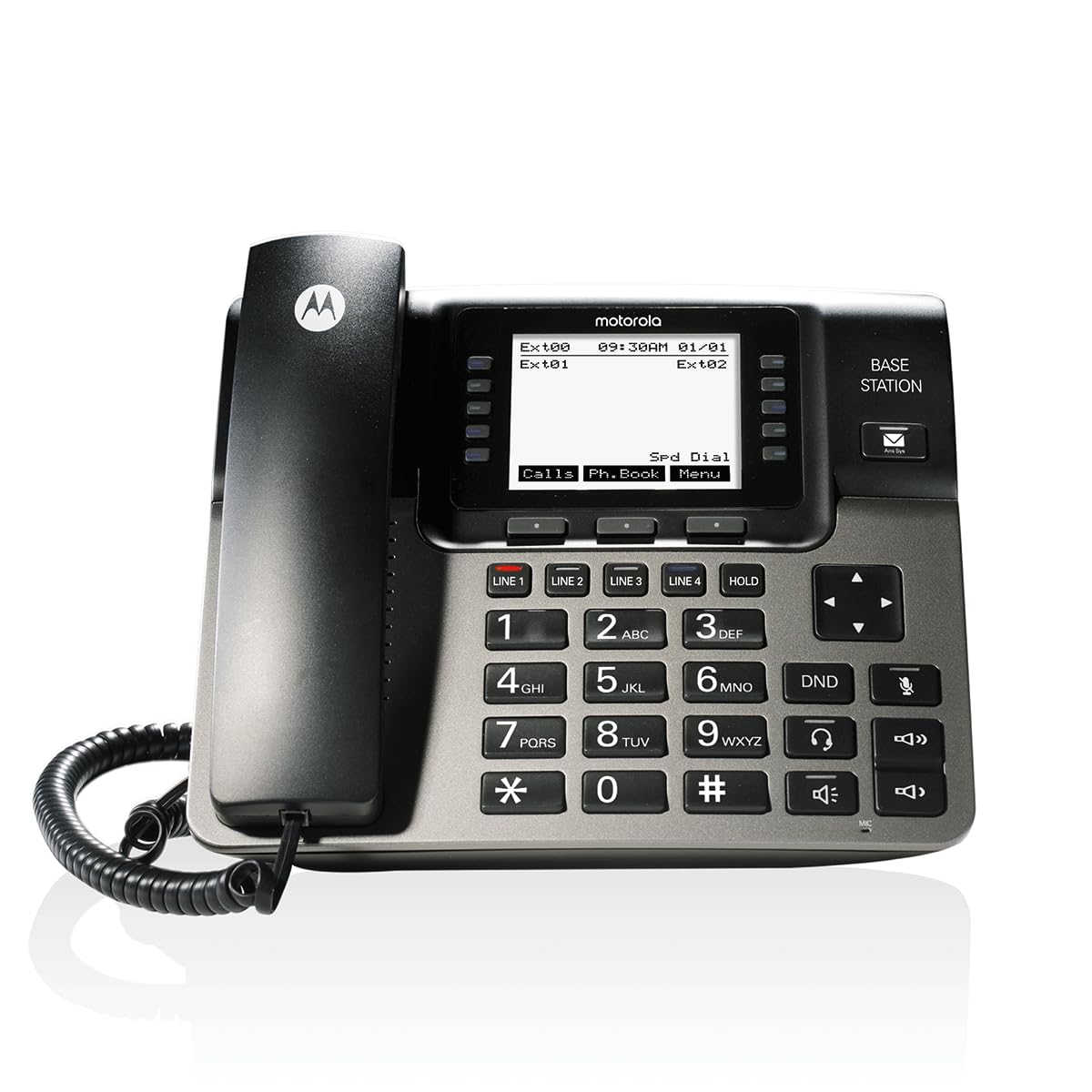
A professional 4-line base station that kickstarts your office phone system for under two hundred.
The Motorola ML1000 is the entry point for a growing business that needs a proper 4-line landline system without a big investment. It is the main base station for the Motorola ML Series, supporting up to 4 lines and 10 wireless extensions (using the ML1100 deskset or ML1200 cordless handset, sold separately). Setup is plug-and-play — you connect one phone jack to the base, and all extensions pair wirelessly using DECT 6.0 technology.
It includes a professional Auto Attendant (digital receptionist) that automatically answers calls and routes them to the right extension. The 200-minute digital answering system stores up to 10 separate mailboxes with time and date stamps, and you can retrieve messages remotely. Owners say the phone works great, sounds clear, and goes from box to running in about three minutes. The downside is that a couple of owners received units with quality control issues — one handset was dead on arrival — so check it quickly when it arrives.
The VTech AM18447 below is a more expensive and well-reviewed alternative with the same 4-line capability. The Motorola is the budget-friendly way to get into that ecosystem.
Why It Makes the List
- 4-line support with 10 wireless extensions
- Built-in Auto Attendant routes calls professionally
- 200-minute answering system with 10 mailboxes
Know Before You Buy
- Some early quality control issues reported
- Limited to the Motorola ML Series for expansion
- Base unit only — you must buy extensions separately
Best for: a startup that needs a low-cost way to handle 4 lines with professional features like auto attendant and voicemail mailboxes.
Think twice if: you cannot afford the risk of a defective unit delaying your office setup; the VTech above is a safer bet.
9. VTech AM18447 Main Console 4-Line System
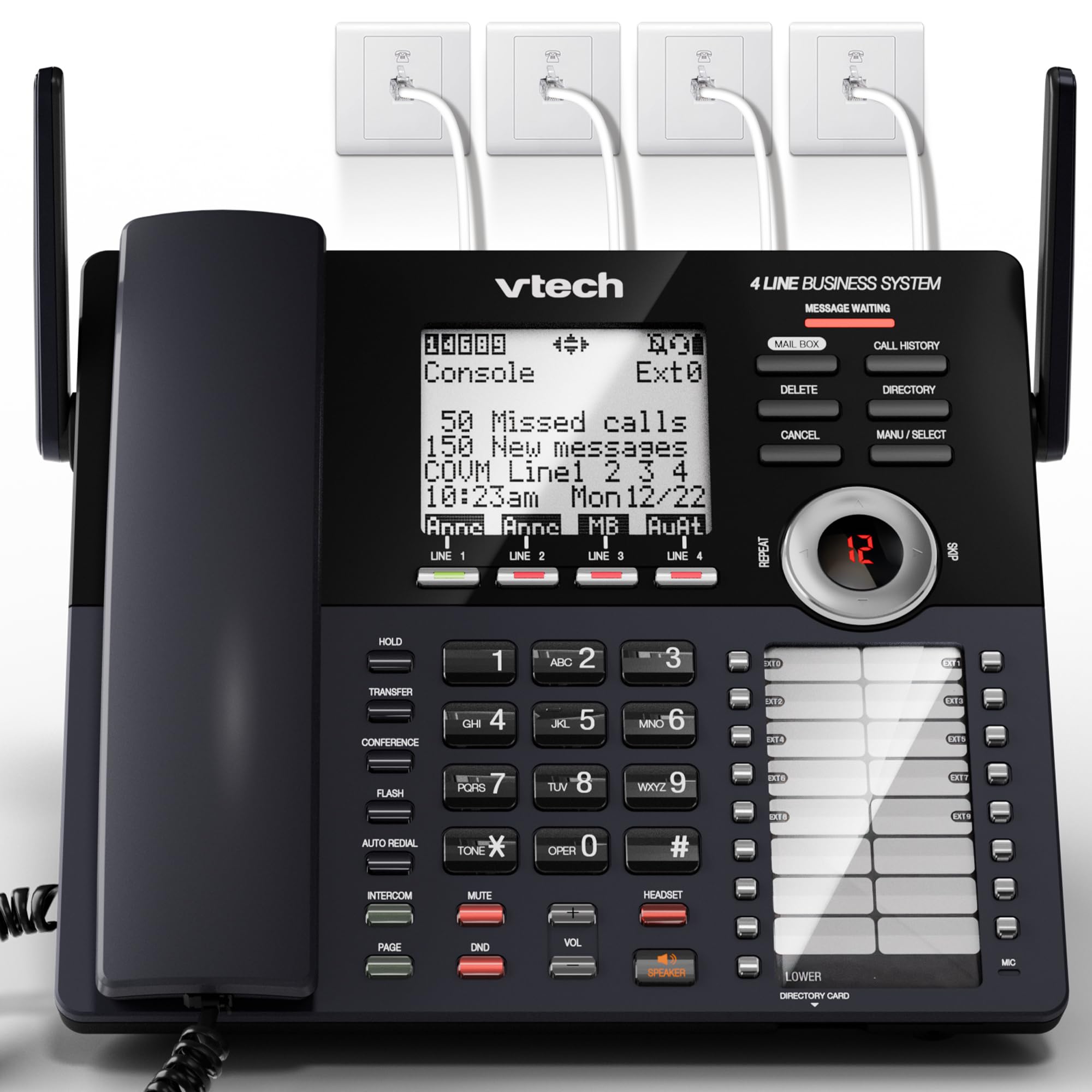
The closest thing to a full PBX system without a monthly lease fee or IT support.
The VTech AM18447 is the most complete landline phone system on this list for a small business that wants PBX-style features. It supports 4 lines, and you can expand up to 10 stations by adding VTech cordless handsets or desksets. The standout feature is the professional auto attendant per line — each of the 4 lines can have its own auto attendant that greets callers, offers a directory, and routes to extensions. This alone replaces a costly virtual receptionist service for many small offices.
The digital answering system captures up to 180 minutes of shared messages across all lines, so you rarely need to clear voicemail. It also has a full-duplex speakerphone, an extra-large display, caller ID and call waiting, a 100-name phonebook, 32 speed dials, intercom, and customizable music on hold (via the 2.5mm jack — plug in an MP3 player for hold music). Owners say setup is quick and the value for money is excellent, especially compared to leasing a PBX. The main cons are mixed feedback on sound quality and some complaints about reliability over a few months.
If your small office currently pays for a PBX or virtual phone system, the AM18447 will do essentially the same job for a one-time cost. It is the adult in the room among landline systems.
The Big Wins
- Auto attendant per line, replacing a paid virtual receptionist
- Expandable to 10 stations with wireless DECT 6.0
- 180 minutes of shared voicemail plus music on hold
Heads Up
- Sound quality gets mixed reviews
- Some units had reliability issues within the first few months
- Only 100-name phonebook feels dated
Get this if: you want to cut the expense of a PBX subscription and run your own auto attendant with four separate lines.
Consider alternatives if: you need Bluetooth or a phonebook bigger than 100 contacts.
Understanding the Specs
VoIP vs Landline: The Underlying Technology
VoIP phones (Voice over Internet Protocol) send calls over your broadband internet. They offer more features (like multiple SIP accounts and HD audio) at a lower cost per line than traditional phone service. Landline phones connect to analog phone lines from a traditional carrier. The benefit is they often work during a power outage if the telephone company’s lines stay active. Your phone must match your service, so decide your internet or phone carrier first, then pick the phone.
SIP Accounts and Phone Lines
A SIP account is the virtual line your VoIP phone uses to connect to your phone service provider. One SIP account = one phone number. A “4 SIP account” phone can handle four separate incoming or outgoing calls at the same time. For landline systems, a “4-line” phone means you connect four physical phone lines to the base station. In both cases, more lines mean more people can talk at once — essential for a busy small office.
DECT 6.0: The Wireless Range Standard
DECT 6.0 is the global standard for Digital Enhanced Cordless Telecommunications. It operates on a dedicated 1.9 GHz frequency that does not interfere with your Wi-Fi network. Phones with DECT 6.0 maintain clear, static-free signals over a much longer range than basic 2.4 GHz cordless phones. For a small office, this means your cordless handsets work reliably through walls and across the whole building without losing audio quality.
Call Blocking: Automated vs Manual
Automated call blocking pre-screens calls against a known database of spam numbers before the phone even rings. Manual call blocking lets you blacklist numbers by pressing a button after a spam call comes through. The best systems combine both — one AT&T model on this list automatically blocks robocalls and lets you add individual numbers with one touch. For a small business, automated blocking is critical because it stops nuisance callers from ever reaching your team.
FAQ
Can I use a VoIP phone on a standard landline?
How many phone lines does a small business really need?
Will a cordless phone work during a power outage?
What is the difference between SIP accounts and physical line ports?
Can I add cordless handsets without running new wires?
Do I need a PoE switch for VoIP phones?
How effective are the call blockers on these phones?
What is the real difference between the Grandstream GXP2135 and the GRP2612W?
Final Thoughts: The Verdict
If you want one dependable pick, the best business phones for small business winner is the Grandstream GXP2135 because it strikes the best balance of HD audio, 4 SIP accounts, 32 programmable keys, and reliability at a price that makes sense for any small office using VoIP. If you want a pure landline system with excellent call blocking, grab the Panasonic KX-TGF852B. And for a growing team that needs professional auto attendant routing across four lines without a monthly PBX fee, the VTech AM18447 is the one to reach for.
How We Picked
We do not accept paid placement. Every pick is matched to a real buyer and a real use-case; we do not hands-on test units.
Sources & Methodology
Specifications: manufacturer listings and product documentation. Review insights: verified customer reviews, as of July 2026. Pricing: not shown on this page (it changes often); check the current price via the retailer link.
As an Amazon Associate, FitlyFast earns from qualifying purchases. This does not affect which products we feature.