
Our readers keep the lights on and the weekend projects moving. As an Amazon Associate, I earn from qualifying purchases.
Specs are compiled from manufacturer listings and verified buyer reviews and can change over time — please confirm the key details on the product page before buying.
Your knives stay sharper longer when they meet a surface that gives slightly, and that is exactly what a good butcher block does. The real decision depends on wood type, thickness, and grain direction — not brand hype. Here are nine boards that earn their place on a countertop, with the trade-offs spelled out in plain English.
I’m Rikta — the founder and writer behind FitlyFast. This guide is built by comparing the manufacturers’ published specifications and the patterns across verified customer reviews, so you get each pick’s real strengths and trade-offs instead of marketing spin.
Whether you carve weekly roasts or just want a beautiful daily prep surface, this breakdown of the best butcher block options helps you match the right wood and thickness to how you actually cook.
Our Picks at a Glance

How To Choose The Best Butcher Block
Buying a butcher block is a long-term decision, so a few minutes of background saves you from a warped or cracked board later. Focus on three things: how the wood is cut, how thick the board is, and what wood it uses.
End grain vs edge grain
End-grain boards are made with the wood fibers standing upright, like a bundle of drinking straws. This structure lets knife edges slip between fibers instead of across them, keeping blades sharper and cut marks less visible. Edge-grain boards have fibers running lengthwise; they’re still solid and durable but they show cuts more and dull knives a bit faster.
Thickness and weight keep it stable
A thick board — around 1.5 to 1.75 inches — stays planted while you chop and resists warping from moisture. A heavy board also absorbs the shock of each cut, which is easier on your hands and your countertop. If you have limited storage, a lighter 6-7 pound board is friendlier to lift; if you want rock-solid stability, look toward 10 pounds and up.
Wood type changes the feel
Maple is the professional standard: dense, light-colored, and resistant to stains and odors. Walnut is softer and darker, showing scratches less but marking more easily. Teak and acacia carry natural oils that repel water, making them lower-maintenance picks. Each wood has a slightly different hardness, so match it to whether you mainly chop vegetables or break down large roasts.
Quick Comparison
| Model | Best For | Grain Type | Thickness | Weight | Amazon |
|---|---|---|---|---|---|
| SHUMARU Mahogany★ Best Overall | Heavy daily prep | End Grain | 1.6″ | 8.5 lb | Amazon |
| BABILONIA AcaciaBest Value | Budget-friendly first board | Edge Grain | 1.6″ | 2.71 kg | Amazon |
| Foressic TeakWater Resistant | Water-resistant prep | Edge Grain | 1.2″ | — | Amazon |
| John Boos Maple | Small kitchens | Edge Grain | 1.5″ | 6 lb | Amazon |
| Yes4All Teak | Turkey-size carving | End Grain | 1.5″ | 11.2 lb | Amazon |
| WoodForChef Maple | Two-sided versatility | Edge Grain | 1.5″ | 7.92 lb | Amazon |
| BABILONIA Walnut | Knife preservation | End Grain | 1.7″ | 3.08 kg | Amazon |
| COZIFA Walnut | Elegant serving + prep | End Grain | 1.6″ | 7.7 lb | Amazon |
| Bevel & Bond Maple | Lifetime investment | End Grain | 1.75″ | 10 lb | Amazon |
In-Depth Reviews
1. SHUMARU Mahogany End Grain Cutting Board
Our pick — over 4.5★ from 750+ verified ratings; the strongest balance of quality and price.
The heavyweight workhorse that takes daily abuse without showing a scar.
This board’s defining trait is its 1.6-inch thickness built into a dense 8.5-pound slab, giving you a platform that stays planted through heavy chopping, slicing, and carving. The end-grain construction lets knife edges sink between upright fibers, protecting blades and allowing minor marks to close over time. Owners who used it daily for three months report no deep cuts, cracking, or warping — a strong sign of solid build quality.
The built-in juice groove runs around the perimeter to catch runoff from meat, fruit, and vegetables before it reaches your counter. improve rubber feet serve two jobs: they stop the board from slipping mid-chop, and they leave a gap underneath so air can circulate and dry the wood faster. The 17 by 13-inch surface gives you 221 square inches of room, enough to prep a full meal and then flip to serving charcuterie.
What wins people over is the craftsmanship — the board arrives triple-sanded and pre-seasoned with food-safe oils, ready to use the moment it lands. Buyers consistently rave about the rich mahogany color and how it looks almost too nice to cut into. The one honest trade-off is weight: at 8.5 pounds it’s not a board you’ll casually toss around, and a few owners wish the juice groove were a touch deeper depending on how juicy their cuts get.
The Strengths
- Dense 8.5 lb build stays rock-solid while you chop
- End-grain surface spares knife edges and hides marks
- Pre-seasoned and ready to use from the start
The Trade-offs
- Heavy to lift and move around the kitchen
- Juice groove depth gets mixed feedback
Grab it for: anyone who preps daily and wants a stunning, stable board that won’t warp or crack.
Think twice if: you need something light to store away between uses — this one earns its permanent counter spot.
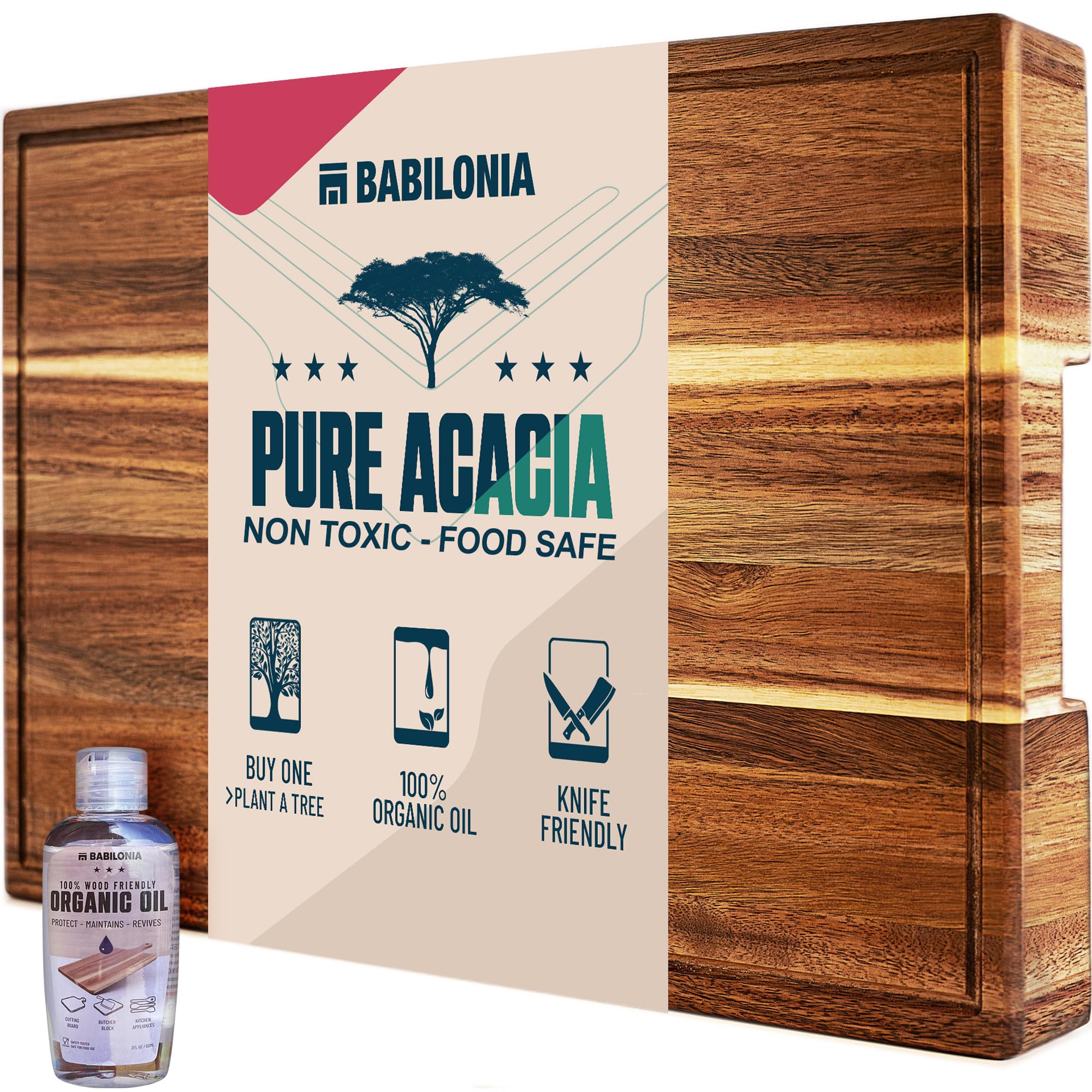
2. BABILONIA Acacia Wood Cutting Board
A clever slide-and-plate system that saves you from lifting the board mid-prep.
The standout feature here is the built-in notch and matching plate: rather than lifting the whole board to dump chopped onions into a pot, you slide them straight across into the dish. It’s the kind of small daily convenience that genuinely changes how smoothly cooking flows, and buyers call the design “genius” for exactly that reason. The acacia wood is 100% sustainable and crafted using edge-grain technique, giving a knife-friendly surface that won’t dull your blades.
The board measures 15.7 by 10.2 inches with a 1.6-inch thickness, making it about 8% shorter than the SHUMARU above — still plenty of room for everyday prep, just less sweeping surface for huge roasts. It arrives pre-oiled and ready to use immediately, with a free bottle of organic oil included to keep it conditioned. The reversible design means the back side works as a serving tray, complete with a hidden handle.
Buyers using it about six times a week for months report it still looks great after just one oiling, and the included plate makes cleanup and transfer noticeably easier. The recurring word is value — this delivers quality and smart design without the premium price tag. The honest caveat is that some owners note acacia can warp over time if it’s not oiled consistently, so a little regular care keeps it flat and happy.
Why It Wins
- Slide-and-plate system speeds up meal prep
- Comes seasoned with free organic oil included
- Reversible design doubles as a serving tray
The Catch
- Smaller surface than larger end-grain boards
- Acacia needs regular oiling to resist warping
Reach for this if: you want a smart, affordable first wood board with a built-in convenience that saves time every single meal.
Look elsewhere if: you regularly carve large roasts and need maximum cutting surface.
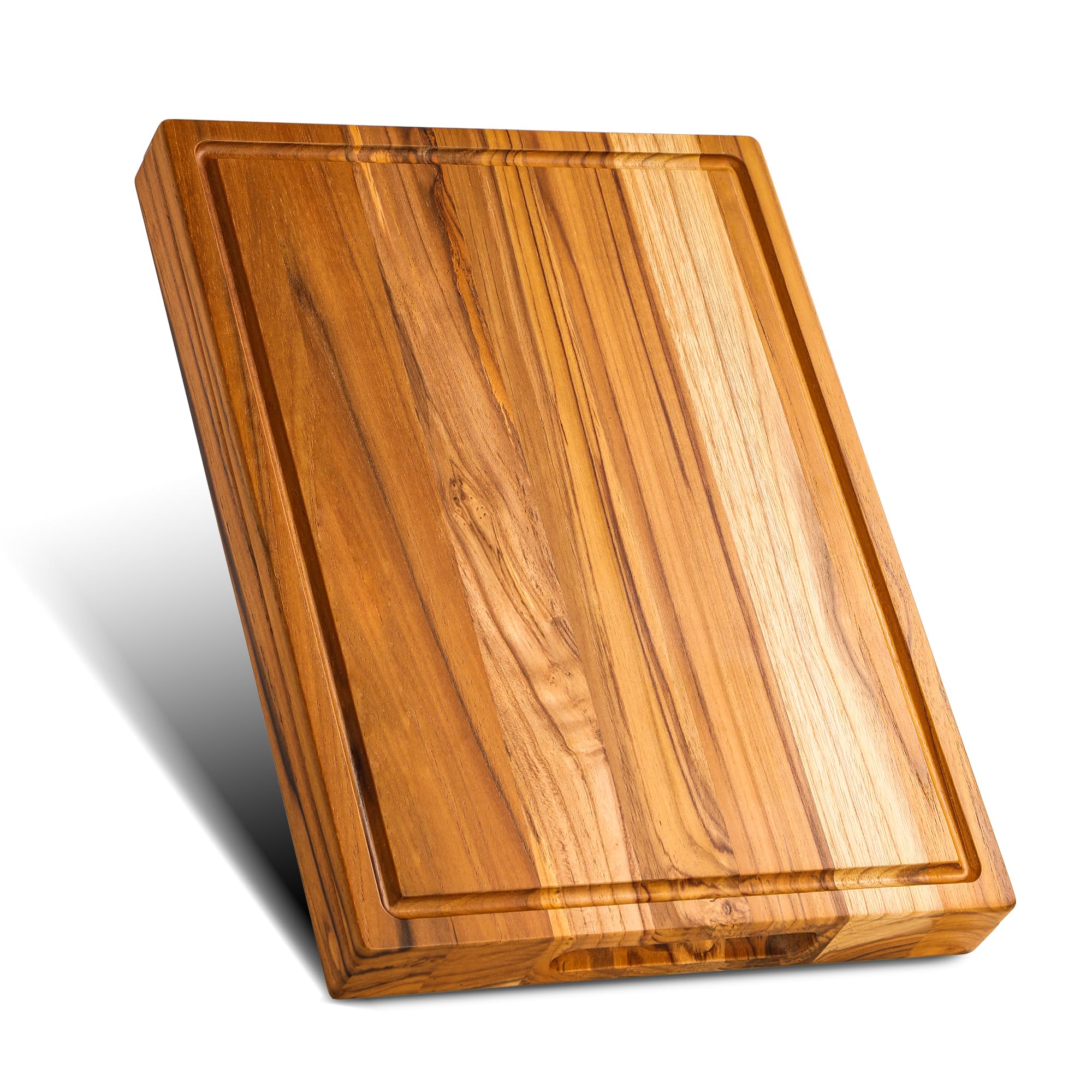
3. Foressic Teak Wood Cutting Board
A teak board that shrugs off moisture and keeps your knives sharp.
Teak’s natural self-protecting oils make this board unusually water-resistant, so it resists juice absorption and odor retention even in damp kitchens. That built-in moisture defense means less maintenance for you while still leaving shallow, self-healing cut marks that won’t harbor food residue. The 16.14 by 12-inch surface with a 1.2-inch solid thickness handles steaks, veggies, and full-family prep without wobbling, and the vertical block splicing gives it superior shock absorption during heavy carving.
The full perimeter juice groove catches meat juices and fruit runoff to keep your countertop clean and stain-free, while dual built-in side handles make it easy to move from counter to table for serving. Detachable non-slip silicone feet prevent sliding during chopping and protect granite or wood counters from scratches. Owners describe it as looking far pricier than it is, with a warm natural grain that brings a minimalist touch to kitchen decor.
The moderate hardness of teak is the key balance here — it’s durable enough for daily use yet gentle enough that chef knives don’t dull or chip. Buyers love that it doubles as an elegant charcuterie and cheese board for entertaining. The one consideration is that at 1.2 inches thick, it’s slightly slimmer than the 1.6-inch boards on this list, so if you want the absolute heaviest, most planted feel, the thicker options deliver more mass.
The Perks
- Natural teak oils resist water, stains, and odors
- Deep juice groove keeps counters clean
- Dual side handles make serving easy
The Notes
- Slimmer 1.2″ profile than other picks
- Occasional oiling maintains the glossy finish
Best suited for: cooks in humid climates or anyone who wants a low-fuss board that resists moisture naturally.
Keep in mind: if heft is your top priority, the thicker maple options will feel more substantial under the knife.
4. John Boos Maple Cutting Board
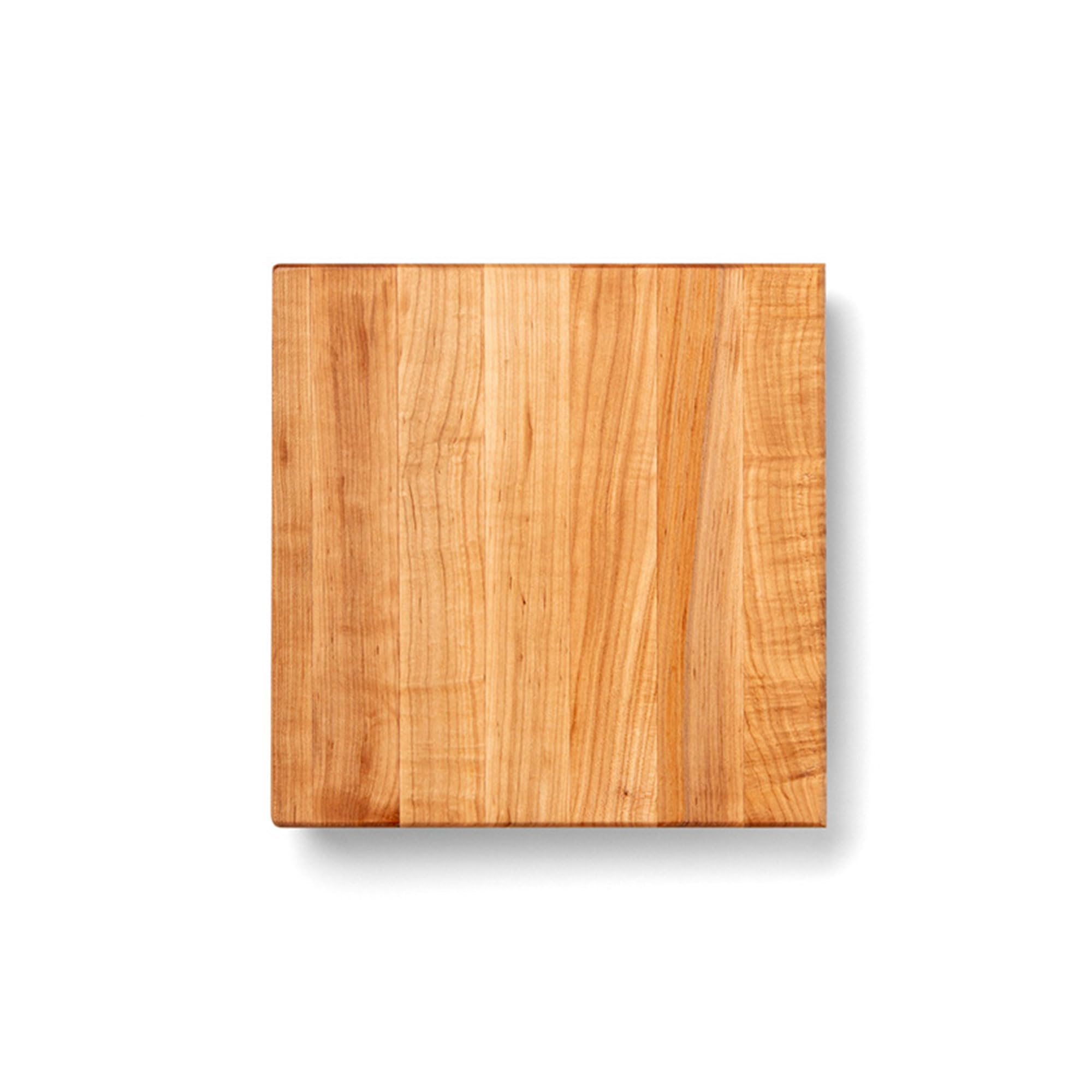
The 12-inch square champ that saves counter space without skimping on quality.
This compact board measures 12 by 12 inches with a 1.5-inch thickness, and it’s the answer for small kitchens where every inch of counter counts. At 6 pounds it’s heavy enough to stay put while you chop but light enough to lift and store with ease. The edge-grain construction from sustainably sourced Northern Hard Rock Maple delivers professional-grade durability in a space-saving footprint, and the wood’s mellow hardness is famously gentle on knife edges.
The square shape is the real differentiator here — buyers find it perfect for two-person meals and much easier to tuck away than a long 18 by 12-inch board. It rests on wooden bun feet that keep it slightly improve, and the reversible design gives you two usable surfaces. It’s made in Effingham, Illinois using techniques the brand has honed since 1918, a pedigree that shows in the smooth, flat cutting surface that won’t rock or wobble.
Owners describe it as professional-grade and note it allows you to do what needs doing without taking over your counter. The care routine is a bit more hands-on than other picks — the brand recommends regular conditioning with their Mystery Oil and Board Cream, which you’ll need to buy separately. That’s the honest trade-off: this board rewards consistent care, and some buyers report splitting if it’s neglected, so it suits someone willing to keep up the maintenance ritual.
The Good
- Compact 12″ square saves valuable counter space
- Made in the USA with a century of craft heritage
- Soft maple surface protects knife edges
The Effort
- Needs regular oiling with separate-brand products
- Smaller surface limits large-roast carving
Choose it for: compact kitchens or anyone who wants a premium American-made board for everyday veggie and herb prep.
skip it if: you’d rather not commit to a regular oiling routine or you regularly carve large cuts.
5. Yes4All Large Teak Cutting Board

The 20-inch surface that carves a whole turkey without breaking a sweat.
At 20 by 15 inches with a 1.5-inch thickness, this is the biggest board in the lineup — and at 11.2 pounds, it’s also one of the heaviest. The end-grain teak construction gives you a knife-friendly surface that owners say is gentle on blades and big enough to carve a full turkey. The wide juice groove and built-in handles make it practical for moving from counter to table, whether you’re prepping a feast or serving a charcuterie spread.
Teak’s tight grain is the reason this board withstands humidity and scratches for lasting use, and buyers confirm it holds up with daily use over months. The appearance is what wins people over most — the rich color and unique wood patterns make it look like a premium centerpiece, not just a prep tool. Owners note it stays flat with no warping when properly oiled, and the self-healing surface keeps cut marks minimal.
The sheer size is the defining feature here: it’s made for heavy use, family meals, and serious entertaining. Because it’s so large and dense, it’s not a board you’ll casually stash in a cabinet — it belongs on the counter, ready for action.
The Wins
- Huge 20×15″ surface handles whole turkeys
- Dense 11.2 lb build stays planted under pressure
- Teak grain resists humidity and scratches
The Trade-offs
- Very heavy and bulky to move or store
- Rough surface may need a quick scouring-pad pass at first
Perfect for: serious home cooks and entertainers who need maximum surface for big cuts and full-family prep.
Not ideal if: you have limited counter space or want something easy to stow between uses.
6. WoodForChef Classic Maple Reversible Cutting Board

A reversible maple board that gives you two clean surfaces from one footprint.
This 16 by 12-inch board with a 1.5-inch thickness is built around a simple idea: flip it over and you get a second fresh cutting surface without washing the first one mid-meal. At 7.92 pounds it’s heavy enough to feel stable and substantial, yet manageable to move around. Crafted in Canada from responsibly sourced hardwood, it arrives pre-seasoned with food-safe mineral oil and wax so it’s ready for your knives from day one.
Buyers who own Japanese knives specifically praise this board for preserving blade sharpness — the moderate hardness of maple doesn’t chip or dull edges the way harder surfaces can. The deep juice groove on one side collects liquid from meats, fruits, and vegetables, while the flat reverse side works as a clean prep or serving surface. Owners describe the feel as premium, with a beautiful finish that holds up to regular use.
The care routine is straightforward: hand wash, dry upright, and re-oil as needed, with each board featuring unique grain and color variations. The recurring note from reviewers is that the board arrives dry and benefits from an initial oiling before first use — it’s not a defect, just part of owning real wood. It also doesn’t come with a stand, so if you want to display it upright, that’s an extra purchase to consider.
The Strengths
- Reversible design offers two surfaces in one board
- Hard maple keeps Japanese knives sharp
- Sustainably sourced and responsibly made
The Notes
- Arrives dry and benefits from initial oiling
- No stand included for upright storage
Pick this if: you want a versatile mid-size board that’s kind to quality knives and gives you two surfaces for busy cooking sessions.
Reconsider if: you want something ready-to-use with zero prep or you need a board that dispays upright.
7. BABILONIA American Walnut Cutting Board
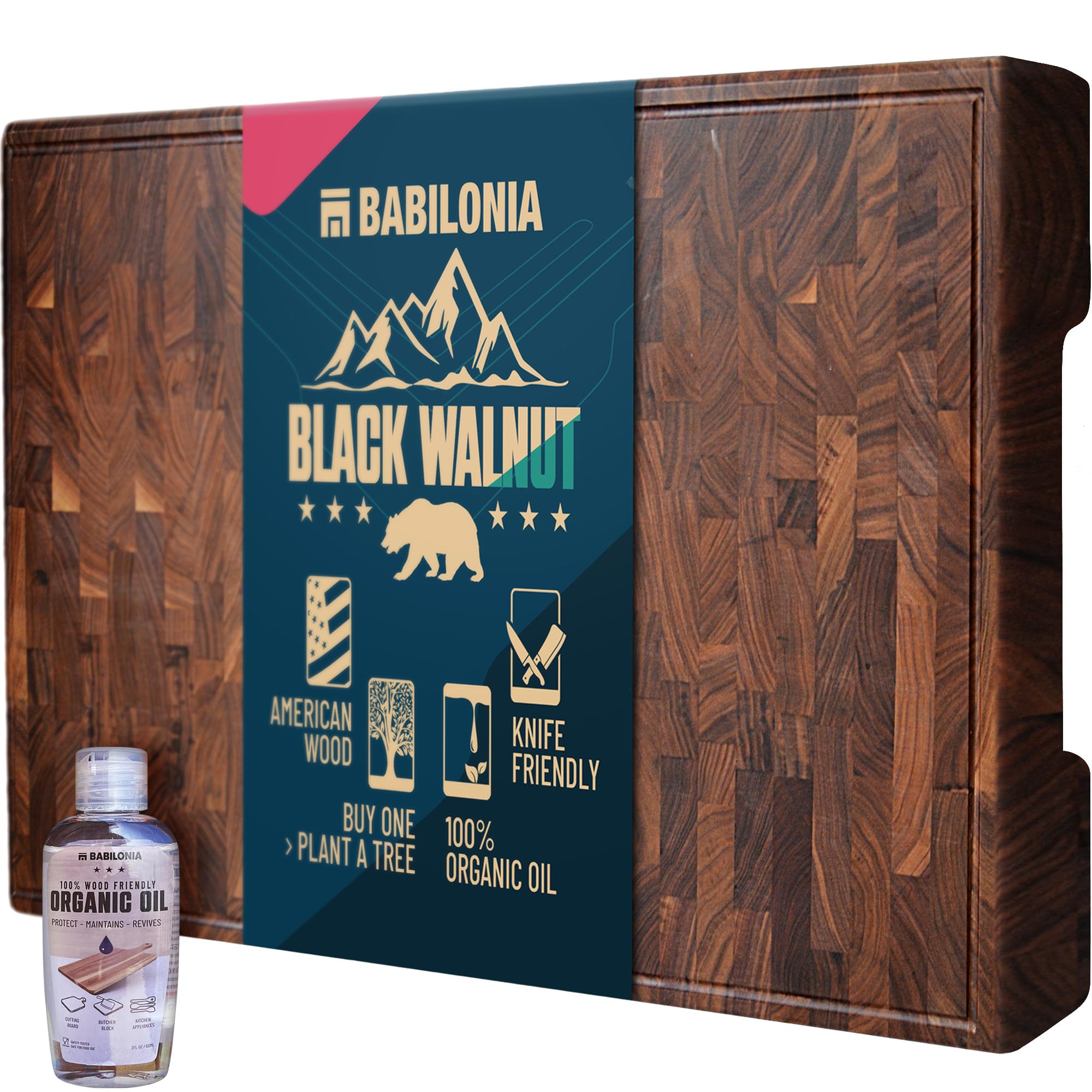
A 1.7-inch end-grain walnut slab that feels like a professional workhorse.
This board pairs a substantial 1.7-inch thickness with end-grain construction — the gold standard for knife preservation and bacteria resistance. The end-grain technique stands fibers upright, so knife edges sink between them, keeping blades sharper and marks nearly invisible. The black walnut is grown in America and 100% sustainable, delivering density and durability that owners say feels rock-solid with zero flex.
The design mirrors the brand’s clever slide-and-plate system: a notch and included plate let you sweep chopped produce directly into a pot or bowl without lifting the board. It’s reversible too, so the back side works as a serving tray with a hidden handle. Rubber feet keep it firmly planted while chopping, and the board arrives pre-oiled and ready to use immediately, with a free organic oil bottle included for ongoing care.
What wins people over is the craftsmanship — buyers describe it as surpassing boards costing two to three times more, with a smooth pre-oiled surface and an heirloom-quality feel. The owner even sends a personal welcome text on warranty registration, which owners note as standout service. The honest caveat: durability gets mixed feedback, with some owners reporting cracks after a couple months of heavy use, so regular oiling and proper drying matter with this one.
The Perks
- 1.7″ end-grain construction protects knife edges
- Slide-and-plate system speeds up prep
- Pre-oiled, ready to use with free oil included
The Effort
- Needs consistent oiling to avoid cracking
- Some owners mention splits with heavy use
Best for: knife enthusiasts who want professional-grade end-grain at a fraction of the high-end price.
Be ready for: a monthly oiling routine to keep the walnut stable and beautiful for the long haul.
8. COZIFA American Dark Walnut Cutting Board
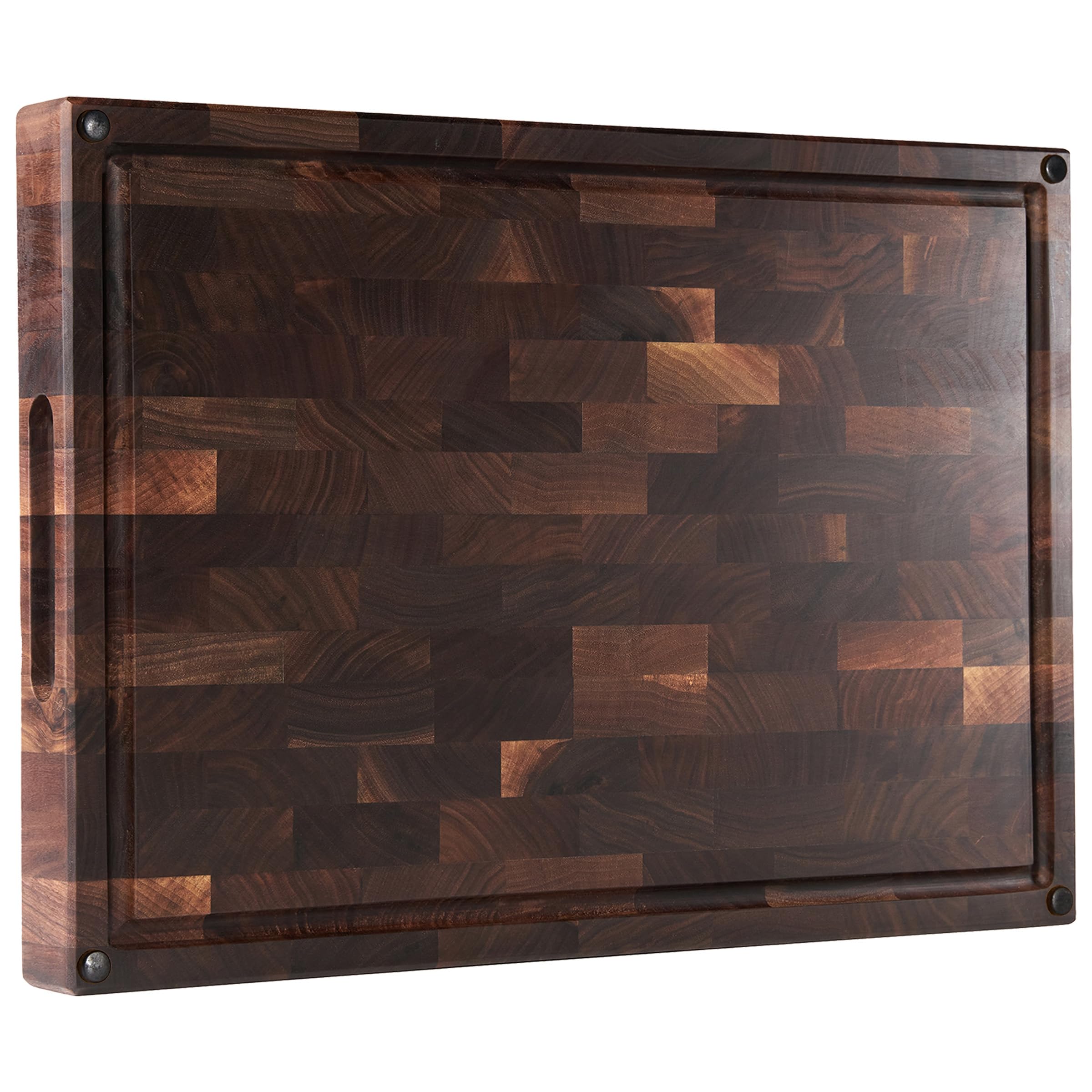
A dark walnut board that works as hard as a kitchen tool and dresses up like a serving piece.
This 17 by 12-inch board with a 1.6-inch thickness is finished with linseed oil, beeswax, and carnauba wax, creating a smooth, durable surface that looks elegant enough for cheese displays. The deep juice groove sits close to the edge, maximizing your cutting area while catching runoff from meat, fruit, and vegetables. End-grain construction adds visual charm and durability, with built-in handles for easy carrying.
Flip this board and you get two surfaces in one: the front side has a juice groove (a channel that catches liquid) so your counter stays dry while you chop, and the flat back works for prepping, serving grilled meats, or as a kitchen mat for BBQs and parties. Owners specifically love that it doubles as an elegant serving piece for cheese and charcuterie, with a rich dark color that looks striking on any countertop. At 7.7 pounds it feels weighted and substantial, and the non-slip stance keeps it planted during use.
The honest trade-off: walnut is a softer wood than maple, so it can show knife marks more readily, and durability feedback is mixed — some owners say it will last a lifetime while others report cracking if moisture sits underneath. Care is specific: hand wash only and oil at least 1-2 times per month. If you keep it dry and conditioned, this board pulls double duty as both a prep surface and a showpiece.
The Highs
- Beautiful dark walnut finish works for serving
- Reversible with deep juice groove on one side
- Built-in handles make carrying easy
The Lows
- Softer wood shows marks more than maple
- Needs careful drying to prevent cracking
Ideal for: home cooks who want one board that transitions from heavy prep to elegant entertaining.
Keep in mind: moisture under the board is the enemy — keep it dry and oiled to protect your investment.
9. Bevel & Bond Maple End-Grain Cutting Board
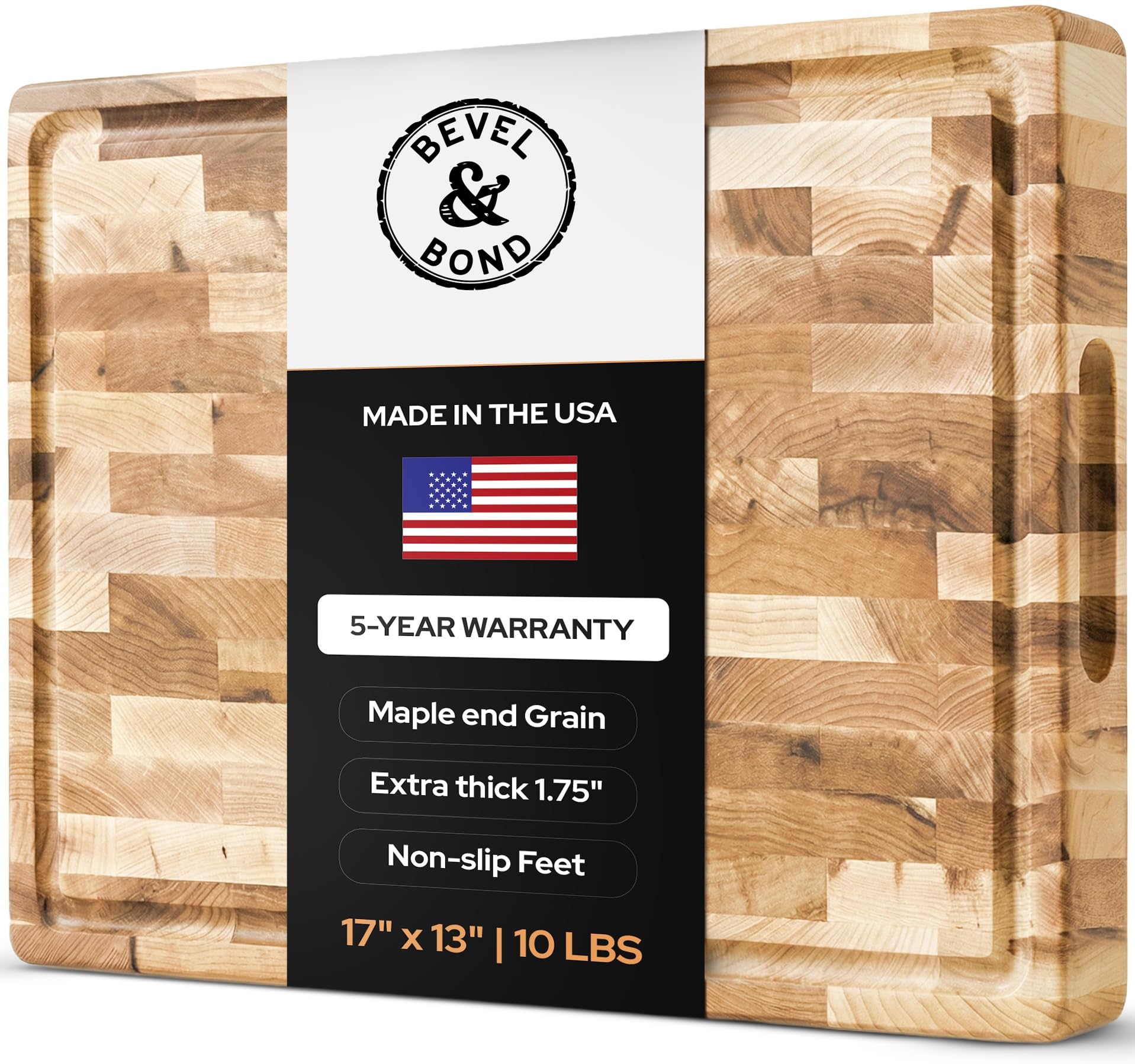
The 1.75-inch American-made slab built to be the last board you ever buy.
This is the thickest board in the lineup at a full 1.75 inches, and at 10 pounds it’s also the heaviest — a combination that delivers the most planted, stable cutting experience you’ll find here. The end-grain construction lets knife edges follow the grain, minimizing marks and creating a self-healing surface for years of use.
The deep juice groove captures liquid runoff from large cuts, and deep finger grips on both sides make it easy to move from counter to table for carving presentations. It ships in a premium gift box and arrives pre-conditioned with a food-safe mineral oil finish, ready to use immediately. The brand backs it with a 5-year warranty against manufacturing defects, and registering the board gets you a complimentary tin of Board Balm conditioner — a level of support owners consistently call out as exceptional.
Buyers describe it as heavy, dense, and beautifully sanded, with no knife marks appearing even after a month of use with sharp knives. The tight maple grain resists staining and odors, keeping the board looking fresh with just a quick monthly conditioning. The honest trade-off is the weight — at 10 pounds it’s simply a permanent counter resident, not something you’ll toss in a cabinet — and it requires hand-washing and drying rather than machine care.
The Strengths
- Thickest 1.75″ build for maximum stability
- Made in USA from professional-grade maple
- 5-year warranty with free conditioner on registration
The Trade-offs
- Very heavy at 10 lb — a permanent counter piece
- Premium price point reflects the American craftsmanship
Reach for this if: you want a true lifetime board and are willing to invest in American-made quality that outperforms cheaper alternatives on every measure.
Pass if: you need something portable, or you prefer a lighter board you can stow between uses.
Understanding the Specs
Thickness and weight
Thickness is the single biggest predictor of a board’s stability and longevity. A 1.5-inch board is the practical minimum for serious use; the 1.75-inch boards in this lineup feel noticeably more planted and resist warping better over years of moisture exposure. Weight matters for the same reason — a heavier board absorbs the shock of each cut and stays put without sliding, which is both safer and more comfortable during long prep sessions.
End grain vs edge grain
End-grain boards stand fibers upright, so knife edges slip between them, keeping blades sharper and letting marks self-heal. Edge-grain boards have fibers running lengthwise; they’re still excellent, but they show cuts more and dull knives slightly faster. If you own quality knives, end grain is worth seeking out.
Wood types compared
Maple is the professional standard — dense, light-colored, and resistant to stains and odors. Walnut is softer and darker, showing scratches less but marking more easily with daily use. Teak and acacia carry natural oils that repel water, making them lower-maintenance picks ideal for humid environments. Each strikes a different balance between hardness, appearance, and upkeep, so match the wood to how you cook.
Juice grooves and feet
A perimeter juice groove catches runoff from meat, fruit, and vegetables so it never reaches your countertop. Non-slip feet serve double duty: they keep the board planted while you chop and lift it slightly for airflow underneath, which helps the wood dry faster and resist moisture damage. Both features add real utility to daily prep, so they’re worth prioritizing.
FAQ
What is the difference between end grain and edge grain butcher blocks?
How thick should a butcher block be?
Which wood is best for a butcher block?
How often should I oil my butcher block?
Can I put a butcher block in the dishwasher?
Is a heavier butcher block better?
Will a butcher block dull my knives?
How do I fix knife marks or scratches on my board?
Is acacia or teak better for a butcher block?
Does a juice groove really matter?
Final Thoughts: The Verdict
For most buyers, the butcher block winner is the SHUMARU Mahogany because it combines the knife-friendly end-grain construction and heavy 8.5-pound stability most home cooks need, with a crowd-pleasing rating that reflects genuine owner satisfaction. If you want a smart, budget-friendly first board with a built-in conveniences, grab the BABILONIA Acacia with its slide-and-plate system. And for a true lifetime investment made in America, the Bevel & Bond Maple at 1.75 inches thick is the one to reach for.
How We Picked
We do not accept paid placement. Every pick is matched to a real buyer and a real use-case; we do not hands-on test units.
Sources & Methodology
Specifications: manufacturer listings and product documentation. Review insights: verified customer reviews, as of August 2026. Pricing: not shown on this page (it changes often); check the current price via the retailer link.
As an Amazon Associate, FitlyFast earns from qualifying purchases. This does not affect which products we feature.