
Our readers keep the lights on and the weekend projects moving. As an Amazon Associate, I earn from qualifying purchases.
Specs are compiled from manufacturer listings and verified buyer reviews and can change over time — please confirm the key details on the product page before buying.
Keeping your mic muted until you actually want to speak is A dedicated foot pedal keeps your hands on the keyboard and mouse, so you can talk without breaking your workflow.. Reaching for a keyboard hotkey mid-sentence breaks your flow, and click-to-talk software sometimes just fails. A dedicated foot-operated button for push to talk solves that by putting the control under your foot, so your hands never leave the keyboard or mouse.
I’m Rikta — the founder and writer behind FitlyFast. This guide is built by comparing the manufacturers’ published specifications and the patterns across verified customer reviews, so you get each pick’s real strengths and trade-offs instead of marketing spin.
From silent optical pedals to studio-grade XLR switches, this breakdown of the best button for push to talk This guide ranks pedals by switch type, pedal count, and OS compatibility to help you pick a reliable model..
Our Picks at a Glance


How To Choose The Best Button For Push To Talk
Most push-to-talk pedals act like a second keyboard. They send a keypress (say, the letter T) that your game or voice app recognizes as “start talking,” so the pedal only works with software that supports hotkey-based push-to-talk. The first decision is matching the pedal’s signal type to your mic setup.
USB keyboard emulation vs. analog XLR
USB pedals that emulate a keyboard are the most flexible — they work across Discord, games, and transcription tools because they just press a key. But they only function while that app is in focus, and some buyers report stray presses in other windows. If you use a professional XLR microphone, a dedicated mute button with XLR in/out cuts the audio signal directly, so it works no matter which software is open, but it costs more and does nothing for USB-only mics.
Switch feel: mechanical click vs. silent optical
Before you buy, decide if you want a click or total silence. Mechanical pedals give a tactile, audible click that confirms activation, but that click can annoy teammates and your own stream. Optical pedals use light to detect the press instead, making them fully silent — great for quiet rooms — but some owners note they slide on hardwood because the lighter housing lacks grip.
Pedal count and software requirements
Single pedals handle one job like push-to-talk, while triple pedals let you separate talk, mute, and a third shortcut like play/pause. Most require downloading free configuration software first, and a few older models insist on a Windows machine for setup before they work on Mac or Linux. If you plan to use the pedal on a Mac, confirm the software path before buying.
Quick Comparison
| Model | Best For | Pedal Count | Switch Type | Connectivity | Amazon |
|---|---|---|---|---|---|
| iKKEGOL USB Double Foot Switch★ Best Overall | Two shortcuts at once | 2 | Mechanical | USB | Amazon |
| Kopul Mute/Talk ButtonStudio Grade | Studio XLR mics | 1 | Momentary analog | 3-Pin XLR | Amazon |
| Hoffnugshween 3-Key PedalSilent Triple | Streamers needing 3 hotkeys | 3 | Mechanical firm spring | USB-A | Amazon |
| OLLGEN USB Foot Pedal | Multi-platform flexibility | 1 | Photoelectric (silent) | USB | Amazon |
| iKKEGOL Single Pedal Switch | Plug-and-play simplicity | 1 | Mechanical | USB | Amazon |
| OLLGEN Metal Foot Switch | Rugged heavy use | 1 | Mechanical metal | USB | Amazon |
| iKKEGOL Upgraded Foot Pedal | Budget first pedal | 1 | Mechanical | USB | Amazon |
In‑Depth Reviews
1. iKKEGOL USB Double 2 Foot Switch
Our pick — over 4★ from 850+ verified ratings; the strongest balance of quality and price.
Two aluminum-plated pedals that handle push-to-talk and a second command without remapping.
Run push-to-talk on the left and crouch on the right with the iKKEGOL USB Double Foot Switch, which keeps two functions live at once on one PC. Its aluminum alloy base plate is rated to bear over 100 kg of weight, and the dominant theme across owner feedback is long-term reliability — the crowd favorite line here is “had this one for years now hasn’t shown any signs of failure.”
Setup requires downloading the PC Sensor software, and owners confirm the workflow: install the tool, remap each pedal to a key, then use it across Windows, Mac, or Linux. The heavy build and audible click give clear feedback, but the pedal spacing earns mixed notes — some find the two pads too close together for their feet. Weigh that if you wear wide shoes or press with your whole foot.
Beyond gaming, musicians use this for scrolling through scores, and a Time Crisis 2 player calls it “lots of fun.” It pairs its rock-solid construction with a one-year warranty and FCC, CE certification. The package includes the aluminum base, the two-pedal switch, and a USB cable, though the manual’s broken English is a recurring minor gripe.
What wins owners over
- 100 kg weight rating on the aluminum base plate adds real durability confidence
- Two simultaneous functions beat single-pedal limits
- Works after configuration on Windows, Mac, and Linux
- Audible click and strong springs give clear press feedback
Where it trips up
- Pedal spacing is too close for some feet, per mixed feedback
- Requires the downloadable software to function at all
- Manual text has broken English that confuses first setup
Best for: gamers who want two mapped actions under foot and value the proven durability of the aluminum base.
Think twice if: you rest your feet wide apart — close pedal spacing is the most common complaint here.
2. Kopul Mute/Talk Button
The pro-audio answer that cuts mic signal at the cable, not through fragile software.
This is the only pick in the lineup that ignores keyboards entirely. Instead of emulating a keypress, it sits between your XLR microphone and your interface, and pressing the red button physically mutes or unmutes the analog signalpath. That means it works in any program, on any system, with zero focus issues — a real edge over USB pedals that only fire when the right window is active.
The spec that matters most here is 85 dB of microphone attenuation, which effectively silences the mic while pressed. It passes phantom power through, so condenser mics keep working, and the rugged metal housing with non-slip rubber feet stays put whether it’s on a desktop or underfoot. At 9.76 ounces it’s compact but weighty, and owners call the build “like a tank” — this is built for live events and daily studio grind.
Owners mention it “exceeds expectations” for talkback in studios with SM57/SM58 mics and for activating a vocoder mic on stage. The trade-off is simple: at roughly double the price of a USB pedal, it only helps you if you already run an XLR mic — plug a USB headset into this and it does nothing. For the crowd running real studio gear, it’s the most dependable push-to-talk button on the list.
Pro-audio verdict: The 46 owners behind its 4.8-star average praise the build quality above every other feature — eight of them single out the rugged construction as the standout.
Know before you buy: This is a momentary switch by design, so you must keep your foot or finger on it to talk; it is not a latched toggle.
Reach for this if: you run an XLR dynamic or condenser mic and want mute control that never depends on which app is in focus.
Look elsewhere if: your mic connects via USB only, since the XLR in/out does nothing for a USB headset.
3. iKKEGOL USB Triple Optical Foot Pedal
A firm-spring triple pedal built so you never trigger push-to-talk by accident.
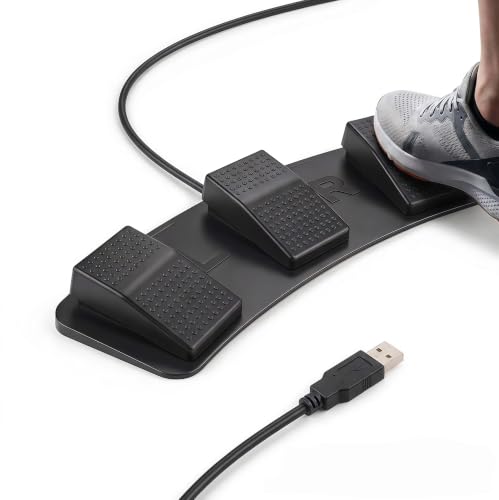
This one is engineered around a specific frustration: feather-light pedals that fire when you just rest your foot on them. The Hoffnugshween uses deliberate forefoot presses with firm spring resistance, so a casual lean won’t broadcast your keyboard clatter to your stream. Three foot-controlled shortcuts let you separate push-to-talk, mic mute, and a third action like play/pause without ever remapping mid-session.
Setup runs through an included guide that points to the software download for Windows and Mac, and each pedal maps to keyboard shortcuts, single keys, key combos, mouse actions, or media controls. The full-size USB-A cable connects to standard PCs, though Macs or laptops with USB-C only need an adapter. Three anti-slip bottom pads keep it steady on common floors — glass pads included, per one satisfied owner.
Owners call it “solid” and note the pedals “don’t trigger by accident,” with a streamer’s partner using it daily on a 5m server. The 0.68 kg weight anchors it well. The honest limit: the MAC setup can be fiddly, so some owners skip the bundled software and use the free Karabiner key mapper instead, since the pedals output A, B, and C by default. There’s also no multi-profile support, which one shooter player misses.
Streamer’s take: The firm springs directly solve the mis-trigger problem most cheap pedals create, which is why accidental presses are the least-mentioned gripe across its owner reviews.
Consider this: If you want per-game profile switching, this unit does not offer it — you remap each time you change games.
Best for: streamers and shooter players who rest their foot near the pedal and need firm resistance to block ghost presses.
Not ideal if: you juggle many games that each need a different mapping, since profiles are not stored.
4. OLLGEN USB Foot Pedal (USB Single Foot Pedal)

A silent photoelectric single pedal that works on PC and, with setup, even Xbox.
The iKKEGOL full-quiet optical pedal is the value-minded pick that refuses to feel cheap in action. Its photoelectric switch makes the press completely silent, and the long USB cable reaches comfortably under a desk. Owners run it for push-to-talk in Apex, mute toggles, and scope actions — one satisfied user has had it “for over several years now and it still works perfectly,” which is This long-term reliability is a key reason it earns a top spot..
The 5.9-ounce weight makes it the lightest of the mid-range picks, and it’s easy to program through downloadable software that works on Windows and Mac. A clever extra: it holds its mapping in onboard memory, so one owner got it running on Xbox Series X with keyboard and mouse after configuring it on a laptop first. Multiple pedals can be connected to one computer, each programmed individually.
Two honest caveats keep it from the top spot. Owners note it needs a firm press — one says you “really have to smash it to get it to register” — and the plastic body feels cheap in hand even though it survives years of use. The software also has limited features compared to rivals. For a quiet, affordable single hotkey, it over-delivers; just expect to press with intent.
Reach for it if: you want a silent single pedal that travels well and even works on a console after a laptop setup.
Look past it if: you want a light-touch pedal — the stiff press is its most repeated complaint.
5. iKKEGOL USB Foot Switch Single Pedal
The long-base classic that shines as a dedicated “push to talk” button for games.
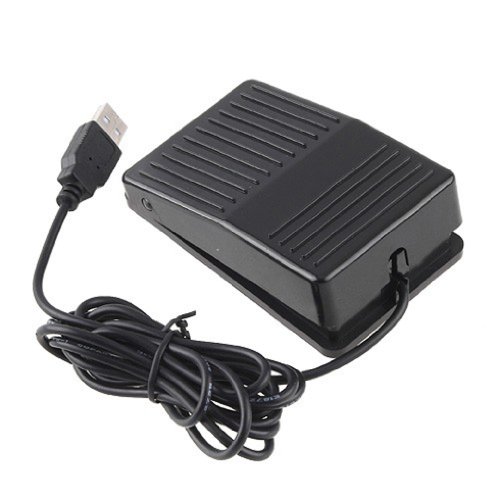
This is the pedal that buyers literally describe as “a ‘push to talk’ button for video games,” and it’s been doing that exact job reliably for years. The switch measures 3.9 x 2.4 x 1.5 inches, and that extended length tucks comfortably under any desk so you can nudge it into place with your heel. At 4.48 ounces, it’s light enough to be a set-and-forget part of your rig.
The PC Sensor software enables a long-press mapping, which is the key feature for Discord push-to-talk — you hold the pedal down to talk and release to mute, just like holding the T key. It reproduces any keyboard shortcut or single key, and the trigger speed is rated at 0.1 seconds, which matters in shooters where a fast attack command wins the fight. Owners find it stable under the desk and responsive in daily use.
Two limitations keep expectations realistic. First, the compatibility list explicitly excludes Windows 10 — it works with Dos/Windows 2000/XP/Vista/Win 7 and Mac Linux, so newer systems need the software workaround or simply won’t recognize it. Second, the plastic body feels slightly fragile in hand and there’s no activation click, so you won’t get audio confirmation of a press. It’s a purpose-built, no-frills talk pedal for gamers on older or Linux systems.
Best for: gamers on Windows 7 or Linux who want a proven, stable single talk pedal with long-press Discord support.
pass on it if: you’re on Windows 10 or 11 — it’s not supported, and one of the newer models is the safer buy.
6. OLLGEN Metal USB Single Foot Switch

A steel, heavy-duty pedal that telegraphs durability the moment you step on it.
This is the pick when you want your foot control to feel like industrial equipment. The all-metal housing is “big honking metal” per one owner, built to survive years of stomping in demanding environments, and its compact 4.65 x 2.99 x 0.79-inch footprint stays put under a desk. It simulates keyboard and mouse shortcuts, handling single keys, combinations, hotkeys, and multimedia actions through free downloadable software.
For push-to-talk, customers note it works “perfectly” for toggling a mic on and off, with zero delay between the press and the action — useful for Discord and Zoom meetings. The application list reads like a factory floor: sewing machines, machine tools, medical equipment, and instruments, plus office computers. The steel construction is the entire story, and sturdiness is exactly what owners praise most.
But this one comes with real setup friction. It is not plug-and-play — the plug carries a programmable circuit that must be initialized with primitive software downloaded from a website, which some owners dislike trusting. The switch has no tactile click or feedback, so you get no confirmation beyond the software’s visual cue. And an occasional unit has arrived defective or without enough clearance to depress at all. It’s sturdy where others are flimsy, but it asks for patience at setup and carries more variance in quality than the top picks.
Why owners stay
- Steel housing feels indestructible under daily stomping
- Action registers with no delay, per owner reports
- Versatile across gaming, medical, and machine-tool use
The honest friction
- Requires driver download from a third-party site before any OS recognizes it
- No tactile click means you can’t feel the press register
- Quality varies — some units arrive with no switch clearance
Reach for this if: you want a steel pedal that shrugs off heavy use and you’re comfortable installing a driver.
Look elsewhere if: you want true plug-and-play simplicity — this demands configuration before first use.
7. iKKEGOL Upgraded USB Foot Pedal Switch (Single Pedal)

An affordable, ergonomic single pedal that’s the natural first step into hands-free talk.
If you’re new to foot-controlled push-to-talk and want a low-risk entry, the upgraded 2020 design is it. It’s a standard HID device (a plug-and-play gadget your PC recognizes without extra drivers) that works as a programmable keyboard and mouse triggered by your foot, and it’s rated to bear over 100 kg of weight — the same durability figure as the pricier aluminum model. Four TPU rubber pads on the base help it stay put on hard floors, and the wide pedal surface with minimal resistance is meant for long comfort sessions.
Owners call it “responsive, sturdy” for daily use and praise the user-friendly software that remaps the pedal to any key — one uses 8/9/0 for games, another toggles mute in MS Teams perfectly. The audible click gives clear press feedback, which the silent optical pedals lack. It’s built for free-hands scenarios across Discord push-to-talk, Zoom, transcription, medical, and factory test work.
The honesty check: durability and responsiveness both earn mixed feedback. Some reviewers point out units breaking within weeks or developing dead clicks, which is the kind of variance you accept at this price tier. The ergonomics also split opinions — a few find it hard to position the foot and trigger it accidentally, and the clicking sound annoys some. The software setup can be confusing the first time, and there’s no Linux web tool. For the price, it’s a solid intro, just not the one for heavy daily abuse.
Entry-level call: The easy setup and user-friendly remapping software are what win owners over, making this the least intimidating first pedal.
Buyer beware: Quality control is the weak spot — an occasional unit dies within weeks, so test it hard during the return window.
Best for: first-time buyers who want a cheap, easy-to-configure single pedal for Discord or Zoom.
Not for: daily professional use — durability reports are too mixed to trust it as a workhorse.
Understanding the Specs
Switch type: mechanical vs. optical
Mechanical switches use a physical contact that closes when pressed, producing an audible click and a tactile bump you can feel. Optical (photoelectric) switches use a light beam that gets blocked by the press, so they make no sound at all. Choose mechanical if you want confirmation feedback; choose optical for silent rooms where every click gets picked up by your mic.
HID device and software mapping
HID stands for Human Interface Device, meaning the pedal acts like a keyboard the computer already understands. Most pedals ship as programmable HID devices that need free configuration software to assign a key, key combination, mouse action, or multimedia command. Some store that mapping in onboard memory, so the pedal works on other systems afterward. A few older models require Windows for setup before working on Mac or Linux.
Pedal count and purpose
Single pedals handle one job — usually push-to-talk or mute. Triple pedals let you separate talk, mute, and a third shortcut like play/pause without remapping constantly. If your voice app supports hotkey-based push-to-talk and you only need one command, a single pedal is simpler. If you stream or transcribe, three pedals earn their space by keeping multiple actions under foot.
Signal type: USB emulation vs. XLR cut
USB pedals emulate keyboard presses, which means they work in any app that recognizes a hotkey, but only when that app is in focus. XLR mute buttons physically cut the analog mic signal at the cable instead, so they work in every program at once and never depend on which window is active. XLR buttons only help if your microphone connects via XLR, not USB.
FAQ
Will a USB foot pedal work with Discord push to talk?
Does an XLR mute button work with a USB microphone?
Why does my foot pedal only work when a certain app is open?
Can I use a programmable USB foot pedal on a Mac?
What is the difference between a momentary mute button and a toggle switch?
How do I stop my foot pedal from sliding on hardwood floors?
Is a silent optical pedal better than a mechanical one for streaming?
Can I connect more than one foot pedal to the same computer?
How long does a USB foot pedal typically last with daily use?
Do I need special software to use a foot switch with Windows 11?
Final Thoughts: The Verdict
The button for push to talk that fits most people is the iKKEGOL USB Double Foot Switch — it pairs two mapped actions with a 100 kg-rated aluminum base, and its years-long reliability record makes it the most dependable all-rounder for most users.. For studio XLR mics, the Kopul Mute/Talk Button is the true professional’s choice, cutting signal at the cable with 85 dB of attenuation (a measure of how much the signal is reduced). And if silent operation matters most for your streams, the iKKEGOL full-quiet optical pedal delivers completely noise-free presses for a modest price.
How We Picked
We do not accept paid placement. Every pick is matched to a real buyer and a real use-case; we do not hands-on test units.
Sources & Methodology
Specifications: manufacturer listings and product documentation. Review insights: verified customer reviews, as of August 2026. Pricing: not shown on this page (it changes often); check the current price via the retailer link.
As an Amazon Associate, FitlyFast earns from qualifying purchases. This does not affect which products we feature.