
Our readers keep the lights on and the weekend projects moving. As an Amazon Associate, I earn from qualifying purchases.
Specs are compiled from manufacturer listings and verified buyer reviews and can change over time — please confirm the key details on the product page before buying.
If you’ve ever stared at a wall of drywall or a stretch of lawn with a dead sprinkler, you know the real question isn’t “where is the wire” — it’s “which tool finds it without making me tear everything apart?” That’s what this guide answers: which cable locators actually live up to the promise of finding buried or hidden wires, and which ones just beep at you. You’ll learn what depth and range numbers really mean, why some locators only work on certain types of wire, and how to match a tool to your specific job, from tracing a dog fence break to scanning a concrete wall before drilling.
I’m Rikta — the founder and writer behind FitlyFast. This guide is built by comparing the manufacturers’ published specifications and the patterns across verified customer reviews, so you get each pick’s real strengths and trade-offs instead of marketing spin.
We’ve separated the dependable workhorses from the finicky ones, so you can confidently choose the right cable locator for your next project without wasting money on a tool that can’t handle the job.
Our Picks at a Glance


How To Choose The Best Cable Locator
Finding a hidden wire isn’t about brand names — it’s about matching the tool to the wire’s location and type. A toner and probe kit works great for tracing a single wire inside a bundle, but it won’t help you find a break buried three feet underground. You need to know what you’re hunting for before you buy.
Depth and Range: The Limits of the Hunt
Every locator lists a maximum depth and length it can trace. A basic toner might reach 1000 feet in length, but only a few inches deep. If you need to find a fence wire buried a foot down, a wall scanner won’t cut it — you’ll need a dedicated underground tracer that can penetrate soil.
Wire Type: Single-Core vs. Multi-Core
Many budget-friendly underground locators are designed for single-strand or double-strand wires only. If you try to trace a multi-core bundle, the signal gets muddled and the tool won’t work. Check the product’s stated wire compatibility before buying, or you might end up with a tool that can’t see your cable at all.
Quick Comparison
| Model | Best For | Max Depth | Max Range | Wire Type | Amazon |
|---|---|---|---|---|---|
| Tempo 701K-G★ Best Overall | In-wall tone tracing | — | — | Voice, data, video | Amazon |
| FNIRSI WD-01Best Value | Drywall stud & wire scan | Up to 1.5″ (studs) | — | Wood, metal, AC wire | Amazon |
| VXSCAN F04Best for Fences | Buried dog fence breaks | 2–3 feet | 1000 feet | Single/Double strand only | Amazon |
| VXSCAN F04 (Blue) | Buried cables & pipes | 2–3 feet | 1000 feet | Single/Double strand only | Amazon |
| KOLSOL F02 | Simple buried wire tracing | 2 feet | 1000 feet | Single/Double core only | Amazon |
| Rocky Mars RM826 | Deep buried line tracing | 3–4 feet | 2000 feet | Multi-core capable | Amazon |
| Bosch D-tect 120 | Radar wall scanning | — | — | All materials (radar) | Amazon |
| Tempo 501 Tracker II | Professional underground use | 7 feet | 4000 feet | Metal pipes & wires | Amazon |
| RIDGID NaviTrack Scout | Sonde & pipe locating | — | — | Sondes & lines | Amazon |
In‑Depth Reviews
1. TEMPO Communications 701K-G Wire Tracer
Our pick — over 4.5★ from 450+ verified ratings; the strongest balance of quality and price.
The industry-standard toner that finds a single wire inside a dense bundle, even through drywall.
When a camera doorbell needs hardwiring and the old wires vanish into the wall, this is the kit that brings them back. The 701K-G pairs a high-power tone generator with a probe amplifier, and the LED proximity light glows brighter as you close in on the right pair — a huge help for someone tracing unfamiliar wiring. Owners describe it as a sanity-saver for exactly this scenario, tracking a dead circuit through drywall and avoiding a costly electrician call-out.
It’s built for voice, data, video, and security alarm wiring, and it ships with the modular plug, RJ11/45 adapter, and alligator test leads you’d expect from a serious kit. At 13.6 ounces and a 150-volt maximum operating voltage, it’s a lightweight but capable bench tool. The build quality is what owners praise most — it feels like a professional instrument, not a toy.
The trade-off is that it’s not an underground tracer. If you have a buried dog fence break, this won’t help you. Also, the tone generator doesn’t change its sound when you short the leads, which makes confirming continuity a bit annoying. But for finding a specific wire behind a wall, it’s the one that just works.
What Wins People Over
- LED proximity indicator brightens as you near the target pair
- Complete kit with alligator leads and RJ11/45 adapter
- Weighs just 13.6 ounces for easy one-handed use
The Honest Shortfalls
- No tone change on shorted leads for continuity checks
- Not designed for underground or buried wire tracing
Reach for this if: you need to trace a single wire behind drywall, ceilings, or inside a panel — the classic toner job.
Look elsewhere if: your project is a buried fence line; you’ll need a dedicated underground tracer instead.
2. FNIRSI WD-01 6-in-1 Stud Finder
A rechargeable wall scanner that finds studs, metal, and live AC wires without burning through batteries.
Before you drill into a wall to run a new cable, you need to know what’s behind it — and this 6-in-1 scanner covers the bases. It reads wood and metal studs up to 1.5 inches deep in depth-scan mode, and it can spot live, unshielded AC wires up to 2 inches deep. That’s a lot of safety information for a tool that weighs just 9.3 ounces.
The built-in rechargeable battery is a standout — people specifically love not having to swap out 9V cells constantly. The LCD screen and audio alarm make it easy to interpret, and auto-calibration means you just place it on the wall and go. It’s lightweight enough to use one-handed while marking your drill points.
The honest catch is that accuracy can be hit-or-miss. Several owners note it occasionally struggles to tell metal from wood, and some report false readings when moving too fast. You’ll want to go slow and double-check before cutting. It’s a solid budget pick for a home DIYer, but not a precision tool for a pro who needs absolute certainty.
Why It’s Handy
- Rechargeable battery removes the constant battery-buying hassle
- Detects live AC wires up to 2 inches deep before you drill
- Auto-calibration for quick one-step wall scans
Know Its Limits
- Occasional false readings or metal/wood mix-ups
- Not a substitute for a dedicated wire toner in bundles
Grab it for: quick home renovations and hanging shelves where you need a general map of studs and wires.
Think twice if: you need to trace a specific cable through a wall — that’s a toner’s job, not a scanner’s.
3. VXSCAN F04 Underground Wire Locator
A budget-friendly tracer that pinpoints a buried dog fence break in inches, saving you a yard-wide dig.
For pet owners, a broken invisible fence wire usually means a long, frustrating afternoon guessing where to dig. This locator cuts through that, finding buried wires and breaks at depths of 2–3 feet and up to 1000 feet in length. The signal stops within inches of the break, which is exactly the precision you need to avoid trenching the whole yard.
It’s an anti-jamming design with adjustable transmission power, so you can dial down the sensitivity as you get close. The included earphones help you hear the signal in noisy environments, and the LED lamp lets you work at dusk.
The catch is that it needs a good ground connection — buyers report you’ll need to rig your own ground stake (it’s not in the box) and connect the black clip to it for a strong signal. It’s also strictly for single or double-strand wire; multi-strand bundles won’t work. And battery drain is noticeably high, so disconnect them when you’re done.
What It Does Well
- Signal stops within inches of the break for precise digging
- Handles depths up to 2–3 feet underground
- Comes with earphones and a work lamp for night use
The Trade-Offs
- Requires a DIY ground stake for reliable signal
- High battery drain if left connected
- Only works on single or double-strand wire
Best for: the DIY pet owner with a dead fence line — it pays for itself on the first fix.
skip it if: your cable is a multi-core bundle; the tool explicitly won’t work on that kind of wire.
4. VXSCAN F04 Cable Locator (Blue)
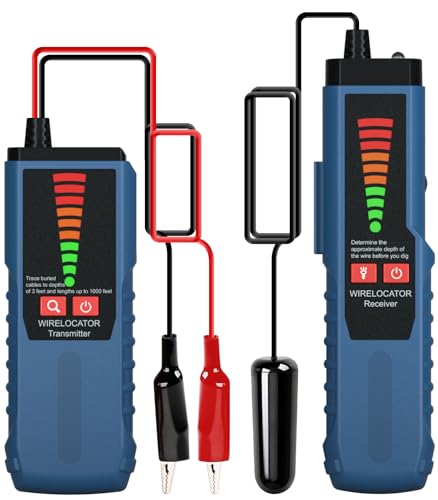
A close sibling to the yellow F04, this one finds buried junction boxes in minutes if the wire is simple.
If your main goal is locating a buried cable or a junction box, this blue VXSCAN gets the job done at an entry-level price. It traces wires up to 1000 feet long and 2–3 feet deep, and owners have found buried junction boxes in as little as three minutes. The included earphone and adjustable volume knob help you sort out the signal in noisy environments, and the built-in LED flashlight is a welcome extra for low-light work.
It shares the same design philosophy as the yellow model — adjustable transmission power to narrow down the exact spot. The tool is genuinely useful for irrigation and pet fence wires, and many owners say it’s worth the cost for a quick DIY fix.
The biggest flaw isn’t the hardware — it’s the instructions. Multiple owners describe them as useless, using vague terms without explaining what they mean. You may need to fiddle with the transmitter’s sensitivity to get a usable reading. It’s also limited to single or parallel double-strand wires, so check your cable before you commit.
Quick Wins
- Can locate a buried junction box in minutes
- Adjustable volume knob and earphone for noisy areas
- LED flashlight for dark crawlspaces
Watch Outs
- Poor instruction manual that frustrates first-time users
- Needs manual sensitivity tuning for best results
- Only for single or double-strand wire
Choose this for: a straightforward buried wire or pipe trace at a budget-friendly price.
Pass if: you dislike tinkering; the sensitivity knob needs fiddling to work well.
5. KOLSOL F02 Underground Wire Locator
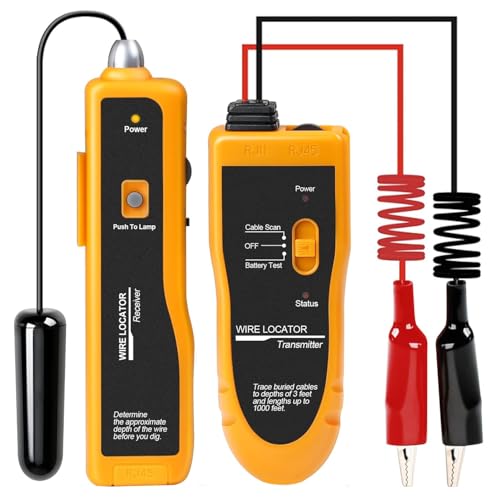
The no-frills tracer that works on bare copper under concrete and rock — if you master the sensitivity dial.
This yellow tracer is for the person who needs a simple tool to find a buried wire without a steep learning curve. It traces up to 2 feet deep and 1000 feet in length, and it’s proven itself tracing copper lines under 4 inches of concrete and 6 inches of rock. It works by clipping the red lead to your cable and the black lead to a ground, which boosts the signal.
The key to success with this model is the side sensitivity roller. Owners who adjust it constantly report excellent results, while those who don’t struggle. When dialed in, you can trace a wire and find the break point with surprising accuracy. It even comes with earbuds to help you hear the tone over wind or traffic.
The build quality is definitely budget-tier — it feels cheaply made, but it’s fine for occasional use. The white-noise hiss is noticeable, and the power toggle has a loud snap. Also, the tone can be extremely loud near the transmitter, so keep the volume low to protect your hearing. And remember, this tool is strictly for non-energized cable — do not use it on live circuits.
What Works
- Traces copper through concrete and rock with sensitivity tuning
- Earbuds help isolate the signal in windy conditions
- Simple red/black clamp setup for tracing
What to Expect
- Feels cheaply built; fine for occasional, not daily, use
- Loud white-noise hiss and a sharp snap on the power switch
- Only for single or double-core wire, not multi-core bundles
Get this if: you want an affordable tracer for a one-off sprinkler or dog fence repair.
Steer clear if: you need a sturdy tool for constant professional work; the build won’t last.
6. Rocky Mars RM826-RE Underground Cable Locator
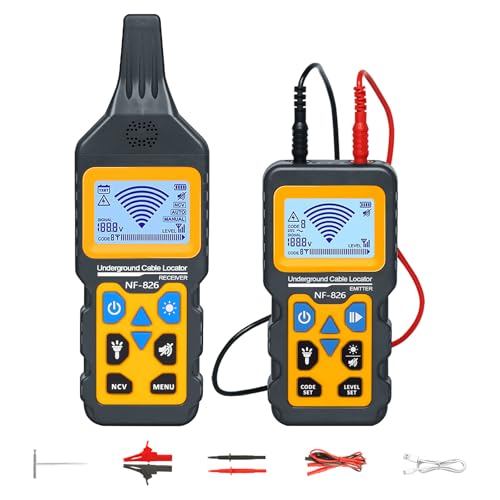
A deep-dive tracer that finds a broken splice four feet underground so you don’t dig up the whole yard.
This is the step-up tool for when you have a serious underground line to find. It traces wires down to 3–4 feet deep and up to 2000 feet in length — nearly double the range of the budget F04 models. Owners have used it to locate a broken splice in an electrical wire four feet under the ground, pinpointing the exact spot for a single repair dig instead of a yard-wide excavation.
It’s packed with features that justify the higher price: a built-in AC/DC voltmeter for measuring 12 to 400V, a self-inspection function, and a backlit LCD screen with flashlight. The receiver sensitivity can be adjusted manually or automatically, which is a big help when you’re switching between a deep buried line and a shallow wall wire. It even handles multi-core cables, provided you ground the other cores — something the cheaper models can’t do.
The learning curve is real, but reviewers report around 95% accuracy once you figure out the sensitivity. The build quality feels solid and it’s good value against the price of a professional locator. The NCV live-voltage detection is weak, but the signal transmitter is excellent for tracing wire in conduit. This is the tool for a serious DIYer or a small contractor who keeps breaking buried lines.
Deep Prowess
- Locks onto wires 3–4 feet deep and up to 2000 feet away
- Built-in AC/DC voltmeter for extra troubleshooting
- Auto and manual sensitivity modes for different jobs
Reality Check
- NCV live-voltage detection is weak compared to the tracer
- Requires a learning curve to hit consistent accuracy
For the serious DIYer: this one handles deep, long traces and multi-core cables that budget models can’t.
Consider skipping if: your work is all shallow and short-run; the extra cost and features go unused.
7. Bosch D-tect 120 Wallscanner Professional

A radar-based scanner that sees through concrete and drywall to find pipes, studs, and live wires before you drill.
When a standard stud finder isn’t enough, this Bosch unit uses patented radar technology to detect everything in a wall — live cables, water-filled plastic pipes, even magnetic and non-magnetic metal. The Spot View mode is a standout: it delivers results instantly even when you have no room to slide the scanner along the wall. That’s a lifesaver in tight corners.
It runs on either a 12V Li-ion battery or standard AA batteries via an adapter, giving you flexibility on the job. The IP54 rating means it’s protected against dust and water splashes, which is reassuring on a messy renovation site. It also comes with a center finder and signal strength indicator to help you locate the exact middle of an object.
It shines on concrete and rebar detection, but for simple drywall stud hunting, you might be overpaying. It’s a specialized tool for a specific, high-stakes job: drilling into concrete walls where a mistake is costly.
Standout Abilities
- Radar detects water pipes and non-magnetic metal, not just wires
- Spot View works in tight spaces with no sliding room
- Dual power source: Li-ion battery or AA batteries
Be Aware
- Stud detection can be less reliable than cheaper units on drywall
- Live-wire detection may require a free hand on the wall surface
Best for: concrete renovation work where you need to avoid rebar and water pipes — radar is the only reliable way.
Not for: simple drywall stud hunting; a cheaper scanner does that just as well for far less.
8. TEMPO Communications 501 Tracker II
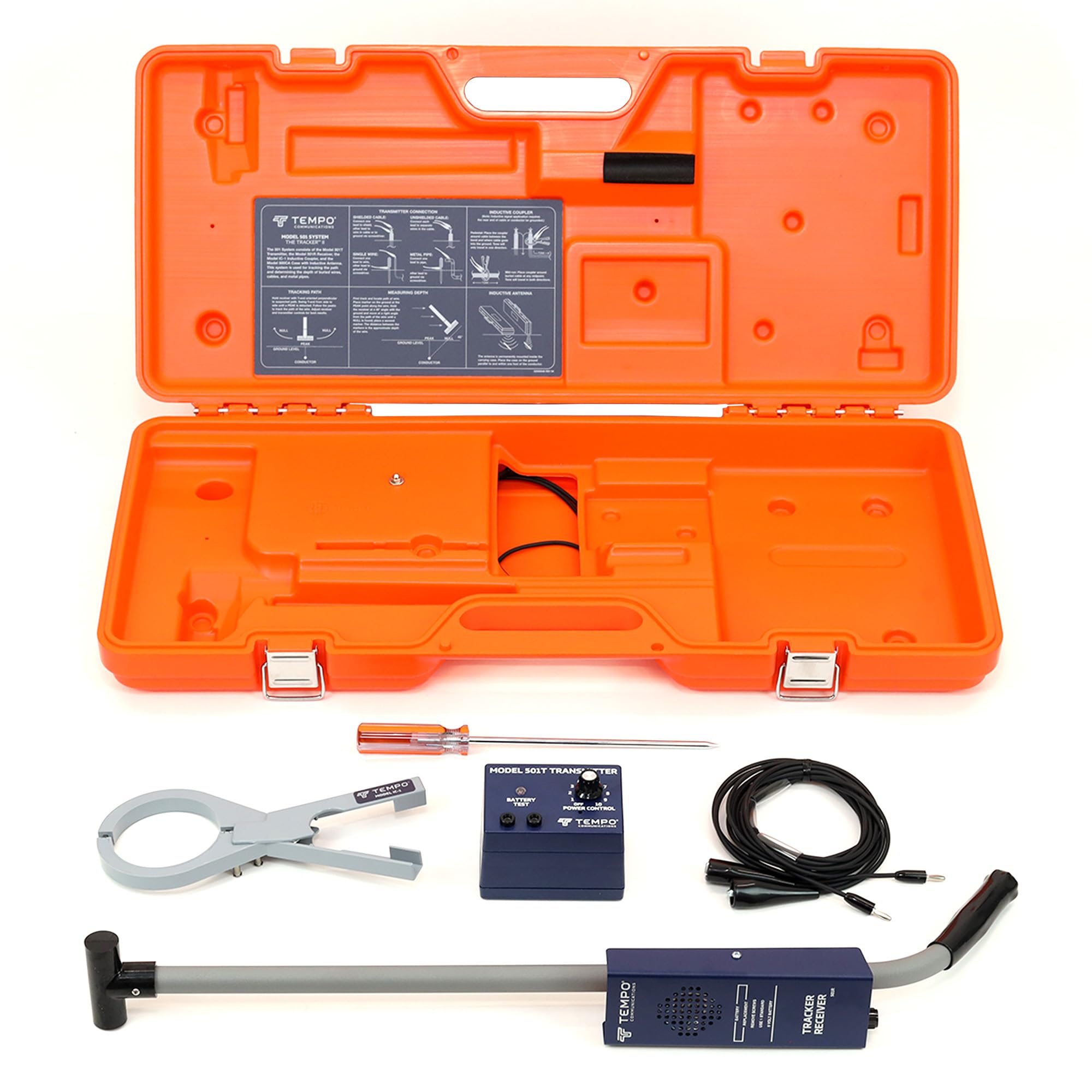
The heavy-duty pro locator that traces a buried wire 7 feet down across 4000 feet of property line.
For contractors and serious landowners, the 501 Tracker II is the real deal. It can isolate and trace buried conductors over distances of 4,000 feet at depths of 7 feet. It’s the tool you reach for when you need to map out an entire underground utility line, not just find a single break. Owners have successfully traced buried Cat6 cable across 1000 feet and live power lines across 400 feet.
It works on active or dead systems thanks to inductive signal detection, and it includes a transmitter, receiver, inductive coupler clamp, and a durable polyethylene case. You get multiple connection options — direct connection, inductive clamp, or inductive antenna — so you can adapt to whatever you’re tracing. The transmitter output and receiver sensitivity are fully adjustable, which is essential for zeroing in on a deep target.
The build is surprisingly light given its 8-pound weight with the case, and it’s been described as simple and effective, with one long-time user relying on it for 25 years. The accuracy is solid, though some users report inconsistent readings in certain soil conditions. It’s a professional investment, but for someone who digs up buried lines regularly, it’s far cheaper than the repair costs it prevents.
Pro-Level Power
- Traces up to 7 feet deep and 4,000 feet in length
- Works on live or dead systems via inductive detection
- Complete kit: transmitter, receiver, clamp, and case
Pro-Level Cost
- Serious investment — the most expensive Tempo here
- Occasional inconsistent readings depending on soil type
For the professional: this is the workhorse that maps entire buried networks without digging blind.
Overkill if: you only need to find one shallow break; the budget models handle that fine.
9. RIDGID NaviTrack Scout Locator
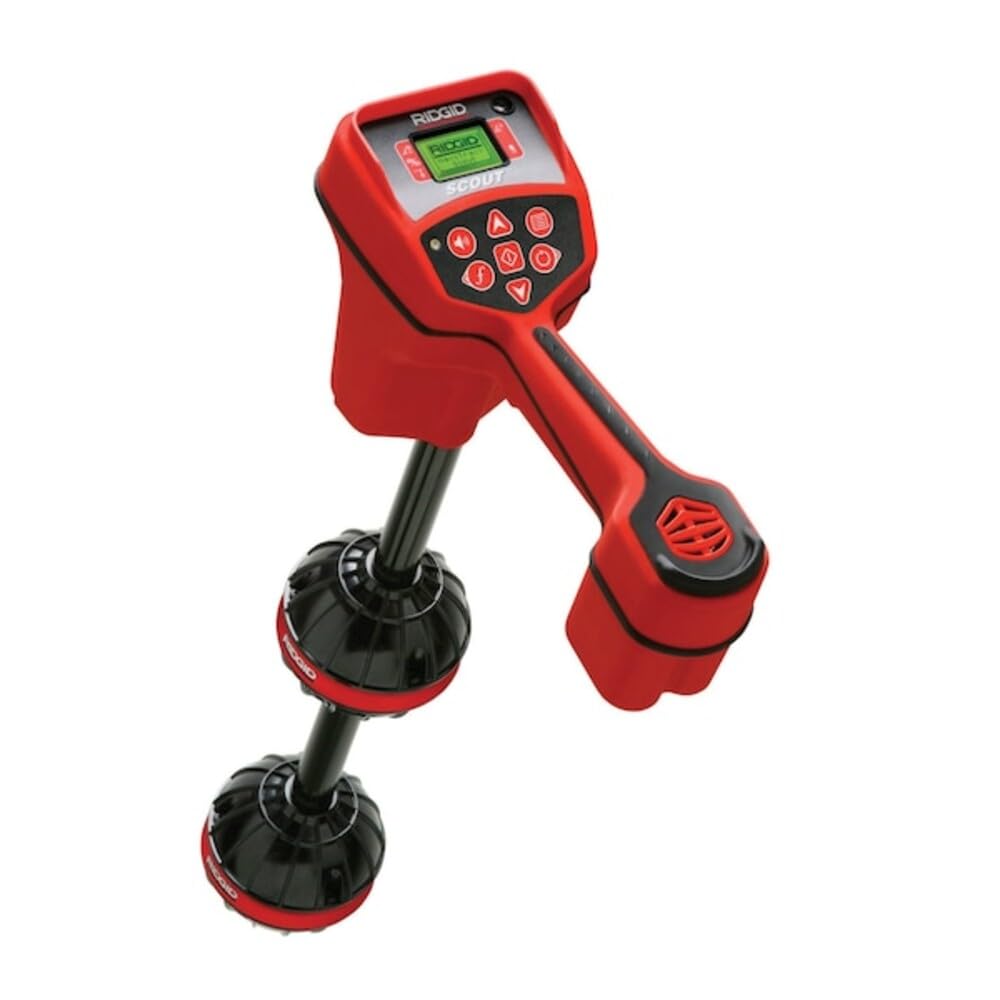
The sonde-finder that locks onto a pipe transmitter with pinpoint accuracy and on-screen depth readouts.
If you’re in the septic or plumbing business, this is the specialized tool that finds the exact spot of a buried pipe or a sonde transmitter. It pairs with SeeSnake inspection cameras and remote transmitters, using multi-directional antenna technology to eliminate the false peaks and nulls that plague cheaper locators. The digital readout gives you real-time signal strength, so you know when you’re directly on target.
It offers 4 sonde frequencies and 5 line-trace modes, giving you flexibility for different locating jobs. The micro-mapping feature verifies your position with on-screen markers, and depth calculations display automatically when you’re over the target. It’s accurate to within 1 foot of the transmitter, according to owners, which is impressive for underground work.
The biggest strength is precision — it’s a tool pros trust for critical locates. The average battery life is 18 hours on 4 C-cell batteries, which means it’ll last through long workdays. But at this price point, it’s a serious investment for a serious business. And a few owners mention durability issues, with one unit breaking after only six uses. It’s the most expensive pick here, but for a plumber who needs to find a septic line, it’s the tool that pays for itself.
Precision Locating
- Accurate to within 1 foot of the transmitter
- 4 sonde and 5 line-trace frequencies for flexibility
- Auto depth calculation when over the target
Know Before Buying
- Very expensive — built for professional, not casual, use
- Some customers note durability issues after a handful of uses
For the septic or plumbing pro: the accuracy and sonde compatibility make it a non-negotiable tool on the truck.
Avoid for home use: the cost and complexity don’t make sense for a single DIY locate.
Understanding the Specs
Depth vs. Range
Depth tells you how far down a cable can be buried and still be detected. Range is the maximum length of the wire you can trace from the transmitter. A tool like the Tempo 501 can go 7 feet deep and 4000 feet long, while a budget tracer might only reach 2 feet deep. Match these numbers to your actual job.
Tone vs. Radar vs. Signal
A tone generator sends a signal you hear through a probe. A radar scanner like the Bosch uses radio waves to see through walls. An inductive tracer pushes a signal through a disconnected wire and follows it. Each serves a different purpose: tone for finding a wire in a bundle, radar for walls, inductive for buried lines.
FAQ
Why won’t my cable locator work on a multi-core wire?
Can I use a wall scanner like the FNIRSI WD-01 to find a buried dog fence wire?
What does the LED proximity indicator on the Tempo 701K-G tell me?
Is it safe to use an underground locator on a live electrical circuit?
How deep can each of these locators actually detect a wire?
Why does an underground tracer need a ground stake connection?
What is the difference between a stud finder and a cable locator?
How long do the batteries last in these locators?
Will a cable locator find a break in my sprinkler system wire?
What is the “Spot View” mode on the Bosch D-tect 120?
Final Thoughts: The Verdict
If you want one dependable pick, the cable locator winner is the Tempo 701K-G because it nails the most common DIY pain: finding a single wire inside a wall bundle with precision. If you want to scan walls for studs and live wires before drilling, grab the {“@context”: “https://schema.org”, “@graph”: [{“@type”: “ItemList”, “name”: “9 Best Cable Locator”, “url”: “https://fitlyfast.com/best-cable-locator/”, “numberOfItems”: 9, “itemListElement”: [{“@type”: “ListItem”, “position”: 1, “name”: “TEMPO Communications 701K-G Wire Tracer”, “url”: “https://fitlyfast.com/best-cable-locator/#product-1”}, {“@type”: “ListItem”, “position”: 2, “name”: “FNIRSI WD-01 6-in-1 Stud Finder”, “url”: “https://fitlyfast.com/best-cable-locator/#product-2”}, {“@type”: “ListItem”, “position”: 3, “name”: “VXSCAN F04 Underground Wire Locator”, “url”: “https://fitlyfast.com/best-cable-locator/#product-3”}, {“@type”: “ListItem”, “position”: 4, “name”: “VXSCAN F04 Cable Locator (Blue)”, “url”: “https://fitlyfast.com/best-cable-locator/#product-4”}, {“@type”: “ListItem”, “position”: 5, “name”: “KOLSOL F02 Underground Wire Locator”, “url”: “https://fitlyfast.com/best-cable-locator/#product-5”}, {“@type”: “ListItem”, “position”: 6, “name”: “Rocky Mars RM826-RE Underground Cable Locator”, “url”: “https://fitlyfast.com/best-cable-locator/#product-6”}, {“@type”: “ListItem”, “position”: 7, “name”: “Bosch D-tect 120 Wallscanner Professional”, “url”: “https://fitlyfast.com/best-cable-locator/#product-7”}, {“@type”: “ListItem”, “position”: 8, “name”: “TEMPO Communications 501 Tracker II”, “url”: “https://fitlyfast.com/best-cable-locator/#product-8”}, {“@type”: “ListItem”, “position”: 9, “name”: “RIDGID NaviTrack Scout Locator”, “url”: “https://fitlyfast.com/best-cable-locator/#product-9”}]}, {“@type”: “Product”, “position”: 1, “name”: “TEMPO Communications 701K-G Wire Tracer”, “image”: “https://m.media-amazon.com/images/I/512h-54BNqL.jpg”, “brand”: {“@type”: “Brand”, “name”: “TEMPO”}, “url”: “https://www.amazon.com/dp/B083Z7V7C2/?tag=fitlyfast00-20”, “offers”: {“@type”: “Offer”, “url”: “https://www.amazon.com/dp/B083Z7V7C2/?tag=fitlyfast00-20”}}, {“@type”: “Product”, “position”: 2, “name”: “FNIRSI WD-01 6-in-1 Stud Finder”, “image”: “https://m.media-amazon.com/images/I/61NrNpFKh0L.jpg”, “brand”: {“@type”: “Brand”, “name”: “FNIRSI”}, “url”: “https://www.amazon.com/dp/B0B9JCWBRQ/?tag=fitlyfast00-20”, “offers”: {“@type”: “Offer”, “url”: “https://www.amazon.com/dp/B0B9JCWBRQ/?tag=fitlyfast00-20”}}, {“@type”: “Product”, “position”: 3, “name”: “VXSCAN F04 Underground Wire Locator”, “image”: “https://m.media-amazon.com/images/I/41hOn+kpI-L.jpg”, “brand”: {“@type”: “Brand”, “name”: “VXSCAN”}, “url”: “https://www.amazon.com/dp/B0C3CCX22Y/?tag=fitlyfast00-20”, “offers”: {“@type”: “Offer”, “url”: “https://www.amazon.com/dp/B0C3CCX22Y/?tag=fitlyfast00-20”}}, {“@type”: “Product”, “position”: 4, “name”: “VXSCAN F04 Cable Locator (Blue)”, “image”: “https://m.media-amazon.com/images/I/41+VK7ZghHL.jpg”, “brand”: {“@type”: “Brand”, “name”: “VXSCAN”}, “url”: “https://www.amazon.com/dp/B0FLXSG1ZC/?tag=fitlyfast00-20”, “offers”: {“@type”: “Offer”, “url”: “https://www.amazon.com/dp/B0FLXSG1ZC/?tag=fitlyfast00-20”}}, {“@type”: “Product”, “position”: 5, “name”: “KOLSOL F02 Underground Wire Locator”, “image”: “https://m.media-amazon.com/images/I/41zjf0kPIhL.jpg”, “brand”: {“@type”: “Brand”, “name”: “KOLSOL”}, “url”: “https://www.amazon.com/dp/B08NP2D4BD/?tag=fitlyfast00-20”, “offers”: {“@type”: “Offer”, “url”: “https://www.amazon.com/dp/B08NP2D4BD/?tag=fitlyfast00-20”}}, {“@type”: “Product”, “position”: 6, “name”: “Rocky Mars RM826-RE Underground Cable Locator”, “image”: “https://m.media-amazon.com/images/I/41mHg+7FtZL.jpg”, “brand”: {“@type”: “Brand”, “name”: “Rocky”}, “url”: “https://www.amazon.com/dp/B0FVF1XBDN/?tag=fitlyfast00-20”, “offers”: {“@type”: “Offer”, “url”: “https://www.amazon.com/dp/B0FVF1XBDN/?tag=fitlyfast00-20”}}, {“@type”: “Product”, “position”: 7, “name”: “Bosch D-tect 120 Wallscanner Professional”, “image”: “https://m.media-amazon.com/images/I/61gS6TKoOzL.jpg”, “brand”: {“@type”: “Brand”, “name”: “Bosch”}, “url”: “https://www.amazon.com/dp/B00PJ2Q1JI/?tag=fitlyfast00-20”, “offers”: {“@type”: “Offer”, “url”: “https://www.amazon.com/dp/B00PJ2Q1JI/?tag=fitlyfast00-20”}}, {“@type”: “Product”, “position”: 8, “name”: “TEMPO Communications 501 Tracker II”, “image”: “https://m.media-amazon.com/images/I/71X4-WARb3L.jpg”, “brand”: {“@type”: “Brand”, “name”: “TEMPO”}, “url”: “https://www.amazon.com/dp/B001GHZP24/?tag=fitlyfast00-20”, “offers”: {“@type”: “Offer”, “url”: “https://www.amazon.com/dp/B001GHZP24/?tag=fitlyfast00-20”}}, {“@type”: “Product”, “position”: 9, “name”: “RIDGID NaviTrack Scout Locator”, “image”: “https://m.media-amazon.com/images/I/512aLrD7dcL.jpg”, “brand”: {“@type”: “Brand”, “name”: “RIDGID”}, “url”: “https://www.amazon.com/dp/B0015B5AJY/?tag=fitlyfast00-20”, “offers”: {“@type”: “Offer”, “url”: “https://www.amazon.com/dp/B0015B5AJY/?tag=fitlyfast00-20”}}, {“@type”: “FAQPage”, “mainEntity”: [{“@type”: “Question”, “name”: “Why won’t my cable locator work on a multi-core wire?”, “acceptedAnswer”: {“@type”: “Answer”, “text”: “Most budget-friendly underground tracers use a single signal that gets muddled in a multi-core bundle. The VXSCAN F04 and KOLSOL F02 explicitly state they only work on single or double-strand wire. If you have a multi-core cable, you’ll need a higher-end locator like the Rocky Mars RM826, which requires you to ground the other cores.”}}, {“@type”: “Question”, “name”: “Can I use a wall scanner like the FNIRSI WD-01 to find a buried dog fence wire?”, “acceptedAnswer”: {“@type”: “Answer”, “text”: “No. A wall scanner is designed to detect objects through drywall or concrete up to a few inches deep, not through soil. For a buried fence wire, you need an underground tracer like the VXSCAN F04 or the Tempo 501, which push a signal through the wire itself.”}}, {“@type”: “Question”, “name”: “What does the LED proximity indicator on the Tempo 701K-G tell me?”, “acceptedAnswer”: {“@type”: “Answer”, “text”: “The LED proximity indicator on the Tempo 701K-G glows brighter as you get closer to the correct wire pair. It’s a visual confirmation that works alongside the audible tone, so you can trace a wire in a bundle with confidence, even in noisy environments.”}}, {“@type”: “Question”, “name”: “Is it safe to use an underground locator on a live electrical circuit?”, “acceptedAnswer”: {“@type”: “Answer”, “text”: “Only specific models are rated for use on live circuits. The Tempo 501 Tracker II works on active systems. However, the KOLSOL F02 explicitly warns against using it on live circuits — you must shut the power off first. Always check your product’s specifications and warnings before connecting to any wire.”}}, {“@type”: “Question”, “name”: “How deep can each of these locators actually detect a wire?”, “acceptedAnswer”: {“@type”: “Answer”, “text”: “The depth varies significantly by model. The budget KOLSOL F02 reaches 2 feet deep. The VXSCAN F04 models go down to 2–3 feet. The Rocky Mars RM826 extends that to 3–4 feet. The pro-level Tempo 501 reaches an impressive 7 feet deep.”}}, {“@type”: “Question”, “name”: “Why does an underground tracer need a ground stake connection?”, “acceptedAnswer”: {“@type”: “Answer”, “text”: “The ground stake completes the circuit for the transmitter’s signal. The VXSCAN F04 requires you to connect the black clip to a ground stake to enhance the signal strength. Without a good ground connection, the signal may be too weak to accurately trace the buried wire.”}}, {“@type”: “Question”, “name”: “What is the difference between a stud finder and a cable locator?”, “acceptedAnswer”: {“@type”: “Answer”, “text”: “A stud finder like the FNIRSI WD-01 scans through a wall to find the framing studs and other objects in one spot. A cable locator traces the path of a specific wire to find its end or break. If you’re hanging a shelf, use a stud finder. If you’re troubleshooting a broken wire, use a locator.”}}, {“@type”: “Question”, “name”: “How long do the batteries last in these locators?”, “acceptedAnswer”: {“@type”: “Answer”, “text”: “Battery life depends on the model and battery type. The RIDGID NaviTrack Scout runs for about 18 hours on 4 C-cell batteries. The FNIRSI WD-01 is rechargeable, which owners say lasts a long time. The KOLSOL F02 and VXSCAN models tend to drain batteries quickly, so it’s wise to disconnect them when not in use.”}}, {“@type”: “Question”, “name”: “Will a cable locator find a break in my sprinkler system wire?”, “acceptedAnswer”: {“@type”: “Answer”, “text”: “Yes, an underground tracer works well for sprinkler wires. The VXSCAN F04 and Rocky Mars RM826 have both been used to locate broken irrigation wires. The key is connecting the transmitter to the specific wire you suspect is broken and following the signal until it stops — that’s where the break is.”}}, {“@type”: “Question”, “name”: “What is the \”Spot View\” mode on the Bosch D-tect 120?”, “acceptedAnswer”: {“@type”: “Answer”, “text”: “Spot View is a Bosch feature that delivers immediate results even when you have very little space to move the scanner across the wall. Instead of sliding the unit, you hold it still and it scans the area directly underneath, making it useful for tight corners or behind pipes.”}}]}]}