
Our readers keep the lights on and the weekend projects moving. As an Amazon Associate, I earn from qualifying purchases.
Specs are compiled from manufacturer listings and verified buyer reviews and can change over time — please confirm the key details on the product page before buying.
Setting up a home gym usually means squeezing a squat rack, a lat pulldown, and a cable crossover into one corner — and that rarely works. An all-in-one cable tower solves that by stacking those stations into one frame, so you get the full range of cable exercises without the clutter. This guide breaks down the best cable towers for home gyms, from all-in-one power cages to dedicated functional trainers, so you can match a machine to your space, your lifting goals, and your ceiling height.
I’m Rikta — the founder and writer behind FitlyFast. This guide is built by comparing the manufacturers’ published specifications and the patterns across verified customer reviews, so you get each pick’s real strengths and trade-offs instead of marketing spin.
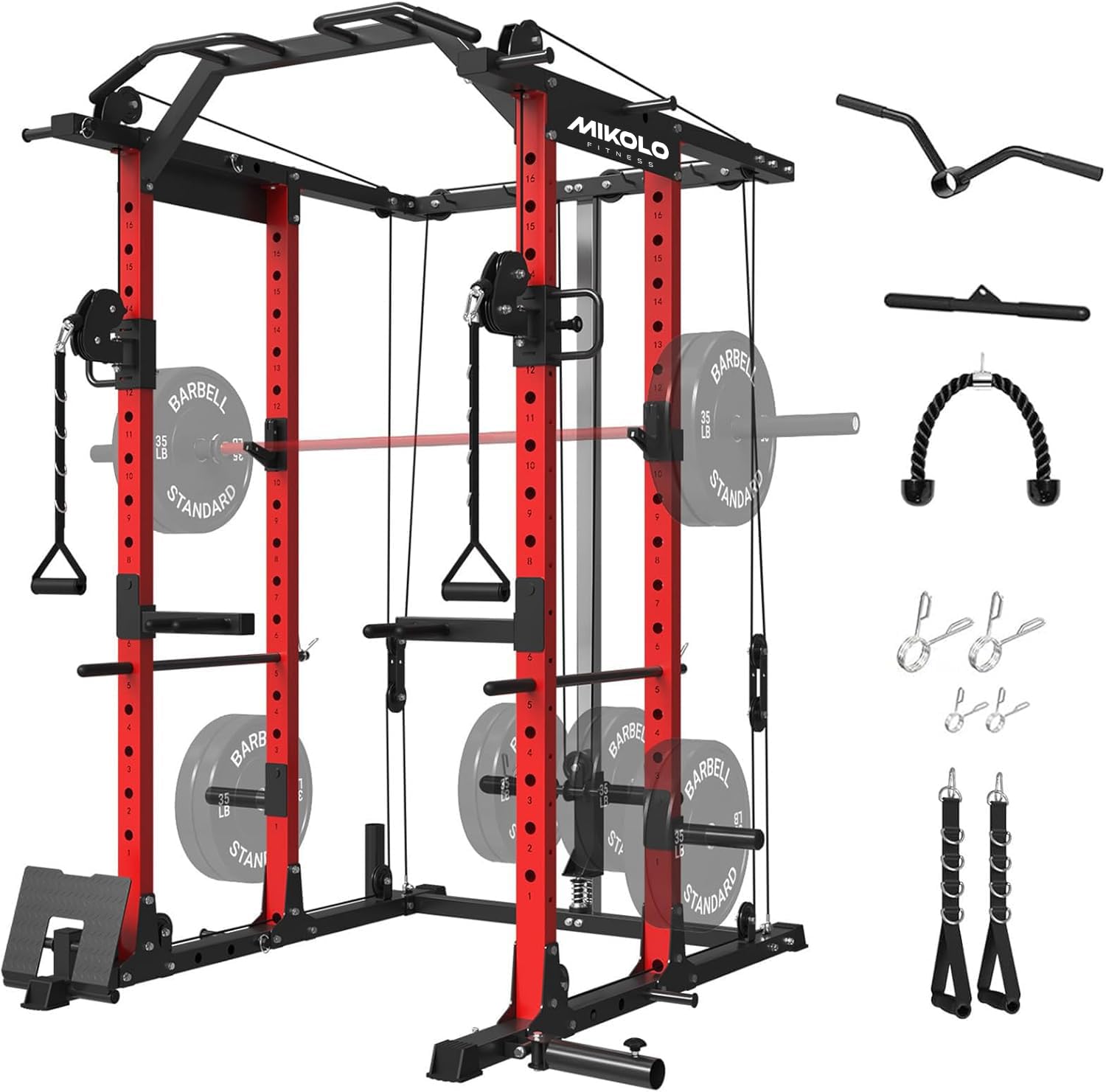
You want a cable tower for home gym that lets you do many exercises without a jerky pulley. The Mikolo K6 delivers that with a 1500-pound frame and eight workout stations, earning a 4.6-star rating from 200+ owners who call it a simple-to-assemble starter rack with good value.
Our Picks at a Glance

How To Choose The Best Cable Tower For Home Gym
Before you buy, you need to match the machine to three things: your floor space, your ceiling height, and the heaviest weight you actually plan to lift. A cable tower that doesn’t fit your room or can’t handle your training style will frustrate you no matter how well it’s built.
Pulley ratio: 1:1 vs 2:1
The pulley ratio tells you how the weight feels compared to what you load. A 1:1 ratio means the weight you load is the weight you feel — load 50 pounds, you lift 50 pounds. A 2:1 ratio means the resistance is halved, so a 100-pound stack feels like 50 pounds, but you get a longer range of motion. Power cages with plate-loaded pulleys often use 1:1, while weight-stack machines frequently use 2:1 to smooth out the motion.
Frame stability and weight capacity
A tower that wobbles during lat pulldowns or dips is dangerous and annoying. Look at the frame’s steel gauge and its rated capacity — but treat the max number with some skepticism. A 2000-pound rating on a lightweight frame is marketing, not a daily-use number. What matters more is how the base spreads out and whether buyers report sway during heavy cable work.
The attachment kit
The attachments determine how many exercises you can actually do. A good kit includes a lat pulldown bar, a tricep rope, cable handles, and usually a landmine or T-bar. Count what’s in the box before you compare prices, since some towers bundle far more than others.
Quick Comparison
| Model | Best For | Frame Capacity | Pulley Ratio | Footprint (D x W) | Amazon |
|---|---|---|---|---|---|
| Mikolo K6★ Best Overall | All-in-one value | 1500 lbs | 2:1 | 67.5″ x 56.5″ | Amazon |
| Goimu C1-V4Budget Champion | Budget starter | 2000 lbs | 1:1 | 57.56″ x 44.72″ | Amazon |
| Body-Solid PCCO90XCrossover Classic | Cable crossover purists | — | — | 39″ x 112″ | Amazon |
| Mikolo HR05 | Independent pulleys | 2000 lbs | 1:1 | 53.4″ x 46″ | Amazon |
| Sportsroyals | Biggest attachment kit | 1600 lbs | 1:2 | 67.9″ x 61.9″ | Amazon |
| Eonfit E3 | Smith machine combo | 1200 lbs | — | 62.5″ x 71″ | Amazon |
| MAJOR FITNESS F22 | Dual-user training | 1600 lbs | 2:1 | 82.5″ x 68.9″ | Amazon |
| RitFit M1 Pro | Smith + cable combo | 1850 lbs | — | 64.5″ x 68.1″ | Amazon |
| Body-Solid PFT100 | True weight stacks | — | 1/2: 1 | 42.3″ x 62.6″ | Amazon |
| pooboo P43 | Full kit + bench | 2000 lbs | — | 62.9″ x 43.3″ | Amazon |
| Inspire FTX | Compact functional trainer | — | — | 54″ x 40″ | Amazon |
In‑Depth Reviews
1. Mikolo K6 Power Cage
Our pick — over 4.5★ from 200+ verified ratings; the strongest balance of quality and price.
The all-in-one cage that swaps a room full of machines for a single 230-pound frame.
The K6 is the machine you buy when you want a power rack, cable crossover, lat pulldown, and dip station without buying four separate pieces. It combines eight workout stations — power rack, cable crossover, lat pulldown, low row with a footplate, chin-up bar, dip station, core trainer, and resistance station — into one 56.5″L × 67.5″W × 86.4″H footprint. Inside dimensions of 41″ × 60″ are deep enough to fit almost all weight benches, and the 230-pound frame with eight reinforcing tabs holds firm during dips and pull-ups, per owners.
What makes this the crowd favorite is the smooth pulley action — four white rollers glide along the riser and protect it from wear. The 2:1 ratio means the resistance is halved, so a 100-pound plate load feels like 50, which is gentler on joints. Owners mention it lasted over a year of constant use and that the dual pulley system stays flexible for a wide range of exercises. Assembly runs 2 to 3 hours with clear instructions, though a few note minor paint chips on the uprights from shipping.
Some attachments feel hollow, and the trolley bars are short for thick bumper plates — one owner found ~135 pounds max for pulling before plates hit the frame; slim cast iron plates fix that. The 1500-pound capacity is for the frame, not the cable stack, so treat it as a rack rating, not a daily pulley number. For a first home gym that does everything, owners keep recommending this one.
What wins people over
- Quality tops the owner feedback — 51 call it out as the standout trait
- Stability is the next big praise, with 46 mentions of a firm base
- Full attachment kit included: T-bar, lat bar, tricep rope, landmine, J-hooks, dip bars
Where to be patient
- Occasional pulley stick on the washer-spring that needs a nudge
- Plastic pulleys are smooth but not commercial-grade metal
- Pull-up bar is small and can dig into your hands
Reach for this if: you need one machine that does squats, cables, and pulldowns in a single compact footprint.
Look elsewhere if: you plan to stack heavy bumper plates on the cable trolley — slim plates work far better here.
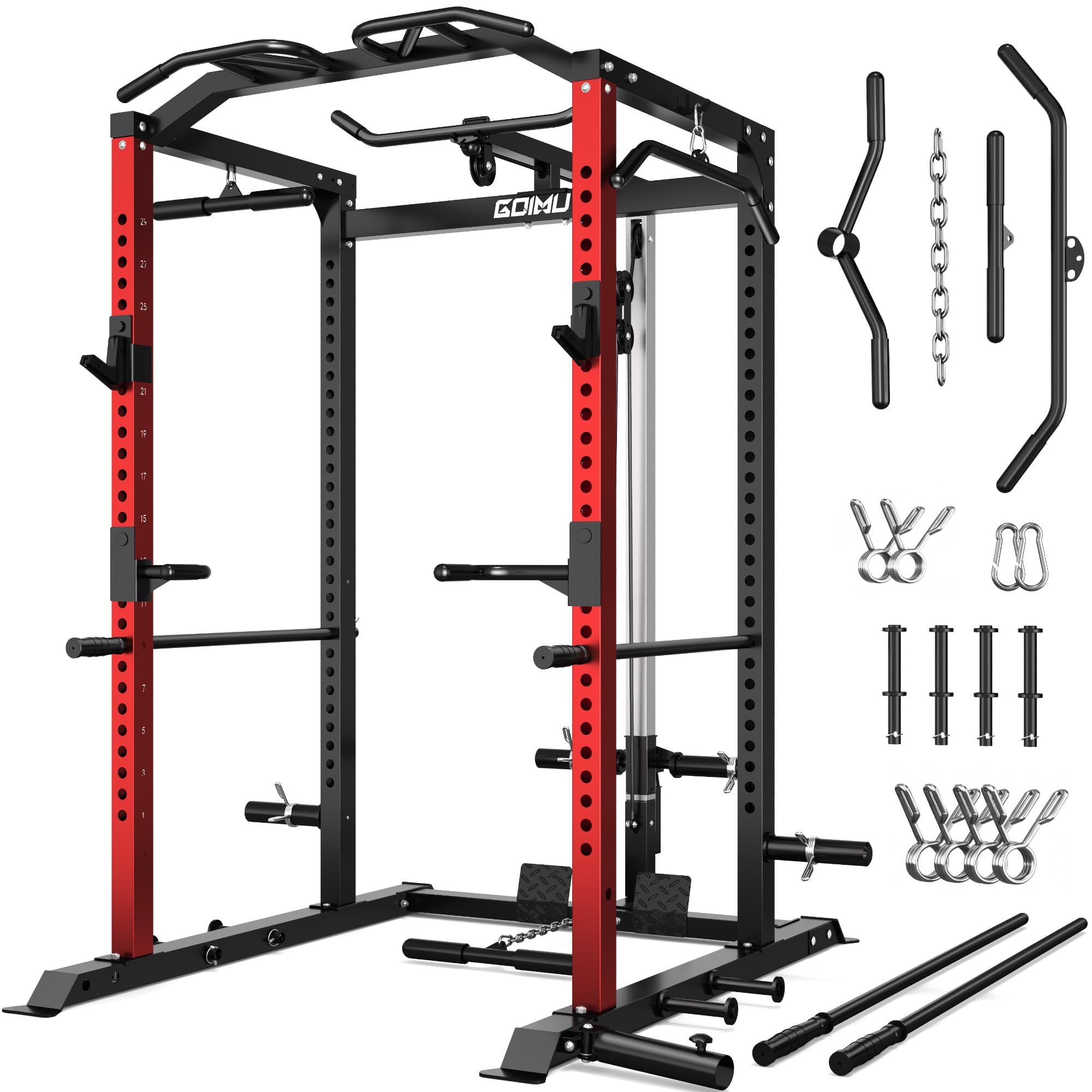
2. Goimu C1-V4 Power Cage
A no-frills cage that gives you a true 1:1 cable ratio without the premium price tag.
The C1-V4 is for the budget-minded lifter who refuses to give up a direct-feel cable system. Its 1:1 pulley ratio means every pound you load is every pound you feel — no halving, no guesswork — and the high-low pulley system covers roughly 90% of cable exercises. The 2″×2″ alloy steel frame is rated to a safe weight of 2000 pounds, making this the strongest-capacity budget pick here, at 33% higher than the Mikolo K6’s 1500-pound frame. Despite that rating, it’s the most compact of the mid-range cages, at 57.56″D x 44.72″W x 83.46″H, which is about 17% smaller in total footprint than the K6.
Owners describe it as stable, not difficult to set up, with a solid pulley system and smooth motion. The package includes over 30 attachments — triceps rope, T-bar, pulldown bar, 2 J-hooks, 6 counterweight racks with clamps, and a 360-degree landmine among them. A recurring note is that the plate rack and holders are solid, and one buyer reports the unit shifts side to side slightly but with no safety concerns. The honest framing from owners: this is suitable for up to 300 lbs rack and 200 lbs pulley work — a realistic daily-use ceiling that’s far below the 2000-pound marketing number.
Assembly takes about 3 hours solo, and the diagram-only manual is sparse — a few owners made minor mistakes. Some report missing parts that took two weeks to reship, and the weight holders earned criticism as useless for heavy plates. The 43.35″ cage depth gives you room for bench presses and squats inside, and the expanded base keeps it grounded. If you want a cage that feels like a real pulley system on a budget, this delivers.
Direct-feel pulley pull: the 1:1 ratio gives you honest resistance without the mush of a 2:1 system.
Set expectations: think 300 lb rack / 200 lb pulley work for daily use, not the printed 2000-pound max.
Best for: the price-sensitive first-time cage buyer who wants a true-feel cable system and a compact footprint.
skip it if: you dislike diagram-only assembly instructions and want a labeled, worded manual.
3. Body-Solid PCCO90X Cable Crossover
A dedicated cable crossover with a 190-pound stack and commercial-grade glide.
The PCCO90X is for the lifter who wants cable work as the main event, not an add-on feature of a squat rack. This is a true functional trainer with a 190 lb weight stack, eight sealed ball bearing high-resin pulleys, and patented nylon bushing technology that owners describe as gliding like a commercial unit. The top and bottom pulleys swivel smoothly with over 180° of movement, so you get frictionless guidance in every direction during pec flys, crossovers, tricep pressdowns, and leg extensions.
It’s a wide machine — 37″x113″x83″ and 102 pounds — so it’s meant for a dedicated wall or corner, not a cramped nook. Owners call it rock solid on the floor and report significant performance improvements at the gym after switching to home training. Assembly is doable solo at about 2 hours the first time; the trick is applying the included silicone spray to the vertical frames before sliding the weight frames, or they stick. A warranty of 10 years on the frame and 1 year on parts backs the buy.
Here’s the honest math: pulleys cause roughly a 38% weight loss, so a 100-pound load feels like about 60 pounds — and the 190-pound stack tops out around 120-130 pounds of actual feel on both cables. The cables and plastic look cheap but work fine, and owners suggest extra carabiner links for swapping attachments. For a pure cable crossover at a mid-range price, serious cable lifters keep returning to this one.
Smoothness is the story: ball-bearing pulleys and a 190-pound stack make this feel like commercial equipment at home.
Know the math: the pulley system about halves the felt weight, so plan your stack needs accordingly.
Ideal for: cable-crossover devotees who want a dedicated machine with a real weight stack, not a plate-loaded add-on.
Think twice if: you’re also hoping to squat or bench — this is a cable machine, not a power rack.
4. Mikolo HR05 Power Cage
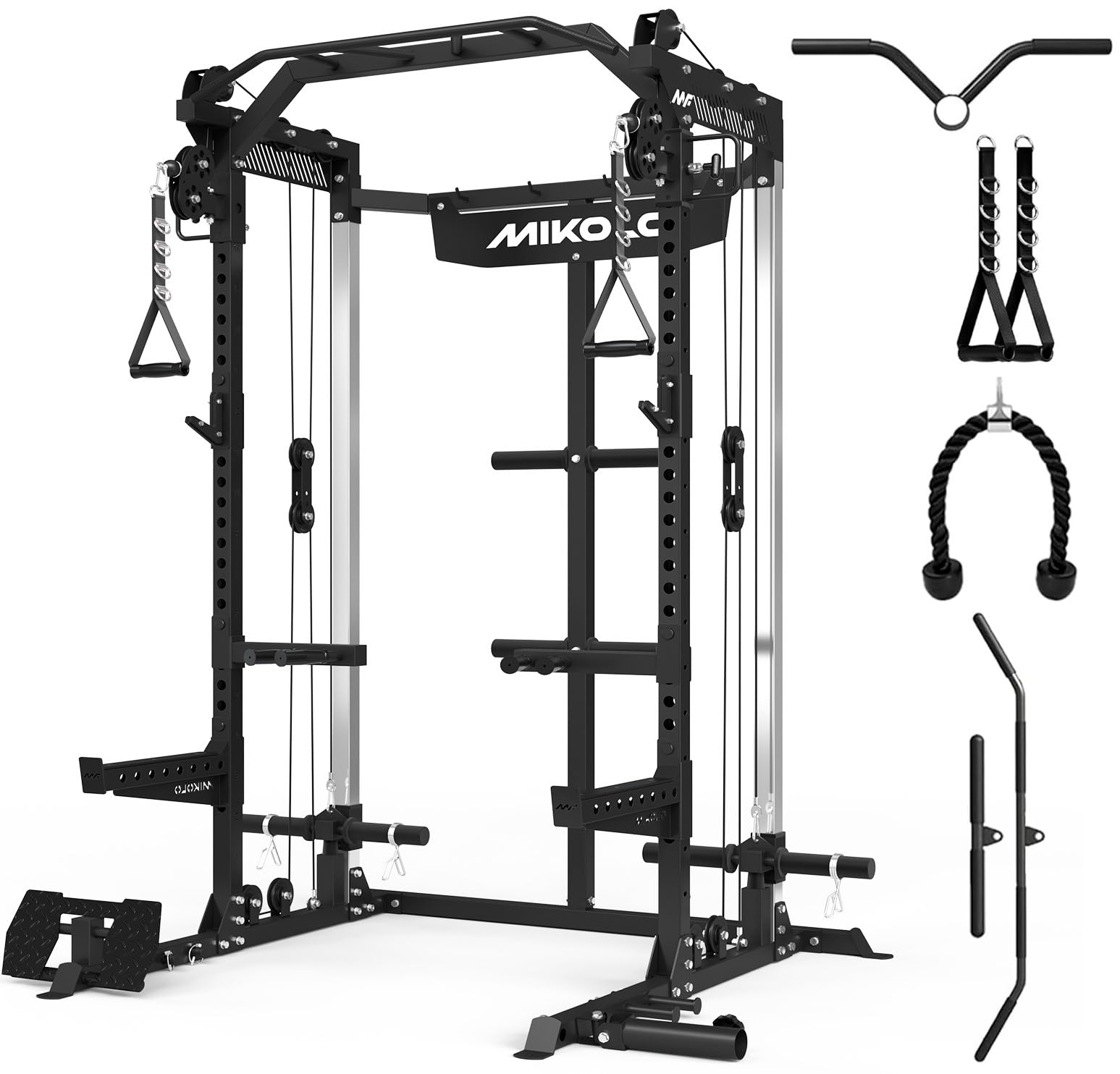
A half-rack that occupies two-thirds less space while keeping independent 1:1 pulleys on both sides.
If space is tight, the HR05 uses a half-rack frame that takes up nearly two-thirds less space than conventional power racks, yet keeps independent 1:1 ratio dual pulleys on both sides. That means the weight you load is the weight you train with, and you can run supersets or drop sets — or have two lifters working at once — without sharing a single weight stack. The machine weighs 205 pounds and carries a max capacity of 2000 pounds.
The smartest feature is the column design: holes drilled at 1-inch spacing give you 30 height options with digital markers on the side for quick location, and the standard 2″×2″ column accepts a wide range of aftermarket accessories. Tube thickness of 2 mm keeps the rack stable, and owners say it’s durable after six months of daily use with no bolt-down needed under a 250-pound squat. Assembly takes about 2 hours, and parts come labeled.
The catch is pulley behavior under uneven loads — the pulleys glide smoothly when loaded evenly but can stick when there’s a 10-pound difference side to side. The 18″ bar is non-rotating and there’s no v-bar included, and the aggressive knurling on the pull-up bar is a love-it-or-hate-it detail. Weight storage sits in the middle of the frame, which both organizes your plates and adds stability. For tight rooms, this packs a full gym’s worth of movement into a much smaller silhouette.
The strengths
- Quality is the top praise — 59 owners single it out
- Assembly is easy, with 45 mentions of clear instructions
- 1-inch hole spacing gives 30 height options for a custom fit
The honest limits
- Pulleys stick when side loads differ by ~10 pounds
- Safety arms and J-hooks work but don’t lock into place
- The landmine can dig into a rubber mat during use
Choose this if: floor space is scarce but you want independent pulleys for two lifters or superset training.
Pass if: you always load cables unevenly — the sticking pulleys will annoy you.
5. Sportsroyals Power Cage
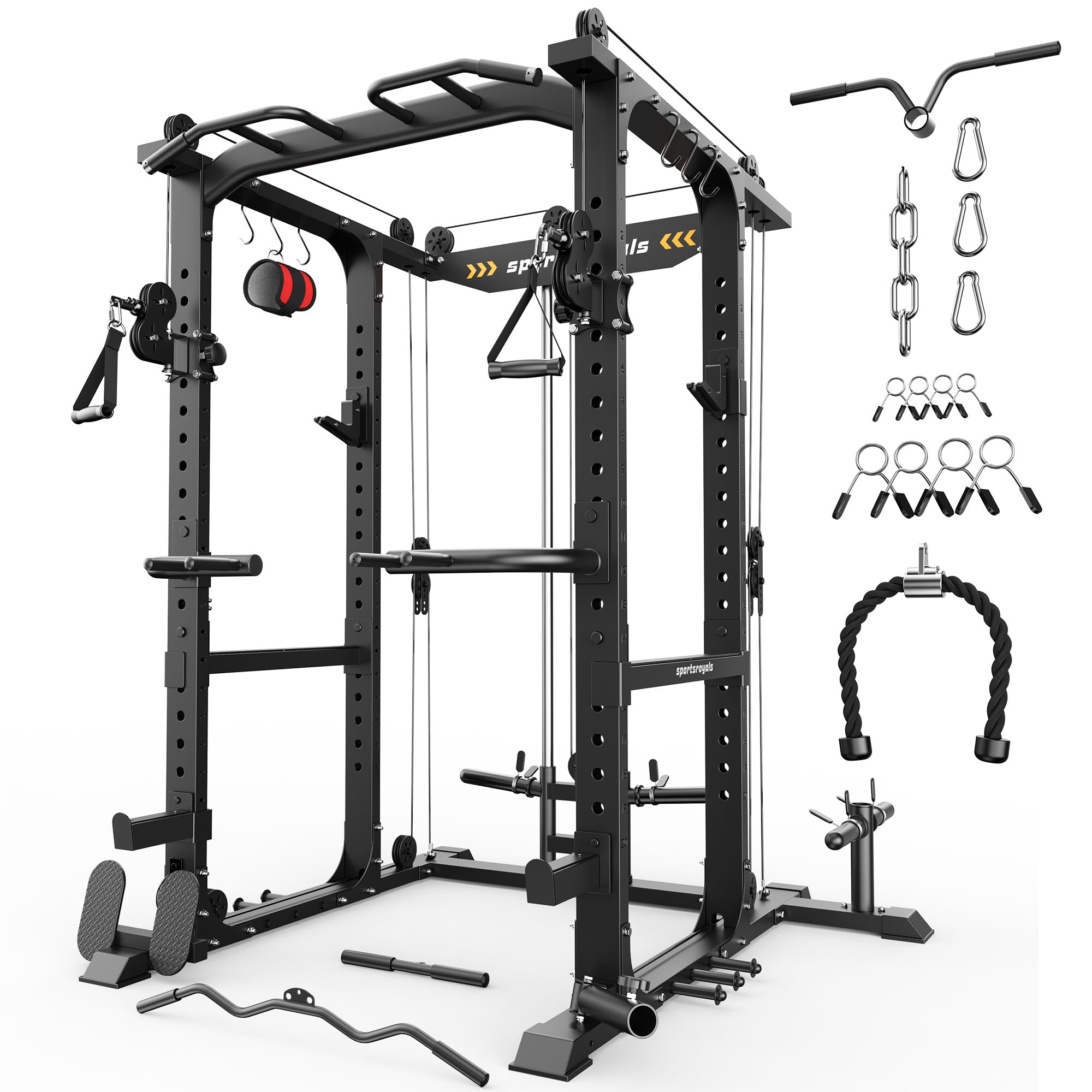
The rack with 20 adjustable pulley positions and a 250-pound tower built for heavy daily use.
The Sportsroyals suits the intermediate lifter, with a tower-structured frame from heavy-duty commercial steel that weighs 250 pounds. Its cable system stands out: 20 adjustable pulley positions with a smooth 1:2 resistance ratio, so you can switch from wide lat pulldowns to seated rows to tricep extensions without leaving the rack. Component ratings tell the story — Safety Bar at 1,800 lb, J-Hooks at 1,000 lb, Dip Bar at 1,200 lb, and Pull-Up Bar at 440 lb — so each piece is rated for real abuse.
Owners call it a high-quality intermediate-level rack with a complete attachment set: lat pulldown bar, cable bar, multi-grip handles, J-hooks, safety bars, wide/narrow dip bars, 360° landmine, foot board, battle rope rings, and band pegs. Quality is the most-praised trait by far — 163 owners cite it — with value for money close behind at 141 mentions. Assembly is straightforward at about 2.5 to 5 hours solo, and the 61.9″L x 67.9″W x 83.6″H footprint fits 8-foot ceilings with about 10 inches of clearance.
The recurring gripes are honest ones: the cable system only feels effective once you load 70+ pounds, so the eccentric control is weak at lighter weights, and taller lifters around 5’8″ find the lat pulldown position awkward. The squat J-hooks sit close to the pulley, which pushes some owners to squat facing backwards, and the plate storage is limited — you’ll need a separate rack for two full sets of plates. If you train heavy and want one rack to do nearly everything, this is the one.
Built for heavy lifting: a 1,800-pound safety bar rating and 1,000-pound J-hooks make this a serious steel structure.
Weight threshold to know: the cables feel best above 70 pounds of load, so light-band work isn’t this rack’s strength.
Best for: intermediate lifters who push 300-500 pounds and want one sturdy rack with every attachment included.
Not for: lighter cable users who want smooth resistance below 70 pounds — the system needs load to feel right.
6. Eonfit E3 Smith Machine
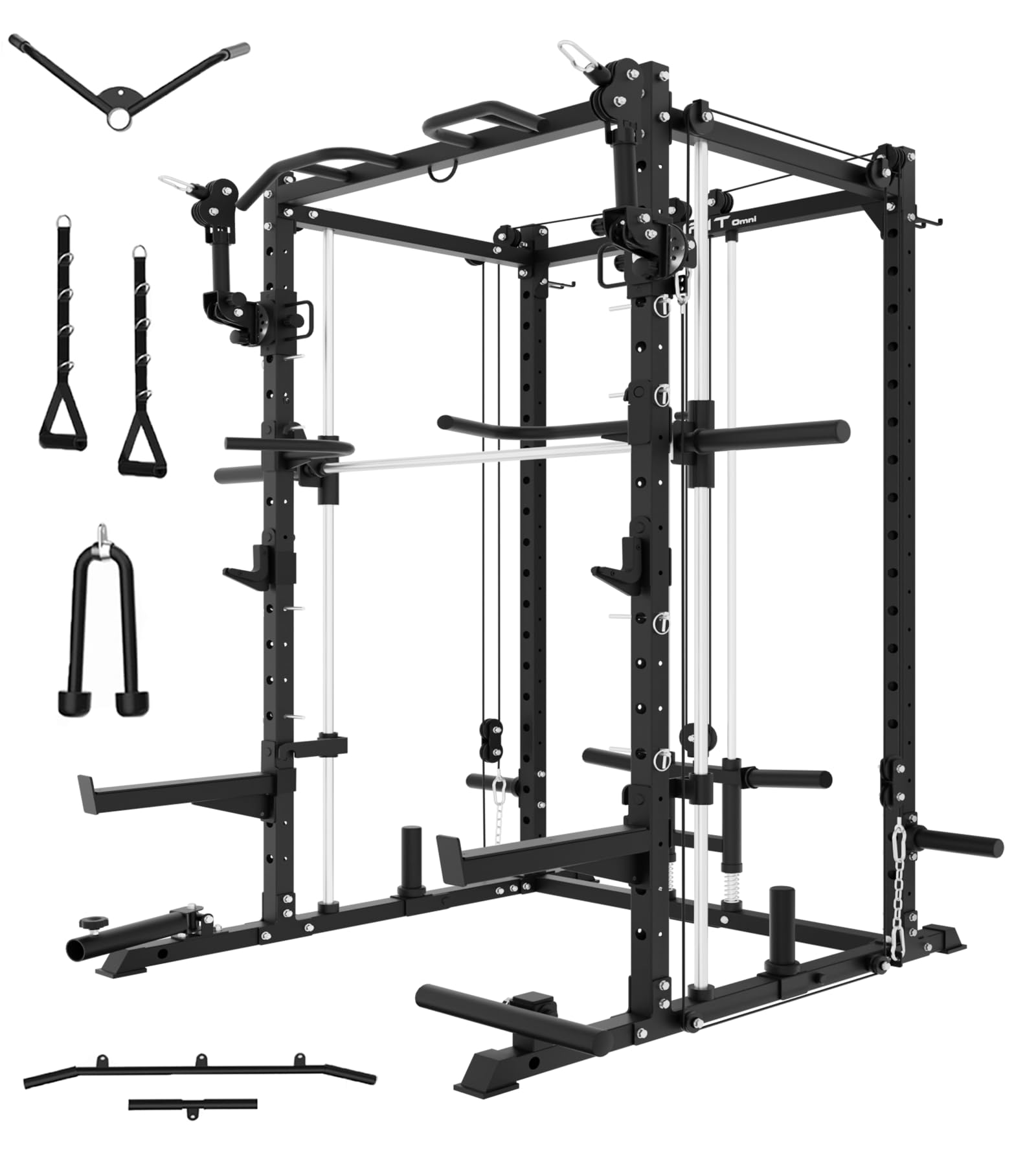
The machine with 3D rotating arms that let you reposition the cable mid-set for better angles.
The E3 stands apart because its pivot arms rotate in three dimensions — position them outwards for a better chest fly stretch, inwards so the weight sits directly beneath you for shrugs, or straight overhead for lat pulldowns. That articulation means you’re not locked into a fixed trolley on a vertical upright, and owners say it adds significant range of motion. It’s a Smith machine first, rated at 400 pounds, with a 1200-pound maximum on the cage — a rare combo that gives you guided squats and free cable work in one frame.
The foundation is the E2 power rack, and the package adds a Smith bar and 4 pairs of lock pins compatible with the pivot arms. Set up at 62.5″L x 71″W x 85″H with an internal size of 42″ x 60″, it’s built from 2″x2″ 14-gauge steel with 1-inch holes at 3-inch spacing. Owners describe it as sturdy and versatile, with smooth Smith action and high-end articulating arms that justify the build effort — assembly runs 4 to 6 hours solo, and a second person helps a lot. The machine weighs nearly 300 pounds, and the warranty covers 36 months on main steel frames and 12 months on accessories.
The honest notes: cables are thick but some owners wish for thinner ones for smoother operation, and the pulleys are plastic rather than stainless steel. One owner flagged the pins that hold the Smith/squat rack up as needing care during adjustment. Even plate loading is required — uneven loads make the motion stick. If you want a Smith machine and a cable crossover without buying two separate units, the E3’s rotating arms make it the most flexible of the Smith combos here.
Range-of-motion win: the 3D rotating arms let you angle cable work in ways a fixed trolley never could.
Budget your time: plan on a 4-6 hour solo assembly over a couple of days, and you’re set.
Grab this if: you want guided Smith squats plus flexible cable crossovers in one footprint.
pass on it if: you expect a plug-and-play build — this one demands assembly patience and a drill.
7. MAJOR FITNESS F22 Power Rack
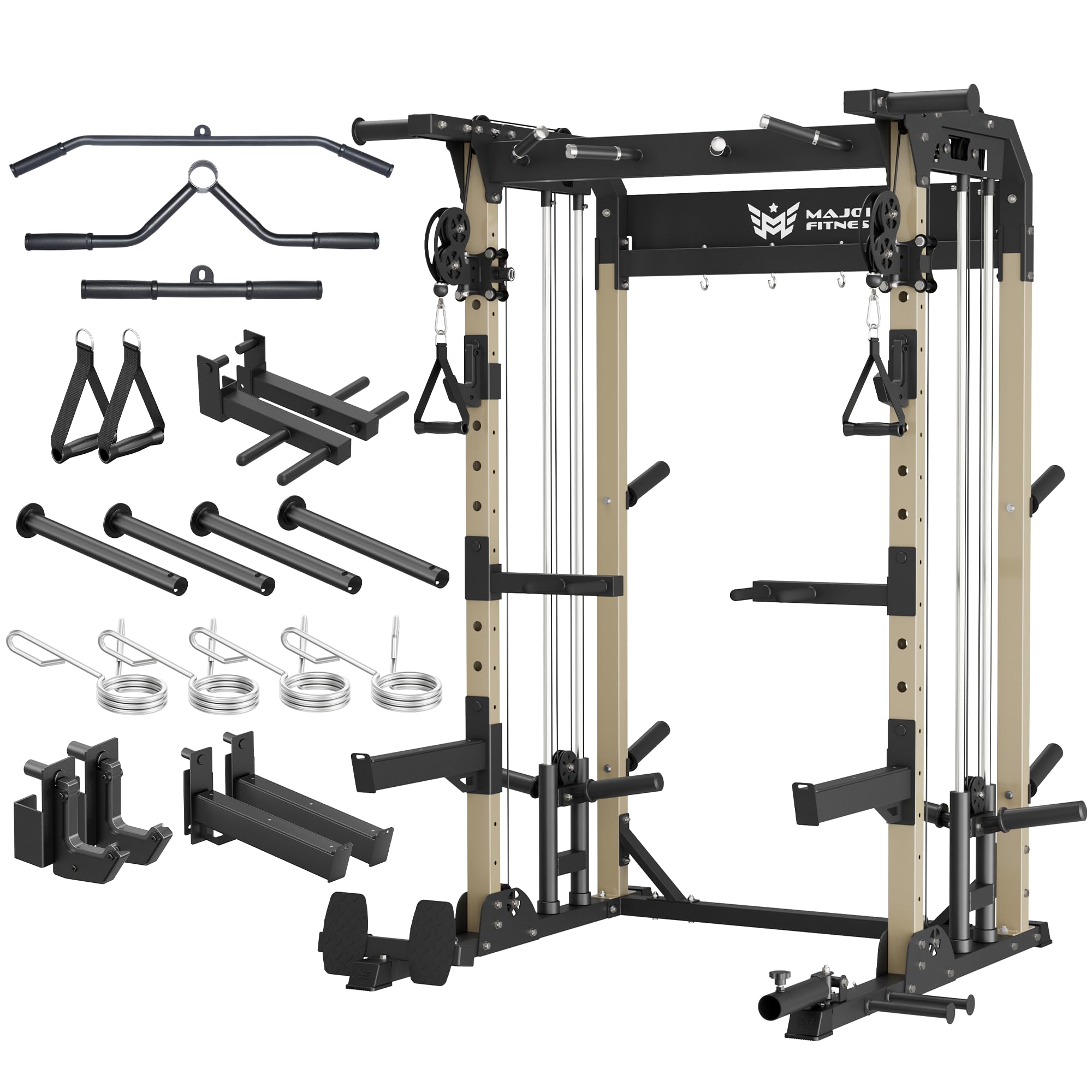
A dual-pulley rack built from 2″x3″ 14-gauge steel that two people can train on at once.
The F22 is engineered for the household with two lifters, because its independent dual-pulley system lets two people train simultaneously without cable interference. The 2:1 ratio makes cable travel smoother and resistance control more precise, and owners say the pulleys work very well. The frame is 2″x3″ commercial-grade 14-gauge steel at 0.08″ thick, supporting a 1600-pound static weight capacity, and the dual-triangle base design increases floor contact so you won’t need bolting for standard stability.
Assembly earns the highest praise here — roughly 3 hours for two people, and owners call the process straightforward. Quality leads feedback at 62 mentions, with sturdiness close behind at 49. The F22 replaces three machines — weight cage, squat rack, and dual-cable crossover — in a single 82.5″D x 68.9″W x 82.5″H footprint, and you can skip the rear plate holders to save 8 inches of depth if space is tight. The attachment set includes J-hooks, safety arms, foot pedals, landmine, T-bar, dip bars, lat pulldown, and cable bars.
The honest trade-offs: the included lat bar is narrow, and attachments aren’t commercial grade — they’ll handle home training but not gym-floor abuse. The dip bar handles measure 1.25″ wide with foam, which some owners find painful and plan to wrap. One owner noted a minor superficial brown discoloration on the powder coating at the top. For a two-person household that wants one sturdy rack for both squatting and cable work, the F22 is a smart pick.
What owners rave about
- Sturdiness gets 49 mentions — the frame stays rock solid under load
- Assembly is a 3-hour job for two, with clear instructions
- Dual independent trolleys allow different weights per side
What to adjust
- Lat bar is narrow and attachments are home-grade, not commercial
- Dip bar handles are 1.25″ wide with thin foam — plan to add grips
- Frame top can show minor powder-coating discoloration
Reach for this if: two people train together and want separate pulleys without stepping on each other.
Look further if: you need commercial-grade attachments that survive daily gym-floor abuse.
8. RitFit M1 Pro Smith Machine
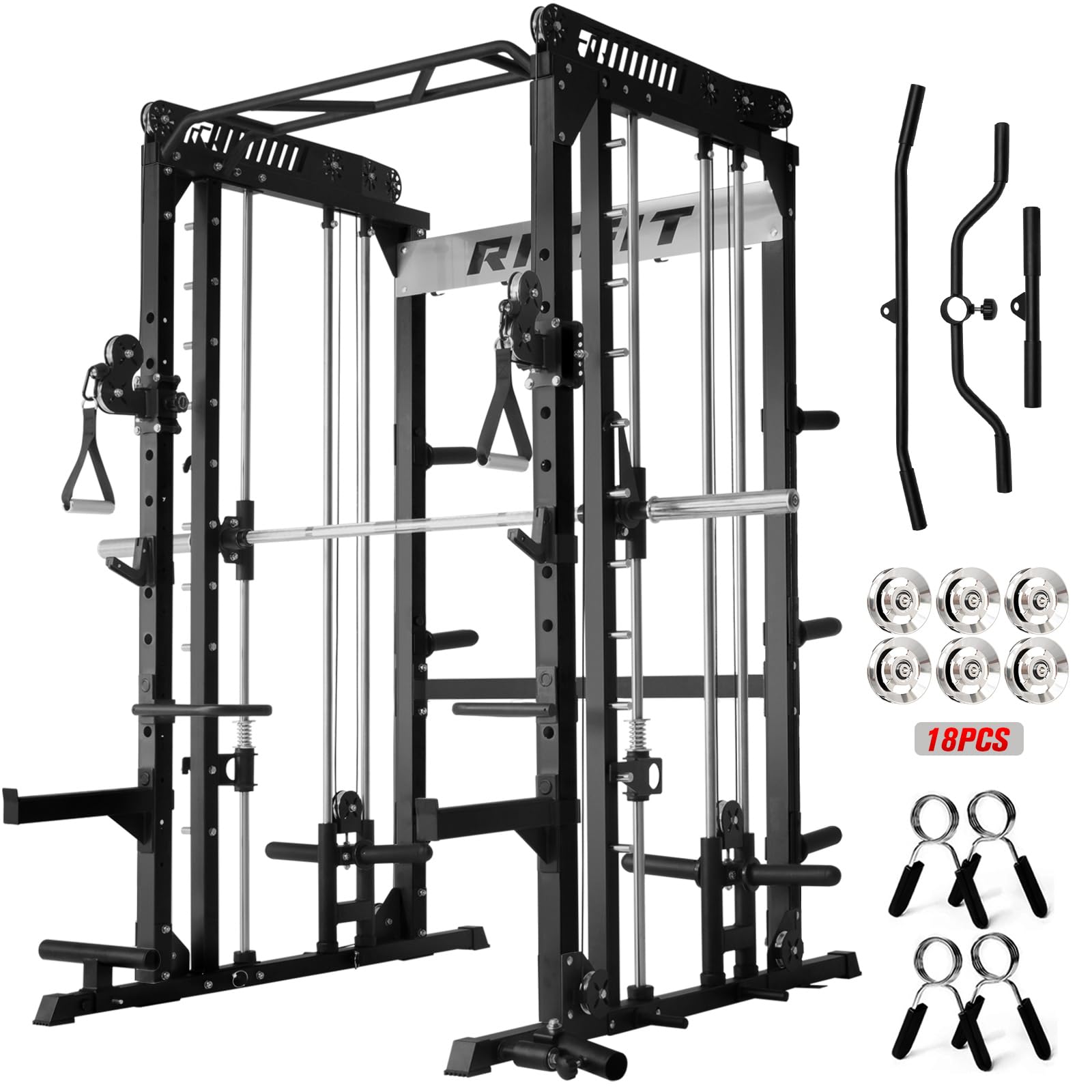
A Smith machine with dual 360-degree cables and an 1850-pound frame that feels smooth as butter.
The M1 Pro combines a Smith machine, cable crossover, and power cage in one unit, and owners describe the pulley action as butter-like with stainless steel composite materials and aluminum pulleys on a dual slide rail structure. The Smith system uses a linear bearing design with spring protection and 11 selectable heights — so you get the guided safety of a Smith machine plus the freedom of cable crossovers for low, mid, and high work. The frame is heavy-duty 2″x2″ steel uprights at 47.8″L x 63″W x 85.2″H, with a high weight capacity of up to 1850 pounds.
Quality leads the feedback at 71 mentions, with sturdiness second at 39. Owners call it a perfect fit for 95% of people who work out at home, noting smooth cables with no sticking and large plates that clear the pulleys and Smith bar without issue. The storage system is a standout — 4 top rear hooks, a central storage crossbeam, and 6 weight plate holders keep the space organized. The warranty runs 36 months on main steel frames and 12 months on accessories.
The biggest complaint is delivery condition: multiple customers note chipped uprights, bent dip bars, and damaged weight holders on arrival, though RitFit’s customer service resolved issues for most. Assembly is the hard part — cable routing took one owner about 5 hours, and YouTube videos helped. An occasional unit arrives with missing attachments like dip bars or a plate holder. If you can get past the assembly and QC risk, the daily-use experience is a smooth, sturdy Smith-plus-cable combo.
Smoothness is the headline: aluminum pulleys and a linear bearing design make the cables glide without sticking.
Budget for QC luck: shipping damage shows up in a chunk of deliveries, so inspect boxes and lean on the responsive support team.
Best for: the lifter who wants Smith-machine safety and cable variety in one smooth-operating frame.
Think carefully if: you lack assembly patience — the cable routing is the trickiest part of the build.
9. Body-Solid PFT100 Functional Trainer

A dual independent weight-stack trainer with 476 pounds of steel for true isolateral movement.
The PFT100 is the dedicated functional trainer for cable purists who want real weight stacks, not plate-loaded pulleys. It comes with two independent 160 lb weight stacks in a 1/2:1 weight ratio, giving you true isolateral movements — each arm works independently, so you can’t cheat by shifting load to your stronger side. The extra-wide mainframe measures 42.3″L x 62.6″W x 83″H and weighs 476 pounds, which is why owners call it rock solid with no wall mounting needed. The 10-year frame warranty and 1-year parts warranty back the investment.
The assembly strikes the best balance in this list — about 3 hours solo, with well-machined parts that align perfectly. Quality and assembly both top the feedback at 42 mentions each, and owners describe the pulleys as smooth and quiet with no friction or noise. The 160-pound-stack setup proved enough for most, with one owner upgrading to a 210-pound stack and others recommending the larger option for advanced lifters. No wall mounting, no bolting down — the weight of the frame anchors itself.
The honest limits: the 160 lb stack is too light for advanced users on heavy compound cable moves, and the instructions have minor gaps — one owner noted 10 set screws listed but only 6 provided, with 4 pre-installed. Some report a missing weight box or pin on delivery. But the feel is gym-quality, and owners who compared it to -3,000 alternatives say nothing is cut here. For a true functional trainer with dual stacks, this delivers commercial feel at a fraction of the cost.
Isolateral advantage: dual independent stacks force each arm to work on its own — no muscle imbalance cheating.
Weight ceiling: 160-pound stacks feel lighter through the 1/2:1 ratio; advanced lifters should budget for the upgrade.
Choose this if: you want a dedicated functional trainer with true weight stacks and no plate-loading fuss.
Pass if: you’re an advanced lifter who needs more than 160 pounds per stack for big cable pulls.
10. pooboo P43 Power Cage
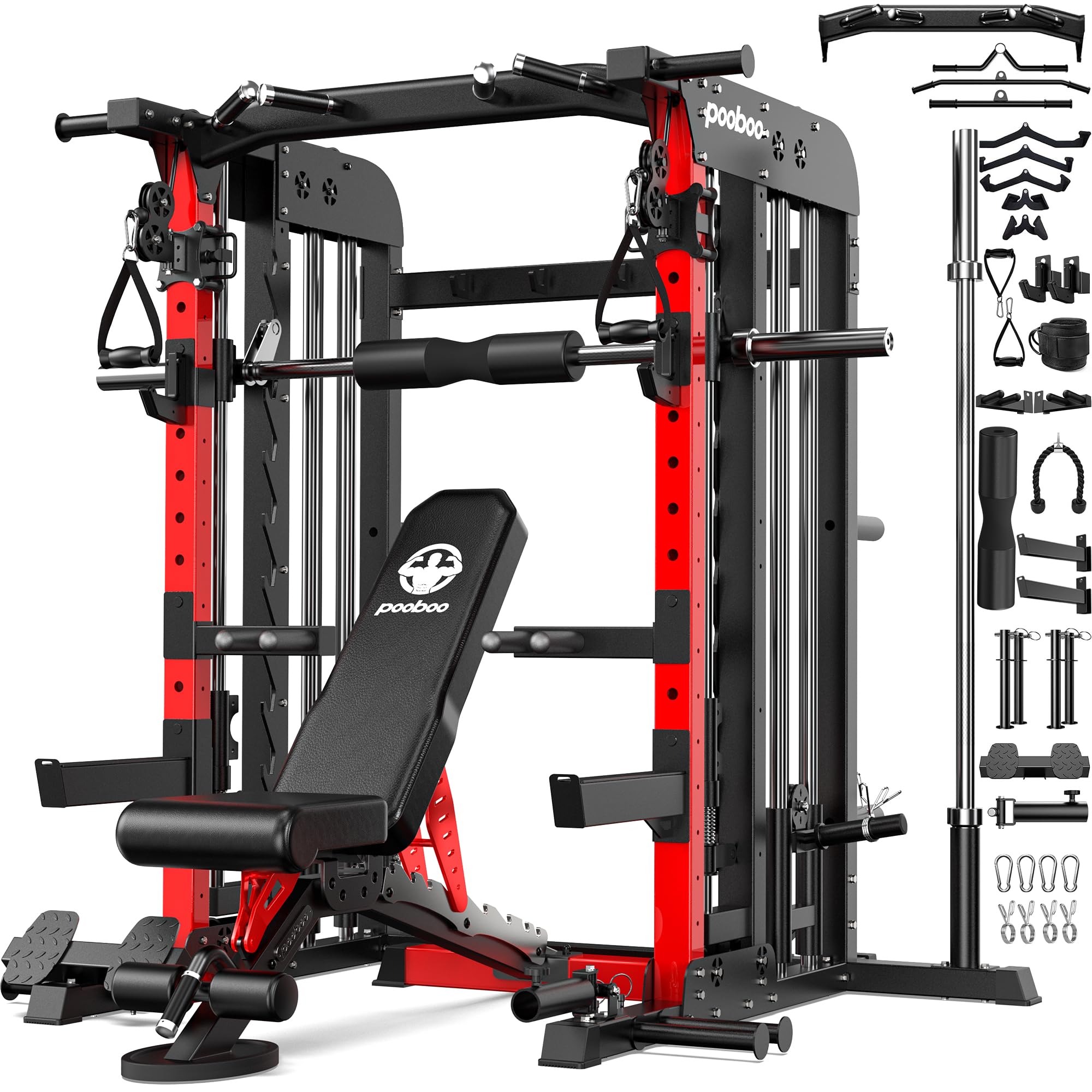
The 2000-pound cage that bundles a 1500-pound bench and 35 attachments into one delivery.
The P43 is the most complete package in this list because it ships with both the rack and a 1500 lb Pro Weight Bench — a wobble-free one-piece steel bench with 8+3 swift-adjust settings, 2.5″ sweat-proof leather seating, and a 4″ leg-shield foam. The main cage supports a 2000-pound weight capacity on heavy-duty steel, and the bundle includes 35 free attachments: 2 J-hooks, 2 safety spotter arms, 2 dip bars, 2 cable grip handles, a lat pulldown bar, a row bar, a low row foot board, a 360° landmine, a vertical barbell holder, a Smith bar with welded safety latches, 4 plate storage pins, 4 weight holders, 4 band pegs, 5 LAT grips, a barbell pad, a free Olympic bar, a double-ended tricep rope, and an ankle strap.
Owners call it sturdy — that’s the top praise at 55 mentions — with a smooth, quiet pulley system and quality that matches commercial gyms at a lower price. The P43-Pro version adds the LAT training handles, the free Olympic bar, the barbell pad, the tricep rope, and the ankle strap for a more complete setup. Sturdiness leads the feedback at 55 mentions, with value for money at 35. The 62.9″D x 43.3″W x 82.6″H footprint is narrow enough for a garage wall. The machine weighs 525 pounds, so it anchors itself.
The honest caveat is assembly time: the full build ran about 10 hours over 3 days for one owner with a child helping, so plan a weekend. Tightening bolts fully is essential to prevent sway during pull-ups, and the padded backrest on the bench helps with ab form. The warranty covers 1 year on the frame and accessories, and pooboo ships in two packages to minimize transit damage. For the lifter who wants everything in one box — bench included — the P43 is the most turnkey heavy package here.
The full-package wins
- Sturdiness is the #1 praise — 55 owners call the frame solid
- 35 attachments plus a 1500 lb bench ship in one kit
- Smooth, quiet pulley system noted across reviews
Plan around these
- Full assembly can stretch to 10 hours — clear a weekend
- Bolts must be fully tightened to stop sway during pull-ups
- Rack ships in two boxes that may arrive on different days
Grab this if: you want rack, bench, and every attachment delivered together for a complete home gym in one go.
it’s not for you if: you lack a full weekend for assembly — this is the longest build in the list.
11. Inspire FTX Functional Trainer

A 544-pound functional trainer with one of the industry’s smallest footprints for full-body cable work.
The FTX is for the home gym where floor space is the rarest commodity, because it packs two 165 lb weight stacks, sliding pulleys, and a pull-up bar into a 54″D x 40″W x 82″H frame. That 40-inch width makes it one of the industry’s smallest full functional trainers, yet it weighs 544 pounds — so it’s rock solid once assembled. Owners describe the motion as friction-free with excellent range of motion, covering nearly every muscle group. The machine comes with four accessories: tricep rope, 2 deluxe D-handles, a dual hook curl bar, and a chin/dip belt.
Quality is the top praise at 41 mentions, with assembly at 25 — and owners call it simple to put together, though the towers are heavy enough that a second person helps. Delivery runs about a week and arrives in 7 boxes totaling roughly 600 pounds, so clear a path. Extra touches include space to secure your phone or tablet during workouts and a built-in storage rack to keep accessories organized. The included 3-month Centr by Chris Hemsworth subscription with 1900+ workouts is a nice bonus.
The honest limits: the weight stacks are not upgradeable, so you’re capped at 165 pounds per side forever, and the 5 lb add-on weights cost extra. Taller users may find the highest pulley setting a bit low for full overhead range. Owners note the machine is cheaper than similar functional trainers but not cheaply made — it’s smooth, sturdy, and squeak-free. For the lifter who wants commercial-grade cable work in a space-saving frame, the FTX is the premium compact answer.
Footprint champion: 40 inches wide with two 165-pound stacks is the best space-to-function ratio here.
Plan for the stack ceiling: weight stacks are non-upgradeable, so 165 pounds per side is your forever max.
Best for: apartment and small-room lifters who want true weight-stack cable work without a garage-sized footprint.
Not for: powerlifters who will outgrow 165-pound stacks or need a heavier Smith cage.
Understanding the Specs
Pulley Ratio
The ratio tells you how the loaded weight feels. A 1:1 ratio means the weight you load is the weight you feel — honest, direct resistance for those who want to know exactly what they’re lifting. A 2:1 ratio halves the felt weight but doubles the cable travel, which smooths the motion and is gentler on joints. Weight-stack machines like the Body-Solid PFT100 use a 1/2:1 ratio, meaning the stack is effectively halved, so a 160-pound stack feels like 80 pounds.
Weight Capacity
Frame capacity and cable capacity are two different numbers. A 2000-pound frame rating tells you the steel structure can hold that static load — it’s a safety ceiling, not a daily-use number. The cable pulley system has its own lower limit, which is why owners of the Goimu C1-V4 suggest thinking of it as 300 lb rack / 200 lb pulley work. Match the capacity to the heaviest weight you’ll actually load, not the marketing max.
FAQ
What is the difference between a 1:1 and 2:1 pulley ratio in a cable tower?
Will a cable tower fit in a room with 8-foot ceilings?
How much floor space does a cable tower for home gym need?
Can two people train on a cable tower at the same time?
Is a 1500-pound frame capacity enough for home use?
What attachments should come with a cable tower?
Are weight-stack cable towers better than plate-loaded ones?
How long does it take to assemble a cable tower for home gym?
Do cable towers need to be bolted to the floor?
What is the difference between a cable crossover and a functional trainer?
Final Thoughts: The Verdict
If you want one dependable pick, the cable tower for home gym winner is the Mikolo K6 because it combines eight workout stations into one sturdy 230-pound frame at a value that’s tough to top. If you want a dedicated cable machine with true weight stacks, grab the Body-Solid PFT100 for its smooth dual-stack feel. And for the space-constrained lifter, the Inspire FTX is the one to reach for — its 40-inch-wide footprint with two 165-pound stacks is the best space-to-function ratio in this list.
How We Picked
We do not accept paid placement. Every pick is matched to a real buyer and a real use-case; we do not hands-on test units.
Sources & Methodology
Specifications: manufacturer listings and product documentation. Review insights: verified customer reviews, as of August 2026. Pricing: not shown on this page (it changes often); check the current price via the retailer link.
As an Amazon Associate, FitlyFast earns from qualifying purchases. This does not affect which products we feature.