
Our readers keep the lights on and the weekend projects moving. As an Amazon Associate, I earn from qualifying purchases.
Specs are compiled from manufacturer listings and verified buyer reviews and can change over time — please confirm the key details on the product page before buying.
Nothing stings like walking out to your garden and finding that beautiful tomato or pepper has a black, sunken bottom. That is blossom-end rot, and it is almost always a cry for calcium. The right supplement stops the rot and sets your plants up for stronger stems, thicker leaves, and bigger harvests. But not all calcium products work the same way — some fix the problem fast by hitting the leaves, while others build healthy soil so the rot never comes back.
I’m Rikta — the founder and writer behind FitlyFast. This guide is built by comparing the manufacturers’ published specifications and the patterns across verified customer reviews, so you get each pick’s real strengths and trade-offs instead of marketing spin.
If your tomatoes have blossom-end rot or your pepper leaves are curling, you need a calcium boost fast. This guide matches the best calcium for plants to your grow style — whether you use soil, hydroponics, or coco coir — and to how much time you want to spend mixing.
Our Picks at a Glance


How To Choose The Best Calcium For Plants
Calcium is not a miracle cure you sprinkle on once. It is a structural nutrient — think of it as the rebar inside every cell wall. When a plant does not get enough, new leaves come out twisted, fruit bottoms rot, and overall growth stalls. The trick is that calcium deficiency is often a watering problem, not a soil problem: if watering is inconsistent, the plant cannot move calcium from the roots to the fruit. So before you buy anything, look at your watering habits. Then pick a calcium source that fits how you grow.
Liquid vs. Powder vs. Granular — Which Delivery Works For You
Liquid products (like General Hydroponics CaMg+) are the fastest way to correct a deficiency. You mix them with water and the roots get calcium within minutes. Powders (like RAW Calcium/Mag or Jack’s Calcium Nitrate) are more concentrated per dollar, but you have to dissolve them fully — a clumpy mix leaves your plants hungry. Granular products (like Cz Gypsum) are the slow burn: you work them into the soil before planting, and they release calcium steadily over weeks. If you already have blossom-end rot on a fruit today, reach for a liquid. If you are prepping next season’s bed, choose the granular.
Calcium Nitrate vs. Cal-Mag vs. Gypsum — The Chemistry Shortcut
Calcium nitrate (15.5-0-0) delivers calcium plus a nitrogen boost, so it is ideal during the leafy growth stage but risky during flowering when too much nitrogen hurts fruit set. Cal-mag blends (like ENVY CalMag+ or TPS Cal-Mag Complete) pair calcium with magnesium to prevent a second deficiency from appearing, which is common in coco coir and reverse-osmosis water setups. Gypsum (calcium sulfate) adds sulfur and does not change soil pH at all, making it the go-to for acidic soils where you want calcium without raising the pH. Match the chemistry to your soil test, not the label.
Concentration and Mixing Ratios Matter More Than Bottle Size
A 32-ounce bottle sounds like less value than a 5-pound bag, but the actual cost per dose depends entirely on the mixing ratio. TPS Cal-Mag Complete recommends 1:100 or 1:200 (around 4 cc per gallon), while Jack’s Calcium Nitrate calls for 8.6 ounces per 100 gallons. A small bottle with a concentrated dose can feed more plants than a giant bag you use too generously. Look for products that give clear mixing instructions in milliliters per gallon or ounces per gallon, and stick to it — pouring extra “just in case” can lock up other nutrients.
OMRI Listing Matters If You Are Growing Organically
If your garden is certified organic or you simply want to avoid synthetic additives, look for the OMRI (Organic Materials Review Institute) seal. The Cz Gypsum Powder carries an OMRI listing, meaning it is allowed in certified organic food production. Most calcium nitrate products are synthetic, and while they are safe for home gardens, they do not carry organic certification. If you sell at a farmers’ market that requires organic verification, OMRI is your non-negotiable filter.
Quick Comparison
| Model | Best For | Form | Calcium Content | Volume / Weight | Amazon |
|---|---|---|---|---|---|
| General Hydroponics CaMg+★ Best Overall | All-around liquid cal-mag | Liquid | Blend (fermented calcium) | 1 Quart (946 ml) | Amazon |
| RAW Calcium/MagBudget Champion | Budget-friendly powder | Powder | Calcium + Magnesium blend | 2 oz | Amazon |
| Southern Ag Stop Blossom-End RotFast Fix | Fixing rot on fruit now | Liquid | Calcium solution | 32 oz (1 Quart) | Amazon |
| Cz Garden Organic Gypsum | Organic soil amendment | Powder | Calcium Sulfate Dihydrate | 5 lb | Amazon |
| ENVY CalMag+ | RO water & coco coir growers | Liquid | Calcium Nitrate based | 32 oz (1 Quart) | Amazon |
| Cz Garden Calcium Nitrate | Greenhouse & heavy feeders | Granules | 19% Calcium | 5 lb | Amazon |
| TPS Cal-Mag Complete | Large hydroponic setups | Liquid | Cal-Mag + Micronutrients | 1 Gallon (128 oz) | Amazon |
| ENVY Calcium Nitrate | Bulk value for soil & hydro | Granules | 19% Calcium | 3 x 1 lb (3 lb total) | Amazon |
| Jack’s Calcium Nitrate 15-0-0 | Commercial-level hydro fertigation | Powder | Calcium + Nitrate Nitrogen | 25 lb | Amazon |
In‑Depth Reviews
1. General Hydroponics GH5312 CaMg+ Plant Nutrition, Quart
Our pick — over 4.5★ from 600+ verified ratings; the strongest balance of quality and price.
The liquid cal-mag that growers reach for first — and keep reordering twice a year.
If you are seeing unhappy yellow leaves or weak fruit set, this is the fastest way to turn things around. The CaMg+ formula uses a blend of fermented calcium and magnesium that is complexed with organic acids and sugar chelates (low molecular weight acids that help calcium and magnesium move into the plant more easily). You only need a little in your watering can, and the effect on leafy greens, flowers, and vegetables is noticeable within a week. Buyers report this is essential for organic care — one owner ran eleven successful batches using CaMg+ alongside BioThrive and Bio Root and called it the must-have combination for excellent growth.
The catch is that it works best when your pH is dialed in. If your water or soil pH is off, even the best calcium blend will struggle to help. And while the liquid is convenient, some users note it can stain surfaces if you spill it. The crowd favorite — a 4.7-star reputation across hundreds of owners — comes because this quart is the least fussy entry point for anyone moving into serious plant nutrition.
What wins people over: the effectiveness is what owners praise most — 45 call it out specifically. It is the “good stuff” for reviving sick plants, and a little goes a very long way.
Best for: gardeners who want one liquid that covers calcium, magnesium, and trace nutrition for both soil and hydroponics.
Think twice if: you need a pure calcium fix without magnesium, or you are on a tight budget — a smaller bottle costs less per quart than larger value packs.
2. RAW Calcium/Mag 2oz – Essential Combo for Plant Health
A concentrated powder that lets you custom-brew your own cal-mag for pennies per gallon.
This 2 oz bag of powder punches far above its size because it is pure, unmixed calcium and magnesium that you dilute yourself. One owner created a concentrated stock solution by dissolving 1 teaspoon of powder in 16 oz of boiled reverse-osmosis water, then used just 1 oz of that concentrate per gallon — achieving a 1/16 tsp per gallon dose and saving significant money over pre-mixed liquids. The 3:2 mixing ratio (calcium nitrate to magnesium sulfate) is designed for versatile application across hydroponics, soil, and coco coir setups, and magnesium supports photosynthesis by helping build chlorophyll. Several owners recommend pairing this with RAW’s organic nitrogen and NPK products every 10-14 days for what they call explosive growth.
Because this is a raw powder, solubility gets mixed feedback — some find it dissolves perfectly while others need warm water to get a clear solution. The ziplock bag packaging is also a known weak point; owners advise sealing it in an extra container if you live in a humid climate. For the price, this is the most economical way to get high-quality calcium and magnesium into your feeding schedule.
Why it stands out
- Extremely cost-effective when you make your own concentrate — one 2 oz bag goes a long way
- Effective against blossom-end rot on tomatoes, especially when used as a consistent weekly feed
The only drawbacks
- Powder does not always dissolve fully in cold water — pre-dissolve in warm or boiled water
- Resealable bag can fail in humid storage; transfer to a jar with a tight lid
Reach for it if: you want to dial in your own dose and save money over bottled cal-mag products.
Look elsewhere if: you prefer a ready-to-pour liquid with zero mixing or you need a large volume up front for a big garden.
3. Southern Ag Stop Blossom-End Rot of Tomatoes, 32oz
The targeted rescue spray that stops blossom-end rot in its tracks — often after one application.
This 32-ounce liquid is formulated specifically to correct calcium deficiency in tomatoes, peppers, and related fruiting vegetables. Apply it as a foliar spray (half a teaspoon per 11 oz of water) and the calcium goes straight to the leaves and stems, bypassing any soil or watering inconsistency that caused the deficiency in the first place. Multiple owners mention that blossom-end rot stopped completely after one use, and one gardener got a full second harvest from plants that were already rotting. The product also prevents bloom drop, which increases overall fruit yield — the grower side benefit that makes this more than just a rot fix.
This is not a long-term soil conditioner; it is a corrective spray for when you already see the black rot forming. For prevention the following season, you are better off amending your soil with calcium before planting. Southern Ag uses the same active ingredient found in pricier garden-center brands, and at this price per quart, it is the cheapest rescue per dose. The only downside is that it works best as a foliar spray, not a root drench, so you have to be willing to get out and spray individual plants.
The verdict from the garden: effectiveness is the most-discussed quality — 59 owners cite it — and the blossom-end rot prevention aspect gets 37 mentions. Customers note this works for peppers too, solving bud drop and lack of fruit almost overnight.
Best if: you have active blossom-end rot on tomatoes or peppers and need a fast, reliable fix you can apply today.
skip it if: you prefer to prevent problems through soil amendments rather than react with sprays during the season.
4. Cz Garden Organic Gypsum Powder 5LB

The slow-release gypsum that feeds calcium without messing with your soil pH.
This 5-pound bag of calcium sulfate dihydrate is OMRI listed, meaning it meets USDA National Organic Program standards for certified organic production. That alone makes it the pick for serious organic gardeners. Gypsum supplies calcium and sulfur while loosening compacted clay soil so water actually penetrates — a double benefit that liquid calcium cannot offer. Several owners mix it into the soil before planting tomatoes and report that blossom-end rot disappeared completely for the whole season. For mushroom cultivation, gypsum improves the water-holding capacity of the substrate and neutralizes excess acidity.
The trade-off is that gypsum works slowly. Unlike a liquid rescue spray, you need to mix this into the soil before planting or at the very start of the season. It is pH neutral, so you do not have to worry about acidifying your soil the way calcium nitrate might. The resealable pouch is a practical touch for long-term storage. If you are already doing a spring soil prep, this is the most natural way to set your garden up for a calcium-rich season.
What owners love: plant health gets the most mentions at 18, followed by effectiveness at 14. One gardener reported that after adding this to the soil every year before planting, blossom-end rot never returned.
Grab this if: you want a clean, organic calcium source that also improves soil structure and is safe for certified organic gardens.
Pass it by if: you need an immediate correction for existing rot — this works over weeks, not days — or you do not have clay-heavy soil that needs loosening.
5. ENVY CalMag+ (4-0-0) Professional Grade, Quart
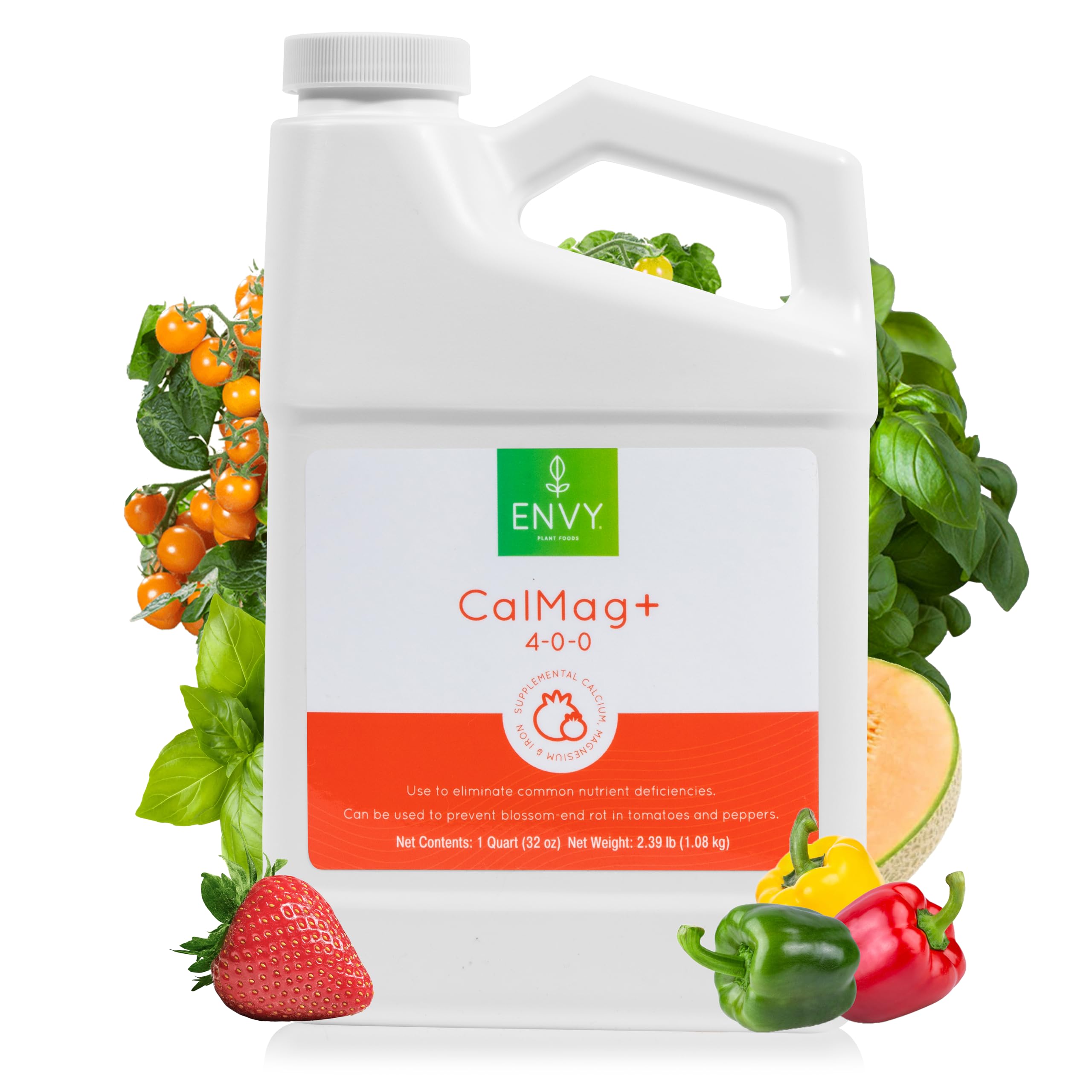
The clean cal-mag for reverse-osmosis users that does not cloud your water.
If you use reverse-osmosis (RO) water, you know it strips out minerals that plants need. ENVY CalMag+ is formulated specifically to replenish those lost minerals. It uses calcium nitrate as its calcium source rather than calcium chloride, which is friendlier for both plants and hydroponic equipment — owners note it does not leave the cloudy residue that other calmags sometimes do. The 4-0-0 analysis means it also provides a small nitrogen boost that supports green leafy growth. One grower used it on tomatoes with active blossom-end rot and reported the rot was completely gone after a couple of doses. Another called it some of the best cal-mag they had used, especially for the price.
This quart is concentrated, so you do not use much per watering. It works well with all hydroponic, soil, and coco coir nutrient lines as a supplementary source, though ENVY recommends pairing it with their own A and B base nutrients for best results. The main limitation is that it is a quart size — heavy users growing multiple plants in coco may go through it faster than they expect. If you run a larger setup, the gallon-size option (not this quart) would be the smarter buy.
High points
- Does not cloud or leave residue in hydroponic reservoirs like some calmags do
- Corrects blossom-end rot fast — owners saw results after just two applications
The fine print
- Quart size runs out fast if you have a large number of plants in coco coir
- Some owners wished for clearer dosing instructions for non-hydro setups
Best for: anyone using reverse-osmosis water or coco coir who wants a clean, residue-free cal-mag that prevents blossom-end rot without clouding the tank.
Consider alternatives if: you need a budget-friendly option for soil-only growing — this is premium-priced for the technology, not the volume.
6. Cz Garden Calcium Nitrate 15.5-0-0, 5LB

High-purity calcium nitrate that dissolves fully — no oily skim, no mess.
This 5-pound bag of greenhouse-grade calcium nitrate delivers 19% calcium and 15.5% nitrogen in a form that is 100% water soluble. That matters because lower-grade agricultural calcium nitrate can leave an oily skim on your solution, your irrigation equipment, and your plant roots — Cz Garden specifically warns against that and tests for it. One owner used it for a Granny Smith apple tree that had leaves dying and falling off; after the first dose they saw great improvement. Another gardener reported that it eliminated blossom-end rot on zucchini and tomato plants after two years of struggling with the issue. The 15.5-0-0 analysis means it is heavy on nitrogen, which is fantastic for leafy growth during the vegetative stage but should be tapered off once plants start fruiting.
The packaging is a heavy-duty resealable pouch with an easy-pour spout. It works across hydroponics, drip irrigation, flood-and-drain, NFT, DWC, soil, and coco coir setups — the 321 feeding schedule mentioned on the label is a standard for many advanced growers. The granules dissolve completely with a quick stir, and owners appreciate that one 5 lb bag goes a long way compared to buying multiple liquid bottles. The only caution is the nitrogen content: if you are already using a high-nitrogen base nutrient, this could push your plants into too much leaf growth at the expense of fruit.
The crowd says: effectiveness leads at 24 mentions, followed by blossom-end rot reduction at 21. One owner emphasized this is greenhouse grade and said it made their plants show strong stems and healthy foliage with vigorous growth.
Ideal for: growers who want a clean, fully-soluble calcium nitrate for both hydroponics and soil feeding, especially during the vegetative growth stage.
Not for: flowering-stage plants that are sensitive to high nitrogen, or anyone who needs calcium without the nitrogen boost.
7. TPS Cal-Mag Complete – Calcium Magnesium Supplement, 1 Gallon
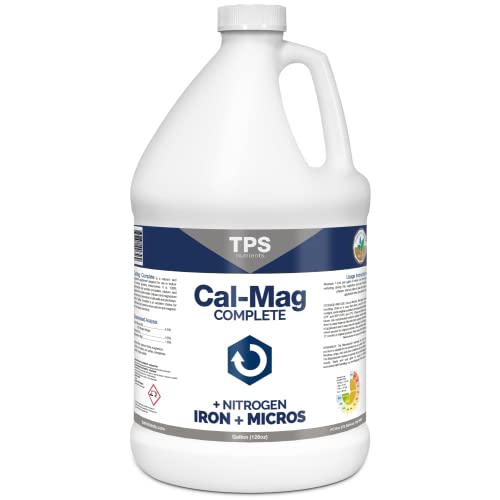
The gallon-size cal-mag with extra micronutrients that keeps a large garden fed for months.
This 128-ounce jug is the volume play: one purchase feeds a serious number of plants across the whole season. TPS Cal-Mag Complete provides not just calcium and magnesium but also a full set of micronutrients (iron, zinc, manganese, and others) that are often missing from simpler cal-mag products. That makes it a better choice for plants showing multiple deficiency symptoms at once. One owner reported using it on indoor tomatoes, peppers, squash, and lettuce and found it eliminated blossom-end rot while also increasing nutrient density in harvested greens like broccoli and kale. The mixing ratio is 1:100 or 1:200 (roughly 4 cc per gallon), and owners using it once or twice monthly during flowering found it long-lasting.
The quality gets 25 mentions from owners (the top positive aspect), and the gallon size means you are paying less per dose compared to smaller bottles. That said, the concentration gets mixed feedback — some find it very concentrated and effective at low doses, while others feel it is weaker than expected and require more. The bottles have also had occasional leakage issues in transit, so check the seal on arrival. If you have a large hydroponic or indoor garden, this is the set-and-forget cal-mag that saves you from reordering every few weeks.
Owner verdict: quality is the most-praised aspect with 25 mentions, followed by effectiveness at 19. One gardener produced over 200 lbs of Brandywine tomatoes with zero blossom-end rot and plants reaching 10 ft tall.
Reach for it if: you grow a lot of plants in soil or hydroponics and want a single, cost-effective gallon that includes trace micronutrients.
Think twice if: you have a small setup — a quart would be more practical — or you are concerned about potential leakage during shipping.
8. ENVY Solution Grade Calcium Nitrate (15-0-0), 3 lb (3 x 1 lb)
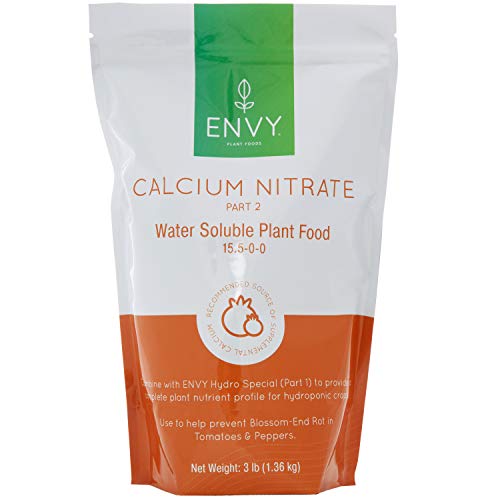
Greenhouse-grade calcium nitrate in resealable pouches that keep your hydro system cleaner.
ENVY packs their calcium nitrate as three separate 1 lb resealable pouches rather than one giant bag, which keeps the granules fresh and makes measuring easy — each pouch includes a small measuring scoop. With 19% calcium and 15.5% nitrogen, this is a pure, greenhouse-grade source that dissolves completely without leaving an oily skim on your water surface (a common problem with lower-grade agricultural calcium nitrate). One owner used it to treat blossom-end rot on tomatoes, tomatillos, and zucchini, and reported a noticeable improvement in two weeks. The application is simple: scoop, dissolve in warm water, and water the plants.
The granular form means you dissolve it before applying, unlike a liquid that is ready to pour. Owners note that solubility is excellent when pre-dissolved in warm water — a quick stir and it goes clear. A few users mention that it is expensive compared to raw calcium nitrate from farm supply stores, but the convenience of the scoop and the resealable pouches justifies the premium for home gardeners who do not want to handle 25 lb sacks. If you are dealing with calcium deficiency symptoms like skinny stems, drooping leaves, and yellow spots, this is a clean, effective fix.
The takeaway from users: effectiveness against blossom-end rot is the dominant theme, and the measuring scoop and resealable packaging get consistent praise for convenience in long-term storage.
Best for: home gardeners who want a clean, scoop-ready calcium nitrate that stores easily in separate pouches and mixes cleanly for soil or hydro.
Not the best if: you are growing on a very large scale — farm-supply bulk is cheaper per pound — or you need a cal-mag blend that includes magnesium.
9. Jack’s Nutrients 15-0-0 Part B Calcium Nitrate, 25lb
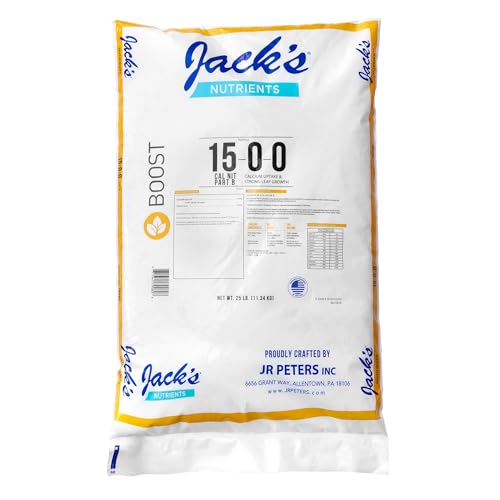
The 25 lb commercial bag that turns into hundreds of gallons of feed for serious operations.
Jack’s 15-0-0 Part B is the calcium half of the famous Jack’s 3-2-1 feeding program, and it is meant for continuous liquid feed systems — think hydroponics, greenhouse drip irrigation, and automated fertigation. The mixing rate is 8.6 ounces per 100 gallons of water to achieve a final feed strength of 100 PPM nitrogen. This is a powdered concentrate, so one bag makes a staggering volume of liquid fertilizer. Owners who grow hydroponic vegetables and fruit report that the results are amazing — one lifelong customer said it is the only brand they will use and that it produces “amazing quality veggies and fruit.” Another noted that it works great for preventing tomato end rot, which is the most common calcium deficiency symptom in fruiting crops.
This is a pure calcium and nitrate supplement with only two major macronutrients — you are expected to fill in the micronutrient needs separately. Jack’s 5-12-26 Part A is the usual partner, and together they form a complete base nutrient system. The 25 lb bag is a big commitment in terms of space and cost, but the per-dose cost is the lowest of any product on this list. If you have a small home garden with a few pots, this bag will last you literally years — and you may find it inconvenient to store. But if you are running a serious grow operation, the standout is this for precision and economy.
Why it wins at scale
- Extremely cost-effective per gallon of mixed feed — the 25 lb bag feeds hundreds of gallons
- Reviewers point out superior quality veggies and fruit compared to other brands, with one saying it is the only brand they will use
Know before you buy
- Requires careful measuring — 8.6 oz per 100 gal is precise and a kitchen scale is recommended
- Large bag is awkward to store for small-space growers, and you must keep it completely dry
Ideal for: dedicated hydroponic and greenhouse growers who already use the Jack’s 3-2-1 system or want the lowest cost per gallon for continuous calcium feeding.
pass on it if: you have a small soil garden of a few plants — the bag is too large and the mixing math becomes a chore for small batches.
Understanding the Specs
Calcium Content (Percentage by Weight)
This is the number that tells you how much actual calcium is in the bag or bottle, not counting the other elements or carrying agents. Calcium nitrate products often list 19% calcium, while cal-mag blends vary lower because they also contain magnesium. A product with higher calcium percentage is more concentrated, so you use less of it per watering. If the label does not clearly state a calcium percentage, the product likely contains a smaller amount than you think.
NPK Ratio (Nitrogen-Phosphorus-Potassium)
This three-number code on every fertilizer label tells you the percentage of nitrogen, phosphorus, and potassium. Calcium nitrate is often 15.5-0-0, meaning it provides a significant nitrogen boost alongside calcium — great for green leafy growth but a risk for flowering plants that prefer lower nitrogen. Cal-mag blends like ENVY CalMag+ have a 4-0-0 ratio, providing less nitrogen. Gypsum does not have an NPK rating because it supplies calcium and sulfur, not N-P-K. Read the NPK to make sure you are not over-feeding nitrogen when your plants are fruiting.
Form: Liquid vs. Powder vs. Granules
Liquids are ready to pour and mix instantly — ideal for correcting an active deficiency today. Powders (like Jack’s Calcium Nitrate) are more concentrated per pound and cheaper per dose, but require dissolving in water, which takes a few minutes and sometimes needs warm water for full dissolution. Granules (like Cz Garden Calcium Nitrate) dissolve quickly too but can leave residue if not stirred properly. Your choice depends on convenience versus cost: liquids win for speed, powders win for value.
Solubility and Residue
Greenhouse-grade and solution-grade calcium products are tested to dissolve completely with no oily skim or sediment. Lower-grade agricultural products can leave a film on your irrigation lines, pump, and plant roots. If you run hydroponics or drip irrigation, choosing a product labeled “greenhouse grade” or “solution grade” (like Cz Garden Calcium Nitrate or ENVY Calcium Nitrate) keeps your system running clean. For soil-only gardens, residue is less of a concern because the soil microbes break it down.
FAQ
What is blossom-end rot and is it caused by a lack of calcium?
Can I use calcium nitrate on all my plants or will it hurt some?
How often should I apply calcium to my tomato plants?
Is gypsum better than calcium nitrate for my garden?
Do I need a cal-mag supplement if I use reverse-osmosis water?
What does OMRI listed mean and why should I care?
Can I mix calcium nitrate with my regular fertilizer and use them together?
How do I know if my plants have a calcium deficiency and not something else?
Is powder or liquid calcium better value for money?
Can too much calcium hurt my plants?
Final Thoughts: The Verdict
For most gardeners, the calcium for plants winner is the General Hydroponics CaMg+ because it works across soil, hydro, and coco with a single liquid that owners have trusted through hundreds of harvests. If you want a budget-friendly powder that you can dial into an exact dose, grab the RAW Calcium/Mag. And for certified organic growers who want to improve soil structure season after season, the Cz Garden Organic Gypsum is the cleanest, most natural pick. No matter which route you take, a consistent calcium feeding schedule will stop the rot before it starts.
How We Picked
We do not accept paid placement. Every pick is matched to a real buyer and a real use-case; we do not hands-on test units.
Sources & Methodology
Specifications: manufacturer listings and product documentation. Review insights: verified customer reviews, as of July 2026. Pricing: not shown on this page (it changes often); check the current price via the retailer link.
As an Amazon Associate, FitlyFast earns from qualifying purchases. This does not affect which products we feature.