
Our readers keep the lights on and the weekend projects moving. As an Amazon Associate, I earn from qualifying purchases.
Specs are compiled from manufacturer listings and verified buyer reviews and can change over time — please confirm the key details on the product page before buying.
Financial calculators feel intimidating because they come with keys you’ve never seen, but the real decision is simpler than it looks. For business students, the machine that handles time value of money, net present value, and internal rate of return without a fight is the one worth carrying through every semester. This guide cuts through the jargon to show which models actually survive a finance major’s workload.
I’m Rikta — the founder and writer behind FitlyFast. This guide is built by comparing the manufacturers’ published specifications and the patterns across verified customer reviews, so you get each pick’s real strengths and trade-offs instead of marketing spin.
Before you spend a dime, here’s what separates a classroom tool from a professional one. calculator for business students choices hinge on exam approval, button feel, and function depth you will actually use.
Our Picks at a Glance


How To Choose The Best Calculator For Business Students
Before you grab the cheapest scientific calculator, know this: business programs demand specific financial keys (like NPV and IRR) that a standard model lacks. Your choice should match your exam rules and your course load, so you don’t end up buying twice.
Check what your program and exam board actually allow
Professional designations like the CFA and GARP FRM exams only approve specific models, so verify before you buy. If you’re aiming for those credentials, your options narrow dramatically. For general coursework, most professors just require a financial calculator with TVM keys.
Weigh button feel and layout against your typing speed
You’ll press these keys hundreds of times during a single exam, so a mushy or sticky button costs you real time. Look for tactile response and consider whether you prefer a compact handheld or a desktop unit with larger keys. The learning curve matters too — some models feel intuitive, others demand a manual.
Decide between standard, professional, or specialized functions
Basic financial calculators handle TVM, NPV, and IRR, which covers most coursework. Professional versions add modified duration, payback, and net future value. Specialized real estate models skip general statistics in favor of mortgage-specific keys. Match the feature set to your major, not the marketing hype.
Quick Comparison
| Model | Best For | Weight | Display | Exam Approval | Amazon |
|---|---|---|---|---|---|
| Texas Instruments BA II Plus★ Best Overall | General finance coursework | 3.68 oz | 10-digit | CFA, FRM, CMA | Amazon |
| HP 10bII+Premium Pick | Exam flexibility | 3.04 oz | 12-digit | SAT, AP tests | Amazon |
| CATIGA CF-300 | Budget-friendly daily work | — | 10-digit | Not CFA/CIPM | Amazon |
| HP 12C | Professional legacy | 0.15 kg | — | CFP prep | Amazon |
| BA II Plus Professional | Advanced coursework | 4.64 oz | 10-digit | — | Amazon |
| Calculated Industries 3400 | Real estate pre-licensing | 4 oz | — | State real estate | Amazon |
| Victor 6500 | Desktop loan math | 9.6 oz | 12-digit | — | Amazon |
In‑Depth Reviews
1. Texas Instruments BA II Plus Financial Calculator
Our pick — over 4.5★ from 22,000+ verified ratings; the strongest balance of quality and price.
The classroom standard that carries you from Finance 101 to your CFA designation.
The Texas Instruments BA II Plus is the most recommended financial calculator for business students because it’s approved for three major exams: the Chartered Financial Analyst (CFA), the GARP Financial Risk Manager (FRM), and the Certified Management Accountants (CMA). Buy it in your sophomore year, and you’ll legally carry the same machine into your career-defining exams later.
Its cash flow function calculates NPV and IRR for uneven cash flows, and the time-value-of-money plus amortization keys handle pension calculations, loans, and mortgages. You also get list-based one- and two-variable statistics with four regression options. At just 3.68 ounces, it slips into a pocket, which is nearly 6 ounces lighter than a desktop unit like the Victor 6500 — a real difference when you’re hauling it between classes.
What wins people over is the functionality — over a thousand owners single it out as the reason they bought it, with usability the second most-discussed strength. The recurring gripe is button responsiveness, with some units showing a double-entry key bounce on the CPT or IRR inputs. The battery change is also awkward, requiring 6 screws and clamps, but the included CR123A battery lasts so long that most students never deal with it.
Why it dominates classrooms
- Approved for CFA, FRM, and CMA professional exams
- Full TVM, NPV, IRR, and amortization coverage
- Featherlight 3.68 oz design for daily carry
- Clear display and intuitive layout for standard math
What to watch for
- Some units show double-entry key bounce on CPT input
- Battery replacement is a 6-screw process
- No nesting indicator for complex equations
Your semester partner: this is the pick for any business, finance, or accounting major who plans to sit for professional exams after graduation.
Think twice if: you want a machine for heavy statistical coursework — this is a financial tool first, a stats machine second.
2. HP 10bII+ Financial Calculator
Exam-permitted, feather-light, and reliable enough to survive an MBA and a CFP.
The HP 10bII+ is the rare calculator that’s permitted on the SAT, PSAT/NMSQT, and College Board AP tests, meaning it covers both your business coursework and your general standardized testing. Over 100 built-in functions include probability distributions, so it stretches beyond pure finance into statistics and economics classes.
Weighing just 3.04 ounces, it’s nearly half a pound lighter than the Victor 6500 desktop unit on this list, which makes it the easiest machine to forget you’re carrying. The intuitive keyboard layout requires minimal keystrokes for common functions, and the display has adjustable contrast with on-screen labels so you can read it in any lighting.
The thing everyone raves about is reliability — it’s the top-praised aspect in the review data, closely followed by build quality. A CFP exam passer called it useful for daily financial planning work, and an accounting major reported it carried them through every finance course. There’s a learning curve, as one MBA student noted, but a quick how-to guide solves that. At 4.7 stars, this is the highest-rated financial calculator in this lineup, though it has fewer reviews than the TI BA II Plus.
Why it earns the premium tag
- Approved for SAT, PSAT/NMSQT, and AP exams
- Over 100 functions including probability distributions
- Adjustable contrast display with on-screen labels
- Top marks for reliability and build quality
The trade-off
- Not approved for CFA or FRM exams
- Learning curve for first-time financial calculator users
Reach for this if: you’re an undergrad who needs one calculator for both standardized tests and finance classes.
Look elsewhere if: your career path requires CFA or FRM approval — that’s the TI BA II Plus territory.
3. CATIGA CF-300 Financial Calculator
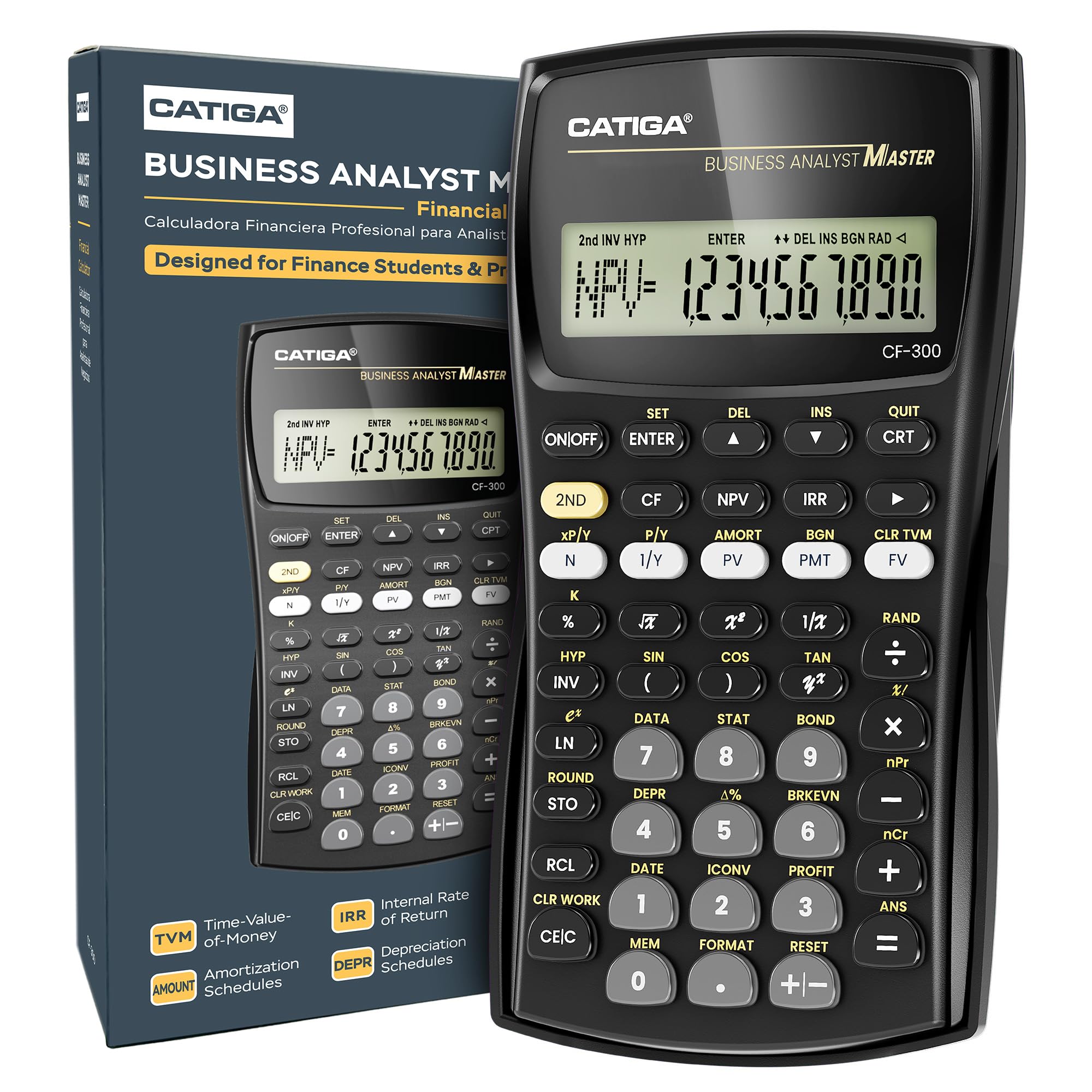
Packs TVM, IRR, and NPV into a compact unit that beats name brands on value.
The CATIGA CF-300 is the newcomer that undercuts the big names on price while delivering the same core functions you need for business coursework. It handles time value of money, IRR, NPV, cash flow, amortization, break-even analysis, and bond pricing — all the heavy hitters for MBA coursework and banking certifications.
The flip-open hard case with a snap-close design protects the keys during daily commutes, and the tactile buttons plus crisp 10-digit display make timed exams less stressful. One professional user called it their daily driver for real estate work, noting it handles TVM, IRR, and amortization easily. The wide-angle display is a standout — you can read it from an awkward lecture-hall angle.
Owners say it beats pricier rivals—one reviewer noted it works “so much better than the hp one” they owned—and it ships with a small instruction book, so you won’t need to search online for help. The honest trade-off: it’s not approved for the CFA Institute’s CIPM exam, which only allows the TI BA II Plus and HP 12C. Also, the instructions can get complex, and the single-line display makes viewing long equations tricky.
The budget-savvy choice
- Full TVM, NPV, IRR, and amortization at a lower cost
- Flip-open hard case protects keys in transit
- Tactile keys with wide-angle 10-digit display
- Statistics with 4 regression models included
Know the limits
- Not approved for CFA or CIPM exams
- Single-line screen limits complex equations
- Instructions can be complex at times
Best for: finance and accounting students who need professional functions without the name-brand premium.
skip it if: you’re already committed to sitting for the CFA — you’ll need the TI model.
4. HP 12C Financial Calculator

The industry standard since 1981, still trusted in high-stakes finance after 40 years.
The HP 12C is not a calculator for everyone — it’s a calculator for people who plan to work in real estate, banking, or finance and want the same tool professionals have used for over 40 years. With 120+ functions covering TVM, NPV, IRR, amortization, and bond calculations, plus programmable keys, it punches well above its size.
The catch is RPN input, a system that feels alien at first but becomes faster than standard algebra once learned. Owners who mastered it report speeds they won’t trade for anything — one user described an “efficient” system that beat their TI experiences. The most common praise is enduring quality, with durability the second most-discussed strength.
Newer models are much faster, with instant IRR computation and no running indicator. The build quality gets honest mixed feedback though — some find it solid, while others report unreliable keys and sticky buttons on certain units. Battery life is stellar, lasting months on 3 LR44 cells. It’s the pick for CFP exam prep, as one recent passer confirmed, and its legendary durability means a single purchase can span your entire career.
The professional’s edge
- Industry standard praised for enduring quality
- Programmable keys for custom workflows
- Newer models compute IRR instantly
- Batteries last months on 3 LR44 cells
The honest downsides
- RPN input has a steep learning curve
- Some units report sticky or unreliable keys
- No manual included — download it online
Your career-long companion: this is the machine for finance and real estate professionals who want the tool that’s outlasted every competitor.
Not your first calculator: if this is your first financial model, the RPN system adds unnecessary friction to your first semester.
5. Texas Instruments BA II Plus Professional

Everything the standard BA II Plus does, plus the advanced functions upper-level finance demands.
The BA II Plus Professional is the step-up version of the classic, adding Modified Internal Rate of Return (MIRR), Net Future Value (NFV), Modified Duration, Payback, and Discounted Payback. If your finance program goes beyond the basics, these extra keys save you from manual spreadsheet work during exams.
The improved 10-digit display and metal enclosure give it a more substantial feel than the standard model, and it ships with a leather-like case to protect it in your bag. At 4.64 ounces, it’s a full ounce heavier than the standard BA II Plus, but that weight comes from the sturdier build.
Reviewers praise its functionality and quality equally, with one student crediting it for saving them in their FINA 3000 class. The key warning is to read the instructions carefully — as one user found, a missed step caused real frustration until they re-read the manual. It’s also not built for general math; fractions and multi-term equations are problematic, so keep a separate scientific calculator for those.
Worth the upgrade: this is the pick for upper-level finance students who need MIRR, NFV, modified duration, and payback functions the standard model lacks.
One honest note: the photo can show the wrong color — one buyer received grey instead of black — and it lacks the key-step quick reference sheet the standard model includes.
6. Calculated Industries 3400 Pocket Real Estate Master
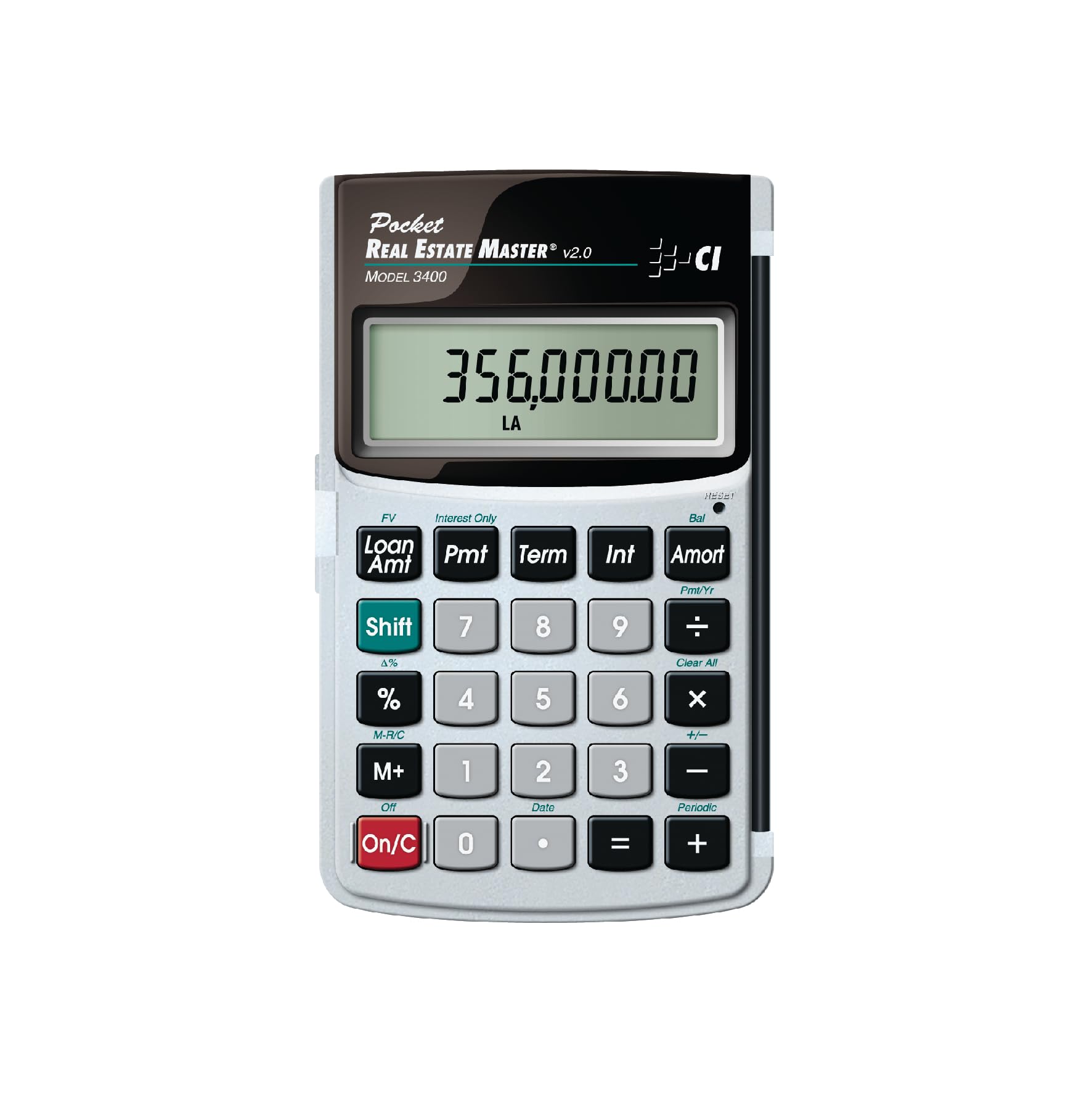
The pre-licensing exam lifesaver with large keys for the over-40 crowd.
The Calculated Industries 3400 is a specialized tool for real estate students, solving payments, loan amount, interest, term, amortization, remaining balance, future value, and date math. It’s not a general business calculator — it’s a focused mortgage machine that does one job exceptionally well.
At 4 ounces and 5 by 3 inches, it’s light enough to carry in a bag all day. The large display and larger keys make it genuinely easy to use, which is why ease of use is the most-praised aspect in the reviews. One buyer bought it the night before their real estate licensing exam and passed using just the basic formulas they remembered — no manual needed in the testing center.
Owners praise it as the ideal affordable amortizing calculator, particularly for those with less-than-perfect vision who need the big keys and display. It runs on a single included CR2 battery, and it’s super easy to turn on and off — a detail that matters when every second counts in an exam. The trade-off: it’s single-use focused, so it won’t help with general statistics or probability coursework.
Exam-day security: if you’re sitting for a real estate licensing exam, the dedicated keys mean you don’t waste time navigating menus.
The limitation: this is a mortgage specialist, not a full business calculator — keep a standard model for general coursework.
7. Victor 6500 Executive Desktop Loan Calculator
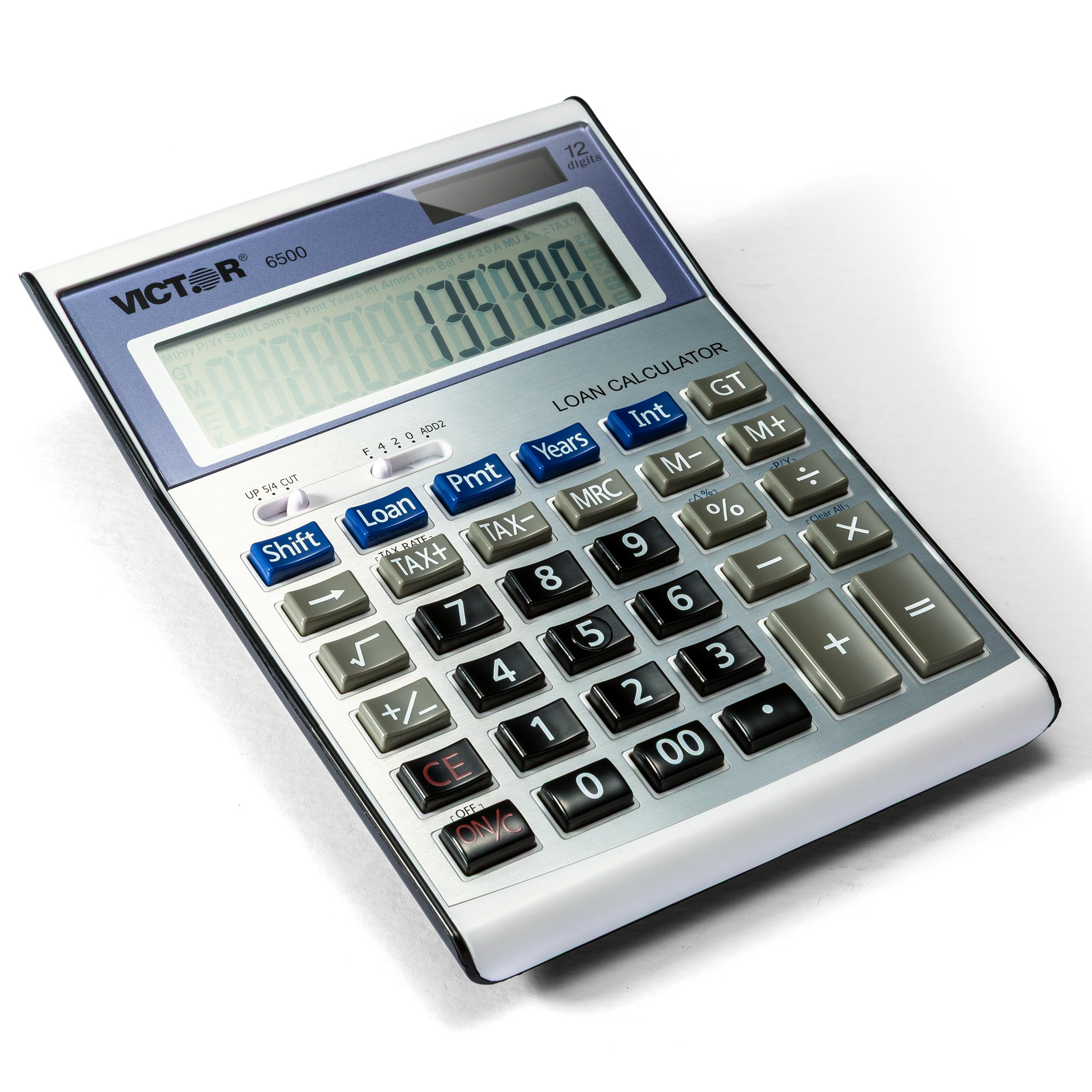
The extra-large angled display that makes mortgage math easy on the eyes.
The Victor 6500 is the desktop option on this list, built for students or professionals who spend long hours on loan calculations and want a display they can read from across a desk. The extra-large 12-digit angled LCD and easy-to-hit buttons make it a favorite among mortgage bankers and CPAs.
Input any three loan variables — payment, amount, interest, or term — and the Loan Wizard computes the fourth automatically. It also has automatic tax keys and a selectable decimal setting. At 9.6 ounces, it’s the heaviest unit here, more than 2.5 times the weight of the BA II Plus’s 3.68 ounces, but that’s because it’s built to sit on a desk, not travel in a pocket.
Functionality is the most-praised aspect, with size a close second — owners love the big display and unique button feel with longer key travel. As buyers report, “Love this calculator” is a recurring theme, including one owner on their third unit after juice spills and toddler mishaps. The honest downside: it’s bigger than some expect, and the directions could be more detailed for first-time users. It runs on 2 AA batteries rather than a specialty cell, which is easier to replace.
Desk-bound companion: this is the pick for students who do loan-heavy coursework at a desk and want a display that doesn’t strain their eyes.
Not for dorms: at nearly 10 ounces, this isn’t a pocket carry — it’s a stay-at-home machine.
Understanding the Specs
Time Value of Money (TVM)
This is the core function that separates a financial calculator from a regular one. TVM keys handle present value, future value, interest rate, and number of periods — the math behind loans, mortgages, and pension calculations. If a calculator lacks TVM, it is not a financial calculator, period.
NPV and IRR
Net present value (NPV) tells you what a series of future cash flows is worth today; internal rate of return (IRR) is the interest rate at which those flows break even. These are the two numbers you’ll compute constantly in corporate finance and investment coursework, and they require a cash flow function to handle uneven amounts.
FAQ
What is the difference between the BA II Plus and BA II Plus Professional?
Will a financial calculator be allowed on my finance exam?
What is RPN input and should I learn it?
How long does the battery last on these calculators?
Can I use a scientific calculator instead for finance classes?
What does the Loan Wizard do on the Victor 6500?
Which calculator is best for a real estate licensing exam?
Is the HP 12C worth the premium price for a student?
Can these calculators handle statistics and probability coursework?
Final Thoughts: The Verdict
For most business students, the calculator for business students winner is the Texas Instruments BA II Plus—it takes you from your first finance class through CFA, FRM, and CMA exams with no second purchase needed. If you want one machine for both standardized tests and everyday coursework, choose the HP 10bII+. For real estate students needing dedicated mortgage keys, the Calculated Industries 3400 is your pick.
How We Picked
We do not accept paid placement. Every pick is matched to a real buyer and a real use-case; we do not hands-on test units.
Sources & Methodology
Specifications: manufacturer listings and product documentation. Review insights: verified customer reviews, as of August 2026. Pricing: not shown on this page (it changes often); check the current price via the retailer link.
As an Amazon Associate, FitlyFast earns from qualifying purchases. This does not affect which products we feature.