
Our readers keep the lights on and the weekend projects moving. As an Amazon Associate, I earn from qualifying purchases.
Specs are compiled from manufacturer listings and verified buyer reviews and can change over time — please confirm the key details on the product page before buying.
Your physics homework depends on the calculator in your hand. You need one that shows fractions exactly as they appear in your textbook, handles derivatives and integrals without a graphing screen, and survives a full semester of abuse. The real question isn’t which brand to buy, but which class you’re walking into: standard algebra-based physics and calculus call for a fast scientific model, while advanced coursework and labs reward a graphing powerhouse.
I’m Rikta — the founder and writer behind FitlyFast. This guide is built by comparing the manufacturers’ published specifications and the patterns across verified customer reviews, so you get each pick’s real strengths and trade-offs instead of marketing spin.
From textbook-style displays to Python-enabled graphing, here is the shortlist of the best calculator for physics work that actually gets you through problem sets without a fight.
Our Picks at a Glance

How To Choose The Right Calculator For Physics
Your choice depends on your course level, your exam rules, and how much you want to see your work laid out like a textbook page. The biggest mistake is grabbing a basic four-function model when your syllabus demands roots, fractions, and logarithms displayed properly.
Match the machine to your course
Algebra-based physics and first-year calculus are handled comfortably by a scientific calculator with a Natural Textbook Display — these show fractions and roots as they appear in your book, which makes checking your setup far easier. Upper-level mechanics, thermodynamics, and lab-heavy courses reward a graphing calculator that can plot functions and hold long programs.
Know your exam’s rules before you buy
Standardized tests like the ACT and AP exams have strict lists of approved devices, so a model that shows textbook-style expressions is often enough — but graphing models have their own approval lists you need to verify. If you plan to take the same calculator through multiple courses, choose one that appears on the widest range of permitted lists.
Decide how you want to power it
Physics students tend to run long problem sessions, so the battery question matters more than it seems. Button-cell scientific models run for months on a single cell, while graphing models with rechargeable packs or USB-C ports remove the scramble for fresh AAA batteries before a big exam.
Quick Comparison
| Model | Best For | Display Style | Functions | Power Source | Amazon |
|---|---|---|---|---|---|
| Casio fx-115ES Plus 2nd Edition★ Best Overall | College math & physics | 16-digit, 4-line LCD | 252+ | 1 LR44 battery | Amazon |
| Texas Instruments TI-34 MultiViewSchool Staple | Middle & high school | 4-line MathPrint | Scientific | Battery | Amazon |
| NEWYES RechargeableNote-Taker’s Pick | Note-takers on the go | 6.5″ tablet + LCD | 552 | USB-C rechargeable | Amazon |
| Casio FX-991ES Plus-2 | Algebra & ACT prep | Natural Display | Scientific | Battery | Amazon |
| TI-83 Plus (Reconditioned) | Budget graphing | 8-line LCD | Graphing | 4 AAA batteries | Amazon |
| TI-83 Plus (New) | Statistics & graphing | 8-line LCD | Graphing | 4 AAA batteries | Amazon |
| TI-84 Plus CE Python, Coral | Chemistry & color graphing | 3.2″ color backlit | Graphing + Python | Rechargeable | Amazon |
| TI-84 Evo, Raspberry | Modern classroom use | 2.8″ color backlit | Graphing + Python | USB-C rechargeable | Amazon |
In-Depth Reviews
1. Casio fx-115ES Plus 2nd Edition
Our pick — over 4.5★ from 7,000+ verified ratings; the strongest balance of quality and price.
The featherweight physics companion that punches into calculus without a graphing screen.
For anyone walking into college-level physics or engineering, the defining feature here is the Natural Textbook Display — a 16-digit, 4-line LCD that shows fractions, roots, and equations exactly as they appear on the page. That means you can check whether you set up an integral correctly before you punch the numbers, which is where most physics mistakes actually happen. It runs on a single included LR44 button cell, so you won’t be hunting for batteries mid-semester.
What wins people over is the function list: derivatives, integrals, and plenty of statistical tools sit behind an intuitive menu, which is why owners describe it as ideal for algebra, calculus, physics, and engineering alike. Buyers report it outperforms the TI-30 at a friendlier cost, and the review pages sum it up: “Best value under. Outperforms TI-30; does derivatives and integrals.” It weighs just 6.05 ounces, so it disappears into a backpack pocket between classes.
One honest limit: the display is not the brightest in a sunlit room, so you’ll want to work in normal lighting. The build feels solid and owners note it lasts for years, with scratch-resistant glass protecting the screen from normal backpack wear. For the money, nothing else in this list delivers this much calculus-ready power in such a light frame.
What wins you over
- Textbook-style display for error-checking physics setups
- Handles derivatives and integrals without graphing cost
- Lightweight 6.05-oz frame for daily carry
Know before you buy
- Screen can look dim in bright sunlight
- Non-graphing, so no plotting for labs
Reach for it if: you want calculus-ready power that slides into any bag.
Look elsewhere if: your physics lab demands live graphing of functions.
2. Texas Instruments TI-34 MultiView
The sturdy four-line workhorse that middle and high schoolers never seem to lose.
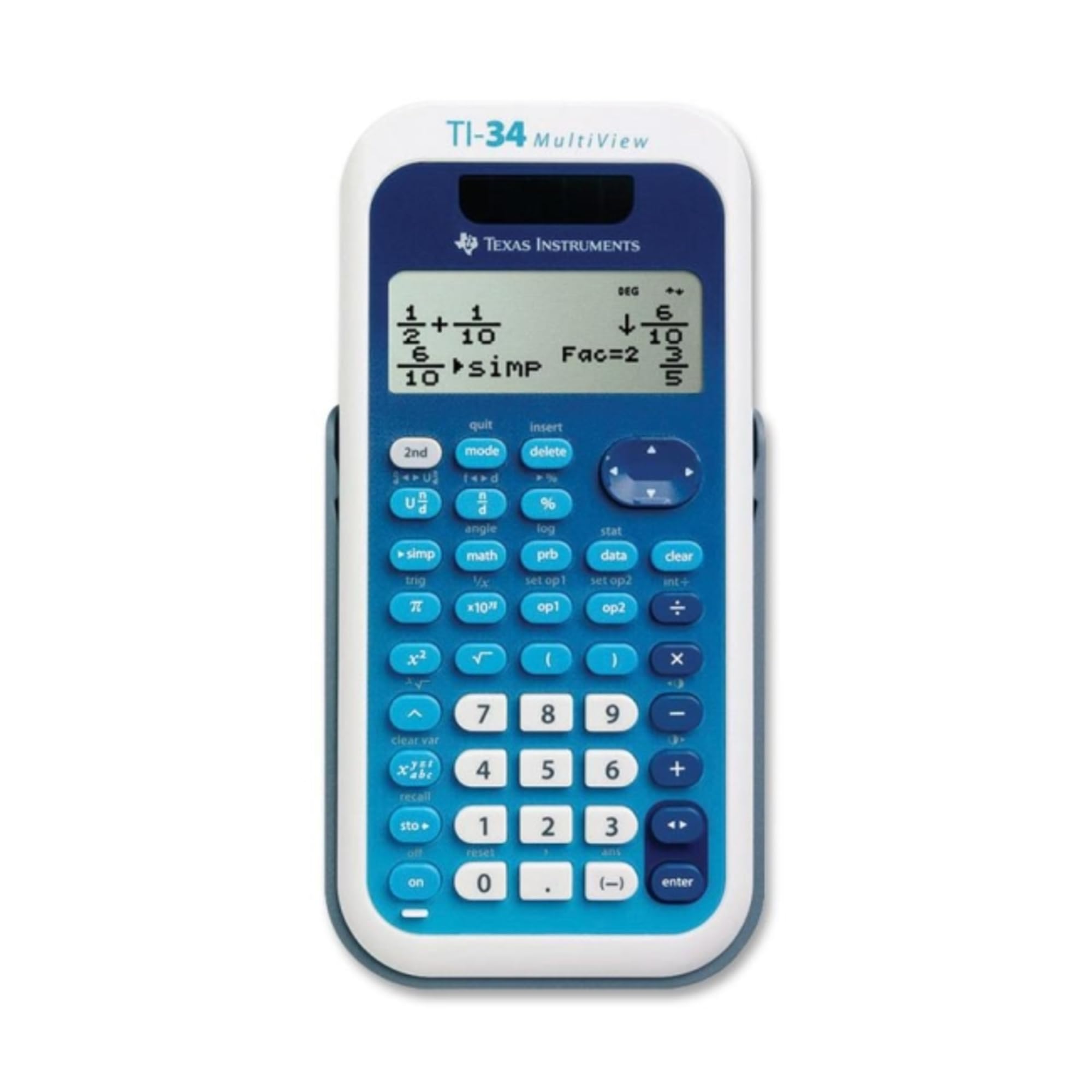
This TI-34 lets you see multiple calculations at once on its four-line display, so you can compare results side by side and watch how a physics formula changes when you tweak a variable. The MathPrint feature (which shows expressions, symbols, and fractions just as they appear in textbooks) makes the bridge from whiteboard to screen obvious for a 6th grader or a high school physics beginner.
Owners mention it’s the exact “required back to school item” for many classrooms, and parents keep coming back to its durability — as one owner put it: “This calculator will last if your kids don’t lose it.” It weighs 7.2 ounces, making it a touch heftier than the Casio picks here, but that weight reads as solid construction rather than bulk.
The fraction exploration tools — simplification, integer division, and constant operators — make this a smarter classroom choice than a bare scientific model, because it actively teaches number relationships. The trade-off is that it stops well short of calculus-level power, so it fits the middle and high school lane rather than university problem sets.
Why it earns its place
- Multi-line screen shows several calculations at once
- Textbook-style MathPrint for clearer learning
- Built to survive a school year in a backpack
Where it taps out
- No derivatives or integrals for upper-level courses
- Heavier at 7.2 ounces than the Casio rivals
Best suited to: students from 6th grade through high school physics.
Not for: college calculus-based physics needing integration tools.
3. NEWYES Rechargeable with Writing Tablet
A scientific brain with a scratch-pad built in — for students who think better with a pen.
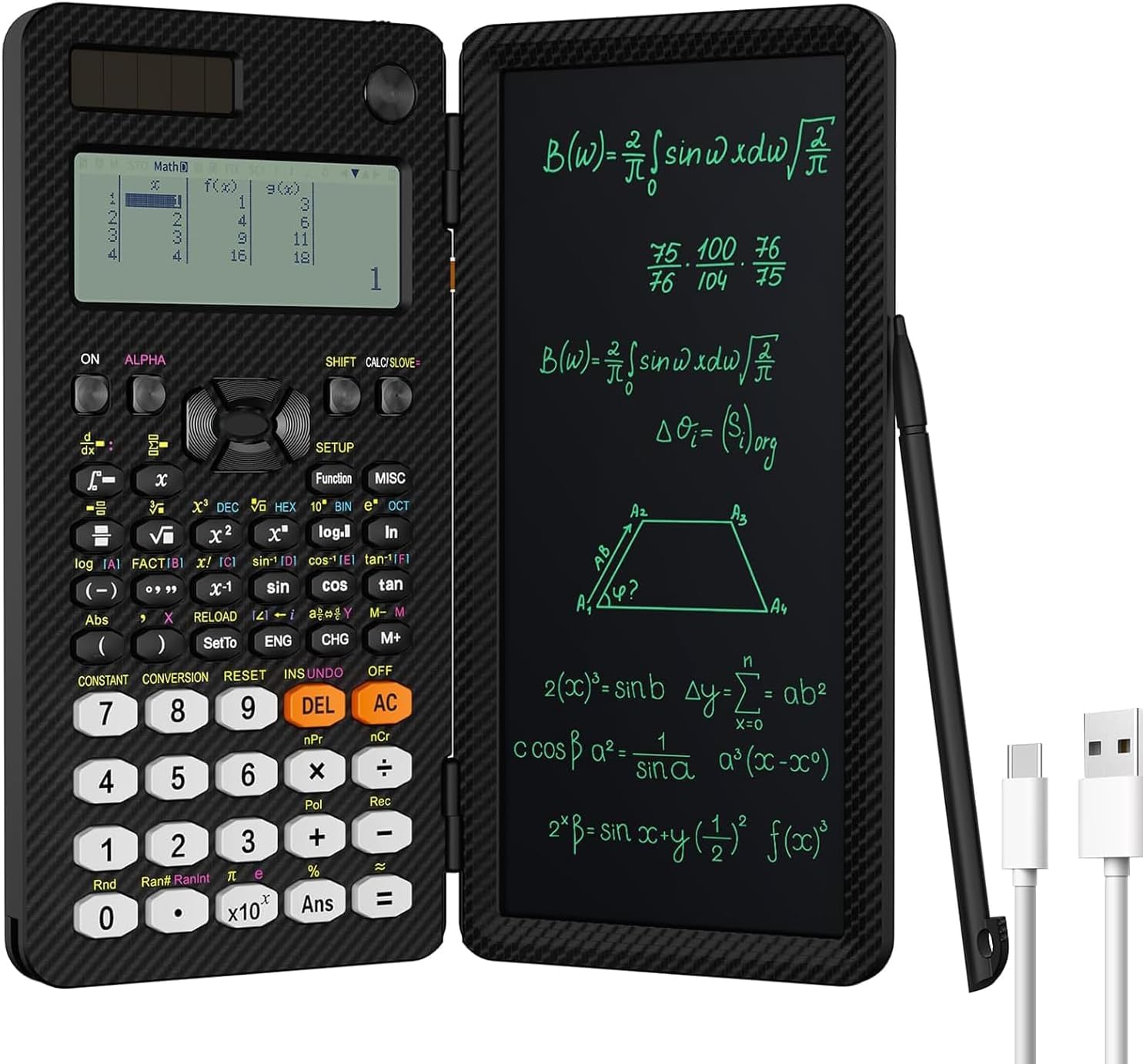
The standout here is the 6.5-inch writing tablet tucked above the keypad, complete with a pen, so you can sketch a free-body diagram or jot a conversion while you crunch numbers. You press the Delete button to erase your notes or lock them in place when you want them to stay — a workflow that owners say is perfect for quick scratch work between classes. The whole unit folds up like a book, with the LCD screen doubling as a protective lid.
Under the hood sit 552 functions covering fractions, statistics, complex numbers, linear regression, equations, inequalities, and polar-rectangular coordinate conversion — enough for physics and engineering coursework. It charges over USB Type-C with a dedicated cable included, and the community wisdom is that it runs for months between charges with indoor use — one owner clocked it plainly: “Months without charging (indoor use).” At 6.3 inches long by 3.15 inches wide, it’s a compact pocket-fit compared to the much larger Casio FX-991ES, which measures 19.69 inches across.
The recurring trade-off is the screen in bright light — it can look unclear outdoors — and the buttons feel a bit cheaper than premium plastic keys on pricier models. The rechargeable design and the built-in scratch pad are the reasons this one earns its place, especially for students who like to see their work next to their numbers.
The clever parts
- Built-in writing pad for notes and diagrams
- USB-C charging means no battery purchases
- 552 functions for broad course coverage
Watch for
- Screen washes out in strong sunlight
- Key feel is less premium than pricier models
Choose this if: you want to sketch problems right beside your calculations.
skip it if: you spend most of your study time under bright lecture-hall lights.
4. Casio FX-991ES Plus-2

A mother-approved pick that carries 6th graders into algebra and university students through physics.
This Casio’s defining trick is the natural display, which shows mathematical expressions like roots and fractions exactly as they appear in your textbook — so the results are easier to understand when you’re verifying a physics setup. The screen itself measures 2 centimeters diagonally, and the body stays light at 100 grams, which makes it an easy daily carry. It ships as a classroom-standard model that shows up everywhere from pre-algebra to university-level math courses.
Customers note it’s accepted for the ACT, and the keypad is noticeably easier to type on than other calculators in its class — a detail that matters when exam time pressure hits. One parent summed up the longevity: “Daughter has been using this for a year in university level math courses.” It’s also a favorite for 6th graders entering algebra, which shows how wide its usefulness spans.
The honest limit is that it’s a scientific model, not a graphing one, so it won’t plot functions for a lab report. But if your course runs on textbook-style notation and you want a model that’s approved for standardized tests, this Casio is a proven, affordable companion.
Why it’s a favorite
- Textbook-style display reduces setup errors
- Easy-to-type keypad for exam conditions
- Approved for the ACT
Its limits
- No graphing capability for plotting
- Small 2-cm screen for dense problems
Grab it for: algebra through university coursework with exam approval built in.
Pass if: you need a graphing screen for physics labs.
5. TI-83 Plus with Screen Protector (Reconditioned)

A certified reconditioned classic that gets graphing power into your hands for less.
This TI-83 Plus arrives certified reconditioned with a Guerrilla screen protector set included, which is the smart way to get graphing capability without paying new-model prices. It runs on 4 AAA batteries, and the LCD screen delivers the classic 8-line graphing display that high school and college math and science classes have relied on for decades. For physics students who need to plot functions but can’t justify a top-tier budget, this is the entry point.
The reconditioned condition reads as nearly new to most buyers, and it works well across physics, math, and science coursework. Because it’s a graphing model, you can visualize how a projectile’s height changes over time or how a spring’s force varies with displacement — the kind of insight a scientific model simply can’t give you.
The caveat with any reconditioned unit is the occasional defect — some reviewers point out screen lines that warrant the available warranty — so it’s worth treating the add-on warranty as part of the purchase. For the price, this is a solid way into graphing for an entry-level budget.
The value angle
- Graphing power at a budget-friendly reconditioned price
- Screen protector included for daily wear
- Runs on 4 easily replaceable AAA batteries
Before you commit
- Reconditioned means occasional screen defects
- Wrap-around warranty is worth adding
Best for: budget-conscious students who need function plotting.
Think twice if: you’d rather buy new for long-term reliability.
6. Texas Instruments TI-83 Plus (New)
The legendary workhorse that some owners have dropped a hundred times and still trust.
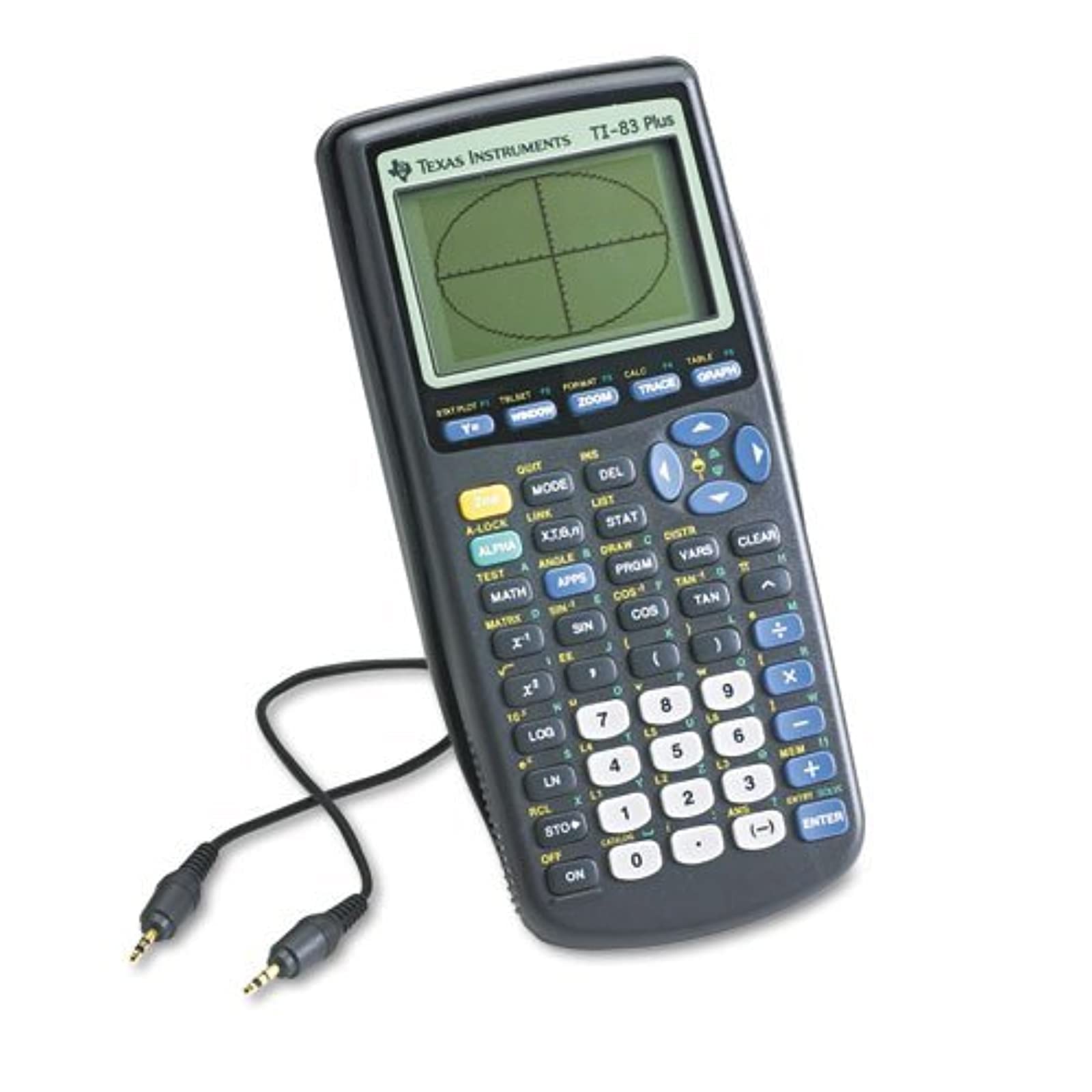
The TI-83 Plus has been a staple of the science, engineering, and math toolbox for three decades, and this blue model is the new-in-box version of that classic. It runs on 4 AAA batteries and tips the scales at 8 ounces, making it the heaviest graphing pick here — but that weight is a trade-off many owners happily accept for the durability that comes with it. One long-term owner reports four years of hard use with the original battery and a screen that survived roughly 100 drops.
The graphing screen lets you plot functions, compute factorials, run z-intervals for statistics, and handle the full range of physics visualization tasks. Buyers specifically prefer this over the TI-84 Plus CE for two reasons: no 3-second OS validation delay at startup and better battery life — the color screen adds no real value for many users. It’s a favorite for stats-heavy physics courses that need graphing plus probability tools.
The honest catch is reliability — the feedback is genuinely mixed, with some units reported to simply stop working within about 6 months. For most owners the build is rock-solid and long-lived, but it’s not a universal guarantee. The design is unchanged in 30 years, so you know exactly what you’re getting: a proven, no-nonsense graphing machine.
Why it endures
- Legendary durability verified by long-term owners
- No startup delay like newer color models
- Full graphing and statistics power
The risk factor
- Reliability is mixed — some units fail within months
- 8 ounces is the heaviest pick in this list
Pick this if: you value proven graphing function over flashy features.
Hesitate if: you want the consistency of a brand-new, never-reconditioned unit but can’t accept any failure risk.
7. TI-84 Plus CE Python, Coral
A color-screen powerhouse that flaunts a built-in periodic table for science majors.
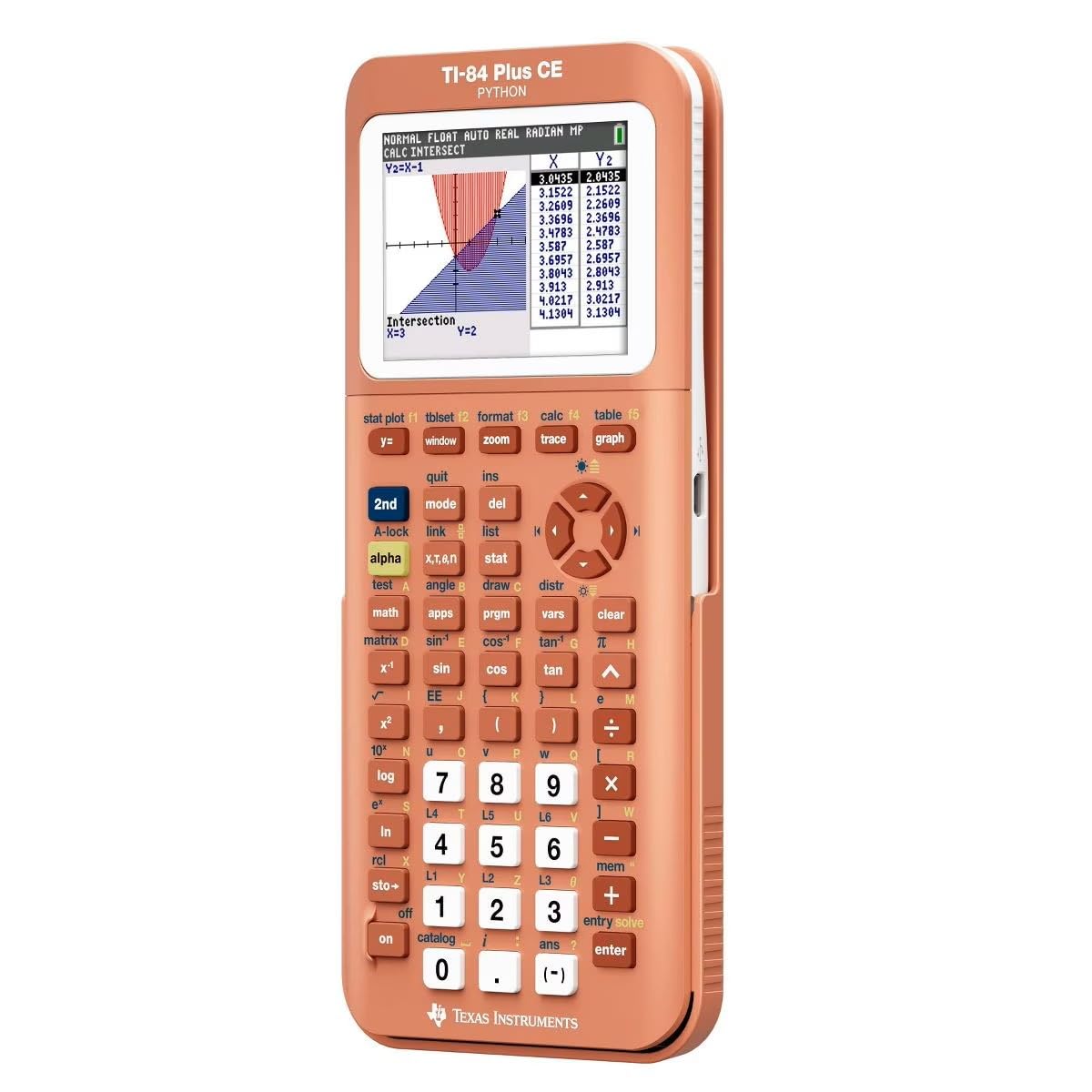
The headline feature here is the high-resolution, full-color backlit display — 140 DPI with 16-bit color on a 3.2-inch screen — which makes graphing a physics function genuinely pleasant to read. The screen is bright enough that the curves stand out clearly, which owners say makes it excellent for math tutoring and daily coursework. And it comes in a metallic coral finish that stands out on any desk.
Beyond the pretty exterior, this TI-84 Plus CE runs Python, so you can write simple programs to automate repetitive calculations — a genuine edge for physics students learning computational thinking. It’s rechargeable, and buyers confirm the battery holds for a long time between charges. The surprise bonus for science students: a color periodic table built in, with element details on tap, which a chemistry major called out as amazing.
The mixed feedback centers on long-term reliability and battery life — most owners are delighted, but a meaningful number report issues down the road. It doesn’t ship fully charged, so plan to plug it in before your first class. For the price, you’re paying for the color screen and the coding capability, both of which deliver real classroom value.
The premium perks
- High-resolution color backlit display for clear graphs
- Built-in Python for computational physics
- Rechargeable battery with long run times
Fair warnings
- Ships without a full charge — charge before class
- Long-term reliability draws mixed feedback
Reach for it if: you want color graphs, Python, and a periodic table in one device.
pass on it if: you need a no-frills graphing machine and prefer to save the difference.
8. TI-84 Evo, Raspberry
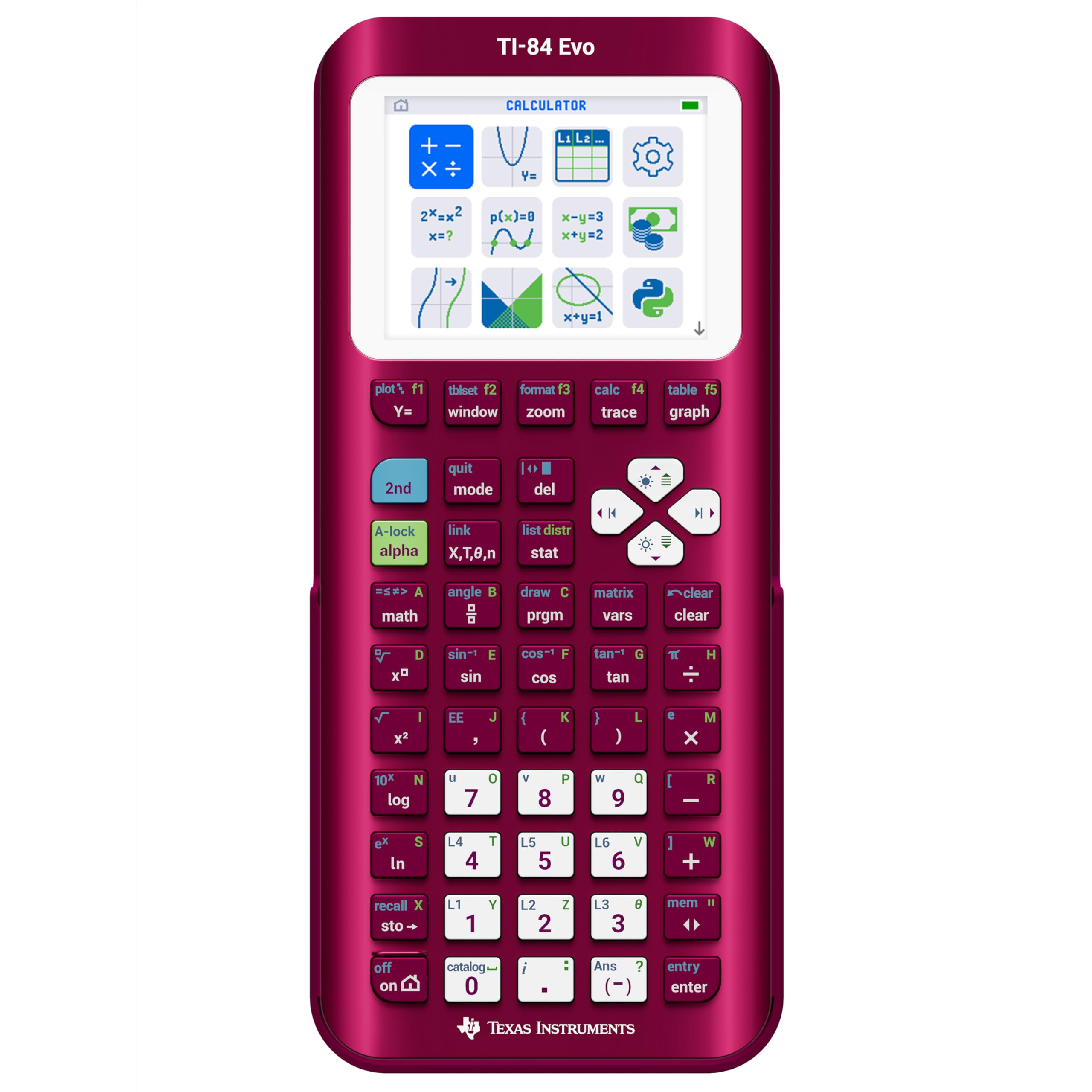
The newest TI-84 with a 3x-faster processor and USB-C — built for the modern classroom.
The TI-84 Evo is the newest entry in the TI-84 series, and its defining upgrade is speed: a powerful processor delivers calculations and graphing that the maker rates at 3x faster than the TI-84 Plus CE. You get 50% more graphing space, which makes it easier to see patterns and relationships in your physics curves. The screen is a 2.8-inch LCD in a slim 7.2-ounce body that runs on an included lithium-ion battery charged over USB-C.
The icon-based home screen puts popular math tools front and center, so you spend less time hunting through menus and more time solving. Buyers call out the bigger display, improved button placement, and the smooth graphing — plus a dedicated fraction button and inequality symbols that appear directly in equations, which helped one student land an A. The raspberry color with a matte finish resists fingerprints, a small but real quality-of-life win.
The honest feedback: the 3x-faster claim is debated, with some owners saying it’s quicker but not 3x, and the APPS button has been removed in favor of a less useful key. It also doesn’t yet support TI Connect CE, so you’re limited to online software and emulator tools rather than TI Basic code transfer. If you already own a TI-84 Plus CE, this is a solid modern refresh rather than a must-have leap.
What’s new here
- USB-C charging with a built-in lithium-ion battery
- Bigger graphs with 50% more graphing space
- Icon-based home screen for faster navigation
Keep in mind
- The 3x speed claim draws mixed real-world feedback
- No TI Connect CE support for TI Basic transfers
Choose it if: you’re buying new and want the fastest, most modern TI-84 experience.
Hold off if: you already own a working TI-84 Plus CE and don’t need the refresh.
Understanding the Specs
Natural Textbook Display
This is the feature that shows fractions, roots, and equations the way they appear in your physics textbook, instead of on a single flat line. It matters because you can see at a glance whether you typed an integral or a derivative correctly before you trust the answer — the difference between catching a setup error and carrying it through an entire problem.
Scientific vs Graphing
A scientific calculator handles arithmetic, trigonometry, logarithms, and often calculus operations like derivatives and integrals, all keyed in as numbers. A graphing calculator adds a screen that plots functions visually, which helps you see how a physical quantity changes over time but costs more and often brings a steeper learning curve.
FAQ
Can I use a scientific calculator for physics or do I need a graphing one?
What does Natural Textbook Display actually do for my physics homework?
How long does the battery last on these calculators?
Is the Casio FX-991ES Plus-2 allowed on the ACT?
Which calculator is better for physics, the ti-83 plus or the ti-84 plus ce?
Does the NEWYES calculator really replace a notebook with its writing tablet?
What is the learning curve like on a graphing calculator?
Is it worth paying more for Python support on a physics calculator?
How does the weight of these calculators affect daily carry?
Which calculator should a 6th grader starting algebra choose?
Final Thoughts: The Verdict
If you want one dependable pick, the calculator for physics winner is the Casio fx-115ES Plus 2nd Edition because it delivers calculus-ready derivatives and integrals in a lightweight 6.05-ounce frame with a textbook display — all without graphing-model cost or bulk. If you want a rechargeable note-taking companion, grab the NEWYES with its built-in writing tablet. And for upper-level coursework demanding color graphing and Python, the TI-84 Evo is the one to reach for.
How We Picked
We do not accept paid placement. Every pick is matched to a real buyer and a real use-case; we do not hands-on test units.
Sources & Methodology
Specifications: manufacturer listings and product documentation. Review insights: verified customer reviews, as of August 2026. Pricing: not shown on this page (it changes often); check the current price via the retailer link.
As an Amazon Associate, FitlyFast earns from qualifying purchases. This does not affect which products we feature.