
Our readers keep the lights on and the weekend projects moving. As an Amazon Associate, I earn from qualifying purchases.
Specs are compiled from manufacturer listings and verified buyer reviews and can change over time — please confirm the key details on the product page before buying.
New buyers often overvalue guide numbers, but control features like TTL and HSS matter more for real-world results. Focus on light quality, sync speed, and color consistency rather than raw reach. Here are the nine flashes that deliver dependable performance for Canon, Nikon, and Sony shooters.
I’m Rikta — the founder and writer behind FitlyFast. This guide is built by comparing the manufacturers’ published specifications and the patterns across verified customer reviews, so you get each pick’s real strengths and trade-offs instead of marketing spin.
From pocket-sized strobes to pro rigs, these are the best camera flash options for Canon, Nikon, and Sony shooters who want dependable light without overpaying.
Our Picks at a Glance


How To Choose The Best Camera Flash
Your camera’s built-in pop-up flash (if it even has one) is a last resort, not a tool. A dedicated flash—speedlight or pocket strobe—gives you control over light direction, quality, and intensity. Match the flash to your camera’s TTL system, your shooting style, and your need for automatic versus manual control.
Match the flash to your camera system first
Canon, Nikon, and Sony each use their own electronic language for automatic flash exposure (TTL). A flash marked “for Canon” won’t do TTL on a Nikon body, even if it physically fits the hot shoe. Some flashes, like the Altura Photo universal speedlite, work in manual mode across all brands, while dedicated units like the Canon Speedlite EL-10 only talk to their own system.
Decide how much automatic control you need
TTL (through-the-lens) metering lets the camera and flash negotiate exposure automatically — ideal for events and quick shots where you can’t fiddle with settings. Manual mode gives you full power control but requires you to dial in the output yourself. If you’re a beginner, a flash with dependable TTL saves you from a lot of frustrating missed shots. If you shoot in a controlled studio, manual is simpler and cheaper.
Think about power, recycle time, and battery
Guide number (GN) tells you how far the light reaches, but watt-seconds (Ws) tell you the total energy. For typical portrait and event work, a 76Ws speedlight is a solid workhorse, while a 200Ws strobe like the Godox AD200 Pro II gives you room to bounce and shape light. Recycle time — the seconds between shots — matters for fast-moving subjects, and a lithium battery (measured in mAh) determines how many full-power pops you get before recharging.
Quick Comparison
| Model | Best For | Power | Sync Speed | Guide Number | Amazon |
|---|---|---|---|---|---|
| Godox AD200 Pro II★ Best Overall | Location portraits | 200Ws | 1/8000s | GN52 | Amazon |
| Altura Photo AP-UNV2Budget Champion | Budget manual learning | Manual | 1/200 | GN38 | Amazon |
| VILTROX Z1 ProCompact Pick | Everyday carry fill | 24Ws | 1/8000s | GN12 | Amazon |
| NEEWER Z1-C | Canon enthusiasts | 76Ws | 1/8000s | GN52 | Amazon |
| NEEWER Z2PRO-C | Event shooters | 76Ws | 1/8000s | GN40 | Amazon |
| Godox V860III-S | Sony owners | — | 1/8000 | — | Amazon |
| Canon Speedlite EL-10 | Canon R-series beginners | — | 1/200 | GN82.7 | Amazon |
| Nikon SB-910 | Nikon CLS shooters | — | 1/250s | GN34-48 | Amazon |
| Profoto A10 | Pro on-camera work | — | 1/8000 | GN100 ft | Amazon |
In-Depth Reviews
1. Godox AD200 Pro II
Our pick — over 4.5★ from 900+ verified ratings; the strongest balance of quality and price.
The pocket strobe that shoots like a studio pack, with a 200Ws punch that defies its 1.2 kg frame.
The AD200 Pro II is the pick for photographers who want true strobe power without hauling a heavy monobloc. It delivers 200Ws of output — enough to overpower the sun for outdoor portraits — yet the whole kit fits in a small carry bag. The interchangeable heads (a bare bulb for soft, omnidirectional light and a speedlight head for reach) make it two flashes in one body.
Color accuracy is where this unit genuinely stands out. It holds color temperature within ±100K across the entire power range, so your skin tones stay consistent as you dial power up or down. The upgraded heads also run cooler under sustained use, letting you shoot all day without the overheating that plagues lesser strobes. With a 2.4G wireless system built in, it pairs easily with Godox X-series triggers — a simple tap on the X3 syncs them instantly.
You get a 10-stop power range down to 1/512, so you can dial it from a subtle accent light to a full key light. The bi-color modeling lamp (up to 1400 lux at 1 meter) lets you preview exactly where shadows will fall before you press the shutter. Owners consistently praise its build quality and how smoothly it slots into the wider Godox ecosystem.
Why owners love it
- Compact 200Ws strobe that goes anywhere
- ±100K color stability for reliable skin tones
- Two heads included for different light quality
- One-tap sync with X3 trigger
Who should think twice
- Requires a trigger for HSS (high-speed sync) work
- Heavier than a standard speedlight at 1.2 kg
Reach for this if: you shoot portraits or products and want studio-grade power that travels in a day bag.
Look elsewhere if: you only need on-camera fill light — a smaller speedlight will do that job with less to carry.
2. Altura Photo AP-UNV2
The no-frills manual flash that teaches you lighting basics for less than a tank of gas.
The Altura Photo AP-UNV2 is the classic starter flash: a manual-only speedlight that works across Canon, Nikon, Sony, Panasonic, Olympus, and Pentax bodies. It won’t do TTL (automatic exposure), so you’ll adjust power yourself from 1/1 to 1/128. That’s a feature when you’re learning — it forces you to understand light instead of letting the camera decide.
Its wide compatibility list covers nearly every mainstream DSLR and mirrorless body, including the Sony RX100 series and ZV-E10. The LCD display keeps your settings readable, and a wireless trigger mode lets you fire it off-camera for portraits. Despite its low cost, buyers report it holds a charge for weeks with a few hours of use, which is impressive for a flash that runs on standard batteries.
The build quality is the main compromise at this price. The hinge on the battery compartment door is fragile, and owners advise gentle handling — as one put it, “for the price you’re not buying a high quality flash.” If you treat it with care, it delivers solid light and dependable function. The compatibility list is long, but some users report it doesn’t work on certain bodies, so check your exact model before buying.
The verdict: a smart, cheap way to learn manual lighting and figure out whether off-camera flash is for you — just be gentle with the battery door.
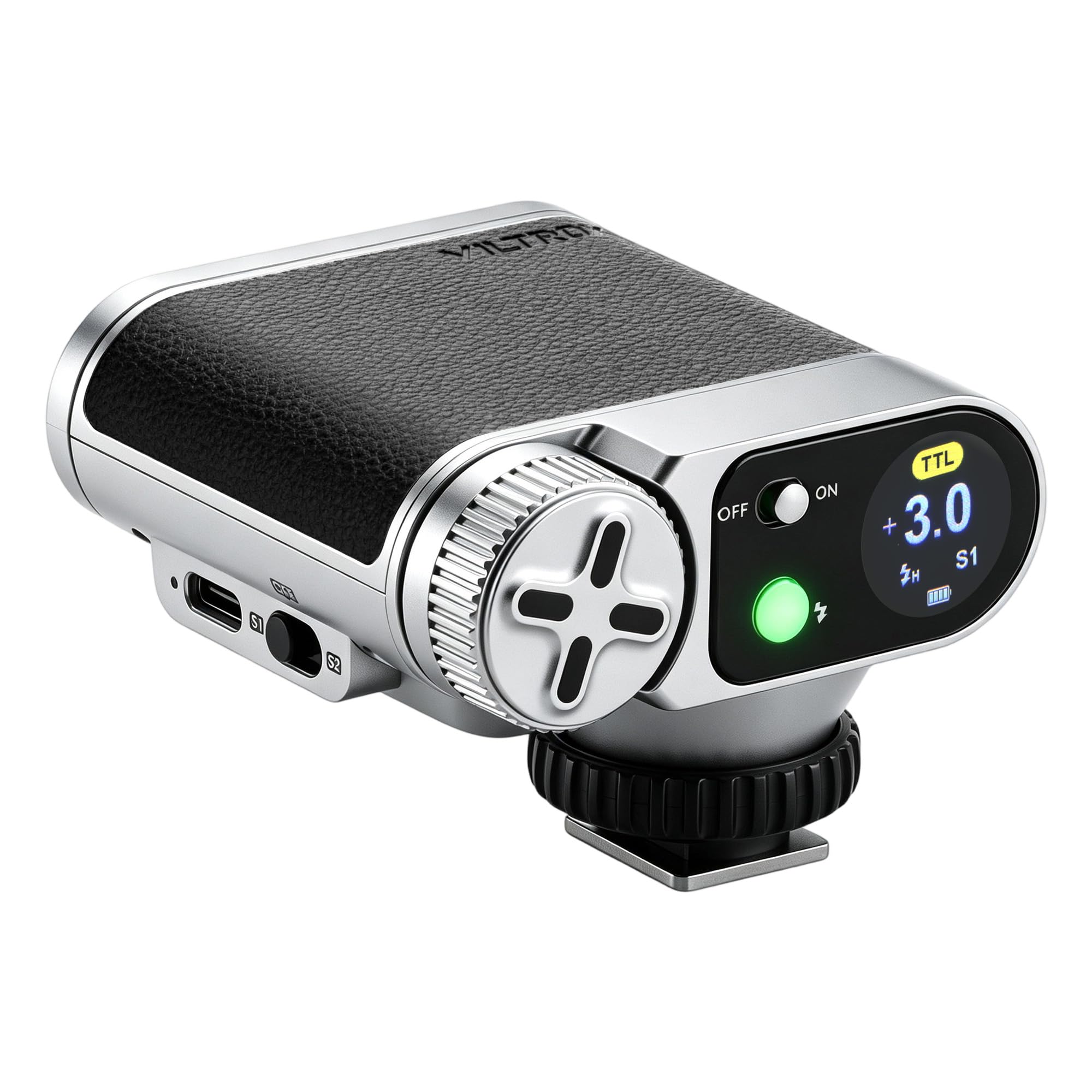
3. VILTROX Z1 Pro (Vintage Edition)
A gorgeous retro-styled mini flash with a touchscreen that actually fits in your everyday carry bag.
The VILTROX Z1 Pro breaks the mold of the boxy black speedlight. This vintage-styled 24Ws flash weighs just 136 g, so it disappears into a bag alongside your camera — meaning you actually have it with you when the light gets flat. Its 2.5D curved glass touchscreen lets you swipe between modes and tap to adjust power, a control scheme far friendlier than most dedicated flashes.
Don’t let the small size fool you on features. It supports TTL for Canon, plus 1/8000s high-speed sync, so you can shoot at fast shutter speeds outdoors to control ambient light. The built-in 800mAh battery charges via USB-C in 70 minutes and delivers up to 350 full-power flashes — or an eye-popping 10,000 at minimum power. Owners call it an EDC (everyday carry) essential, especially useful for fill flash and macro work where a big speedlight is overkill.
Its 24Ws output limits it to fill and macro work. At 24Ws and a guide number of 12, it’s not going to light up a wedding ballroom. It’s a fill light and a macro tool, not a main strobe. If you’re pairing it with a Sony, Nikon, or Fuji body, you’ll get manual mode (M-mode) rather than full TTL — only Canon owners get automatic exposure.
Best for: street photographers, macro shooters, and anyone who wants a capable flash that’s always in the bag.
skip it if: you need bounce-power for event coverage — this one tops out before the ceiling gets interesting.
4. NEEWER Z1-C

The round-head speedlight that softens light naturally, with a 76Ws punch for Canon shooters.
The NEEWER Z1-C uses a circular fresnel head, which produces an even beam with soft falloff at the edges — the kind of natural, pleasing light that rectangular-head flashes struggle to match. The color temperature sits at a stable 5600K, so your whites stay white and skin tones stay true. A built-in 2W LED modeling lamp with 10 brightness levels lets you preview the effect before you fire.
Power comes from a 76Ws output with TTL auto flash, manual, stroboscopic, and optical slave modes. It syncs up to 1/8000s and offers both first and second curtain sync — essential for creative motion-blur shots. The 2600mAh lithium battery delivers 480 full-power flashes and a 1.5s recycle time, fast enough to keep pace with a busy event.
The magnetic dome diffuser snaps on to soften and spread light, cutting harsh shadows on faces. Owners praise the quality and value for the price, though a few have hit reliability issues and one reported a hotshoe lock that got stuck. It’s a compelling Canon-specific option that undercuts the OEM price by a wide margin, but the occasional reliability gripe means it’s worth testing thoroughly when it arrives.
Why it makes the list: round-head light quality at a square-head price, with a battery that keeps pace with your shooting.
Careful with: the hotshoe lock — a small number of owners reported it jamming, so test the release repeatedly before a paid job.
5. NEEWER Z2PRO-C
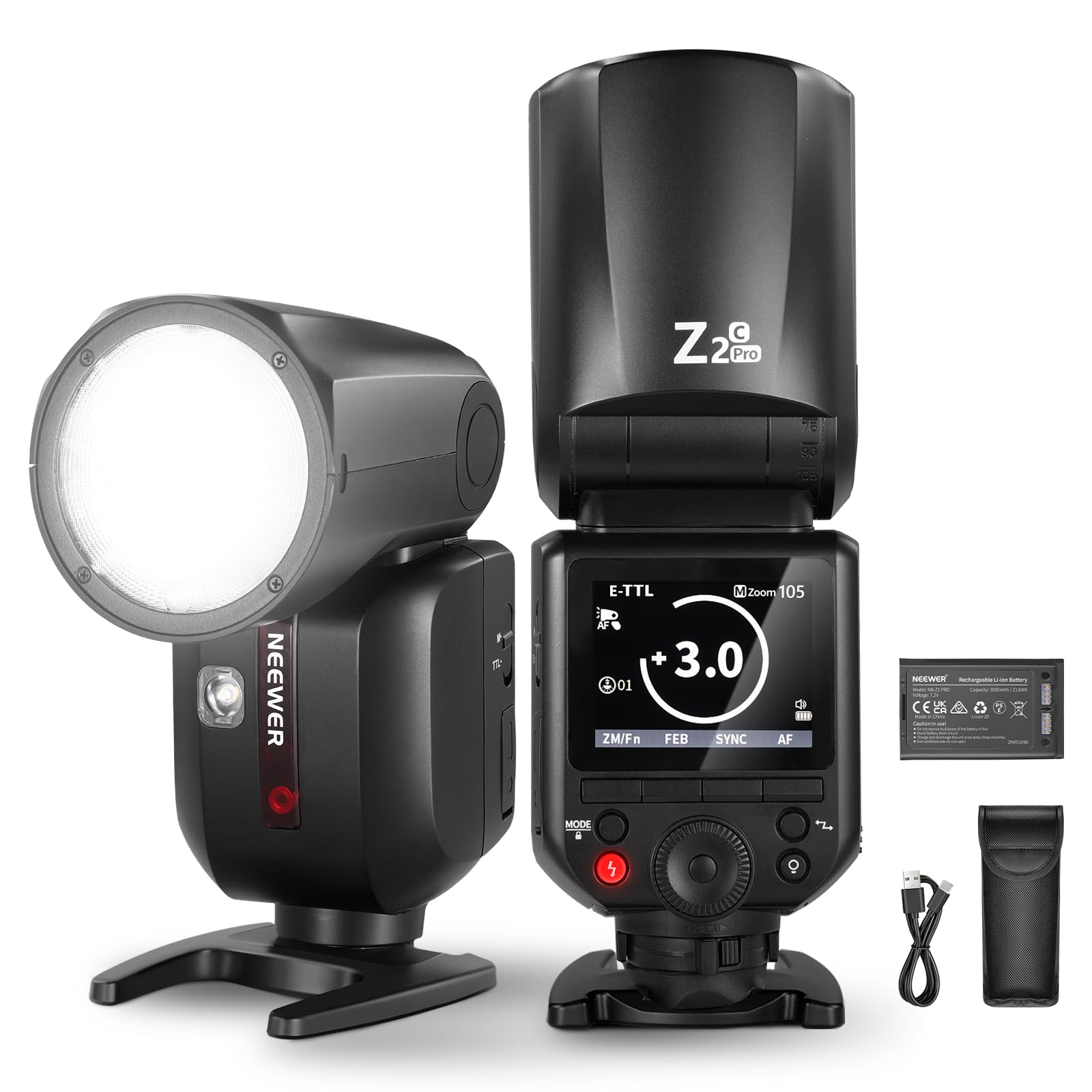
The speedlight that matches a Godox V1 Pro in spirit, for a fraction of the outlay.
The Z2PRO-C is NEEWER’s answer to the premium round-head speedlights, and it’s a remarkably close match. It delivers the same 76Ws output you’d expect from a top-tier speedlight, boasts an tune cooling system that handles up to 100 consecutive full-power flashes, and its premium quartz tube carries a lifespan of 100,000 flashes. For event and portrait shooters, that’s years of reliable work.
The headline features are all about speed and control. The 7.2V/3000mAh lithium battery provides 600 full-power flashes with a 1.5s recycle, and Type-C charging tops it up in 2.5 hours. A one-touch TCM (TTL-to-Manual conversion) shortcut lets you lock in your automatic reading and then fine-tune manually — a workflow pro shooters swear by. Wireless control covers 32 channels and 99 IDs, and it even plays nice with Godox’s 2.4G X system as a slave.
The build quality earns genuine praise from owners who’ve dropped theirs multiple times without issue. It can be powered down to 1/256 for precise control, and the dual 2W LED modeling lights help you see exactly where your shadows will land. Full compatibility with newer Canon R-series bodies like the R50 requires a separate AD-E1 adapter. And the Q and X wireless systems can’t run simultaneously, so pick your ecosystem.
Standout strengths
- 600 full-power flashes per charge
- Godox X-system compatibility as a slave
- 100,000-flash quartz tube lifespan
- TCM one-touch TTL-to-manual switch
Things to watch
- R50 users need a separate AD-E1 adapter
- Q and X wireless systems can’t be used together
6. Godox V860III-S
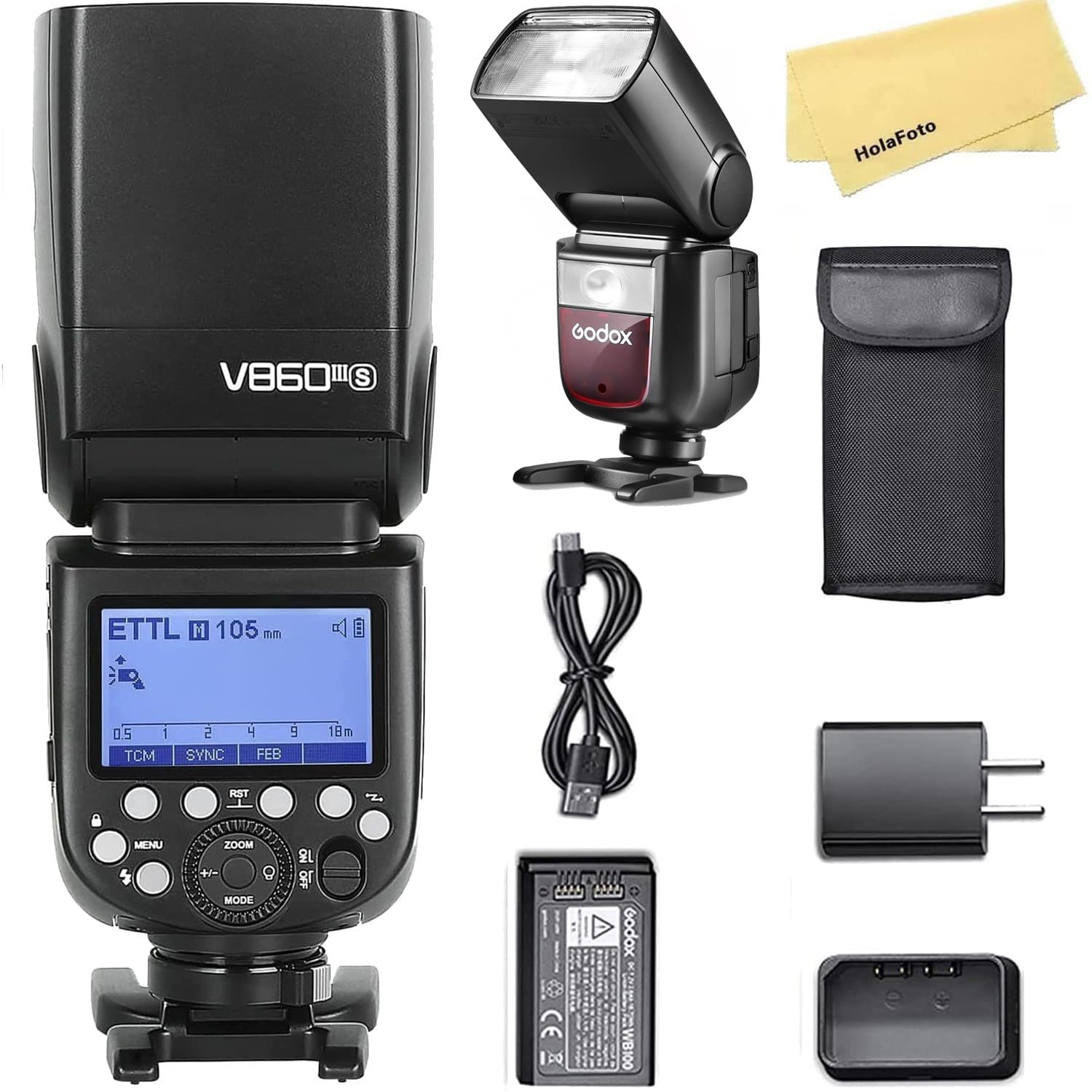
Sony shooters get a dedicated speedlight that lights faster and lasts longer than their OEM option.
The Godox V860III-S is the flash Sony owners reach for when they outgrow their camera’s built-in unit. It’s a full-size speedlight with a built-in Godox 2.4G wireless X system, so it works flawlessly as both a master and a slave in a multi-light setup. The quick-release lever lock keeps it secure on the hot shoe — a thoughtful upgrade over the twist-lock mechanisms of older flashes.
Performance is built around longevity. The large-capacity lithium battery delivers 480 full-power flashes with a 1.5s recycle time, so you’re not swapping AAs mid-shoot. It also packs a 10-level LED modeling light for pre-visualizing your light effect, plus a quick switch that toggles between manual and TTL modes in an instant — a real time-saver when the light changes mid-event.
Owners consistently highlight its build quality and reliability over many shoots with Sony A7-series bodies. Newspaper and event photographers praise its speed and power, noting it outperforms much pricier branded options like the Canon 600EX-RT. The main gripes are minor: the interface isn’t the most intuitive, and some find the TTL exposure slightly underexposed. But as a Sony-specific workhorse that integrates into a whole Godox ecosystem, it’s a tough act to beat.
Who it’s for: Sony mirrorless owners who plan to grow a multi-light kit and want one flash that works on-camera and off.
Who should pass: anyone on a tight budget who doesn’t need TTL or wireless triggering — a manual flash covers the basics for less.
7. Canon Speedlite EL-10

Canon’s own R-series flash gives beginners a guided path into off-camera creativity.
The Canon Speedlite EL-10 is the brand’s approachable mid-range flash, designed as the natural successor to the popular 430EX-III RT. For Canon R-series owners who want to step up from a basic pop-up flash, it delivers the reassuring build and smooth integration of a genuine OEM accessory. My son and I share equipment, and he has a newer Canon R-10 — the EL-10 slots right into that ecosystem.
Its defining feature is that new Multi-function connector on the foot, which open up advanced communication with cameras that have multi-function shoes. That means more customization and control passed directly between flash and body. The head tilts up to 90 degrees and swivels 150 degrees left and 180 degrees right, giving you the full range of bounce techniques for soft, natural light.
Wireless capability separates it — it can control up to 15 additional compatible Speedlite units, and the Canon Camera Connect app lets you adjust wireless flash settings and check photos from your phone. Custom Flash modes let you register and recall your favorite setups instantly. Owners mention it works flawlessly with the R6 Mark II and R7, though compatibility is mixed — it doesn’t work with the EOS R100 or R5, so verify your body before purchasing.
The takeaway: a solid, well-built entry point for Canon shooters who value native integration and app control over raw power.
The catch: compatibility is body-specific, and some owners found their exact camera unsupported despite the marketing claims.
8. Nikon SB-910

The Nikon speedlight that redefined the category, and still refuses to be retired.
The Nikon SB-910 is the veteran pick — a full-featured speedlight built around the Nikon Creative Lighting System (CLS). For Nikon shooters, it delivers smooth i-TTL Balanced Fill-Flash and wireless control that third-party units simply can’t replicate. Its expanded auto power zoom covers 17-200mm, meaning it adapts its beam to whatever lens you’re using, from wide interiors to long telephoto reach.
Durability is the SB-910’s legend. Customers note running 3000+ shots on a set of rechargeable AAs and, in some cases, years and hundreds of thousands of photos without a single failure. The improved thermal cut-out protection keeps it from overheating during long event work, and the new hard-type color filters help match tricky ambient light. The interface is clean and menu navigation is straightforward, even for beginners.
The trade-offs are real, though. It’s a heavy unit that runs on 4 AAs — old-school battery management compared to the lithium-ion speedlights of today. Owners also note the CLS system drains batteries faster and produces pre-flashes that can cause blinking. At a premium price, some pros suggest a cheaper third-party unit with similar output, but for those who want flawless native Nikon integration, the SB-910 remains the benchmark.
Why it endures: class-leading reliability and native CLS integration — remains the reference standard for event photographers.
Where it shows its age: AA batteries and a heavy body feel dated next to modern lithium-ion alternatives.
9. Profoto A10

The flash where price fades into memory and only the performance lingers.
The Profoto A10 is the endgame on-camera flash — the unit you buy once and never outgrow. Its 100 ft / 30 m guide number gives it serious reach, and the power range from 1/1 to 1/256 provides enormous creative latitude. With a 1-second recycle time, it keeps pace with the fastest events, letting you fire shot after shot without the frustrating “waiting” light blinking at you.
What separates the A10 is the marriage of raw power and intelligent control. It supports Canon E-TTL / E-TTL II for spot-on automatic exposure, plus high-speed sync (HSS) up to 1/8000s for freezing motion in bright daylight. The exchangeable lithium-ion battery means you can carry a spare and never stop shooting, and the flash head’s 90-degree tilt and 360-degree rotation give you complete command over bounce direction.
Owners describe it as the “best Flash I have ever used” — but candidly, some also report units failing mid-event, which is a sobering reality at this price point. “Worth the price of admission” is how several pros frame it, praising the no-nonsense interface that “just works.” The verdict is simple: if you’re a working professional who charges by the hour, the A10 pays for itself in reliability and speed. If you’re an enthusiast, this is a serious price to justify for a hobby.
The pro list
- 1s recycle time for non-stop shooting
- GN100 ft / 30 m powerful reach
- Canon E-TTL / E-TTL II automatic exposure
- HSS up to 1/8000s
The honest caveats
- Premium price tag
- A small number of owners reported units failing in the field
Understanding the Specs
Guide Number (GN)
This is the flash’s reach measurement — higher means the light travels further. A GN of 52 will illuminate a subject at 52 feet with the flash at full power and ISO 100. For most indoor work, a GN around 40 is plenty; you’ll rarely shoot beyond 30 feet with a speedlight.
Watt-Seconds (Ws) and Recycle Time
Watt-seconds measure total flash energy — a 200Ws strobe has more overhead for bouncing off ceilings or diffusing through softboxes than a 76Ws speedlight. Recycle time is the gap between flashes; fast 1.5s times keep you in the action at events, while slower speeds mean missed moments.
FAQ
What does TTL mean on a camera flash?
Can I use a Canon flash on a Nikon camera?
What is high-speed sync (HSS) and do I need it?
How many flashes should I expect from a lithium battery?
What’s the difference between a speedlight and a strobe?
Will a universal flash work with my mirrorless camera?
How important is color temperature stability?
What is a modeling lamp and why would I use it?
Is a round-head flash better than a rectangular one?
Final Thoughts: The Verdict
For most shooters, the best camera flash is the Godox AD200 Pro II because it packs genuine studio power into a portable body, and its ±100K color stability means you’ll trust every shot. If you want a dedicated on-camera unit, the NEEWER Z2PRO-C offers an outstanding balance of battery life and features at a friendlier price. And for Sony owners specifically, the Godox V860III-S is the speedlight that integrates smoothly into a growing kit.
How We Picked
We do not accept paid placement. Every pick is matched to a real buyer and a real use-case; we do not hands-on test units.
Sources & Methodology
Specifications: manufacturer listings and product documentation. Review insights: verified customer reviews, as of August 2026. Pricing: not shown on this page (it changes often); check the current price via the retailer link.
As an Amazon Associate, FitlyFast earns from qualifying purchases. This does not affect which products we feature.