
Our readers keep the lights on and the weekend projects moving. As an Amazon Associate, I earn from qualifying purchases.
Specs are compiled from manufacturer listings and verified buyer reviews and can change over time — please confirm the key details on the product page before buying.
Backpacking forces a brutal trade-off: you want a camera that captures the summit at golden hour, but every ounce you carry is paid for in sore shoulders at mile 14. The right camera is the smallest one that still delivers print-worthy image quality. This guide cuts through the specs to find trail-worthy cameras that earn their place in your pack.
I’m Rikta — the founder and writer behind FitlyFast. This guide is built by comparing the manufacturers’ published specifications and the patterns across verified customer reviews, so you get each pick’s real strengths and trade-offs instead of marketing spin.
Your backpacking camera needs to survive the trail, fit your pack, and still deliver sharp shots—so you want one that balances weight, durability, and image quality. The right camera for backpacking does all three without weighing you down.
Our Picks at a Glance


How To Choose The Best Camera For Backpacking
Your pack’s capacity and your back’s tolerance set hard limits on camera size and weight. The ideal trail camera stays out of the way until you need it, then delivers a shot worth the climb. Focus on these four pillars before you buy.
Battery Life Is Your First Filter
A camera that dies by lunch on day two is useless for the rest of the trip. Look at the stated recording or shot count per charge, and know that cold air drains batteries faster. Spare batteries are the cheapest insurance you can pack.
Ruggedness and Weather Sealing
Trails bring dust, rain, and the occasional drop onto granite. A camera rated waterproof to a specific depth (like 15 meters) removes the need for a housing on river crossings. If a camera isn’t sealed, treat it as a fair-weather companion and pack it accordingly.
Zoom Range vs. Image Quality
A long zoom (like 30x) lets you photograph a distant peak or a shy deer without moving, but it often lives in a smaller sensor. A large sensor (like APS-C) gives cleaner low-light shots but usually pairs with a shorter kit lens. Decide which matters more for the shots you chase.
Weight and Size Are Carried Every Mile
Every gram adds up over miles of switchbacks. A pocketable compact or a lightweight mirrorless body with a retractable kit lens will travel further in practice than a heavier pro body that you leave at camp. Choose a camera you’ll actually carry every day, not just on summit days.
Quick Comparison
| Model | Best For | Battery Life | Waterproof Depth | Zoom / Lens | Amazon |
|---|---|---|---|---|---|
| DJI Osmo Action 5 Pro★ Best Overall | Rugged video & all-day power | 4 hours | 20m (IP68) | Fixed wide-angle | Amazon |
| GoPro Hero Black BundleBest Value | Compact budget action video | 1 hour | 33 ft (10m) | Fixed wide-angle | Amazon |
| OM System Tough TG-7Underwater Pick | Underwater & macro durability | Rated per shot | 15m | 4x optical | Amazon |
| Canon EOS R100 | Beginner mirrorless image quality | ~LP-E17 rated | Not sealed | 18-45mm | Amazon |
| Panasonic LUMIX ZS99 | Long zoom in a pocket | Rated per shot | Not sealed | 24-720mm (30x) | Amazon |
| Nikon Z 30 | Vlogging & streaming on trail | Rated per shot | Not sealed | 16-50mm | Amazon |
| OM System E-M10 IV | Compact 5-axis stabilized stills | Rated per shot | Not sealed | 14-42mm | Amazon |
| Sony Alpha A6100 | Fast autofocus & eye tracking | Rated per shot | Not sealed | 16-50mm | Amazon |
| Canon EOS R50 | Creator-friendly 4K vlogging | Rated per shot | Not sealed | 18-45mm | Amazon |
| Ricoh GR IIIx | Pocketable high-end snapshots | Rated per shot | Not sealed | 40mm fixed | Amazon |
| Sony Alpha a6700 | Hybrid pro-level stills & video | Rated per shot | Not sealed | 18-135mm | Amazon |
In‑Depth Reviews
1. DJI Osmo Action 5 Pro Adventure Combo
Our pick — over 4.5★ from 900+ verified ratings; the strongest balance of quality and price.
The rugged action camera that outlasts a full day of trail miles with a 4-hour battery.
You will not miss the sunset summit with the Osmo Action 5 Pro, because its 1950mAh battery records up to 4 hours, versus the GoPro Hero Black’s 1-hour runtime. The Adventure Combo adds three batteries total and a multifunctional battery case, so multi-day trips do not mean hunting for an outlet.
It’s built for the elements. The IP68 rating means it survives 20m underwater without a separate housing, and the 1/1.3″ sensor with 2.4 µm large pixels delivers strong low-light footage at camp. Buyers report two years of heavy use without a failure, and the voice control works within one meter for hands-free capture when you’re scrambling.
The real trade-off is the fixed wide-angle lens—you get no zoom for distant peaks. The 360° HorizonSteady keeps your horizon level even on rough terrain, and dual OLED touchscreens make framing easy, but if your backpacking is about wildlife photography, an action camera is the wrong tool for that specific job.
Why It Wins On Trail
- 4-hour battery life crushes the competition for all-day shooting
- IP68 waterproof to 20m means river crossings need no case
- Three batteries included in the Adventure Combo
- Subject tracking keeps moving targets centered
Where It Falls Short
- No optical zoom—fixed wide-angle only
- Extension rod has no shutter button, so you need the Mimo app for photos when extended
- Generates some heat after a few minutes of recording
Your trail partner if: you want a set-and-forget rugged camera for video, snorkeling, and hands-free capture that won’t die before you do.
Think twice if: a zoom lens for far-away subjects is essential to your photography.
2. GoPro Hero Black Compact Action Camera Bundle
A featherweight 3-ounce action camera that slips into a pocket with a full accessory kit.
At just 3 oz, this GoPro Hero is the lightest way to get steady 4K30 video on the trail. HyperSmooth stabilization smooths out the bumps of a mountain bike descent, and the compact body uses foldable prongs to attach to a helmet, pack strap, or chest mount. The bundle adds a 50-in-1 accessory kit and a 64GB memory card, so you have everything for day one.
The waterproofing goes to 33 feet (about 10 meters) without a housing, covering most snorkeling and stream crossings. Voice control recognizes 8 commands in 11 languages and 6 accents, useful when your hands are full of trekking poles. The 12MP stills are solid, and you can pull 8MP frames straight from your video using the Quik app.
The honest limit is the battery: 1 hour of recording at the highest settings is short for a full day out, and the battery is non-removable. Some owners hit app compatibility problems with older phones, while others report the exact same app worked fine on the DJI unit—worth checking your phone’s age before buying.
The Bundle’s Strengths
- Ultra-light 3 oz design fits anywhere
- HyperSmooth stabilization for steady action footage
- 50-in-1 accessory kit and 64GB card included
- Waterproof to 33 feet without a housing
The Reality Check
- 1-hour battery life demands a charging plan
- Non-removable battery limits swap-and-go shooting
- No clip for a belt, as some owners noted
Reach for this if: you want the lightest possible camera for action video and you are happy to recharge nightly.
Look elsewhere if: your trips run multiple days without power and battery life is your top priority.
3. OM System Olympus Tough TG-7
The tank-like compact that dives to 15 meters and shoots macro from 1 centimeter away.
If you treat gear hard, the TG-7 is built for you: it is waterproof to 15 meters (50 feet), shockproof for drops from 2.1 meters (7 feet), crushproof to 100 kilogram-force, and freezeproof to -10°C (14°F). That means it rides in your pack through hail, river crossings, and the occasional tumble without complaint—owners mention it keeps shooting after rocks, swimming, and rafting.
The macro system is the hidden star: four macro modes let you focus as close as 1 centimeter from the lens, with a guide light and focus stacking to reveal details in flowers, insects, and tide pools. Five underwater modes include an underwater microscope and underwater HDR, making it a genuine scuba companion without a housing.
The trade-off is the interface. With DSLR-like controls packed into a tiny body, buttons are fiddly to operate underwater through a mask, and the 12MP sensor limits how much you can crop. The battery can die without warning, so a spare is a smart pack addition.
Built For The Worst Conditions
- Waterproof to 15m with no housing needed
- Shockproof, crushproof, and freezeproof ruggedness
- Incredible 1cm macro capability
- 4K video plus 120fps high-speed recording
Plan Around These
- Small, dim LCD makes underwater framing tricky
- Battery dies without warning—carry a spare
- Controls are cramped for gloved or underwater hands
Best suited for: divers, snorkelers, and gear-abusing adventurers who prioritize survival over image size.
Not the pick: if you need big crops or large prints from a 12MP sensor, a mirrorless camera serves you better.
4. Canon EOS R100 Mirrorless Camera Bundle

The beginner-friendly mirrorless that delivers sharp 24.1MP photos without a steep learning curve.
The R100 is built for first-time mirrorless users who want real image quality without a photography degree. The 24.1MP APS-C CMOS sensor paired with the DIGIC 8 processor produces vibrant, detailed shots, and the included RF-S 18-45mm lens covers wide landscapes to standard portraits. Its auto scene modes and simplified menus make the transition from phone photography painless, which is exactly what the owner feedback highlights—quality and ease of use are the top raves.
For backpacking, the Dual Pixel CMOS AF with 143 AF zones tracks faces and subjects quickly, and the built-in image stabilization on the lens reduces handheld blur after a long day. The package includes a 64GB card and a shoulder bag, so the kit is trail-ready from the start. Full HD 60p video covers casual clips, while 4K 24p is there when you want it.
The catch is durability: there’s no weather sealing, so this is a pack-a-rain-cover camera, and it’s bulkier than a compact. The kit neck strap drew a complaint from one owner after it fell off, so a third-party strap is worth considering for rugged use.
The Starter’s Edge
- Large 24.1MP APS-C sensor for real photo quality
- Beginner-friendly auto modes and simplified menus
- Kit includes lens, 64GB card, and bag
- Dual Pixel AF with 143 zones for reliable focus
Pack Smart Around It
- No weather sealing—protect it from rain and dust
- Bulkier than a point-and-shoot for ultralight setups
- Stock neck strap may need replacing for security
Start here if: you’re graduating from a phone and want the image quality jump without learning manual controls.
skip it if: your pack list demands a waterproof or weather-sealed body for exposed ridge lines.
5. Panasonic LUMIX TZ/ZS99 Point and Shoot Camera

A 30x zoom that pulls distant peaks and wildlife into frame from a pocket-sized body.
The LUMIX ZS99 delivers the longest reach on this list: a 24-720mm LEICA lens with 30x optical zoom (and 60x iZoom) turns a far-off ridgeline or a marmot on a rock into a full-frame subject. For backpackers who want one camera for both sweeping valleys and distant detail, this travel zoom is the classic answer, and owners consistently call the zoom its standout feature.
It shoots 4K video at 30p and 4K PHOTO bursts at 30fps, plus 120fps HD slow-motion for creative flexibility. The 1,840k-dot tiltable touchscreen helps you frame from awkward angles, and a dedicated Send Image button pushes photos to your phone via built-in Bluetooth v5.0 and the Panasonic Image App. USB Type-C charging means you can top it up from the same power bank you carry for your phone.
Be honest about the trade-offs: owner feedback is mixed on image quality (a small sensor shows its limits in low light), and the user interface is widely described as dated and clunky—especially the app for transferring photos, which one owner called “super slow.” Owners also note it is heavier than expected for a “pocket” camera, though the photos justify the weight.
The Reach Advantage
- 30x optical zoom (24-720mm) for distant subjects
- Pocketable size for everyday carry
- USB Type-C charging via your power bank
- Send Image button for quick phone transfers
Know The Limits
- Small sensor means softer low-light shots
- App and menu interface feel dated, transfer can be slow
- Heavier than the name “pocket camera” suggests
Choose this when: zoom range is your priority and you want a single do-it-all travel camera.
Pass if: you shoot mostly at dusk or dawn where a larger sensor will shine.
6. Nikon Z 30 with Wide-Angle Zoom Lens

Nikon’s most compact mirrorless is a creator’s tool with 4K video and eye tracking for pets and people.
The Z 30 is designed for creators, vloggers, and streamers, and it brings that DNA to the trail. The flip-out touchscreen selfie monitor, built-in stereo microphone with adjustable sensitivity, and red REC light make trail vlogs easy, while autofocus with eye tracking locks onto both people and pets. The 16-50mm wide-angle zoom covers landscapes and talking-head shots in one compact kit.
Image quality punches well above its size. A 209-point autofocus system and strong low-light performance deliver sharp 4K footage, and the camera doubles as a plug-and-play webcam via USB-C for post-trip content. Owners consistently praise the lightweight build, fast autofocus, and intuitive controls, with several highlighting it as excellent value.
The notable omissions: there’s no viewfinder and no in-body stabilization, so you’ll rely on the screen and your steady hand (or the lens’s VR). Some customers note reliability concerns—a minority describe units stopping after one use, which makes a warranty check worthwhile.
Made For Content
- Flip-out touchscreen and red REC light for vlogging
- Eye tracking autofocus for people and pets
- Plays as webcam over USB-C for easy streaming
- Lightweight and easy to carry all day
The Omissions
- No viewfinder—screen only for composition
- No in-body stabilization built in
- A minority of reviewers point out reliability issues
Pick this for: a hybrid photo-video trail companion that makes vlogging genuinely easy.
Reconsider if: you need a viewfinder for bright-sun composition or in-body stabilization for handheld video.
7. OM System Olympus E-M10 Mark IV

Jacket-pocketable mirrorless with in-body 5-axis stabilization that steadies handheld shots without a tripod.
The E-M10 IV is the backpacker’s mirrorless balance: a 20MP Micro Four Thirds body with a collapsing 14-42mm pancake lens that fits a jacket pocket, yet delivers interchangeable-lens quality. Its defining feature is in-body 5-axis image stabilization rated at 4.5 shutter speed steps—shoppers say sharp 1-second handheld shots with no tripod, a genuine edge for dawn and dusk trail photography.
It’s a joy to use, with a flip-down monitor that auto-triggers selfie mode and 16 Art Filters (31 types) for creative shots without editing. The Micro Four Thirds mount means a huge line of compact lenses can grow with you, from fast primes to telephoto zooms. Owners repeatedly call it the best beginner interchangeable-lens camera, praising its size and weight above all.
The rechargeable battery charges via a non-USB-C external charger (no USB-C cable charging), which is an extra cable to pack. Reliability is the recurring caveat—some buyers report the camera not working or failing to recognize the lens, so test it before a long trip.
The Stabilization Edge
- In-body 5-axis stabilization for handheld sharpness
- Jacket-pocketable with the 14-42mm pancake lens
- 20MP sensor and a full suite of manual controls
- Flip-down monitor with auto selfie mode
Packing Notes
- No USB-C charging—pack the external charger
- Some owners mention lens recognition issues
- Wireless app requires Wi-Fi, inconvenient on-trail
Perfect for: hikers who want DSLR-quality stills with a tripod-free stabilization system and a tiny carry size.
Be aware: the charging setup adds a cable, and the occasional lens-recognition quirk means test before departure.
8. Sony Alpha A6100 Mirrorless Camera

A 0.02-second autofocus with 425 phase-detection points that locks onto moving subjects instantly.
The A6100 is the speed king of this list. Its real-time autofocus achieves a claimed 0.02-second lock-on with 425 phase-detection and 425 contrast-detection points spread over 84% of the sensor, plus Real-time Eye AF for both humans and animals. On the trail, that means a bird taking off or a friend cresting a ridge is captured sharp, not as a blur. Touch Tracking lets you tap a subject on the 180-degree tiltable 3″ touchscreen and the camera follows it smoothly.
Image quality comes from a 24.2MP APS-C Exmor sensor with a front-end LSI reaching ISO up to 51,200. It shoots up to 11fps continuous at full RAW with AF/AE tracking, so burst sequences capture the decisive moment. Owners praise the compact size, superb JPEGs straight out of camera, and the fact that it converted “awful pictures” takers into photographers with frame-worthy shots.
The two recurring caveats: the menu system is not user-friendly by owner consensus, and the electronic viewfinder is considered poor compared to rivals like the Sony A6400 or Fuji XT-30. There’s no in-body stabilization, so rely on the lens or a steady hand.
The Speed Advantage
- 0.02s autofocus with 425 AF points
- Real-time Eye AF for humans and animals
- 11fps continuous shooting with tracking
- Compact body with 180-degree tiltable screen
The Trade-Offs
- Menu system is complex and not user-friendly
- Electronic viewfinder is weaker than key rivals
- No in-body stabilization
Grab this for: fast action and wildlife where autofocus speed decides the shot, plus great value on the APS-C mount.
Pass if: you want an intuitive menu or a high-quality viewfinder for composing.
9. Canon EOS R50 Mirrorless Camera Bundle
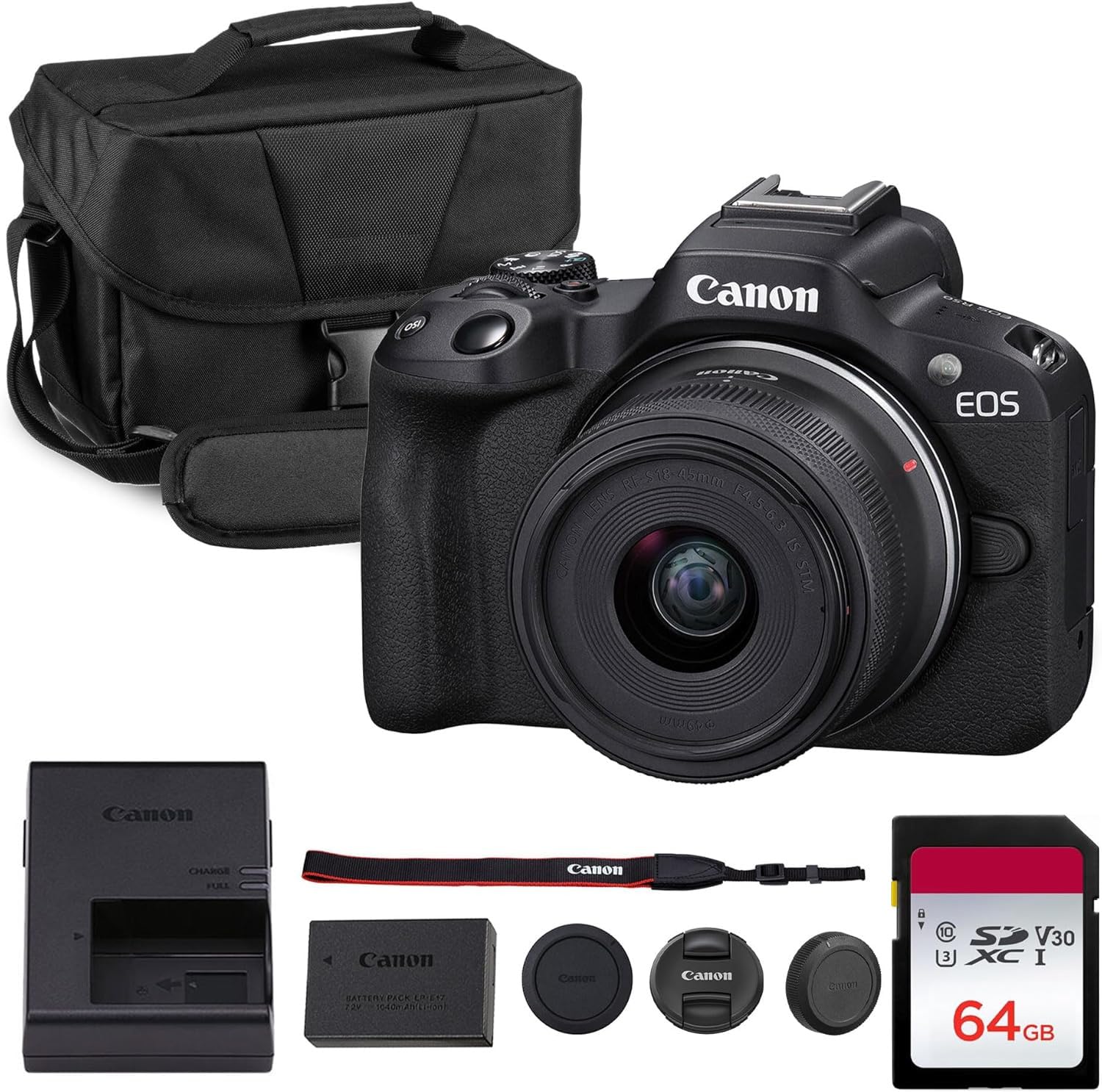
The lightweight 4K creator camera with a vari-angle touchscreen and in-camera vertical video.
The R50 is Canon’s answer for creators and vloggers who want quality without complexity. The 18-45mm kit lens covers wide to standard focal lengths, and oversampled 4K with Dual Pixel AF II delivers sharp, smooth footage with reliable subject, face, and eye tracking. Its standout for trail content is the vari-angle touchscreen and vertical video mode, making social-ready clips a one-handed operation.
Owners consistently rave about the camera quality and image quality—it’s described as an incredible first camera with stunning image quality and a satisfying shutter feel. The compact size suits small-to-medium hands well, and the bundle includes a 64GB card and shoulder bag. It’s often cited as a smart replacement for the pricier G7X for those who want interchangeable lenses.
The limitations are clear: there’s no in-body image stabilization (you depend on the lens’s IS), and the buffer fills quickly in burst shooting. Value-for-money opinions are mixed, so check if the feature set matches your budget expectations.
The Creator’s Toolkit
- Oversampled 4K with Dual Pixel AF II tracking
- Vari-angle touchscreen and vertical video mode
- Compact, lightweight body for small hands
- Bundle includes 64GB card and bag
The Limitations
- No in-body image stabilization
- Buffer fills fast during burst sequences
- Value-for-money opinions are mixed
It’s a fit if: you want easy 4K vlogging with excellent autofocus in a portable body.
Think again if: you shoot bursts of fast action or need in-body stabilization for handheld video.
10. Ricoh GR IIIx Premium Digital Compact Camera

The cult-classic pocket rocket with a full APS-C sensor and a sharp 40mm F2.8 fixed lens.
The GR IIIx packs a 24.2MP APS-C sensor into a body that slips into a pants pocket—the same sensor class as much larger mirrorless cameras, but in a true everyday-carry form. The 40mm fixed lens (in 35mm format) gives a natural, human-eye field of view that owners praise as distinct from a phone, with phenomenal sharpness and minimal distortion. Its high-speed start-up of about 0.8 seconds means you catch the moment, not miss it.
In-body SR (sensor-shift stabilization) helps handheld shots, and the 14-bit depth supports serious editing. Owners love the film simulation modes for fun, characterful JPEGs straight out of camera, and the macro capability is a pleasant surprise. It’s regularly called the best always-with-you travel camera for its image quality-to-size ratio.
The compromises are real for backpacking: battery life is short—owners advise carrying three spares—and there’s no weather sealing, so it demands care in rain or dust. The fixed 40mm lens means no zoom, and video is weak with no 4K. The 101-point contrast-detect autofocus is slower than phase-detect rivals.
The Pocket Advantage
- Full APS-C 24.2MP sensor in a pocketable body
- Sharp 40mm F2.8 lens with natural perspective
- 0.8-second startup captures fleeting moments
- In-body SR helps stabilize handheld shots
The Packing Compromises
- Short battery life—carry spare batteries
- No weather sealing for rain or dust
- Fixed 40mm lens, no zoom, weak video
Pick it for: the highest image quality per ounce on this list, for photographers who love a fixed lens.
Avoid if: you need zoom, weather protection, or all-day battery from one battery.
11. Sony Alpha a6700 Mirrorless Camera

The pro-grade hybrid with a 26MP sensor, 4K 120p, and AI-driven subject tracking—the do-everything trail camera.
The a6700 is the most capable camera on this list for backpackers who refuse to compromise. Its 26MP APS-C Exmor R back-illuminated sensor pairs with the BIONZ XR processor and a dedicated AI Processor for accurate Real-time Recognition—tracking people, pets, and even cars with sticky, reliable autofocus. The bundled 18-135mm zoom covers wide landscapes to telephoto reach, making it a genuine one-lens trail kit.
Video is where it flexes: 4K/60p from 6K oversampled 4:2:2 10-bit recording (with Long GOP or All Intra formats), plus high-frame-rate 4K 120p for silky slow motion. Owners praise the fast, accurate autofocus on moving subjects and the IBIS (in-body stabilization) that helps in low light. The 18-135mm kit lens is sharp, and the camera feels solid yet light for all-day carry.
The honest limits: it overheats after about 40 minutes of 4K 60fps recording (serious videographers should consider the FX30), and there’s a single SD slot. The camera doesn’t include a battery charger or USB cable in the box—you’ll need to source one—and the setup is time-consuming to configure.
The Pro Edge
- 26MP sensor with AI-powered subject recognition
- 4K 120p and 4K/60p 10-bit video quality
- Versatile 18-135mm zoom for one-lens travel
- IBIS helps stabilize handheld low-light shots
The Heavy Truth
- Overheats after ~40 minutes of 4K 60fps
- Single SD card slot only
- No charger or USB cable included in the box
Worth the weight for: serious hybrid shooters who want professional photo and video in one rugged kit.
Look elsewhere if: you mostly shoot long 4K video (consider the FX30) or want a smaller, lighter pack load.
Understanding the Specs
Battery Life in Hours
For a backpacking camera, stated battery life is your planning anchor. A 4-hour rated battery (like the DJI Osmo Action 5 Pro) means all-day video on one charge, while a 1-hour rating demands a charging strategy. Cold air drains lithium-ion batteries faster, so treat stated numbers as best-case and pack accordingly.
Waterproof and IP Ratings
A “waterproof to 15 meters” spec means the camera survives underwater to that depth without a housing—a green light for snorkeling and river crossings. An IP68 rating (like the DJI’s 20m) is the scale’s top end for dust and immersion. Without such a rating, assume rain protection is not guaranteed and pack a dry bag.
Zoom Range and Focal Length
Expressed as a range like “24-720mm” (or “30x zoom”), this tells you how wide and how far the lens sees. A 24mm wide end captures sweeping landscapes; a 720mm telephoto end pulls distant animals close. A fixed lens (like the Ricoh’s 40mm) gives great image quality but no reach—choose based on the shots you chase.
Sensor Size and Stabilization
Large sensors (APS-C, like 24.1MP) gather more light for cleaner low-light shots. In-body stabilization (like the E-M10 IV’s 5-axis system) steadies handheld photos and video, letting you shoot sharp without a tripod. Action cameras use smaller sensors but add software stabilization (like HyperSmooth or HorizonSteady) for smooth motion.
FAQ
What is the best type of camera for backpacking?
How long should a camera battery last for a multi-day backpacking trip?
Is a waterproof camera necessary for hiking and backpacking?
What zoom range do I need for wildlife photography on the trail?
Will a mirrorless camera survive a rugged backpacking trip?
How many spare batteries should I carry for a week-long trip?
Is an action camera better than a mirrorless camera for backpacking?
What does IBIS mean and do I need it?
Can I charge my backpacking camera from a power bank?
What is the trade-off between a long zoom and a large sensor?
Final Thoughts: The Verdict
For most backpackers, the camera for backpacking winner is the DJI Osmo Action 5 Pro because its 4-hour battery, 20m waterproof rating, and rugged build make it the most reliable and versatile trail companion. If you want a long zoom for wildlife and distant peaks, grab the Panasonic LUMIX ZS99. And for the highest image quality in a portable body for stills, the Sony Alpha a6700 is the one to reach for—provided you pack the extra care its non-sealed body demands.
How We Picked
We do not accept paid placement. Every pick is matched to a real buyer and a real use-case; we do not hands-on test units.
Sources & Methodology
Specifications: manufacturer listings and product documentation. Review insights: verified customer reviews, as of August 2026. Pricing: not shown on this page (it changes often); check the current price via the retailer link.
As an Amazon Associate, FitlyFast earns from qualifying purchases. This does not affect which products we feature.