
Our readers keep the lights on and the weekend projects moving. As an Amazon Associate, I earn from qualifying purchases.
Specs are compiled from manufacturer listings and verified buyer reviews and can change over time — please confirm the key details on the product page before buying.
Camping tools live in a weird spot: pick the wrong hatchet and you are stuck swinging a dull brick; pick the wrong shovel and it is dead weight on your back. The real question is which steel and fiberglass tools earn their spot in your pack. This guide covers the nine tools that matter for campsite work., from the featherlight hatchet that splits kindling in one strike to the tactical spade that survives years of abuse.
I’m Rikta — the founder and writer behind FitlyFast. This guide is built by comparing the manufacturers’ published specifications and the patterns across verified customer reviews, so you get each pick’s real strengths and trade-offs instead of marketing spin.
Whether you are topping up a fire pit or planning a backcountry trek, the best camping tools balance blade quality, handle comfort, and packed weight for your exact kind of trip.
Our Picks at a Glance


How To Choose The Best Camping Tools
Every campsite job boils down to chopping, digging, and fixing. The best kits cover all three without weighing down your pack. Before you buy, weigh the actual size of the wood you will split and the ground you will break.
Match the Tool to the Log, Not the Fantasy
A small hatchet with a 1.4-pound head is a joy for kindling but a poor match for felling trees. A full-size splitting axe with a 28-inch handle gives you leverage for medium and large logs but takes up real space. Buy for the campsite you actually visit, not the one in a catalog.
Handle Material Decides Your Hands’ Fate
Wood handles look classic and absorb shock, but they need care. Fiberglass and molded composite handles shrug off weather and overstrikes, which is why many modern designs use them. If you plan to chop for an hour straight, the handle’s grip and shock absorption matter as much as the blade.
Weight Is a Promise You Carry
Every ounce you add to a tool is an ounce you feel on the trail. A folding spade that collapses to about 9.37 inches beats a rigid shovel for backpacking, while a heavier one-piece axe earns its place in a truck or at a basecamp. Decide if the tool lives in your hand or your vehicle before buying.
Quick Comparison
| Model | Best For | Weight | Blade Length | Handle Material | Amazon |
|---|---|---|---|---|---|
| Fiskars X7 Hatchet★ Best Overall | Kindling & small logs | 1.4 lb | 5.12 in | FiberComp | Amazon |
| Rush Deer MultitoolBest Value | Everyday fixes | 15.4 oz | — | Stainless Steel | Amazon |
| Cold Steel ShovelMost Versatile | Digging & chopping | 1.6 lb | — | Hickory | Amazon |
| Gerber Suspension NXT | Pocket carry | 6.7 oz | 2.25 in | Alloy Steel | Amazon |
| Schrade Bedrock Axe | Backpacking | 1.4 lb | 3.8 in | Glass-filled PA | Amazon |
| Estwing Sportsman’s Axe | Durability | 1.8 lb | 3.25 in | Leather over Steel | Amazon |
| Husqvarna Hatchet | Hand-forged feel | 1.3 lb | — | Hickory | Amazon |
| Gerber E-Tool Spade | Trenches & fire pits | 2 lb | — | Glass-filled Nylon | Amazon |
| Fiskars X25 Splitting Axe | Medium & large logs | — | — | FiberComp | Amazon |
In-Depth Reviews
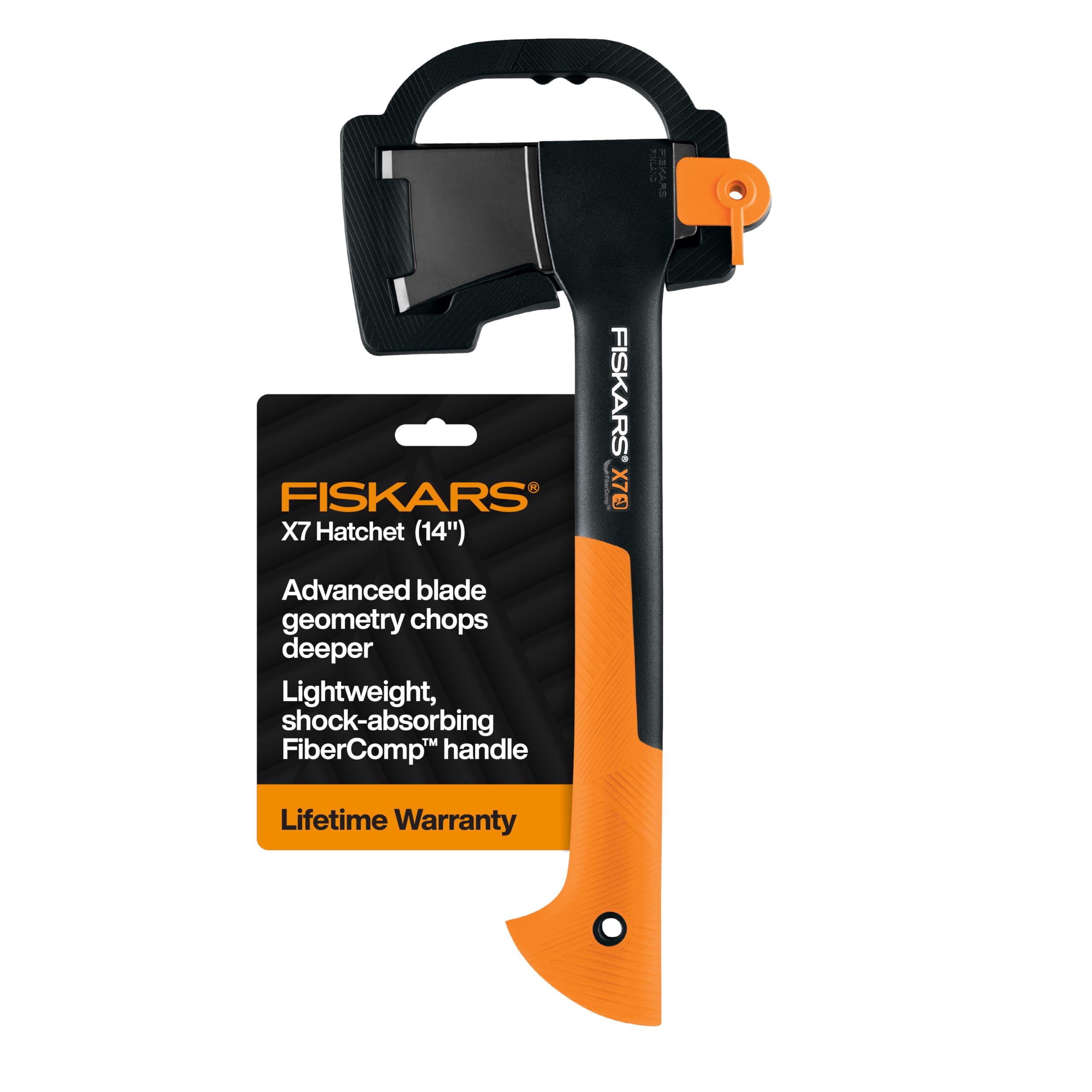
1. Fiskars X7 Small Hatchet Axe 14″
Our pick — over 4.5★ from 12,000+ verified ratings; the strongest balance of quality and price.
The kindling-splitting king that makes campfire prep feel easy with its wedge-shaped blade.
The X7 is the tool that defines what a camp hatchet should be — a 1.4-pound head swinging with a balance so perfect it feels like the axe is doing the work. The 5.12-inch forged steel blade stays sharp from the start, and the low-friction coating stops it from sticking in the wood after each strike. For splitting small to medium kindling, buyers report the wedge blade drives 60-70% of splits in a single strike.
The FiberComp handle is the real story here. It absorbs shock so your hands don’t, even during extended chopping sessions, and it is molded as one piece so there is no head to fly off. The included sheath protects that very sharp edge, and the bright orange handle makes it easy to spot in the leaves. The trade-off is that the steel is soft enough to roll the edge under heavy use, so you will want a sharpening puck on hand.
At 1.4 pounds, it is a full 14% lighter than the Cold Steel Special Forces Shovel (1.6 pounds), and it carries far easier than any full-size axe. Owners mention the hollow fiberglass handle feels indestructible, and the lifetime warranty backs that confidence. This is the single most useful tool a camper can own for fire prep.
What Owners Keep Raving About
- Wedge blade geometry delivers one-strike splits on small logs
- Shock-absorbing handle keeps hands fresh for long sessions
- Lifetime warranty and head cover included
Where It Asks For Patience
- Soft steel rolls the edge and needs periodic sharpening
- Plastic sheath is not built for belt carry
- Not designed for felling trees or heavy tasks
Reach for this if: your campsite routine is kindling, branches, and fire prep — this is the undisputed champion of that job.
Look elsewhere if: you plan to fell trees or want a belt-carry sheath, because this asks for a sharpening stone and a pack instead.
2. Rush Deer Camping Essentials Multitool, 16 in 1
A 16-in-1 survival grab-bag that stashes a hammer, pliers, and glass breaker in a 6.4-inch frame.
Folded down to 6.4 x 3.1 x 0.9 inches, this multitool is the answer to “what if I need it” — and it covers a staggering list of needs. The 16 tools include a car safety hammer, mini claw hammer, pliers, wire cutters, multiple screwdrivers, a steel file, a bottle opener, and two different knives. The whole thing folds into a handle shape that fits in the included waist clip bag.
What makes it special is the hammer. Most multitools stop at pliers and a blade, but this one actually shatters glass and pulls nails, making it a legitimate car-emergency tool as much as a camping one. It is built from stainless steel with an aluminum frame, so it resists rust and stays sturdy under light and moderate use.
Owners find it perfect for working outside without running back to the garage — “I’m buying 2 more,” as the review pages put it. The construction is alloy steel, aluminum, and stainless steel, which explains why it feels solid at 15.4 ounces. The main quibble is the material belt loop, which forces you to take your belt off to remove the pouch; several owners simply add a belt clip. For light and moderate fixes, this is the value king.
Smart buy for: anyone who wants a do-everything tool for the car, campsite, or glovebox without spending much. It won’t replace a dedicated hatchet or shovel, but it covers a dozen smaller jobs with one carry.
Worth knowing: precision and compactness trade off — it is ideal for fixes, not heavy-duty demolition.
3. Cold Steel Special Forces Shovel with Hardwood Hickory Handle
More machete than shovel — a 24-inch steel blade that digs foxholes and chops branches with equal ease.
You get a shovel that also chops like a machete for the ground, thanks to three sharp edges on its broad flat steel blade. At 24 x 2 x 2 inches, it is a full 3.8x larger than the folded Rush Deer multitool, but that size pays off in real work: it digs, chops roots, cuts through ice and snow, splits kindling, and even doubles as an improvised paddle.
The medium carbon steel blade is sharp — customers note it cuts through bamboo and branches with ease — and the stout hickory handle gives you a solid grip for one-handed use. It is heavier than the Fiskars X7 hatchet at 1.6 pounds, but it replaces both a shovel and a cutting tool in one carry. Owners describe it as “the perfect space saver in my truck,” and it has earned a loyal following among barn and campsite users alike.
The honest trade-offs: it does not come with a sheath, so you will want a blade bag to protect the sharp edges in transport. The factory sharpening is decent but not perfect, and the handle varnish can be slick — some owners strip and reseal it for a better grip. Check your local regulations, since the sharp edges make it a legal-weapon consideration in some areas.
Why It Wins Fans
- Three sharp edges chop roots, ice, and branches
- Digs foxholes and fire pits with surprising efficiency
- Hickory handle offers excellent grip and durability
What Needs Attention
- No sheath included — buy a blade bag
- Factory edge is inconsistent, needs filing
- Handle varnish can be slippery in wet conditions
Perfect for: the truck camper or barn owner who wants one tool that digs and chops without carrying both.
skip it if: you need a folding shovel for a backpack, because 24 inches is too long for a daypack.
4. Gerber Suspension NXT 15-in-1 EDC Multitool

The pocket-riding multitool that lives on your hip because 6.7 ounces is barely noticeable.
The Gerber Suspension NXT is built for the person who wants a tool within reach at all times. At 6.7 ounces and 4.25 inches closed, it slides into a jean pocket or clips on with the included pocket clip. The 15 tools cover the essentials: needle nose pliers, wire stripper, three flathead drivers, two cross drivers, an awl, nail file, scissors, can opener, bottle opener, and a 2.25-inch partially serrated blade.
The butterfly opening and tool lock keep everything protected when not in use. Pliers handle most campsite fixes, while the blade takes care of cord, food prep, and small cutting jobs. Reviewers point out it beats earlier Gerber generations and even Leatherman tools for everyday carry, with one noting “I live with this thing on my hip.”
At 8.48 ounces per the spec sheet (the 6.7-ounce figure is the manufacturer’s lighter claim), it is not the lightest multitool, but it is far lighter than carrying a dedicated toolkit. The pliers have a slight gritty spring and the arms start tight, but both loosen with use. The limited lifetime warranty means a broken tool is replaced, and one owner had Gerber honor it five years after the sale.
Best for: fishermen, tradesmen, and everyday carry where a full toolbag is overkill. The blade and pliers handle 90% of campsite tasks.
Fair warning: it is not for heavy prying or demolition — the pliers feel flimsy under serious torque, so give it light duty.
5. Schrade Delta Class Bedrock Axe

The compact backpacker’s axe that splits like a bigger tool thanks to a head-heavy design.
The Schrade Bedrock Axe is the answer for ultralight campers who still need to process wood. At 11.8 inches overall with a 3.8-inch blade, it is small enough for a backpack strap, but the 1.4-pound head weight gives it surprising splitting power. Shoppers say it splits like larger axes because the weight is concentrated at the head, making each swing count.
The 3Cr13 titanium-coated stainless steel blade takes a razor edge with minimal effort, and the black glass-filled PA handle with a TPR rubber grip stays planted in your hand even when wet. A hammer pommel on the butt doubles as a tent stake driver, and the extra-large ferro rod stored inside the shaft means you always have a fire starter. The belt sheath keeps the blade protected and within reach.
At 1.4 pounds, it matches the Fiskars X7 for weight but adds the fire-starting rod and hammer pommel that the X7 lacks. The blade arrives sharp — one owner sharpened it to paper-cutting in 30 minutes with a puck. Durability gets mixed marks from long-term use, so it is best treated as a capable tool rather than a forever heirloom. For the backpacker who wants one tool that chops and starts fires, this is the pick.
Trail-Ready Strengths
- Ferro rod in the handle means fire-starting is always included
- Ergonomic rubber grip stays secure when wet
- Hammer pommel drives stakes without a rock
What To Expect
- Mid-grade steel needs periodic touch-up sharpening
- Blade can arrive less sharp than hoped
- Long-term durability is mixed for heavy use
Grab this if: you backpack and want one compact tool that splits small wood, drives stakes, and starts fires.
Think twice if: you need a full-size chopper — this is a small axe for light work, not a felling tool.
6. ESTWING Sportsman’s Axe 14″

The one-piece forged American classic that will outlast every other tool in your kit.
The Estwing Sportsman’s Axe is the heirloom pick — forged from a single piece of solid American steel in Rockford, IL since 1923. There are no welds or castings to fail, which is why owners trust it for a lifetime. The 3.25-inch hand-sharpened cutting edge arrives ready to split firewood and kindling, and the 1.8-pound weight feels perfectly balanced in hand.
The genuine leather grip is hand-sanded and lacquered, giving you a comfortable, secure hold that also looks timeless. The head works as a tent stake puller, and the whole tool handles chopping limbs, small trees, and splitting duties at the campsite. The rugged ballistic nylon sheath protects the edge and offers a belt loop for quick access.
This is the heaviest hatchet on this list by a real margin — 1.8 pounds versus 1.4 pounds for the Fiskars X7 — and that weight is exactly why it splits so well. Owners describe it as “very sharp and well balanced” and “beautiful and functional.” The only knock is cosmetic: the factory stickers are stubbornly hard to remove, and a few owners note minor marring on the hammer edge. The hand-sharpened 4-inch cutting edge (listed at 3.25 inches) and the lifetime quality make this the axe for those who want to buy it once.
Built To Last
- Single-piece forging eliminates weak points entirely
- Genuine leather grip is comfortable and durable
- Rugged ballistic nylon sheath with belt loop included
Minor Quirks
- Factory stickers are difficult to remove cleanly
- Heavier than most camp hatchets at 1.8 lb
- Hammer edge may show minor marring from the factory
Choose this for: the camper who wants a rugged, American-made tool that will be passed down — the weight is a feature, not a flaw.
Pass if: you are counting ounces for a long backpacking trip; the Fiskars X7 is a pound lighter.
7. Husqvarna Hatchet with Leather Sheath
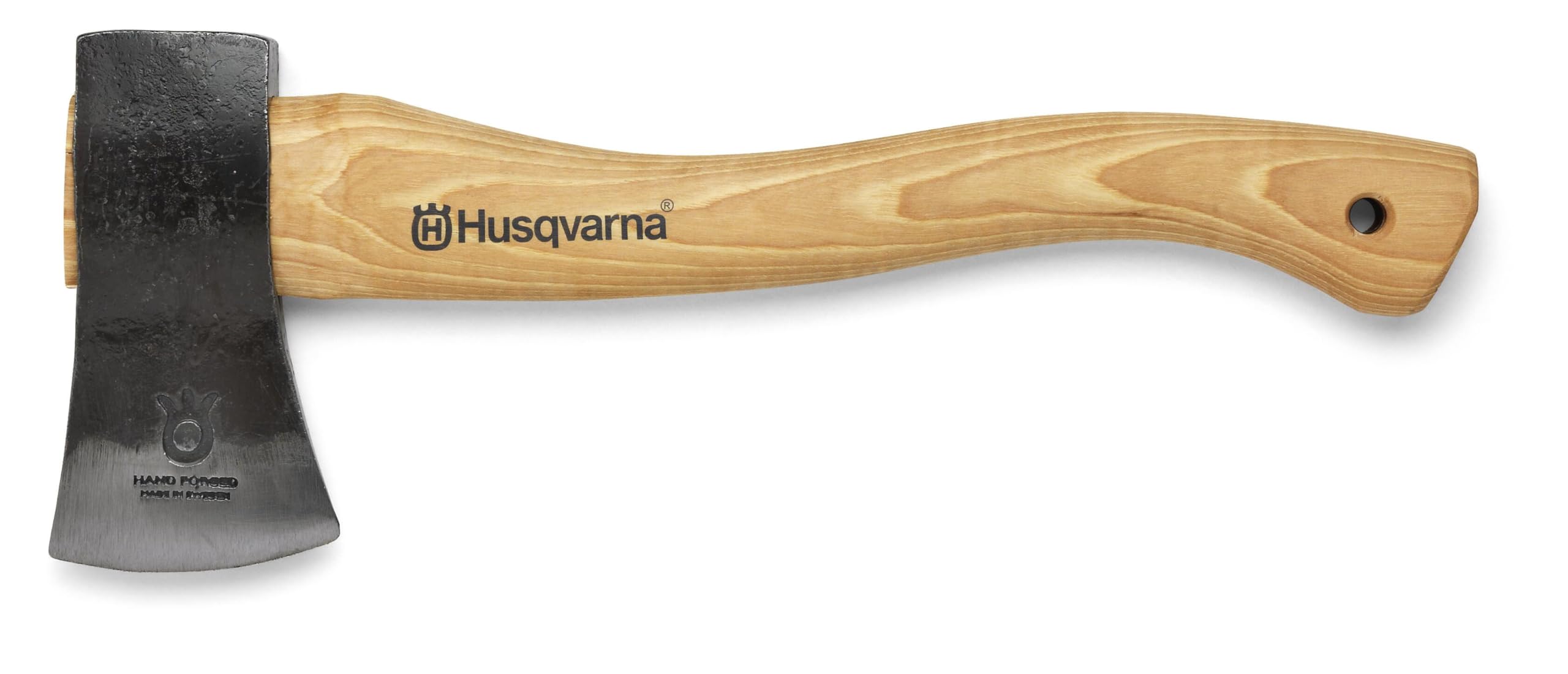
Swedish hand-forged craftsmanship with a hickory handle that feels like it was made for your palm.
The Husqvarna Hatchet is for the purist who values traditional craftsmanship. Made in Sweden, this hand-forged axe head is paired with a tight-grained hickory handle that owners consistently call the best handle of any axe they have held. The 1.32-pound head is built for one-handed use on light wood cutting, making it ideal for campsite duties and gardening.
The leather sheath included is a cut above the nylon covers on most hatchets, with brass rivets and a snap closure that protects the edge during transport. The Swedish steel takes an edge exceptionally well — owners note it sharpens up beautifully, though the factory edge may need a little extra work before first use. The handle responds well to sanding and a coat of tung oil for a perfect personalized finish.
At 1.3 pounds, it is the lightest hatchet on the list, just edging out the Fiskars X7’s 1.4 pounds. That lightness, combined with a well-balanced head, makes it a joy for light work. The trade-off is that some units arrive with a dull edge and poor bevel, requiring a few hours of filing to reach prime sharpness. The sheath’s snap can also be finicky. For the traditionalist who enjoys working on their tools, this is a rewarding pick.
Love it for: the hands-on owner who enjoys a tool that rewards a little care — sand the handle, sharpen the edge, and it becomes yours.
Know this: the factory edge is inconsistent, so budget time for sharpening; the steel takes an edge well once you do.
8. Gerber E-Tool Tactical Folding Spade
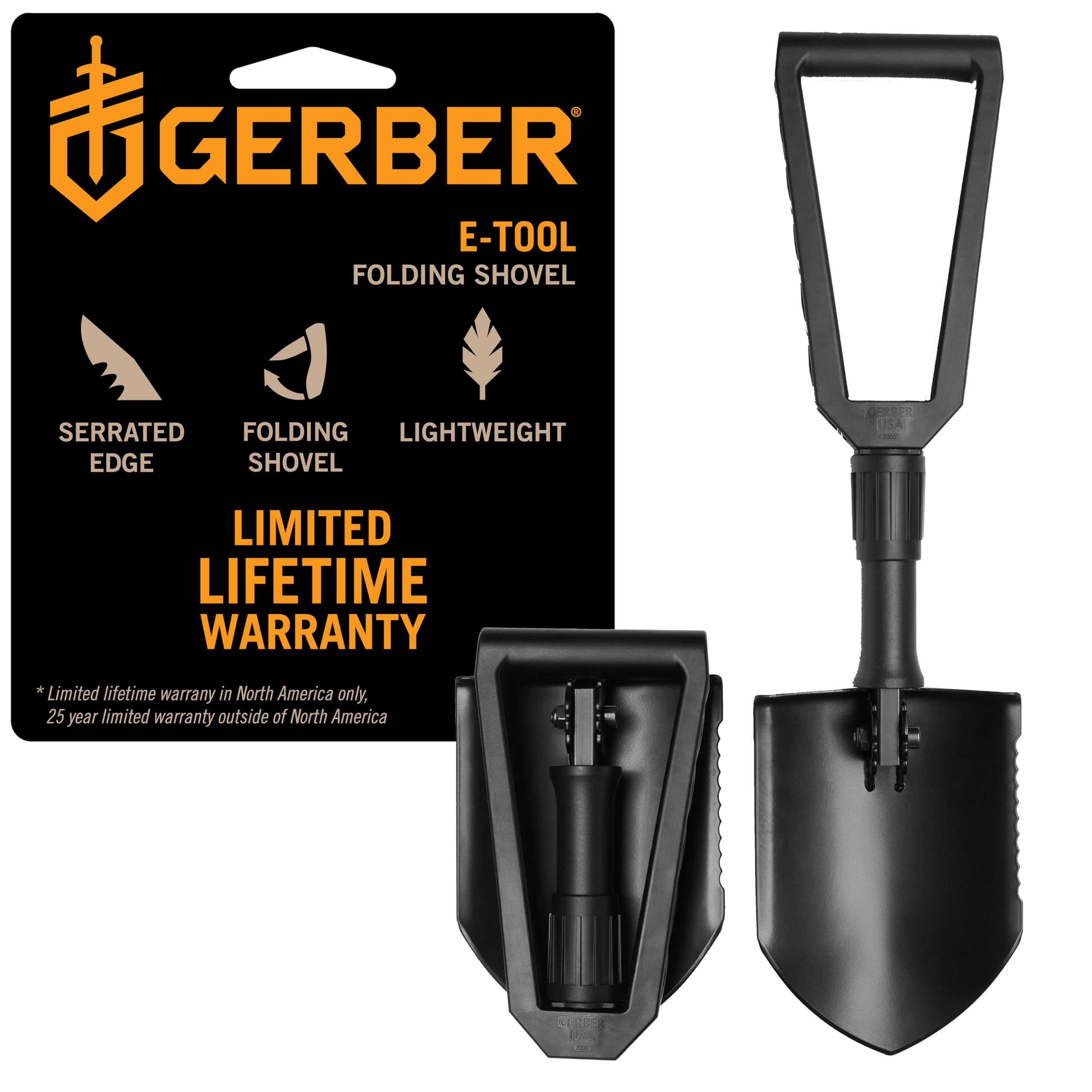
The folding spade that dug a 225-foot trench on knees and belly and came back for more.
The Gerber E-Tool is the serious digger’s choice, built for trenches, fire pits, and post holes. It folds down to just 9.37 inches for packability, but extends to a full 2 feet for real digging leverage. The powder-coated steel head and serrated edge handle roots and ice, while the glass-filled nylon handle provides a firm, comfortable grip.
The folding design locks firmly in place when open, and the locking mechanism holds even under heavy use. Owners have put it through remarkable abuse — one dug a 225-foot trench in a crawlspace, staying locked and sharp for roots throughout. The anodized aluminum shaft keeps the weight manageable, and the boron carbon steel blade resists breaking. It collapses into a small, lightweight unit that fits in a pack.
The honest trade-offs: at 2 pounds, it is heavy for backpacking, and the locking mechanism angles to about 65-70 degrees rather than a full 90. The weight (68 mentions in reviews) is the most mixed aspect, with some owners finding it too heavy for long carries. The serrated edge gets mixed sharpness marks but holds up for root-cutting. It is the sturdiest shovel on this list, and the Gerber limited lifetime warranty backs it.
Serious Digging Cred
- Folds to 9.37 inches for easy transport
- Serrated edge chops roots and ice while digging
- Locking mechanism holds firmly in use
Weight And Angles
- 2 lb feels heavy for long backpacking trips
- Locks at about 65-70 degrees, not a full 90
- No carrying case included
Best for: the car camper, hunter, or overlander who needs serious digging power that still folds away.
Not for: ultralight backpackers — the Cold Steel shovel is lighter, though less versatile.
9. Fiskars X25 Splitting Axe 28″
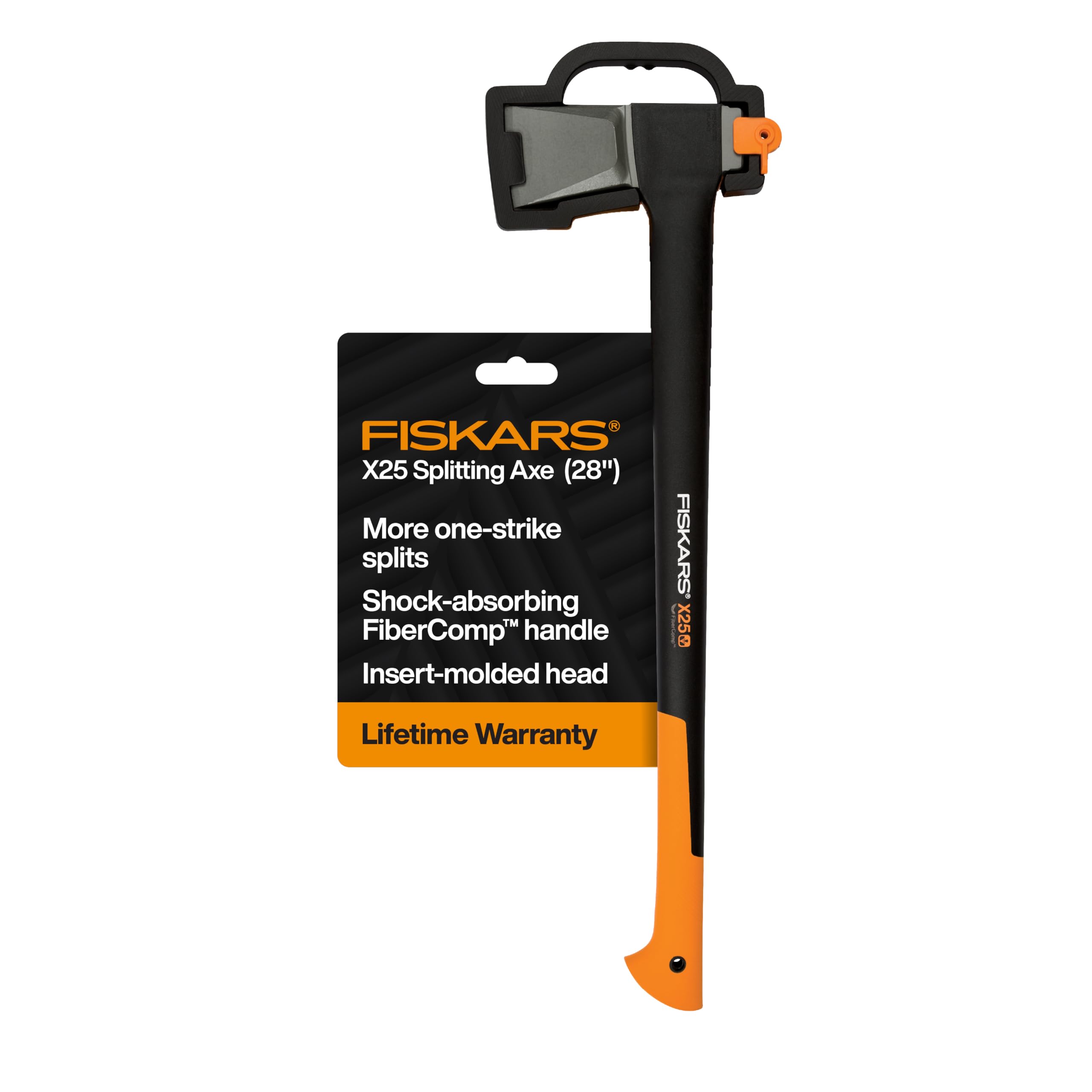
The 28-inch power tool that turns medium and large logs into split firewood with single strokes.
The Fiskars X25 is the full-size answer for anyone splitting serious firewood at camp or home. The 28-inch FiberComp handle gives you the leverage to generate real swing speed, and the advanced bevel convex blade geometry adds power while making the blade easier to remove from wood. Buyers report splitting freshly felled cherry and seasoned oak with a single stroke.
The shock-absorbing FiberComp handle is lightweight yet stronger than steel, so overstrikes won’t destroy it. This is the same handle technology that makes the X7 so comfortable, scaled up for bigger jobs. The balanced power-to-weight ratio multiplies your swing speed, much like an aluminum baseball bat — less effort, more result.
What owners mention is near-universal satisfaction: it is “super sharp,” holds an edge well on oak and hickory, and splits 24-36 inch rounds with ease. Customers note it splits medium and large logs with minimal force. The included protective sheath keeps the blade safe in transit. The one mixed note is ergonomics — a few owners felt thumb tingling with certain gloves, which resolved with a different glove choice. For the camper with a wood stove or a serious fire pit, this is the workhorse.
Why It Crushes Logs
- 28-inch handle multiplies swing power
- Convex blade geometry splits and releases easily
- Shock-absorbing handle prevents overstrike damage
Size Considerations
- Too long for a daypack — this is a basecamp tool
- Ergonomics vary with glove choice for some users
- Overkill for kindling and small branches
Reach for this: for campsites where you process real firewood every day — this is the highest-power splitter on the list.
Keep the X7 instead if: your job is kindling; the 28-inch handle is wasted on small splits.
Understanding the Specs
Head Weight and Blade Geometry
Heavier heads like the X25’s splitting wedge generate more force per swing, which is why it handles medium and large logs that a 1.4-pound hatchet cannot. A convex blade bevel pushes wood apart as it enters, making the blade easier to pull back out. For kindling, a lighter head with a wedge shape, like the X7, is all you need.
Handle Material and Length
Longer handles (28 inches) give you leverage that multiplies swing speed, but they do not fit in a pack. Shorter handles (11 to 14 inches) are portable but trade power. FiberComp handles absorb shock and resist weather, while hickory and leather-over-steel options offer classic feel and durability but need care. The grip’s job is to keep the tool in your hand, wet or dry.
FAQ
What is the difference between a hatchet and a splitting axe?
How heavy a camping tool should I carry on a backpacking trip?
Will a hatchet chop down a small tree?
Why does my new hatchet blade roll or dull so fast?
What is a ferro rod and how do I use it?
Is a folding shovel worth carrying for camping?
Which is better, wood handle or fiberglass handle?
How do I keep my camping tools from rusting?
What is the difference between the Fiskars X7 and the Estwing Sportsman’s Axe?
Final Thoughts: The Verdict
The clear crowd favorite from the data — 4.8 stars across 12,000+ owners — is the camping tools winner, the Fiskars X7 Hatchet, because it nails the balance of sharpness, light weight, and one-strike splits that every camper wants for fire prep. If you want a do-everything tool that digs and chops in one carry, grab the Cold Steel Special Forces Shovel. And for serious firewood splitting at a basecamp, the Fiskars X25 is the power pick that turns large logs into kindling with single strokes.
How We Picked
We do not accept paid placement. Every pick is matched to a real buyer and a real use-case; we do not hands-on test units.
Sources & Methodology
Specifications: manufacturer listings and product documentation. Review insights: verified customer reviews, as of August 2026. Pricing: not shown on this page (it changes often); check the current price via the retailer link.
As an Amazon Associate, FitlyFast earns from qualifying purchases. This does not affect which products we feature.