
Our readers keep the lights on and the weekend projects moving. As an Amazon Associate, I earn from qualifying purchases.
Specs are compiled from manufacturer listings and verified buyer reviews and can change over time — please confirm the key details on the product page before buying.
The single biggest fear when you pick up a buffer for the first time is wrecking your paint—burning through the clear coat and turning a light scratch into a bigger problem. A dual-action (DA) polisher—where the pad both spins and orbits—makes burning through clear coat nearly impossible, turning a weekend of hand-waxing into an hour of smooth, even work. This guide focuses on the machines that actually remove scratches without needing a pro’s steady hand, breaking down the power, pad options, and speed control that matter most.
I’m Rikta — the founder and writer behind FitlyFast. This guide is built by comparing the manufacturers’ published specifications and the patterns across verified customer reviews, so you get each pick’s real strengths and trade-offs instead of marketing spin.
If you are ready to bring back that showroom shine without the expensive detail shop bill, read on for the definitive breakdown of the best car buffer for scratches that suits your skill level.
Our Picks at a Glance

How To Choose The Best Car Buffer For Scratches
Before you pick a machine, you have to decide how deep you need to go. A scratch that barely catches your fingernail is a clear-coat flaw that a dual-action (DA) polisher with the right compound can erase. A scratch you can feel with your nail is usually too deep to polish out completely and needs touch-up paint first. So the buffer’s job is to level the clear coat around the scratch until it blends invisibly, and the machine you choose determines how aggressively you can do that.
Dual-Action vs Rotary: the safety factor
Before you buy, you must choose between a dual-action (DA) polisher and a rotary buffer. A DA spins the pad in an orbit at the same time, so it’s constantly moving and doesn’t stay in one spot long enough to burn the paint. That is why every beginner-friendly pick in this guide is a DA. A rotary spins on a single fixed axis, which cuts much harder and faster but also heats the paint quickly and leaves hologram marks (little circular buffer trails) if you don’t have experience. If this is your first machine, a DA is the tool to buy.
Power and speed: what the numbers mean
Horsepower on a buffer is measured in watts (W), and the higher the wattage, the less the pad slows down when you press it into the paint. You’ll see 380W mini tools for tight spots and 1000W-1600W full-size machines for whole panels. Speed is just as important: a variable-speed dial is essential. You want low speeds (around 1000-1500 RPM or OPM) to apply wax and spread product, and higher speeds (3000+ RPM or OPM) to actually cut and remove scratches from the clear coat and oxidation.
Pad size and orbit throw: the correction duo
Bigger pads (6-7 inches) cover more area and are great for large panels like the hood or roof. Smaller pads (2-3 inches) are for tight corners, A-pillars, and door jambs. The orbit throw (the distance the pad moves in its circular pattern, typically 8mm-9mm) determines how much cut the machine delivers. A larger throw like 9mm means more correction power per pass, which is what the two premium picks in this guide use to make scratches disappear faster.
Quick Comparison
| Model | Best For | Power | Speed Range | Drive Type | Amazon |
|---|---|---|---|---|---|
| Adam’s Polishes 9mm DA★ Best Overall | Beginners wanting a complete scratch kit | 1000 W | up to 6500 OPM | Dual-Action 9mm | Amazon |
| KITLUCK 12Amp RotaryBest Value | Detail spots and hard-to-reach areas | 1400 W | 800-3500 RPM | Rotary | Amazon |
| WorkBless 1600W RotaryTop Performer | Full-panel polishing on a budget | 1600 W | 1300-3500 RPM | Rotary | Amazon |
| GEVEELIFE 1600W Rotary | Value-minded buyers wanting 7 speeds | 1600 W | 1000-3500 RPM | Rotary | Amazon |
| Niusken Cordless DA | Taking the machine anywhere | 21V Battery | 2800-5800 RPM | Dual-Action 8mm | Amazon |
| ZOTA Mini Polisher | Tight curves and motorcycle panels | 380 W | 3000-7200 RPM | Dual-Action 8mm | Amazon |
| VERVEWAVE 6″ Orbital | Dewalt 20V owners going cordless | 20V Tool Only | 1800-5500 RPM | Orbital | Amazon |
| SPTA Cordless Mini | Micro corrections and emblems | 12V Battery | 2000-4500 OPM | Dual-Action | Amazon |
| Griot’s Garage G9 | Enthusiasts wanting pro-grade correction | 1000 W | 2000-6400 OPM | Dual-Action 9mm | Amazon |
In-Depth Reviews
1. Adam’s Polishes 9mm Dual Action Car Polisher (Polishing Kit)
Our pick — over 4.5★ from 400+ verified ratings; the strongest balance of quality and price.
The complete package that turns a scared first-timer into a confident paint corrector.
This DA polisher rewards careful beginners with safe, effective paint correction. It’s a dual-action (DA) long-throw polisher, meaning the pad orbits in a 9mm pattern, so it’s far less likely to burn through your clear coat than a hard-spinning rotary. The 1000W motor provides steady power, and with a maximum 6500 OPM (orbits per minute), it levels the clear coat to blend away swirls and surface scratches efficiently. Buyers report it “worked great saving paint on my 30 year old vehicle,” which shows this machine’s gentle hand on aging clear coat.
The complete kit—pad, compound, and polish—lets you start correcting paint immediately. You get a foam polishing pad, a cutting compound, and a finishing polish designed to work together with the machine. The whole unit weighs under 5.5 pounds and has a 16-foot power cord, so you won’t be chasing outlets around the garage during a full detail. The two-hand grip and rubber contact points absorb vibration, which makes long sessions on a roof or hood much easier on your arms.
Beginners report achieving great results on a 2021 Jeep Wrangler after just 4.5 hours on their first attempt. The experience is described as gliding smoothly with minimal vibration and no heat buildup. The only honest caveat from owners is that the included compound is light-duty, so it only removes the lightest scratches. For deeper flaws, you will need a more aggressive compound, but the polish itself is high quality and leaves an excellent finish.
What wins people over
- Effectiveness is the top praise—owners mention it exceeds expectations on everything from 30-year-old paint to newer Jeeps.
- The 9mm throw cuts faster than typical 8mm machines for faster scratch removal.
- Kit includes compound, polish, and a pad, so you can start immediately.
- Comfortable two-hand grip with low vibration for extended use.
Worth knowing first
- The bundled compound is light, so it won’t tackle deep scratches without a stronger product.
- Durability gets mixed feedback from long-term owners.
Grab it if: you want a single kit that walks you from light scratches to a glossy finish with beginner-proof safety.
Think twice if: you need heavy correction on deep oxidation—the light-duty compound will leave you wanting more cut.
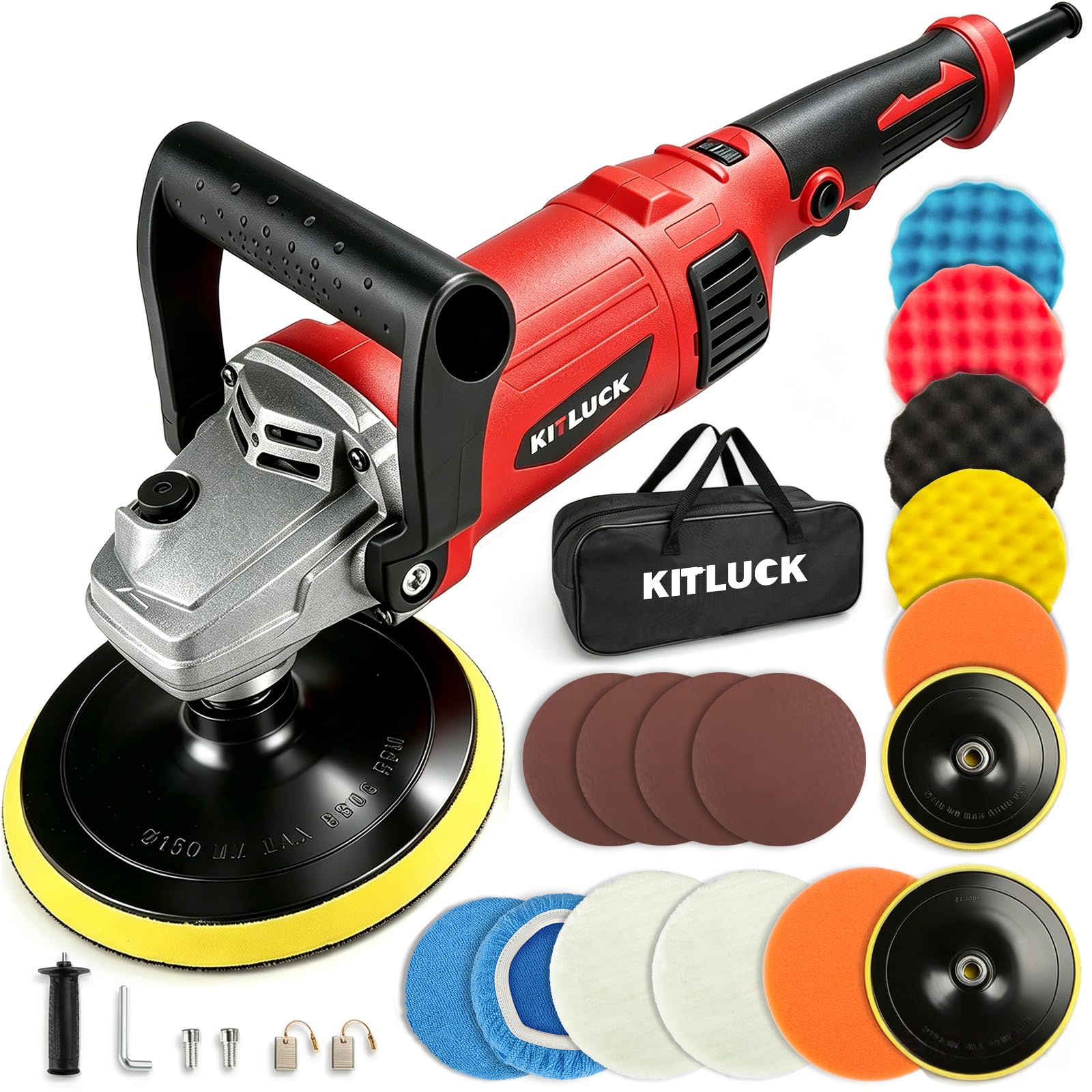
2. KITLUCK Buffer Polisher, 12Amp 6″/7″ Rotary
A rotary that packs a big punch for the money, ideal for spot repairs, not full panels.
This is a rotary polisher, which changes the game entirely. Unlike a dual-action (DA) machine, a rotary spins the pad on a fixed axis and cuts with much more aggression. The KITLUCK brings a 1400W pure copper motor with speeds from 800 to 3500 RPM, which is plenty of muscle to eat through scratches and oxidation on a clear coat. Customers note it as a “strong little detail buffer” that “definitely holds its own in detail and hard to reach areas.” You should not expect to buff whole panels with this, but for spot corrections it is a force.
The kit is designed to be your only box of tools. It includes two hook-and-loop backing plates (6-inch and 7-inch), 4 wave foam pads, wool polishing bonnets, microfiber bonnets, and sandpaper. With an M14 spindle, you can swap in different disc sizes to match the job. The package even includes a thick storage bag, a D-handle, a side handle, and two replacement carbon brushes—so you have everything for a first detail session right from the start.
Buyers call the price “ridiculously lower than the big names” while still delivering solid rotary performance. There is a learning curve though. Because it is a rotary, pressing down too hard or lingering in one spot can burn paint. Owners note the tool gets hot to the touch quickly and the two-part trigger takes some getting used to. It is a fantastic deal if you are careful, but it is not the machine to learn on.
Owner verdict: The quality is praised most, with buyers noting it feels better than expected for the cost.
Best suited for: someone who understands rotary risk and wants a cheap, powerful option for fixing door dings and rock chips.
Not for: absolute beginners—the rotary action can burn clear coat if you don’t keep the pad moving.
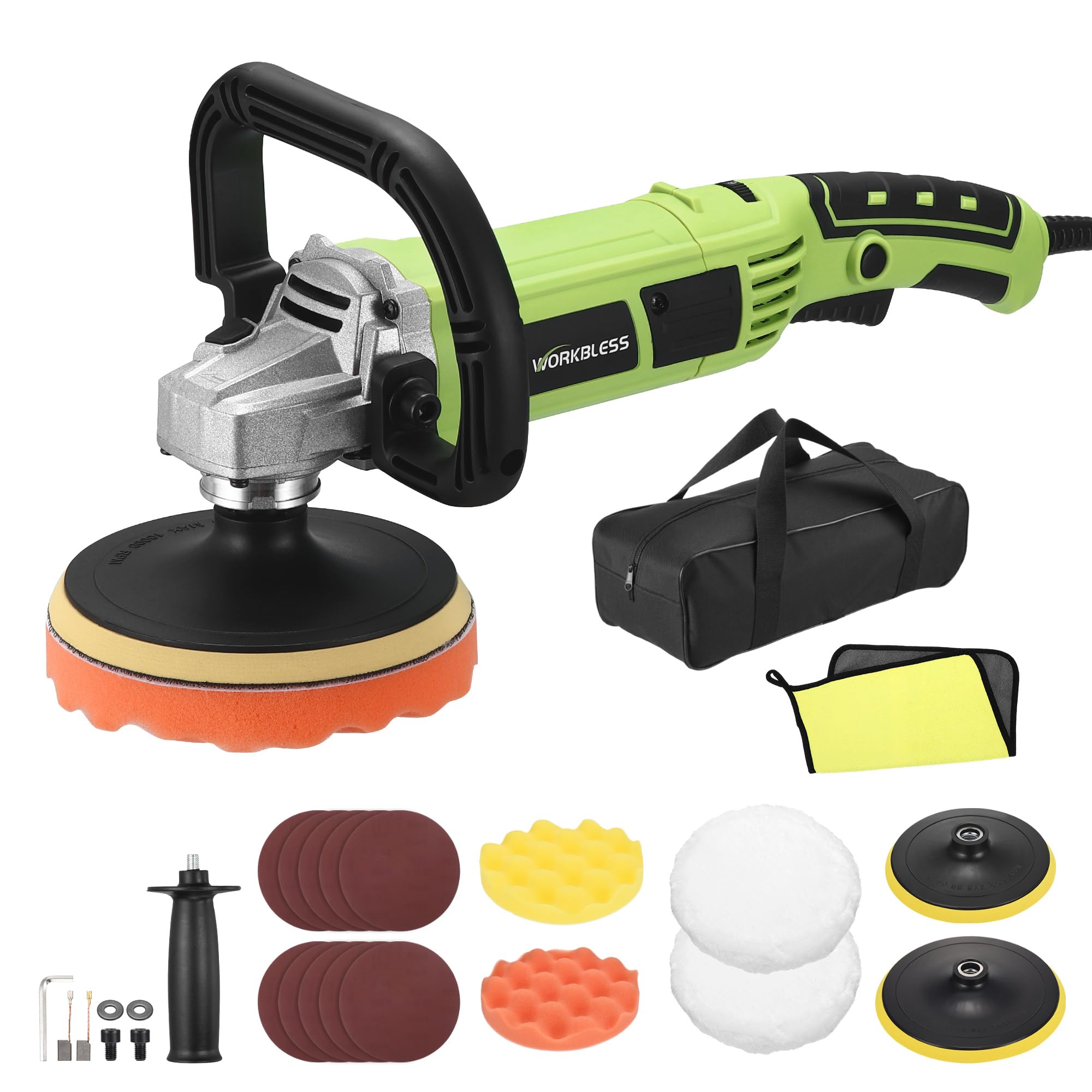
3. WorkBless 1600W 6 Inch/7 Inch Rotary Polisher
The highest-wattage rotary here—1600W of grunt for boats, headlights, and stubborn oxidation.
If the KITLUCK is the spot-repair scout, this is the heavy hitter. The WorkBless pushes a full 1600W through a pure copper motor, which is a 60% power gap over the Adam’s Polishes DA at 1000W. That raw wattage translates to less bogging down when you press a cutting pad into weathered gel coat or faded headlights. Reviewers point out it “works wonders on faded headlights” and that it is “powerful enough for sanding and buffing.”
Configurability is the strong suit here. There are three ergonomic handle modes: side handles on either side, a U-shaped handle for easy movement, or going handle-free entirely. That flexibility is rare at this price. The kit includes a mix of soft wool pads for gentle polishing, durable sponge pads for multi-purpose use, and hard sandpaper pads for heavy grime. One owner even found it perfect for polishing granite countertop edges since it uses a standard grinder thread.
The honest feedback is split on the accessories. Owners rave about the foam pads perform excellently, but the wool pads don’t hold up. One buyer restored a red boat with a Makita wool pad and 3M compound after ditching the included wool. It is a full-sized, heavier machine, ideal for classic cars and boat work where you want serious cut, but not ideal for quick spot fixes on a daily driver.
What the reviews highlight
- Performance is the most-praised aspect, with buyers citing headlight restoration as a standout job.
- 1600W motor with heat sinks handles prolonged use without stalling.
- Boat owners confirm the gel coat shines up beautifully with foam pads.
- Great value for the huge accessory bundle.
Reality check
- The included wool pads are a weak point—buyers recommend replacing them.
- It is a large full-size machine, so it is not for tight garage spots.
Choose this if: you need serious correcting power for boats, old paint, or headlights and don’t mind a heavier tool.
Look elsewhere if: you want a lightweight machine for quick everyday touch-ups.
4. GEVEELIFE 1600W 6 Inch/7 Inch Rotary Polisher

Featherlight at 4.5 lbs but packing a 1600W wallop, this one is easy to hold and hold onto.
The GEVEELIFE is the lightest full-power rotary in this lineup, and that matters more than you’d think. Weighing only 4.5 lbs, it reduces arm fatigue during a multi-panel polishing session. But the 1600W motor is no lightweight for output, offering 7 variable speeds from 1000 to 3500 RPM. Owners describe the feel as solid, with one buyer saying it’s “better than a Dewalt that I had that costs 3x more.”
The safety switch lock is a standout design choice. You can lock the speed button down, so you don’t have to keep squeezing the trigger during a long pass over a hood. The dual handles—a detachable D-handle and a side handle—let you adjust your grip for different hand sizes, which is a thoughtful touch for a budget-tier machine. It even comes with a 2-year warranty, which is above average for this price range.
Beginners should read this warning carefully: this is still a rotary polisher, and one owner reported scratching their paint on the first use before they got the hang of it. The adjustable speeds offer a wide range, but some owners note the lower settings can feel too slow. That said, with practice on a low speed first, shoppers say it removes small scratches and leaves a nice shine, making it “a good DIY alternative to a shop.”
Best-loved feature: The quality is the headline—131 buyers single it out as exceeding expectations at this cost.
Reach for this if: you want the most power-per-pound for your money and don’t mind a rotary learning curve.
Be careful if: you have zero polishing experience—practice on a junk panel or low speed first to avoid burning paint.
5. Niusken Cordless Car Buffer Polisher Kit
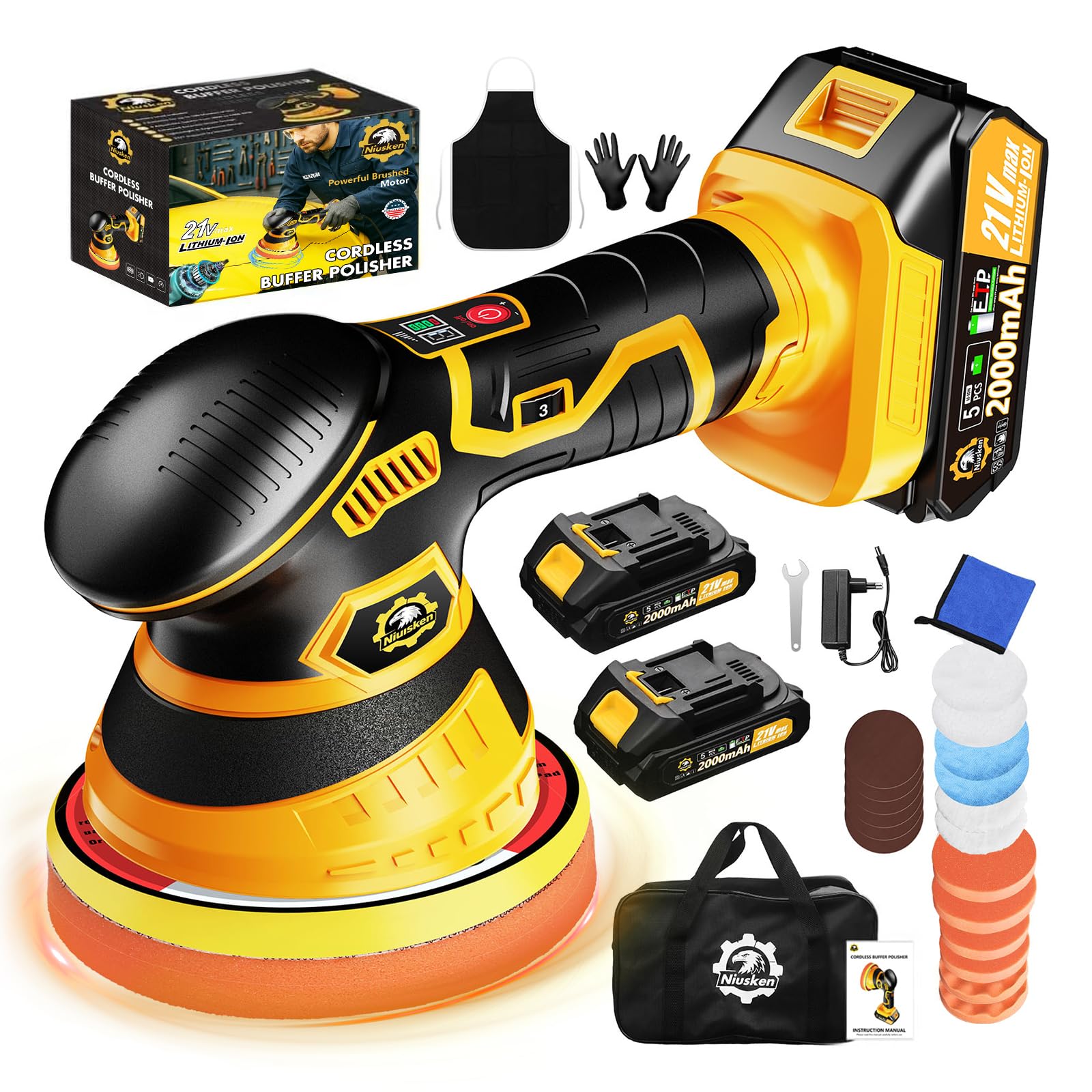
The cordless DA with an LED brain that tells you your speed and battery life in real time.
Dragging an extension cord around a car is a constant annoyance, and the Niusken cuts that cord completely. It runs on two 21V 2000mAh rechargeable batteries, and buyers report one full battery can handle polishing an entire car on high speed. The dual-action (DA) mechanism is a random orbital, which means it is far safer on clear coat than a rotary. One owner even removed a scratch completely with it, which is impressive for a battery-powered tool.
The 6-speed motor spans 2800 to 5800 RPM, and the integrated LED screen shows your current speed and remaining battery level at a glance. That is genuinely useful—you can see exactly when the battery is about to die rather than watching the pad slow down mid-panel. The tool weighs only 3.3 lbs, so it is light enough to maneuver one-handed in awkward spots around mirrors and bumpers.
The trade-off is battery runtime: high-RPM use drains the 2000mAh cells fast, and overheat protection can pause work after 20 minutes. At high RPM, the battery drains fast, and the machine has an overheating protection system that can shut it down after more than 20 minutes of continuous high-speed use to cool off. Owners note battery life decreased after multiple charge cycles, but the included second battery mitigates that. Just remember: this battery system is unique and will not work with your DeWalt batteries.
Why owners like it
- One fully charged battery can complete a whole car on high speed.
- It removed a scratch completely for a buyer using the included pads.
- The LED display is a practical touch that shows speed and battery %.
- Weighs only 3.3 lbs, making it easy to maneuver into tight panels.
Know the limits
- High-RPM use drains the 2000mAh batteries fast.
- Overheat protection can pause work after 20 minutes of continuous use.
Perfect if: you detail on the go, need to work far from outlets, or want a safe DA to learn on.
skip it if: you have long multi-hour correction sessions—the battery swaps will interrupt your flow.
6. ZOTA Mini Polisher, 2-inch/3-inch DA

The tiny tool that dives into door jambs, A-pillars, and tight curves the big buffers can’t reach.
Full-size polishers are useless for the tight confines of a car’s body lines, and that is exactly where the ZOTA shines. This mini dual-action (DA) polisher uses 2-inch and 3-inch backing plates, making it the perfect partner for a full-size machine. It is “perfect for what I use it for” according to one owner who tackles door jambs and body lines, and it is small enough to polish tricky motorcycle panels and scratches around headlights.
Despite its size, the 380W motor delivers a strong output with an 8mm orbit and 1-6 variable speeds reaching 3000-7200 RPM. The shell is made of a high-impact nylon (PA6 with 30% glass fiber) which owners mention feels very durable. The noise level is low enough that you can work comfortably without ear protection. Owners confirm it “vibrates but manageable,” which is a fair trade for a tool this small.
Unlike the cordless SPTA mini below, this ZOTA is corded, so you never run out of battery mid-detail. However, that cord can be a minor annoyance when you are reaching around a tight wheel arch. Owners note the included pads are low quality and recommend upgrading to higher-end pads like SPTA for the best cut. It is well-balanced, easy to hold, and handles a full compound/polish/wax cycle on a 22.5-foot boat without overheating.
What stands out: Performance and build quality are equally praised—buyers love how it handles tight spaces without feeling flimsy.
Grab this if: your work is mostly door jambs, pillars, and small panels where a big buffer won’t fit.
Consider the cords: if you need to reach far away from a power outlet, the SPTA cordless version might suit you better.
7. VERVEWAVE Cordless 6-Inch Orbital Polisher
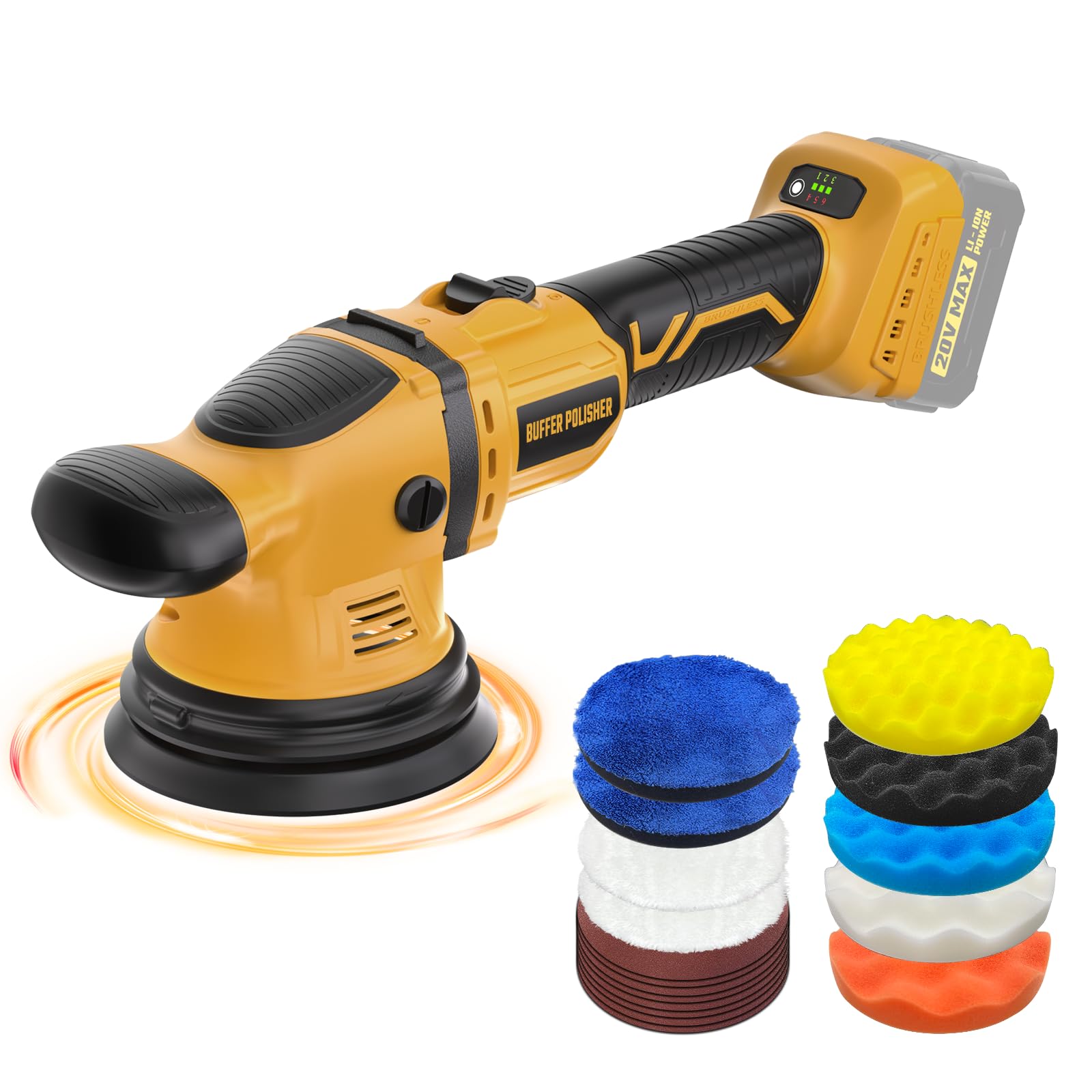
Drops right onto your existing Dewalt 20V batteries and gives you a 6-inch orbital with zero cords.
If you already own Dewalt 20V MAX tools, this polisher is a no-brainer addition. The VERVEWAVE is a tool-only machine that runs on your existing Dewalt batteries (compatible with DCB200 through DCB240). Buyers confirm the “Dewalt battery fit nicely,” and one owner finished a full car on a single 6Ah charge. It is lighter than a corded machine, which customers note is easier on the arms during long sessions.
The upgraded DC brushless motor is the star here. It produces more power and less noise than a standard brushed motor, and it is built to last longer. The 6 variable speeds span 1800 to 5500 RPM, covering everything from gentle waxing to aggressive defect removal. The eccentric orbital motion keeps the pad moving randomly, which prevents hologram marks (circular buffer trails) and makes over-polishing nearly impossible.
The ergonomic extended handle and rubber front grip make it easy to hold at any angle. Plus, it uses a lock switch instead of a one-touch button. That means the machine won’t suddenly start up the next time you grab it after the battery dies—a real safety feature. The 17-piece kit includes 5 foam pads, 2 wool pads, 2 waxing pads, and sandpaper, so you have real correcting power from the start.
The strongest points
- Build quality is the most-praised aspect—reviewers point out it feels well-made and worth the money.
- One 6Ah Dewalt battery completes a full car on a single charge.
- Brushless motor stays cool for about an hour of continuous use.
- Lock switch prevents accidental start-ups, a real safety upgrade.
Before you click buy
- Battery and charger are NOT included—you must own Dewalt 20V already.
- The 6-inch pad is large, so it’s not ideal for tight spots without a smaller pad.
Perfect for: Dewalt 20V owners who want a cordless orbital without buying a whole new battery platform.
Not for: people starting from scratch—you’d need to invest in the Dewalt battery system separately.
8. SPTA Cordless Mini Polisher, 12V
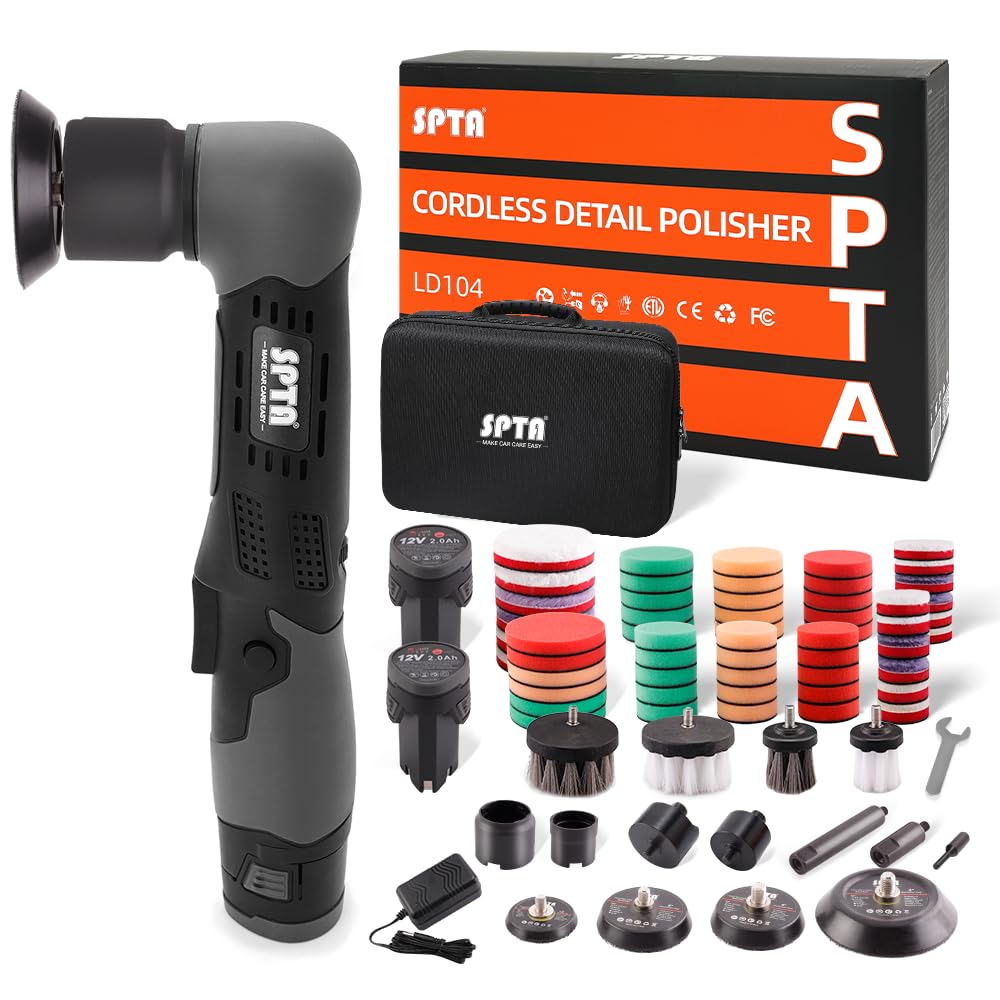
The Swiss Army knife of paint correction—91 pieces of tiny pads, brushes, and a cordless body for micro detail work.
This is the most comprehensive mini-polisher kit you can buy. The SPTA cordless polisher comes with two 2000mAh batteries, two extension shafts, and an astonishing array of pads: 21 pieces of 25mm pads, 21 pieces of 50mm pads, and 12 pieces of 76mm pads. With three backing plate sizes (25mm, 50mm, and 80mm), it can tackle everything from polishing chrome trim to removing light scratches from emblems and body lines. Owners praise it specifically for motorcycle detailing.
The double-action free-spinning rotation delivers a hologram-free finish, which is the gold standard for safe polishing. Speed control switches between 2000 and 4500 oscillations per minute (OPM), and you can swap to a rotary attachment for heavier cut or carpet drilling work. The nimble 2000mAh battery allows long work hours at maximum speed, and it fully recharges quickly while the second battery is ready to go.
Real-world feedback is strongly positive on the polish results: buyers removed light scratches and restored shine on small, hard-to-reach areas. The trade-offs are practical. The fully charged batteries have a shorter run time than some hoped, and there is no plug-in option—it only runs off battery. The included case is also too small, requiring full disassembly of the tool to store it. One owner noted the charging port is not USB, so you need the included charger.
The collective take: It is a quality, easy-to-handle tool that comes with everything needed, but the 91-piece count includes many small parts you may not use.
Ideal if: you motorcycle enthusiasts, and detailers who obsess over emblems, badges, and mirror caps.
Reconsider if: you expect to correct full car panels—this is a precision tool, not a whole-car machine.
9. Griot’s Garage G9 Random Orbital Polisher

The enthusiast’s benchmark—a fan-cooled 1000W motor with a 9mm throw that makes paint correction feel easy.
This is the machine that serious hobbyists and pros reach for when they want predictable, smooth, professional-grade results. The G9 matches the Adam’s Polishes at 1000W and a 9mm orbit throw, but it distinguishes itself with a fan-cooled counterbalance and premium bearing construction. That engineering means constant-speed control that prevents the pad from bogging down when you apply pressure, and buyers rave about the low vibration. One owner called it “a quality machine for a reasonable price” and noted “it’s not super loud.”
The double-shot rubber grip and contoured shroud keep hands comfortable during extended detailing. The double-shot rubber grip and contoured shroud keep your hands comfortable, and the speed dial is accessible for both right- and left-handed users. The 6 variable speeds run from 2000 to 6400 OPM, giving you a massive range from gentle waxing to aggressive swirl removal. The included 6-inch vented backing plate is standard, but you can convert it to a 5-inch pad system with an optional backing plate for tighter work.
Novices report a minimal learning curve, with one calling it “excellent for a first time correction.” A novice reports it “worked excellent for a first time correction” and found the learning curve minimal. The 10-foot quick-connect power cord and rest pads for stable placement round out a thoughtful design. The one caveat from owners is that it takes a while to correct deep scratches—it is not the fastest cutter compared to a rotary, but it is infinitely safer for your paint. For a careful beginner who wants room to grow, this is the tool that will last for years.
What justifies the premium
- Quality is the most-praised aspect, with buyers calling it a quality tool that’s very easy to use.
- Constant speed control prevents bogging down under pressure.
- Low vibration and low noise make it comfortable for extended detailing.
- Converts to a 5-inch pad system for added flexibility.
The honest trade-off
- Correcting deep scratches takes longer than with an aggressive rotary.
- Sold without pads or compound—you supply your own for the first session.
Buy it if: you want a refined DA that grows with your skills, from first polish to full paint correction.
Look at the KITLUCK instead if: raw speed and heavy cutting power matter more to you than safety and smoothness.
Understanding the Specs
Orbit Throw (DA machines)
This is the distance the pad travels in its circular pattern, usually 8mm or 9mm. A larger throw like 9mm moves the pad further with each rotation, which means more cutting power and faster scratch removal. An 8mm throw is gentler and ideal for applying wax or finishing, while a 9mm throw suits correction jobs. For your money, dual-action (DA) polishers are the safest tool for beginners because the pad never lingers in one spot long enough to burn paint.
Speed Range (RPM/OPM)
Speed is measured either in rotations per minute (RPM) for rotary polishers or orbits per minute (OPM) for dual-action machines. A wide variable-speed range lets you match the tool to the task: low speeds around 1000-1500 are for spreading wax and sealant, medium speeds suit light polishing, and high speeds of 3000+ are for cutting defects and oxidation. Look for a dial you can adjust without stopping the machine, so you can speed up or slow down mid-panel as needed.
Power Output (Watts/Amps)
Watts measure the motor’s raw power, and amps measure electrical current draw. More watts (like 1400W-1600W) means the pad keeps spinning at full speed even when you press firmly into the paint, making it easier to cut through tough clear coat and oxidation. Lower-wattage tools (like 380W mini polishers) have enough grunt for small spots but will bog down if you try to correct a whole hood. The trade-off: higher power usually means a heavier, bulkier tool.
Backing Plate and Pad Size
The backing plate is the disc that holds your polishing pad, and its size determines how much area you cover. Bigger plates (6-7 inches) are efficient for large flat panels like hoods and roofs. Smaller plates (2-3 inches) are essential for tight curves, door jambs, and around headlights. Buffers often use an M14 spindle thread, which lets you swap backing plates to change pad sizes, so a single machine can handle both broad panel work and precision detailing.
FAQ
Will a car buffer remove deep scratches completely?
Can I burn or damage my car’s paint with a buffer?
What is the difference between a rotary and a dual-action polisher?
What speed should I use to remove scratches?
Will a cordless buffer polisher have enough power to correct paint?
Do I need a separate pad for polishing versus waxing?
Can I use a car buffer on headlights?
What is the ideal buffer for a beginner?
Final Thoughts: The Verdict
For most people, the best car buffer for scratches is the Adam’s Polishes 9mm DA because it pairs a safe dual-action design with a complete kit of compound, polish, and a pad, making first-time paint correction genuinely achievable. If you are a Dewalt tool owner who wants cordless flexibility, the VERVEWAVE drops straight onto your existing batteries. And for tight spots and motorcycle detailing that a full-size polisher can’t reach, the ZOTA Mini is the one to reach for.
How We Picked
We do not accept paid placement. Every pick is matched to a real buyer and a real use-case; we do not hands-on test units.
Sources & Methodology
Specifications: manufacturer listings and product documentation. Review insights: verified customer reviews, as of August 2026. Pricing: not shown on this page (it changes often); check the current price via the retailer link.
As an Amazon Associate, FitlyFast earns from qualifying purchases. This does not affect which products we feature.