
Our readers keep the lights on and the weekend projects moving. As an Amazon Associate, I earn from qualifying purchases.
Specs are compiled from manufacturer listings and verified buyer reviews and can change over time — please confirm the key details on the product page before buying.
If you crank the volume and your music still sounds flat and muddy, the factory speakers are likely the culprit—they’re built to save costs, not to deliver clear sound. You can fix that with a simple upgrade, if you want crisper vocals, deeper bass, or just a direct replacement for your worn-out original equipment manufacturer (OEM, the speakers that came with your car) units.
I’m Rikta — the founder and writer behind FitlyFast. This guide is built by comparing the manufacturers’ published specifications and the patterns across verified customer reviews, so you get each pick’s real strengths and trade-offs instead of marketing spin.
You’ll learn what truly matters in a set of car speakers — from power ratings to cone materials — so you can buy with confidence and hear the difference on your first drive.
Our Picks at a Glance


How To Choose The Best Car Speakers
The right speaker matches your car’s power output, fits your door’s mounting holes, and delivers the sound you enjoy.
Start with Your Power Source
Your factory radio or aftermarket amp only gives out so much power. If you buy speakers that need more wattage than your source can provide, they’ll sound weak and quiet. Check the RMS (Root Mean Square) rating — that’s the continuous power a speaker can handle, not the peak burst. Match this number roughly to what your head unit or amp outputs.
Check Fitment Before You Fall in Love
Most cars take 6.5-inch speakers, but not all. Measure your mounting depth and hole diameter first. A speaker that’s too deep won’t fit behind your door panel, and one that’s too big won’t bolt in without modification. Look for the mounting depth and overall diameter in the specs before buying.
Coaxial or Component?
A coaxial speaker has the tweeter (for high notes) built into the same frame as the woofer (for lows and mids) — a simple, direct swap. A component system splits the tweeter and woofer into separate pieces for better sound staging, but requires more wiring and mounting spots. If you want the best sound quality and don’t mind the extra work, components win.
Quick Comparison
| Model | Best For | Max Power | RMS Power | Type | Amazon |
|---|---|---|---|---|---|
| ORION Cobalt CM654★ Best Overall | Loud midrange on a budget | 1000W | 250W | Mid-Range Bullet | Amazon |
| Kenwood KFC-1666RBest Value | Easy drop-in replacement | 300W | 30W | 2-Way Coaxial | Amazon |
| Rockford Fosgate R165-SBest Component Value | Clear highs and mids | 80W | 40W | 2-Way Component | Amazon |
| JBL Stage 3637F | Three-way balance | — | — | 3-Way Coaxial | Amazon |
| DS18 PRO-X6.4BM | Vocal clarity with an amp | 500W | 250W | Mid-Range Bullet | Amazon |
| CT Sounds Meso 6.5 | Premium build and smooth sound | 300W | 150W | 2-Way Coaxial | Amazon |
| JBL GTO629 | Aimable tweeters for staging | — | — | 2-Way Coaxial | Amazon |
| Pioneer TS-A653CH | Deep response with an amp | 370W | 85W | 2-Way Component | Amazon |
| Rockford Fosgate P165-SI | High-end component sound | 120W | 60W | 2-Way Component | Amazon |
In-Depth Reviews
1. ORION Cobalt CM654
Our pick — over 4.5★ from 750+ verified ratings; the strongest balance of quality and price.
The budget midrange bruiser that turns your doors into a front-row concert.
Most budget speakers ask you to sacrifice loudness for clarity, but the ORION Cobalt CM654 refuses that trade. Its 1000W max power handling compares with the Kenwood KFC-1666R’s 300W, and the continuous 250W RMS compares with the Kenwood’s 30W RMS. This headroom lets you drive them hard with an amp without distortion.
The bullet tweeter design extends high-frequency response while preserving midrange output. With a 96.67 dB sensitivity rating, it’s also remarkably efficient, so even modest power turns into serious volume. Buyers report it simply: “Easy installation. Perfect price. Fits amazingly.”
Check fit: the 6.54-inch diameter and 2.63-inch depth may be tight in some doors, so measure before buying.
What wins people over
- Massive 1000W max power for distortion-free volume
- High 96.67 dB efficiency means loud output on less power
- Bullet tweeter design keeps highs clear without losing mids
Check before you buy
- 6.54-inch diameter can be tight in some factory openings
- Midrange focus means you’ll want separate tweeters for the very top end
Reach for these if: you’re building a system with an amplifier and you want extreme volume without spending premium money.
Look elsewhere if: your car has shallow mounting holes or you want a simple speaker that covers every frequency on its own.
2. Kenwood KFC-1666R
The straight swap that makes your daily commute sound like a studio session.
If you want better sound without learning to be a car audio installer, the Kenwood KFC-1666R is the safest bet. Its cloth woofer and balanced dome tweeter produce a smooth, natural tone across a 40Hz to 22kHz frequency response. The 300W peak power and 4-ohm impedance (the standard resistance most car stereos expect) mean it’s designed to work correctly with your factory wiring.
Installation is straightforward thanks to the shallow depth and low-profile tweeter. The heavy-duty magnet uses a shallow depth, and the lower tweeter height helps them tuck behind stock grilles. A Honda Element owner found the flange’s multiple hole patterns matched the factory 3-screw locations with zero drilling needed — a rarity for aftermarket speakers.
As owners mention: “Finally got these put in. My car sounds amazing. So happy I bought these. There were easy to install.” Some owners have even bought a second pair, which is the clearest vote of confidence you can get.
Solid all-rounder: clear highs and punchy bass that satisfies most listeners.
Keep in mind: with 30W RMS they’re meant for factory-sized power, not a high-powered amp.
Perfect for: anyone making their first upgrade with a stock radio and no amp.
Not for: bassheads chasing window-rattling lows or those running a dedicated subwoofer amp.
3. Rockford Fosgate Prime R165-S
A factory-replacement component kit that delivers crisp, clear highs from the dash.
Stepping up from a coaxial to a component system usually means more money and more work. The Rockford Fosgate Prime R165-S makes that leap affordable and straightforward. It’s rated at 40 watts RMS and 80 watts peak, making it perfectly suited to run on a factory head unit while giving you the clarity of separate tweeters and woofers.
The kit includes two 6.5-inch woofers with grilles and two 1-inch tweeters with integrated crossovers (the little circuit that directs highs to the tweeter and lows to the woofer). The tweeters use a Mylar balanced dome, and they can be mounted flush into the panel, on the surface, or at an angle to point at your ears. One owner fitted all 8 factory positions in a 2004 Monaro/GTO — woofers in the front doors, tweeters in the dash top — and “couldn’t be happier.”
Note: the woofers run slightly smaller than typical 6.5-inch units, and bass output is modest—plan for a subwoofer.
Clear, not thumpy: reviewers highlight the crisp sound quality and old-school Rockford build.
Trade-off: you get detail and staging, not deep bass, and fitment needs measuring.
Choose this for: a major sound-quality jump from factory paper cones with a simple install.
skip it if: you’re after heavy bass or you want a single-piece drop-in without separate tweeter wiring.
4. JBL Stage 3637F

The three-way upgrade that rescues factory radios with surprising efficiency.
Most 6.5-inch speakers are two-way designs, splitting the sound between a woofer and a tweeter. The JBL Stage 3637F adds a third driver for midrange, aiming for a fuller, more layered sound across the board. It’s engineered with a “Plus One” woofer cone that’s larger than typical in the size class, which JBL says boosts efficiency by up to 2dB.
This efficiency boost is key for factory-radio power. An owner who swapped them into a 2016 Nissan Rogue noted the factory radio supplied enough power for all four speakers and described the result as a significant improvement over the stock Bose paper units. Another reported no door panel modification was needed at all.
No mounting hardware is included—reuse your stock brackets—but the edge-driven dome tweeter delivers clear, crisp highs.
The highlights
- Three-way design fills in the midrange for fuller sound
- Efficient Plus One cone works well on factory radio power
- Vented basket frame helps cool the voice coil for reliability
Watch out for
- No mounting hardware included — you’ll reuse factory brackets
- No grilles supplied, so exposed installs need planning
Grab these if: you want a broad, balanced sound from a straight swap on your factory stereo.
Think twice if: you need a complete kit with brackets and grilles or plan to run them without an amp.
5. DS18 PRO-X6.4BM

A vocal-forward bullet midrange that turns lyrics into the star of the show.
The DS18 PRO-X6.4BM is built for one specific job: handling the most important part of the audio spectrum — the human voice. It’s a dedicated midrange driver with a bullet dust cover, designed to be paired with separate tweeters and a crossover in a full system. Don’t expect it to do everything; expect it to do vocals and instruments spectacularly well.
It’s rated at 250W RMS and 500W max power at 4 ohms, powered by a 1.5-inch high-temperature CCAW (copper-clad aluminum wire) voice coil. That coil is what lets it play loud for long stretches without overheating. One owner paired them with an amp and crossover, noting “extreme” loudness with zero distortion, and another reported they were still going strong after 8 months.
This isn’t a standalone solution — customers note they’re “kinda bulky” and clearly meant for a tuned system. Durability has a split reputation, with most units proving reliable while a few failed quickly. If you have an amplifier and crossover ready, this is the midrange your setup is missing.
Vocal clarity champ: the midrange presence is the standout, with clear, loud output when amped.
A system piece: requires matching tweeters, a crossover, and likely an amp to shine.
Built for: the enthusiast who already has an amplifier (a device that boosts the audio signal) and a crossover (a component that splits the sound into different frequency ranges) and wants crisp vocals.
Not for: casual listeners who want one pair of speakers to run off a stock radio.
6. CT Sounds Meso 6.5

A premium coaxial that treats your ears to detail without demanding a full audio build.
The CT Sounds Meso 6.5 bridges the gap between budget coaxials and boutique components. It’s a 2-way coaxial rated at 75W RMS and 150W max per speaker, or 150W RMS and 300W max for the pair. The build quality is the story here — a fiberglass cone with a nitrile butadiene rubber surround (the flexible ring around the cone) that delivers a crisp, well-controlled sound.
The attached tweeters use a silk dome with a CCAW voice coil and a neo magnet, which owners describe as clear, smooth, and punchy. They come with premium wire, screws, and signature grilles included. The spring-loaded connectors are a small thing that makes a big difference during install — reviewers point out no crimping or splicing was needed to hook them up.
Fit is generally positive, though one owner noted a slight adjustment was needed in the door. While they play fine on an aftermarket radio alone, they truly come alive with a bit of amplifier power, hitting mid-bass hard with tunable highs.
Least-effort premium: true plug-and-play quality sound with included mounting gear.
Worth noting: the highs can get slightly harsh at extreme volume, but that’s tunable on most amps.
Choose this when: you want near-component-level quality with a much simpler installation.
Pass if: you need maximum power handling or prefer a component system’s separate tweeter placement.
7. JBL GTO629
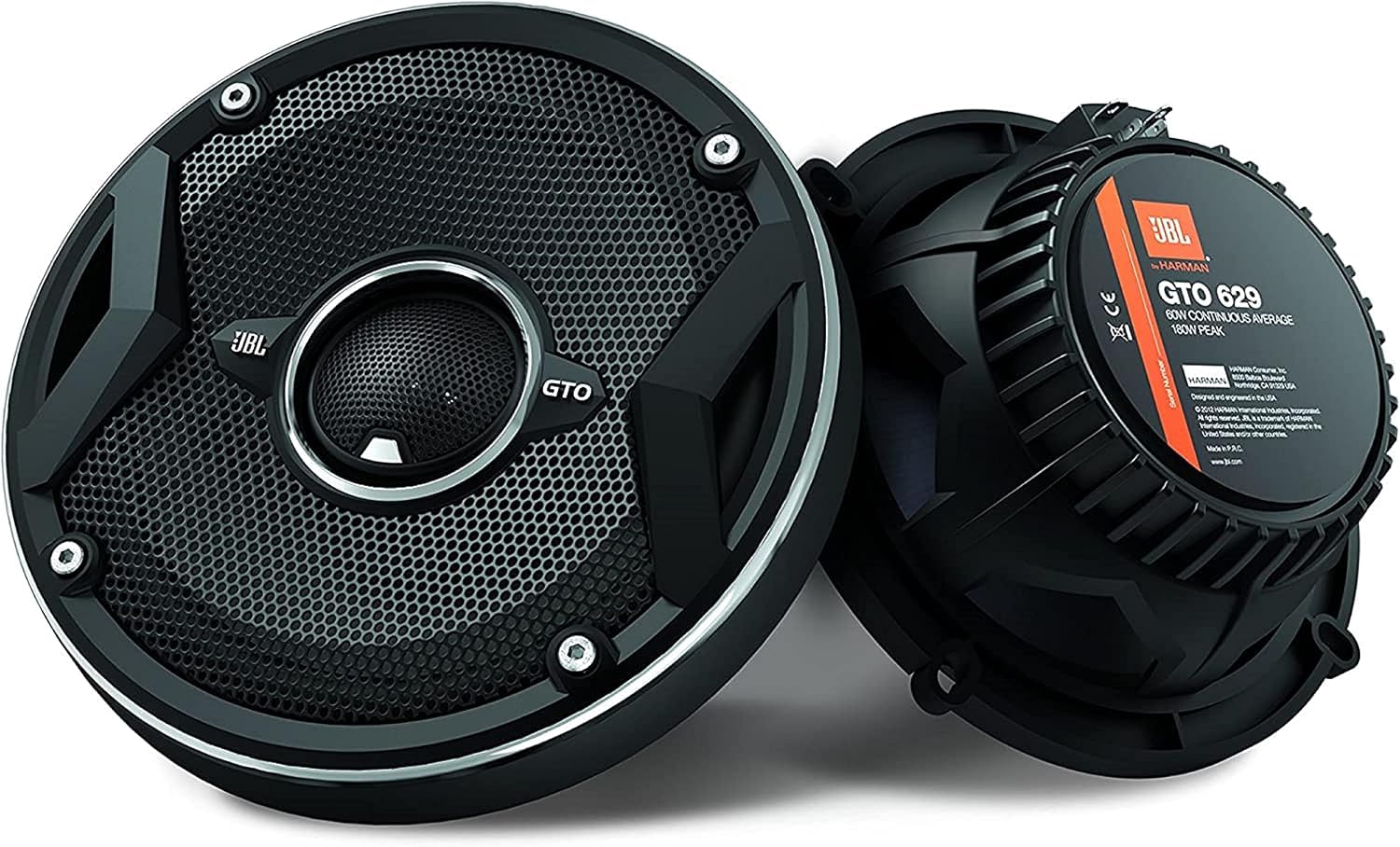
Aimable tweeters put the soundstage right at ear level, even from low door mounts.
Most speakers aim their tweeters straight out, but the JBL GTO629 doesn’t assume that’s where your ears are. Its patented UniPivot tweeter can be rotated to point the sound at you, which is a huge advantage when speakers are mounted low in door panels. That aimability is the defining feature here, creating a much more lifelike soundstage than a fixed speaker.
It’s also clever where it counts. The carbon-injected Plus One cones are larger than others in the class, helping them move more air and dig deeper into the bass. The 3-ohm impedance is lower than the standard 4-ohm, which helps compensate for the thin, undersized wires found in many modern cars and gets more usable power out of your stereo.
The sound is described as having strong mid-bass and crisp highs, but durability has a split track record — some shoppers say they didn’t last a full year while others praise their longevity. The mounting depth is a shallow 2 inches with a 6-1/4 inch external diameter, making them a versatile fit for many doors.
Smart design: the aimable tweeter and lower impedance offer real real-world benefits.
A fair warning: longevity is the main point of debate, so keep your receipt handy.
Best for: listeners who want to direct the sound precisely and get the most from factory wiring.
Question them if: long-term durability is your top priority over soundstaging flexibility.
8. Pioneer TS-A653CH

A component system with a frequency range that goes well beyond what your ears can hear.
The Pioneer A-Series MAX TS-A653CH is a 2-way component system, meaning you get separate midrange drivers and tweeters for better sound placement. It handles a substantial 370W max and 85W continuous power, with a frequency response from 33 Hz to 58 kHz. That top number is far above human hearing (which tops out around 20 kHz), but it means the drivers are capable of reproducing every audible detail with room to spare.
The 91 dB sensitivity rating is the key number for real-world use. It tells you how efficiently the speaker converts power into sound — a higher number means louder output from the same wattage. Buyers report tight, controlled bass and warm, precise vocals, with one noting they “reach into the 40 to 45 Hz range” even without a subwoofer.
The included 6-1/2 inch multi-fit adapters are a double-edged sword: they fit GM and Chevy vehicles perfectly with zero drilling, but owners of other makes will need to source their own brackets. It’s best paired with an amp, as deck power alone won’t open up its full potential.
Where it excels
- Wide 33 Hz – 58 kHz frequency response captures every detail
- Smooth, non-harsh highs even at high volume
- 91 dB sensitivity means loud, clean sound on moderate amp power
What to expect
- Included adapters only fit GM/Chevy vehicles
- Benefits greatly from an aftermarket amplifier
Right for: the builder who wants a detailed, tunable component system and has an amp ready.
Not ideal for: non-GM owners wanting a true bolt-in install or anyone staying on factory power.
9. Rockford Fosgate Punch P165-SI

The top-shelf Rockford that replaces a harsher set with smooth, balanced sound.
The Rockford Fosgate Punch P165-SI is the step-up from the Prime series, and you can hear where the money goes. This 2-way component system pairs 6.5-inch midrange drivers with 1-inch tweeters, handling 60W RMS and 120W max. The injection-molded, mineral-filled polypropylene cone with a santoprene rubber surround is built to reproduce frequencies accurately without distortion.
One owner made the direct comparison, swapping out a set of JBL GT7s for these and finding “no harsh treble” and fuller mids. That’s the signature of the PEI dome tweeter, which is smoother than cheaper metal domes. The FlexFit2 basket uses a slot-mounted frame that allows variable adjustments to the mounting position, which helps when your factory holes don’t line up perfectly.
The install is a bit more involved than a coaxial — you’ll need to route the internal crossover and tweeter wires, and the included flush and angled tweeter mounts give you options. The build quality is described as top-tier and “built to last,” though the tweeters have occasionally been reported to stop working, so treat them gently during install.
Signature smoothness: the balanced, non-brittle sound is what owners praise most.
Plan the install: separate tweeters and crossover mean more wiring than a simple drop-in.
Best for: the discerning listener who wants component clarity with Rockford’s signature smooth tuning.
Pass on these if: you want the simplest possible install or need heavy, subwoofer-style bass from the door speakers.
Understanding the Specs
RMS vs Max Power
RMS stands for “Root Mean Square” — it’s the continuous power a speaker can handle safely, like the cruising speed of a car. Max power is the brief peak it can survive, like a short burst of acceleration. Always compare RMS ratings between speakers, because a huge max power number with a small RMS rating isn’t as impressive as it looks.
Sensitivity (dB)
Sensitivity measures how efficiently a speaker turns power into volume, rated in decibels (dB). A speaker rated at 91 dB will play louder on the same wattage than one rated at 89 dB. This matters most if you’re keeping your factory radio, which delivers modest power — a more efficient speaker gets louder with less.
Impedance (Ohms)
Impedance is the electrical resistance a speaker presents to your stereo, measured in ohms. Most car speakers are 4 ohms, designed to match standard car stereos. A 3-ohm speaker like the JBL GTO629 can pull slightly more power from the same stereo, but it’s important to match impedance to what your head unit or amp is designed for to avoid overheating.
Coaxial vs Component
A coaxial speaker puts the tweeter and woofer in one unit on the same axis, making it a simple one-for-one replacement. A component system separates the tweeter from the woofer, placing them in different locations (like the door and the dash) for better stereo imaging. Components offer better sound staging but require more installation work.
FAQ
Will 6.5-inch car speakers fit my car?
What’s the difference between RMS and max power in car speakers?
Do I need an amplifier for new car speakers?
What does “component speaker system” mean?
What is speaker sensitivity and why does it matter?
Is a 3-way speaker better than a 2-way?
Can I install car speakers myself or do I need a professional?
What is a “bullet” midrange speaker?
How long should car speakers last?
Are higher wattage car speakers always louder?
Final Thoughts: The Verdict
For most drivers, the car speakers winner is the ORION Cobalt CM654 because it delivers a staggering 1000W of max power and 96.67 dB efficiency (a measure of how loud it plays per watt of power) at a price that’s hard to argue with—making it the crowd favorite. If you want a simple, reliable upgrade for your factory stereo, the Kenwood KFC-1666R is the one to reach for. And for premium, component-level sound with a top-tier brand name, the Rockford Fosgate P165-SI is the pick for audiophiles who don’t mind a bit more installation work.
How We Picked
We do not accept paid placement. Every pick is matched to a real buyer and a real use-case; we do not hands-on test units.
Sources & Methodology
Specifications: manufacturer listings and product documentation. Review insights: verified customer reviews, as of August 2026. Pricing: not shown on this page (it changes often); check the current price via the retailer link.
As an Amazon Associate, FitlyFast earns from qualifying purchases. This does not affect which products we feature.