
Our readers keep the lights on and the weekend projects moving. As an Amazon Associate, I earn from qualifying purchases.
Specs are compiled from manufacturer listings and verified buyer reviews and can change over time — please confirm the key details on the product page before buying.
Upgrading your car audio isn’t about just buying the loudest speaker you can find. It’s about matching the right head unit, speaker size, and power rating to your vehicle and your ears — so you get clean, distortion-free sound at the volume you actually want. The best approach is to pick a system where the stereo’s output and the speakers’ power handling work together, not against each other.
I’m Rikta — the founder and writer behind FitlyFast. This guide is built by comparing the manufacturers’ published specifications and the patterns across verified customer reviews, so you get each pick’s real strengths and trade-offs instead of marketing spin.
From full marine kits to high-fidelity component sets, here are the best options for upgrading your car stereo and speakers this year, each chosen to fit a different listening style and installation goal.
Our Picks at a Glance

How To Choose The Best Car Stereo And Speakers
The biggest mistake first-time buyers make is ignoring the RMS power rating — the continuous power a speaker can handle — and instead focusing on the “max” wattage, which is just a peak number that rarely reflects real listening. Matching your amplifier’s output to your speakers’ RMS rating is what prevents the dreaded blown voice coil.
Match the Head Unit to Your Speakers
Your stereo is the brain, and the speakers are the voice. If you’re replacing both, keep the head unit’s power output (like 50 W x 4) in mind and pair it with speakers that have a reasonable sensitivity rating — the higher the dB number, the louder they’ll play on the same amount of power.
Consider Your Environment
A boat or ATV needs weatherproofing, so a marine-rated kit with waterproof speakers is non-negotiable. For a car, you have more freedom, but you still need to check mounting depth — a speaker with a deep basket (like 2.75″) won’t fit every door or dash, so measure your factory locations first.
Quick Comparison
| Model | Best For | Power Handling (RMS) | Speaker Size | System Type | Amazon |
|---|---|---|---|---|---|
| ORION Cobalt CM654★ Best Overall | Loud midrange on an amp | 250W RMS | 6.5″ | Mid-Range Bullet | Amazon |
| Pyle PLMRKT48BKMarine Master | Marine/boat installs | — | 6.5″ (x4) | Head Unit + Speakers | Amazon |
| BOSS MCK632WB.6Colorful & Compact | Golf carts & small boats | — | 6.5″ (x2) | Head Unit + Speakers | Amazon |
| BOSS 656BCK | Budget full-car setup | — | 6.5″ (x2) | Head Unit + Speakers | Amazon |
| KICKER CS Series Pack | Upgrading factory 6.5″ & 4×6″ | — | 6.5″ & 4″x6″ | Coaxial Speakers (x4) | Amazon |
| KICKER DS Series Pack | Full-size trucks & SUVs | — | 6″x9″ & 6.5″ | Coaxial Speakers (x4) | Amazon |
| Alpine UTE-73BT Bundle | Clean digital media + 4 speakers | — | 6.5″ (x4) | Mechless Receiver + Speakers | Amazon |
| AudioControl PNW Series | High-fidelity component sound | 100W RMS (125W max) | 6.5″ + 1″ Tweeter | Component System | Amazon |
| Kenwood XR-1701P | Audiophile-grade clarity | 100W RMS (300W peak) | 6.5″ + 1.18″ Tweeter | Component System | Amazon |
In-Depth Reviews
1. ORION Cobalt CM654 Mid-Range Speakers
Our pick — over 4.5★ from 800+ verified ratings; the strongest balance of quality and price.
The loudest, most versatile upgrade for anyone running an aftermarket amplifier.
These are pure mid-range drivers, not full-range speakers. They handle a massive 1000W max and 250W RMS, which means they’re built for a system with a dedicated amp — and the 96.67 dB efficiency rating (how loud a speaker plays with one watt of power) means they get very loud without demanding huge amounts of power. The 1.5″ high-temperature voice coil (the wire coil that moves the cone) is designed to soak up heat during hard play, but you must tune your amp carefully.
What wins people over is the sheer output at the price — owners call the sound “clear and strong” and love them for custom builds like motorcycle fairings and Jeep roll bars. The bullet tweeter (the small horn in the center) reaches high frequencies without sacrificing the low-to-mid range, giving you a genuinely dynamic sound. There is one hard rule here: buyers report running one channel per speaker, because “Bridging on 4ch amp fried voice coils in ~2min.”
Unlike a plug-and-play coaxial, these need an external amp and some tuning knowledge. They won’t drop into factory enclosures without trimming — Jeep owners note the magnets need extra space. But if you have the amp and the expertise, nothing here matches their output per dollar.
Built for Loud
- Huge 250W RMS handling for serious volume
- 96.67 dB sensitivity turns small amps into loud ones
- Bullet design keeps highs crisp alongside strong mids
Needs Careful Setup
- Requires an external amplifier to run well
- Tuning mistakes can destroy the voice coil quickly
- Deep magnets may not fit factory enclosures without trimming
Reach for these if: you have an aftermarket amp and want maximum midrange presence in a custom build.
Look elsewhere if: you’re replacing factory door speakers with no amp — these need the extra power.
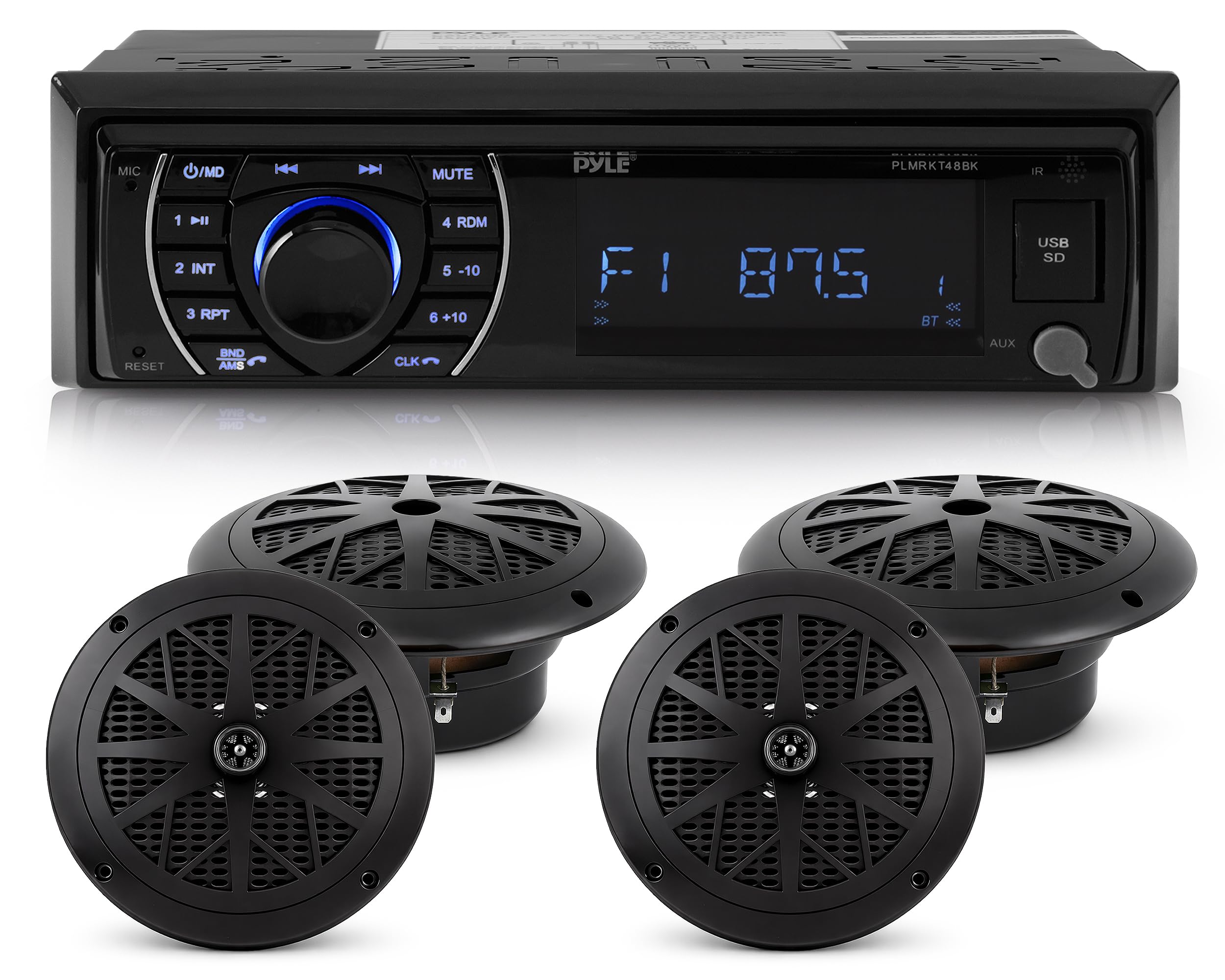
2. Pyle Marine PLMRKT48BK Head Unit & Speaker Kit
A complete audio system that takes the guesswork out of a boat build.
This kit includes the single-DIN head unit (the standard 2″ tall stereo size) plus four 6.5″ marine-grade waterproof speakers. The receiver pushes a 300W peak power, has a 30-station AM/FM memory, USB and SD card readers up to 32GB, plus an aux input. You get Bluetooth for streaming and a built-in microphone for hands-free calls.
The speakers are 2-way cones with a 4-ohm impedance (the electrical resistance that matches most head units), a 20 oz. circuit magnet, and a 1.0″ aluminum voice coil, covering a 45Hz–16kHz frequency response. On a pontoon, owners mention it’s “Loud enough on the pontoon to hear over 115 hp outboard” — so it genuinely cuts through engine noise. Installation is simple, often completed in about an hour.
The trade-offs show up in the details: the remote has short range, working best within about 5-6 feet, and a few owners found the auxiliary jack plugs can fall out. One owner had the unit fail after only a few uses. For the money, it’s a solid, complete marine package, but don’t expect premium-grade remote reliability.
Best for boaters: This is the complete, weather-resistant package for pontoons and small boats where playing loud over engine noise matters most.
The honest catch: The remote and auxiliary inputs are the weak points — plan to control it from the unit or your phone.
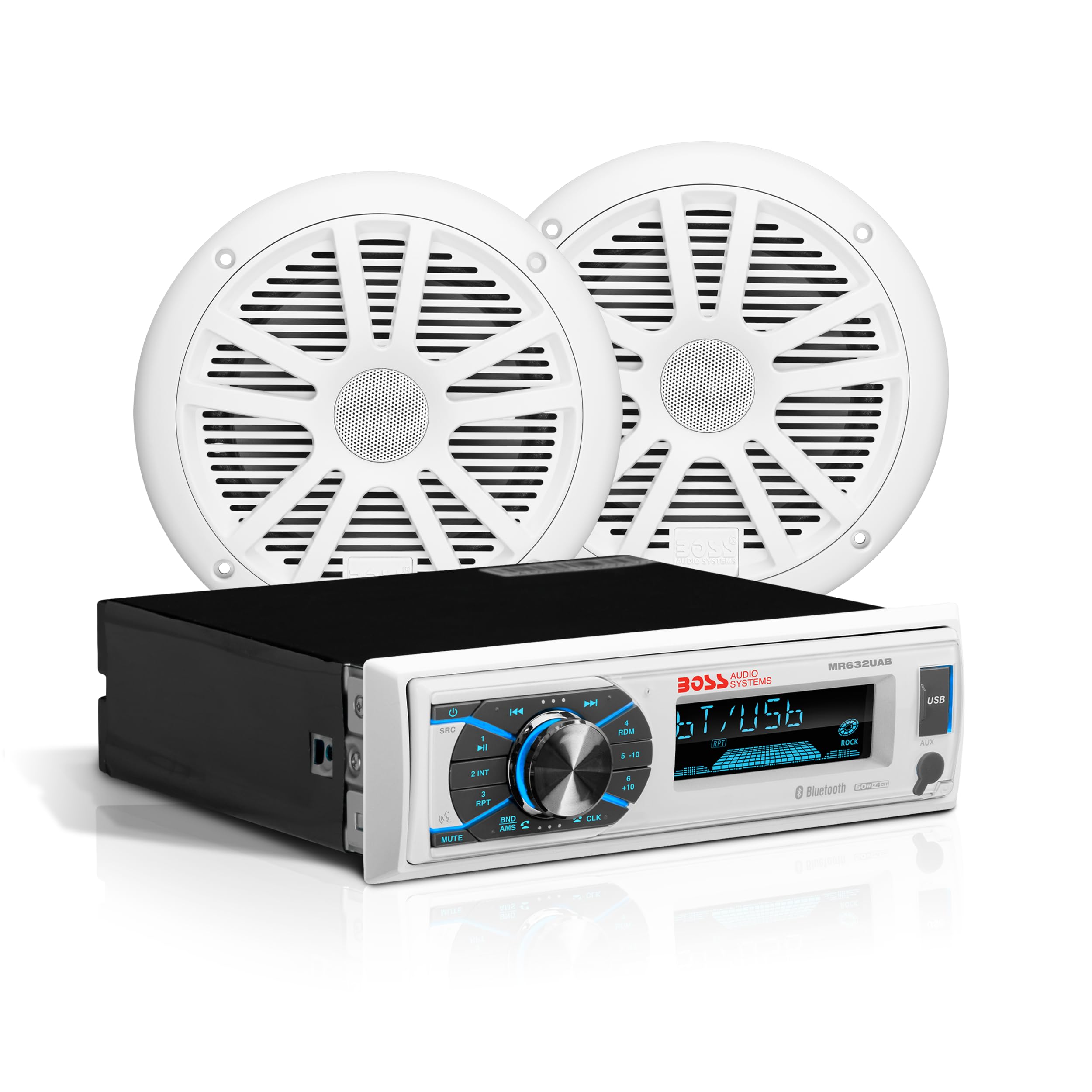
3. BOSS Audio MCK632WB.6 Marine Stereo & Speakers
A splash-proof system with a rainbow of color options for weekend toys.
This single-DIN receiver pairs with two dual-cone 6.5″ marine speakers rated at 90 watts each. The head unit is a 50W x 4 (50 watts per channel across four channels) with front and rear pre-amp outputs, so you can add an external amplifier later. It also includes a detachable front panel for security.
The multicolor illumination lets you cycle through the rainbow to match your ride, which is a real crowd-pleaser on golf carts and small boats. Bluetooth pairs reliably for most owners, and the included 36″ male-to-male 3.5mm aux cable gives you a wired fallback. BOSS backs it with a 3-year platinum online dealer warranty when bought through Amazon.
It’s light on bass, and a few owners found the Bluetooth range shorter than they’d like. One unit arrived that wouldn’t power on at all, so there’s some quality lottery. But for a golf cart, ATV, or small boat where space is tight, this is a neat, self-contained upgrade that sounds surprisingly big.
Great for small vehicles: Golf cart and boat owners adore the compact build, easy install, and colorful faceplate.
Not for bass heads: Expect clean but not thunderous sound; this is about clarity, not deep low-end.
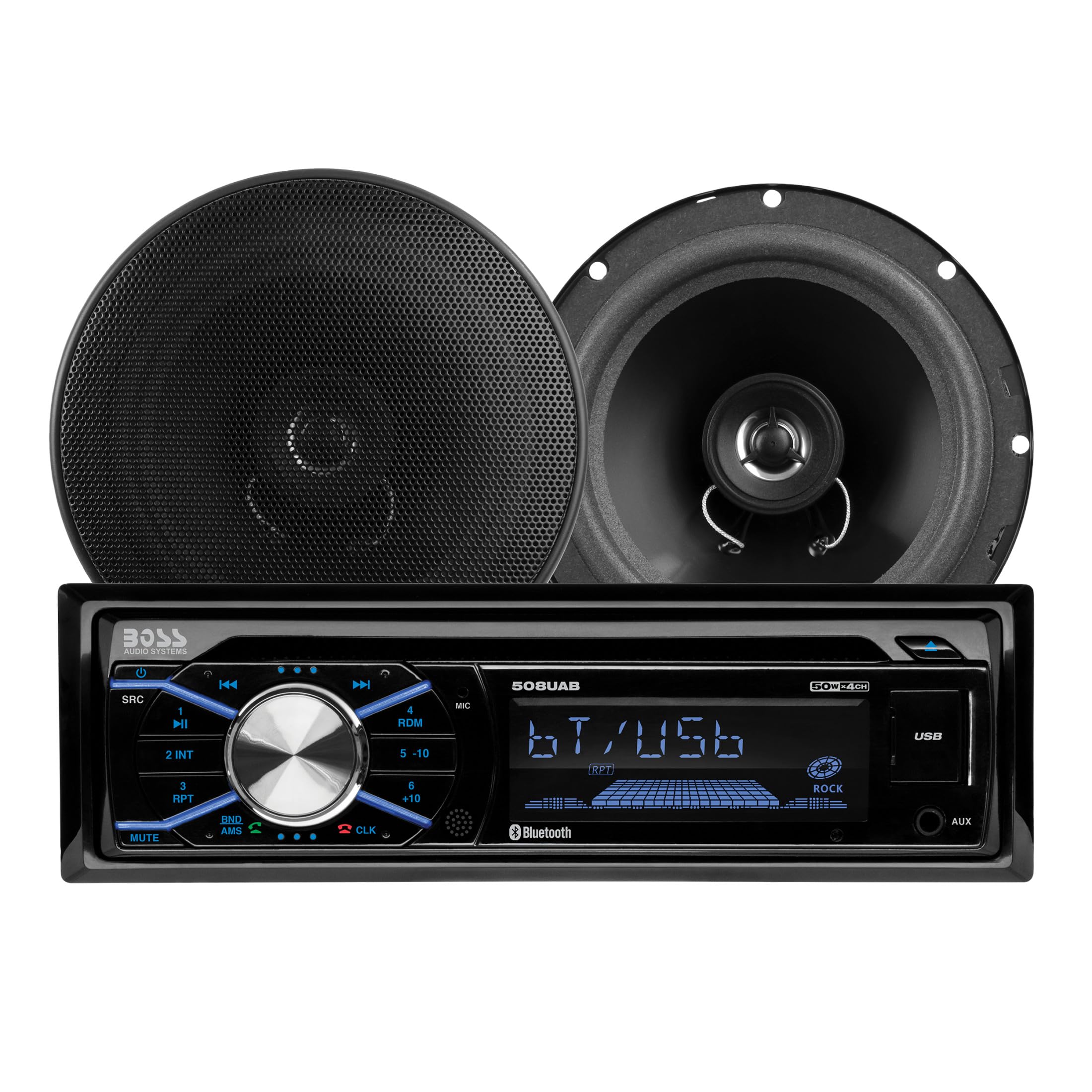
4. BOSS Audio 656BCK Bluetooth Stereo & Speakers
A full-featured budget system that proves you don’t need to spend big for Bluetooth.
This bundle gives you a CD receiver with Bluetooth and two 6.5″ speakers. The receiver is a 50W x 4 unit with a built-in microphone for hands-free calls, and it’s weatherproofed against splashing water. It plays CDs, USB drives, AM/FM radio, and streams from apps like Spotify and Pandora via Bluetooth.
The speakers are 4-ohm units covering 80Hz–18kHz, with a mounting depth of 2.18″ that fits many factory locations. Owners call the sound “clean” with “actually has some base,” which is a win at this level. The panel is backlit for easy use at night, and a wireless remote is included. BOSS covers it with a 3-year parts and labor warranty.
Reliability is the mixed bag here — the unit is great when it works, but a few customers note failures, with one lasting only 30 days. The speakers are decent but not exceptional, and some buyers had to drill to align the mounting holes. If you want a cheap way to add Bluetooth and a screen to an older car, this delivers.
Everything Included
- Bluetooth, CD, USB, and AM/FM all in one box
- Weatherproofing shrugs off splashes
- 50W x 4 output with front/rear pre-amp outs
Keep Expectations Real
- Some units fail early — reliability is a gamble
- Speakers sound good but not premium
- Mounting holes may need drilling on some cars
Perfect if: you want a low-cost, all-in-one Bluetooth and CD upgrade for a daily driver.
Think twice if: long-term durability is your top priority — the quality lottery is real at this price tier.
5. KICKER CS Series 4-Speaker Package

The direct bolt-in answer to flat, weak factory sound in pickups and Jeeps.
This package covers an entire vehicle: two 6.5″ CS Series 2-way coaxial speakers and two 4″x6″ CS Series 2-way speakers. Coaxial means the tweeter is mounted on top of the woofer in one unit, so you get a full range of sound from each speaker hole without extra mounting work. They’re a popular drop-in replacement for factory units.
Owners swapping out blown stock speakers describe the change as dramatic — “much improved over factory ones” is the recurring theme. They’re praised for fitting perfectly in vehicles like the 2001 Chevy Silverado single cab, and installation is straightforward for anyone comfortable with basic wiring. The sound gets loud and stays clean for the price.
The catch is fitment on specific models. A 2000 Jeep Wrangler TJ owner found the front speakers didn’t line up and required custom angling and screw holes to mount. These are budget-to-mid speakers, so if you’re chasing JBL-level detail, you’d need to spend more. For a solid, low-drama refresh of a factory system, they hit the mark.
Best for Wranglers and trucks: A no-fuss, four-speaker refresh that brings factory systems back to life.
Watch the fitment: Check your vehicle’s speaker patterns — some Jeeps need a little persuasion to make these fit.
6. KICKER DS Series 4-Speaker Package

Big 6″x9″ drivers that fill trucks, SUVs, and roadsters with crisp, room-filling sound.
This bundle steps up the size: a pair of 6″x9″ DS Series 3-way coaxials and a pair of 6.5″ DS Series 2-way coaxials. The 6″x9″ format is a favorite for rear decks and truck doors because the larger surface area moves more air, giving you bigger bass and a wider soundstage without a dedicated subwoofer.
Owners consistently highlight “crisp mids and highs” and call them a big upgrade over factory speakers. In a 2014 Silverado 1500, buyers reported the 6.5s screw right in, while the 6x9s needed a little fabrication with an oscillating saw on the stock adapters. Others found plug-and-play convenience with the right connector, like a Metra 72-8104 for a Toyota Highlander.
These are a true mid-range step up at a mid-range price. The trade-off is that you’ll often need to buy mounting adapters separately, and a Dodge Ram owner found the rear 6x9s didn’t line up with the factory screw pattern. If you’re comfortable with a little DIY, the clarity payoff is worth it.
Bigger Sound
- 6″x9″ drivers deliver stronger bass and volume
- 3-way design separates mids and highs clearly
- Clear, crisp sound that flatters most music
Plan the Install
- No mounting hardware included — buy adapters separately
- Screw patterns don’t match every factory location
- Some vehicles need light cutting to fit
Choose this for: trucks, SUVs, and rear-deck installs where you want maximum cone area and clean highs.
skip it if: you want a pure bolt-in install with zero modification to your vehicle.
7. Alpine UTE-73BT Bundle with 4 SXE-1726S Speakers

A name-brand mechless receiver paired with four Alpine coaxials for a clean, cohesive build.
This bundle combines the Alpine UTE-73BT digital media receiver (no CD slot — hence “mechless”) with two pairs of Alpine SXE-1726S 6.5″ 2-way coaxial speakers, giving you a matched system from one trusted brand. The receiver is made for iPod and iPhone, works with Android AOA 2.0, and plays FLAC, MP3, and WMA files from USB — FLAC being a lossless format that preserves full audio detail.
The receiver includes a built-in AM/FM tuner with RBDS (Radio Broadcast Data System) info, so you see station and song data, plus controls like bass, LPF (low-pass filter), and HPF (high-pass filter) to shape the sound. Owners say the speakers “sound better than I expected” and praise the customizable color options on the unit’s display.
The honest take from owners: “This wont win any competitions but it’s solid” — it’s about clean, reliable, everyday sound quality rather than earth-shaking volume. There’s no CD player, which is a dealbreaker for anyone with a physical disc collection. If you want a trusted brand with modern connectivity and a full set of quality speakers, this is a tidy package.
Best for Spotify/streaming users: A modern, no-CD receiver with FLAC support and match-built Alpine speakers.
Not for disc collectors: With no CD slot, your old CDs won’t play — it’s all digital and streaming here.
8. AudioControl PNW Series Component Speakers

Separate woofers and tweeters that open up detail you simply cannot get from a coaxial.
These are component speakers: the 6.5″ woofer and the 1″ tweeter are separate units, so you can place the tweeter higher in the door or dash for better imaging. The woofer has a rigid poly-mica coated cone and a linear double-roll rubber surround (the flexible ring around the cone) for precise, controlled movement. They handle 100W RMS recommended power with up to 125W max.
The included 1″ rear-dampened hybrid silk dome tweeters deliver extended frequency response — soft, warm highs without the harshness cheaper metal tweeters can produce. Second-order Linkwitz-Riley crossovers (the circuits that split the audio signal between woofer and tweeter) tune the output and protect against damage. Owners describe the sound as “warm, present” and call them a “massive improvement over stock.”
The price is the barrier — this is a genuine step up from the mid-range packs. One owner swapped them into a Kia Sorento dashboard and connected them to an aftermarket amp for best results. They fit many modern factory locations, but the included mounting hardware assumes you’re comfortable with a more detailed install than simple coaxials.
Detail You’ll Hear
- Separate silk tweeters deliver smooth, warm highs
- 100W RMS handling for powerful, clean output
- Fits many modern factory locations easily
Premium Commitment
- Costs significantly more than full-range options
- Component install is more involved than coaxial
- Best results come from pairing with a good amp
Reach for these if: you’re building a serious sound system and want crisp, accurate imaging over sheer volume.
Look elsewhere if: you want a simple, low-cost speaker swap with no amplifier or tuning involved.
9. Kenwood XR-1701P Component Speaker System

Kenwood Reference-series engineering for listeners who demand true high-fidelity detail.
This is the top-tier component system on this list. It pairs a 6.5″ glass fiber woofer (a lightweight, rigid cone material) with a rubber surround, and a 1.18″ titanium hard dome tweeter with a neodymium magnet — a compact but powerful magnet design. It handles up to 100W RMS and 300W peak power, so it’s ready for a serious amplifier.
The sound signature is bright and detailed. Owners running them in a 350Z Roadster with a Kenwood Excelon Reference amp describe the clarity as just that: “no distortion, no noise, no hiss, just crisp, clear sound.” External crossovers and mounting gear are included, so you have everything needed for a proper install.
The honest advice from owners is to pair these with a high-quality amplifier and a subwoofer, “otherwise the treble can get a little overwhelming.” The titanium tweeter is brilliant but can be forward-sounding without proper tuning. This is the pick for someone building a reference-grade system with matched components.
Reference Detail
- Glass fiber woofer with rubber surround for deep, clean bass
- Titanium tweeter delivers exceptional high-frequency clarity
- External crossovers and mounting gear included
Built to Be Driven
- Best with a quality external amp and subwoofer
- Treble can become overwhelming without tuning
- Premium price for premium gear
For the serious listener: This is a reference-grade component set that rewards a well-matched amplifier and tuning.
Skip if: you’re running on factory head-unit power — these need quality amplification to shine.
Understanding the Specs
RMS vs. Max Power
RMS is the continuous power a speaker can handle safely; max (or peak) power is a brief burst number that’s mostly marketing. Always match your amplifier’s RMS output to your speaker’s RMS rating. A 250W RMS speaker needs an amp that delivers close to that, not a head unit pushing 50W x 4.
Impedance in Ohms
Impedance is the electrical load a speaker presents to the amplifier, measured in ohms. Most car speakers are 4-ohm, which matches standard head units and amps. Lower impedance (like 2-ohm) draws more power but requires an amp that can handle it — mismatching can cause overheating or damage.
FAQ
What does RMS power mean for my car speakers?
Can I use marine speakers in my car?
What is the difference between coaxial and component speakers?
Will a 6.5-inch speaker fit in my car?
Do I need an amplifier for new car speakers?
What does sensitivity (dB) mean on a speaker?
What is a mechless digital media receiver?
How do I prevent blowing my car speakers?
Is a head unit and speaker bundle worth buying?
What is a voice coil and why does it matter?
Final Thoughts: The Verdict
For most buyers, the winner is the car stereo and speakers champion, the ORION Cobalt CM654, because no other pick matches its blend of massive 250W RMS power handling and crowd-pleasing loudness per dollar. If you want a complete marine setup, grab the Pyle marine kit. And for the purest detail, the AudioControl PNW Series is the one to reach for.
How We Picked
We do not accept paid placement. Every pick is matched to a real buyer and a real use-case; we do not hands-on test units.
Sources & Methodology
Specifications: manufacturer listings and product documentation. Review insights: verified customer reviews, as of August 2026. Pricing: not shown on this page (it changes often); check the current price via the retailer link.
As an Amazon Associate, FitlyFast earns from qualifying purchases. This does not affect which products we feature.