
Our readers keep the lights on and the weekend projects moving. As an Amazon Associate, I earn from qualifying purchases.
Specs are compiled from manufacturer listings and verified buyer reviews and can change over time — please confirm the key details on the product page before buying.
A craft fair is a cash-and-carry crowd, but more and more shoppers expect to tap a card or phone before they walk away with your handmade goods. A portable card reader lets you accept card payments at your booth without a landline, power outlet, or laptop. This guide compares top wireless readers that pair with your smartphone or tablet for craft fair sales.
I’m Rikta — the founder and writer behind FitlyFast. This guide is built by comparing the manufacturers’ published specifications and the patterns across verified customer reviews, so you get each pick’s real strengths and trade-offs instead of marketing spin.
For craft fair sales, you need a card reader that won’t fail mid-transaction. This breakdown of the best card reader for craft fairs shows which portable, battery-powered models actually hold up at an outdoor event or indoor market.
Our Picks at a Glance


How To Choose The Best Card Reader For Craft Fairs
Choosing a craft fair card reader hinges on power source, connectivity, and payout method. A Bluetooth reader can drop mid-sale, but a standalone terminal with its own battery and cellular data keeps working independently.
Standalone vs. Phone-Dependent
A standalone terminal like the Square Terminal runs on its own built-in battery and connects to Wi-Fi, so you are not at the mercy of a finicky Bluetooth link to your phone. A phone-dependent reader is smaller and cheaper, but it needs your smartphone to stay paired and nearby, which can be a weak point in a crowded expo hall full of competing signals.
Battery and Connectivity for the Fair Floor
Look for a reader with all-day battery life, since you won’t have an outlet at your booth. Also consider offline payment processing, which settles later if fair Wi-Fi fails during peak hours.
Fees and Merchant Accounts
Before buying, check if the reader locks you into a specific processor or requires a merchant account. Some readers work with any processor, while others force you to sign up with their own service, and the processing fees can eat into your craft fair profits if you are not careful.
Quick Comparison
| Model | Best For | Connectivity | Battery | Receipts | Amazon |
|---|---|---|---|---|---|
| Square Terminal★ Best Overall | All-day booth with printing | Wi-Fi, Ethernet, USB | Built-in, all-day | Prints on device | Amazon |
| SumUp SoloBest Value | Budget-friendly standalone | Wi-Fi + Free SIM data | Charging station | OLED screen, digital | Amazon |
| Deftun MSR-X6BT | Magnetic stripe encoding | Bluetooth + USB | USB powered | None | Amazon |
| Square Handheld | Pocketable on-the-go sales | Wi-Fi + Offline mode | Long-lasting | E-receipts only | Amazon |
| Clover Go (Newest) | Tipping and tax settings | Bluetooth to phone | Compact | Email/text receipts | Amazon |
| Clover Go Contactless | Tap-to-pay phone payments | Bluetooth | Limited | Digital | Amazon |
| X6BT VIP Reader | Multi-OS card writing | Bluetooth + USB | USB powered | None | Amazon |
In‑Depth Reviews
1. Square Terminal
Our pick — 4.5★ from 4,000+ verified ratings; the strongest balance of quality and price.
The all-in-one booth companion that prints, charges, and sells without ever touching your phone.
The Square Terminal rings up sales, takes payments, and prints receipts from a single 14.7-ounce device, which means you can leave your phone free for photos and messaging. It accepts all major credit and debit cards at one flat rate with no hidden fees and no long-term contracts, so there is no surprise bill after your weekend market.
For a craft fair, the speed matters: chip cards process in just two seconds, which keeps your line moving during a busy morning rush. You get your money as soon as the next business day, and the built-in battery is designed to last all day, so you are not hunting for an outlet behind your booth.
The ease of use is the thing everyone raves about — the crowd favorite here holds a 4.5-star average across 4,300+ owners. Buyers report it works perfectly for selling crafts and charity fundraising alike, with the same interface as the app and a sturdy build. The main trade-off is durability, with a few owners finding the device gives out around the 30-day mark, so treat it as a tool that needs care, not a brick.
Why it wins the booth
- Prints receipts on the spot, no phone needed
- Two-second chip processing keeps lines moving
- Next-business-day payout for your cash flow
Fair-floor cautions
- Heavier than other picks at 14.7 ounces
- Some owners mention reliability issues past 30 days
- Wi-Fi dependent, so a dead fair signal stalls sales
Best for: makers who want a full countertop experience on a folding table, with printed receipts and no phone dependency.
Think twice if: your craft fair site has notoriously weak Wi-Fi, since this terminal leans on the internet to stay online.
2. SumUp Solo
A standalone reader with its own SIM card, so it keeps selling even when fair Wi-Fi wilts.
The SumUp Solo is a true standalone terminal with a full touch-screen interface, and it ships with a free SIM card and mobile data so you can process payments anywhere your booth travels. That is a genuine edge at an outdoor craft fair where public Wi-Fi is unreliable or missing entirely.
You get a charging station with the unit, so the battery can top up between shows, and the OLED display keeps the interface simple for customers to tap through. Reviewers describe it as compact, portable, and offering excellent battery life, with quick transactions and a responsive touchscreen.
The experience is genuinely mixed, though. Some owners love it, while others hit frequent processing failures with “cannot process” errors and waits of two to five minutes. A few also note that invoicing and payment links only work on the desktop, not through the app or device, which limits how you run a craft fair sale remotely. Expect a 3.4-star average across 128 ratings here, so this is a value pick for the SIM-card convenience, not a reliability guarantee.
Standalone freedom: the free SIM and mobile data mean you are not dependent on fair Wi-Fi, a rare feature at this price tier.
Honest fit: ideal for a vendor who wants a dedicated device and is willing to work through occasional processing hiccups.
Pick this if: you want a low-cost standalone reader with its own data connection for outdoor events with sketchy Wi-Fi.
Look elsewhere if: you need rock-solid reliability and invoicing on mobile, since customers note mixed processing results.
3. Deftun MSR-X6BT

A compact magnetic stripe encoder that travels in a pocket and plugs in anywhere.
The Deftun MSR-X6BT is a mini portable card reader and encoder that reads and writes magnetic stripes, connecting to your smartphone, tablet, or computer over Bluetooth or USB. At 5.5 by 1.6 by 1.6 inches, it slips into an apron pocket beside your craft fair change bag, and the 480 megabits per second data transfer rate keeps swipes snappy.
This is not a payment terminal for taking customer card sales at a fair. It is a specialized reader-writer for encoding cards like hotel keys or loyalty cards, which is why repeat buyers keep coming back — one owner has purchased more than five over the years and simply buys a new one when heavy use wears one out.
With a 4.4-star average across 499 ratings, this is the highest-rated non-Square pick here, and buyers call it high quality and true to the description. The honest caution is the app: some owners find the software glitchy, with one reporting it would not get past the home page, so test the app before you depend on it at a busy booth.
Pro-grade encoding: handles all three magnetic tracks and supports ISO 7811-6 standards, making it a true tool, not a toy.
Reality check: this is for card writing, not payment processing, so pair it with a separate POS system for taking fair sales.
Reach for this if: your craft business also issues membership or gift cards that need encoding on the spot.
Skip it for: taking customer payments, since it has no chip or tap capability for fair sales.
4. Square Handheld

The featherweight that takes a sale and a barcode scan in the same hand.
The Square Handheld lets you scan a QR code on your earrings, take the card payment, and hand it back to the customer — all without putting your craft down. It’s a slim, pocketable POS (point-of-sale terminal) at just 2.11 ounces with a built-in barcode scanner. Its battery lasts through a full fair day, and its offline payment mode keeps you selling even if the fair’s internet drops mid-afternoon.
Buyers love how it stores inventory and accepts tap, insert, and swipe payments, with one greenhouse owner calling it a standout for moving to a farmers market. The functionality gets the most praise by far, and owners note it processes an offline sale as soon as Wi-Fi returns. This is the newest model, earning a 4.7-star average from 193 ratings, the highest score in this list.
The catch is fragility: one owner cracked the screen in week one, so a protective case is worth the extra spend. It also sends e-receipts only, with no built-in printer, which is fine if your customers are happy with a text or email receipt after their purchase.
Built for the go
- 2.11 ounces, truly pocketable in an apron
- Offline payments settle when Wi-Fi returns
- Built-in barcode scanner doubles as inventory tool
Handle with care
- Screen prone to cracks without a case
- No paper receipts, e-receipts only
- Wi-Fi connectivity can drop at some venues
Your pick if: you sell at pop-ups and farmers markets where pocketability and offline mode beat a bulky terminal.
Pass if: you need printed receipts for customers who prefer paper, since this model is digital-only.
5. Clover Go (Newest Model)

A pocket-sized reader that pairs with your phone and lets you set tips and tax rates per craft.
The Clover Go is the newest model of Clover’s mobile POS, pairing with any smartphone over Bluetooth so you can take card payments right from your phone at the fair table. At 5.6 ounces, it is light enough to keep in a jacket pocket and hand to a customer to complete their own payment.
what separates it for craft fairs is the flexibility: you can set custom percentage amounts for tips, create multiple tax rates for the different things you sell, and email or text paperless receipts. You can also manage multiple employee permissions, which helps if you have a helper running the booth while you restock.
The honest warning is the fine print. This unit requires processing through Powering POS, and only US-based businesses qualify. Several reviewers point out being charged excessive processing fees and being locked into a merchant account, with one calling the setup a scam, so read the merchant agreement before you commit. It is a 3.6-star device across 21 ratings, and it works best if you already have a Clover account.
Custom sales controls: per-item tax rates and custom tip percentages are genuinely useful at a fair with varied price points.
Do your homework: the mandatory processor and reported fees make this a pick for Clover loyalists, not first-timers.
Choose this if: you already run a Clover ecosystem and want a compact reader with tip and tax flexibility.
Avoid if: you want freedom to pick your own payment processor, since this locks you into Powering POS.
6. Clover Go Contactless Reader
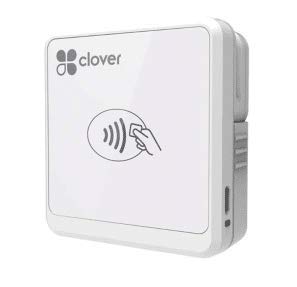
An EMV-ready reader that loves tap-to-pay phone customers, at just 4.8 ounces.
The Clover Go Contactless Reader works with iOS and Android devices over Bluetooth, and it is specifically built for customers who tap to pay with their phones. At 4.8 ounces, it is light enough for a booth apron, and it handles chip cards as well as contactless payments.
A museum seller praises it for offsite vending, saying they can easily scan barcodes, enter cash, credit, or check, and it goes right to the Clover system. The ease of use is what wins people over, with owners finding it super easy to connect over Bluetooth and start taking payments.
The catch is reliability over time. Some shoppers say it works flawlessly, while others say the Bluetooth stops connecting after about six months, and a few find the device simply will not turn on. There is also a warning in the listing that quantities are limited and end of life, so orders may be fulfilled with the current version of Clover Go. With a 4.0-star average across 130 ratings, it is a solid tap-to-pay option if you already use Clover, but treat the Bluetooth longevity as a fit note.
Tap-and-go ready: built for the growing number of customers who pay with their phone or watch at a fair.
Watch the clock: reported Bluetooth dropouts after months of use make this a short-term tool for some owners.
Best if: your craft customers are heavy tap-to-pay users and you want a lightweight reader to pair with a Clover account.
Not for: vendors who need a device to last for years, since some owners see Bluetooth fail around the six-month mark.
7. Bluetooth X6BT VIP Card Reader

A versatile card reader-writer that speaks to nearly every operating system you own.
The X6BT is a Bluetooth-enabled and USB-powered card reader writer that works with iOS, Android, Windows, MacOS, and even Linux, with free software included for older Windows versions. It reads and writes all three magnetic tracks with full support for ISO 7811-6 standards, making it a flexible tool for encoding cards in a craft business that sells gift cards.
Owners are impressed with the installation, with one saying they purchased three and will get another within the month. It is genuinely useful when you need to write an extra card on the spot, whether it is a loyalty card or a custom gift card for a fair customer.
The weak point is Bluetooth reliability. Some buyers report the device disconnects the moment they try to swipe, working only when plugged in via USB — as buyers put it, “My computer will say it’s Bluetooth connected but as soon as I try and swipe anything the card reader writer shuts off and disconnects.” With a 3.8-star average over 18 ratings, this is a budget pick best used with a USB cable for dependable performance.
Cross-platform freedom: rare support for Linux and old Windows systems makes it a versatile workshop tool.
Wired is wiser: the Bluetooth pairing can drop mid-swipe, so plan to use it USB-connected for critical jobs.
Grab it if: you need a low-cost multi-OS card encoder for gift cards and will use it plugged into a laptop at your booth.
Leave it if: you need true wireless freedom, since the Bluetooth connection is not dependable for all owners.
Understanding the Specs
Battery Life and Charging
For a craft fair, battery life is everything. A reader with a built-in battery designed to last all day means you are not hunting for an outlet behind your booth. Some picks, like the SumUp Solo, come with a charging station so you can top up between shows, while others like the Square Handheld claim a battery that powers through your shift.
Connectivity: Bluetooth vs. Wi-Fi vs. SIM
Bluetooth readers pair to your phone, which is great for portability but can drop in a crowded expo hall. Wi-Fi terminals like the Square Terminal need a reliable fair internet signal. The SumUp Solo stands out with a free SIM card and mobile data, so it can process payments anywhere, even where Wi-Fi is weak.
Payment Methods: Chip, Tap, and Swipe
Customers at a craft fair carry a mix of cards, phones, and watches. A reader that accepts all major credit and debit cards with chip, tap, and swipe support covers every customer. The Square Terminal processes chip cards in just two seconds, which keeps your line moving, while the Clover Go devices are built for tap-to-pay phone customers.
Receipts: Printed vs. Digital
Decide how you want to hand out receipts. The Square Terminal prints on the spot, which some customers appreciate at a fair. The Square Handheld and Clover Go models email or text paperless receipts, which is faster but requires customers to have their phones handy. Consider which your fair crowd prefers.
FAQ
Can I use these card readers at an outdoor craft fair with no Wi-Fi?
Do I need a merchant account to use these readers?
How long does the battery last on a full day at a fair?
Can I print a receipt for a customer who wants paper?
Will these readers work with my Android phone or iPhone?
What is the difference between a card reader and a card encoder?
How fast will I get my money from a craft fair sale?
Are tap-to-pay phone customers covered by these readers?
Which reader is best for a first-time craft fair vendor?
Final Thoughts: The Verdict
For most craft fair vendors, the card reader for craft fairs winner is the Square Terminal because it combines all-day battery, printed receipts, and two-second chip processing in one dependable device. If you want a pocketable option that handles offline sales, grab the Square Handheld. And for a budget-friendly standalone unit with its own SIM data, the SumUp Solo is the one to reach for.
How We Picked
We do not accept paid placement. Every pick is matched to a real buyer and a real use-case; we do not hands-on test units.
Sources & Methodology
Specifications: manufacturer listings and product documentation. Review insights: verified customer reviews, as of August 2026. Pricing: not shown on this page (it changes often); check the current price via the retailer link.
As an Amazon Associate, FitlyFast earns from qualifying purchases. This does not affect which products we feature.