
Our readers keep the lights on and the weekend projects moving. As an Amazon Associate, I earn from qualifying purchases.
Specs are compiled from manufacturer listings and verified buyer reviews and can change over time — please confirm the key details on the product page before buying.
Turning a cold, bare concrete basement into a warm, usable room usually starts with one big question: what do you put on the floor? Carpet tiles are the practical answer because they go down fast without professional help, and if one gets stained or damaged, you swap out just that square instead of redoing the whole room. That modular design matters extra in a basement, where moisture and heavy foot traffic from workshops, playrooms, and pet areas are part of daily life.
I’m Rikta — the founder and writer behind FitlyFast. This guide is built by comparing the manufacturers’ published specifications and the patterns across verified customer reviews, so you get each pick’s real strengths and trade-offs instead of marketing spin.
You can cover a small laundry room or the entire lower level with these carpet tiles for basement floors, and they balance grip, comfort, and easy cleanup so your space feels finished. carpet tiles for basement floors are the smart pick when you want warmth you can install in an afternoon and replace one square at a time.
Our Picks at a Glance


How To Choose The Best Carpet Tiles For Basement
Basements are not like the rest of the house. The floor is usually bare concrete, the air can feel damp, and the room often doubles as a workshop, gym, playroom, or dog zone. That combination means the tile you pick needs to grip well, shrug off moisture, and survive things getting dropped or dragged across it.
Backing and installation style
Peel and stick tiles have adhesive already on the back, so you remove the film and press them down. Some use an aggressive glue that locks firmly to concrete, while others rely on interlocking tabs or separate adhesive strips. For a basement, look for a backing that bonds to bare concrete without extra tools or special glue.
Thickness and pile height
Pile height is the length of the fiber loops — the taller the pile, the plusher it feels underfoot, but low pile is usually more resistant to crushing from furniture and heavy foot traffic. Tile thickness adds cushioning and a bit of insulation over cold concrete, but thicker is not always better if you need to trim tiles to fit around posts and corners.
Material and moisture resistance
Polypropylene and polyester are the two common fiber materials here, and both resist water well enough for a basement. The real question is what happens when a spill or a flood occurs. Tiles that lift up easily let you dry the floor beneath, while glue-down options may need to be peeled off. Some materials are also fade-resistant, which matters if the basement has windows letting in direct sun.
Quick Comparison
| Model | Best For | Tile Size | Coverage | Installation | Amazon |
|---|---|---|---|---|---|
| 4URFloor Assorted 24″x24″★ Best Overall | High-traffic and pet-proof floors | 24″ x 24″ | 96 sq ft | Peel & Stick | Amazon |
| Emaraxy 12″x12″ Black 30 PackBudget Champion | Budget-friendly small rooms | 12″ x 12″ | 30 sq ft | Peel & Stick | Amazon |
| CvoMep Dark Gray 30 PackDIY Favorite | DIY pattern mixing | 12″ x 12″ | 30 sq ft | Peel & Stick | Amazon |
| Livelynine Black Carpet Roll | Stairs, runners, and narrow areas | 24″ x 158″ roll | 26 sq ft | Peel & Stick | Amazon |
| Smart Squares Iron Frost 18″ | Soft, padded comfort | 18″ x 18″ | 22.5 sq ft | Peel & Stick | Amazon |
| ALTRUISTIC Khaki 24″ | Rooms needing non-slip grip | 24″ x 24″ | 72 sq ft | Interlocking | Amazon |
| Mohawk Home Black Couture 24″ | Outdoor and garage transitions | 24″ x 24″ | 60 sq ft | Peel & Stick | Amazon |
| Mohawk Basics Stone Walk 24″ | Large basement flood-prone areas | 24″ x 24″ | 96 sq ft | Glue Down / FlexLok | Amazon |
In‑Depth Reviews
1. 4URFloor Assorted Carpet Tile 24″x24″
Our pick — over 4.5★ from 600+ verified ratings; the strongest balance of quality and price.
The crowd-pleaser that shrugs off pets, kids, and spilled paint without flinching.
This is the pick that wins people over with commercial-grade toughness at a fraction of what traditional flooring costs. Each order brings 24 tiles at 24″ x 24″ each, covering 96 square feet, and the whole box weighs 32 pounds — you feel the density the moment you lift it. That weight, plus a weatherproof rubber base, is why owners say the tiles stay put even on wood and in enclosed decks where lighter options slide around.
What makes it fun is that every shipment is different — a mix of colors, patterns, and textures that lets you assemble a patchwork floor with real character. As owners put it: “These are wonderful if your wife is in love with her million year old Chihuahua that pisses all over the place and drives you crazy. Just buy these by the caseload like I do and pop a new one in place whenever needed.” For a basement that doubles as a dog zone, that replace-one-square-and-move-on flow is the entire point.
The trade-off is that you do not get to pick your exact color scheme, since assortments vary between boxes and orders. If you want a precise, uniform look, that unpredictability might frustrate you. But if you enjoy the patchwork aesthetic and want a floor that looks intentional and high-end — owners compare it to hotel carpet — this is the strongest all-around value on this list.
What owners rave about
- Quality is the #1 praise point — the dense nylon feels like commercial grade, not throwaway
- Weatherproof rubber base grips wood and concrete firmly
- Install a room in hours with just a utility knife and a chalk line
The honest trade-offs
- Colors and patterns vary with every order — no custom color matching
- Some owners found the adhesive strips grip unevenly, so pressing firmly matters
- Assorted look is not for anyone who wants a single solid color
Reach for this if: you want a durable, pet-proof basement floor that looks custom and costs far less than broadloom.
Look elsewhere if: you need a specific color palette — the assortment is the whole charm here, and you cannot control it.
2. Emaraxy Peel and Stick Carpet Tiles 12″x12″ 30 Pack
A 30-pack of thick, professional-looking black squares that go down in minutes with zero tools.
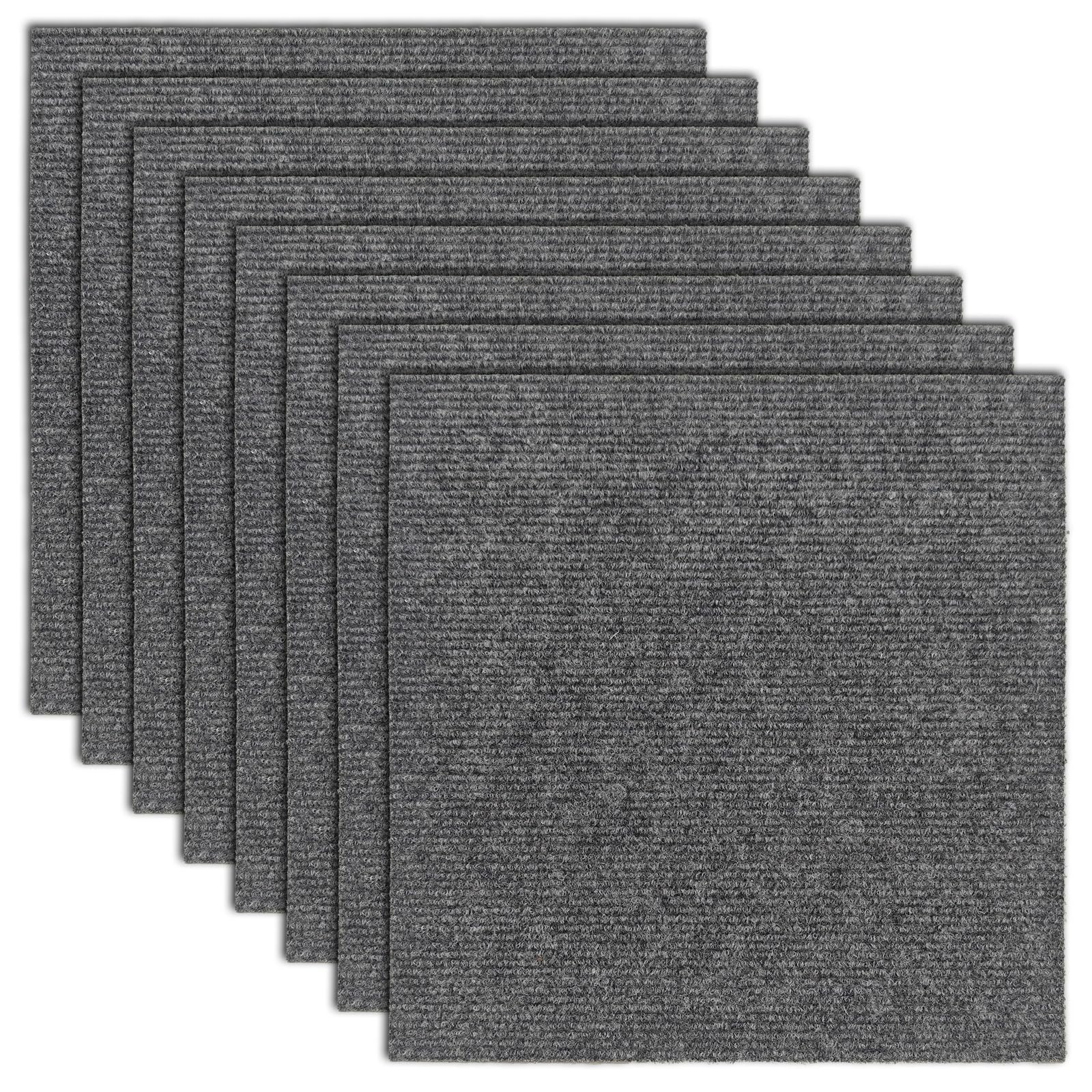
You get a genuinely substantial profile for a self-adhesive tile with the 4.5mm pile height (the thickness of the carpet fibers), and buyers report it feels “thicker and more durable than I expected for a self-adhesive carpet tile.” Each of the 30 pieces measures 12″ x 12″, so the whole box covers 30 square feet, and it weighs just 2.7 pounds, making it easy to carry down to the basement. That low weight also hints at what this is: a light, comfortable layer, not armor plating.
Owners love the clean, professional look of the black finish for home offices, workshops, and storage areas. The adhesive is the thing people mention most after quality — it bonds tightly to concrete, plywood, and linoleum, and it is built to resist curling at the corners under foot traffic. The modular setup means a stained or torn square lifts right out and gets replaced without touching the rest of the floor.
Where this pick sits: it is the budget-friendly entry point, and the reviews reflect that. Some owners who wanted heavy-duty durability found it soft and thin-feeling, and there is a note of caution about the adhesive being aggressive once set. For a guest room, office, or pet kennel floor, this is a bargain that looks far more expensive than it is.
Best for tight budgets: a fast, good-looking floor for a small basement room at a very approachable cost, backed by buyers who found the quality surprisingly solid for the price.
One real caution: if you plan to drag heavy workbenches across it, the softer construction may show wear faster than the commercial-grade options above.
3. CvoMep Peel and Stick Carpet Tiles 12″x12″ 30 Pack
Waterproof polypropylene squares that held up a full year in a busy entryway without curling.
Made from polypropylene at 0.2 inches thick, these tiles are waterproof, moisture-resistant, and non-deformable — exactly the traits a basement floor needs when you cannot control what gets spilled on it. Owners who used them in a high-traffic indoor entryway report no rips, fading, slipping, or curling after a year of daily use. The padded backing also reduces the clicking sound of footsteps, which matters when the basement is underneath living space.
Each box holds 30 tiles at 12″ x 12″, covering 30 square feet of floor. The adhesive is strong, and that is both a strength and a caveat — it is permanent once set, and removing a tile later takes real effort. Buyers who planned to rearrange found the grip too tenacious, while those who wanted a set-and-forget floor loved it.
One honest note: a few owners measured the tiles at 11 3/4″ x 11 3/4″ rather than a full 12″, so if you are replacing a damaged tile in an existing grid, measure first. For a fresh install across a whole basement, that slight variance disappears into the pattern. The dark gray color leans slightly blue in person, which most found visually pleasing.
Why it wins DIY fans: owners say it cuts cleanly with scissors, sticks to most flat surfaces, and looks “just as new” after a year of abuse.
The fit note: the permanent adhesive is hard to remove, so this is a commit-to-it floor, not a renters-friendly temporary one.
4. Livelynine Black Carpet Roll Peel and Stick 2ft x 13ft
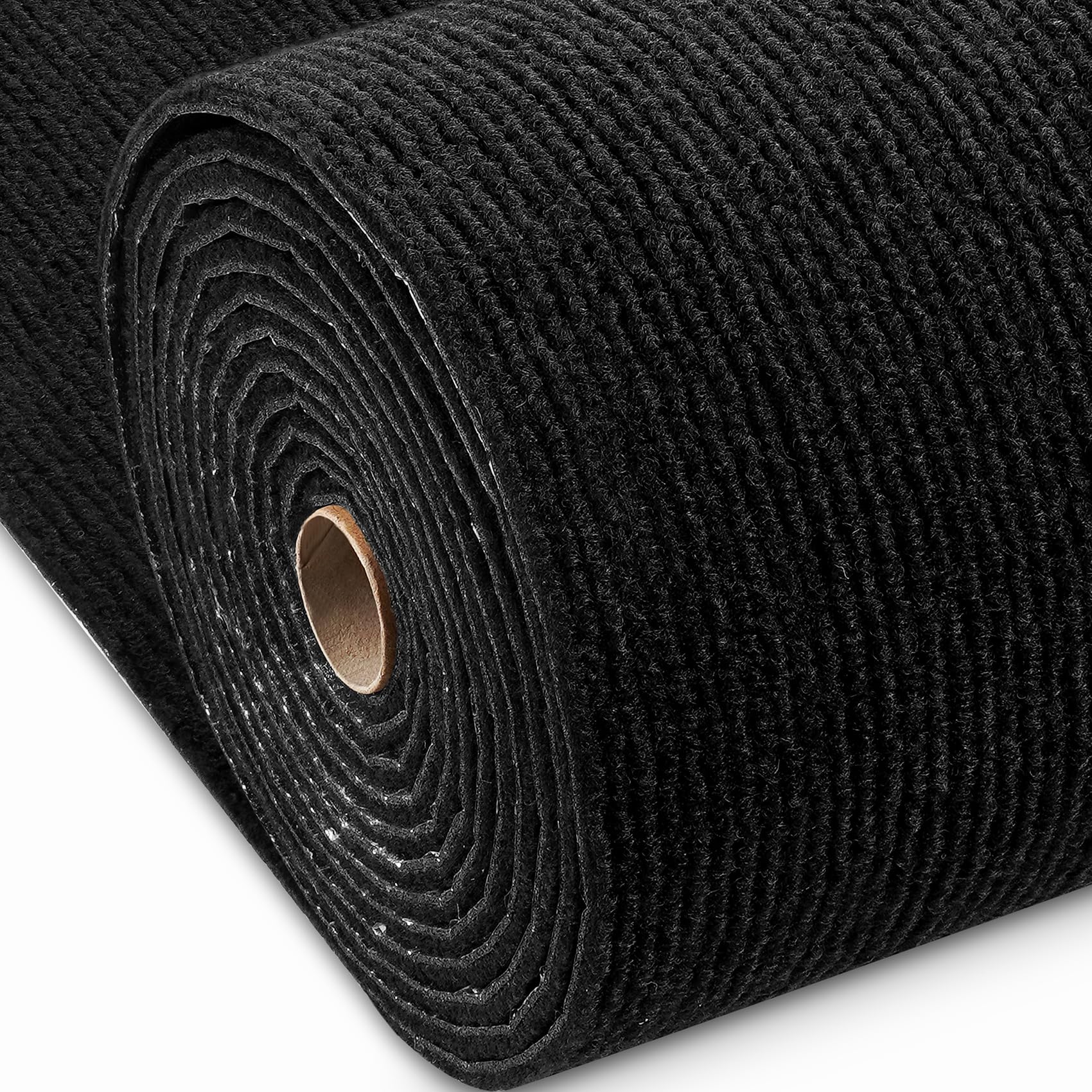
A roll, not squares — cut-to-fit carpet that wraps stair risers, headboards, and hallways alike.
You can skip grid lines entirely with this shape-shifter, because it comes as one continuous roll measuring 24 inches wide by 158 inches long, covering 26 square feet, at a 0.2-inch thickness. Instead of laying individual tiles, you cut the length you need and stick down a single smooth piece — perfect for stair runners, entryway strips, or covering the front of basement stair risers.
Because it is one sheet with no seams, there is nothing to catch a heel or pet claw. The self-adhesive backing is aggressively non-slip — owners describe pulling it off a floor as “an absolutely treacherous experience” requiring heavy-duty glue remover. That tells you the grip is serious, which is exactly what you want on stairs and in front of doorways where slips happen.
The same aggressive glue is the reason to think before installing it somewhere permanent. It bonds so strongly that repositioning is basically impossible, so measure twice and press once. Buyers used it to cover a faux leather headboard, replace a rug under a computer desk, and protect stair risers — all with easy cutting and flat laying against awkward curved surfaces.
What buyers praise most
- Functionality is the top mention — one continuous roll handles stairs, desks, and headboards
- Easy to cut and lays completely flat against curved or vertical surfaces
- Victorious against cat scratch and holds firm underfoot
Where it gets tricky
- The adhesive is brutally strong — removal takes hours and solvent
- 1 roll covers just 26 sq ft, so a full basement needs many rolls
- Low pile means soft, not plush — comfort is decent, not deep
Grab this for: narrow runs, stair risers, and any spot where a smooth custom-length strip beats individual tiles.
Pass on it if: you want to freely rearrange your floor — this roll sticks for good.
5. Smart Squares Easy Street Premium Plush Carpet Tiles 18″x18″
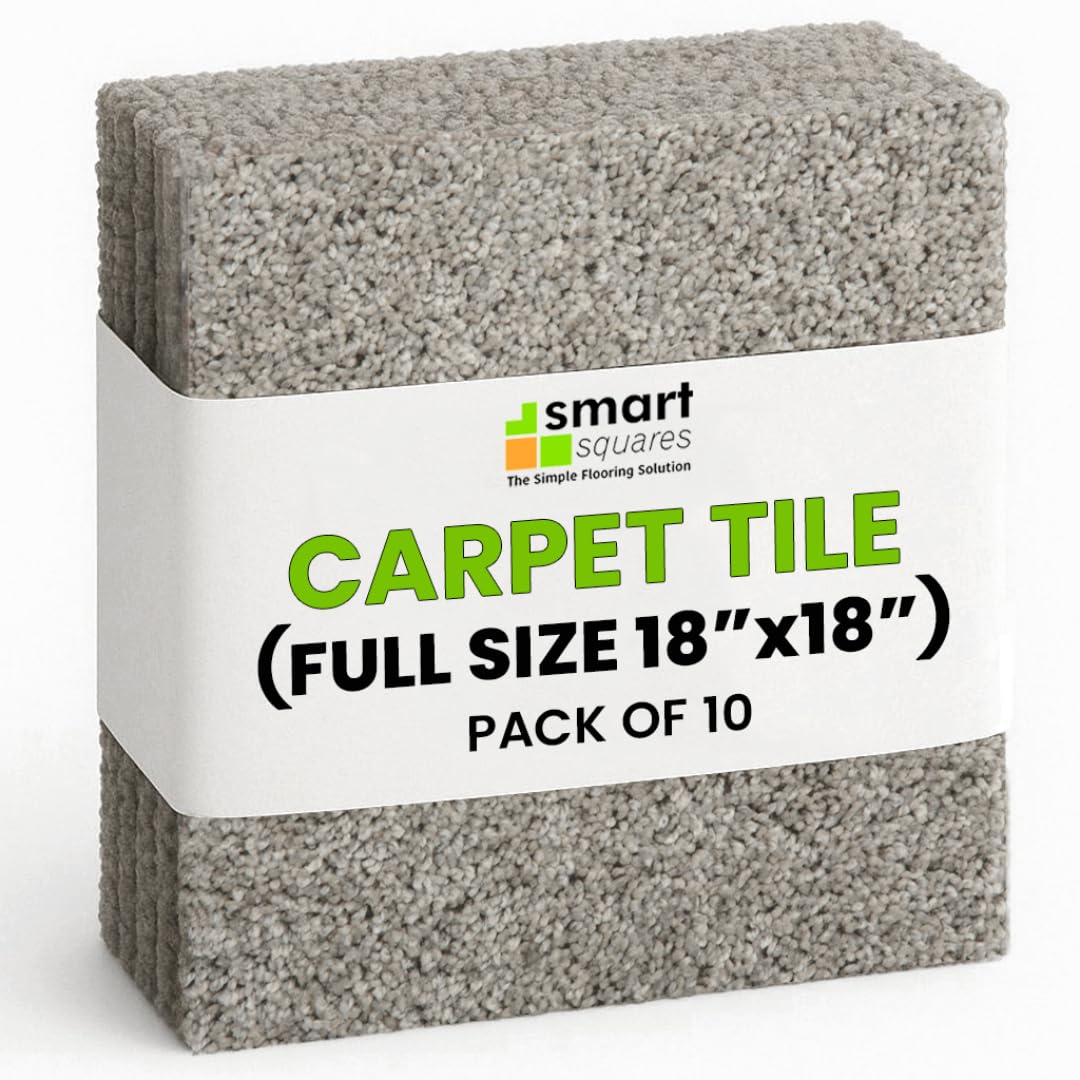
The softest squares here, with memory foam padding built into every single tile.
This is the plush premium option, and the reason it feels different underfoot is the 6-pound high-density polyurethane memory foam padding attached to each 18″ x 18″ tile. That built-in cushion means you do not need a separate pad, and it softens every step while tamping down noise from the room above or below. Each pack holds 10 tiles covering 22.5 square feet, and the Iron Frost color reads as a neutral gray with subtle darker flecks.
Precision cutting keeps the seams tight for a wall-to-wall look, though owners note the squares are “not truly square” and show slight size variance. That variance is a double-edged sword — it helps hide seams in some layouts but makes perfect alignment harder in others. Buyers used these to replace RV carpet and finish a basement, and the recurring verdict is a lovely, soft, finished appearance.
There is a real caveat about the adhesive. A portion of owners reported the peel-and-stick backing does not cover the entire back of every tile or arrives dried out, which is worth checking before a full install. The soft, longer yarn also takes a bit more effort to install neatly. If comfort is your top priority for a basement lounge or play area, this is the pick — just order a sample first.
Why buyers love it
- Memory foam padding built into each tile for real underfoot cushion
- Neutral Iron Frost color with flecks that hide dirt and add depth
- Repeat buyers — some ordered three separate times for different rooms
Check before you commit
- Tiles may not be perfectly square, so seams can show in some layouts
- Adhesive backing is inconsistent — some tiles arrive with dry or partial coverage
- Each pack covers only 22.5 sq ft, so a full basement means many boxes
Choose this when: bare concrete makes your feet ache and you want a soft, quiet basement floor without a separate underlayment.
Think twice if: you need flawless grid alignment or a budget-tier price per square foot.
6. ALTRUISTIC Heavy Duty Carpet Tiles 24″ x 24″ 18 Pieces
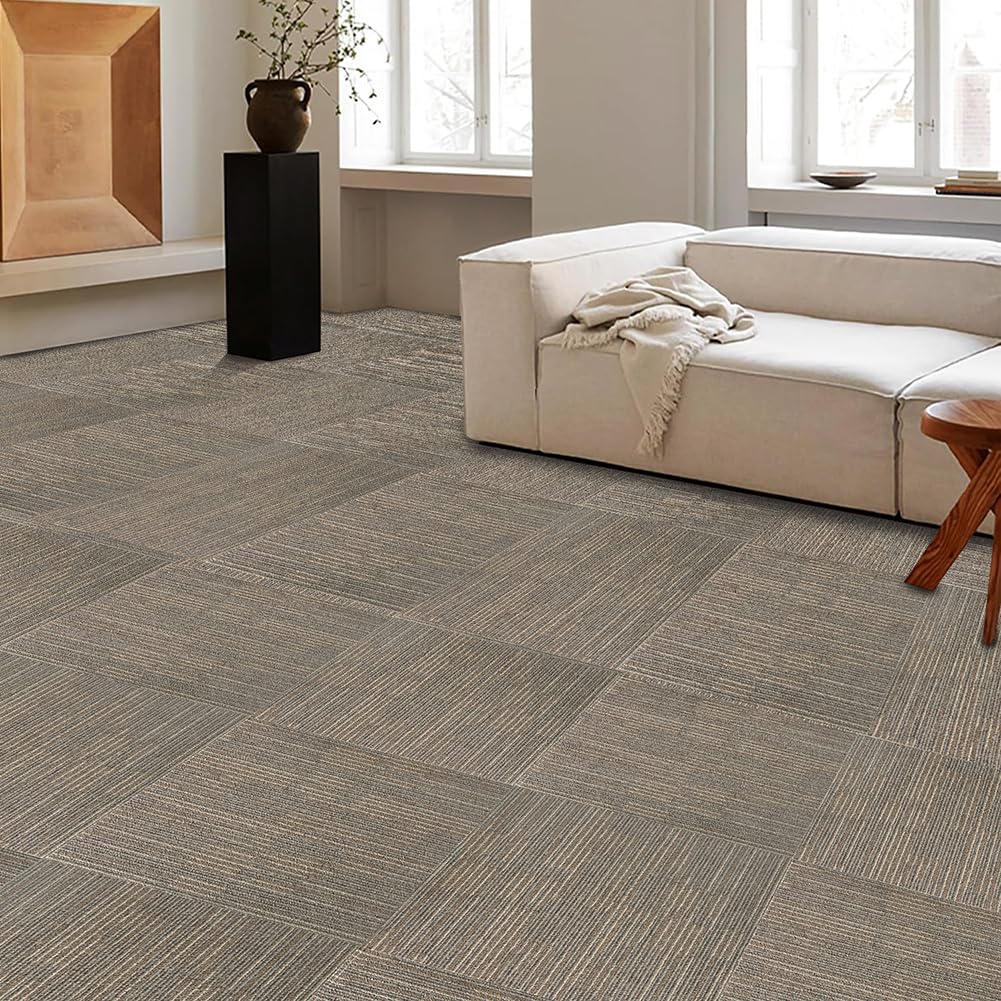
The anti-slip heavyweight that a ten-year-old could install without harming the floor.
You need grip that won’t quit, and each 24″ x 24″ tile uses a non-slip asphalt cloth backing that grips the floor so well the tiles do not slide at all, with owners confirming they “stay in place and don’t lift when vacuumed over.” The 18-piece box covers 72 square feet, and the 0.25-inch pile height gives it a sturdy, commercial feel underfoot. The khaki color reads neutral and warm for a basement living space.
Installation is genuinely kid-friendly — the box includes FlexLok adhesive connectors that fix only the four corners of each tile, so nothing sticks permanently to the floor beneath. That makes it a standout for renters or anyone who may want the tiles up later. Owners mention easy cutting with scissors and describe the quality as “truly durable” and “solid value.” One household’s ten-year-old installed most of the tiles in a loft play area without help.
The honest trade-off is the smell. The asphalt backing carries a lingering odor that did not fully clear for some owners even after a month of ventilation. That is worth weighing if the basement is poorly ventilated or doubles as a bedroom. If you can live with the initial scent, you get a durable, non-slip floor that comes up cleanly when you want it to.
Why it stands out: quality is the #1 thing buyers mention — tough, warp-resistant, and cut-friendly without shedding fibers.
The real caveat: the asphalt backing’s odor can linger for weeks, so ventilate the room after install.
7. Mohawk Home 24″ x 24″ Indoor/Outdoor Carpet Tile Black

A familiar brand name that stretches from the basement to the patio without missing a beat.
Mohawk is among the most recognized names in flooring, and this tile brings that reliability to spaces that blur the indoor-outdoor line. The 24″ x 24″ polyester tiles at 0.25-inch pile height resist soil, stains, and fading, and the all-weather construction means they handle the damp, cool conditions of a basement as easily as a covered patio. Each box holds 15 tiles covering 60 square feet, and the black finish looks sharp and hides dirt well.
Owners used these to finish a partially finished basement on concrete, and the tiles stayed firmly in place while withstanding large-dog traffic. On an enclosed patio, the adhesive gripped surprisingly well. The easy-install story is the #1 thing buyers mention — measure, peel, press, and done — with many noting how easy it is to cut with sharp scissors for custom edges.
The catch is consistency. While many owners found the adhesive excellent, a fair number hit tiles where the backing did not stick well, and there are mixed takes on whether the value justifies the price. The black color also ran lighter in person than the photos for some. For a basement that connects to a garage or outdoor space, this is the flexible all-weather workhorse worth considering.
What stands out
- Easy installation is the top praise point — peel, press, and it stays
- All-weather polyester handles basements, garages, patios, and pool areas
- Larger than many competitor tiles, so fewer seams per room
The mixed notes
- Adhesive performance varies — some tiles stick great, others poorly
- Black color runs lighter than the product photos suggest
- Value opinions split down the middle among buyers
Reach for it if: your basement flows into a garage or patio and you want one tile that works in both climates.
Hold off if: you need a perfectly uniform color from photos or expect flawless adhesive on every single tile.
8. Mohawk Basics 24″ x 24″ Berber Carpet Tile Stone Walk

Berber loop durability with a 10-year warranty — built for basement flood risk and heavy use.
This is the tile for a big basement because one carton covers 96 square feet with 24 tiles at 24″ x 24″ each. The Berber loop pile at just 0.09 inches is thin and dense, which makes it remarkably resistant to crushing and ideal for gyms, playrooms, and workshops. The Stone Walk color is a textured, multi-colored taupe loop that hides dirt cleverly, and the PET fiber construction resists moisture damage from spills and water extraction cleaning.
Owners praise it for flood-prone basements specifically — tiles stay put on bare concrete, align well, and cut easily, though the thin profile means no real cushioning. The density is the star: no smell, low pile, comfortable to walk on, and a single box covered a 10×10 patio. One owner installed a full basement and found the seams so tidy the floor looked wall-to-wall.
The caveats are practical. The design has lines that should match as you lay tiles, but a handful of tiles arrived cut crooked, so the pattern veered off. The color also reads differently in person — shifting between denim, gray, and purple tones depending on the light. Backing is EcoFlex Matrix, and you buy the FlexLok tabs or adhesive separately. For the 10-year limited wear and stain warranty, this is the long-haul pick.
Why it wins for big spaces
- 96 sq ft per box covers an entire room fast with fewer boxes to buy
- 10-year limited warranty on wear, stain resistance, and fading
- Dense Berber loop resists crushing from furniture and foot traffic
What to know before buying
- Design lines may not match on every tile — some arrive cut slightly crooked
- Thin at 0.09 inches, so no cushioning underfoot
- FlexLok tabs and adhesive cost extra beyond the box
Pick this for: a large, flood-prone basement where durability and easy replacement outrank plush comfort.
skip it if: you want a padded, soft surface — this is firm and functional, not cushioned.
Understanding the Specs
Pile Height and Thickness
Pile height is the length of the carpet fiber loop above the backing, and it usually falls between 0.09 and 0.25 inches on basement tiles. A lower pile like 0.09 inches resists crushing from heavy furniture and looks crisper, while a taller pile around 0.25 inches feels plusher under bare feet but can mat down in high-traffic paths. Thickness includes the backing layer, so a tile can be thick without a tall pile — check both numbers.
Backing Type and Adhesion
The backing is what actually touches your concrete, and it controls grip, moisture behavior, and removal. Peel-and-stick tiles have pressure-sensitive adhesive applied at the factory, while interlocking tiles use tabs or strips that fix only the corners and leave the floor untouched. Asphalt cloth backings grip aggressively but can smell, rubber bases bond well to wood and concrete, and some polyester backings arrive with inconsistent adhesive coverage — inspect each tile’s backing before a full install.
FAQ
Will carpet tiles stick to bare concrete in my basement?
How many carpet tiles do I need for a 10×10 basement room?
Can I remove peel and stick carpet tiles later without damaging the floor?
Are carpet tiles safe for basements that flood occasionally?
What is the difference between peel and stick and interlocking carpet tiles?
Do carpet tiles help insulate a cold basement floor?
Can I cut carpet tiles to fit around posts and corners?
Will carpet tiles work over existing hardwood or laminate?
How do I clean carpet tiles in a basement?
Which carpet tile material lasts longest in a basement?
Final Thoughts: The Verdict
For the majority of shoppers, the carpet tiles for basement winner is the 4URFloor Assorted 24″x24″ because it combines commercial-grade nylon durability with a pet-proof, replace-one-square design and a patchwork look owners genuinely love. If you want plush comfort underfoot, the Smart Squares Iron Frost with built-in memory foam is the one to grab. And for a flood-prone basement that needs dense, moisture-resistant coverage across a large area, the Mohawk Basics Stone Walk delivers the most square footage per box behind a 10-year warranty.
How We Picked
We do not accept paid placement. Every pick is matched to a real buyer and a real use-case; we do not hands-on test units.
Sources & Methodology
Specifications: manufacturer listings and product documentation. Review insights: verified customer reviews, as of August 2026. Pricing: not shown on this page (it changes often); check the current price via the retailer link.
As an Amazon Associate, FitlyFast earns from qualifying purchases. This does not affect which products we feature.