
Our readers keep the lights on and the weekend projects moving. As an Amazon Associate, I earn from qualifying purchases.
That musty smell in the basement, the fogged-up windows in the bathroom, and the creeping dampness that makes your bedroom feel heavy — chasing moisture shouldn’t drain your wallet. The market is flooded with cheap options, but the real trick is separating the effective workhorses from the noisy plastic bricks that barely collect a cup of water. This guide exists to cut through the noise, pinpointing the models that actually pull their weight without demanding triple-digit investments.
I’m Rikta — the co-founder and writer behind FitlyFast. Over many hours of research, I’ve combed through technical specs, customer feedback, and real-world performance data to identify which budget-friendly dehumidifiers deliver genuine moisture removal and which ones just look the part.
Whether you’re fighting dampness in a cramped closet or a sprawling basement, finding the right balance of extraction power, quiet operation, and convenient drainage is key. This is your complete guide to the best cheap dehumidifier options available now.
How To Choose The Best Cheap Dehumidifier
Buying a cheap dehumidifier is a balancing act between upfront cost and long-term effectiveness. Knowing which specs actually matter — and which are marketing fluff — will save you from buying a unit that sits on the shelf.
Match Pints Per Day to Your Room Size
The single most critical spec is the moisture removal rate, measured in pints per day. A small, damp bedroom (150-300 sq. ft.) can often get by with a compact 20-pint unit, but a musty 1,500 sq. ft. basement needs at least a 30-pint machine to keep humidity under control. Oversizing is safer than undersizing — a unit that’s too weak will run nonstop and never get the air truly dry.
Compressor vs. Peltier (Thermoelectric) Technology
Compressor-based dehumidifiers use a refrigeration cycle and are far more efficient in warm, humid conditions, often pulling several pints per day. Peltier (thermoelectric) models are cheaper, lighter, and silent, but they extract much less moisture and struggle below 60°F. For any space larger than a closet, a compressor unit is almost always the right choice — even within a budget.
Drainage: Tank vs. Continuous Hose
A 1.5-liter tank might fill up in 6-8 hours in a humid basement, requiring multiple daily empties. A continuous drain hose — even a short 3-foot section — lets a cheap dehumidifier run 24/7 without any attention, routing water directly to a floor drain. If you plan to use the machine while you sleep or at work, prioritize a model that includes or accepts a drain hose.
Noise Level and Sleep Mode
Cheap dehumidifiers can be distractingly loud, with some budget units pushing 50 dB or more. Look for a model with a dedicated sleep mode that drops fan speeds and dims or turns off display lights. Units rated at or below 40 dB on low speed are generally fine for a bedroom, while anything louder is best relegated to a basement or garage.
Quick Comparison
On smaller screens, swipe sideways to see the full table.
| Model | Category | Best For | Key Spec | Amazon |
|---|---|---|---|---|
| Uhome 30 Pint | Mid-Range | Basements up to 1,500 sq. ft. | 30 Pints / Day | Amazon |
| GoGuess 21 Pint | Mid-Range | Versatile home use | 21 Pints / Day | Amazon |
| Trazico 30 Pint | Premium | Quiet operation in living areas | 30 Pints / Day | Amazon |
| Glowells 34 Pint | Premium | Large rooms up to 2,500 sq. ft. | 34 Pints / Day | Amazon |
| Dravonic 30 Pint | Premium | Reliability & auto-defrost | 30 Pints / Day | Amazon |
| Onsekin 2000 Sq.Ft | Mid-Range | Cold-weather performance | 2.2 Liters / Day | Amazon |
| OWAAE 95oz | Budget | Small rooms & personal spaces | 95 oz Tank (2.8L) | Amazon |
In‑Depth Reviews
1. Uhome 30 Pint Dehumidifier

The Uhome 30 Pint strikes the ideal balance for most buyers, combining a powerful compressor rated for 1,500 square feet with genuinely quiet operation at 39 dB. It pulls an impressive 30 pints of moisture daily under standard test conditions, making it more than capable of handling a typical damp basement or large family room.
The inclusion of both a 1.7-liter manual tank and a 23.6-inch drain hose gives you flexibility: use the tank for short sessions or attach the hose for continuous, hands-off drainage. The activated carbon filter is a welcome bonus — it traps some household odors and dust, adding a mild air-purifying effect that cheaper units skip entirely.
The water tank is small relative to its extraction power, filling up quickly in very humid conditions. Some users have reported the continuous drain fitting can be finicky, occasionally requiring slight elevation of the front wheels to ensure proper flow. Still, at this price point, the Uhome delivers performance that rivals more expensive models.
Why it’s great
- High extraction rate (30 pints/day) for the price
- Very quiet at 39 dB — fine for living spaces
- Includes both manual tank and drain hose
Good to know
- 1.7L tank fills quickly; expect frequent emptying without the hose
- Continuous drain may need adjustment for reliable flow
2. GoGuess 21 Pint Dehumidifier
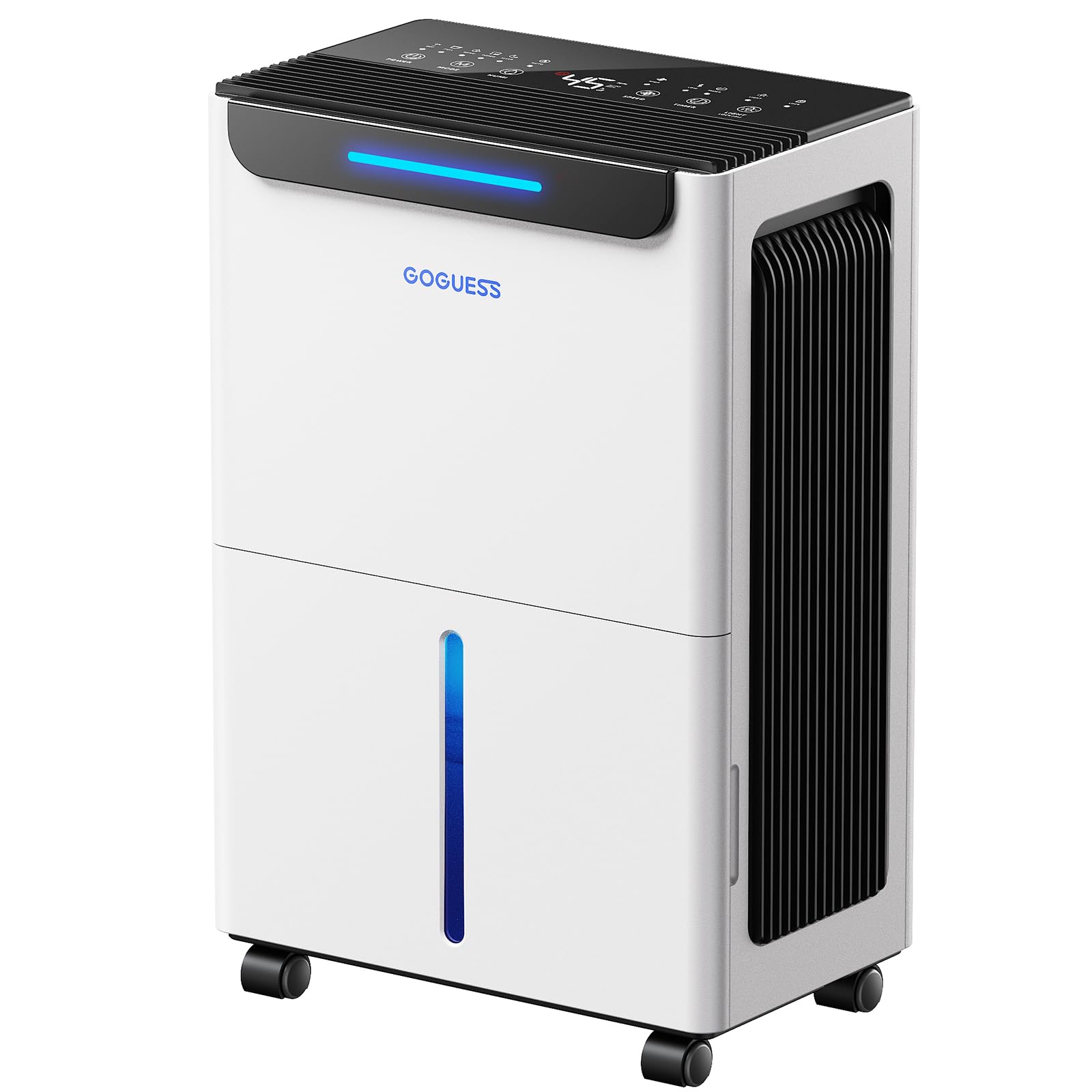
The GoGuess 21 Pint is a well-rounded mid-range model that excels in versatility, offering DEHU, TURBO, and SLEEP modes to adapt to different rooms and conditions. Its compressor extracts 21 pints per day — enough for an average bedroom, bathroom, or moderately humid basement up to 1,600 square feet.
A standout feature at this level is the real-time humidity display and color-changing LED indicator, which shows current humidity even when the unit is switched off. The 2.3-liter tank is sized sensibly for the extraction rate, and the included 3.28-foot drain hose lets you set it and forget it in a laundry room or basement with a floor drain.
User feedback consistently highlights the quiet sleep mode and intuitive touch panel, though the physical dimensions are slightly wider than most budget models. The auto-defrost function protects the coils in cooler conditions, which is a thoughtful addition for garages or unfinished basements in northern climates.
Why it’s great
- Real-time humidity display with color-coded LED
- Good balance of tank size (2.3L) and extraction rate
- Auto-defrost for cooler environments
Good to know
- Wider footprint than some comparable units
- Tank still requires emptying every 8-12 hours in humid conditions
3. Trazico 30 Pint Dehumidifier

The Trazico 30 Pint is engineered for those who refuse to tolerate a noisy appliance in their living space. With a rated sound output of just 35 dB — quieter than a library — it is one of the most discreet compressor-based dehumidifiers in its class, making it ideal for bedrooms, nurseries, or open-plan living rooms.
Beyond its whisper-quiet operation, it offers three intelligent modes: Comfort mode for maintaining a set humidity between 30-80%, Continuous mode for persistent dampness, and Quick Dry mode for accelerating laundry drying. The 1.7-liter tank is on the smaller side, but the included 3.3-foot drain hose allows for worry-free continuous drainage.
Several long-term users praise the energy efficiency, noting their electricity bills barely budged. The 360-degree swivel wheels and hidden handle make it easy to move between rooms, though the compact design means the filter is small and should be cleaned frequently to maintain airflow.
Why it’s great
- Exceptionally quiet at 35 dB — top of its class
- Smart modes (Comfort, Continuous, Quick Dry) for various needs
- Very energy efficient for a 30-pint compressor
Good to know
- Small 1.7L tank fills fast; rely on the drain hose
- Filter is small and needs regular cleaning
4. Glowells 34 Pint Dehumidifier

The Glowells 34 Pint stretches its coverage to 2,500 square feet, making it the most powerful compressor unit in this guide by extraction rate. It removes 34 pints of moisture per day, which is enough muscle for a large basement, open-plan ground floor, or combined living/kitchen area prone to steam and humidity.
It is the only model here with stainless steel elements in its construction, hinting at better corrosion resistance. The three operating modes — DEHU, DRY (clothes drying), and CONTI (continuous) — cover every common scenario, while the 6.56-foot drain hose is the longest included in this lineup, giving you much more flexibility in positioning away from a drain.
User reports consistently note how quickly it banishes musty smells and how quietly the smart compressor cycles on and off. The touch controls and clear display are intuitive, and the castor wheels make it easy to reposition. The only real compromise is the 2-liter tank, which is tiny relative to the extraction rate — plan to use the drain hose full-time.
Why it’s great
- Highest extraction rate (34 pints/day) in this guide
- Covers very large spaces up to 2,500 sq. ft.
- Long 6.56-foot drain hose for flexible placement
Good to know
- 2L tank is extremely small — continuous drain is necessary
- Some users find it louder than competing 30-pint models
5. Dravonic 30 Pint Dehumidifier
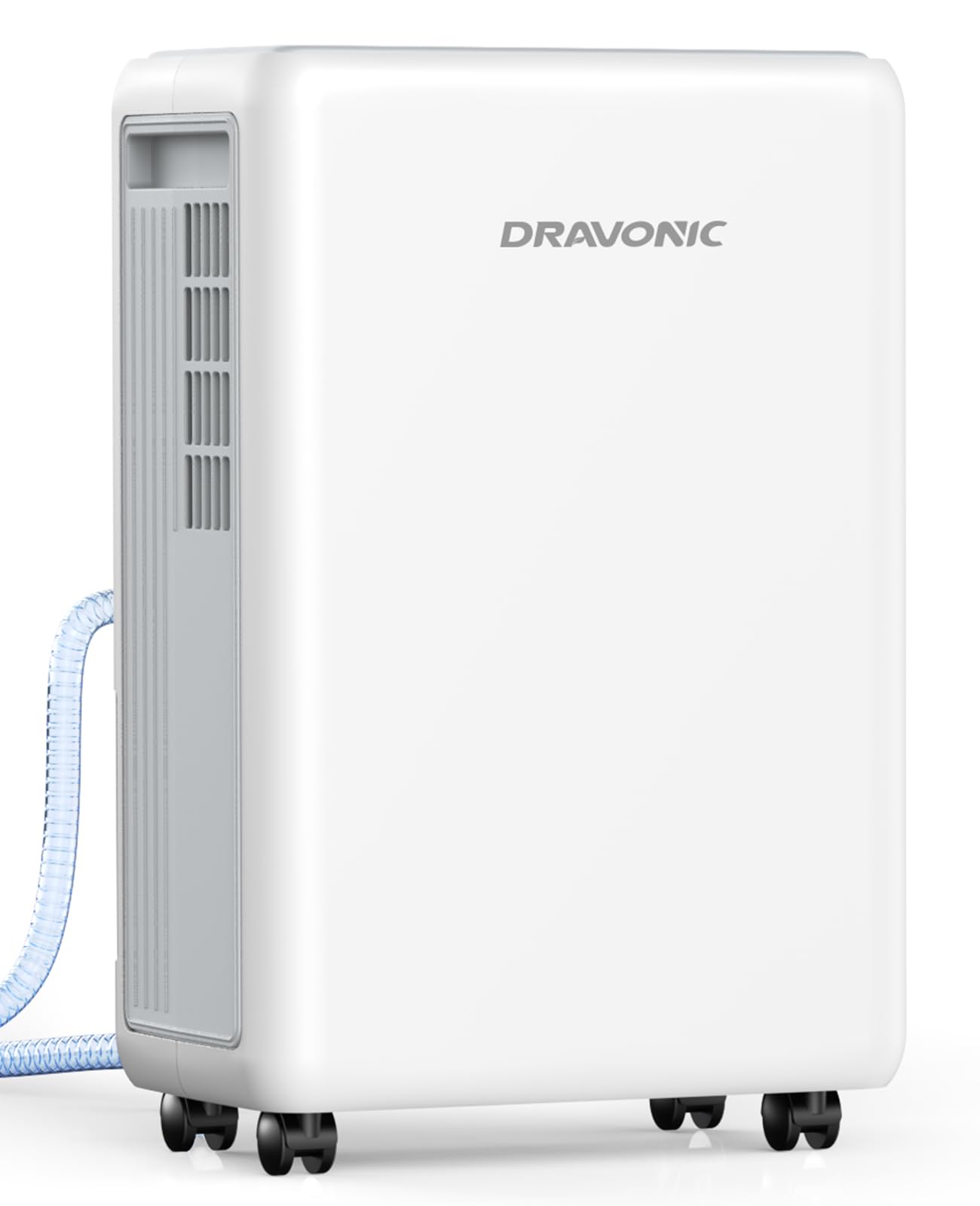
The Dravonic 30 Pint stands out for its long-term reliability and robust feature set, including a built-in auto-defrost that protects the compressor down to 41°F. This makes it a strong choice for unheated basements, garages, and coastal properties where temperatures dip during winter months.
It extracts 30 pints daily across a 2,000-square-foot area, operates at a quiet 40 dB on low fan speed, and offers three modes: DEHU for precise humidity control, DRY for accelerating laundry, and CONTINUOUS for persistent damp spaces. The 0.5-gallon tank is tiny, but the included 3.28-foot drain hose makes a full-time hose connection the obvious setup for hassle-free use.
The 130W power draw makes it one of the more energy-efficient 30-pint models, and the 24-hour timer and child lock add peace of mind for family homes. Customer service reviews are notably positive, with users reporting quick resolution for the rare defect — a good sign for a budget-tier investment.
Why it’s great
- Auto-defrost function for cold basements and garages
- Very low power consumption (130W) for a 30-pint unit
- Solid customer service reputation
Good to know
- 0.5-gallon tank is tiny — drain hose is essential
- Some reports of units failing after ~10 months of continuous use
6. Onsekin 2000 Sq.Ft Dehumidifier
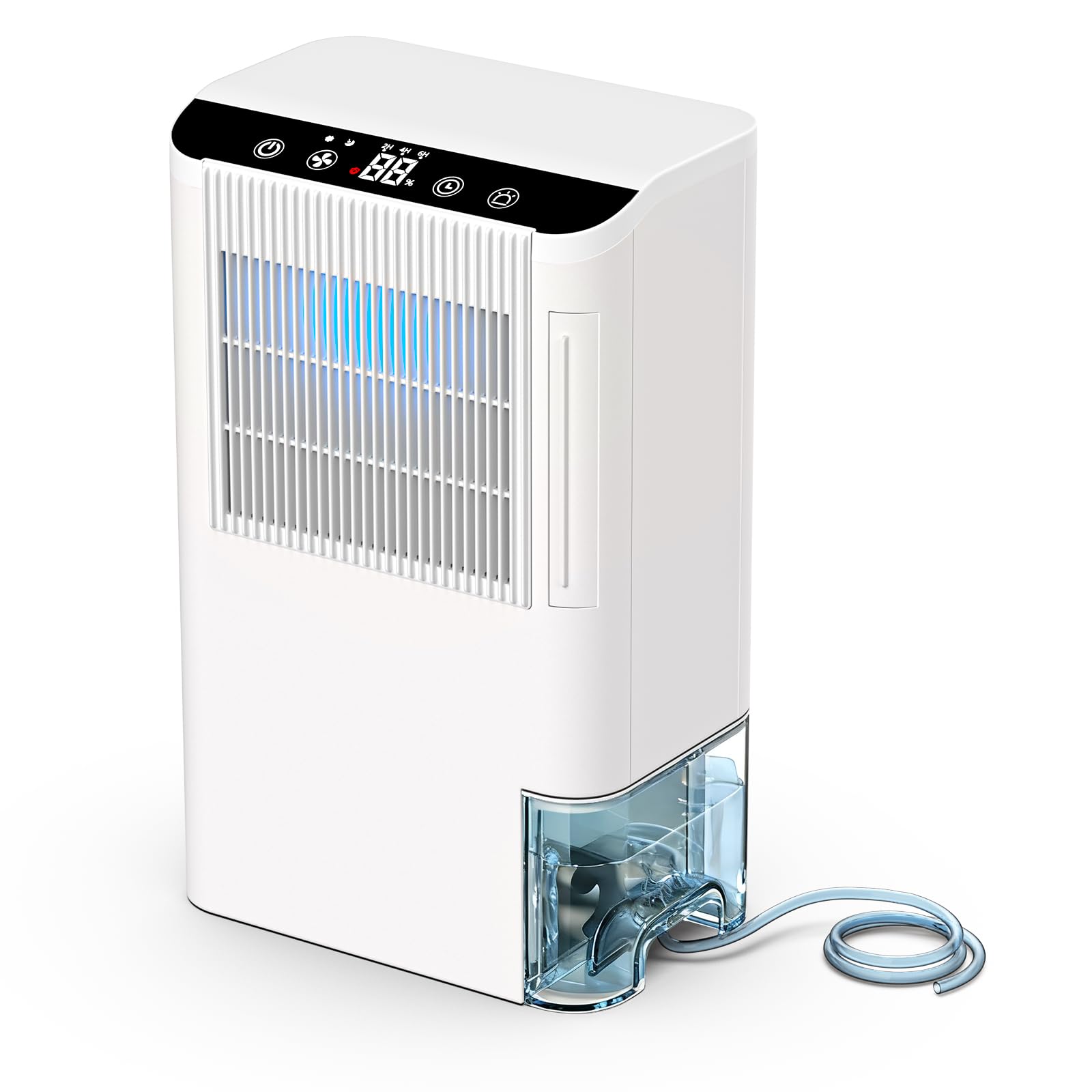
The Onsekin is a unique entry because it uses a rotary (desiccant-style) mechanism rather than a traditional compressor. This design lets it continue extracting moisture even when ambient temperatures drop below 41°F, where compressor units typically freeze up and stop working — a game-changer for unheated cabins, boats, and lake houses.
Its rated extraction of 2.2 liters per day is far lower than the compressor competitors, but it compensates with consistent performance in cold conditions. The unit features a built-in digital hygrometer that samples air every 3 seconds, holding the set humidity within ±2% of the target. Sleep mode drops fan speed to 1900 rpm and cuts noise to 46 dB while turning off all LED lighting.
The 2.5-liter tank is paired with a magnetic float safety shut-off and a tilt sensor that kills power if knocked over. While it covers up to 2,000 square feet, it pulls moisture slowly — expect it to run more hours per day than a compressor model. It is also heavier on power at 270W, but the absence of ozone-depleting refrigerants is a clear environmental plus.
Why it’s great
- Works in cold temperatures where compressor units freeze
- Precise humidity control (±2% of set point)
- No refrigerant — better for the environment
Good to know
- Low extraction rate (2.2L/day) — runs much longer than compressors
- Uses 270W, which is higher than comparable compressor models
7. OWAAE 95oz Dehumidifier
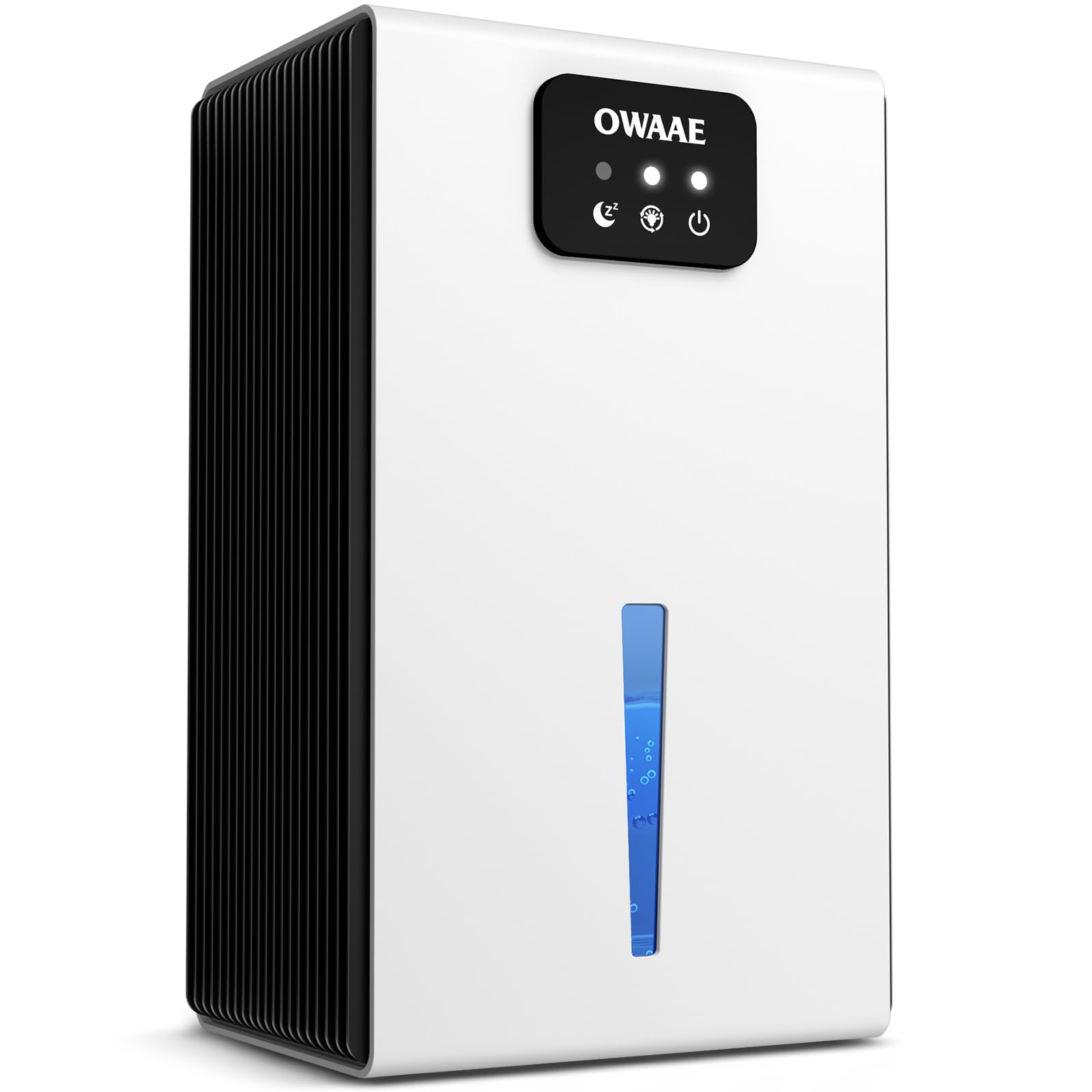
The OWAAE is an entry-level Peltier (thermoelectric) dehumidifier designed for very small personal spaces like closets, bathrooms, and RVs. It features a 95-ounce (2.8-liter) tank — actually larger than many more expensive models — and operates silently, with a sleep mode that drops noise below 30 dB.
This unit is not going to dry out a basement or large bedroom, but it excels in contained environments where humidity spikes are moderate. The 7-color LED lighting is a nicety for bedrooms or nurseries, and the compact design (7.8 x 4.9 x 13.3 inches) lets it tuck onto a bathroom shelf or under a sink without being obtrusive. The auto shut-off and tilt sensor add basic safety features.
Note that Peltier technology has very low moisture extraction rates, typically around 300-500 ml per day in ideal conditions. The 1,000 sq. ft. coverage claim is optimistic for a thermoelectric unit — in practice, it is best suited to rooms under 200 sq. ft. It is a good trial for those new to dehumidifiers, but anyone with real dampness should step up to a compressor model.
Why it’s great
- Massive 95 oz tank for a Peltier unit
- Under 30 dB in sleep mode — genuinely silent
- Very compact and easy to place in tight spaces
Good to know
- Very low moisture extraction — only for small, moderate-humidity rooms
- Claimed 1,000 sq. ft. coverage is unrealistic; real range is ~200 sq. ft.
FAQ
Does a cheap dehumidifier use a lot of electricity?
Why does my cheap dehumidifier keep freezing up?
Can I leave a cheap dehumidifier on all night?
Final Thoughts: The Verdict
For most users, the cheap dehumidifier winner is the Uhome 30 Pint because it combines a high 30-pint extraction rate, quiet 39 dB operation, and the option of continuous drainage at the best balance of performance and value. If you need whisper-quiet operation in a living space, grab the Trazico 30 Pint. And for cold basements or cabins where compressor units freeze, nothing beats the Onsekin rotary dehumidifier.