
Our readers keep the lights on and the weekend projects moving. As an Amazon Associate, I earn from qualifying purchases.
You want a machine that handles homework, bills, and the occasional document without a migraine, and that means knowing which specifications actually keep your per-page costs down. This guide breaks down five wireless all-in-one printers under most household budgets, showing you exactly what the speed numbers and ink systems mean for your wallet.
I’m Rikta — the co-founder and writer behind FitlyFast. This guide is built by comparing the manufacturers’ published specifications and the patterns across verified customer reviews, so you get each pick’s real strengths and trade-offs instead of marketing spin.
You are looking for a cheap printer that won’t quietly drain your wallet with expensive proprietary cartridges after the first few weeks of use, which is exactly what the ink yield numbers and replacement costs in these reviews are designed to help you avoid.
How To Choose The Best Cheap Printer
The cheapest printer on the shelf often has the most expensive ink, so the key is to ignore the machine’s sticker price and focus on the cost of replacement cartridges and how many pages you print each month. The three specs that affect your wallet most are the pages-per-minute (ppm) speed (it tells you if you will be waiting around), the print technology (inkjet vs. laser), and the duplex (automatic two-sided) printing feature that cuts your paper bill in half.
Speed — The “Pages Per Minute” That Actually Matters
The number you see on the box — like “15 ppm” for black-and-white — is the manufacturer’s maximum speed under perfect lab conditions. In real life, your printer starts slower, especially the first page, which can take 10 to 20 seconds to come out. For a home or small office, 10 to 15 ppm for black documents is perfectly fine; anything slower than 8 ppm will feel frustrating if you are printing a multi-page homework assignment or a work report. Color speed is almost always slower; a printer that claims 10 ppm for black might do only 5 ppm for color, so if you print a lot of color flyers or photos, that number becomes very important.
Ink Costs — The Real Price You Pay Per Page
Most cheap inkjet printers come with “starter cartridges” that hold about half the ink of a full-size replacement. You will likely run out of the black cartridge after around 100 to 120 pages and the color after 75 to 80 pages. After that, a standard black cartridge usually costs between $15 and $25, while a color set (cyan, magenta, yellow) can run $25 to $45. Divide that cost by the number of pages the cartridge is rated for, and you get your cost per page; a good target for a budget printer is under 5 cents per black page and under 15 cents per color page. Printers that use individual color cartridges (one for each color) let you replace only the empty one, which saves money compared to a single tri-color cartridge that forces you to toss all three colors when one runs out.
Duplex Printing — The Feature That Cuts Paper Waste
Automatic duplex printing means the printer flips the paper and prints on the back without you touching anything. Manual duplex means you have to flip the stack yourself and reload it. For a busy household printing 50 pages of school or work documents a week, automatic duplex can save you a ream of paper (500 sheets) every two months or so. That is about $5 to $10 saved per year, but more importantly, it cuts the physical bulk of your documents by half. If you are printing two-sided handouts or multi-page assignments, you will use this feature constantly; if you mostly print one-sided flyers or photos, you can safely deprioritize it.
Connectivity — How You Get Your Phone and Laptop to Talk to It
All five printers in this guide support wireless printing over your home Wi-Fi network, which means you can send a document from your laptop in the bedroom or your phone on the couch without plugging in a cable. The standard here is dual-band Wi-Fi (2.4 GHz and 5 GHz), which helps avoid interference and keeps the connection stable. You will also see support for AirPrint (iOS) and Mopria (Android), which let you print directly from apps like Google Docs or Apple Pages without installing a separate driver. Some printers also work with Alexa or Siri for voice commands, but that is a convenience, not a necessity — the main thing you need is reliable Wi-Fi that your phone finds within seconds.
Quick Comparison
On smaller screens, swipe sideways to see the full table.
| Model | Category | Best For | Key Spec | Amazon |
|---|---|---|---|---|
| Epson Workforce WF-2930 | Mid-Range | Home offices needing a fax and auto document feeder | 10 ppm black, 5 ppm color | Amazon |
| Canon PIXMA TS7720 | Premium | Users who want fast speeds and a touchscreen display | 15 ppm black, 10 ppm color | Amazon |
| Canon PIXMA TR7120 | Premium | Heavy home use with a need for a reliable auto document feeder | 14 ppm black, 9 ppm color | Amazon |
| HP Envy 6155 | Mid-Range | Low-volume home printing with an optional ink subscription | 10 ppm black, 7 ppm color | Amazon |
| HP OfficeJet Pro 8125 | Premium | Home offices needing professional-quality color documents | 20 ppm black, 10 ppm color | Amazon |
In‑Depth Reviews
1. Canon PIXMA TR7120

The Canon PIXMA TR7120 strikes the best balance between speed, features, and long-term value for home or hybrid work. It prints 14 pages per minute in black and 9 pages per minute in color — that is about 40% faster on black and 80% faster on color than the Epson Workforce WF-2930 (10/5 ppm), so a 20-page report finishes in under a minute and a half instead of two minutes. Buyers report that this printer replaced an old HP and printed 500 pages without a single paper jam, which points to solid mechanical reliability for daily use. The auto document feeder (ADF) lets you stack multi-page documents for scanning or copying without lifting the lid each time, and the automatic duplex (two-sided printing) cuts your paper usage roughly in half. The honest limit: the starter ink cartridges run out quickly, and replacement cartridges are expensive if you stick strictly to Canon-brand options; light users may find the per-page cost manageable, but heavy users should factor an instant ink subscription or third-party cartridges into their plan. If you print more than 50 pages a week and want an ADF without moving up to a pro-grade machine, this is the one to get over the TS7720.
Why it’s great
- Fast print speeds: 14 ppm black, 9 ppm color — beats every other printer in this lineup on both counts except the TS7720 on black.
- Auto document feeder (ADF) for hands-free scanning of multi-page sets.
- Automatic duplex printing saves paper without manual flipping.
Good to know
- Starter ink runs out quickly; budget for replacement cartridges soon after purchase.
- Physically larger than the TS7720, so it needs a dedicated desk space.
2. Canon PIXMA TS7720

The Canon PIXMA TS7720 beats the top pick (TR7120) on pure black speed — 15 ppm versus 14 ppm — and matches it on color at 10 ppm, but it lacks an auto document feeder (ADF), so you cannot stack a pile of pages for hands-free scanning or copying. If you frequently scan or copy multi-page documents, the TR7120’s ADF is the feature that makes the difference; if you mostly print homework and photos, the TS7720’s faster black speed will save you a bit of time on every multi-page job. The 2.7-inch LCD touchscreen makes navigating menus and changing settings far more intuitive than the smaller buttons on the WF-2930. Owners mention that the TS7720 delivers sharp, fast prints and that replacing an old HP with it was a solid upgrade, but they also caution that “setup not plug-and-play; needed manual to connect wirelessly” — so set aside about 15 to 20 minutes for the initial Wi-Fi configuration. The TS7720 is one of the few cheap printers with a color 2.7-inch touchscreen at this price, which makes everyday use much less fiddly than models with tiny monochrome displays.
Where it shines
- Fastest black-and-white speed in the lineup: 15 ppm.
- Intuitive 2.7-inch color touchscreen for easy navigation.
- Compact footprint fits well on a small desk.
Worth noting
- No auto document feeder (ADF) for multi-page scanning or copying.
- Some users found initial wireless setup more complicated than expected.
3. HP OfficeJet Pro 8125
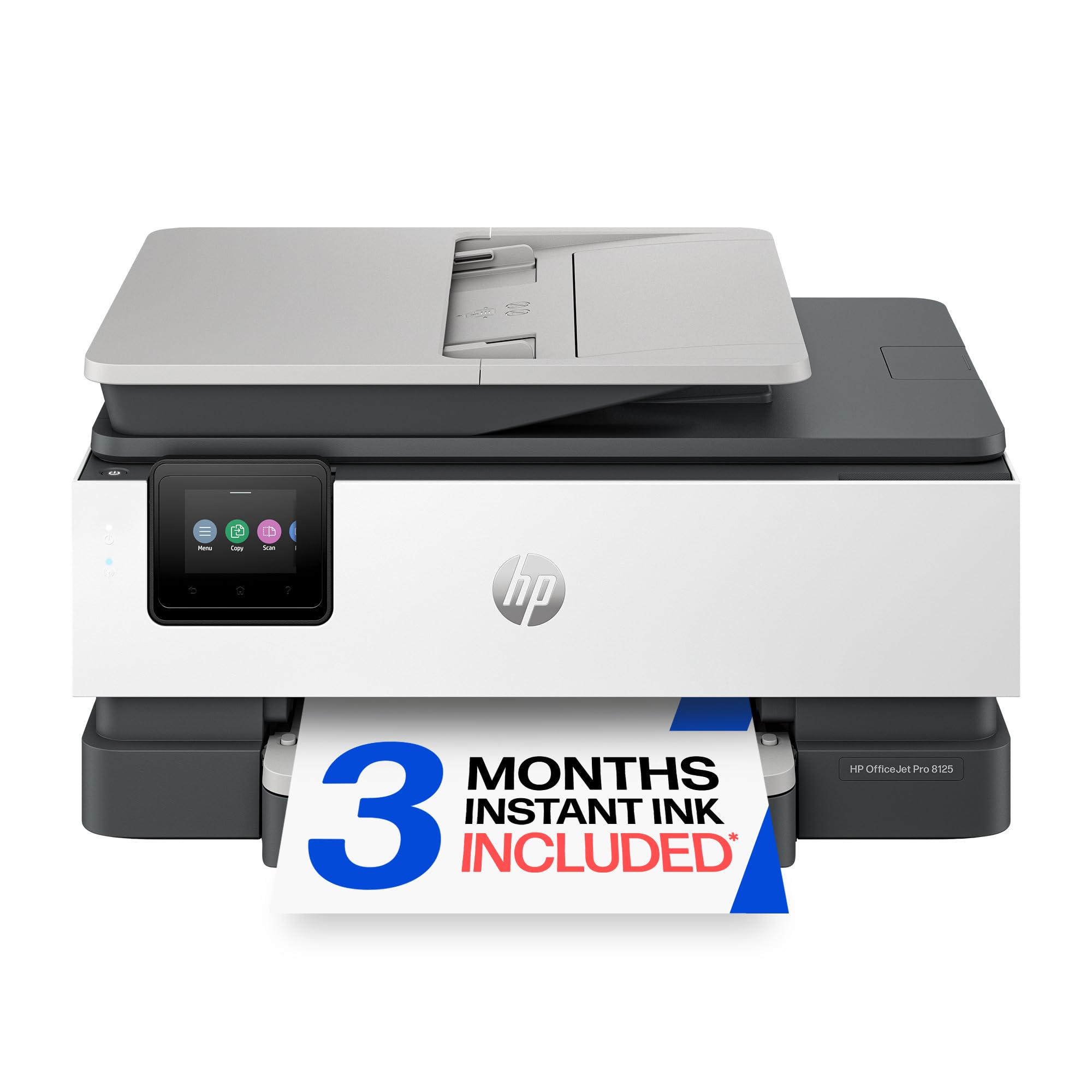
The HP OfficeJet Pro 8125 is for the user who prints a high volume of professional documents — it cranks out 20 pages per minute in black and 10 in color, which beats every other printer here by at least 33% on black speed (the Canon TR7120 is 14 ppm). The 225-sheet input tray, automatic duplex, and auto document feeder make it capable of handling a full morning of school or work printing without you hovering over it. The build quality feels a bit smaller and cheaper than previous generations of the OfficeJet Pro, as customers note, but the print quality is top-tier. The decisive feature that sets it apart from the rest: Ethernet and USB ports in addition to dual-band Wi-Fi. This is rare in this price tier and critical if your home office has a wired network or if your computer struggles with wireless connections. The HP Smart app lets you print, scan, and copy from your phone; users report that it works reliably after setup, though the initial Wi-Fi pairing may require a couple of attempts on a PC. The catch is expensive ink; according to buyer accounts, the Instant Ink subscription is almost essential to keep per-page costs down. This is the pick for the home office that needs a rock-solid wired connection over the WF-2930 or the TR7120.
What stands out
- Fastest overall: 20 ppm black, 10 ppm color — leads the field on pure speed.
- Ethernet, USB, and dual-band Wi-Fi for flexible network setup.
- 225-sheet input tray reduces paper refills for heavy print jobs.
The trade-offs
- Ink is expensive; the Instant Ink subscription is almost essential to keep per-page costs down.
- Setup can be finicky on a PC; the HP Smart app on a phone works more smoothly.
4. HP Envy 6155
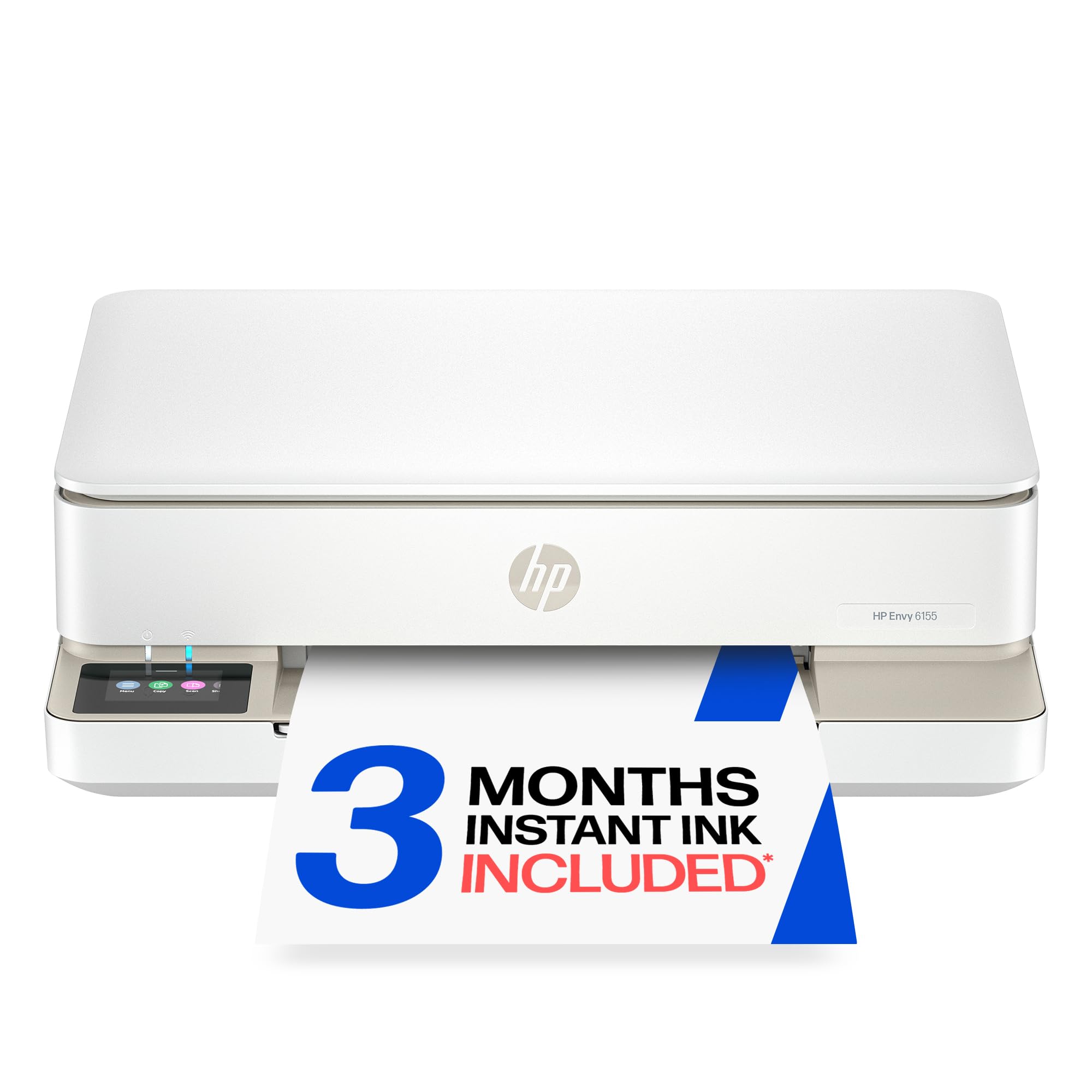
The single number that matters most here is the 10 ppm black speed — it is the slowest among these five printers, but for a household that prints maybe 20 pages a week of school permission slips, recipes, and the occasional document, that speed is more than adequate. The HP Envy 6155 is designed for low-volume use, and that is its sweet spot; if you print lightly, you save money upfront without feeling the pinch of slower speeds. The downside you accept is the cost-per-page once the starter ink runs out. The included HP 68 black cartridge yields about 120 pages, and the tri-color cartridge yields about 75 pages, as reviewers report. After that, standard cartridges cost about $15 to $25 each, which makes the per-page cost high for heavy printing. The 3-month Instant Ink trial can help offset that, but after the trial you pay a monthly fee based on the number of pages you print. For price-to-performance, this is the best pick for someone who prints less than 50 pages a month and wants a reliable wireless machine with a 2.4-inch touchscreen and a slim, attractive design. Choose this over the more expensive Canon TR7120 only if your volume is very low and you want the smallest upfront cost.
The upsides
- Low upfront cost; well under $100 at launch.
- Compact, slim design in white that looks clean on a desk.
- 2.4-inch color touchscreen for easy navigation.
Keep in mind
- Slow print speed (10 ppm black) — not suitable for large or frequent print jobs.
- High cost-per-page with standard cartridges; Instant Ink subscription recommended.
5. Epson Workforce WF-2930
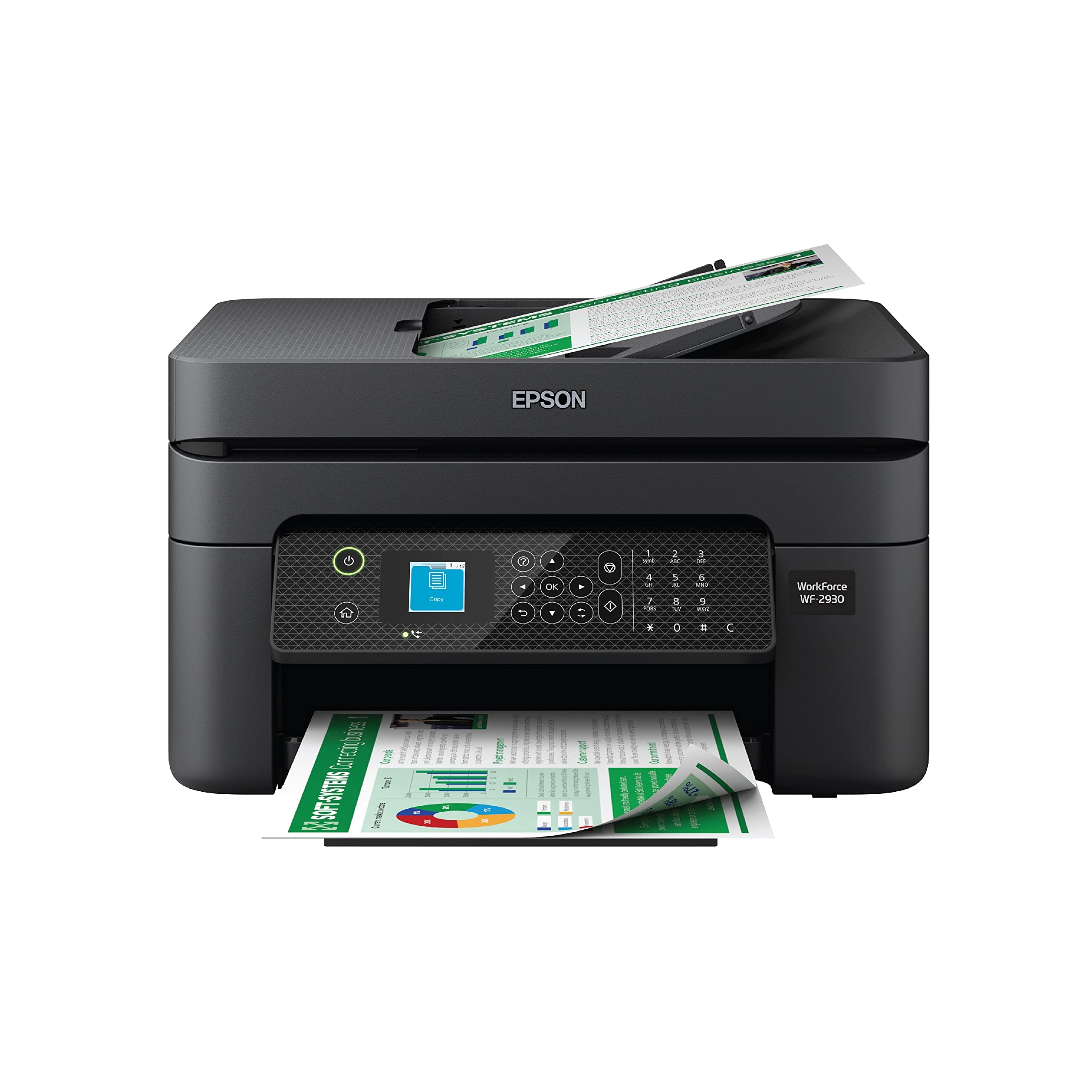
At the lowest price point in this lineup, the Epson Workforce WF-2930 gives you an auto document feeder, automatic duplex, and a fax line (yes, fax) — features usually reserved for printers that cost twice as much. You get 10 ppm black and 5 ppm color, which is noticeably slower than the Canon TR7120 (14/9 ppm) and the HP OfficeJet Pro 8125 (20/10 ppm), but for light home office use the speed is workable. What you give up is speed — especially color speed, which at 5 ppm means a five-page color document takes a full minute to finish. The smaller 1.4-inch color display is also less responsive than the larger touchscreens on the Canon and HP picks. One significant warning: reviewers point out that “Epson firmware update caused printer to reject non-Epson cartridges,” so if you plan to use third-party ink, be very careful about firmware updates, or choose a different printer. This exact budget buyer it is perfect for: someone who needs fax capabilities and a document feeder (ADF) at the lowest possible upfront cost, and who is willing to navigate the firmware cartridge restriction and the slower color speeds. Pick this only if your budget simply cannot stretch to the Canon TR7120.
Why we’d pick it
- Lowest price among the five printers.
- Includes auto document feeder (ADF) and fax, rare at this price point.
- Automatic duplex printing for paper savings.
A few caveats
- Slowest color speed: 5 ppm.
- Firmware updates can block third-party ink cartridges; shoppers say this risk.
Understanding the Specs
Pages Per Minute (PPM)
This is the manufacturer’s measure of how many pages the printer can churn out in one minute of continuous printing. For black-and-white documents, look for at least 10 ppm to avoid standing around waiting for homework or work reports. Color ppm is always slower; 5 ppm is the floor for acceptable, and 9-10 ppm is where you feel the speed. These numbers are under ideal conditions — your first page will take about 10 to 20 seconds longer before the printer gets going.
Duplex and Auto Document Feeder (ADF)
Duplex (automatic two-sided printing) saves you paper by printing on both sides without you flipping the stack. This is a must-have if you print multi-page documents every week. The ADF is a slot on top of the scanner where you stack multiple pages, and the printer feeds them through one by one for scanning or copying — a huge time saver compared to lifting the lid for each page. Not all cheap printers include an ADF, so check for it if you scan or copy multi-page sets.
FAQ
Why is the ink so expensive for a cheap printer?
Should I buy a wireless printer or a wired one?
What is Instant Ink and should I subscribe?
Final Thoughts: The Verdict
Across the board, the cheap printer winner is the Canon PIXMA TR7120 because it delivers the best combination of speed (14/9 ppm), automatic duplex, a document feeder, and solid build quality at a price that won’t break you. If you want the fastest black-and-white speed and a 2.7-inch touchscreen, grab the Canon PIXMA TS7720. And for a home office that needs Ethernet and professional-quality color documents, the HP OfficeJet Pro 8125 gives you wired reliability that the others cannot match.