
Our readers keep the lights on and the weekend projects moving. As an Amazon Associate, I earn from qualifying purchases.
Specs are compiled from manufacturer listings and verified buyer reviews and can change over time — please confirm the key details on the product page before buying.
Most “cinema” soundbars are really just a wide speaker pretending to be surround sound. Real cinema speakers change how movies feel—dialogue becomes crisp, explosions have weight, and you stop re-winding scenes because you missed a line. This guide walks you through nine genuine home-theater speaker setups, from tower speakers with built-in height channels to full 5.1.4 systems, and tells you exactly which one fits your room, your receiver, and your ears.
I’m Rikta — the founder and writer behind FitlyFast. This guide is built by comparing the manufacturers’ published specifications and the patterns across verified customer reviews, so you get each pick’s real strengths and trade-offs instead of marketing spin.
Upgrading from a soundbar or building your first dedicated setup? The best cinema speakers give you clear dialogue and rich bass without taking over your living room or emptying your wallet.
Our Picks at a Glance


How To Choose The Best Cinema Speakers
Before you buy anything, look at your room and your receiver. A huge tower speaker will overpower a small bedroom, while a compact bookshelf pair will struggle to fill a large open-plan living room. Your receiver’s power output and the speakers’ sensitivity rating decide how loud and how clean the sound gets before distortion creeps in.
Decide on your speaker form factor first
Tower (floorstanding) speakers stand on the floor and usually deliver deeper bass and fuller sound on their own—great if you want to skip a subwoofer. Bookshelf speakers sit on stands or cabinets and need help with the lowest frequencies, but they are smaller and easier to place. The Polk Audio Monitor XT60, for example, uses two passive radiators to punch out bass that most bookshelf speakers simply cannot reach.
Check the power handling and sensitivity
Power handling tells you how many watts a speaker can take before it gives up—the Klipsch R-26FA handles 100W continuous and 400W peak, meaning it can play loud without strain. Sensitivity tells you how efficiently a speaker converts power into volume. Pair high-power speakers with a receiver that can actually drive them, or you lose headroom exactly when an action scene demands it.
Understand Dolby Atmos before you pay for it
Dolby Atmos adds height channels that make sounds appear to come from above you—rain, helicopters, overhead effects. Some speakers fire sound upward off your ceiling (up-firing), while others need separate modules. It is a real upgrade for cinema, but only if your receiver supports Atmos and your ceiling is not vaulted or acoustic-tiled in a way that scatters the sound.
Quick Comparison
| Model | Best For | Type | Power Handling | Driver Size | Amazon |
|---|---|---|---|---|---|
| Klipsch R-26FA★ Best Overall | Built-in Atmos towers | Floorstanding Pair | 100W / 400W peak | Dual 6.5″ woofers | Amazon |
| Polk ES10Best Value | Compact surround pair | Bookshelf Pair | — | 1″ tweeter / 4″ woofer | Amazon |
| Polk XT60Bass Champion | Bass-rich towers | Floorstanding Single | — | 6.5″ woofer + dual radiators | Amazon |
| Sony SS-CS5M2 | Small rooms & desks | Bookshelf Pair | — | 5.12″ woofer | Amazon |
| Sony BRAVIA Theater 6 | All-in-one 5.1 setup | Soundbar System | — | 3 front + 2 rear | Amazon |
| Klipsch Cinema 5.1.4 | Full Atmos system | 5.1.4 System | — | 5.25″ satellites | Amazon |
| Sonos Arc Ultra | Premium soundbar + ecosystem | Soundbar | — | Hybrid drivers | Amazon |
| Nakamichi Shockwafe 9.2.4 | Maximum immersion | 9.2.4 Soundbar System | 1300W total | Dual 10″ subs | Amazon |
| SVS Prime Tower | Audiophile-grade music & movies | Floorstanding Pair | — | Dual 6.5″ woofers | Amazon |
In‑Depth Reviews
1. Klipsch Reference R-26FA Floorstanding Speaker, Black, Pair
Our pick — over 4.5★ from 950+ verified ratings; the strongest balance of quality and price.
Tower speakers with Dolby Atmos built in, so you skip the separate height modules entirely.
You get the full cinema experience without a stack of extra boxes on your shelves. Each R-26FA tower carries a 1″ aluminum diaphragm compression driver with a 90° x 90° Tractrix horn for crisp highs, plus dual 6.5″ copper-spun IMG woofers that deliver deep, resonant bass through a front-firing port. They handle 100W continuous and 400W peak power, which means you can push them hard on action blockbusters without hearing them strain.
The built-in elevation speakers bounce sound off your ceiling for a convincing overhead Atmos effect. At roughly 100 lbs per pair, they are serious furniture, but the sturdy build and easy setup win people over. Buyers report the bass is decent on its own, though a subwoofer makes the low end truly shake.
The thing everyone raves about is the sound quality—over 180 owners single it out as the standout feature, with crisp, clear voice playback and no distortion at high volume. If you have a vaulted ceiling, the Atmos effect works especially well. Just be ready for the weight: each cabinet tips the scales around 46 lbs.
What wins people over
- Built-in Dolby Atmos height channels — no extra modules needed
- 100W continuous / 400W peak power handling for loud, clean playback
- Bi-amp and bi-wire capable with dual binding posts
The honest trade-offs
- Heavy — roughly 46 lbs per speaker and 100 lbs per pair
- Bass is solid but not chest-thumping; a subwoofer helps
- Large footprint needs real floor space
Reach for these if: you want a full Atmos-ready tower setup in one box, with the height channels already built in.
Think twice if: your floor plan is tight or you expect thunderous sub-bass straight from the start.
2. Polk Audio Signature Elite ES10 Surround Speakers, Pair
Compact bookshelf speakers that punch well above their price for rear and surround duty.
These compact speakers handle the surround channels in a home theater setup beautifully, and they look sharp doing it. Each ES10 packs a 1″ Terylene tweeter (a lightweight fabric dome that reproduces high frequencies) and a 4″ woofer in a Dynamically Balanced Acoustic Array (a design that aligns the drivers for smoother sound). Polk’s patented Power Port Technology delivers 3dB louder bass with less distortion for cleaner low-end punch. They are timbre-matched with the rest of the Signature Elite series, meaning they blend smoothly with ES60 towers and an ES35 center for a consistent soundstage.
Owners use them as side, rear, or elevation surrounds, and the screw inserts plus keyhole slots make wall mounting easy. The sound is crisp and defined with clear highs and lows — owners mention the mids and highs are more pronounced than some other budget speakers they own, even if the bass runs shallow without a sub. High sensitivity and 4- and 8-ohm compatibility mean they work with most amplifiers and AV receivers, including Dolby Atmos and DTS:X units.
Owners love the looks and sound, noting these outperform their price as rear surrounds. One reviewer noted the bass is “not as strong as a pair of Micca speakers,” but the overall definition makes up for it.
Why they impress
- Power Port Technology delivers 3dB louder bass with less distortion
- Works as side, rear, or elevation surround — wall-mountable
- Timbre-matched with the full Signature Elite series
The catch
- Bass is shallow on its own — pair with a subwoofer
- Best as surrounds, not as main left/right fronts for big rooms
Grab these if: you are building out a surround setup and want high-value rear or height channels that look and sound premium.
Look elsewhere if: you need deep, room-shaking bass from the speaker itself.
3. Polk Audio Monitor XT60 Home Theater Tower Speaker (Single)
A single tower with dual passive radiators that produces surprising bass for the size.
One XT60 cabinet delivers smooth mid-range and deep bass thanks to a 1″ Tweeter, a 6.5″ Dynamically Balanced Woofer, and two 6.5″ Passive Radiators. Because this is sold as a single speaker, you buy two for a stereo pair — and owners say the passive radiators give the low end a boost that makes a subwoofer optional in many rooms. The sealed enclosure (no port) keeps the bass tight and controlled.
This is a Hi-Res Audio speaker that is also Dolby Atmos, Auro 3D, and DTS:X compatible, so it slots into modern surround sound systems without a fight. Rubber feet designed for both carpet and hardwood floors make placement flexible. Owners describe a “drum-like” clarity in the midrange — one noted it sounds like you are sitting on top of the snare drum.
Buyers consistently praise the sound quality for the price, calling these among the best speakers they’ve owned. They fit perfectly in small corners of a music room, per one owner, and work great with or without a sub. The honest limit: they are essentially large bookshelf speakers, and physics means they won’t fill a very large room at extreme volumes.
What stands out
- Dual 6.5″ passive radiators deliver impressive bass for a tower this size
- Sealed enclosure keeps bass tight and controlled
- Compatible with Dolby Atmos, Auro 3D, and DTS:X
Know before you buy
- Sold as a single — you must buy two for stereo
- Large rooms and loud volumes exceed what these can deliver
Buy these if: you want tower-level bass in a smaller footprint, especially for music plus movies in a medium room.
Pass if: you have a huge open floor plan and like reference-volume playback.
4. Sony SS-CS5M2 3-Way 3-Driver Hi-Res Compact Bookshelf Speakers (Pair)

A 3-way bookshelf pair that sounds bigger than it looks, perfect for desks and small rooms.
This compact pair squeezes three drivers into each cabinet: a 5.12″ woofer for low-end punch, a high-precision tweeter for faithful highs, and a wide-dispersion super tweeter that creates an expansive sound stage. The bass reflex enclosure keeps low frequencies distortion-free, and with a 53-50,000 Hz frequency response you get Hi-Res Audio detail that reaches beyond what most ears can hear.
Owners are surprised by the “punchy bass” and clear, loud presentation from such small passive speakers — they need little power to move, giving higher volume for the size. They are a perfect match for Sony AV receivers, but the 6-ohm impedance means they work with most decent amplifiers. The rear port needs some breathing room behind it, and owners recommend isolation feet to avoid muffling the bass on a desk.
Buyers are impressed by the performance for the size, saying they sound like larger speakers and reveal new details in familiar music. One owner called them a “great value” and loved that they work well from Rock to Orchestra in a small space. The honest caveat: deep bass is limited, so a subwoofer and a capable amp help them shine.
Why they’re loved
- Wide-dispersion super tweeter creates a big, expansive sound stage
- Punchy bass from a compact 5.12″ woofer
- Hi-Res Audio certified with 53-50,000 Hz response
The trade-off
- Deep sub-bass requires a subwoofer
- Rear port needs clearance from walls
Ideal if: you want high-fidelity sound in a small space — a desk, bedroom, or compact living room — without tower speakers.
Consider another if: you want wall-shaking low end from the speakers themselves.
5. Sony BRAVIA Theater System 6 5.1ch Soundbar with Subwoofer & Rear Speakers

A complete 5.1 system that pairs with BRAVIA TVs and practically sets itself up.
If you want cinema sound without running speaker wire to towers, this all-in-one system delivers. It includes a soundbar with three front-firing speakers, two rear speakers, and a subwoofer for true 5.1ch surround sound. It supports Dolby Atmos and DTS:X, and a dedicated center channel keeps dialogue crisp — a feature owners say makes a huge difference for movie night.
The setup story is what seals the deal for many buyers. Paired with a compatible BRAVIA TV, the soundbar and TV “worked together and did most of the work” — one owner called it their fourth attempt at surround sound over the years and said it finally worked beautifully. The BRAVIA Connect app gives you volume, sound profiles, and advanced settings from your phone, and Voice Zoom 3 enhances dialogue further when used with a BRAVIA TV.
Owners praise the crisp, loud sound with strong bass, and the build quality is solid. The honest trade-offs: the subwoofer must be wired to the TV, and the system requires HDMI (no optical), which limits some older setups. Still, for a fuss-free path to real rear-channel surround, this is the pick.
The best parts
- Full 5.1ch setup with soundbar, subwoofer, and rear speakers included
- Dedicated center channel keeps movie dialogue clear
- Voice Zoom 3 enhances dialogue with compatible BRAVIA TVs
Watch out for
- Subwoofer must be wired to the TV
- HDMI-only connection — no optical input
- Rear speaker stands sold separately
Choose this if: you want true rear-channel surround with an easy, app-guided setup and you already own or plan to buy a Sony BRAVIA TV.
skip it if: you have a non-Sony TV and want a system that connects via optical or legacy inputs.
6. Klipsch Reference Cinema Dolby Atmos 5.1.4 System

Four Atmos-enabled satellites deliver height effects from the front and back for a true 360° bubble of sound.
This complete system is the short path to a genuinely rich home theater. It includes four satellite speakers with Dolby Atmos up-firing drivers (speakers that bounce sound off the ceiling to create overhead effects), a center channel, and a subwoofer. Because the height channels fire from both the front and the back, you get a more convincing overhead effect than many soundbar setups. Exclusive Tractrix 90° x 90° horn technology with aluminum tweeters delivers impressive high-end response, so dialogue and effects stay crisp even at high volumes.
Owners describe the sound as “live stage” quality for music, with overhead effects that work accurately even without perfect ceiling conditions. The built-in all-digital subwoofer amplifier delivers strong bass, though it lacks the deepest punch of larger dedicated subs. The system is easy to configure, and the magnetic grills and copper cones look great in any room.
What wins people over is the sound quality for the money, with buyers calling it a definite upgrade over a soundbar system. One owner echoed the general consensus: “the longer I listen, the more I appreciate” the detail. The setup is straightforward, though the push-locking wire connections can be finicky — small banana plugs are recommended. That said, a few customers note the subwoofer acting up after a couple of months, so treat it gently.
What makes it great
- Four Atmos up-firing speakers for front and rear height effects
- Tractrix horn technology with aluminum tweeters for crisp highs
- Complete system — no separate modules to buy
Keep in mind
- Subwoofer lacks the deepest punch of larger dedicated units
- Push-locking wire connections need small banana plugs
- Satellite speakers are larger than some expect
Best for: anyone who wants a complete, upgrade-ready Atmos experience without assembling components separately.
Who might pass: buyers who demand ceiling-rattling sub-bass above everything else.
7. Sonos Arc Ultra Soundbar with Dolby Atmos – Black

A single soundbar that simulates 9.1.4 channels with Sound Motion tech and AI-enhanced dialogue.
This is the soundbar for people who want premium spatial audio without a single tower speaker in the room. The all-new acoustic architecture uses Sound Motion technology to fill every inch of the room and place sounds precisely around you, delivering an “outstanding 9.1.4 spatial audio experience” with Dolby Atmos. Speech Enhancement, powered by AI, detects the human voice and clarifies every word — a genuine boon for dialogue-heavy films.
Setup is easy with a single HDMI eARC connection and step-by-step guidance from the Sonos app, which owners consistently call a breeze. The bar works with your TV remote, touch controls, Sonos Voice Control, and Amazon Alexa. Trueplay quickly fine-tunes the sound for your specific room, and you can stream via WiFi, Bluetooth, Apple AirPlay 2, and Spotify Connect.
Owners rave about the sound quality — 170 of them single it out — and call the speech reproduction remarkably articulate. The bar shines even more when paired with a Sonos Sub and Era 300 rear speakers. The honest caveats: the price sits at the premium end, and a few owners hit TV pairing hiccups or LAN connection quirks that need a re-pair to resolve.
Why it’s worth it
- 9.1.4 spatial audio from a single soundbar
- AI-powered Speech Enhancement clarifies every word
- Trueplay room calibration fine-tunes the sound
The trade-offs
- Premium price, especially with optional Sub and rears
- Occasional TV pairing hiccups reported
- Best experience requires the full Sonos ecosystem
This is the one if: you want a clean, wire-free premium soundbar that grows into a full surround system over time with Sonos Add-ons.
Reconsider if: you are on a budget or prefer physical rear speakers included in the box.
8. Nakamichi Shockwafe 9.2.4 Dolby Atmos/DTSX Surround Soundbar System
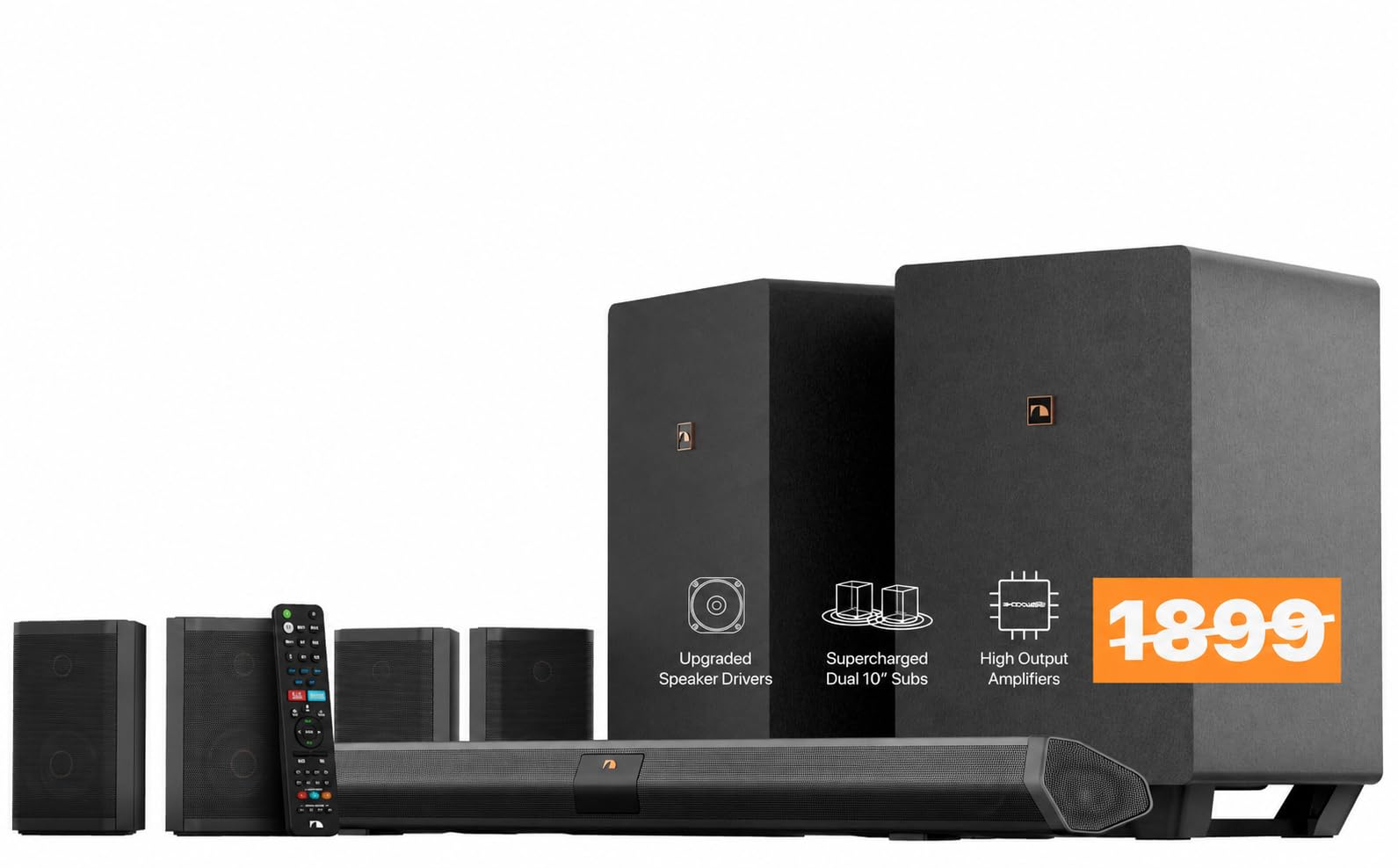
Dual 10-inch wireless subwoofers and four surround speakers make this the bass king of soundbar systems.
If your priority is feeling the movie in your chest, this system delivers. It boots 1300W of total power through a soundbar, four modular surround speakers, and a pair of 10″ wireless subwoofers — an industry-exclusive dual-sub design that fills the room evenly with low-frequency energy. Each sub pushes up to 600W, and the four surround speakers create a wide 360° sound field.
The SSE MAX engine handles Dolby Atmos and DTS:X, while HDMI eARC and three inputs support Dolby Vision and 4K HDR pass-through. You also get 24-bit high-resolution Bluetooth streaming via aptX HD, plus Optical, Coaxial, and 3.5mm Aux-in options. The full-function remote has backlit buttons for dark movie rooms.
Owners who upgraded from older 7.2 systems call the deeper, felt bass and clearer highs a massive step up, with zero connectivity issues versus earlier Bluetooth crackle. One long-time audio enthusiast said the system “rocks the house” with extreme clarity and handled near-max volume for hours without issues. The honest notes: each surround speaker connects to the sub via an included RCA cable (not wireless), and a couple of owners flagged a loose eARC port.
The standouts
- Dual 10″ wireless subwoofers with up to 600W each
- Four modular surround speakers for 360° immersion
- HDMI eARC + 3 inputs with Dolby Vision and 4K HDR pass-through
Before you buy
- Surround speakers connect to subs via RCA cable, not wirelessly
- Large footprint — subs are 20.2″ tall and 23.8 lbs each
- A few reviewers point out loose eARC ports
Get this if: you want soundbar convenience with the bass authority of a dedicated subwoofer setup.
Think twice if: your space can’t accommodate two large subwoofers and wired surround modules.
9. SVS Prime Tower Speakers – Pair (Piano Gloss Black)

Reference-grade towers with pinpoint accuracy and easy bass, for the buyer who hears everything.
These towers are built for the listener who values tonal accuracy over raw volume. Each Prime Tower pairs a 4.5-inch midrange driver in its own sealed compartment — which keeps the mids smooth and free from coloration — with dual 6.5-inch woofers that deliver deep, articulate bass. The 1-inch aluminum dome tweeter is light, efficient, and rigid, playing crisp at high volumes with an “airy” presence.
The proprietary SVS SoundMatch 3.5-way crossover ensures accurate frequency response and silky-smooth transitions between drivers, giving pinpoint imaging and phase coherency. Tapered chamfers on the front baffle minimize edge diffraction for precise soundstaging. This is a speaker that “disappears” in the room — owners say the soundstage is so accurate you forget where the cabinets are.
Owners praise the rich, controlled bass and note the towers perform exceptionally well at modest volumes — a genuine win for apartment dwellers. One buyer called them the perfect size for an apartment and a huge upgrade over a 5.1.2 soundbar. The subtle catch: they benefit from a subwoofer in larger rooms, and at very high volumes some treble distortion can appear.
What separates them
- Dedicated sealed midrange compartment for clean, uncolored vocals
- SVS SoundMatch 3.5-way crossover for pinpoint imaging
- Excellent at modest volumes — apartment-friendly
The honest limits
- Premium price point
- Needs a subwoofer to fill very large rooms
- Possible treble distortion at extreme volumes
Perfect for: the audiophile who listens at moderate volumes and values precise imaging and tonal balance above all else.
Not for: bass-heads who want wall-rattling output at reference volume without a subwoofer.
Understanding the Specs
Power Handling (Watts)
This tells you how much amplifier power a speaker can handle continuously and in short bursts. The Klipsch R-26FA, for example, is rated at 100W continuous and 400W peak. Higher numbers mean the speaker can play louder and harder before distorting, so match it with a receiver that can actually deliver that power for the best headroom in action scenes.
Frequency Response (Hz)
This is the range of pitches a speaker can reproduce, from deep bass to airy highs. The Sony SS-CS5M2 covers 53-50,000 Hz, which extends beyond human hearing at the top end. Lower numbers mean deeper bass, while higher top-end numbers mean more high-frequency air and detail. “Hi-Res Audio” certification typically means the speaker can reproduce frequencies above 40,000 Hz.
Dolby Atmos & Height Channels
Atmos adds speakers that fire sound upward, bouncing it off the ceiling to create the illusion of sound coming from above. The Klipsch R-26FA has these built into the tower, while the Klipsch Cinema 5.1.4 system spreads them across four satellites. If your ceiling is vaulted or highly textured, the effect may be less convincing.
Impedance (Ohms)
This is how much electrical resistance a speaker presents to your amplifier — most home speakers are 4 to 8 ohms. The Polk ES10 is compatible with both 4- and 8-ohm receivers, and the Sony SS-CS5M2 sits at 6 ohms. Lower impedance demands more current from the amp, so always check that your receiver is rated for the speaker’s impedance.
FAQ
Do I need a receiver for tower cinema speakers like the Klipsch R-26FA?
What is the difference between the Klipsch R-26FA tower and the Klipsch Cinema 5.1.4 system?
Will the Polk ES10 work as front main speakers?
Can the Sonos Arc Ultra work without a Sonos Sub?
Is the Nakamichi Shockwafe worth the extra cost over a standard soundbar?
What does the 9.2.4 or 5.1.4 number mean on these systems?
Are the Sony SS-CS5M2 speakers good for music, not just movies?
Do I need to buy speaker wire separately for the Klipsch Cinema 5.1.4 system?
Which cinema speaker is best for a small apartment?
Can I control the Sonos Arc Ultra without a Sonos app?
Final Thoughts: The Verdict
For the majority of shoppers, the cinema speakers winner is the Klipsch Reference R-26FA because it packs Dolby Atmos height channels into a pair of powerful towers — the crowd favorite holding a 4.7 out of 5 across nearly a thousand ratings. If you want the simplest path to rear-channel surround, grab the Sony BRAVIA Theater System 6. And for the buyer who wants maximum bass immersion above all, the Nakamichi Shockwafe 9.2.4 with its dual 10-inch subs is the one to reach for.
How We Picked
We do not accept paid placement. Every pick is matched to a real buyer and a real use-case; we do not hands-on test units.
Sources & Methodology
Specifications: manufacturer listings and product documentation. Review insights: verified customer reviews, as of August 2026. Pricing: not shown on this page (it changes often); check the current price via the retailer link.
As an Amazon Associate, FitlyFast earns from qualifying purchases. This does not affect which products we feature.