
Our readers keep the lights on and the weekend projects moving. As an Amazon Associate, I earn from qualifying purchases.
Specs are compiled from manufacturer listings and verified buyer reviews and can change over time — please confirm the key details on the product page before buying.
Sealing gaps and cracks with spray foam is a messy, one-shot job — you want a can that comes out smooth, adheres the first time, and actually delivers the square footage printed on the label. A good kit sprays smoothly, cures rigid, and hits its stated coverage; a bad one clogs, sputters, or stays spongy.
I’m Rikta — the founder and writer behind FitlyFast. This guide is built by comparing the manufacturers’ published specifications and the patterns across verified customer reviews, so you get each pick’s real strengths and trade-offs instead of marketing spin.
We compared the top Closed Cell Spray Foam kits by specs and user feedback to help you choose the right one.
Our Picks at a Glance
How To Choose The Best Closed Cell Spray Foam
Closed cell foam is the dense, rigid type of spray insulation that stops air movement and adds strength to whatever surface it bonds to. Unlike fluffy open cell foam, closed cell foam has tiny sealed pockets that block moisture and drafts — which is why you want it for rim joists, basements, and roof lines.
Understand R-Value and Coverage
R-value measures how well the foam resists heat flow — the higher the number, the better the insulation per inch. Since you apply foam in layers, the R-value per inch matters more than the total, because it tells you how thick you need to go to hit your target. Coverage is listed in board feet at a set thickness, so a kit promising 240 sq ft at 1 inch only gives you half that at 2 inches.
Match the Kit to Your Project Size
Small jobs like filling pest gaps or sealing rim joists call for a handful of 29 oz cans with a reusable gun. Whole-room or whole-attic insulation is a different beast — you need a two-part kit with separate chemical tanks and a long hose, which is a bigger investment but covers far more area in one setup. Buying more small cans than you need gets expensive, while renting a big kit for a tiny gap wastes material.
Quick Comparison
| Model | Best For | Coverage | R-Value | Pieces | Amazon |
|---|---|---|---|---|---|
| Vega Bond SF001★ Best Overall | Air Sealing & Gaps | 20 board ft / can | 5.66 per inch | 12 | Amazon |
| Magic Chems KitBest Value | All-in-One Starter | — | — | 24 | Amazon |
| Sprayman Spraycoat | Fire-Rated Walls | 240 sq ft @ 1″ | 11.32 per 2 in | 12 | Amazon |
| Akfix Thermcoat | Large Area Coverage | 360 sq ft | 11.32 per 2 in | 18 | Amazon |
| Kraken Bond Fastcoat | Fire-Rated Versatility | 240 sq ft | 5.66 per inch | 18 | Amazon |
| STANLEY F 990P | Whole-Room Insulation | 480 sq ft | 11.32 per 2 in | 24 | Amazon |
| Froth Pak 630 | Pro-Scale Jobs | 630 sq ft @ 1″ | 6.2 per inch | 1 | Amazon |
In-Depth Reviews
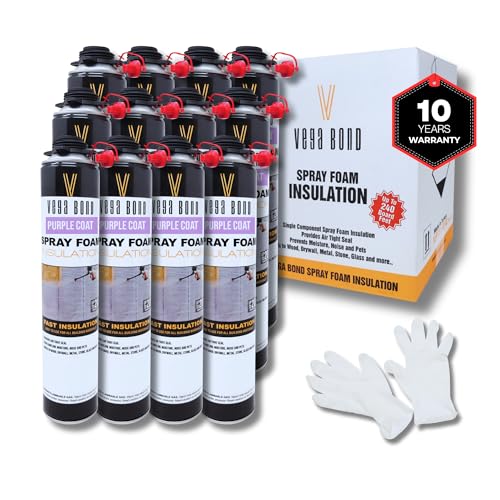
1. Vega Bond SF001 Purplecoat Closed Cell Foam Spray 29 oz (12 Pack)
Our pick — over 4★ from 550+ verified ratings; the strongest balance of quality and price.
A versatile 12-pack that seals gaps and bonds to wood, brick, and metal with included gun accessories.
This 12-pack earns the top spot for the simplest reason: it just works across the widest range of jobs. Each 29 oz can covers up to 20 board feet at 1-inch thickness, with an R-value of 5.66 per inch so your walls, attic, or rim joist block heat transfer effectively. Unlike cheaper options, it adheres to wood, brick, stone, concrete, metal, drywall, and OSB — so you are not stuck matching the foam to a specific surface.
You get a solid grip on wood by prepping right: warm the cans to 85°F, warm the surface above 70°F, and mist the wood with water first. One buyer sums it up: “It seals up any holes or cracks where rodents are coming from.” The included applicator gun options and 45-degree elbow connector make overhead work like ceiling gaps far easier, which is where most DIY spray foam gets messy.
The honest trade-off is in the details. The foam dries a bit spongier than the 2-part kits, so it is best for air sealing and small-to-medium gaps rather than filling wide open cavities. The gun clogs after roughly 20-25 cans — owners note that soaking it in acetone brings it back — and the instructions are sparse, so expect to watch a few videos before starting.
What wins people over
- High-quality feel with strong adhesion on many surfaces
- Effective as an air seal and moisture barrier
- Easy application with the right prep
- Great value in the 12-pack size
Where you’ll push back
- Coverage varies; some cans underperform
- Requires warm cans and warm surfaces for best results
- Gun can clog; plan for acetone cleaning
Reach for this if: you need a dependable, multi-surface air sealant for gaps, rim joists, or pest sealing and are okay with some prep work.
Look elsewhere if: you need to fill deep, wide wall cavities where a rigid 2-part kit delivers better density.
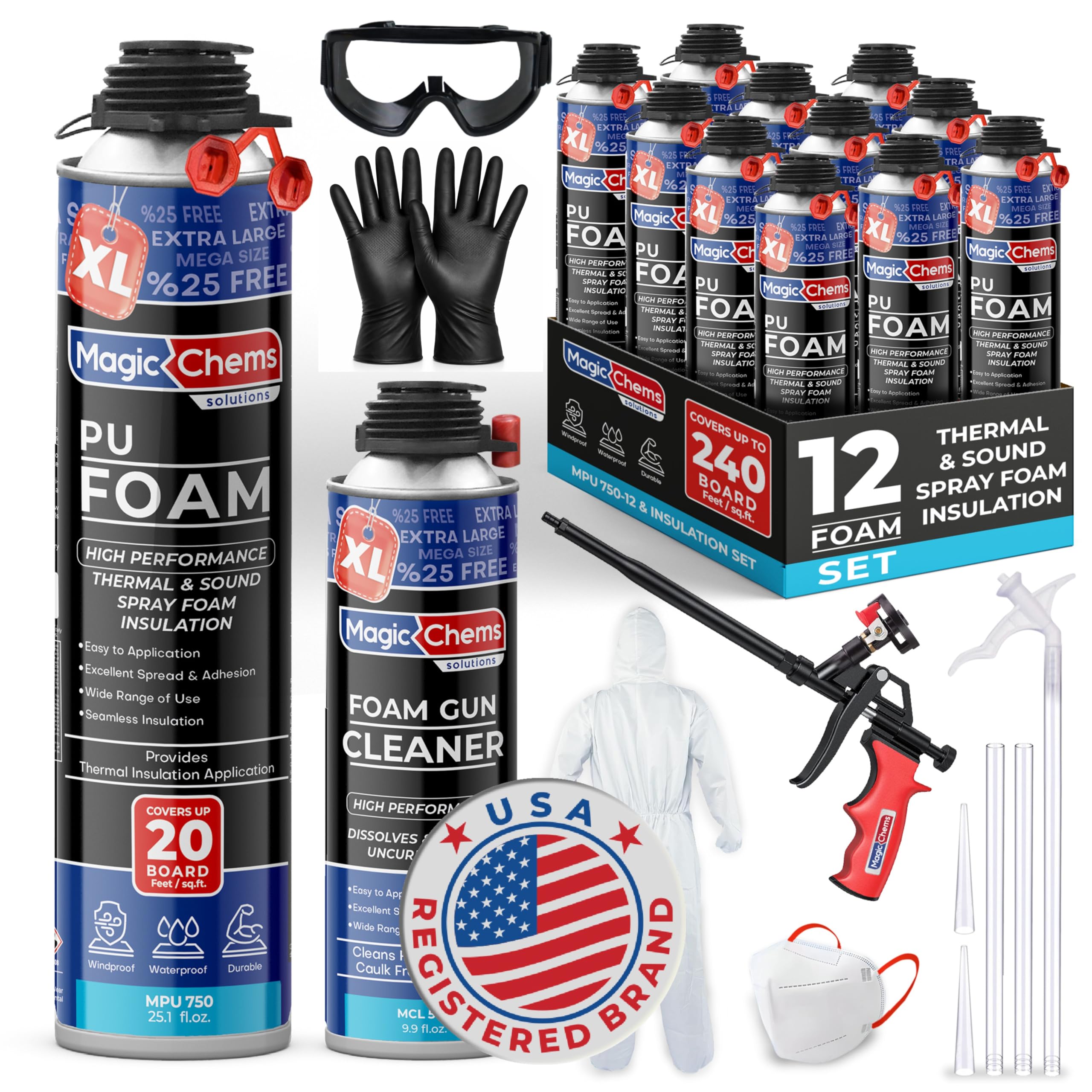
2. Magic Chems Spray Foam Insulation Kit, Expanding Sealant, 12 Pack-25.4 oz
A 24-piece kit with gun, cleaner, nozzles, and safety gear for first-time sprayers.
You save money because this kit does not make you buy gear separately. You get 12 cans of 25.4 oz foam, a Teflon-coated spray gun, a 9.9 oz foam gun cleaner, 12 red nozzles, two long and two short nozzle tips, plus a safety suit, goggles, nitrile gloves, and a mask — everything you need for the first project is in the box. That full cure time of 24 hours is on the slower side, but it means you have time to correct mistakes before the foam hardens.
The spray performance gets the most praise, and it makes sense — the kit is designed for a controlled 25 to 30 cm spray distance, so a steady hand gives you a uniform layer. Buyers report it foams up thick, sets fast, and handles gaps and cracks well. The kit is heavier than it looks at 27.4 pounds, but that weight is spread across the full set of accessories, not just the cans.
The fit note is about adhesion: some users found the foam did not stick properly on certain surfaces, and coverage came up shorter than expected for a few projects. It is also messy to apply — the review pages make clear that wearing the included gear is non-negotiable, not optional.
Smart starter: this is the one to buy if you want a single box with a gun, cleaner, and protection, not just cans.
Plan for prep: test adhesion on a small area first, and expect a learning curve before the foam lays down clean.
3. Sprayman Spraycoat Fire Rated Spray Foam Insulation Kit 240 Sq.Ft
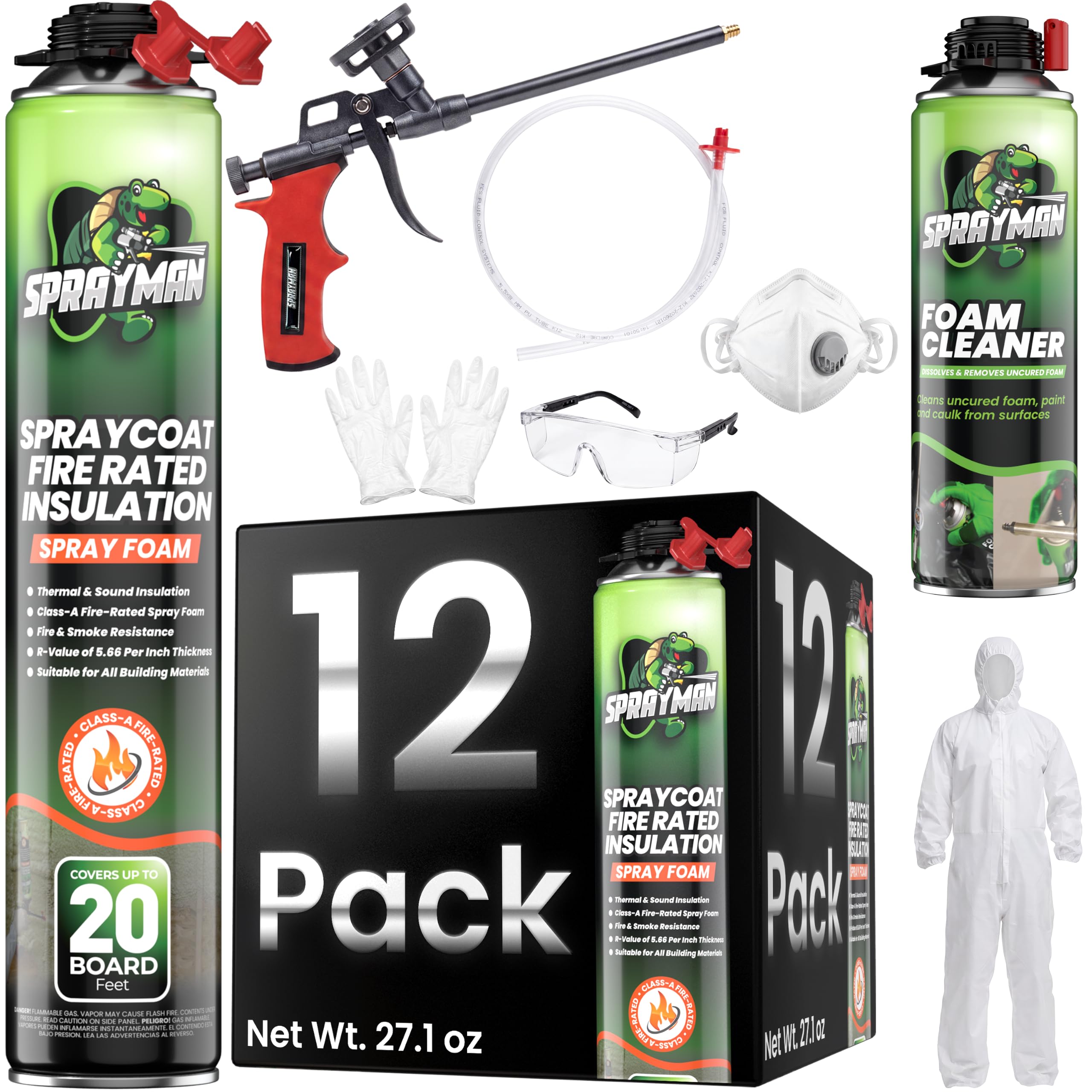
A Class-A fire-rated kit with dual nozzles for walls and ceilings, covering 240 sq ft.
Fire resistance is the headline here: this closed-cell polyurethane foam carries a Class-A Fire Rating tested to ASTM E84 standards, which means it resists flame spread on roofs, walls, basements, and tanks. It covers 240 square feet at 1-inch thickness, with an R-value of 11.32 per 2 inches making it a strong thermal and acoustic performer. The rigid, dense structure resists cracking, shrinking, and settling, so it keeps its shape for years after the single application.
The dual-nozzle system is the standout feature. Nozzle A is designed for vertical wall and surface work, while Nozzle B is for ceiling spraying — switching between them keeps expansion consistent and avoids dripping on overhead jobs. The foam bonds strongly to drywall, wood, concrete, plaster, stucco, brick, sheetrock, MDF, and metal, and it stays dimensionally stable so it will not warp window or door frames over time.
Owners mention it works great and dries fairly quickly on metal cabin walls — misting the surface with water first is the key to good adhesion. The catch is that each can covers less than some expect, and it is easier to use in open spaces than in tight, confined ones. A few cans have arrived with issues, so it is worth testing one can before committing the whole box to a wall.
The fire-rated edge
- Class-A fire rating for confidence
- Dual nozzles for walls and ceilings
- Strong adhesion to most building materials
- Rigid, durable structure that resists settling
The honest limits
- Coverage per can can feel short
- Messy and hard to control in tight spaces
- Occasional delivery or can issues
Best for: homeowners and DIYers who want fire-rated insulation on walls and attics, with a nozzle system that handles ceilings.
Consider twice if: you are working in a cramped crawl space where the gun and foam are hard to maneuver.
4. Akfix Thermcoat Fire Rated Spray Foam Insulation Kit 360 sq ft
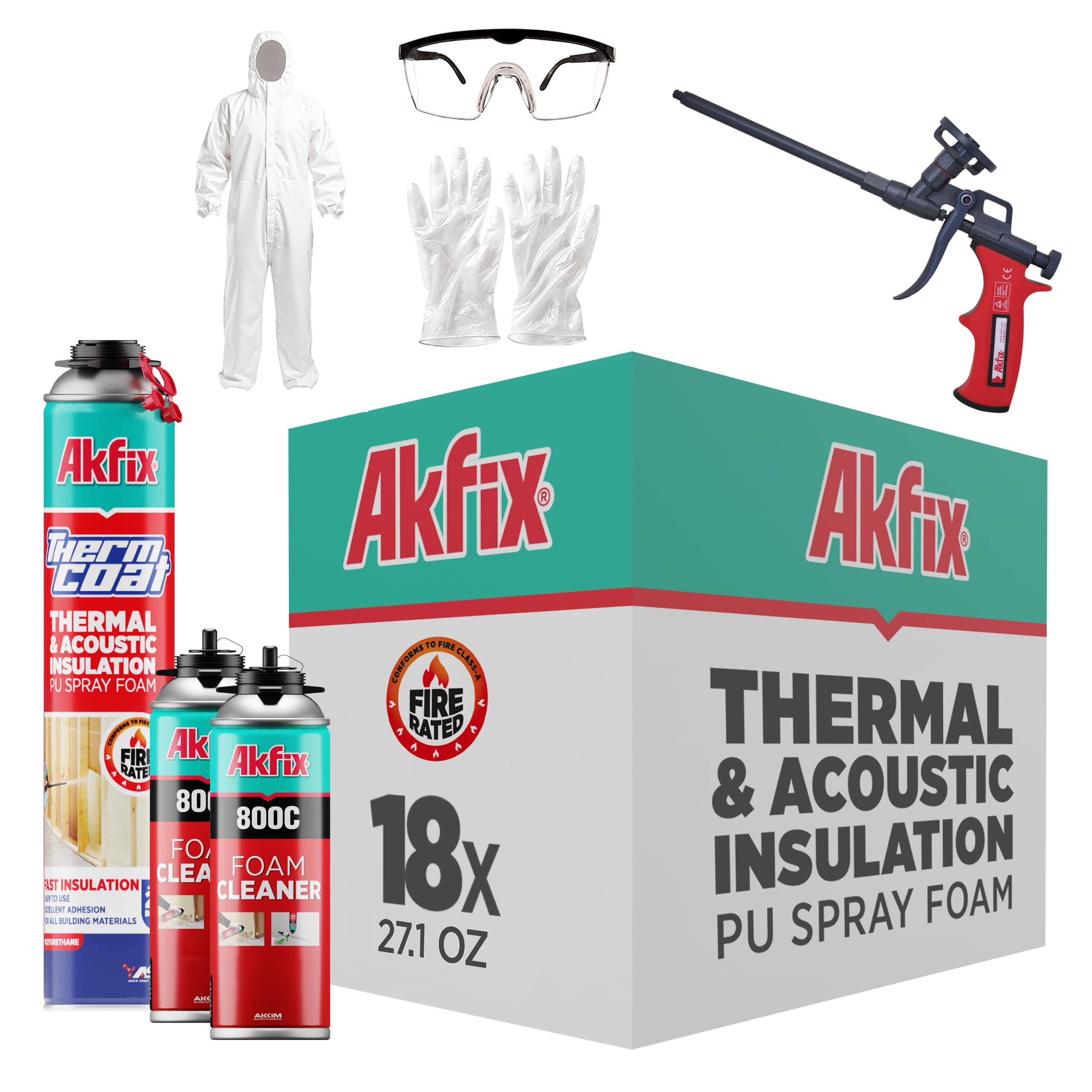
An 18-can, 360 sq ft fire-rated kit that bonds to wood, brick, and metal for large walls and attics.
When the project is bigger than a few gaps, this 18-can kit steps in with 360 sq ft of coverage and a Class-A Fire Rating. It delivers an R-value of 11.32 per 2 inches with low thermal conductivity of 0.025 W/m·K, so it cuts both heat transfer and noise transmission for a quieter, more efficient space. Layered application lets you build up to a thickness of 5 cm without losing the airtight seal.
Adhesion is the strongest suit here — it bonds to wood, brick, drywall, concrete, metal, PVC, and more, which makes it a fit for hard-to-reach, irregular surfaces where traditional insulation falls short. Like the Sprayman, it includes Nozzle A for vertical surfaces and Nozzle B for ceilings. The cans perform best when warmed to 68°F, with an effective range of 41°F to 86°F for flexibility in different climates.
Buyers who insulated large metal buildings report solid results with no can issues and meaningful savings versus a contractor quote. The flip side: coverage expectations vary wildly — some say it covers more than advertised while others report about half the expected area, so ordering 20% extra is a smart cushion. The foam has a strong odor for the first few minutes, and a respirator is a must during application.
Big-project pick: this is the mid-range kit for whole-wall and attic insulation where you need volume and fire resistance.
Budget for extras: plan on extra cans and strong PPE, since coverage and fumes vary by conditions.
5. Kraken Bond Fastcoat Fire Rated Spray Foam Insulation (18×27.1 oz)

An 18-can fire-rated pack with dual nozzles for sealing tight corners and ceiling gaps.
Kraken Bond brings a Class-A Fire Rating with a dense, monolithic closed-cell spray that blocks thermal bridges and dew point formation. Each of the 18 cans is 27.1 oz, covering 240 square feet total with an R-value of 5.66 per inch. The dual-nozzle system handles both vertical and ceiling applications, which keeps coverage thorough in corners and tight wall cavities where other insulation simply will not reach.
The foam creates a watertight, airtight seal that blocks pests and drafts, and it bonds to most building materials. The optimal can temperature is 68°F, with an effective range of 41°F to 86°F, so in colder months you will want to let the cans acclimate to room temperature before spraying. Cleanup is manageable — owners note that wiping the nozzle every couple of cans keeps the flow smooth.
A 12-can pack fully covered a 6x8x8 hunting blind including walls and ceiling, and customers note it heats up fast inside with a heater. The main controversy: some owners say the foam behaves like open cell foam, not the closed cell advertised, so it may be softer than true closed cell. If a rigid, dense final foam is the top priority, test one can before committing.
What stands out
- Fire-rated formulation for safer applications
- Dual-nozzle design for walls and ceilings
- Seals out pests and drafts completely
- Easy to apply with good coverage
Check before buying
- Some reviewers point out the foam is softer than true closed cell
- Coverage can fall short of the 240 sq ft claim
- An occasional can arrives dried or non-functional
Choose this if: you want a fire-rated, versatile kit for sheds, hunting blinds, and pest sealing and you keep expectations realistic on density.
skip it if: you need guaranteed rigid closed cell density for a high-moisture basement.
6. STANLEY F 990P Supercoat Spray Foam Insulation Kit (24 Pack)
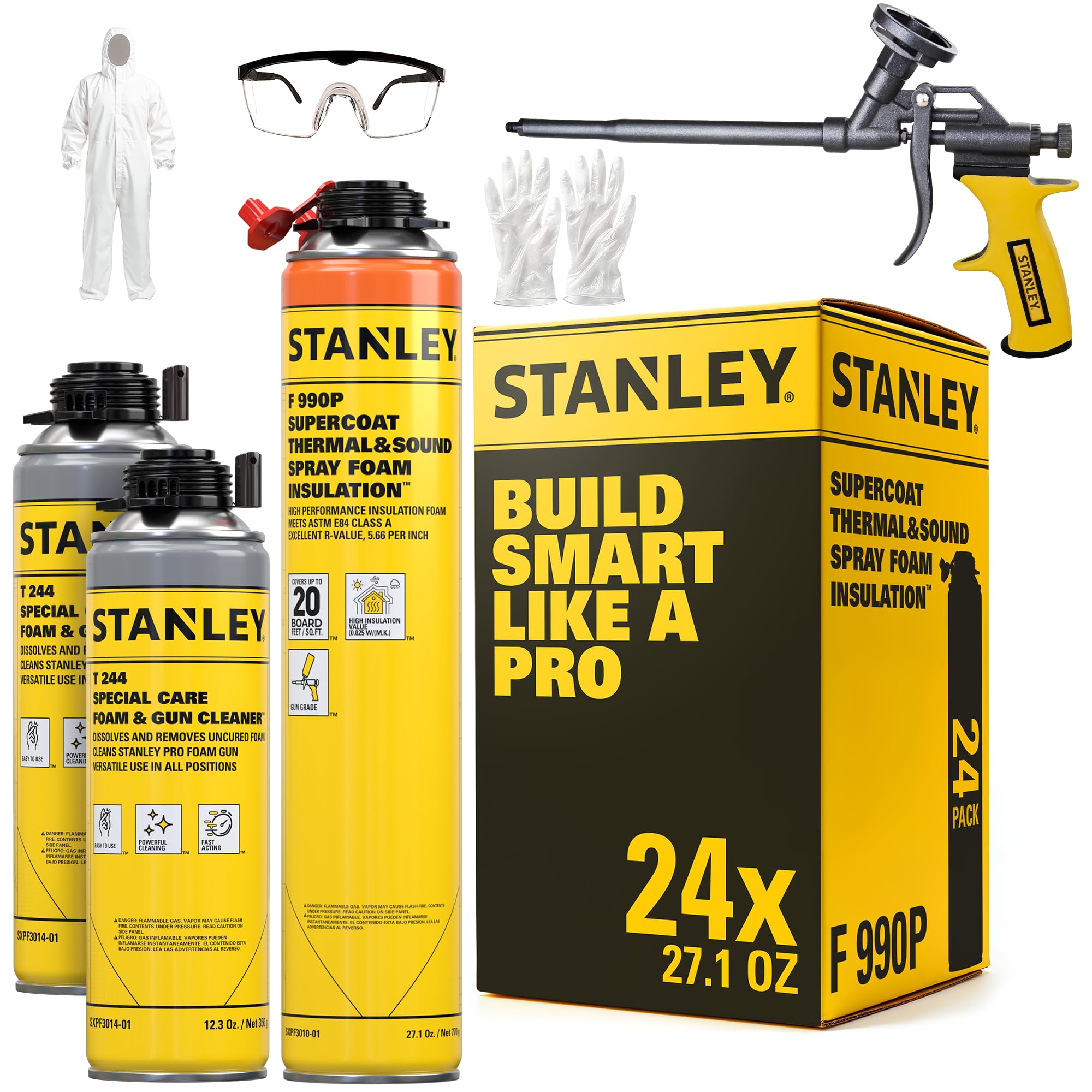
A 24-can, 480 sq ft kit that creates a smooth, monolithic insulation layer for whole rooms.
Grab this kit when the job is a whole room, not a gap. With 24 cans covering up to 480 square feet and an R-value of 11.32 per 2 inches, the STANLEY Supercoat delivers heat and sound insulation in one smooth application that outperforms EPS boards, glass wool, and rock wool. The low thermal conductivity of 0.025 W/(m.K) prevents thermal bridges and dew point formation, and the dense structure acts as a barrier to water, air, and pests.
The quality is what wins people over — owners insulated a full garage and reported about 20 board feet per can with efficient spray and easy ceiling work. The kit comes with the foam gun, two cans of foam cleaner, gloves, glasses, and a suit, so protection is included. The Class-A fire rating tested to ASTM E84 adds safety confidence for residential and commercial use.
The trade-off is the cost per square foot. Shoppers say it runs about 4x the price of batt insulation, though it creates a much tighter air seal. Trimming the cured foam is difficult and can push drywall, so it is best for projects where the extra air-sealing performance justifies the premium. A few buyers report the foam cures more like open cell in practice, which means checking density before a big pour.
Whole-room contender: this is the premium one-part kit for a garage, trailer, or shed where you want a clean monolithic layer.
Be ready to trim: cured foam is tough to cut flush, so budget time for sanding or grinding.
7. Froth Pak 630 Spray Foam Insulation Kit, 15 ft Hose, Closed Cell
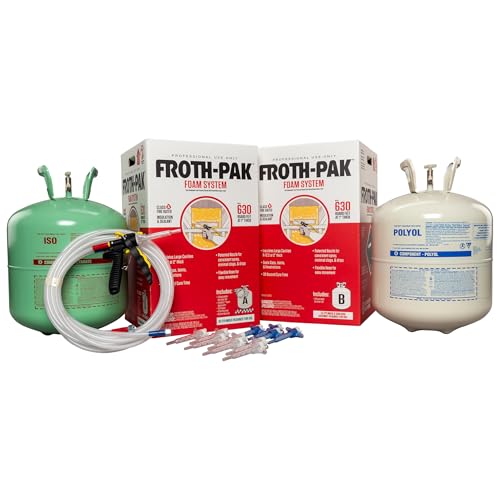
A two-part pro kit that cures in 30 seconds and covers 630 square feet in one shot.
This is the serious system. The Froth Pak 630 is a two-component kit with separate Part A and Part B tanks, a 15 ft hose, and an INSTA-FLO gun dispenser, covering up to 630 square feet at 1 inch thickness. It delivers an R-value of 6.2 at 1 inch and jumps to 12.2 at 2 inches, so you get more insulation per inch than the one-part cans. The two-part chemistry cures in just 30 seconds, and you can re-enter the space in 1 hour with proper ventilation.
The fire-rated foam bonds to wood, drywall, masonry, and other surfaces while resisting moisture and allergens. It is Green Circle Certified, LEED V4 Compliant, and ICC listed, making it compliant in all contiguous 48 states — a meaningful credential if you need to meet building code requirements for air changes per hour (ACH). The kit includes 8 cone nozzles and 4 fan nozzles, giving you control over the spray pattern for different gap sizes.
Contractors and ambitious DIYers report success insulating crawl spaces and walls, with one buyer crediting it for improved cabin heating. The foam is messy and sticky, with strong VOCs, so a Tyvek suit, hat, gloves, and a full respirator are essential — and plan to ruin whatever clothes you wear. The value gets mixed reviews: it is expensive, and you will likely need multiple kits for a full house, but for large areas it beats buying dozens of individual cans.
Why it’s the pro choice
- High yield: 630 sq ft per kit at 1 inch
- Fast 30-second cure time
- Class-A fire rated and code-compliant
- Long 15 ft hose reaches hard spots
The real cost
- Premium price; multiple kits needed for a whole house
- Strong VOCs and very messy application
- Nozzle needs constant wiping while spraying
Buy it for: large crawl spaces, basements, or wall assemblies where one kit can do the work of dozens of cans.
Hold off if: you only have a few gaps to seal — that is overkill, and the small cans will cost far less.
Understanding the Specs
R-Value Per Inch
R-value tells you how well the foam resists heat transfer. Closed cell foam typically delivers more R-value per inch than open cell, which is why you need less thickness for the same insulation level. A kit with R-Value 11.32 per 2 inches is roughly double the insulation capacity of a 5.66 per inch product, so check this number before comparing coverage.
Board Feet vs Square Feet
Coverage is measured in board feet — one board foot is 1 square foot at 1 inch thick. A can that covers 20 board feet gives you 20 sq ft at 1 inch, but only 10 sq ft at 2 inches. When a kit advertises 240 sq ft, that usually means at 1 inch; doubling the thickness halves the area you can cover.
Class-A Fire Rating
This rating, tested to ASTM E84 standards, measures how quickly flames spread across the foam surface. Class-A is the highest rating for building materials, meaning the foam resists flame spread effectively. Fire-rated foam matters most in garages, basements, and other areas where building codes require it.
One-Part Cans vs Two-Part Kits
One-part cans like the 29 oz options combine the chemicals inside a single can — just shake, attach the gun, and spray. Two-part kits like the Froth Pak mix separate tanks of isocyanate and polyol in the gun tip, curing faster and denser. For small projects, one-part cans are simpler; for large areas, the two-part system saves time and money per square foot.
FAQ
How long does closed cell spray foam take to cure?
What is the difference between closed cell and open cell foam?
How much area does a 29 oz can of spray foam cover?
Do I need a respirator when applying spray foam?
Why does my spray foam not stick to the surface?
What temperature should the cans be before spraying?
How do I clean the spray foam gun after use?
Is fire-rated spray foam required for my project?
Can I paint over cured spray foam?
How many cans do I need for my project?
Final Thoughts: The Verdict
For the majority of shoppers, the closed cell spray foam winner is the Vega Bond SF001 because it balances high-quality adhesion, strong R-value, and multi-surface versatility with a 12-pack size that fits weekend projects. If you want fire-rated protection for your walls, grab the Sprayman Spraycoat. And for a large crawl space or whole-room insulation job, the Froth Pak 630 is the one to reach for.
How We Picked
We do not accept paid placement. Every pick is matched to a real buyer and a real use-case; we do not hands-on test units.
Sources & Methodology
Specifications: manufacturer listings and product documentation. Review insights: verified customer reviews, as of August 2026. Pricing: not shown on this page (it changes often); check the current price via the retailer link.
As an Amazon Associate, FitlyFast earns from qualifying purchases. This does not affect which products we feature.