
Our readers keep the lights on and the weekend projects moving. As an Amazon Associate, I earn from qualifying purchases.
Specs are compiled from manufacturer listings and verified buyer reviews and can change over time — please confirm the key details on the product page before buying.
A CO2 detector for home gives you a live number so you know exactly when to crack a window. A CO2 detector for home gives you a live number so you know exactly when to crack a window, and this guide breaks down the nine models worth your attention.
I’m Rikta — the founder and writer behind FitlyFast. This guide is built by comparing the manufacturers’ published specifications and the patterns across verified customer reviews, so you get each pick’s real strengths and trade-offs instead of marketing spin.
This comparison shows which monitors actually earn their place on your shelf.
Our Picks at a Glance

How To Choose The Best CO2 Detector For Home
You want a CO2 monitor that actually warns you before the air in your home gets stuffy or unsafe. So focus on three things: what it senses, how it alerts you, and where you will place it. Get those right, and you will pick a useful device.
Sensor Technology: The Heart of Accuracy
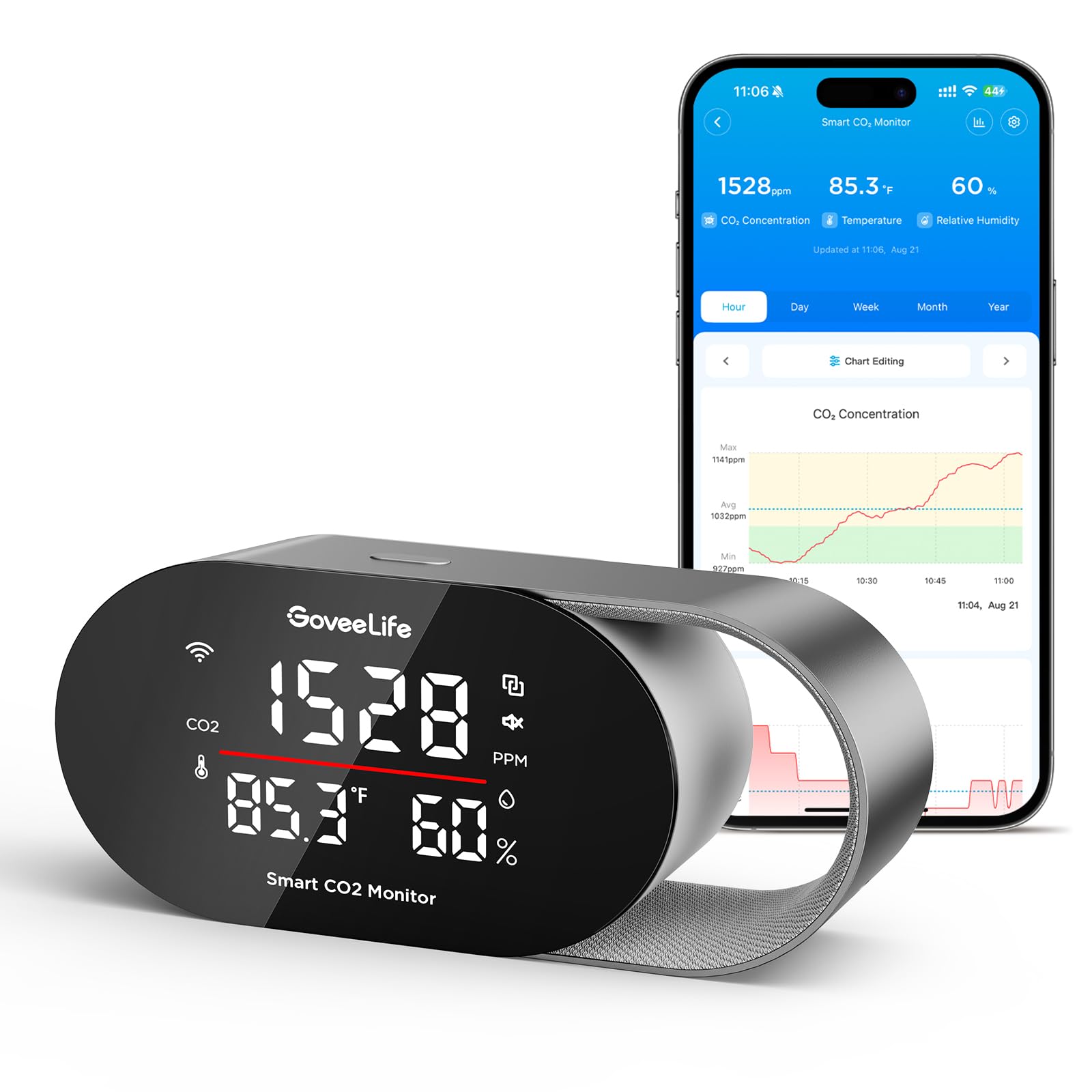
You’ll see two sensor types. NDIR (non-dispersive infrared) bounces light off the air to measure CO2, and photoacoustic sensors use sound waves created by the gas. Both are found in the models here, and both are far more reliable than cheap chemical sensors that drift out of calibration. A model like the GoveeLife uses the SCD4x sensor with accuracy of ±(40ppm + 5%), which is enough to trust the number you see.
Alert Systems: How You’ll Know It’s Bad
Some monitors just show a color change, others beep, and a few push alerts to your phone. If you want to be woken up when levels spike while you sleep, look for a built-in buzzer or app notifications. If you just need a glanceable readout, a colored light bar or display might be all you need.
Quick Comparison
| Model | Best For | Sensor Type | Display | Power | Amazon |
|---|---|---|---|---|---|
| GoveeLife H5140 | Smart home integration | SCD4x (NDIR) | 4.82-inch | AC Power | Amazon |
| Temtop CO2 Monitor | Budget-friendly basics | NDIR | Compact LCD | Battery | Amazon |
| U UNNI CO2 Monitor | Large display value | Photoacoustic | Large LCD | USB + Battery | Amazon |
| SwitchBot CO2 Detector | Wall-mount smart home | NDIR | 92mm screen | Battery | Amazon |
| Newentor CO2 Monitor | Clock + monitoring combo | Sensirion PASens | Clear Colorful | Corded Electric | Amazon |
| YNAK 16-in-1 Monitor | Big display all-in-one | Multi-sensor | 7-inch LED | 2500mAh Battery | Amazon |
| Temtop M2000 | Professional data logging | SenseAir NDIR | Color TFT | Rechargeable | Amazon |
In-Depth Reviews
1. GoveeLife Smart Air Quality Monitor CO2 Detector H5140
The smart-home CO2 monitor that turns stuffy air into a phone alert and a window-opening habit.
Working from home with the door shut turns your office into a CO2 trap. Buyers report that a home office CO2 hit 1500 with the door closed, and they felt more alert after ventilating. This GoveeLife model catches that rise with its SCD4x sensor (a photoacoustic NDIR sensor), which claims accuracy of ±(40ppm + 5%) and refreshes every 5 seconds, so you see changes fast rather than waiting for a slow average.
The 4-in-1 display shows CO2, temperature, humidity, and a clock, all on a 4.82-inch screen. Its triple alert system—a built-in buzzer, app notifications, and email reports—means you won’t miss a spike even if you’re in another room. It runs on standard AC power, so there’s no battery to recharge and the data never stops. That constant connection lets it track up to two years of history in the app, which is handy for spotting patterns.
Setup is the one friction point: several owners found the WiFi pairing tricky until they changed a phone setting. After that, the app works well, with some users noting they barely touch it after the initial setup. It also plays nicely with Alexa and Google Assistant for voice queries, and it links to humidifiers and tower fans for automatic responses.
What wins people over
- Fast 5-second refresh rate catches spikes quickly
- Triple alerts mean you never miss a high reading
- Two years of history stored in the app
Fair warnings
- WiFi setup can be finicky on first attempt
- Needs a wall outlet, so placement is limited
Reach for it if: you want a smart, connected monitor that pushes alerts to your phone and tracks long-term trends in your home office or nursery.
Consider elsewhere: if you need a portable device to move between rooms, since this one is tethered to AC power.
2. Temtop CO2 Monitor Indoor Air Quality Monitor
A featherweight monitor with months of battery life and an accuracy you’d expect from a pricier meter.
This Temtop is the one to grab if you want reliable data without chasing a wall plug. It weighs 4.96 ounces—a 6% gap lighter than the GoveeLife above—so it’s easy to move from nursery to office to car. Owners mention the battery simply doesn’t quit; it ran for months without dying, which is the whole point of a portable monitor.
Inside is a Swiss-engineered NDIR sensor with accuracy of ±40 ppm +5% in the 400–2500 ppm range, plus a 5-second refresh rate. That speed matters when you’re trying to see if cracking a window is working. One owner woke to a 3.3k PPM reading in their bedroom—a level that convinced them to buy an ERV system. The lesson is clear: this little device catches problems you might not otherwise notice.
It measures CO2 from 400 to 5000 PPM, plus temperature and humidity, and it can be silenced for sleep. The magnetic back is a small touch that owners appreciate for mounting on metal surfaces. One buyer found it “somewhat more stable” and less startling than faster-reacting meters—a fair note if you prefer a smoothed average over quick spikes.
Hands-free monitoring: set it, forget it, and check the clear display whenever you want. The main catch is no Bluetooth or app—this is a pure display device, and some users expect more for their money.
Ideal for: budget-conscious buyers who want a no-fuss, long-battery monitor for a spare room or travel.
Not for: anyone who needs app connectivity or historical data export.
3. U UNNI CO2 Monitor for Home
The large-display value pick that makes air quality readable from across the room.
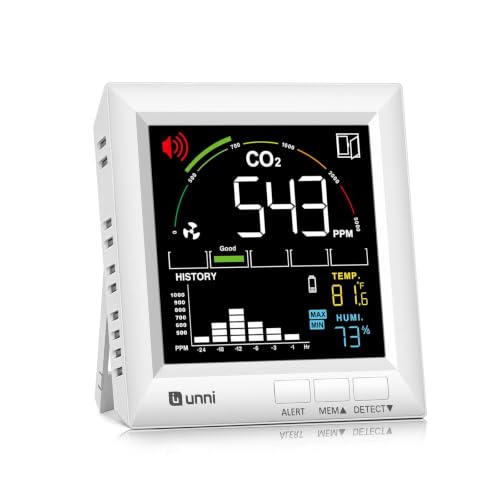
If you want to glance at your air quality from your desk rather than squinting at a tiny screen, this U UNNI monitor delivers. The large display is the thing owners praise most—63 buyers specifically call out its functionality, and 35 highlight the display for being easy to read from a distance. It uses a Swiss-made photoacoustic sensor with a detection range of 400 to 5000 PPM and accuracy of ±5% +50PPM.
This is a do-it-all device for home, RV, or grow tents. It runs on USB power to keep the backlight on 24/7, or you can switch to 3 AAA batteries (not included) for backup. The adjustable backlight and three volume levels for the alarm mean you can dial it to fit your sleep setup, and the low battery indicator removes the guesswork.
Owners note the alarm is loud and clear when CO2 crosses thresholds, and the trend graph helps you see daily patterns. One user found it sensitive—450ppm alone, 550ppm after smoking—which shows it’s picking up real changes. The trade-off: calibration needs a manual outdoor setup in a 400PPM environment, and the alarm rings for a full minute with no way to silence it early.
Glance-and-go reading: the big screen is the standout feature here. Just remember the alarm is not silencable once triggered, so place it away from where you sleep if that would bother you.
Perfect for: you if you want a wall-mountable display with clear visibility and a battery backup for power outages.
Look elsewhere if: you need app connectivity or a fully silent alarm.
4. Temtop C1+ CO2 Monitor with BLE App

A 92-millimeter screen and Swiss NDIR sensor make this van-lifer and home-smart favorite a versatile pick.
SwitchBot built this Meter Pro for people who want data without a complex setup. The 92-millimeter screen shows CO2, temperature, humidity, time, date, and comfort level all at a glance—and owners specifically praise the readability across a room or a van. One owner uses it for van living; another cross-checked it against a purifier’s sensor and found readings within 0.61% (1140 vs 1147 ppm).
The Swiss-made NDIR sensor measures every 1 second with ±50 ppm accuracy across a 400 to 9000 ppm range, which is the widest span in this lineup. That means it tracks both gentle rises and extreme spikes without pegging out. Battery mode samples every 5 minutes to stretch life past a month, and when plugged in it updates every minute.
The smart-home angle is real: it integrates with Home Assistant easily, and Bluetooth works across floors. Phone alerts require a separate SwitchBot Hub, which is an extra purchase to factor in. Owners also note the app graphs can be slow to update, so it’s not the best for real-time trend chasing.
The strengths
- Fast 1-second CO2 sampling when powered
- Huge 92mm display readable from a distance
- Works with Home Assistant for automation
The catches
- Phone alerts need a separate hub purchase
- App graphs are delayed and glitchy for some
Choose it if: you want a large, wall-mountable display with automation potential in your home or a van.
skip it if: you don’t want the extra cost and setup of a hub for phone notifications.
5. Newentor CO2 Monitor Indoor Air Quality Meter

Measures CO2, tracks humidity, and acts as a clock and alarm in one compact bedside unit.
This Newentor pulls triple duty. Beyond CO2, it’s a real-time temperature and humidity monitor, a clock, and a programmable alarm. Owners who found low humidity in their home traced it to a broken furnace humidifier—this device gave them the data to fix it. It also helps you gauge ventilation during gatherings, alerting when levels exceed 1000 ppm.
The sensor uses Swiss Sensirion’s PASens technology (a photoacoustic technique) for reliable readings across a wide range. It runs on USB power to keep the display lit, or on battery with a timeout. The display is vivid, and a touch sensor toggles brightness levels—bright, medium, or off. Customers note it’s accurate and fast on AC power, dropping to ~400 ppm with windows open and rising to ~1500 at night without ventilation.
Calibration is worth noting: one owner needed a manual outdoor recalibration to get from 550 ppm down to 400 ppm. Another found the AAA battery requirement a drawback, preferring a rechargeable option. It also lacks WiFi, so data stays on the screen only—no app trends to scroll through.
Functional all-rounder: the clock-plus-monitor combo earns its spot on your desk. Just budget a moment for initial calibration, and know there’s no WiFi app.
Suits: anyone who wants a bedside air quality monitor that doubles as a clock and alarm.
Not ideal: for smart-home users who need remote access or automatic alerts.
6. YNAK 16-in-1 Air Quality Monitor with 7″ Display
A 7-inch LED screen that shows every pollutant at once, with 8 hours of cordless battery backup.
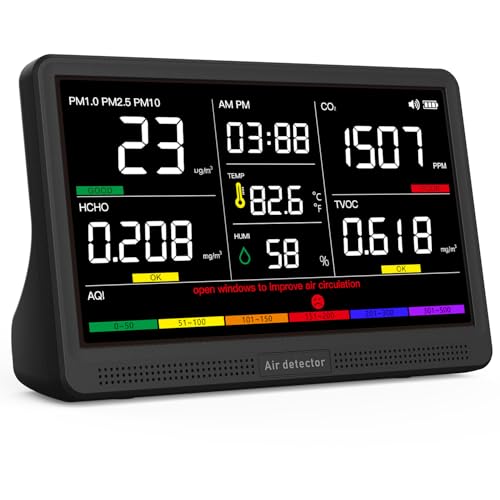
If you want to stop juggling multiple gadgets, this 16-in-1 monitor puts everything on one bright 7-inch LED display. It tracks CO2, PM2.5, PM1.0, PM10, HCHO (formaldehyde), TVOC, temperature, humidity, and AQI with 7 distinct alert functions. Owners love that it shows all readings simultaneously—no menu diving required—and call the 7-inch screen “huge and clear.”
The 2500mAh battery gives up to 8 hours of cordless use, so you can carry it room to room or rely on it during a power blip. It’s wall-powered with a battery backup, so the display stays on. The temp/humidity sensor holds accuracy of ±1 to ±3 °F and ±2% to ±3% RH, and one owner confirmed the time stayed accurate against a phone over a month.
The honest caveat comes from the company itself: it’s built for general monitoring, not medical-grade use. One owner returned it because of odd readings and was told by support to seek a medical-grade device for asthma concerns. For general air watching—cooking smoke, candles, open windows—it responds fast and honestly.
Why it stands out
- Massive 7-inch display makes every reading glanceable
- 8 hours of battery for portable checks
- No app needed for full functionality
Keep in mind
- Not a medical-grade instrument
- Sensors may need outdoor recalibration
Best for: families who want one big display to watch multiple pollutants without an app.
Consider something else: if you have a respiratory condition and need lab-accuracy monitoring.
7. Temtop M2000 Professional CO2 Detector
An 8-in-1 professional monitor with data export for those who take air quality seriously.
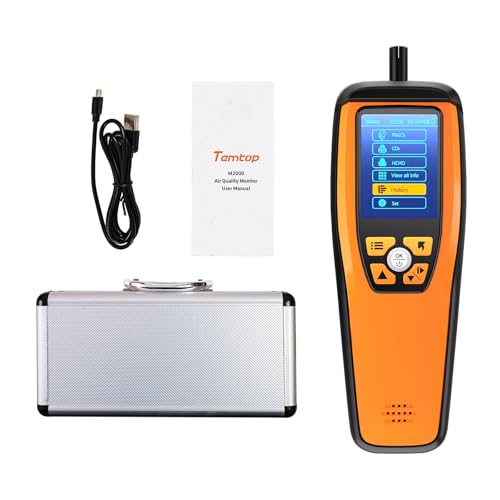
This is the heavyweight of the lineup. The M2000 2nd Generation pairs a SenseAir NDIR CO2 sensor with a Dart HCHO sensor and a professional-grade particle sensor, covering CO2, PM2.5, PM10, formaldehyde, temperature, and humidity. Owners describe it as feeling “high-end” with solid buttons and premium build—and it responds every 2 seconds, so you see changes almost instantly.
Where it truly separates itself is data. You can export full logs via USB—including CO2, PM2.5, PM10, HCHO, particles, temperature, and humidity—and the internal RAM holds more than 3 months of continuous logging. One owner specifically wants minute-by-minute logging, a feature they found unique among reasonably priced counters. It’s a genuine diagnostic tool, not just a display.
There are quirks. The formaldehyde sensor cross-reacts with alcohols—one owner found it detects wine like a breathalyzer. Another unit stopped giving accurate particle readings after two weeks, though the replacement worked well, and the seller was responsive. It’s also the priciest here by a wide margin, so it’s for buyers who need exportable data or professional-grade monitoring over casual use.
Data-driven diagnostics: if you need to log and export air quality over weeks, this is the pick. The trade-offs are cost and a sensor that has opinions about your wine collection.
Worth it for: researchers, chronic respiratory sufferers, or anyone tracking air quality trends with serious data.
Overkill for: casual users who just want a glanceable CO2 number in the living room.
Understanding the Specs
PPM: What the Number Means
PPM stands for “parts per million.” Outdoor air typically sits around 400 ppm. Indoors, anything above 1000 ppm can start to feel stuffy, and higher levels can cause drowsiness or headaches. The monitors here measure from around 400 up to 5000 or even 9000 ppm, so the number tells you how much carbon dioxide from your breathing is building up without fresh air.
NDIR vs Photoacoustic Sensors
NDIR (non-dispersive infrared) sensors shine a light through the air and measure how much CO2 absorbs it. Photoacoustic sensors use sound waves instead. Both are accurate, but NDIR is the older, more proven technology while photoacoustic sensors can be smaller and cheaper. What matters is the accuracy spec—look for something around ±50 ppm or ±5% of the reading for reliable data.
FAQ
What is a safe CO2 level in a bedroom?
Can a CO2 detector detect gas leaks or carbon monoxide?
How often should I calibrate my CO2 monitor?
Is battery or plug-in power better for a CO2 monitor?
What is the difference between NDIR and photoacoustic sensors?
Will a CO2 monitor work in a car or grow tent?
Why does my monitor show high CO2 in a room with several people?
Can I connect my CO2 monitor to smart home systems?
How long do CO2 monitor sensors last?
Does a CO2 monitor help with sleep quality?
Final Thoughts: The Verdict
The co2 detector for home winner is the GoveeLife H5140 because its fast 5-second refresh, triple alert system, and app history make it the most complete home monitor. If you want portability and months of battery life, grab the Temtop portable. And for the data-obsessed or those with respiratory concerns, the Temtop M2000 is the one to reach for.
How We Picked
We do not accept paid placement. Every pick is matched to a real buyer and a real use-case; we do not hands-on test units.
Sources & Methodology
Specifications: manufacturer listings and product documentation. Review insights: verified customer reviews, as of August 2026. Pricing: not shown on this page (it changes often); check the current price via the retailer link.
As an Amazon Associate, FitlyFast earns from qualifying purchases. This does not affect which products we feature.