
Our readers keep the lights on and the weekend projects moving. As an Amazon Associate, I earn from qualifying purchases.
Specs are compiled from manufacturer listings and verified buyer reviews and can change over time — please confirm the key details on the product page before buying.
Fresh-roasted coffee isn’t just a trend — it’s the difference between a bitter, flat cup and one that bursts with the flavors locked inside the green bean. The problem is that most home setups either over-roast, under-roast, or fill your kitchen with smoke. This guide breaks down the real trade-offs between fluid-bed, drum, and gas-powered roasters to match your gear to your coffee habits.
I’m Rikta — the founder and writer behind FitlyFast. This guide is built by comparing the manufacturers’ published specifications and the patterns across verified customer reviews, so you get each pick’s real strengths and trade-offs instead of marketing spin.
Match batch size, heat control, and smoke management to your countertop and daily cup. A countertop fluid-bed unit (which roasts beans in a stream of hot air) suits small batches, while a drum roaster (which tumbles beans in a rotating heated drum) handles bigger yields.
Our Picks at a Glance


How To Choose The Best Coffee Roasting Equipment
Choosing a roaster is really about matching three things: how much coffee you drink, how much control you want, and where you’re willing to roast. A machine that roasts 100g per batch will keep one person happy, while a family or small office will want something closer to 400–500g to avoid roasting every other day.
Match the Batch Size to Your Habit
Batch capacity is the first number you should check. Small fluid-bed roasters handle 120–180g per batch — enough for a few days of coffee. Drum roasters with 400–750g capacity suit weekly roasting for a household. If you’re roasting for a business, you’re looking at machines with 1kg capacity or more. Pick a batch size you’ll actually use; too-large roasters cooled down too quickly can bake the beans.
Decide How Much Control You Want
Beginners often want a machine with preset profiles, while experienced roasters need adjustable heat and fan settings to chase specific flavor notes. Look for a clear temperature display and a timer. Machines with variable heat and fan control let you ease into first crack (the audible pop where beans expand) and stop the roast precisely where you like it.
Quick Comparison
| Model | Best For | Batch Size | Heat Source | Control Type | Amazon |
|---|---|---|---|---|---|
| Fresh Roast SR800★ Best Overall | Home beginners | 170–226g | Fluid-bed (hot air) | Manual heat & fan | Amazon |
| ANGELLOONG Coffee RoasterBest Value | Nuts & multi-food | 750g | 1200W electric | Timer + temp dial | Amazon |
| DYVEE Gas Burner RoasterOutdoor Pick | Outdoor propane use | 300–400g | Gas burner | Manual | Amazon |
| Fresh Roast SR540 | Small-batch starter | 120g | Fluid-bed (hot air) | Manual heat & fan | Amazon |
| ICZW Drum Roaster 14.5L | Heavy batch volume | 3.5–4kg | Gas stove | Manual speed | Amazon |
| MAGO MAGA Roma Pro | Smart auto/manual | 300g | Fluid-bed (hot air) | Auto & manual | Amazon |
| NIASIA PKF-500g | Serious home roasters | 350–500g | Electric drum | 9 auto profiles + manual | Amazon |
| Sandbox Smart R1 | App-based control | 100–150g | Electric direct-fire | App + manual | Amazon |
| Precision 1kg Roaster | Small business | 1kg | 240V 2000W hot air | 10 auto profiles + Artisan | Amazon |
In-Depth Reviews
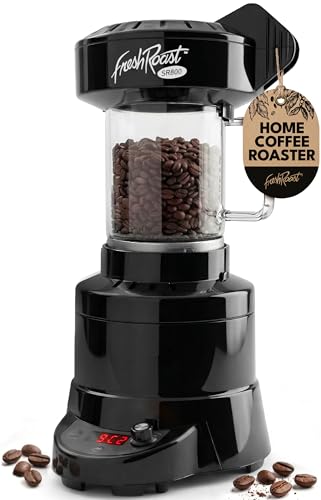
1. Fresh Roast SR800 Coffee Roaster
Our pick — over 4★ from 550+ verified ratings; the strongest balance of quality and price.
The fluid-bed favorite that roasts 170–226g per batch and hands you manual heat and fan control.
The Fresh Roast SR800 is the go-to for home roasters who want real control without a huge footprint. It roasts 6–8 oz (170–226g) per batch, which buyers report comfortably handles even a bit more. The nine-level power settings and convection fan control let you adjust the roast as the beans change color — a level of manual control that experienced roasters say beats single-profile programming.
You get a full batch of 14–28 cups in under 10 minutes thanks to the speed roast fluid motion system (which circulates beans in hot air). The real-time temperature display lets you track the roast, but a few owners say the built-in meter can be inaccurate and recommend an infrared temp gun (a handheld device that reads surface heat) for precise readings. Holding 350–370°F before first crack (the beans’ first audible pop) boost sugar development. The controls are a single knob you push and turn, which some find unintuitive at first.
What wins people over is the consistent roasting performance and the ability to dial in exactly the profile you want. Owners mention that the chaff catcher rim can crack if you tap it too hard, so treat it gently and clean with compressed air after cooling. At 6.2 pounds, it’s easy to move around, and it’s backed by a USA family-owned company with close customer communication.
What owners love
- 170–226g per batch vs 120g on smaller units
- Nine-level power settings give precise control
- Fast roasts — under 10 minutes for 14–28 cups
What to know
- Chaff catcher rim can crack if handled roughly
- Built-in temp meter may read inaccurate — use a probe
- Single-knob controls take some getting used to
Reach for this if: you want the best combination of batch size, manual control, and speed for a 2–3 drinker household.
Look elsewhere if: you need a machine that roasts 500g or more per batch without babysitting.
2. ANGELLOONG Coffee Roaster Machine 110V 1200W
A budget-friendly drum roaster with a massive 750g batch and a transparent lid for watching color changes.
The ANGELLOONG delivers serious batch capacity at an entry-level price. It roasts up to 750g (1.65 lb) of green beans in about 25 minutes with automatic stirring for even heating. The 1200W heating element and 212–464°F temperature control give you a wide window to work with, from light to dark roasts. At 6.8 pounds versus 6.2 pounds for the Fresh Roast SR800, it’s slightly heavier, but the bigger drum means far fewer batches.
Buyers love the transparent heat-resistant lid with four vent holes, so you can watch the beans change color in real time. The honeycomb pan with black Teflon coating (a non-stick surface) reduces sticking and wipes clean with a damp towel. A recurring note from owners is that reliability is the trade-off at this price — some report the machine lasting one to two years, with one buyer summing it up: “1-2 year life is all that should be expected.”
That honesty matters. If you roast once a week, the value is tough to top. The same machine roasts peanuts, chestnuts, barley, dried fruit, and popcorn, making it a versatile kitchen tool. Just plan to use it in a well-ventilated area, as there’s no smoke filtration built in.
Why it’s a bargain
- 750g batch capacity is huge for the price tier
- Automatic stirring gives even heat distribution
- Transparent lid lets you watch the roast
Consider this
- Durability is the main concern — some units last 1–2 years
- Heating element failures are the most-reported issue
- No smoke filter, so ventilation is required
Who it’s for: budget-conscious roasters who want large batches and don’t mind replacing a budget unit every couple of years.
Who should skip: anyone who roasts daily and needs commercial-grade longevity.
3. DYVEE Gas Burner Coffee Roasting Machine 400g
A solidly built gas-powered drum roaster for anyone who prefers roasting outdoors over a propane burner.
If you’re happy to roast outside, the DYVEE G400 turns a propane burner into a real roasting setup. The quartz glass drum lets you watch the beans transform from green to your desired roast level, and you can stop at first or second crack by adjusting the gas flame. The 304 stainless steel frame and base, plus a wooden handle, are built to take heat.
The recommended batch is 200–300g for best results, though some owners push it higher. A 12V motor keeps things safer than higher-voltage machines, and the power adapter is included. The main trade-off is ease of use — owners describe the thermometer as useful but clumsy, and the glass drum needs gentle handling to remove. It also produces chaff that blows around, so it’s really an outdoor tool.
Buyers who roast weekly over propane love the consistent results. The smoke is a non-issue outdoors, and the direct gas heat gives a different flavor profile than hot-air roasting. It measures 43 x 21 x 21.5cm and weighs 17 pounds, so it’s portable enough to move to the patio but not a countertop appliance.
What stands out
- Quartz glass drum shows the full roast in real time
- 304 stainless steel frame built to last
- 12V low-voltage motor adds safety
Keep in mind
- Glass drum requires careful removal and cleaning
- Thermometer mount is awkward to use
- Chaff blows around — outdoor use essential
Best for: weekend roasters with a propane setup who prioritize visibility and build quality over convenience.
Think twice if: you plan to roast indoors or want a set-and-forget machine.
4. Fresh Roast SR540 Automatic Coffee Bean Roaster
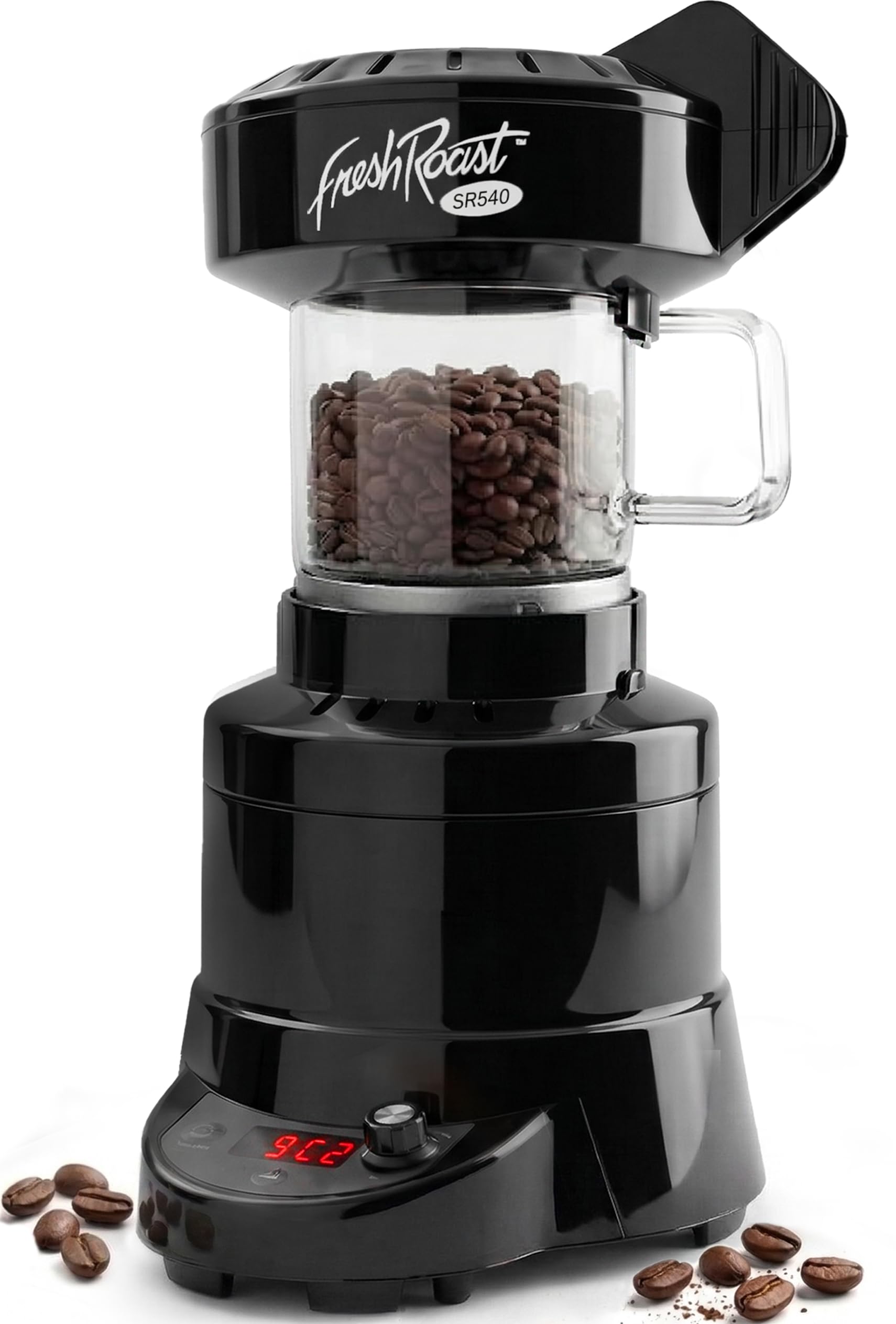
The smaller sibling that keeps the manual heat and fan control for hobbyists who roast just for themselves.
The Fresh Roast SR540 is the entry point to the family that the SR800 sits above. It roasts up to 4 scoops, or 120 grams, per batch — enough for 7–14 cups of coffee in under 10 minutes. The nine-level power settings and convection fan control carry over from the SR800, so you get the same adjustability in a more compact, budget-friendly package.
Owners consistently describe it as beginner-friendly with great results from light to espresso roast. The glass roasting chamber is easy to clean, and the chaff basket does its job. Adjustability is the double-edged sword: some praise the precise control over heat, while others find the settings tricky to dial in. One owner, with hundreds of batches since 2021, gets consistent espresso roasts at 430–460°F in 14–16 minutes.
The one honest caveat is durability — the analog knob can become less reliable over time, though the manufacturer has been known to send free replacement motherboards even after the warranty period. It’s heavier than it looks at 2.56 kg, giving it a solid feel. For a single drinker or couple, the 120g batch is the real daily-driver size.
Why it clicks
- Great beginner learning curve with manual control
- 120g batch fits a daily-drinker routine
- Consistent roasts from light to espresso
Watch out for
- Analog knob may become unreliable over time
- Some find it can’t get hot enough for very dark roasts
- Settings take practice to master
Reach for this if: you’re starting out and want the same control as the SR800 at a smaller batch size.
Look elsewhere if: you need to roast for more than two people or want programmable, set-and-forget profiles.
5. ICZW 14.5L Gas Burner Drum Roaster

A 14.5-liter gas drum that roasts nearly 4kg per batch for ambitious home and small commercial use.
The ICZW drum roaster is for the person who wants serious volume. With a 14.5L capacity, it roasts about 3.5–4.0kg (7.7–8.8 lbs) of beans per batch over a gas stove. The stainless steel construction and external motor make it durable and easy to maintain, with cooling holes and double baffles inside the drum for even rotation.
What makes this different from the electric options is its raw scale — this isn’t a countertop machine. It’s a tool you place over a gas flame and monitor. The included thermometer helps with temperature control, but buyers warn about a few real issues: there is no switch or speed control, the flat drum design can let beans fall out, and some units suffer from poor shaft and bearing alignment. These are concerning enough that one owner reports melted bearings after a single use.
For all its flaws, the capacity is exceptional for the money, and it handles coffee beans, peanuts, nuts, and soybeans with diameters larger than 2mm. the balance for this machine is a home user or small vendor who needs bulk roasts and is willing to work around its quirks, watch it closely, and perhaps add their own zip-tie or alignment fixes.
The upside
- Massive 3.5–4kg batch capacity
- Stainless steel for durability and easy cleaning
- External motor is convenient for maintenance
The catch
- No switch or speed control on some units
- Flat drum can let beans escape
- Reports of bearing and motor failures
Who it’s for: bulk roasters who want maximum capacity per dollar and are comfortable with a hands-on, high-maintenance machine.
Who should skip: anyone who wants a reliable, warrantied roaster for daily use.
6. MAGO MAGA Roma Pro Smart Home Coffee Roaster
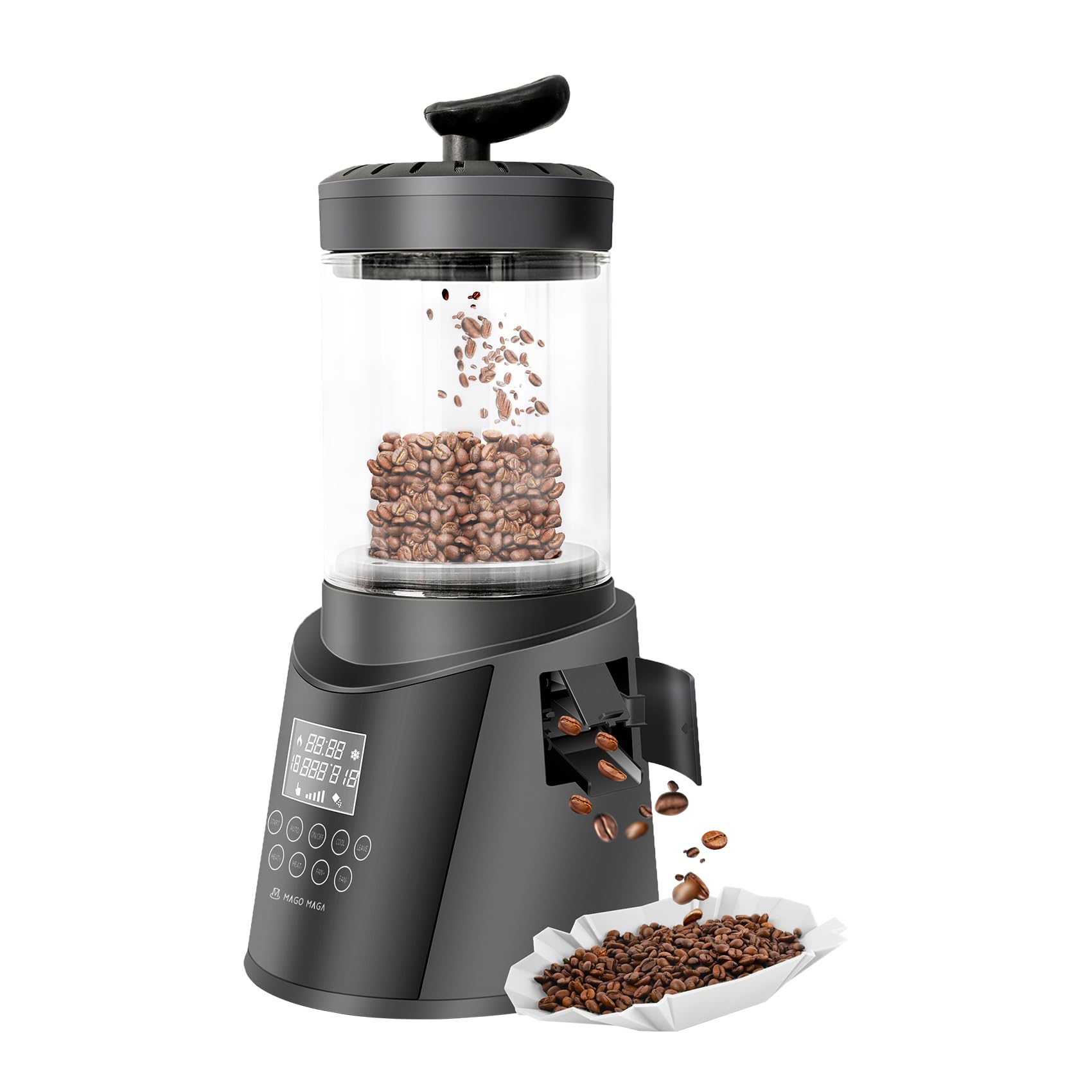
A smart, app-era fluid-bed roaster that switches between auto profiles and full manual control.
The Roma Pro positions itself as the bridge between set-and-forget convenience and hands-on control. It roasts up to 300g per batch, with an auto mode that handles most regular green beans and a manual mode for precise control over personalized profiles. The digital display switches freely between Celsius and Fahrenheit, and it roasts green coffee beans only — not a coffee maker.
What impresses most is the ease of use; owners find it the easiest fluid-bed roaster to operate, with consistent even roasts for beans like Ethiopian and Colombian varieties. The double-layer glass window gives a clear view, and auto-cooling quickly locks in flavor. It holds the 2025 SCA Best New Product Award and CE/ETL safety certifications.
The honest mixed note concerns reliability — some units perform beautifully for months, while others decline after a few months or need the bean bin door switch improved, which version 1.6 addresses. It’s worth knowing that auto profiles run a bit slow on 120V US power, and the 300g max is more reliable around 250g. The company’s customer service, however, gets strong praise for quick replacements.
What wins people over
- Incredibly easy to use with auto/manual modes
- 300g batch handles a week of coffee
- Ultra-low smoke with efficient chaff collection
What’s mixed
- Reliability varies — some units decline after months
- Auto profiles run slow on 120V power
- 300g max is more reliable around 250g
Best for: beginners who want a smart, low-smoke roaster with the option to grow into manual control.
Think twice if: you need industrial-grade reliability or roast larger batches regularly.
7. NIASIA PKF-500g Automatic Coffee Roaster

A 500g drum roaster with nine built-in profiles and a serious smoke-filtration system for home pros.
The NIASIA PKF-500g is the upgrade path for serious home roasters who’ve outgrown small fluid-bed machines. It roasts up to 500g per batch, though the balance is 350–400g. The nine automatic roasting profiles cover light, medium, and dark roasts, plus specific profiles for sun-dried, washed, and honey-processed beans — just select the code and let it run.
Experienced roasters praise the real preheat capability, the sampling spoon, and the excellent chaff collection. The separate high-speed cooling tray quickly drops the bean temperature to lock in flavor. A 25-year roaster even paired it with TC4/Artisan software for full computer control. The smoke management is its party piece: a smoke purifier for light roasts, plus two aluminum alloy pipes to vent smoke outdoors for medium and dark roasts.
The trade-offs are the learning curve and some build quirks. The auto mode can over-roast if you walk away, and the manual mode is confusing at first. Customers note the head-unit wire is fragile and the manual is mediocre. The 110V version is best with 250g batches for accurate temperature probe readings. It’s not recommended for commercial use — frequent roasting reduces component lifespan.
Why pros like it
- 500g batch with real preheat and cooling tray
- 9 profiles for different bean processes
- Excellent chaff collection and smoke control
What holds it back
- Manual mode has a steep learning curve
- Head-unit wire is fragile
- Not meant for daily commercial use
Reach for this if: you’re an experienced roaster who wants larger batches and serious smoke management at home.
Look elsewhere if: you want a simple, beginner-friendly machine or plan to roast for a business daily.
8. Sandbox Smart R1 Home Coffee Roaster

A direct-fire roaster that puts your roast history, community recipes, and 16 curves in your pocket.
The Sandbox Smart R1 is the most app-forward roaster here. It roasts 100–150g of beans in about 15 minutes, guided step-by-step through the Sandbox Smart Roaster app. Your roast profiles are automatically saved, and there are 16 built-in roasting curves from light to dark, plus community-shared recipes. Manual mode gives experienced users adjustable power and fan speed.
The quality is genuinely good — buyers describe consistent medium and light roasts with customizable profiles. The drawer that collects silverskin (the papery chaff) makes cleanup easy, and the cooling tray keeps your space tidy. The direct-fire electric heating gives a clean, controllable roast in a compact footprint, with a 1-year warranty included.
Where it gets complicated is the app ecosystem. Reviewers point out the app isn’t the most intuitive, with poor color contrast on heating curves. More critically, some app-controlled features have been moved behind a VIP paywall after purchase, and the company’s Kickstarter model has raised concerns about long-term support. It’s a capable roaster, but one to buy with open eyes about the software dependency.
What’s impressive
- 16 preloaded roasting curves plus custom profiles
- App saves your roast history automatically
- Silverskin drawer makes cleanup fast
What’s concerning
- App-only control — no PC app
- Features locked behind a VIP subscription
- Drum latch issues reported by some owners
Who it’s for: tech-savvy roasters who enjoy app-guided roasting and want a compact, quality machine.
Who should skip: anyone who hates subscription paywalls or wants a standalone roaster with physical controls.
9. Precision 1kg Commercial Electric Coffee Roaster
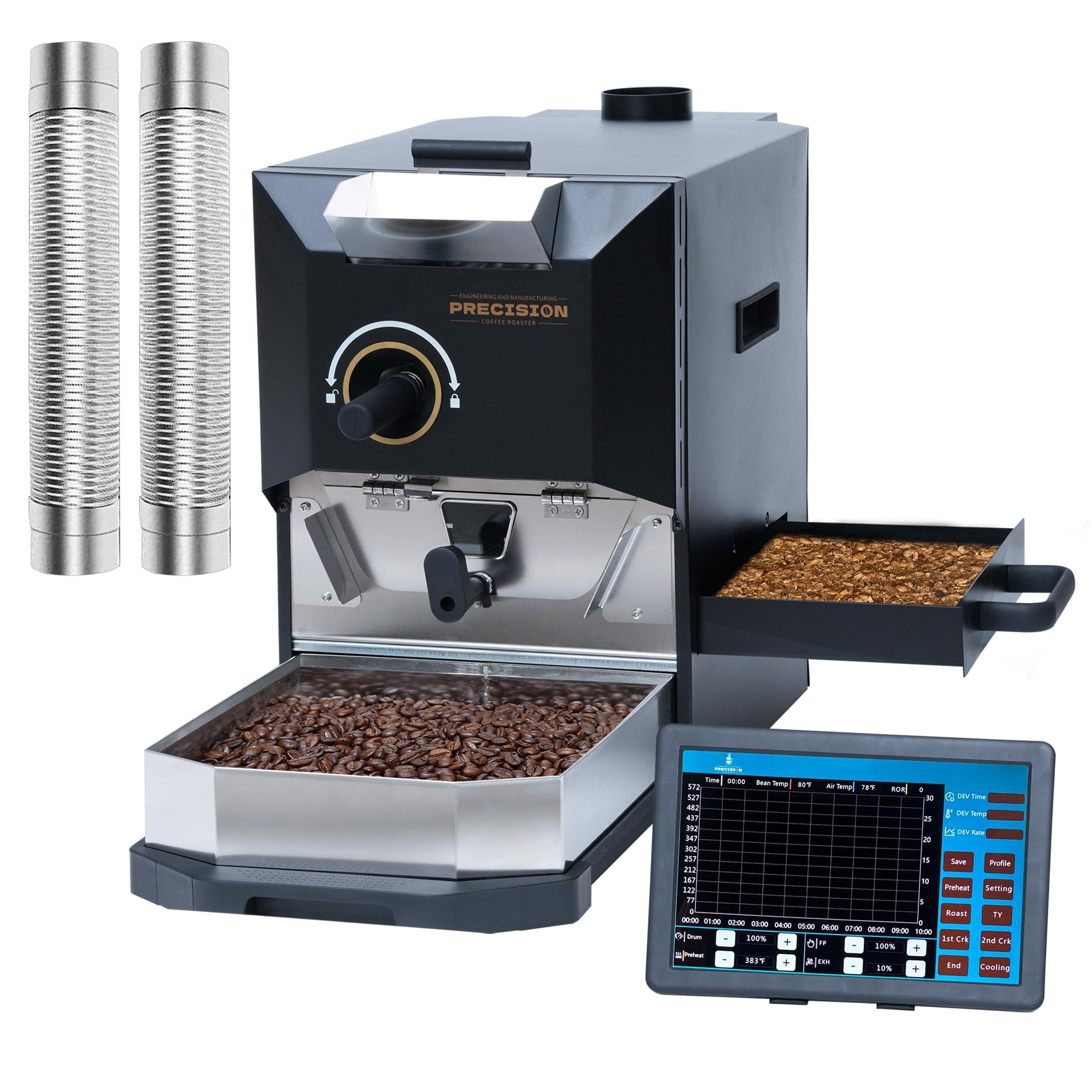
A 1kg hot-air drum roaster with a 10.1-inch touchscreen and Artisan software for serious coffee businesses.
The Precision 1kg roaster is the commercial-grade option for startups, small cafes, and serious home roasters. It runs on 240V 2000W with a NEMA 6-15 plug, and its enhanced bearing motor paired with a siphon exhaust fan supports continuous roasting up to 20kg (44lbs) of green beans per day. The all-metal, high-temperature-resistant front panel is built for daily commercial use.
The 10.1-inch HD LCD display gives you real-time temperature, curve, and process visualization — a level of visibility that rivals machines costing far more. It has 10 preset automatic roasting profiles and connects with Artisan software for curve import and export, plus manual profile saving. Buyers find the auto mode produces excellent, even roasts in about 5 minutes of cool-down.
At 70 pounds, this is a stationary machine, and it’s not for beginners — the pro-like heat and fan control has a modest learning curve. Some shoppers say the control module can be unreliable, so it’s worth understanding the warranty terms. For an intermediate roaster or small business, the value compared to pricier rivals is the main draw.
The heavy hitter
- 1kg batch with 20kg daily capacity
- 10.1-inch LCD for full process visualization
- 10 auto profiles plus Artisan compatibility
The fine print
- Control module reliability is mixed
- 70-pound unit needs a permanent spot
- Not for beginners — real learning curve
Best for: small businesses and serious home roasters who need commercial-grade volume and data-driven control.
Think twice if: you’re new to roasting or want something that can be tucked into a cabinet between batches.
Understanding the Specs
Batch Capacity
This is the most important number to match to your habit. Machines range from 120g (a few days of coffee) to 1kg (small commercial). A too-large drum for a small batch cooks unevenly, so bigger isn’t always better. Choose capacity based on how often you plan to roast.
Heat Source and Control
Fluid-bed roasters use hot air, which is fast, even, and great for beginners — but can be smoky. Drum roasters use direct heat, giving deeper flavor development. Look for variable temperature control, measured in degrees Fahrenheit or Celsius, and a timer to track the roast.
Smoke and Chaff Management
Roasting creates smoke and papery chaff (silverskin). Entry-level machines expect you to roast near a window or outdoors. Mid-range and premium machines add chaff collectors, smoke purifiers, or exhaust pipes. If you roast indoors, this spec decides whether your kitchen smells like a coffee shop or a fire.
Auto Profiles vs. Manual Control
Auto profiles let you select a light, medium, or dark roast and walk away — perfect for beginners. Manual control over heat and fan speed is for experienced roasters chasing specific bean profiles. Many machines offer both, letting you grow into the craft.
FAQ
What size roaster do I need for home use?
What is the difference between fluid-bed and drum roasting?
Can I roast coffee indoors without smoke filling my kitchen?
How long does a batch of coffee take to roast?
What is first crack and why does it matter?
Is a gas-powered roaster better than an electric one?
How much coffee can I roast at once with a 1kg roaster?
Do I need a roaster that connects to an app?
Final Thoughts: The Verdict
For most people, the coffee roasting equipment winner is the Fresh Roast SR800 because it delivers the best balance of batch size, manual control, and speed for the home roaster — a crowd favorite with a strong 4.4-star average. If you want a budget-friendly machine with huge 750g capacity, grab the ANGELLOONG. And for small businesses needing commercial-grade volume with full data control, the Precision 1kg roaster is the one to reach for.
How We Picked
We do not accept paid placement. Every pick is matched to a real buyer and a real use-case; we do not hands-on test units.
Sources & Methodology
Specifications: manufacturer listings and product documentation. Review insights: verified customer reviews. Pricing: not shown on this page (it changes often); check the current price via the retailer link.
As an Amazon Associate, FitlyFast earns from qualifying purchases. This does not affect which products we feature.