
Our readers keep the lights on and the weekend projects moving. As an Amazon Associate, I earn from qualifying purchases.
Specs are compiled from manufacturer listings and verified buyer reviews and can change over time — please confirm the key details on the product page before buying.
The moment your starter ink runs dry is the moment you discover a color printer’s real cost. The single biggest decision in this category isn’t print speed or brand — it’s how you’ll pay for ink month after month, year after year. This guide cuts through the marketing to the one question that decides everything: cartridge printer or refillable tank?
I’m Rikta — the founder and writer behind FitlyFast. This guide is built by comparing the manufacturers’ published specifications and the patterns across verified customer reviews, so you get each pick’s real strengths and trade-offs instead of marketing spin.
You want a color printer scanner for home that handles school projects, home-office documents, and photo prints without draining your wallet on ink later. The upfront price matters, but so does the cost of replacement cartridges over time.
Our Picks at a Glance


How To Choose The Best Color Printer Scanner For Home
Start with your monthly print volume. A family printing homework, coupons, and the occasional photo might only need 50 pages a month. A home business churning out hundreds of pages needs a completely different machine. Your volume dictates which ink system makes sense.
Cartridge vs. Ink Tank: The Real Cost Difference
Cartridge printers are cheaper at the register, but each replacement set of ink costs a significant chunk of the printer’s original price. Ink-tank printers cost more upfront but come with bottles of ink that last for thousands of pages — the Canon MegaTank promises up to 6,000 black pages from one set of included inks. If you print regularly, tank technology wins on running costs.
Speed, Scanning, and the ADF Factor
Pages-per-minute (ppm) matters when you’re printing a 20-page report, but for home use the difference between 14 ppm and 21 ppm is a few seconds. What matters more is the scanner. A flatbed is essential for photos and books; an automatic document feeder (ADF) lets you stack a pile of pages and have them scanned or copied hands-free. For a busy home office, that one feature is worth the upgrade.
Quick Comparison
| Model | Best For | Print Speed (B&W) | Ink System | Duplex / ADF | Amazon |
|---|---|---|---|---|---|
| Canon PIXMA TR7120★ Best Overall | Budget value & versatility | 14 ppm | Cartridge (2-cartridge) | Auto / Yes | Amazon |
| Epson Workforce Pro WF-3823Fast & Focused | Fast home-office printing | 21 ppm | Cartridge (pigment) | Auto / Yes (35-page) | Amazon |
| Brother MFC-J1410DW | Home office & cloud scanning | 16 ppm | Cartridge (LC501) | Auto / Yes (20-sheet) | Amazon |
| Canon MegaTank G3270 | Lowest cost per page | 11 ppm | Refillable tank | No / No | Amazon |
| Epson EcoTank ET-2980 | High-volume cost savings | 15 ppm | Refillable tank | Auto / No | Amazon |
| Brother MFC-L3720CDW | Professional color output | 19 ppm | Laser toner | Auto / Yes (50-sheet) | Amazon |
In-Depth Reviews
1. Canon PIXMA TR7120
Our pick — over 4★ from 400+ verified ratings; the strongest balance of quality and price.
The everyday all-in-one that does everything well without asking a premium.
The Canon PIXMA TR7120 earns the top spot because it nails the essentials for a typical home. It prints crisp text and vibrant photos thanks to its 2-cartridge hybrid ink system, and the 1.42″ monochrome OLED screen keeps ink levels and settings readable at a glance. Owners have hammered it with heavy use — some report printing 500 pages without a single jam — which speaks to its reliable build for the price.
Its defining strength is versatility. The Auto Document Feeder (ADF) lets you stack a pile of pages and walk away while it scans or copies them in order — a feature usually reserved for pricier office machines. Add automatic 2-sided printing to cut paper use, and you have a workflow that saves you time and money on every multi-page job. Mobile printing works through the Canon PRINT app, Apple AirPrint, and Mopria Print Service, so your phone or tablet is a full remote control.
The trade-off is the starter ink, which owners say runs out quickly — the included demo cartridges are meant to get you going, not last. The 14 ppm black speed is solid for home use, though it trails the faster Epson below at 21 ppm. For most households that print documents, school projects, and the occasional photo, this is the balanced pick that doesn’t overreach.
What wins people over
- Auto duplex saves paper on every multi-page job
- ADF means hands-free batch scanning and copying
- Crisp text and vivid colors from the hybrid ink system
- Easy mobile printing via Canon PRINT, AirPrint, and Mopria
Know before you buy
- Starter ink cartridges run out quickly
- Small paper tray holds roughly 50–100 sheets
Reach for this if: you want one affordable machine that prints, scans, and copies well for a typical home or hybrid-work setup.
Look elsewhere if: your print volume is huge — a refillable tank model will save you far more on ink.
2. Epson Workforce Pro WF-3823
The speed demon for a busy home office that hates waiting at the printer.
If your bottleneck is time, the Epson Workforce Pro WF-3823 is the fastest inkjet here. It rips through black documents at 21 ppm and color at 11 ppm — that’s 50% faster black printing than the Canon TR7120’s 14 ppm, and 22% faster color than the Canon’s 9 ppm. First page out is quick too, so you’re not staring at a spooling spinner. A 250-sheet paper capacity means you refill less often during big jobs.
It’s built with Epson’s PrecisionCore Heat-Free Technology and DURABrite Ultra instant-dry pigment inks, which means professional-looking documents that don’t smudge the moment they leave the tray. The 35-page ADF streamlines scanning stacks of paper, and the 2.7″ color touchscreen makes navigation simple. Setup is genuinely approachable — some less tech-savvy owners set it up entirely on their own using the included DVD.
The honest catch is that this printer is designed to use Epson Genuine Cartridges exclusively, and buyers report that non-genuine ink can cause issues the warranty won’t cover. A few owners have hit cartridge acceptance problems even within the first year, so stick with genuine Epson ink to stay safe. It’s a cartridge machine, so running costs are higher than a tank printer — but for a home office that values speed and crisp output, it delivers.
Speed-first verdict: The WF-3823 is the pick for high-volume home offices where minutes matter more than ink-penny-pinching.
Worth noting: Owners mention great 100+ page runs on the starter ink, but genuine-cartridge-only design means no cheap third-party refills.
Best suited to: busy households or home businesses printing many multi-page documents daily.
Think twice if: you plan to use third-party ink — this printer is built exclusively for Epson Genuine cartridges.
3. Brother MFC-J1410DW
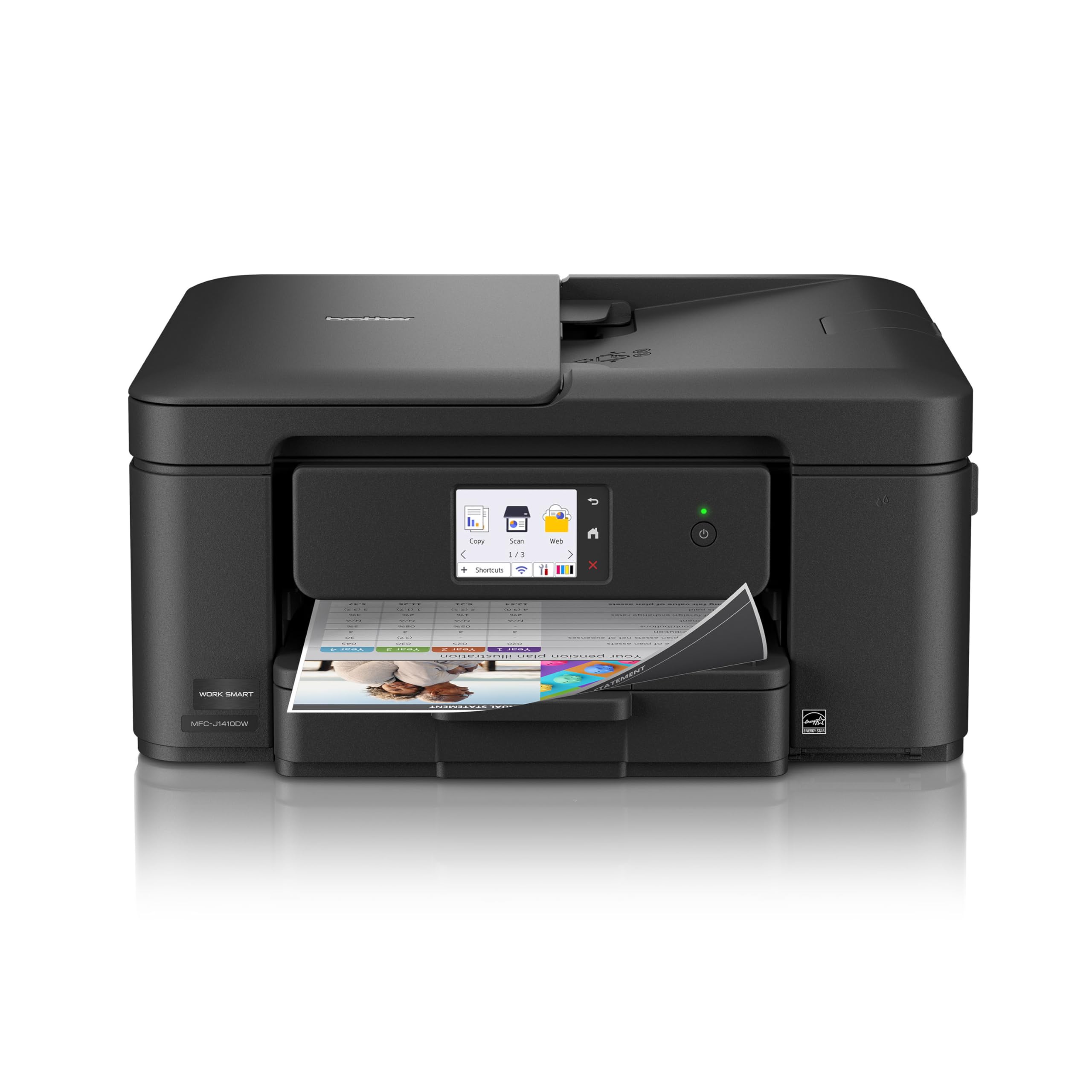
A cloud-connected workhorse that puts Google Drive right on your touchscreen.
The Brother MFC-J1410DW is the smart choice if you live in the cloud. Its 2.7″ color touchscreen gives you direct access to Google Drive, Dropbox, Box, OneDrive, and more — so you can scan a document straight to your cloud storage or print a file from it without touching a computer. The Brother Mobile Connect app extends that control to your phone, including ink monitoring so you know when to reorder.
Owners find it prints clear, smudge-free pages with no streaks — the crowd favorite for speed is the 16 ppm black output, with 9 ppm color keeping pace for everyday jobs. It’s a compact unit at 13.5″D x 15.4″W x 7.2″H, which is actually 10% more compact in depth than the Canon TR7120, so it tucks into tighter desks. The 20-sheet ADF handles multi-page jobs, and automatic duplex printing cuts paper in half.
The weak spot reported by a few is setup reliability — most owners get it running in about 10 minutes, but a minority hit friction with the PC app and driver updates. There are also scattered reports of a unit stopping after a few months, though these are offset by many happy long-term owners. For a student, small business, or anyone who lives on cloud apps, this is a capable, quiet companion.
What it does best
- Cloud app integration for scan-to-Drive and print-from-Dropbox
- Touchscreen navigation and ink monitoring via mobile app
- Compact footprint fits tight home-office desks
Watch out for
- Occasional PC setup friction requiring driver updates
- Only two starter cartridges included
Ideal for: students and cloud-first users who want to print and scan directly to and from their favorite apps.
Not ideal for: those who want a completely friction-free first-time setup — be ready for possible driver wrangling.
4. Canon MegaTank G3270

The refillable tank that makes running out of ink a distant memory.
This is the printer that changes the math on ink costs. The Canon MegaTank G3270 comes with a set of ink bottles that print up to 6,000 black and white pages or 7,700 color pages — enough for up to two years of typical home use. Instead of buying cartridges every few months, you pour in a bottle of ink and keep going. Owners describe the ink barely depleting even after heavy use, with no subscription fees to worry about.
What wins people over is how well it prints. The user-replaceable print heads are a genuine advantage — several owners switched to it specifically because they could replace the heads themselves, something many competitors don’t allow. Print quality for stickers, cards, and documents is strong, and the separate ink tanks prevent color mixing. Setup is straightforward, and it works with PC and smartphones.
The trade-offs are real but manageable. Print speed is modest at 11 ppm black and 6 ppm color — fine for home, slow for a busy office. There’s no automatic duplex and no ADF, so you’ll flip pages manually for 2-sided jobs. The wireless connectivity gets mixed feedback, with some owners finding it drops to “offline” and needing a driver reinstall — a USB cable solves it instantly if you hit that. For sheer ink economy, nothing here beats it.
Cost-per-page champion: No other pick comes close to the MegaTank’s per-page ink cost — it’s the budget king for high-volume homes.
Realistic expectation: You trade print speed and wireless polish for that incredible ink economy.
Choose this when: you print a lot and want to stop buying cartridges for years.
skip it if: you need fast output, automatic 2-sided printing, or batch scanning — this is a single-sided, no-ADF machine.
5. Epson EcoTank ET-2980
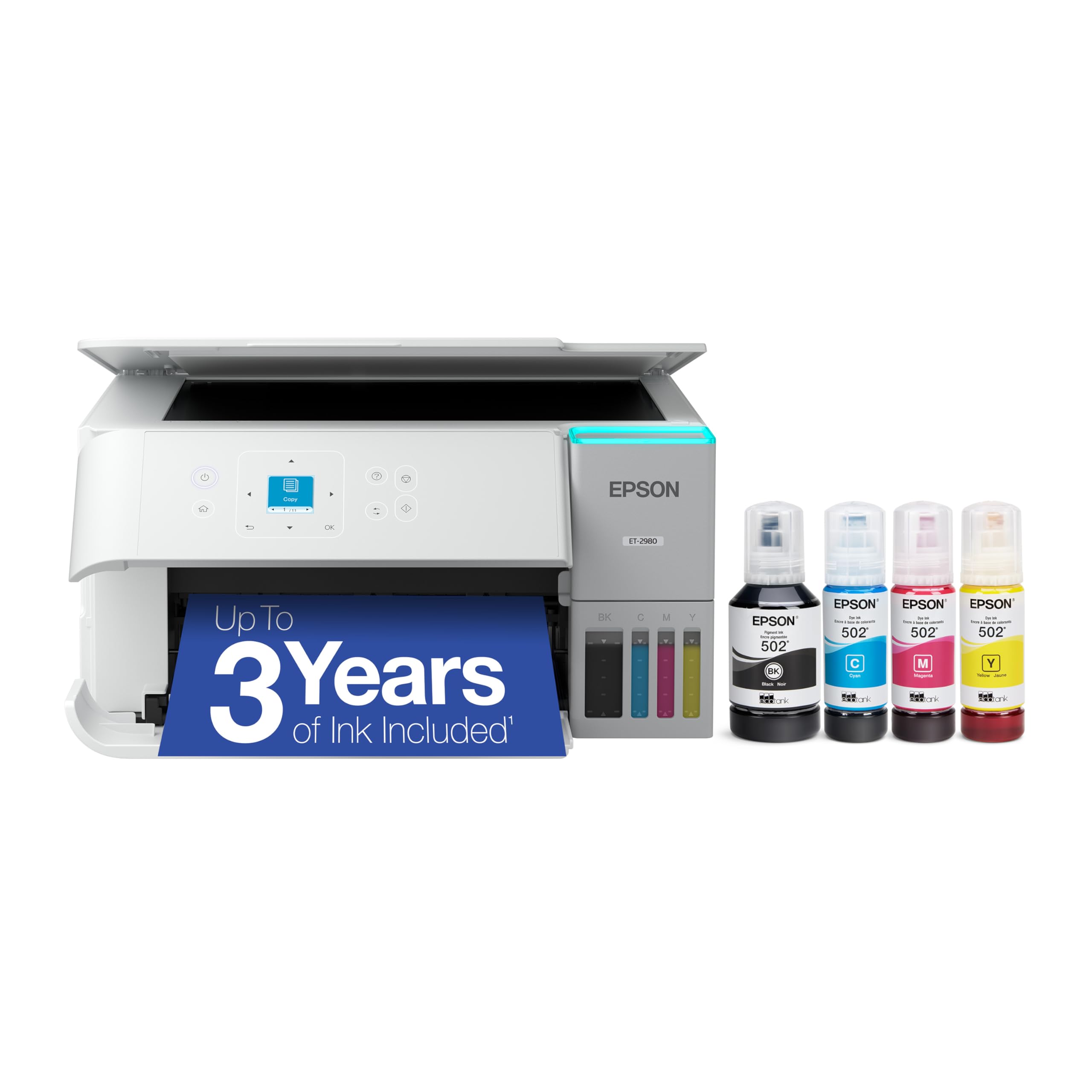
The cartridge-free supertank that pairs huge ink reserves with duplex printing.
The Epson EcoTank ET-2980 is the premium answer to running out of ink. It ships with enough ink to print up to 6,600 black and 5,500 color pages — roughly three years of home printing — and each replacement bottle set equals about 90 individual cartridges. Owners replacing older cartridge models describe the transition as long overdue, with the huge ink reserve being the standout feature.
It improves on the MegaTank with automatic duplex printing, so 2-sided jobs run hands-free. The 11.5-pound unit is compact enough for a home office, and the supersized tanks with EcoFit bottles make refilling simple without mess. On heavy homeschool use — over 1,100 pages in six months — customers note the black ink still around 80% full, an exceptional cost-per-page story.
The recurring complaints center on wireless stability and duplex paper jams. Some reviewers point out frequent network drops requiring a USB cable, and others find the duplex mode occasionally needs the back opened to clear a jam. It’s slower at 15 ppm black and 8 ppm color, and photo quality draws mixed feedback, with ink occasionally rubbing off on glossy paper. If your priority is documents and low-cost volume, it’s a stellar value; if you’re printing photos regularly, temper expectations.
Why owners stay happy
- 3 years of ink included in the box
- Auto duplex printing saves paper hands-free
- Ink reserve that visibly barely depletes after heavy use
The trade-offs
- Wireless drops reported by some — USB cable is the workaround
- Duplex mode can jam, needing the back opened
- Photos not as durable as document prints
For the high-volume family: This is the ink economy of a tank printer plus duplex convenience — ideal for homeschooling or a printing-heavy household.
For photo enthusiasts: Look elsewhere — document and book printing is its strength, not glossy photos.
6. Brother MFC-L3720CDW

The color laser that makes your documents look professionally printed.
The Brother MFC-L3720CDW delivers what owners describe as stunning laser-quality output that makes documents stand out. At 19 ppm in both black and color, it’s no slouch, and the 3.5″ color touchscreen with 48 customizable shortcuts puts your most-used tasks right at your fingertips. Direct access to Google Drive, Dropbox, and OneNote from the panel means cloud document management without a computer.
This model keeps big jobs moving: a 50-sheet auto document feeder (ADF, which scans multi-page stacks automatically) and a 250-sheet adjustable paper tray mean you load once and walk away. Automatic duplex printing (printing on both sides without flipping pages) saves paper. The dual-band wireless (2.4GHz/5GHz) plus Wi-Fi Direct and USB 2.0 let several people connect without fuss. Buyers report sharp color prints, dependable wireless, and a scanner that easily handles multi-page documents from that roomy ADF.
The main caveats are toner-related and compatibility. Chipped cartridges mean third-party toner can trigger a “non-genuine toner” error, forcing premature replacement in a few reported cases. There are isolated reports of units failing after several months — though the overwhelming majority of owners mention long, reliable service. For a home office or small business that wants professional-grade color documents without the inkjet fuss, this is the finish line.
The standout strengths
- Vibrant, sharp color prints that rival professional printing
- 48-customizable-shortcut touchscreen for one-tap workflows
- Dual-band Wi-Fi with multiple connection options
- Room for a whole team via wireless, Wi-Fi Direct, and USB
Keep in mind
- Chipped cartridges block third-party toner
- Starter toner and ongoing toner costs add up
The pick for: a small business or demanding home office that needs professional color documents, batch scanning, and intuitive touchscreen control.
The caveat: If you were hoping to save with generic toner, the chip-locked cartridges will force you to stick with Brother genuine.
Understanding the Specs
Pages Per Minute (ppm)
This is how fast the printer produces pages. A 14 ppm machine prints a 14-page document in about one minute; a 21 ppm model does it in 40 seconds. For home use, the difference is convenience, not a dealbreaker. For a home office where you regularly print long reports, the faster machines pay off in minutes saved daily.
Automatic Document Feeder (ADF)
An ADF is a slot on top of the scanner that holds a stack of pages and feeds them through automatically. Without one, you must lift the lid and place each page on the glass one at a time — tedious for anything longer than two pages. With a 20-sheet or 50-sheet ADF, you stack the whole pile, press scan or copy, and walk away.
Duplex Printing
Duplex means the printer automatically prints on both sides of the paper. The word “automatic” matters — it means the machine flips the page itself, so you don’t have to re-feed the paper manually. It cuts paper use roughly in half for multi-page documents and makes reports look far more professional. Single-sided printers save money upfront but waste paper over time.
Ink System: Cartridge vs. Tank
Cartridge printers use replaceable ink cartridges — cheap to buy, pricey to refill. Tank printers use built-in reservoirs you fill with ink bottles. The tank costs more upfront but the ink itself is dramatically cheaper per page. If you print more than a few pages a week, a tank printer (like the MegaTank or EcoTank) pays for itself quickly in ink savings.
FAQ
What is the difference between a cartridge printer and an ink tank printer?
How many pages per minute do I actually need for home use?
What is an automatic document feeder (ADF) and do I need one?
Is a color laser printer or inkjet better for home use?
How long does a set of ink last in a tank printer?
Can I print from my phone to these printers?
What does automatic duplex printing actually save me?
Why does my printer say offline and how do I fix it?
Are starter ink cartridges included with these printers?
Which printer is cheapest to run per page?
Final Thoughts: The Verdict
For the majority of shoppers, the color printer scanner for home winner is the Canon PIXMA TR7120 because it balances affordable upfront cost, crisp prints, automatic duplex, and a document feeder in one compact machine. If your priority is slashing ink costs, the Canon MegaTank G3270 is the value champion with up to 6,000 black pages included. And for the speed of laser output with professional color, the Brother MFC-L3720CDW is the one to reach for.
How We Picked
We do not accept paid placement. Every pick is matched to a real buyer and a real use-case; we do not hands-on test units.
Sources & Methodology
Specifications: manufacturer listings and product documentation. Review insights: verified customer reviews, as of August 2026. Pricing: not shown on this page (it changes often); check the current price via the retailer link.
As an Amazon Associate, FitlyFast earns from qualifying purchases. This does not affect which products we feature.