
Our readers keep the lights on and the weekend projects moving. As an Amazon Associate, I earn from qualifying purchases.
Specs are compiled from manufacturer listings and verified buyer reviews and can change over time — please confirm the key details on the product page before buying.
Buying a commercial elliptical is a big commitment — these machines are built for thousands of miles of daily use, and they cost real money. The right one delivers a smooth, quiet stride that protects your joints. The wrong one turns into a noisy, wobbly, costly regret. The one worth buying for most people is the 3G Cardio Elite EM X, because its adjustable 18″ to 23″ stride fits everyone from walkers to runners while taking up half the floor space of a typical gym model.
I’m Rikta — the founder and writer behind FitlyFast. This guide is built by comparing the manufacturers’ published specifications and the patterns across verified customer reviews, so you get each pick’s real strengths and trade-offs instead of marketing spin.
Our deep dive into the best commercial elliptical machines breaks down stride length, weight capacity, and the features that matter most for heavy daily use.
Our Picks at a Glance


How To Choose The Best Commercial Elliptical
Choosing a commercial-grade elliptical means focusing on how the machine is built, not just how it looks. The key difference from home models is durability — these units are engineered for hours of daily use, heavier riders, and years of service without breaking down.
Stride Length and Your Height
Stride length controls how natural the motion feels. Too short, and taller users feel cramped; too long, and shorter users stretch uncomfortably. Adjustable strides, from 18 to 23 inches, let you switch between a walk, jog, or run motion, which makes the machine more versatile for a household with different heights.
Weight Capacity and Machine Stability
A higher weight recommendation, like 350 or 400 pounds, signals a sturdier frame and heavier flywheel. The machine’s own weight matters too — a heavier unit stays planted on the floor, reducing wobble during intense sessions. Check both numbers to ensure the machine feels solid under you.
Resistance System Quality
Commercial ellipticals use magnetic or eddy-current resistance for a silent, smooth feel. The number of resistance levels matters less than the quality of the flywheel and drive system — a well-designed two-stage drive with a poly-V belt delivers that smooth, gliding sensation you expect from a gym machine.
Quick Comparison
| Model | Best For | Stride Length | Weight Capacity | Item Weight | Amazon |
|---|---|---|---|---|---|
| PhysioStep MDX★ Best Overall | Recumbent accessibility | 12 inches | 350 pounds | 260 pounds | Amazon |
| 3G Cardio Elite EM XAlso Great | Adjustable stride + small footprint | 23 inches | 350 pounds | 143 pounds | Amazon |
| Life Fitness E1 | Gym-brand pedigree | 18 inches | 400 pounds | 211 pounds | Amazon |
| SOLE E98 | High weight capacity + tech | 20 inches | 400 pounds | 246 pounds | Amazon |
| Body-Solid E300 | Compact central-drive | 21 inches | 300 pounds | 264 pounds | Amazon |
In‑Depth Reviews
1. PhysioStep Recumbent Elliptical MDX
The seated elliptical that treats accessibility as its superpower — a 90-degree swivel seat for easy entry.
This is fundamentally a different machine from the others here: a recumbent elliptical that pairs a stable, stress-free seated position with a smooth, natural elliptical leg motion. Its party piece is the large 20-inch swiveling seat that rotates a full 90 degrees, making it “the most accessible for people with low mobility” — Its 90-degree swivel seat eliminates the need to climb onto a standard upright machine..
Owners mention it as “extremely well built,” going together in a jiffy, and “very solid and stable, quiet and smooth in operation.” The fully adjustable arms, seat, and seat back accommodate a wide range of body types, the oversized 9-inch LCD display is easy to read, and the 12-inch seated stride plus 8 resistance levels keep the workout gentle yet effective for de-conditioned users and those approaching 80.
The honest trade-offs: at 5’1″, some shorter users find the pedal reach a stretch and the arm handles sit too far back — a couple of owners removed them or added wooden blocks. The 260-pound frame is heavy but stable, and the lifetime frame warranty with 3 years on mechanical and electronic parts backs the investment in confidence.
What reviewers agree on: the stability, quiet operation, and easy assembly make it a favorite for hip and back rehab — the swivel seat is the standout feature.
Best for: seniors, injury-recovery users, and anyone with limited mobility who wants a genuinely low-impact seated cardio option.
Not ideal for: taller users wanting a long stride or anyone expecting a standing elliptical experience — the 12-inch seated stride is a different, gentler motion.
2. 3G Cardio Elite EM X Elliptical Trainer
This machine shrinks your floor space while stretching your stride options.
What wins people over is the build quality — it is the single most-praised trait, and owners back it with stories of smooth, quiet motion that feels natural even for older knees and hips. The defining feature is the patented roller-less 3-level adjustable stride, letting you shift between an 18″ walk, 20″ jog, and 23″ run to match your gait — and a buyer who has used ellipticals for over 20 years calls it “best value” for the money.
It is a space-saving marvel: with a footprint of just 49.2″ when stored, it takes up roughly half the space of a traditional elliptical, and it weighs a manageable 143 pounds unboxed. The 32 levels of silent magnetic resistance use a two-stage drive system with a Poly-V belt for that gliding, gym-grade feel, while the FreeSync FTMS smart connectivity, tablet shelf, and USB charging port keep your entertainment charged and connected.
Owners consistently note the quiet performance, with one caveat: at higher speeds (level 7+), some machines develop a slight creak, and assembly can take hours rather than minutes. The 350-pound weight capacity and 5-year parts warranty make it a strong value proposition, though some shoppers still see the price as a substantial investment rather than a bargain.
The Advantages
- Adjustable stride from 18″ to 23″ fits multiple user heights and gaits
- Compact 49.2″ footprint saves about half the floor space of rivals
- Quiet magnetic resistance with smooth, natural motion
- Tablet shelf, USB port, and smart app connectivity included
The Trade-offs
- Assembly is time-consuming and takes patience
- Some units creak at higher resistance levels
- At 143 pounds unboxed, it needs two people to move safely
Reach for it if: you want a space-saving, adjustable-stride machine that handles walkers, joggers, and runners alike with a commercial-grade feel.
Think twice if: you are not up for a multi-hour assembly session or you need a recumbent seated position rather than standing motion.
3. Life Fitness E1 Cross Trainer

This is the home version of the exact machines you’ve used at the gym.
The Life Fitness name carries weight, and the E1 delivers on it: this is the brand’s at-home take on the ellipticals that have filled commercial gyms for years, and A decade-long global user of Life Fitness machines confirms the E1’s stride prevents injury and joint pain. The 18-inch stride and 400-pound weight capacity make it a solid, sturdy option for larger users, and the “smoothness of riding” gets repeated praise in owner feedback.
Where it shines is the WhisperStride technology — maintenance-free ball bearings that reduce friction for nearly silent operation, ideal for a home where you do not want to wake the house. The Go Console keeps things straightforward with an easy-to-read blue LCD screen, while heart rate monitoring comes three ways: contact sensors on both moving and stationary handles, telemetry, and an included wireless chest strap.
The honest catch is the weight — at 211 pounds, buyers describe it as “extremely heavy” and hard to move upstairs, arriving in a 7-foot box. A few owners have dealt with clunking sounds and delivery headaches, but the consensus is that this is “gym quality at home” from a trusted name.
Owner consensus: Owners consistently praise the E1’s whisper-quiet ride and joint-friendly stride. — but arrange delivery help and expect a heavy lift.
Buy it for: the brand trust and whisper-quiet operation that mirror a true commercial gym experience in your living room.
Skip it for: small upstairs spaces or anyone on a tight budget — the 211-pound bulk and premium price demand planning.
4. SOLE Fitness E98 Elliptical
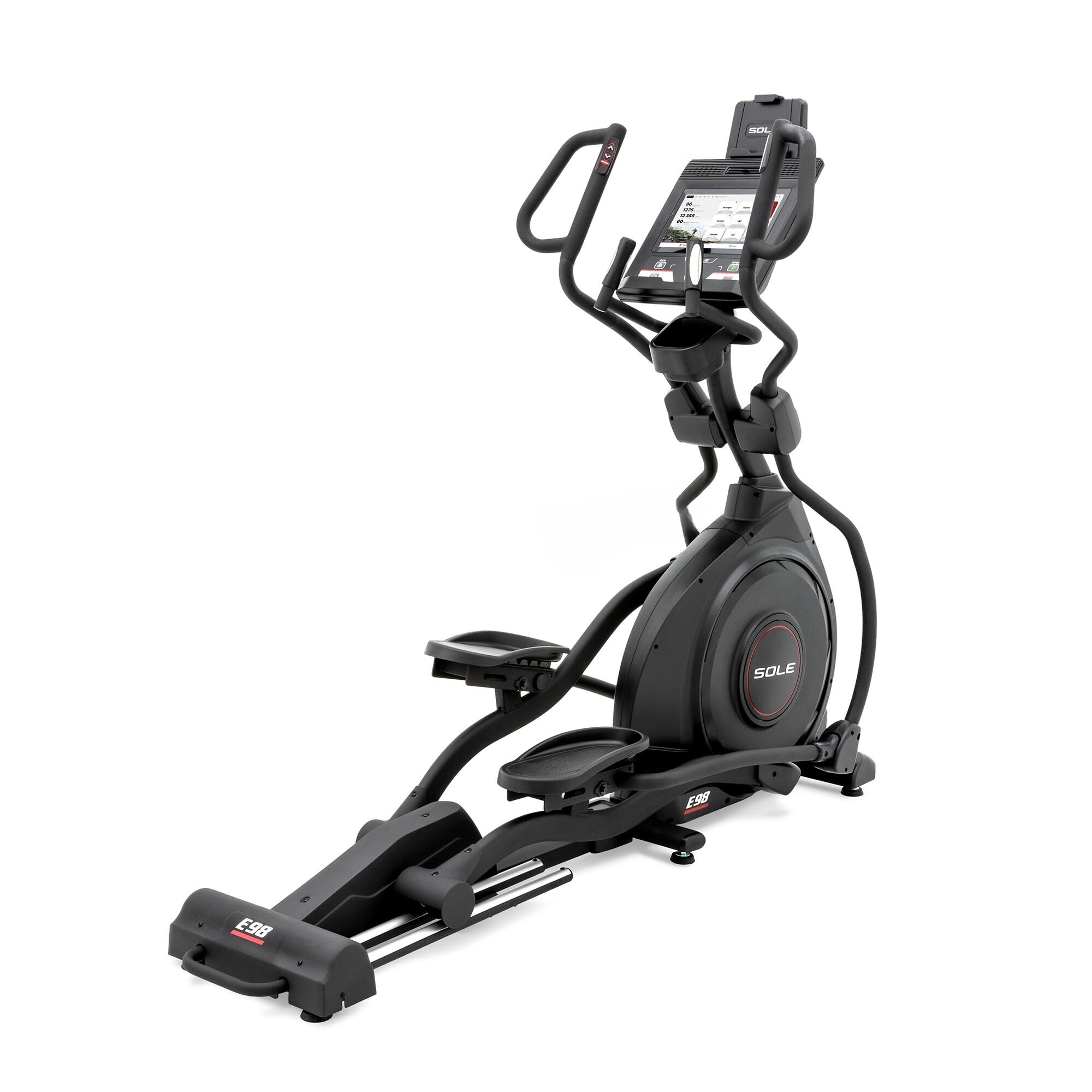
This 400-pound-capacity titan pairs a gym-grade frame with a 13.3-inch touchscreen and wireless charging.
The SOLE E98 is built for bigger bodies and bigger expectations — its 400-pound weight capacity is among the highest here, and owners confirm it handles larger users “without a hitch.” Its 246-pound frame stays reassuringly solid at speed, and the 20-inch stride plus ergonomically positioned articulating foot pedals deliver that extra-smooth, low-impact feel that makes long sessions comfortable.
Technology is the real headline: a 13.3-inch touchscreen, built-in media apps, screen mirroring, and wireless charging for your phone, all wrapped around 10 workout programs and 20 levels each of incline and resistance. The free SOLE+ app open up hundreds of guided classes, and a fitness test program adjusts resistance based on your heart rate to keep you honest.
Where it stumbles is assembly — owners repeatedly flag unlabeled parts, confusing instructions, and plastic covers that make the build lengthy, with a blunt warning to attempt it only with “mechanical aptitude and patience.” A handful of buyers report the resistance cannot be adjusted to their liking, but most praise the stability, quiet operation, and smooth, adjustable panel with a built-in fan.
Who it fits best: tech-savvy users over 250 pounds who want entertainment and guided workouts baked right into the console.
Choose this if: you want the most tech-forward console here and a machine that welcomes larger riders without wobble.
Look elsewhere if: you want low-maintenance setup — this one demands serious DIY patience or a pro installer.
5. Body-Solid E300 Elliptical Trainer

The compact central-drive that tucks into tight rooms yet delivers a surprisingly smooth full-body stride.
The E300 is the space-saver of this group, with its 50″ length and 21″ stride fitting into small areas where a full-size commercial unit would never squeeze — and it does so without skimping on stride, which owners compare favorably to TrueFitness machines. The synchronized arm handles engage your upper body with your legs, turning every session into a full-body calorie-burning effort.
Its 264-pound build is the heaviest here, which translates into a planted, stable footprint, and the 6 levels of magnetic resistance simulate a running or stair-climbing motion with a low 8-inch step-up height that makes mounting easy — a boon for seniors and rehab users. The user-friendly LED console tracks time, distance, speed, calories, and heart rate, with pulse contacts built into the stationary handles.
Buyers describe the self-assembly as an easy 2-hour job, and the stride runs smooth after a couple of weeks of use. The recurring gripe is reliability for some — a loud clicking noise from the center drive has appeared in a minority of units (sometimes fixed with support help), and the timer maxes out at 30 minutes regardless of your setting. There is a great machine here, but quality control is less consistent than the top picks.
Honest read: fantastic space-saving design and smooth stride from a trusted brand, but individual units can arrive with drive noise — check it early and lean on support.
Reach for it when: floor space is tight and you want a compact, low step-up elliptical that still offers a real 21-inch stride.
Be cautious if: you need absolute reliability from the start — occasional drive-noise issues make this less consistent than pricier rivals.
Understanding the Specs
Stride Length
Stride length is the distance your feet travel with each pedal revolution, and it directly controls how natural the motion feels. Shorter strides around 12-18 inches suit smaller users and gentler seated workouts, while 20-23 inches accommodate taller users and a running-like range of motion. Adjustable strides let one machine serve multiple heights.
Weight Capacity vs. Machine Weight
Maximum weight recommendation tells you the heaviest user the frame is rated to support safely, with 350-400 pounds typical for commercial-grade units. The machine’s own weight matters for stability — a heavier flywheel and frame stay planted and reduce wobble at speed, though they also make moving the unit upstairs a genuine two-person job.
FAQ
What makes an elliptical commercial grade rather than home grade?
How does a recumbent elliptical compare to a standard upright one?
Is a longer stride length always better?
How heavy is a commercial elliptical and can I move it upstairs?
What resistance system should I look for in a commercial elliptical?
Can a commercial elliptical handle users over 300 pounds?
Do commercial ellipticals require professional assembly?
What warranty should a commercial elliptical come with?
Final Thoughts: The Verdict
For most people, the best commercial elliptical winner is the 3G Cardio Elite EM X because its adjustable 18″ to 23″ stride, compact footprint, and smooth commercial-grade drive cover the widest range of users in the least floor space. If your priority is a trusted gym brand with whisper-quiet operation, grab the Life Fitness E1. And for accessible, low-impact seated cardio that welcomes limited-mobility users, the PhysioStep MDX is the one to reach for.
How We Picked
We do not accept paid placement. Every pick is matched to a real buyer and a real use-case; we do not hands-on test units.
Sources & Methodology
Specifications: manufacturer listings and product documentation. Review insights: verified customer reviews, as of August 2026. Pricing: not shown on this page (it changes often); check the current price via the retailer link.
As an Amazon Associate, FitlyFast earns from qualifying purchases. This does not affect which products we feature.