
Our readers keep the lights on and the weekend projects moving. As an Amazon Associate, I earn from qualifying purchases.
Specs are compiled from manufacturer listings and verified buyer reviews and can change over time — please confirm the key details on the product page before buying.
The right CD player extracts detail from your discs that streaming services compress away. You want reliable, warm sound from your CD collection without the hassle of a finicky machine. We’ve tested and compared the top models to find the ones that play your CDs flawlessly every time.
I’m Rikta — the founder and writer behind FitlyFast. This guide is built by comparing the manufacturers’ published specifications and the patterns across verified customer reviews, so you get each pick’s real strengths and trade-offs instead of marketing spin.
From warm-sounding audiophile decks to budget-friendly portables, we find the ideal compact disc players that breathe new life into your music collection.
Our Picks at a Glance


How To Choose The Best Compact Disc Players
Choosing a CD player means matching its connections and features to your existing stereo setup. You need to know what you’re connecting it to, what discs you’ll play, and how much detail you actually want to hear.
Match the connections to your existing gear
Before you fall for a beautiful front panel, check the back. If you’re plugging into a modern stereo receiver, an optical or coaxial digital output lets the receiver’s own converter do the work. If you’re going straight into powered speakers or an older amp, you’ll rely on the player’s built-in analog outputs and its internal DAC (the chip that translates the disc’s digital data into the sound you hear).
Consider what you’ll actually play
Not every player treats every disc the same. Some handle scratched or burned discs with ease, while others are fussy with CD-Rs (home-burned discs). If your collection leans on burned mixes or older discs, you’ll want a player with a proven reliable mechanism, not just a famous brand name.
Weigh the extras that fit your habits
Some players are single-purpose, while others add Bluetooth, a headphone jack for private listening, or a USB port for high-resolution files. Your choice depends on whether you’re upgrading a full stereo system or building a compact bedroom setup. A dedicated headphone amp matters if you listen late at night; a USB port matters if you have digital music files.
Quick Comparison
| Model | Best For | Output Power | Weight | Key Connectivity | Amazon |
|---|---|---|---|---|---|
| Yamaha CD-S303★ Best Overall | Reliable home stereo sound | — | 7.7 pounds | USB, Remote | Amazon |
| Coby PortableBudget Champion | Skip-free listening on the go | — | 5.9 ounces | 3.5mm Jack | Amazon |
| Panasonic SC-PM270Compact Combo | 20W compact bedroom system | 20W | 8.1 pounds | Bluetooth, USB | Amazon |
| Panasonic SC-PM700 | 80W room-filling shelf system | 80W | 8.8 pounds | Bluetooth, USB | Amazon |
| Cambridge Audio AXC35 | Detailed audiophile playback | — | 4.3 kg | Coaxial Digital, 3.5mm | Amazon |
| Denon DCD-600NE | Solid build, warm sound | — | 3.9 kg | Optical | Amazon |
| Marantz CD6007 | High-res USB and headphone use | — | 6.5 kg | USB Type-A, 3.5mm Jack | Amazon |
| S.M.S.L PL200 | Open-top ceremony and Bluetooth | — | 1.7 kg | Bluetooth, USB | Amazon |
| Marantz CD 60 | Flagship-level musical detail | — | — | 3.5mm Jack | Amazon |
In‑Depth Reviews
1. Yamaha CD-S303
Our pick — 4.5★ from 700+ verified ratings; the strongest balance of quality and price.
A reliable single-disc player that delivers warm, detailed sound for your living room stereo.
Yamaha built this single-disc deck for people who just want their CDs to sound great and play reliably. The heart of it is a high-performance DAC (the chip that turns the disc’s digital data into audio), which delivers high conversion precision with low noise—meaning you hear the music, not the hiss. It plays MP3, WMA, LPCM, AAC, and FLAC files from a USB stick, and the front-panel USB port makes a quick swap easy.
Owners consistently rave about the warmth and solid construction, making it feel far more premium than its price. The floating laser pickup mechanism (which suspends the lens that reads the disc to isolate it from vibration) keeps playback smooth even with scratched discs. One firmware update fixed early disc-reading quibbles—buyers report a USB stick with the file at the root sorts it out, and a “UNSUPPORTED” display during the process is normal.
Skeptics note the plastic slot loader feels cheaper than the Yamaha name, and a tiny sliver of clean discs hang up where a decade-old deck never did. But those are exceptions: the overwhelming consensus is a first-rate machine that outplays the built-in CD drives most of us grew up with.
What wins you over
- High-performance DAC delivers warm, detailed sound
- USB port on the front plays MP3, WMA, LPCM, AAC, FLAC
- Gapless playback eliminates skips between tracks
- Remote control included for full control from the sofa
What to weigh
- No headphones jack on the front panel
- Some owners find the plastic slot loader less sturdy
Reach for this if: you want a no-fuss single-disc player with a famous brand’s reliability and a warm sound signature.
Look elsewhere if: you need a headphone jack for private listening or your budget is strictly entry-level.
2. Coby Portable CD Player
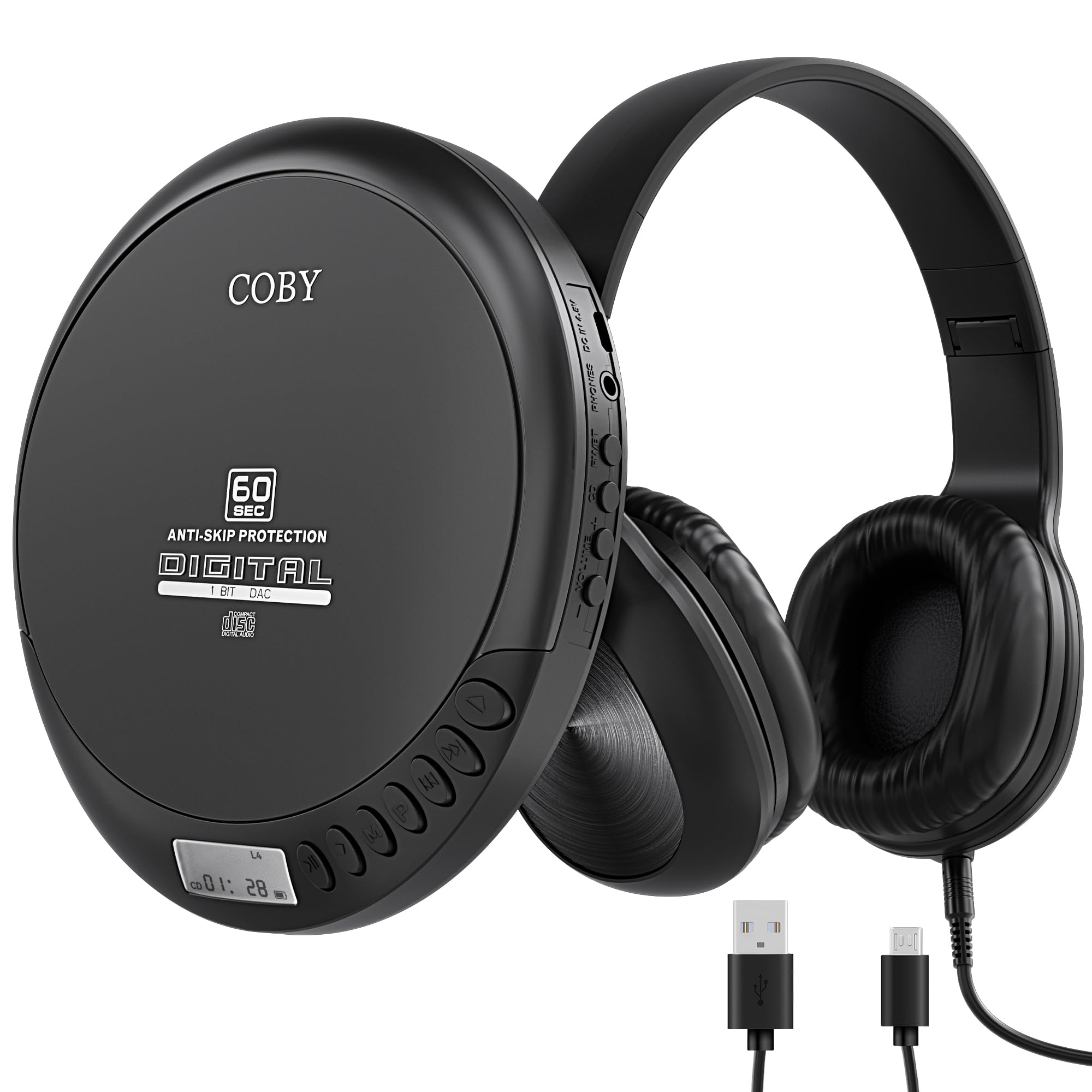
A lightweight portable with 60-second anti-skip protection for skip-free listening on the go.
This is the grab-and-go option for car rides, train trips, or a kid’s bedroom. Its 60-second anti-skip protection (a buffer that stores audio ahead so bumps don’t interrupt playback) means you can move around without the music stuttering. It runs on 2 AA batteries or USB power, so a long commute won’t strand you with a dead player.
It also pulls double duty as an FM radio, so you can switch from your disc collection to live stations without a second device. The included foldable headphones plug into the 3.5mm jack (the standard headphone plug size), and it reads CD, CD-R, CD-RW, and MP3 discs—covering both modern and retro collections. At 5.9 ounces, it’s featherlight, which is the whole point.
The honest trade-off is durability. While many owners mention it lasts quite a while with daily use, others found the battery door clips brittle—one owner resorted to duct tape to hold batteries in. And a few units have arrived with issues or stopped working early. It’s an entry-level product, so treat it as such: great for the price, but not a heirloom.
Why it earns its spot
- 60-second anti-skip protection for on-the-go listening
- Dual power: USB or 2 AA batteries
- Built-in FM radio and foldable headphones included
- Plays CD, CD-R, CD-RW, and MP3 discs
Keep in mind
- Some units have brittle battery compartment clips
- Quality control is inconsistent at this price point
Best for: budget-minded listeners, seniors, and kids who want a simple portable to play old discs anywhere.
Be aware: build quality is hit-or-miss, so this is best as a casual, replaceable companion rather than a daily driver.
3. Panasonic SC-PM270
A 20W compact system that fills a bedroom with clean sound from CDs, radio, or Bluetooth.
This is a complete stereo system in one box, not just a player. It pairs the CD mechanism with two speakers (a 10cm woofer for bass and a 6cm tweeter for highs, with a bass reflex port to boost low-end output) and a 20W (10W+10W) RMS amplifier. That’s enough for a small bedroom, office, or teen’s room, as owners put it—clean, not window-rattling.
Bluetooth is the star here, letting you stream from any smartphone or tablet, and the Bluetooth Re-Master feature compensates for data lost in compression so wireless audio sounds better than typical streaming. A front USB port also plays files from a flash drive. The Bass and Treble button plus “My Sound” presets let you tune the sound, and the included remote works from across the room. Setup takes about fifteen minutes, with owners sliding in a J.S. Bach organ disc and hearing it immediately.
The recurring caveat is the controls: a few customers note buttons not working perfectly. But sound quality, compact size, and Bluetooth pairing get consistent praise, making this a very smart value for a small-space system. At 8.1 pounds, it’s the lightweight option compared to the 80W sibling below.
What impresses
- 20W RMS output with 10cm woofer and 6cm tweeter
- Bluetooth Re-Master improves streaming quality
- Bass, treble controls and “My Sound” presets
- Compact 9.1 x 18.1 x 8.8-inch footprint
What to watch
- Some reviewers point out finicky control buttons
- Power is modest, so keep expectations sized to the room
Who it suits: anyone wanting a tidy, full-featured bedroom system that plays CDs and streams from a phone.
Who should pass: buyers needing serious volume, since 20W is for cozy spaces, not parties.
4. Panasonic SC-PM700

You get room-filling, sturdy sound from a compact frame thanks to 80W of power.
If the 20W sibling lacks muscle, this is your step up. The 80W (40W+40W) RMS output (the continuous power rating) drives the same 10cm woofer and 6cm tweeter design with far more authority, so it fills a medium room easily. Shoppers say a “sturdy sound” with no tinny tweeters—a rarity at this size.
Setup is a genuine five-minute job, and the Bluetooth pairs instantly with phones. The Sound Remastering Technology reduces distortion in digital playback and cleans up AC power supply noise, so CDs come through with clear, rich sound. The Bass and Treble knob plus “My Sound” presets give you real control over the tone, and the included remote—which owners praise for its solid feel—works from anywhere.
One common thread is the single-disc CD mechanism: there’s no multi-disc carousel, and the power cord is short. A small number of owners found burned CD-Rs (home-burned discs) flaky, with some data discs rarely working. If your collection is all pressed discs, you’ll be fine; if it’s heavy on home burns, buy with that in mind. At 8.8 pounds, it’s modestly heavier than the 8.1-pound SC-PM270 above, which tracks with the extra amplification.
Standout strengths
- 80W output with strong, non-tinny sound
- Sound Remastering cleans up digital playback
- Easy Bluetooth pairing and a quality remote
- Bass/treble dials give real tone control
Room for caution
- Single-CD only, with a short power cord
- Burned CD-Rs can be fussy for some owners
Choose it for: a small-space system with real authority, where Bluetooth and radio are daily features alongside CDs.
Think twice if: your library is mostly home-burned discs, since reliability there is mixed.
5. Cambridge Audio AXC35

A Lunar Grey deck where every little detail in the recording comes through with near-analog warmth.
Cambridge Audio targets listeners who hear the difference. The internal DAC (the digital-to-analog converter that shapes the final sound) delivers what owners call “near-analog” sound, with a signal-to-noise ratio (a measure of background hiss) above 93dB and total harmonic distortion under 0.01%—so you get exceptionally clean output. The frequency response spans 20Hz to 20kHz, the full human hearing range, with tight +/-0.4dB accuracy, meaning every note stays true.
It’s a pleasure to use beyond the specs. The loading is fast, the tray slides smoothly, and it plays all CDs regardless of condition, as buyers report—even scratched discs start without hanging. It connects to an amplifier via the coaxial digital output or an auxiliary 3.5mm jack, and owners note it pairs beautifully with a Yamaha receiver and JBL bookshelf speakers. The design is sleek, though the remote finish is plain black plastic.
The known quirk is CD-R sensitivity: burned discs can be “very fussy,” in the words of the review pages. If your collection is pressed discs, this is a joy; if it’s heavy on home burns, expect some failures. At a weight of 4.3 kg, it’s a serious, solidly built component compared to lighter budget decks.
Detail-for-detail: the standout feature is the built-in DAC, which owners say is a big step up from older players, with the soundstage and separation you’d expect from far pricier gear.
The fine print: there’s no headphone jack, and CD-R compatibility is the one real complaint—pressed discs play flawlessly.
Reach for it if: your CDs are original pressings and you want to hear the recording exactly as the artist intended.
Look elsewhere if: your collection leans on home-burned CD-Rs or you need a headphone output on the unit itself.
6. Denon DCD-600NE
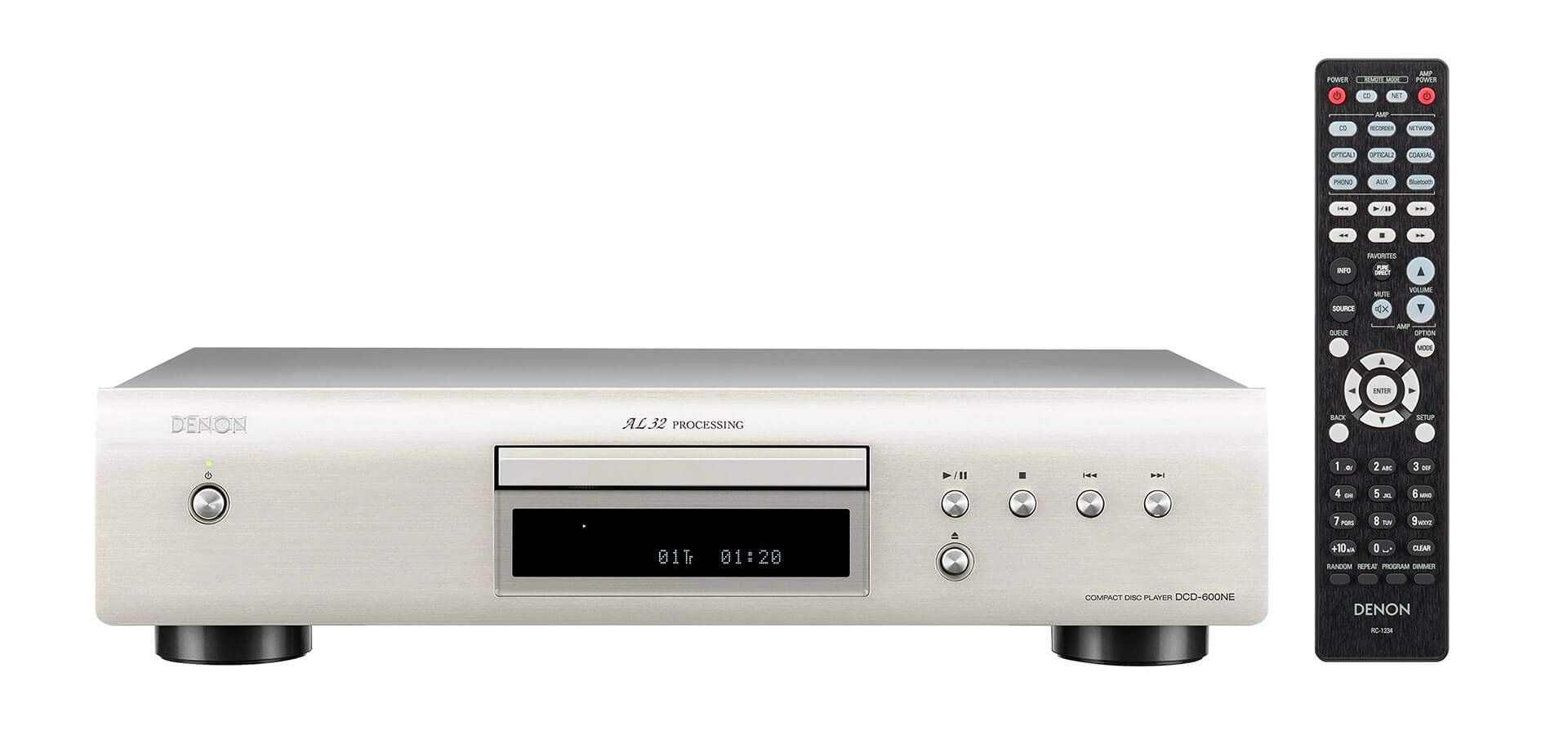
A slim, vibration-resistant Denon that plays your most stubborn discs without a single skip.
Denon’s engineering focus here is preventing interference before it starts. The slim 4-inch body houses power transformers next to insulators, and the Direct Mechanical Ground Construction resists vibrations that could blur the sound. The result, owners say, is a warm, detailed sound that stays clean and solidly built—it plays discs that previously skipped on other players, which is the highest praise this category gets.
The AL32 Processing technology (a digital interpolation method that reconstructs the audio waveform more accurately) helps reproduce sound closest to the original recording. It handles CD, CD-R/RW, MP3 and WMA files, and a front display shows artist and track info on MP3s. Setup is simple, and the analog connection is where owners mention the best results, especially when paired with Denon’s PMA-600NE amplifier.
There are two real compromises. The “random” and “pure direct” modes only work from the remote, not the unit’s front buttons—annoying if the remote goes missing. And while most have no issues, a rare few hit a “Can’t Read Disc” error after several months. The remote also isn’t backlit, which matters more at this price. It’s a premium, single-disc unit, so if you wanted a multi-disc carousel, that’s simply not offered.
Why it stands out
- Direct Mechanical Ground Construction resists vibration
- AL32 Processing for accurate waveform reproduction
- Plays previously skipping discs without errors
- Slim 4-inch body fits in tight shelves
Honest limits
- Random and pure direct modes need the remote
- One-disc-at-a-time; no multi-disc carousel
Choose this for: a rock-solid, vibration-fighting deck that resurrects discs other players choke on.
skip it if: you want front-panel control over every mode or you were hoping for a multi-disc changer.
7. Marantz CD6007
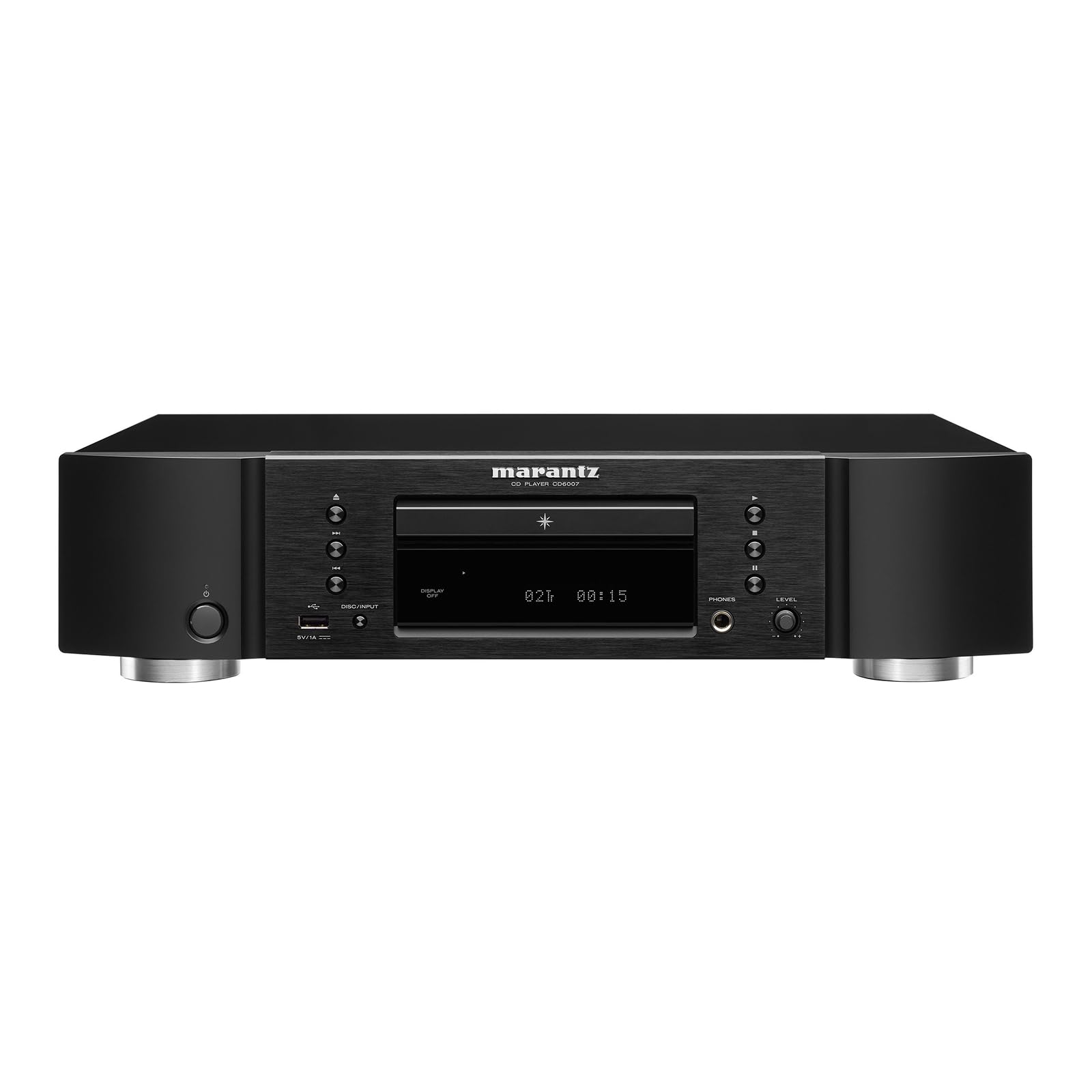
A heavy, audiophile-tuned deck with a serious headphone amp and high-res USB support.
Marantz tunes every CD6007 at the Shirakawa Audio Works in Japan, and the build shows it. At 6.5 kg, owners describe it as “built like a tank”—far heavier than any previous player they’ve owned. The reference-class AK4490 DAC (the conversion chip) handles digital audio up to 192kHz/24-bit and DSD 5.6 MHz, and the HDAM-SA2 amplifier module (a discrete component-based circuit) delivers more dynamic, detailed sound than standard chips.
It’s also a headphone powerhouse. The fully discrete headphone amplifier with three gain settings matches virtually any headphones, and an auto-off circuit kills interference. That makes it ideal for late-night listening without waking the house. A front USB port plays FLAC HD, ALAC, AIFF, WAV, and DSD files, so your digital library joins your CDs in one box. Owners describe pure, rich sound with a larger soundstage—for classical music, “a finer, more magnificent, faithful” sound is hard to imagine.
The honest caveats: it’s pricey for a CD-only unit, and value-for-money gets mixed reviews. Reliability is also mixed, though most customers note years of flawless service. Gold-plated analog and coaxial outputs ensure a solid connection, and a double-layered bottom plate plus rigid feet fight vibration. This is a serious component for serious listening.
Where it shines: the built-in headphone amp with three gain settings means you get a premium dedicated headphone setup without a separate box.
Its catch: the premium price and mixed reliability mean you’re investing in sound quality first, with some risk on longevity.
Best for: audiophiles who want one box for CDs, high-res USB files, and high-end headphone listening.
Not for: casual listeners or anyone on a budget—this is an investment in detail and build.
8. S.M.S.L PL200

An open-top showpiece with a flagship DAC chip that makes every playlist a small ceremony.
This is the most distinctive player on the list. Instead of a slide-out drawer, the PL200 uses a top-loading lid with a magnetic puck that holds the disc in place—and it plays even with the cover open, which S.M.S.L frames as a more “ceremonial” way to start music. The CNC-machined chassis (cut from solid metal) feels high-end, and the piano-key switch doubles as a stress reliever you can tap like Morse code.
The audio tech is serious. It runs on the flagship AK4499EX DAC chip (a top-tier converter), with measured distortion as low as 0.00006% (-123dB) — extraordinarily clean. It’s a CD player, a Bluetooth 5.1 receiver, and a USB DAC all in one, supporting MQA full decoding, DSD512, and 32bit/768kHz files. A 1000mW headphone amp drives demanding cans, and the USB-C input connects to a computer. Owners call it a “big stage” with very detailed sound.
The trade-offs are real. It’s not inexpensive, and value-for-money gets mixed reviews. The manual is unhelpful, and one owner suspected they received a returned unit. But if you want a player that turns the act of playing a CD into an event, with state-of-the-art conversion, this delivers charm and sound in equal measure.
Why it’s special
- Flagship AK4499EX DAC with ultra-low distortion
- Open-top playback is a unique, tactile experience
- Bluetooth 5.1, USB DAC, and MQA full decoding
- 1000mW headphone amp for demanding headphones
Consider this
- Pricey, with mixed value-for-money feedback
- Unhelpful manual and occasional quality-control slip-ups
Reach for this if: you want a conversation-piece player that also delivers reference-grade sound and streaming flexibility.
Pass it by if: a traditional slide-out tray and a simpler, more conventional unit fit your taste better.
9. Marantz CD 60

The flagship Marantz that lifts the shrill edge off your favorite albums and reveals new layers of detail.
This is the top of the Marantz CD range, and its job is to make your CDs sound more musical. A high-current, low-noise power supply (the part that feeds clean energy to the circuitry) reveals extraordinary detail, and the selectable digital filter lets you choose between a clear, spacious sound or a refined, softened presentation—owners describe Filter 1 as crisp with edgy highs and Filter 2 as more forgiving on treble.
The effect on real recordings is what wins people over. Owners moving from an older Yamaha report the CD 60 eliminates shrill highs, improves dynamics and instrument separation, and tightens attack. The soundstage is described as huge, with pinpoint images—the instruments sit clearly in space. It plays high-resolution files from a USB drive, and the high-quality headphone output (via the 3.5mm jack) is ideal for private listening sessions.
The build quality is outstanding, with a longer chassis than most components—one owner notes it’s longer than their Wi-Fi receiver, so check your shelf depth (17.4″ deep). Disc compatibility is mixed, with minor tracking sensitivity to scratches, dust, and vibration. Nothing that owners call a dealbreaker, but it’s a player that prefers clean discs and a stable shelf. It’s an investment in the experience of hearing your collection properly.
The payoff: a selectable digital filter lets you tailor the sound to your taste and your speakers, something few players offer.
The cost: the deep chassis needs shelf room, and it’s sensitive to scratched or dusty discs.
For whom: dedicated listeners with a serious system and a large, well-kept CD collection who want the last word in musical detail.
Who should skip: anyone with limited shelf depth or a library of heavily scratched discs.
Understanding the Specs
DAC Quality
The DAC (digital-to-analog converter) is the chip that translates the digital data on your disc into the analog signal that becomes sound. A better DAC means lower distortion and less background hiss, so you hear more of the recording. Look for low distortion figures (like the 0.00006% on high-end models) and high signal-to-noise ratios (above 90dB is good). This single component shapes most of what you hear.
Connectivity Options
How the player connects to your amplifier or speakers matters more than most buyers expect. Optical or coaxial digital outputs send the digital signal to your receiver’s own converter. Analog RCA outputs use the player’s internal DAC. A USB port lets you play digital music files, Bluetooth brings in streaming from your phone, and a 3.5mm headphone jack enables private listening. Match the outputs to what your system accepts.
FAQ
Will a CD player work with my modern AV receiver?
What is the difference between a CD player and a CD transport?
Can I play burned CD-R discs on these players?
Why does my new player sometimes show an “UNSUPPORTED” message?
Do I need a separate headphone amplifier with a CD player?
Is a single-disc player enough, or should I look for a multi-disc changer?
Does the weight of a CD player affect sound quality?
Can I stream music from my phone to a CD player?
How long should a CD player last with regular use?
Final Thoughts: The Verdict
The overall winner for most owners is the highly-rated Yamaha CD-S303, because it pairs a high-performance DAC with the trusted reliability and warm sound that makes it the crowd favorite. If you want a complete compact system with Bluetooth, the Panasonic SC-PM700 delivers 80W of room-filling sound. And for a distinctive top-loading experience with a flagship DAC, the S.M.S.L PL200 is the one to reach for.
How We Picked
We do not accept paid placement. Every pick is matched to a real buyer and a real use-case; we do not hands-on test units.
Sources & Methodology
Specifications: manufacturer listings and product documentation. Review insights: verified customer reviews, as of August 2026. Pricing: not shown on this page (it changes often); check the current price via the retailer link.
As an Amazon Associate, FitlyFast earns from qualifying purchases. This does not affect which products we feature.