
Our readers keep the lights on and the weekend projects moving. As an Amazon Associate, I earn from qualifying purchases.
Specs are compiled from manufacturer listings and verified buyer reviews and can change over time — please confirm the key details on the product page before buying.
Your teammates will hear your keyboard clatter more than your voice if your current setup is weak. A good microphone fixes that by cutting out the mechanical click-clacks so your callouts land sharp during clutch moments. Below, we break down today’s strongest contenders, from ultra-budget USB dongles to premium XLR-ready broadcast machines, so you can match one to your setup and your voice.
I’m Rikta — the founder and writer behind FitlyFast. This guide is built by comparing the manufacturers’ published specifications and the patterns across verified customer reviews, so you get each pick’s real strengths and trade-offs instead of marketing spin.
If you’re a PC gamer tired of being told you sound like you’re in a wind tunnel, this breakdown of the best computer mic for gaming helps you find a clear, reliable upgrade that fits your desk and your budget.
Our Picks at a Glance


How To Choose The Best Computer Mic For Gaming
Most gaming microphones do one core job: turn your voice into a clean signal your PC can broadcast. Before you compare RGB lighting or brand names, focus on three things that actually change how you sound to your squad: the pickup pattern, the connection type, and the controls.
Pickup Pattern: How the Mic Hears Your Room
This decides what the mic listens to. A cardioid pattern captures sound best from the front and reduces pickup from the sides and rear, which is ideal for focused vocal recording. A supercardioid pattern is even tighter, suppressing more background noise like typing or mouse clicks. If you game in a noisy room, a tighter pattern is a real advantage.
USB vs. XLR: Simplicity vs. Future-Proofing
A USB microphone is plug-and-play — you connect it to your PC and it works, no extra gear needed. An XLR connection requires an audio interface, which adds cost and complexity but opens the door to higher-end sound processing. Many mics now offer both outputs, so you can start with USB and upgrade later without replacing the mic itself.
Controls and Mounting: Daily Usability
Look for tap-to-mute sensors with LED indicators so you can instantly silence yourself without fumbling. A built-in shock absorber dampens vibrations from accidental knocks and bumps. Think about your desk space, too: a tall stand might block your keyboard, which is why many gamers end up pairing their mic with a boom arm.
Quick Comparison
| Model | Best For | Pattern | Connection | Weight | Amazon |
|---|---|---|---|---|---|
| Shure MV7+★ Best Overall | Streaming & Podcasts | Dynamic | USB-C & XLR | 3.6 lbs | Amazon |
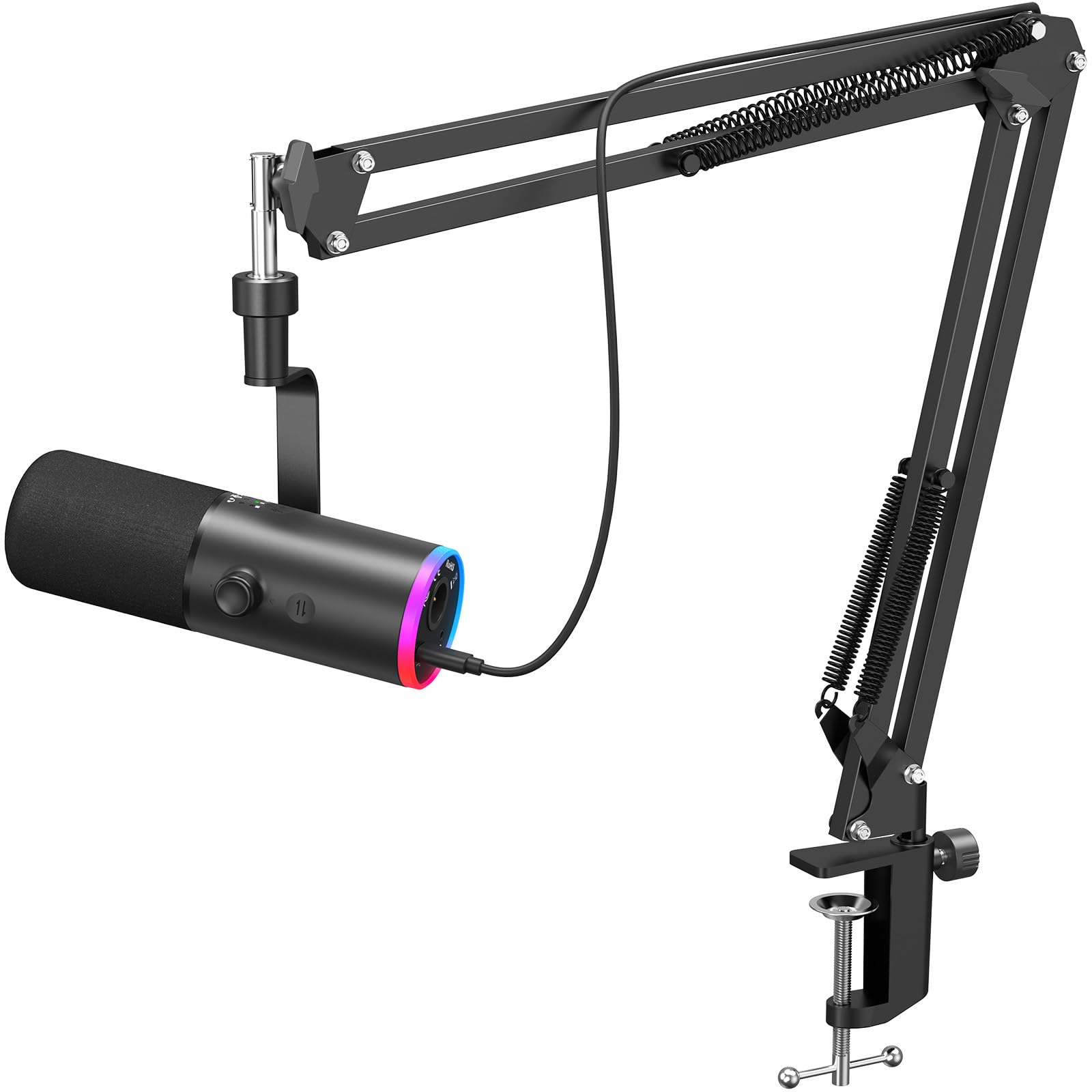
| TONOR TD510 AIR S H+Best Value | Budget with Boom Arm | Dynamic | USB & XLR | 850 g | Amazon |
| Razer Seiren V3 MiniCompact Pick | Compact Desk Use | Supercardioid | USB | 8.32 oz | Amazon |
| HyperX SoloCast 2 | Simple Plug & Play | Cardioid | USB-C | 330 g | Amazon |
| Razer Seiren V2 X | Streaming with Monitoring | Supercardioid | USB | — | Amazon |
| SENNHEISER Profile | Natural Voice Quality | Cardioid | USB-C | 350 g | Amazon |
| HyperX QuadCast 2 S | RGB & Versatility | 4 Selectable | USB-C | — | Amazon |
| Audio-Technica AT2020USB-X | Sensitive Studio Capture | Cardioid | USB | — | Amazon |
In‑Depth Reviews
1. Shure MV7+
Our pick — over 4.5★ from 550+ verified ratings; the strongest balance of quality and price.
The studio-grade standard that turns your desk into a broadcast booth — if your budget reaches that far.
This is the mic the crowd trusts most — a 4.8-star favorite among nearly a thousand owners who switch it on and instantly sound professional. It’s a dynamic microphone, which means it naturally rejects background noise better than most condensers, so your fans and room echo stay out of the mix. Its built-in DSP filters out ambient noise in real time, so your voice stays sharp even with a loud PC fan nearby.
What makes it special is the control surface: a multi-color LED touch panel with 16.8 million hues lets you tap anywhere to mute instantly during a stream. Auto Level Mode adjusts gain based on your distance and voice volume, so you don’t have to fiddle with settings mid-game. It connects via USB-C or XLR, letting you start simple and later plug into a pro audio interface without buying a new mic.
The honest trade-off is physical size and your desk layout. At 3.6 pounds and about 15.9 x 7.8 x 7.7 inches, it’s a weighty presence, and buyers report the solid, adjustable stand “got in the way of using my keyboard, so I end up buying a boom arm.” Plan for a boom arm if your desk is cramped, and you’ll have a mic that rivals much pricier broadcast setups.
Why It’s The Top Pick
- Dynamic capsule rejects room echo and fan noise cleanly
- Auto Level Mode keeps your gain consistent automatically
- Dual USB-C and XLR outputs future-proof your rig
Consider This First
- Heavy 3.6 lb body demands a sturdy stand or boom arm
- Premium price tag places it firmly in the high-end tier
Reach for this if: you stream, podcast, or record voiceovers and want a single mic that handles all of it with zero fuss.
Think twice if: you’re on a strict budget — this is an investment, not an impulse buy.
2. TONOR TD510 AIR S H+
A complete boom arm kit that delivers surprising broadcast quality without emptying your wallet.
If you want a real desk setup — boom arm, pop filter, and all — this TONOR kit is the crowd-pleasing value pick. This dynamic mic uses triple AI noise cancellation to zero in on keyboard clatter. The capsule captures your voice clearly while the AI filter strips out background noise, so teammates hear you, not your mechanical switches.
The dual USB and XLR outputs are a genuine long-term win. Start with USB straight into your PC or PS5, and later upgrade to an audio interface with XLR cables without replacing the mic itself — though the kit doesn’t include those cables. Owners were honestly surprised at the versatility: “Sounded amazing and works on both my PC and on my phone which came as a surprise, it matches with my desk and doesn’t take up alot of space, and the clamp is much more sturdy than my previous mic.”
The catch is that this is an entry-level performer, not a professional broadcast tool. The raw sound is a bit tinny from the start, though it cleans up beautifully with a compressor and EQ in OBS. One detail to remember: the AI noise cancellation works via USB but not over the XLR connection. For casual chat and gaming streams, it’s an exceptional deal at a budget price point.
Smart Budget Buy: You get a sturdy boom arm, pop filter, RGB lighting, and dual outputs in one package — arguably the most complete value in this list.
Know The Limit: Serious streamers will want to apply EQ in software to bring out the best in this capsule.
3. Razer Seiren V3 Mini
A featherweight 8.32-ounce condenser that disappears on your desk while making your voice shine.
This tiny Razer proves that good things come in small packages — and at a very friendly price. It’s a supercardioid condenser mic, which means it uses a tighter pickup pattern to focus on your voice while suppressing room noise like typing or mouse clicks. The custom capsule captures detail well, especially in higher frequencies, so your voice broadcasts with impressive clarity.
The standout feature is the tap-to-mute sensor with an LED indicator. Tap the top of the mic and you’re instantly muted, with a glanceable light showing your status — a lifesaver on chaotic work calls and in-game. The built-in shock absorber dampens knocks and bumps, and the tiltable stand detaches for boom arm use.
It’s the classic “much better than my wireless headset microphone” upgrade, as the review pages sum it up. One honest note: background noise dampening is a bit weak on the raw setting, though it’s fixable through software settings. This is a perfect pick for the casual gamer who wants a clear, compact, no-driver mic that just works with Discord, OBS Studio, and XSplit.
the balance: Compact, sleek, and genuinely plug-and-play — ideal for a tidy desk setup.
Who Should Pass: Anyone gaming in a very noisy room who needs aggressive noise cancellation from the start.
4. HyperX SoloCast 2
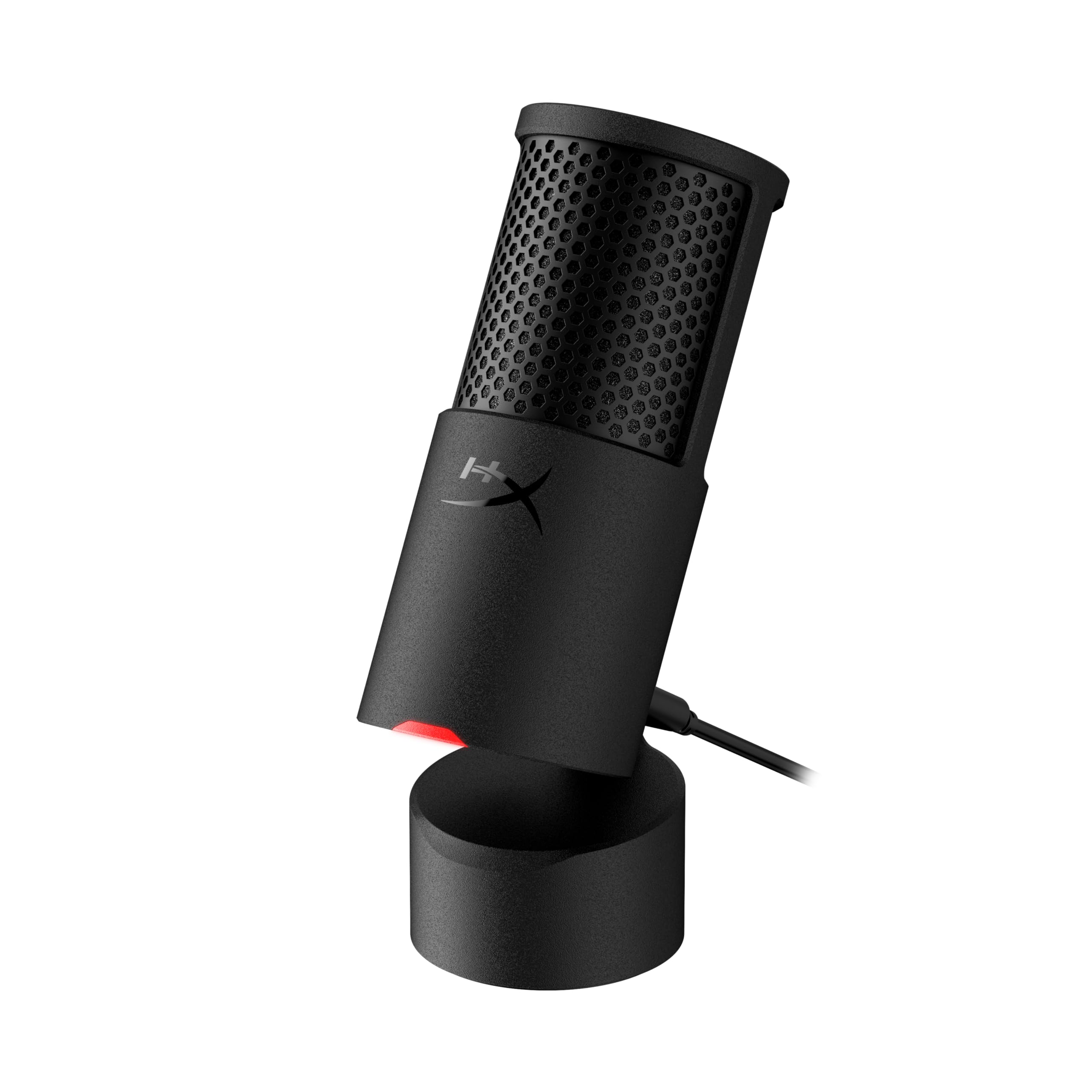
Everything built-in and nothing extra to buy — just clear sound in a compact, tiltable frame.
The SoloCast 2 is for the gamer who wants studio-quality recording without the studio clutter. It captures high-resolution audio with a 24-bit bit depth and 96kHz sampling rate, so your voice is reproduced with crisp, natural detail. The cardioid polar pattern captures sound best from the front while reducing pickup from the sides and rear, making it ideal for focused vocal recording at your desk.
Everything you need is built in: a foam pop filter, a tilt-adjustable stand with a weighted base for stability, and even 3/8″ and 5/8″ threads for easy mounting to compatible mic arms. The built-in suspension system dampens external vibrations in a compact, no-fuss design. Tap-to-mute with an LED indicator rounds out the package — red LED when live, off when muted.
Audio filters are customizable via HyperX NGENUITY software, and you can save your settings to the mic for consistent sound anywhere. The honest trade-off: one owner noted the USB-C port on the lower back feels insecure and may unplug with movement, so securing the cable to a boom arm is a smart precaution. At this price, it rivals pricier mics on sheer recording quality.
All-In-One Appeal: Pop filter, shock mount, and stand are included — no hidden extras needed.
Small Caveat: The lower-back USB-C port benefits from a cable clip to stay snug.
5. Razer Seiren V2 X

A 25mm condenser with pro-level monitoring and a digital limiter to keep your stream clean.
This Razer is built for the streamer who wants control without complexity. The 25mm condenser capsule captures voices with a high degree of accuracy, especially at higher frequencies, and you should speak directly into the top of the mic for optimal performance. Its supercardioid pickup pattern suppresses noise from the back and sides, so it captures your voice clearly without picking up on typing or mouse clicks.
The integrated digital limiter prevents clipping and peaking, so your stream stays clean even when you get excited. The mic monitoring feature lets you plug a headset into the mic to hear your own input, which is convenient for maintaining optimal audio levels on chaotic voice channels. Easy-access volume, mic gain, and mute buttons sit right on the mic body.
Owners praise it as a sturdy, stable unit that survives drops, and it even works on Steam Deck. The main software gripe is the unhelpful Razer bloatware that tries to install — but the mic works flawlessly without it. At this price, it’s a solid “set and forget” choice for gamers who want clean, reliable voice pickup.
Choose This For: Headphone monitoring and on-mic gain control that let you manage your sound mid-stream.
skip it if: You dislike proprietary software prompts — though you can ignore them entirely.
6. SENNHEISER Profile

German-engineered warmth in a compact metal body that delivers a natural, warm voice presence.
Sennheiser brings its legendary audio heritage to a simple USB mic that just works. It’s a cardioid condenser microphone capsule with a metal housing, delivering a natural, warm sound that accentuates the body and presence of the human voice. There’s no software required — one simple USB connection is all you need to achieve the sound you’re looking for, making setup genuinely stress-free.
The controls are where it shines: a twist of a dial adjusts gain, a mute button changes color to show status, and a built-in headphone jack offers zero-latency direct monitoring. You can even control the mix between your desktop audio and your voice chat, so you’re not re-adjusting system volumes constantly. The compact table stand keeps things tidy, though many owners recommend a boom arm for ideal placement.
Owners consistently note it outperforms “90% of cheap USB mics” and works beautifully with apps like NVidia Broadcast. The one mixed note: voice pickup is front-facing only, so you need to speak directly into it — which is standard for a cardioid pattern. It’s a premium pick for the gamer who values natural, unprocessed voice tone over flashy features.
easy Quality: No software, no drivers, just dial-in sound with a premium all-metal build.
Placement Matters: Front-facing pickup means a boom arm is worth adding for the best position.
7. HyperX QuadCast 2 S

A lighting show and four polar patterns in one mic — the most versatile showpiece on this list.
If your stream is as much about the look as the sound, the QuadCast 2 S is your centerpiece. It boasts over 100 individually customizable aRGB LEDs that display over 16 million color options, turning your mic into a dynamic lighting display that complements your whole setup. But it’s not just a pretty face — it features top-tier audio recording resolution on a consumer USB gaming microphone.
The multifunction knob is the star: it lets you select and adjust microphone gain, headphone volume, monitor mix, and even the desired polar pattern. You get four selectable polar patterns — cardioid, omnidirectional, bi-directional, or stereo — to fit a wide variety of recording needs. The redesigned detachable shock mount uses spring-loaded pins and is compatible with 3/8″ and 5/8″ threading, making boom arm setup easy.
The tap-to-mute sensor and LED VU meter keep you in control at a glance. Owners love the “crisp voice capture” and “outstanding build quality,” calling it the prettiest mic they’ve owned. The honest caveat: the NGENUITY software needs improvement, and opinions split on whether it’s worth the premium price. For the streamer who wants versatility and visual flair, this delivers on both.
Go For It If: You want a single mic that switches between solo, group, and interview setups with a twist of a knob.
Be Aware: The software is a work in progress — the hardware itself earns the praise.
8. Audio-Technica AT2020USB-X

The legendary studio name in a USB format, capturing rich detail with a stainless steel body.
The AT2020 is a name that needs no introduction in recording studios, and this USB-X version brings that pedigree straight to your gaming desk. It’s a cardioid condenser microphone with a high-resolution AD converter running at 24-Bit/96 kHz sampling rate for extremely clear, natural sound reproduction. The smooth, extended frequency response is ideally suited for podcasting, home studio recording, and voiceover work.
The built-in headphone jack lets you directly monitor your own voice from the microphone with zero latency. A soft-touch capacitive mute button on the body quickly and silently mutes audio, with a two-state LED indicator ring that lights blue when powered and red when muted. The directional pickup minimizes background noise, keeping the focus on your voice.
The stainless steel enclosure gives it a sturdy, heavy build that feels premium on the included custom desk stand. Owners note it handles loud sources like an electric guitar without loss, yet remains clear for voice. The honest trade-off: its sensitivity means it picks up ambient noise like a leaf blower, so it performs best in a quiet room. It’s a pricey option for pure gaming, but a fair investment for those who also record music or podcasts.
Versatile Performer: Handles voice, acoustic guitar, and loud sources with equal clarity — a true all-rounder.
Room Matters: Highly sensitive capsule wants a quiet space; a shock mount is a worthwhile add-on.
Understanding the Specs
Polar Pattern (Pickup Pattern)
This describes the shape of the mic’s listening area. Cardioid picks up sound best from the front and reduces pickup from the sides and rear, ideal for focused vocal recording. Supercardioid is tighter, suppressing even more background noise like typing. Omnidirectional picks up sound from all directions, and bi-directional captures from front and back for interviews. For gaming, cardioid or supercardioid is usually your best bet.
USB vs. XLR Connection
A USB connection turns your mic into a plug-and-play device — connect it to your PC and it works instantly. An XLR connection sends an analog signal to an audio interface, which gives you more control over the sound but adds cost and complexity. Mics with both outputs, like the Shure MV7+ and TONOR TD510 AIR, let you start with USB and upgrade to a professional XLR setup later without replacing the microphone.
FAQ
Will a USB gaming microphone work with my PS5 or Xbox?
What is the difference between a cardioid and supercardioid pickup pattern?
Do I need an XLR microphone and audio interface for gaming?
Why is my gaming microphone picking up so much background noise?
How does tap-to-mute work and why is it useful?
Is a dynamic or condenser microphone better for gaming?
What is mic monitoring and do I need it?
How does a shock mount help my gaming audio?
Final Thoughts: The Verdict
For most people, the best computer mic for gaming is the Shure MV7+ because its dynamic capsule, auto level mode, and dual USB/XLR outputs make it a true broadcast-grade investment. If you want the best value with a full boom arm kit, grab the TONOR TD510 AIR. And for a compact, budget-friendly desk upgrade, the Razer Seiren V3 Mini is the one to reach for.
How We Picked
We do not accept paid placement. Every pick is matched to a real buyer and a real use-case; we do not hands-on test units.
Sources & Methodology
Specifications: manufacturer listings and product documentation. Review insights: verified customer reviews, as of August 2026. Pricing: not shown on this page (it changes often); check the current price via the retailer link.
As an Amazon Associate, FitlyFast earns from qualifying purchases. This does not affect which products we feature.