
Our readers keep the lights on and the weekend projects moving. As an Amazon Associate, I earn from qualifying purchases.
Specs are compiled from manufacturer listings and verified buyer reviews and can change over time — please confirm the key details on the product page before buying.
Tired of tinny laptop audio that turns your favorite game’s explosions into a weak pop? A dedicated subwoofer is the difference between hearing sound and feeling it — that physical rumble that makes movies, music, and games genuinely rich. This guide breaks down the best computer speakers with subwoofer across every tier, from budget-friendly upgrades to premium, room-shaking systems that could rival a home theater.
I’m Rikta — the founder and writer behind FitlyFast. This guide is built by comparing the manufacturers’ published specifications and the patterns across verified customer reviews, so you get each pick’s real strengths and trade-offs instead of marketing spin.
We cut through the specs to give you the real-world performance of each system, so you can pick the pair that fits your desk, your ears, and your gaming habits. The best computer speakers with subwoofer delivers powerful bass that doesn’t muddy the vocals you need to hear.
Our Picks at a Glance


How To Choose The Best Computer Speakers With Subwoofer
Picking a 2.1 speaker system (two satellite speakers plus one subwoofer) is about more than just looking for the biggest wattage number. You need to match the system’s power and physical size to your room, your primary use (gaming, music, or movies), and your desk space. Let’s walk through the three most important decisions.
Power: Peak vs. RMS
Manufacturers love to advertise peak wattage — a theoretical maximum the speakers can hit in a burst. The more honest, everyday number is RMS (Root Mean Square), which is the continuous power the speakers can sustain without distorting. A system with 400 watts peak might only deliver 200 watts RMS, which is still plenty loud for a large room.
Driver Size and Subwoofer Design
The size of the subwoofer driver (the large speaker cone that produces bass) directly impacts how deep the sound goes. A 6.5-inch driver is usually the balance for a home office or bedroom, delivering punchy, feelable bass without dominating the room. Larger drivers in the 8-inch range or above will pressurize a bigger space but may be overkill for a small desk setup.
Quick Comparison
| Model | Best For | Peak Power | Subwoofer Driver | Connectivity | Amazon |
|---|---|---|---|---|---|
| Logitech Z623★ Best Overall | Room-filling, THX-certified audio | 400 Watts | High-excursion driver | RCA & 3.5mm | Amazon |
| SteelSeries Arena 7Premium Pick | rich gaming with RGB | — | 6.5″ downward-firing | USB, Aux, Optical, BT | Amazon |
| Klipsch ProMedia 2.1Top Performer | Legendary clarity & THX certification | 200 Watts | 6.5″ side-firing | 3.5mm | Amazon |
| Edifier S355DB | Hi-Res audiophile listening | 150W | 8″ wireless | BT, Optical, HDMI, USB | Amazon |
| Creative Pebble X Plus | Compact USB-C desk setups | 30W (60W peak w/ PD) | — | USB-C, BT 5.3, AUX | Amazon |
| Nylavee 2.1 Soundbar | Clean desk with soundbar form | 60W | 5.25″ | Bluetooth 5.4, AUX | Amazon |
| Bluedee 2.1 Speakers | DSP-tuned, casual listening | 80W | — | BT 5.4, USB, AUX | Amazon |
| Logitech Z313 | Budget-friendly basic upgrade | 50W | Compact driver | 3.5mm | Amazon |
| FIFINE AmpliGame A22 | Budget gaming with RGB sync | — | Dedicated driver | OTG, Optical, AUX, BT | Amazon |
In‑Depth Reviews
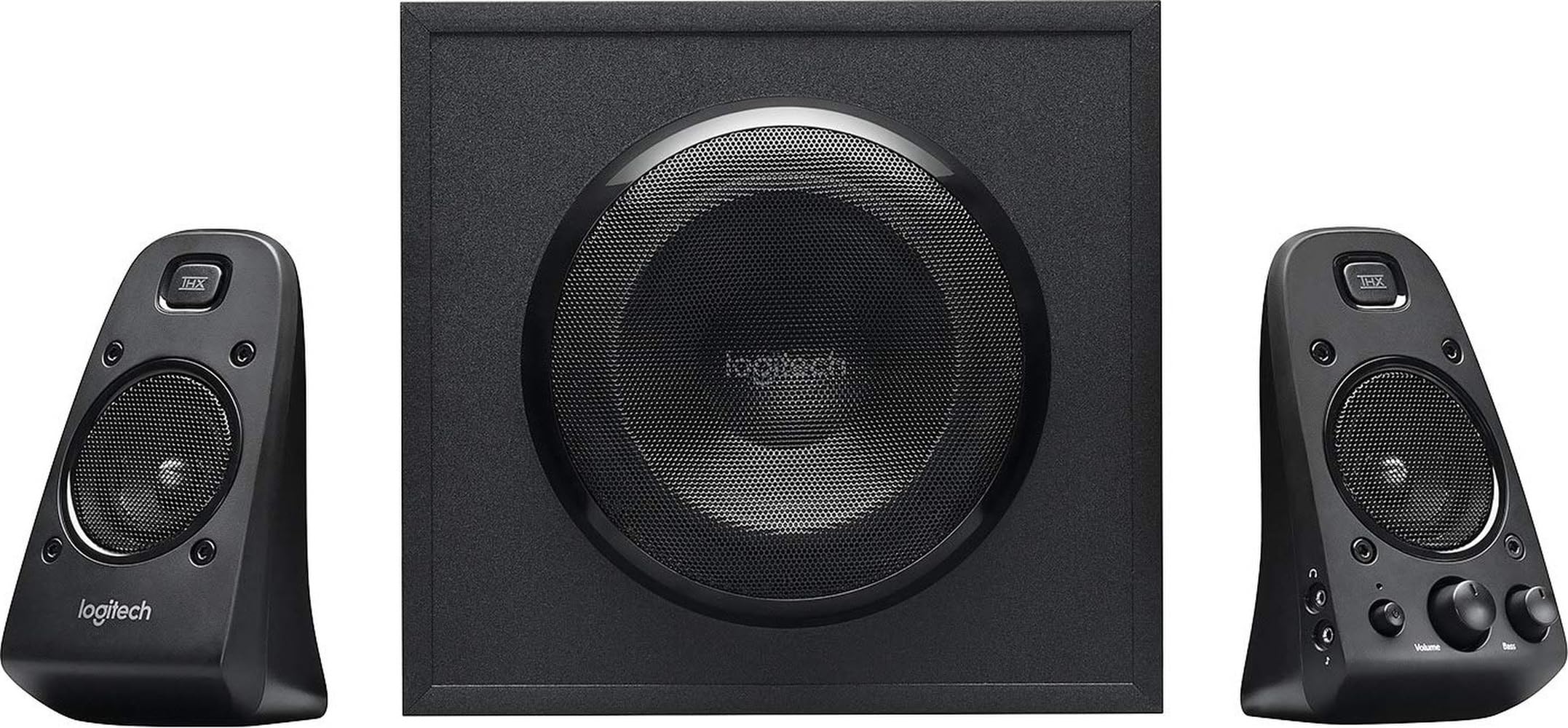
1. Logitech Z623 400 Watt Home 2.1 Speaker System
Our pick — over 4.5★ from 11,000+ verified ratings; the strongest balance of quality and price.
The best-selling 400W THX-certified system that fills large rooms with clean, distortion-free audio.
This is the system buyers keep coming back to, and the reason is the raw output: 400 Watts Peak (200 Watts RMS) of power pushes sound big enough for even large entertainment rooms. It’s THX-certified (a strict quality standard for audio equipment), so you know the 2.1 channel setup delivers studio-quality playback for music, movies, and games. The dedicated subwoofer packs 130W of power on its own, delivering the deep, physical bass that makes explosions rattle your desk.
You get two satellite speakers (each with 35 Watts) and a sub with a 12-inch audio driver, a combo that owners say produces “crisper highs and deeper, more powerful bass” than the Klipsch ProMedia 2.1, especially on electronic test tracks with zero distortion. The satellites have a 25° up-tilt, which angles them perfectly toward your ears on a desk. With RCA and 3.5mm inputs, you can plug in up to 3 devices — your computer, a game console, and a music player — and switch between them using the integrated controls on the right satellite.
The most-discussed praise centers on the sound quality and value, with owners noting the volume is intense but never overpowering. The bass level is called “perfect” by many, and the system is widely described as well worth the price. The recurring gripes are about durability, with an occasional subwoofer failing early on, and the fact that the 3.5mm cable is short, often needing an extension for convenient placement. Since it lacks tweeters and uses ports only, high frequencies are bright but slightly shy on the extreme top end — a sacrifice for that deep bass.
What wins people over
- THX-certified sound for rich, studio-quality audio
- Massive 400W peak power fills large rooms easily
- Separate bass knob gives you precise control over low-end punch
The trade-offs
- Short 3.5mm cable limits where you can place the speakers
- Bulky satellites take up significant desk space
The top pick for: anyone who wants maximum, certified power and isn’t worried about desk space — this is a serious audio upgrade.
Think twice if: you need a compact, minimalist setup or want a remote control, as the Z623 has neither.
2. SteelSeries Arena 7 RGB Illuminated 2.1 Gaming Speakers
The premium gaming pick with 2-way drivers and PrismSync RGB that reacts to on-screen action.
If your PC setup is as much about the look as the sound, the Arena 7 is built for you. It uses 2-way speaker drivers — meaning separate silk dome tweeters for highs and organic-fiber woofers for mids — which owners consistently call the “cleanest sounding PC speakers” they’ve ever owned, especially when coming from typical Logitech or Klipsch sets. The thundering bass comes from a 6.5″ downward-firing subwoofer, a design that pushes air down into the floor to pressurize the room without rattling your windows.
Connectivity is a highlight: you get USB, Aux, and optical inputs, plus Bluetooth for your phone — and it works with PC, PlayStation, and Mac. The reactive PrismSync lighting uses 4-zone LEDs that can be mapped to different areas of your screen, so you can set your speakers to flash when your health drops in a game or blink for Discord notifications. The Sonar Software open up a 10-band Parametric EQ (a tool that lets you fine-tune specific sound frequencies), Acoustic Echo Cancellation, and Spatial Audio for a simulated surround effect.
Buyers praise the excellent stereo separation and the fact that the sound stays crisp and distortion-free at any volume. The value debate is the main sticking point — some feel the premium cost is fully justified by the audio quality, while others find it subpar for the price if they’re not using the RGB or software features. The RGB lighting is bright and can be distracting, though it’s easily toggled off, and the lack of Linux driver support is a niche concern for some.
Worth it for: gamers and desk enthusiasts who want premium sound plus the reactive RGB light show. It’s a massive upgrade over any built-in monitor audio.
The honest catch: the price tag includes the lighting and software — if you don’t care about RGB, you can get similar audio for less elsewhere.
3. Klipsch ProMedia 2.1 THX Certified Computer Speaker System
Legendary Klipsch clarity meets 110dB of power in a system that reveals every detail.
Klipsch is a name synonymous with high-end home audio, and the ProMedia 2.1 brings that pedigree to your desktop. The secret is the exclusive Klipsch MicroTractrix Horn Technology — a horn-shaped waveguide that makes the speakers extremely efficient, reproducing more sound from every watt and controlling where it goes so it hits your ears directly. This results in incredible clarity, especially in the mids and highs, which is why owners often describe it as surpassing pricier Altec Lansing and Logitech systems.
The system pushes 200 watts of peak power and hits 110dB in-room — to put that in perspective, that’s roughly the loudness of live rock music. A solid, 6.5″ side-firing, ported subwoofer delivers bass you can genuinely feel, with a gain control on the wired control pod that ranges from zero to extreme. The satellites use 3″ midrange drivers that blend perfectly with the sub for full-bandwidth response, and the plug-and-play setup with a 3.5mm input means you’re running in minutes.
While the sound quality is the top-discussed praise by a huge margin, the reliability record is more mixed than the rest of the list. Some buyers report units that have been “going strong” for over six years, but a notable number have had a speaker or the subwoofer fail early on, often within the first week. The lack of a power switch on the system is a consistent annoyance (you’ll unplug it or use a power strip), and the bright green LED on the control pod bugs some users enough that they tape over it.
Why it’s legendary
- Horn-loaded tweeters deliver exceptional clarity and detail
- Tight, defined bass that doesn’t overpower vocals
- Long, separate cables allow flexible, left-handed placement
What to watch
- No power switch — you’ll need to unplug it or use a strip
- Mixed long-term reliability reports despite legendary sound
Choose this if: audio purity is your priority — this system is ruthlessly revealing, including low-quality music files.
Not for you if: you want a “set and forget” system, as the reliability record is less certain than the Z623 above.
4. Edifier S355DB 2.1 Powered Bookshelf Speakers
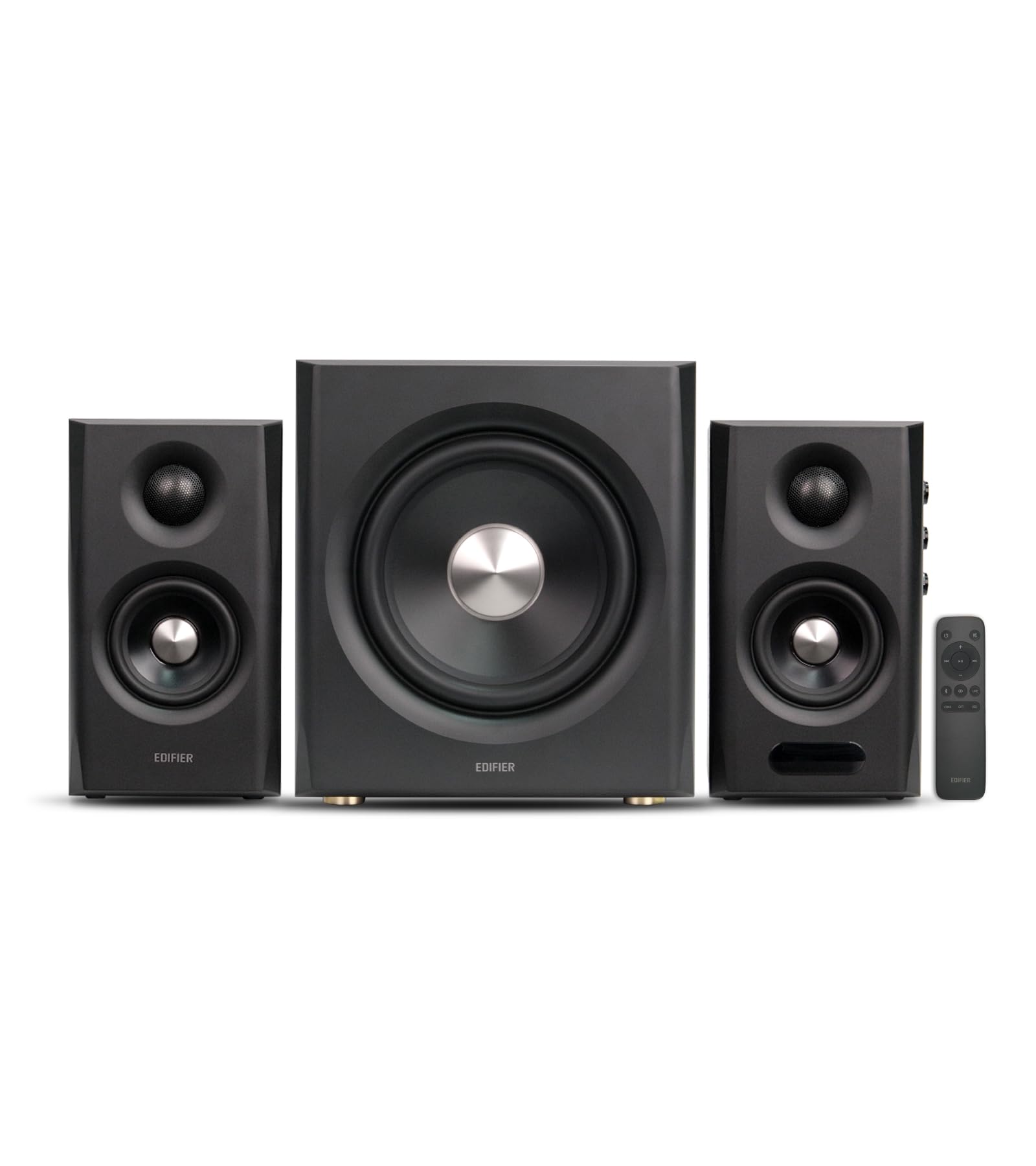
The audiophile’s desktop endgame, with a subwoofer so big it can be placed anywhere wirelessly.
It’s the final upgrade for listeners who refuse to settle for less than studio-grade fidelity. The Edifier S355DB delivers 150W of room-filling power through 3.5″ aluminum cone mid-bass drivers and 1.5″ titanium dome tweeters. It’s a 2.1 setup that’s Hi-Res Audio certified (a standard ensuring it can reproduce high-frequency details beyond standard CD quality), supporting high-resolution audio up to 24-bit/96kHz for studio-grade sound. Owners who upgraded from a 15-year-old system describe it as an “amazing 2.1 system” that was worth the money immediately.
The defining feature here is the massive 8″ subwoofer, which is completely wireless — it connects to the satellites via a dedicated 5.8GHz signal instead of a cable. This solves the classic ‘where do I put the box?’ problem; you can place it anywhere in the room for optimal bass without tripping over wires. A tri-amped active crossover with Digital Signal Processing (DSP) ensures each driver gets precisely the right frequencies, keeping the deep bass clean and the vocals clear.
Buyers consistently praise the simple installation, the sound quality, and the sheer power — one owner’s exact words are that “the base shakes my house.” There are literally zero negative patterns in the customer feedback for this unit. The only decision you’ll face is the premium cost, which puts it firmly in a different class than the others here. You also get extensive control options: knobs on the main speaker, a remote, or the EDIFIER ConneX app, which lets you choose 4 preset sound effects or build your own EQ.
The top-tier verdict: if you want the best sound quality on this list and can afford the jump, this is the one. Its premium build and wireless subwoofer are designed to last through years of daily use.
For everyone else: the other picks here offer 80% of the experience for a fraction of the cost, so only upgrade if the extra fidelity matters to you.
5. Creative Pebble X Plus 2.1 USB-C Computer Speakers

The compact pick with spherical satellites that pack 30W RMS power into a sleek, matte-black design.
These small speakers are a giant leap forward from the older Pebble models — the upgraded 2.75″ drivers and an all-new compact subwoofer deliver 15W RMS power (30W peak), producing punchy bass and a sturdy, balanced sound that owners call “audiophile-grade” with “superb detail.” The design is a sleek, spherical, space-saver, and the customizable RGB lighting with 16.8 million color combinations and six presets lets you match your desk aesthetic perfectly.
What makes these clever is the power flexibility. Plugged into a standard USB-C port, you get the base power. But if you connect the speakers to a 30W or higher USB PD adapter (not included), they amplify to a much louder 30W RMS and 60W peak. This means you can have a quiet desk setup that can suddenly roar when you plug into a powerful charger. The connectivity is versatile too: USB-C for digital audio, Bluetooth 5.3 for wireless, and a 3.5mm AUX input for older devices, plus built-in headphone and microphone jacks on the front for quick private listening.
Owners love the “zero desk clutter” of the single-cable USB-C setup and the flawless subwoofer crossover (the point where the audio transitions from the satellites to the sub). The Creative app is essential for open up the full EQ and RGB control, and owners mention the sound is ideal for quiet environments — “hearable, not feelable” bass. The main limitations are the small size, which means it won’t pressurize a huge room like a bigger system, and some minor gripes about permanently attached speaker cables that cap your stereo placement at about 4 feet apart.
What stands out
- Plug-and-play USB-C digital connection bypasses poor PC sound cards
- Venal RGB lighting that’s customizable without being distracting
- Compact spheres free up valuable desk real estate
Consider this
- Maximum volume could be higher for large rooms
- Non-removable speaker cables limit stereo separation
Reach for these if: you have a tidy, medium-sized desk and want near-Bose quality in a tiny footprint.
Look elsewhere if: you’re building a home-theater-style setup that needs to fill a large living space.
6. Nylavee Computer Speakers with Subwoofer, 2.1 PC Soundbar
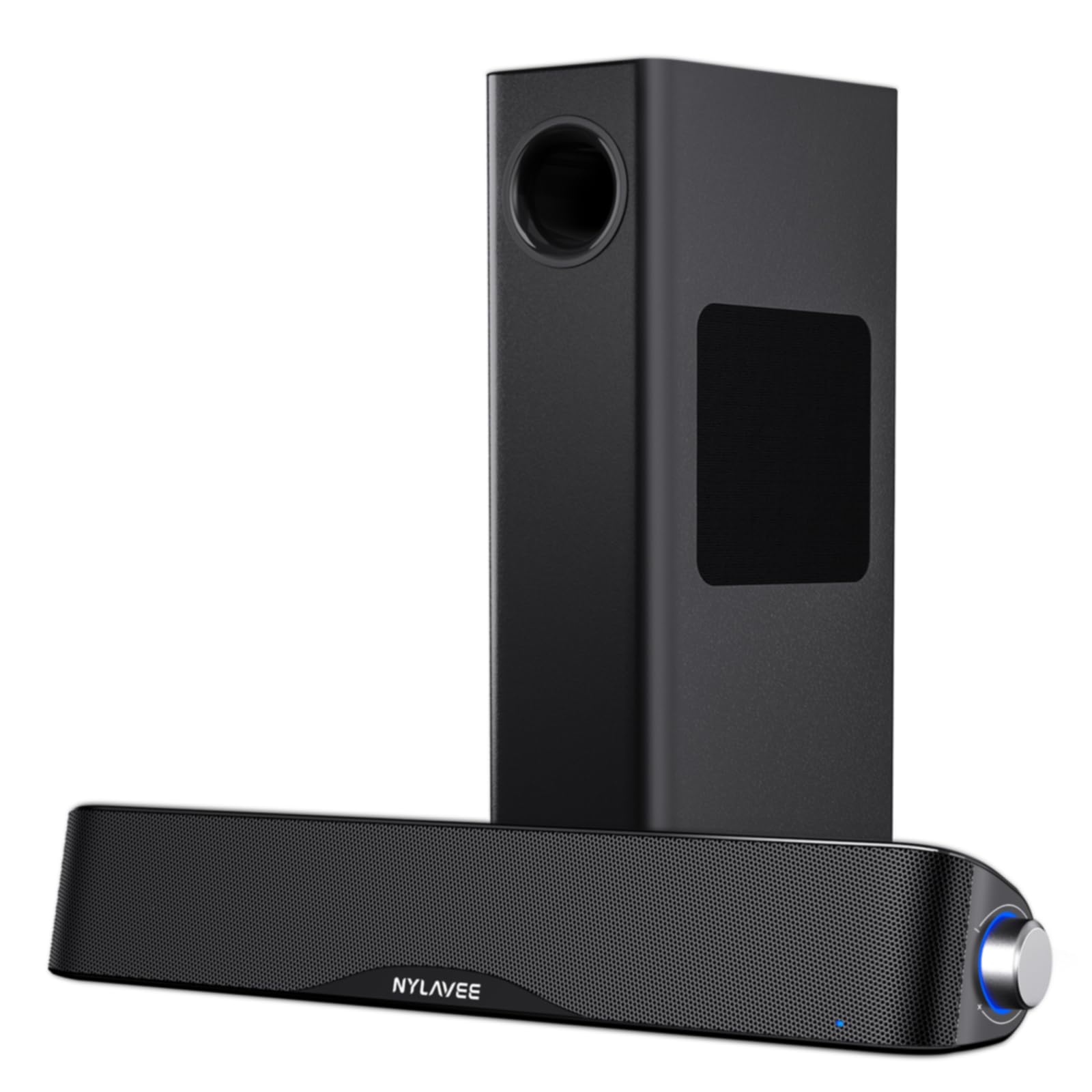
A soundbar-style upgrade that simplifies your desk while delivering punchy, defined bass.
Instead of two separate satellites, the Nylavee uses a single soundbar unit for the left and right channels, which is a brilliant desk-space solution. Inside, it pairs dual soft-dome silk tweeters with full-range drivers to produce crisp highs, balanced mids, and punchy bass — a combination that owners say delivers “big, full sound” they “really can’t believe” from such a compact unit. The standalone subwoofer houses a 5.25″ bass driver with 60W peak power (30W RMS), providing deep, effective lows that can make your desk vibrate while keeping vocals clear and defined.
Connectivity is where this pick gets interesting. It supports Bluetooth 5.4 for stable wireless streaming and uses a 3.5mm AUX cable for wired connections. The standout feature for desk users is the ability to wire it to your TV and simultaneously connect it to your computer via Bluetooth, allowing you to “smoothly transition” between audio sources without unplugging anything. The setup is actively plug-and-play: powered by an AC adapter with no drivers or software needed, and all functions — power, mode, volume, reset — are controlled by a single, satisfying side knob.
The customer feedback is overwhelmingly positive on sound quality and value, with the subwoofer specifically praised for enhancing the balance of music and movies without drowning out the mids. Customers note it handles high volume “easily” and feels sturdy and heavy for its price class, describing it as superior to a popular Cyber Acoustics set. The only minor note is that it’s “slightly larger than expected” — the soundbar footprint is longer than a typical pair of small satellites, so you’ll want to measure your desk before committing.
Best desk setup: the all-in-one soundbar form factor is perfect for minimalists who hate cable clutter between two satellite speakers.
The one caveat: while the soundbar offers great stereo imaging, it can’t create the wide left-right soundstage that a pair of separated satellites can.
7. Bluedee Computer Speakers with Subwoofer, 2.1 PC Speakers
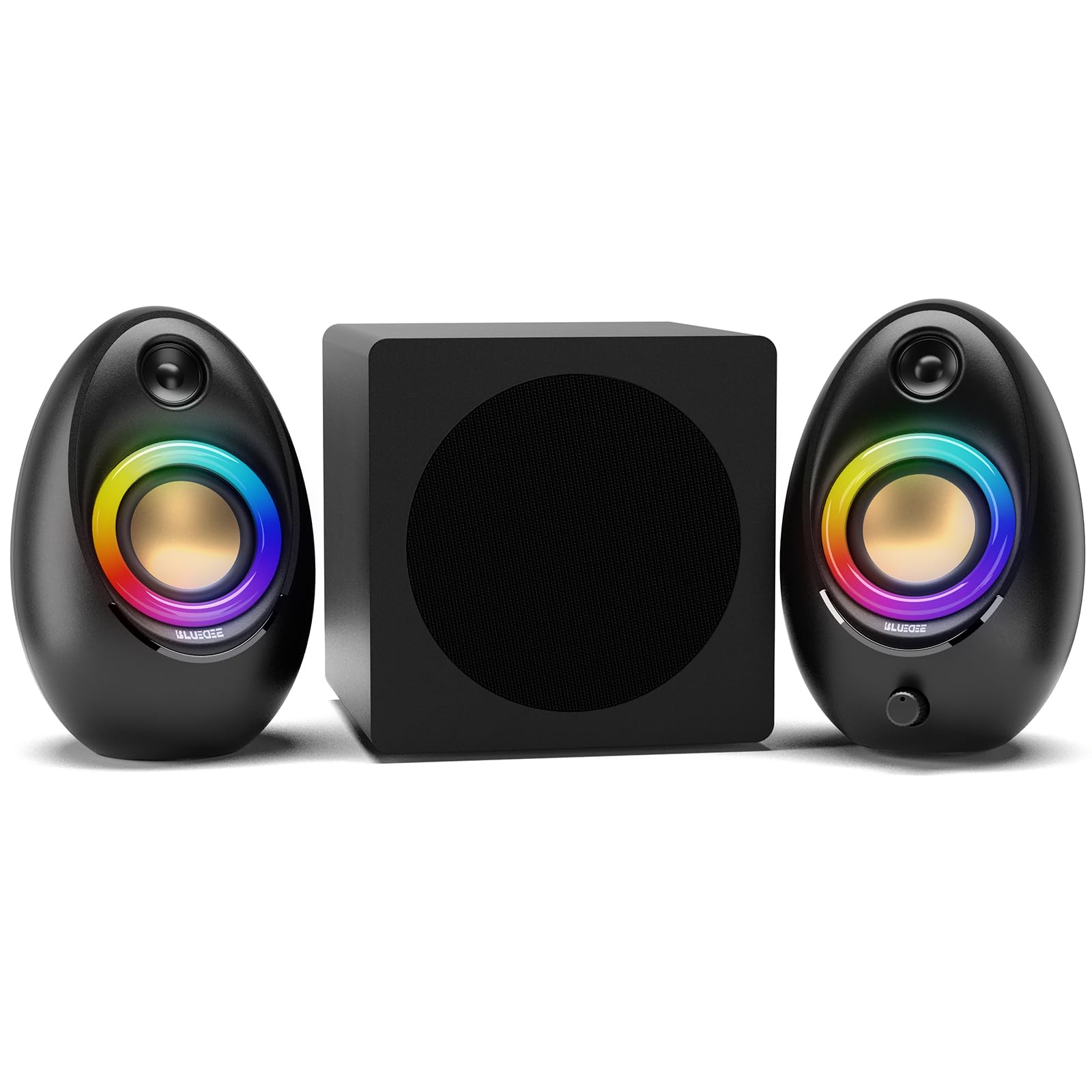
The value pick with DSP tuning that delivers smooth, non-fatiguing sound well above its price.
This Bluedee set is the surprise package of the list. It uses built-in DSP tuning (Digital Signal Processing — a chip that shapes the audio to reduce distortion and harsh highs), resulting in a “smoother, more comfortable sound” that’s ideal for long work-from-home sessions and everyday listening. The 2.1 system features a dedicated, independent bass unit that keeps the low frequencies separate from the satellites, so you get deep, punchy bass without the muddy sound that plagues cheap 2.1 setups.
With 80W of peak power, it’s more than enough for a bedroom or office. The connectivity is refreshingly modern: Bluetooth 5.4 handles wireless, but you also get USB-A, USB-C, and 3.5mm AUX wired options, making it compatible with virtually any desktop or laptop. The all-in-one control knob on the front is a design win, letting you adjust volume, play/pause, cycle lighting effects, and switch modes without hunting for buttons. The RGB lighting is desk-friendly, allowing you to choose dynamic colors or a “soft static glow” to match your vibe without being distracting.
Owners are genuinely impressed by the “clean sound” and the fact that the small subwoofer “gives a surprising kick” that doesn’t overwhelm the mids and highs. For the money, it delivers what buyers describe as “excellent value.” The main criticisms are honest ones: it distorts at very high volume or on bass-heavy tracks (you’ll need to dial it back), the egg-shaped satellite speakers “are prone to rolling” so placement needs care, and the RGB lights default to a solid blue that some found wasn’t the selling point they expected.
Why it’s the value pick
- DSP tuning delivers smooth, clear sound that avoids listener fatigue
- Four connection options (BT, USB-A, USB-C, AUX) for maximum compatibility
- One-knob control makes everyday use easy and clean
Where it cuts corners
- Distorts at maximum volume — keep it below the top end
- LED flashes when Bluetooth disconnects until you unplug it
Grab these for: a versatile, modern-feeling upgrade for a home office or bedroom that needs smooth audio, not just loud audio.
Amp-up the volume: if you’re a basshead who listens at maximum volume constantly, the Z623 or Klipsch will handle the abuse better.
8. Logitech Z313 2.1 Channel Multimedia Speaker System

The budget classic with a real subwoofer and a wired control pod for easy volume access.
If you just want to leave the world of tinny laptop speakers behind without emptying your wallet, this is the classic starting point. The Z313 is a 2.1 system that delivers balanced acoustics and “enhanced bass” from its compact subwoofer, all driven by 50W peak power (25W RMS) — plenty for a dorm room, small bedroom, or office cubicle. The satellites are small enough (5.76″H x 3.52″W) to disappear behind a monitor, and the sub is a modest 8.99″H x 5.91″W that tucks neatly under a desk.
The best feature has nothing to do with raw power — it’s the wired control pod. This little puck puts volume control right on your desk, so you don’t have to reach behind for a knob or fiddle with software. It also has a headphone jack, letting you instantly switch between speakers and private listening. Buyers who upgraded from speakers without this control love it, saying it “works great” and is a huge quality-of-life improvement. Setup is genuinely plug-and-play via a single 3.5mm input, working with any device that has a headphone jack.
The feedback here is remarkably consistent: buyers call it a “value priced basic speaker set” with “nice sound for the money,” praising the mid and high frequency performance and the easy installation. It’s not designed to shake walls — owners note it sounds “amazing for the price” but it’s clearly in the budget tier. The compact subwoofer adds a noticeable thump to music and games, but it won’t deliver the visceral, room-shaking bass of the larger systems on this list.
The best first-timer pick: an uncomplicated, reliable way to get real bass and better sound without any setup headaches or learning curve.
Who should skip it: gamers or movie buffs who crave deep, physical bass — you’ll want a system with a bigger subwoofer driver.
9. FIFINE AmpliGame A22 2.1 Gaming Computer Speakers
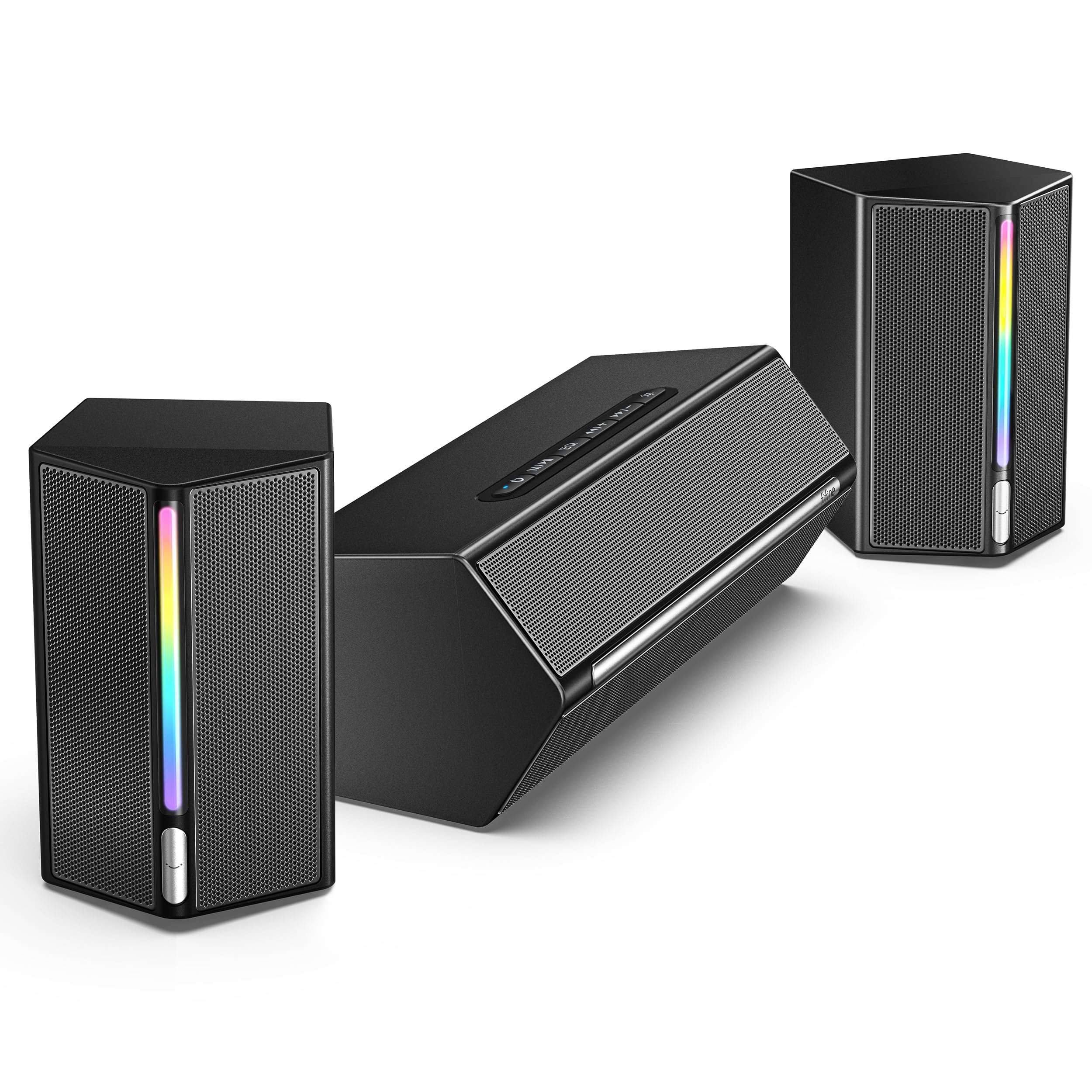
The budget gaming pick with audio-synced RGB, four connection modes, and a top-mounted EQ button.
This FIFINE set is designed specifically for gamers who want that rich audio setup on a budget. It’s a 2.1 system with a dedicated subwoofer and dual satellite speakers that creates a lifelike soundscape — the marketing nails the promise: explosions get deep bass, footsteps come through “pinpoint accurate,” and movie dialogue stays clear. What makes it stand out in the budget tier is the 18 kinds of dynamic RGB lighting modes, including audio-sync, which makes the lights pulse in harmony with your game’s sound or music, creating a mini light show on your desk.
One major advantage over similarly priced competitors is the rear connectivity panel. You get an OTG connection (for clear digital audio from PCs and phones), an optical input (for digital audio from TVs, which avoids the buzzing that plagues analog connections), AUX for standard analog, and Bluetooth for wireless convenience. A long press of the RGB button turns the lights off completely for a dark, focused gaming room. The top-mounted function keys handle volume, music playback (play/pause/next/previous), and a dedicated EQ button that cycles through Game, Movie, and Music modes — each tuned for its specific content.
Owners describe these as a “solid” budget solution, ideal for day-to-day use, with the satellite speakers using replaceable Type-C cables, which is a clever touch. The consensus is that the bass could be deeper and the soundstage fuller than pricier systems, but for the money, they’re “compact and solid.” The most honest guidance comes from a detailed review: the AUX and Bluetooth modes can introduce a constant buzzing — using the optical input delivers the cleanest sound, and Bluetooth has about 180ms of lag, which is noticeable in fast-paced games or when watching movies.
The gaming edge
- RGB lighting syncs with in-game audio for an rich effect
- Optical input provides the cleanest, buzz-free audio signal
- Replaceable Type-C satellite cables are a smart durability feature
Know before you buy
- Bluetooth latency (~180ms) makes it poor for gaming — stick to wired
- Aux mode can buzz; the optical input is the recommended connection
Perfect for: a budget-conscious gamer who wants the RGB aesthetic and clean digital audio via optical cable.
Leave it on the shelf: if you need deep, room-shaking bass, or if you only plan to use Bluetooth — this one is strictly for wired use.
Understanding the Specs
Peak Power vs. RMS Power
You’ll see two wattage numbers on speaker boxes. Peak power is the absolute maximum a speaker can hit in a millisecond burst before distorting — it’s mostly a marketing number. RMS (Root Mean Square) is the continuous power a speaker can handle for extended periods, which is the honest number that tells you how loud it can actually play. Think of peak as a sprinter’s speed and RMS as how fast they can run a marathon.
Subwoofer Driver Size
The “driver size” refers to the diameter of the main speaker cone inside the subwoofer box, measured in inches. A larger driver moves more air, which translates to deeper, more physical bass you can feel in your chest. A 5.25″ driver is great for a desk, while a 6.5″ or 8″ driver is needed to pressurize a larger room with real authority. The driver size is usually the single biggest indicator of bass potential.
THX Certification
THX is a strict quality standard originally developed for movie theaters, and it’s now licensed for consumer electronics. A THX-certified speaker system has passed rigorous testing for distortion, frequency response, and volume. In practice, it means the system is guaranteed to sound clean and accurate, with a flat frequency response, even when you crank it up to reference volume levels.
DSP Tuning for Clear Audio
DSP stands for Digital Signal Processing — a tiny computer chip inside the speaker that shapes the sound before it reaches the drivers. It can filter out harsh frequencies, boost weak ones, and prevent distortion at higher volumes. A well-tuned DSP makes cheap speakers sound much more expensive by smoothing out the audio, which is why some budget systems sound better than others with identical hardware.
FAQ
What does the “2.1” in computer speakers with subwoofer mean?
Can I connect these speakers to my TV or game console?
How much power do I really need for a desk setup?
Is Bluetooth good enough for gaming, or should I use a wired connection?
What does the THX certification actually guarantee?
Do I need a sound card for these speakers?
What is a “downward-firing” or “side-firing” subwoofer?
Will a subwoofer on my desk rattle my neighbors?
Can I mix and match speakers from different systems?
How do I get rid of a constant buzzing noise from my speakers?
Final Thoughts: The Verdict
For the majority of shoppers, the computer speakers with subwoofer winner is the Logitech Z623 because it delivers the best combination of massive, THX-certified power and a proven track record of owner satisfaction. If you want the best clarity with a legendary audio brand, grab the Klipsch ProMedia 2.1. And if you’re a gamer who wants premium sound with a reactive RGB light show, the SteelSeries Arena 7 is the one to reach for.
How We Picked
We do not accept paid placement. Every pick is matched to a real buyer and a real use-case; we do not hands-on test units.
Sources & Methodology
Specifications: manufacturer listings and product documentation. Review insights: verified customer reviews, as of August 2026. Pricing: not shown on this page (it changes often); check the current price via the retailer link.
As an Amazon Associate, FitlyFast earns from qualifying purchases. This does not affect which products we feature.