
Our readers keep the lights on and the weekend projects moving. As an Amazon Associate, I earn from qualifying purchases.
Specs are compiled from manufacturer listings and verified buyer reviews and can change over time — please confirm the key details on the product page before buying.
You bought a conference speakerphone so your remote colleagues stop saying “can you repeat that?” The real problem isn’t volume — it’s that most speakerphones only hear the two people sitting nearest to them. This guide sorts through the field of conference room speaker and microphone options to find the units that actually pick up a whole room, not just the person who pressed mute.
I’m Rikta — the founder and writer behind FitlyFast. This guide is built by comparing the manufacturers’ published specifications and the patterns across verified customer reviews, so you get each pick’s real strengths and trade-offs instead of marketing spin.
You’ll discover which speakerphones truly cover a full conference table, which ones filter out keyboard clicks and HVAC noise, and which wired or wireless setups stay reliable meeting after meeting.
Our Picks at a Glance


How To Choose The Best Conference Room Speaker And Microphone
A speakerphone does two jobs: it plays the far end loud enough for your room to hear, and it captures your room’s voices clearly enough for the far end to understand. The second job is the one most units fail at, and it’s the one you should shop by.
Microphone Pickup Radius and Mic Array
Every speakerphone lists a pickup range — often 3 meters, 5 meters, or 16.4 feet. That number tells you how far away someone can sit and still be heard clearly. The number of microphones in the array (4, 6, or 8 mics) affects how evenly voices are captured from all directions. A larger radius with more mics means people at the far end of a long table won’t be leaning into the unit to be heard.
Connectivity: USB, Bluetooth, or Dongle
A wired USB connection is the most stable and needs no charging, but tethers you to the laptop. Bluetooth offers freedom to roam, but you trade that for occasional connection quirks. Some premium units add a USB dongle that pairs automatically and sidesteps PC Bluetooth compatibility problems altogether — a genuinely useful middle ground for rooms where IT support is scarce.
Battery Life and Talk Time
Wireless units live and die by their battery. A unit rated for 5 hours of talk time will die mid-afternoon on a heavy meeting day, while a 10-hour unit covers an all-day session on one charge. Check the charge time too — a 4-hour battery that takes 15 hours to refill can leave you scrambling.
Echo Cancellation and Noise Reduction
DSP (Digital Signal Processing) features like Acoustic Echo Cancellation stop the far end from hearing themselves bounce back through your speaker. Noise reduction filters out background hums — air conditioning, keyboard clicks, a running waterfall. These matter more in open offices and home offices than in a quiet boardroom.
Quick Comparison
| Model | Best For | Pickup Range | Battery Life | Group Size | Amazon |
|---|---|---|---|---|---|
| Jabra Speak 710★ Best Overall | Day-long portable meetings | 6 people coverage | 5 hours | 6 | Amazon |
| EMEET Luna Plus KitLarge Room Value | Large rooms with a satellite mic | 14 people coverage | 10 hours | 14 | Amazon |
| PolaTab Q95miniWired Workhorse | Wired simplicity with USB hub | 3 meters radius | Wired | 8–10 | Amazon |
| Sennheiser SP 20 | Smartphone and softphone calls | 6–8 people coverage | 20 hours | 6–8 | Amazon |
| Jabra Speak 510 | Quick Bluetooth setup | Single-room audio | 15 hours | 4–6 | Amazon |
| Anker PowerConf | Noise-heavy home offices | 6-mic 360° array | 24 hours | 6–8 | Amazon |
| Bose VB-S | Video plus audio in one device | 4 beamforming mics | Wired | Small rooms | Amazon |
| TONGVEO Wireless | Wireless daisy-chain expansion | 16.4 ft pickup | 16 hours | 20–30 | Amazon |
| TONGVEO All-in-One | PTZ camera plus speakerphone | 16.4 ft pickup | 6 hours | 8–12 | Amazon |
| Owl Labs Meeting Owl 3 | Premium hybrid meeting rooms | 18 ft pickup | Wired | Large rooms | Amazon |
In‑Depth Reviews
1. Jabra Speak 710
Our pick — over 4.5★ from 650+ verified ratings; the strongest balance of quality and price.
A portable speakerphone that sets up in seconds over USB or Bluetooth for small meetings.
You get clear, rich calls for up to 6 people with the Jabra Speak 710, thanks to its omnidirectional microphone (picks up sound from all directions) and HD voice (high-definition audio that reduces background noise). Setup is genuinely plug-and-play — connect via USB or Bluetooth to a laptop, smartphone, or tablet and you’re live in seconds, no driver installation required.
The 5-hour battery life is the honest weak point here, and it charges slowly at 15 hours for a full refill. That’s a 3.8x gap against the EMEET Luna Plus below, which fills in just 4 hours. For a unit weighing almost nothing with a protective travel pouch, the trade-off is portability over endurance — it’s built for the person who moves between huddle rooms, not the one parked at a desk all day.
Buyers report crisp conference calls with no echo, loud volume, and the ability to hear every speaker clearly. The recurring gripe is Bluetooth — connections are quick to set up but can drop on occasion. A few owners also caution against updating the firmware, which triggered connection drops for some.
What wins meetings
- rich HD voice with omnidirectional pickup for up to 6 people
- Truly plug-and-play over USB or Bluetooth, no IT needed
- Doubles as a decent music speaker with intuitive touch controls
Where it stumbles
- 5-hour battery charges slowly at 15 hours to refill
- Bluetooth can drop mid-call, especially after some firmware updates
- Premium pricing for a unit that tops out at 6-person coverage
Reach for it: You want a dependable, portable speakerphone for small meetings that sets up in seconds and sounds great on both ends.
Look elsewhere if: Your meetings run all day on battery, or you need pickup for more than 6 people in one room.
2. EMEET Luna Plus Kit
An 8-mic main unit plus a satellite mic that stretches clear pickup across a 14-person room.
EMEET’s kit solves the classic big-room problem: one speakerphone simply can’t hear everyone at a long table. The main unit carries an 8-microphone omnidirectional array (a set of mics that captures sound from all directions) for up to 10 people, and the bundled satellite mic extends pickup to a full 14-person conference room — 360° coverage that ensures the quiet voice at the far end still gets through.
Battery life is where this unit beats the Jabra 710 above decisively: 10 hours of call time on a 2600mAh cell versus Jabra’s 5 hours — a 2.0x gap — and it refills in just 4 hours compared to Jabra’s 15. The 5W speaker pushes up to 89 dB, so your message lands loud and clear without anyone leaning forward. The VoiceIA noise-reduction algorithm (a software filter that removes background sounds) filters out air conditioning and keyboard clicks, while full-duplex tech with echo cancellation keeps conversations natural and uninterrupted.
Owners mention it handles a packed room with ease — in one real-world test, a 30-person conference heard everything well, and remote participants heard the room clearly too. Setup spans USB 2.0, Bluetooth 5.3, or the A350 dongle for a low-latency, driver-free connection across Windows, macOS, iOS, and Android. The main trade-off is that daisy-chaining a second unit for up to 25 attendees needs the EMEET Daisy-Chain Cable, which you buy separately, and a few owners found the controls take some figuring out on first use.
Room-filling reach: The satellite mic is the differentiator — most units at this level stop at the main array’s radius, and EMEET is one of the few that extends it cleanly.
All-day stamina: At 10 hours of talk time with a 4-hour charge, this outlasts the Jabra 710 by 5 hours and refills nearly 4x faster, making it the better desk-and-meeting companion.
3. PolaTab Q95mini
A wired plug-and-play speakerphone that doubles as a USB hub for your mouse and keyboard.
If you never want to worry about battery life or Bluetooth pairing, this is the pick. It connects over a 3-meter (9.8ft) USB cable — long enough to sit at the center of a table and reach a laptop — and works instantly with no drivers to install. The 360° omnidirectional microphone picks up voices clearly up to a 3-meter radius, so a group of 8-10 people can talk at normal volume.
The clever trick here is the built-in USB hub. You plug a mouse, keyboard, or flash drive into the speakerphone itself, turning it into a tidy docking point rather than just another cable. The DSP chip handles Acoustic Echo Cancellation (AEC) and Automatic Noise Suppression (ANS), so the far end hears you without their own voice echoing back. A physical mute button gives you a guaranteed way to cut audio fast — just note the instructions warn to mute the microphone, not the speaker.
Buyers consistently describe sound that beats built-in laptop mics by a wide margin, and the plug-and-play setup is the thing everyone raves about — one owner went from overnight delivery to a live hybrid conference in minutes. The honest limit is reach: at 3 meters of pickup, keep everyone within about 6 feet. Beyond that, voices drop off noticeably, so this suits a huddle room or one side of a longer table, not a 15-person boardroom. It also works with Windows 7-10 and macOS across Zoom, Skype, Teams, and WebEx.
Why it’s a desk favorite
- True plug-and-play USB with a long 3m cable, no drivers or charging
- Built-in USB hub adds ports for mouse, keyboard, or flash drive
- Echo cancellation and noise suppression keep calls clean
What to know
- Pickup tops out at a 3-meter radius — keep voices close
- Wired only, so ‘roaming’ around the room isn’t an option
- Plastic build; it’s a desk tool, not a travel device
Best for: A permanently wired desktop setup where stability and instant setup matter more than portability.
Skip if: You move between rooms or need to cover more than a 3-meter radius.
4. Sennheiser SP 20

A genuinely small speakerphone that stays loud all week on one 20-hour charge.
This is the battery champion of the list, and it’s a stunner for anyone tired of charging gear. Up to 20 hours of talk time means a full week of meetings on a single charge, and it refills in just 2.5 hours. The omnidirectional microphone is certified for small huddle groups of 6-8 people, and built-in echo canceling keeps the conversation flowing naturally.
What makes it flexible is the triple connection: USB to a PC, a 3.5mm jack for a desk phone, or directly to your smartphone. Owners praise the crisp voice quality for Microsoft Teams and Google Meet, and one long-time user specifically bought two — one for the home office and one for work — after years of cradling a phone between ear and shoulder. The carrying case is included, so it travels free of scratches.
The catch is the most-discussed trade-off: sound quality gets mixed reviews. While human voices come through crisp and the unit is loud for its size, some customers note echo issues in certain rooms, and the mute functionality draws the occasional complaint. At 4.1 stars from a large pool of owners, this is a solid performer with clear strengths — battery and portability — rather than an audio-perfectionist’s tool. It’s certified for Skype for Business and merges PC, softphone, and mobile calls into one conference.
Where it shines
- 20-hour talk time with a fast 2.5-hour charge — best in this list
- Smartphone, USB, and 3.5mm connections for total flexibility
- Compact size that’s loud enough for small huddle rooms
Where it’s honest
- Voice is crisp but a few rooms bring out echo
- Mute button draws occasional owner complaints
- Best for 6-8 people, not big boardrooms
Reach for it: You’re on hours of calls daily and want to charge the speakerphone far less often than your laptop.
Think twice if: You need flawless audio in unusually echoey rooms, or coverage beyond 8 people.
5. Jabra Speak 510

A compact unit with strong noise rejection for noisy home-office environments.
Don’t let the size fool you — the 50mm dynamic driver inside this compact unit delivers genuinely professional call audio. Its 15-hour battery refills in 2 hours, and a 100-foot Bluetooth range lets you roam while talking. Setup takes seconds, whether you connect over Bluetooth or a USB cable to a laptop, smartphone, or tablet.
Where this one earns its keep is noise isolation. One owner specifically runs noisy computer fans and 3D printers in the same office, and remote callers couldn’t hear any of it while the speaker was live. That kind of background-noise rejection makes it a standout for home offices and open-plan spaces where the Jabra 710 above costs more for similar coverage. The travel pouch is included, so it moves easily between desk and bag.
The one meaningful comparison against the 710 is endurance — the 710 broadcasts to a full room, while the 510 is more of a personal or small-huddle device. Owners consistently call it a “professional-quality speakerphone” that’s easy to move around and reliable on both ends of the call. The main limitation is group size: with a single built-in mic, it’s best for 1-4 people around a desk rather than a full conference table.
Noise-killing talent: The microphone’s noise rejection is the thing owners rave about — callers can’t hear fans, printers, or background chatter while you talk.
Endurance pick: At 15 hours of battery with a 2-hour charge, this outlasts the 710 by 10 hours and refills in a fraction of the time.
6. Anker PowerConf

A 6-mic array with AI noise reduction that silences background noise for home offices.
Anker’s PowerConf has become the default recommendation for home offices, and the reason is its 6-microphone 360° array paired with Voice Radar 3.0 AI. That combination filters out noise, cancels echo, and detects multiple speakers simultaneously — so the far end hears clean conversation, not your dishwasher or the waterfall machine running behind you. One owner specifically tested it with a waterfall humidifier running and callers couldn’t hear it at all.
Its 24-hour battery covers roughly three full days of meetings before a top-up. It connects to a phone over Bluetooth or to a computer via USB-C without installing any drivers, and it’s Zoom certified with compatibility across popular conferencing platforms. Voice balancing automatically evens out volume differences, so the quiet talker and the loud talker both come through at a consistent level.
The most interesting note comes from an owner who compared it directly against a Jabra Speak 510: the PowerConf wins on USB-C charging and comes with a hardshell case, but the Jabra edges ahead on raw audio and mic quality, with occasional voice-volume fluctuation on the Anker. It’s a trade-off — slightly softer audio detail for dramatically better battery and noise handling. It’s best for 6-8 people around a desk rather than a full boardroom.
What makes it a no-brainer
- 24-hour battery covers three full days of meetings
- 6-mic array with AI noise reduction handles noisy spaces
- USB-C or Bluetooth, Zoom certified, no drivers needed
Trade-offs to weigh
- Audio and mic detail trails Jabra’s competing unit slightly
- Cord is short — position it close to the laptop
Best for: A home or small office where background noise is the enemy and you want days of battery between charges.
Consider alternatives if: You demand reference-grade audio detail over sheer noise-handling power.
7. Bose Professional VB-S

A 4K camera, four beamforming mics, and a hi-fi speaker in one low-profile bar.
If your meetings are hybrid — some people in the room, some on screen — this videobar replaces a separate webcam, mic, and speaker with one device.. It packs a 4K Ultra-HD camera with 5x digital zoom, a wide field of view, and four beamforming microphones that focus on voices while cutting unwanted noise. In plain terms: remote participants see a sharp, professional image and hear only the people talking, not the room humming.
The camera includes digital point-tilt-zoom (PTZ) with two auto-framing modes and customizable presets, all controllable via the included IR remote. Mount it on a tabletop or wall with the included kit, and it works with Google Meet, Microsoft Teams, and Zoom. Owners describe the voice quality as “almost studio recording level for the talking voice,” and a few note it works unexpectedly well as a desktop webcam for Zoom when placed on a shelf.
The honest caveats: this is a premium, connected device, and a small number of reviewers point out connection reliability issues after a computer restart on Windows 11. It’s also a stationary unit — no battery, no carrying case — so it’s built to live on a table or wall in one room. For anyone who wants to replace a webcam, clip-on mic, and separate speaker with one elegant bar, it’s tough to top the physical package: 4K video and four-mic audio in a single low-profile frame.
Studio-grade voice: The beamforming mics plus noise reduction earn near-universal praise for making the speaker sound broadcast-ready.
Room for caution: A small number of owners hit connection drops after Windows 11 restarts — test your workflow before a make-or-break call.
8. TONGVEO Wireless Conference Speaker
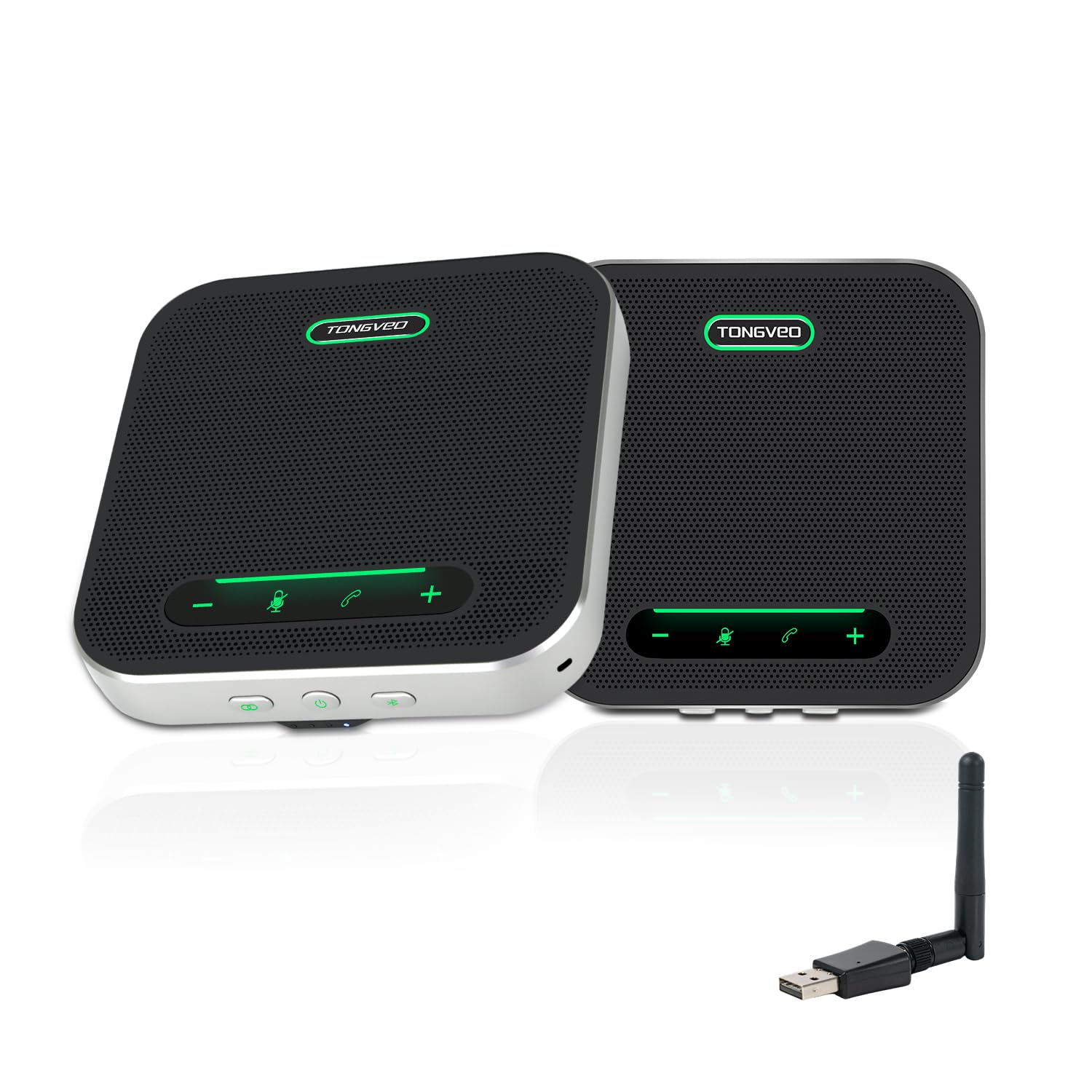
A 16-hour wireless speakerphone that links a second unit to cover up to 30 people.
This is the scaling answer for growing meeting rooms. A single unit captures voices within a 16.4ft (5m) pickup radius using a 4-mic omnidirectional array, and it’s full-duplex — meaning both sides can talk at once without interruption. When the room outgrows one unit, you wirelessly cascade a second speakerphone (with units up to 23ft apart) to cover up to 20 people in a 25-50㎡ space, or daisy-chain via cable for bigger groups.
The battery is the standout number: a 6000mAh cell delivers up to 16 hours of playback and charges fast — roughly 2 hours to full. The 5W speaker pushes to a very loud 112dB with a 100Hz-to-20kHz frequency response, so your message lands clearly even in a large room. Connection options span USB, Bluetooth 5.0, a wireless dongle that pairs automatically, and a 3.5mm aux jack — five total ways to link your devices.
Buyers are impressed by the far-field mic pickup — remote participants can hear voices from across the room without shouting, and the AI-based VoiceIA algorithm cuts keyboard clicks and ambient noise. A few owners note the earlier version had intermittent Bluetooth drops, fixed with a v1.1 upgrade, and reliability gets mixed feedback in the broader pool. The touch-sensitive controls handle call, mute, and volume, and the compact 4.92-inch footprint travels easily.
The big wins
- 6000mAh battery runs 16 hours, charges in about 2 hours
- Wireless daisy-chain links two units for up to 30 people
- 5 connection methods: USB, Bluetooth, dongle, aux, daisy-chain
Know before you buy
- Early units had Bluetooth drops — look for the v1.1 version
- Reliability gets mixed owner feedback despite strong sound
Reach for it: You run a growing meeting space and want the option to link two units wirelessly without extra cables or IT support.
Look elsewhere if: You want a proven, battle-tested brand name over a feature-rich newcomer.
9. TONGVEO All-in-One Conference System
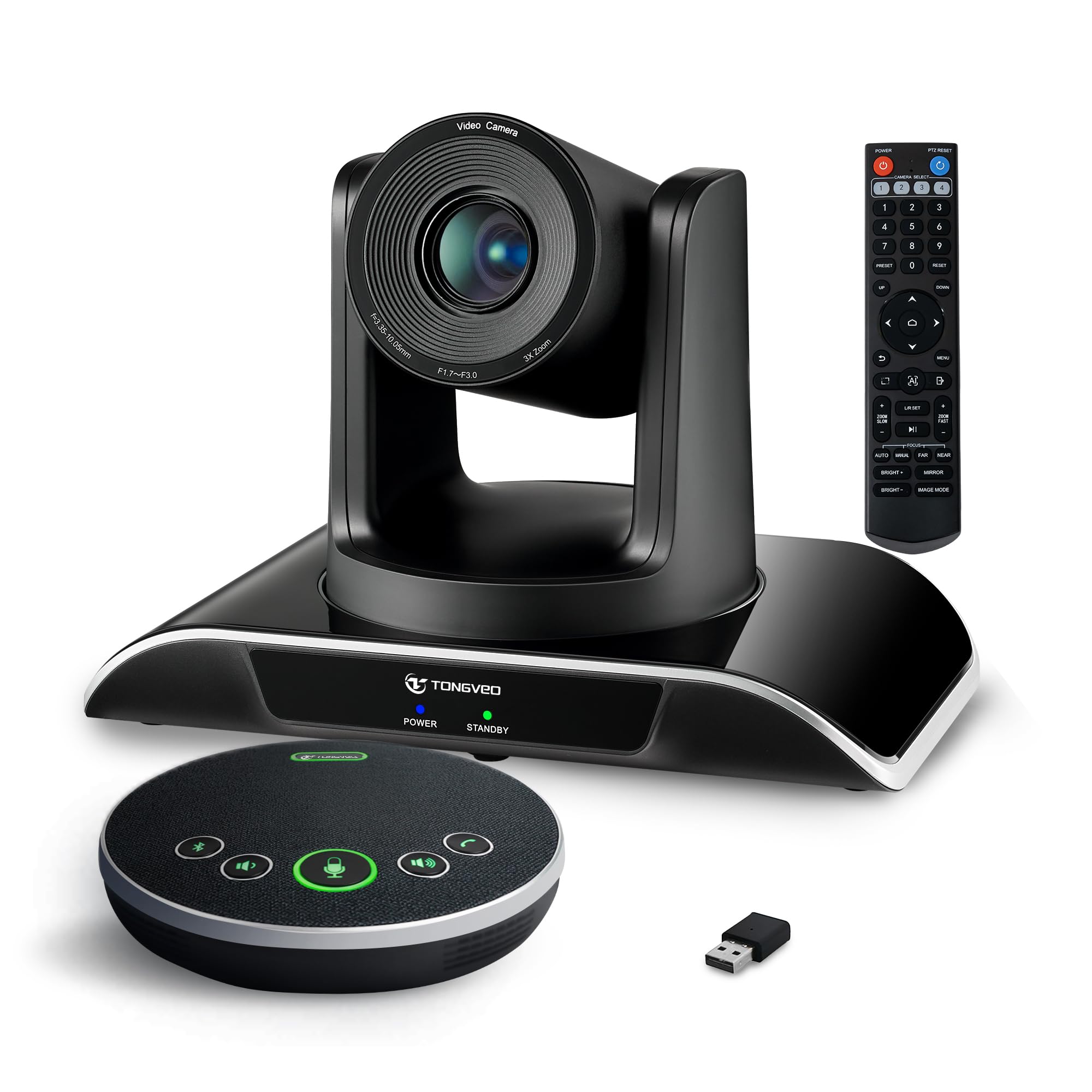
A PTZ camera with AI auto-tracking plus a Bluetooth speakerphone, packaged for small-to-medium rooms.
This bundle answers the question “what if I need video too?” The HD 1080p PTZ camera (pan-tilt-zoom, meaning it can move and zoom) features AI auto-tracking — it locks onto and follows the person speaking — with 3x optical zoom, 350° horizontal rotation, and 180° vertical tilt. It outputs 1920×1080 at 60fps over both HDMI and USB 3.0, using a 1/2.8″ CMOS sensor (a light-capturing chip) with 2.38MP resolution and a 114° field of view. The paired Bluetooth speakerphone handles audio with a full-duplex mic array, echo cancellation, and a 16.4ft pickup radius.
This is the pick for small-to-medium conference rooms (the maker suggests up to 40 square meters, roughly 430 sq ft) with 8-12 people. The speakerphone runs on a built-in 2400mAh battery for 6-8 hours of continuous work, connects via USB, Bluetooth 5.0, or dongle, and the whole system is plug-and-play with Zoom, Teams, WebEx, and other major platforms. Owners praise the clear video, smooth Bluetooth, and the auto-tracking that keeps a moving speaker centered on screen.
The honest trade-offs: the camera is wired while the speaker is wireless, so cable routing matters for a clean install. A few shoppers say the Bluetooth speaker can drop its connection on occasion, and the audio is serviceable rather than spectacular. The all-in-one value is the draw — one system replaces a separate camera, mic, and speaker for a room that’s outgrown a laptop’s built-in hardware.
Auto-tracking value: The AI camera follows the speaker, a feature usually found in far pricier systems that cost multiples of this.
Keep it close: Bluetooth speaker can drop occasionally — position the dongle nearby for a stable link.
10. Owl Labs Meeting Owl 3

An all-in-one with 360° video and an 18-foot pickup radius for large hybrid rooms.
This is the hybrid-meeting benchmark. The Meeting Owl 3 captures 360° video in 1080p HD and 360° audio from up to 18 feet (5.5 meters) away — the longest pickup radius on this list. The proprietary Owl Intelligence System uses visual and audio cues to automatically focus on whoever is speaking, showing remote participants a 360° view of the room while keeping the active speaker centered. Owners describe it as transforming hybrid meetings; one office reports it “revolutionized” their cross-functional calls.
Setup is genuinely fast: from unboxing to your first meeting in 6 minutes via a single plug-and-play USB connection. It’s certified for Microsoft Teams and works with Zoom, Google Meet, and WebEx. The ecosystem scales too — pair two Meeting Owls, or add an Expansion Mic for larger rooms, and IT admins can manage a fleet remotely through the Nest management tool with bulk registration. It survived nine drops in one owner’s two-year test and kept working, which says a lot about the build quality.
The caveat is honest: at this premium level, the 1080p video is the main gripe, with some owners wishing for 4K given the investment. It’s also a wired device — no battery, so it stays put on a table. But for a dedicated conference room where remote participants need to feel present, the 18-foot pickup and automatic speaker tracking are capabilities the rest of this list simply doesn’t offer.
Why teams love it
- 18-foot pickup covers even a large room without an expansion mic
- Auto speaker-tracking keeps the active voice centered on video
- 6-minute setup, Teams certified, fleet management via The Nest
What to weigh
- 1080p video feels limited at this premium price point
- Wired only — it lives on the table, not in a bag
Reach for it: You run a dedicated hybrid room where remote participants must feel fully present, and you want the longest pickup radius available.
Think twice if: You need 4K video or a portable unit you can carry between rooms.
Understanding the Specs
Microphone Array and Pickup Radius
The number of microphones (4, 6, or 8) determines how evenly a speakerphone captures voices from all directions. A 4-mic array with a 16.4ft radius covers a typical mid-size room, while an 8-mic array with a satellite mic extends reach further. The pickup radius is the honest number to check — it tells you how far someone can sit and still be heard clearly. A 3-meter radius suits a huddle room; an 18-foot radius suits a boardroom.
Battery Life vs. Talk Time
Battery numbers come in two flavors: average life (how long a full charge lasts during calls) and charge time (how long it takes to refill). A 5-hour unit with a 15-hour charge time needs overnight planning; a 10-hour unit with a 4-hour charge can be topped up between meetings. If you can’t predict your day, favor a longer talk time and a shorter charge time.
FAQ
How many people can a conference speakerphone actually cover?
What is the difference between omnidirectional and beamforming microphones?
Should I choose a wired USB or wireless Bluetooth speakerphone?
How long does a conference speakerphone battery last per charge?
What does full-duplex audio mean for my meetings?
Will a conference speakerphone work with Zoom, Teams, and Google Meet?
Can I connect two speakerphones together for a bigger room?
What is the difference between a conference speaker and a conference speakerphone?
How much background noise can a speakerphone filter out?
Do I need a separate conference camera, or should I buy an all-in-one system?
Final Thoughts: The Verdict
For most offices, the conference room speaker and microphone winner is the Jabra Speak 710 because it combines reliable, rich sound for up to 6 people with easy plug-and-play setup that needs no IT help. If your room is bigger, the EMEET Luna Plus Kit extends coverage to 14 people with its satellite mic and a 10-hour battery that refills fast. And if hybrid video matters as much as audio, the Owl Labs Meeting Owl 3 delivers the longest 18-foot pickup radius and automatic speaker tracking — the closest thing to being in the room when you’re not.
How We Picked
We do not accept paid placement. Every pick is matched to a real buyer and a real use-case; we do not hands-on test units.
Sources & Methodology
Specifications: manufacturer listings and product documentation. Review insights: verified customer reviews, as of August 2026. Pricing: not shown on this page (it changes often); check the current price via the retailer link.
As an Amazon Associate, FitlyFast earns from qualifying purchases. This does not affect which products we feature.