
Our readers keep the lights on and the weekend projects moving. As an Amazon Associate, I earn from qualifying purchases.
An economical printer shouldn’t be a contradiction in terms. Too many budget-friendly machines lure you in with a low upfront cost only to hold your wallet hostage with aggressive cartridge pricing and forced subscription models. The real cost of printing is measured across thousands of pages, not the single transaction at checkout.
I’m Rikta — the co-founder and writer behind FitlyFast. I’ve spent many hours cross-referencing real-world test data, supply costs, and connector standards to pinpoint which printers actually deliver on the promise of affordable home and office output.
This guide breaks down the models that balance purchase price with ongoing ink or toner costs, helping you find a true economical printer that won’t drain your budget over its lifetime.
How To Choose The Best Economical Printer
Finding a genuinely economical printer requires looking past the sticker price and examining the total cost of ownership. The cheapest box on the shelf often hides the most expensive ink. Focus on three pillars: print engine type (laser vs. inkjet vs. supertank), the cost of replacement consumables, and the features that reduce waste like automatic duplex printing and high-yield cartridge support.
Page Yield and Cost-Per-Page (CPP)
The single most important number for an economical printer is the cost per page. This is calculated by dividing the price of a replacement cartridge or bottle by its declared page yield. A printer that costs a bit more upfront but accepts high-yield cartridges with a CPP under 5 cents for black will save you significantly over a few reams of paper compared to a unit using standard-capacity cartridges that cost 10 cents or more per page.
Print Engine: Laser vs. Inkjet vs. Supertank
Laser printers excel at high-volume black-and-white output with toner that doesn’t dry out, making them ideal for text-heavy home offices. Standard inkjets offer color capability at the lowest upfront cost but often have the highest CPP. Supertank printers like the Epson EcoTank use refillable reservoirs and bundled bottles that drastically lower the CPP for both black and color, making them the long-term value champions for mixed-use households.
Automatic Duplex and Connectivity
Automatic duplex printing cuts paper consumption roughly in half — a direct savings that compounds with every document. For an economical setup, wireless connectivity is non-negotiable for eliminating cable clutter and enabling mobile printing from phones and tablets. Models with an Automatic Document Feeder (ADF) further boost efficiency by batch-scanning or copying multi-page stacks unattended.
Quick Comparison
On smaller screens, swipe sideways to see the full table.
| Model | Category | Best For | Key Spec | Amazon |
|---|---|---|---|---|
| Brother Work Smart 1360 | Color Inkjet | Home Office Duplex | Auto duplex, 16 ppm black | Amazon |
| Canon PIXMA TS7720 | Color Inkjet | Compact Home Printing | 2.7″ touchscreen, 15 ppm black | Amazon |
| HP DeskJet 2755e | Color Inkjet | Entry-Level Occasional Use | 6-month Instant Ink trial included | Amazon |
| Canon PIXMA TR7120 | Color Inkjet | Office Duplex with ADF | Auto duplex, 1.42″ OLED display | Amazon |
| HP LaserJet M209d | B&W Laser | High-Volume Text Printing | Auto duplex, 30 ppm black, USB | Amazon |
| Brother Work Smart 1410 | Color Inkjet | Small Office All-in-One | 2.7″ touchscreen, ADF, auto duplex | Amazon |
| Epson EcoTank ET-2803 | Supertank Ink | Lowest Ink Cost per Page | Up to 4,500 black pages per refill | Amazon |
In‑Depth Reviews
1. Brother Work Smart 1360
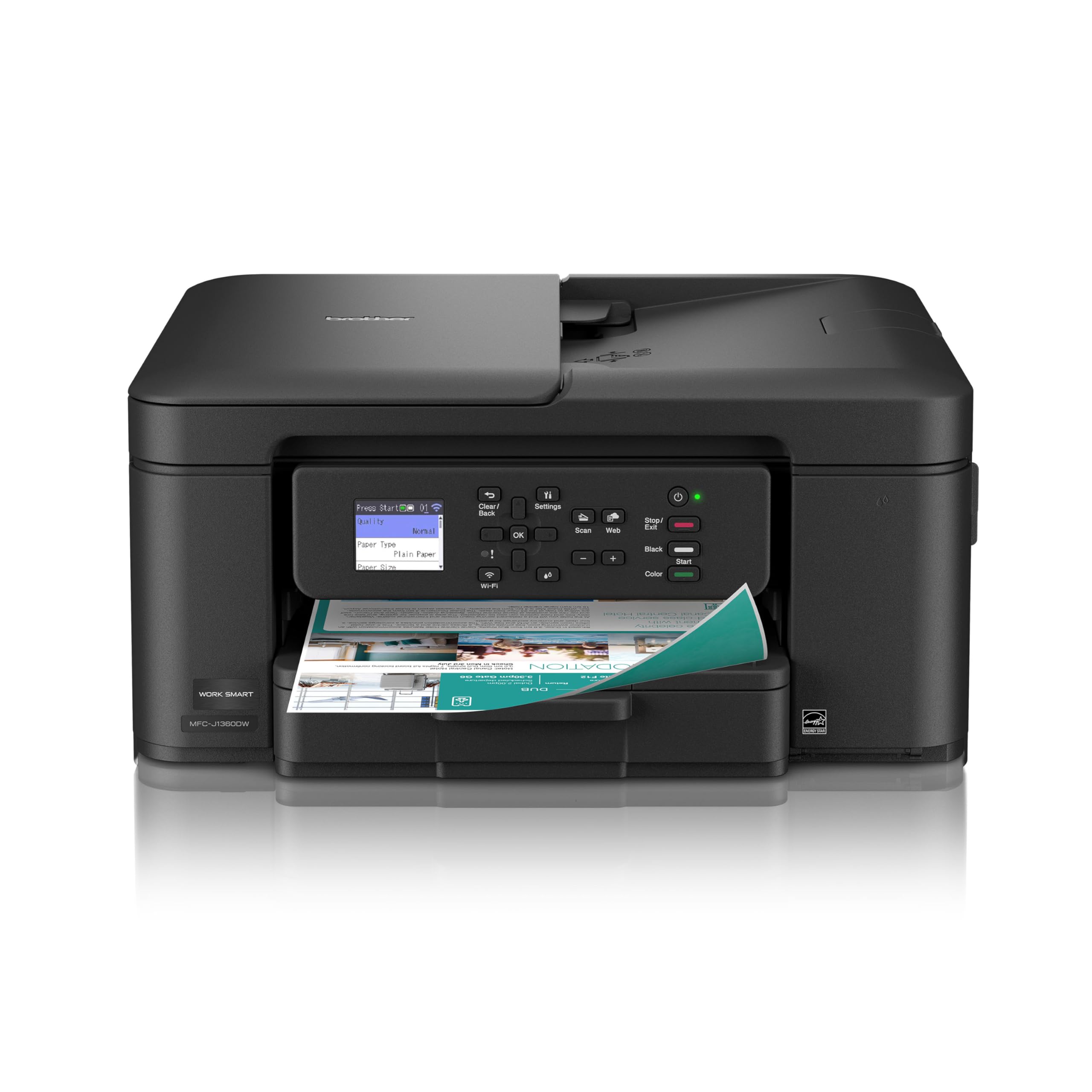
The Brother Work Smart 1360 nails the economical formula better than any other model in this list. It packs automatic duplex printing, a 20-sheet ADF for batch scanning, and a 150-sheet paper tray into a compact body that costs very little upfront. Its print speeds of 16 ppm black and 9 ppm color are competitive for a mid-range inkjet, and the LC501 series ink offers a reasonable cost-per-page when you move to standard or high-yield cartridges.
Setup is straightforward via the Brother Mobile Connect app, and the 1.8-inch color display makes cloud service integration with Google Drive and Dropbox genuinely usable. The wireless connection is stable — a major headache eliminated compared to budget models that drop signal mid-job. Owners consistently report these units running reliably for years, with the Refresh Subscription trial offering a low-pressure entry to automatic ink delivery if you want to reduce reorder friction.
The trade-off is that the starter cartridges in the box are deliberately low-yield, so your first replacement cycle arrives sooner than expected. Additionally, the all-plastic chassis feels less robust than the heavier Brother or Canon office-oriented siblings. Even so, for the home office user who prints a few hundred pages a month and values automated two-sided output, the 1360 is the most complete, wallet-friendly choice.
Why it’s great
- Auto duplex included at this price point
- ADF speeds up scanning multi-page documents
- Reliable wireless with cloud app support
Good to know
- Starter ink cartridges run out quickly
- Plastic build feels a bit light
- No auto-document feeder for two-sided scanning
2. Canon PIXMA TS7720

The Canon PIXMA TS7720 is engineered for the home user who wants a small, attractive printer that doesn’t compromise on basics. Its 2.7-inch color touchscreen is the largest in its class, making menu navigation and wireless network selection genuinely intuitive. Print speeds of 15 ppm black and 10 ppm color are respectable, and the two-cartridge system (PG-285 black and CL-286 color) simplifies ink replacement to just two snap-in units.
Photo quality on glossy paper is a clear strength here — Canon’s color science produces saturated, natural-looking prints that beat most competitors at this price tier. The auto duplex feature works smoothly for text documents, and the compact footprint means it slides into a shelf or desk corner without dominating the room. The setup process, however, can be finicky with Windows PCs; several users report needing to manually connect to the router during initial configuration rather than relying solely on the app.
The biggest hidden cost is the ink: starter cartridges are notoriously low-yield, often running dry after just a few dozen pages. Replacement CL-286 color cartridges are also among the more expensive per-page options in this roundup, making the TS7720 better suited for light, infrequent printing rather than heavy weekly use. For someone who prints a mix of school projects, recipes, and the occasional photo, the trade-off for convenience and print quality is acceptable.
Why it’s great
- Large, responsive color touchscreen display
- Excellent photo print quality for the price
- Very small footprint fits tight spaces
Good to know
- Low-yield starter ink empties fast
- Color cartridge cost-per-page is high
- Setup on Windows can be tricky
3. HP DeskJet 2755e

The HP DeskJet 2755e is the quintessential entry-level all-in-one, designed for the household that prints occasionally and wants the lowest possible entry cost. It includes a six-month Instant Ink trial, which converts the unit into a subscription-based printer during that period — meaning HP monitors your ink levels and ships replacements before you run dry. The dual-band Wi-Fi with self-reset capability delivers better wireless stability than older HP budget models.
Print quality for basic documents is acceptable, with 1200 DPI resolution that handles text and simple graphics without issue. The HP Smart app provides a clean interface for mobile scanning and printing from smartphones, eliminating the need for a direct computer connection. Setup is app-driven and can take 30-40 minutes if the initial connection fails, but once online, it generally stays connected without further intervention.
The serious limitations are manual duplex (you flip the pages yourself) and the glacial print speeds of 7.5 ppm black and 5.5 ppm color. Any document over five pages becomes a waiting game. The Instant Ink trial is appealing, but if you let it expire without opting out, you’ll be paying a monthly fee that can exceed the cost of buying standard cartridges for very light users. The 2755e works best for the user who prints a few pages a week and wants HP’s ecosystem support.
Why it’s great
- Very low upfront cost with Instant Ink trial
- Dual-band Wi-Fi improves connection reliability
- HP Smart app is polished and easy to use
Good to know
- Manual duplex printing only
- Slow print speeds for larger jobs
- Starter cartridges are very low yield
4. Canon PIXMA TR7120

The Canon PIXMA TR7120 brings office-oriented features to a price tier usually reserved for bare-bones home units. It includes an Automatic Document Feeder for hands-free multi-page scanning and copying, plus automatic duplex printing that halves paper usage. The hybrid two-cartridge ink system (one pigment black, one tri-color) delivers sharp text and vibrant photos, and the compact design with a 1.42-inch monochrome OLED display keeps the footprint small enough for a crowded desk.
Dual-band Wi-Fi support (2.4 GHz and 5 GHz) ensures reliable connectivity even in homes with crowded wireless networks. The Canon PRINT app, Apple AirPrint, and Mopria Print Service provide broad mobile printing compatibility. Users consistently praise the straightforward setup and the fact that the starter cartridges seem to last longer than those included with cheaper models — a welcome surprise for an economical printer.
The primary drawback is the cost of replacement cartridges: the tri-color cartridge forces you to replace cyan, magenta, and yellow simultaneously even if only one color runs out, which raises the effective cost-per-page. Off-brand alternatives are scarce and often unreliable. The TR7120 is best for the hybrid worker who needs ADF and duplex efficiency but prints only a few hundred color pages per month, keeping the ink expense manageable.
Why it’s great
- ADF for unattended scanning and copying
- Auto duplex saves significant paper
- Compact footprint with OLED status display
Good to know
- Tri-color cartridge wastes remaining ink
- Limited third-party ink options
- Starter ink runs out faster than standard bottles
5. HP LaserJet M209d
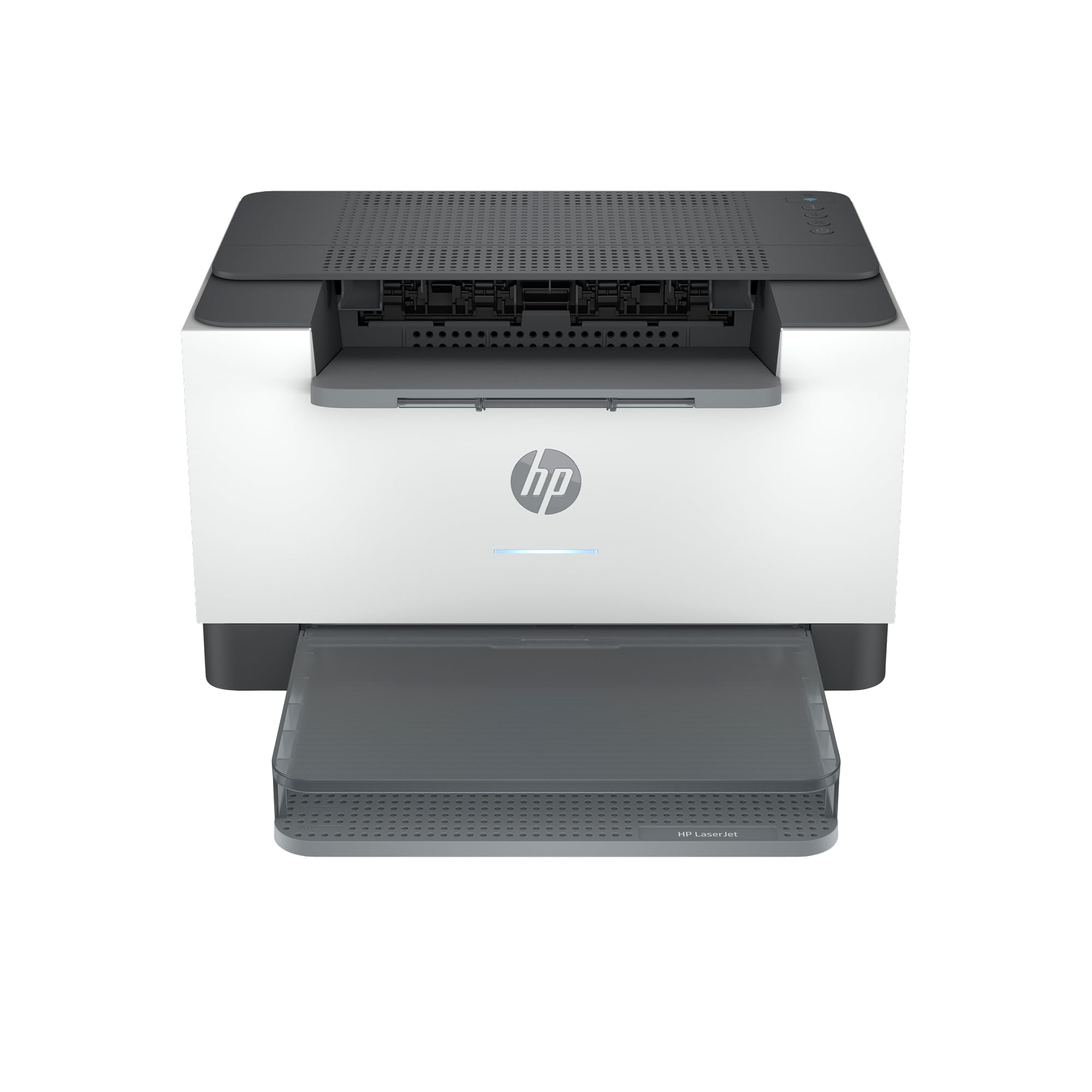
The HP LaserJet M209d is a pure black-and-white laser printer built for one thing: producing crisp text pages faster and more cheaply than any inkjet. With a blistering 30 ppm print speed and automatic duplex as standard, it can chew through a 50-page report in less than two minutes without any manual page flipping. Laser toner also doesn’t dry out if the printer sits idle for weeks, making this the most maintenance-free option in the lineup.
The hardwired USB connection is a deliberate choice — there is no Wi-Fi whatsoever, which eliminates the single biggest source of printer headaches. The smart-guided buttons on the front panel handle basic operations without requiring a touchscreen. At roughly 8 inches wide and 11 inches deep, the footprint is impressively compact for a laser unit, and the included dust cover keeps debris off the paper path.
The dealbreaker for many will be the complete lack of wireless, scanning, or copying capability — this is a print-only device. Mac users also need to check compatibility closely, as some owners report driver issues with macOS 12 and later. The starter toner cartridge that ships with the unit is standard-yield (around 700 pages), so upgrading immediately to a high-yield cartridge is recommended to bring the cost-per-page down to under 3 cents. For the home office that prints hundreds of text pages monthly and doesn’t need color, the M209d is the most genuinely economical runner in this roundup.
Why it’s great
- Extremely fast 30 ppm black-and-white output
- Toner doesn’t dry out with infrequent use
- Very compact for a laser printer
Good to know
- Print-only — no scanner or copier
- No wireless connectivity, USB only
- Mac driver compatibility issues reported
6. Brother Work Smart 1410
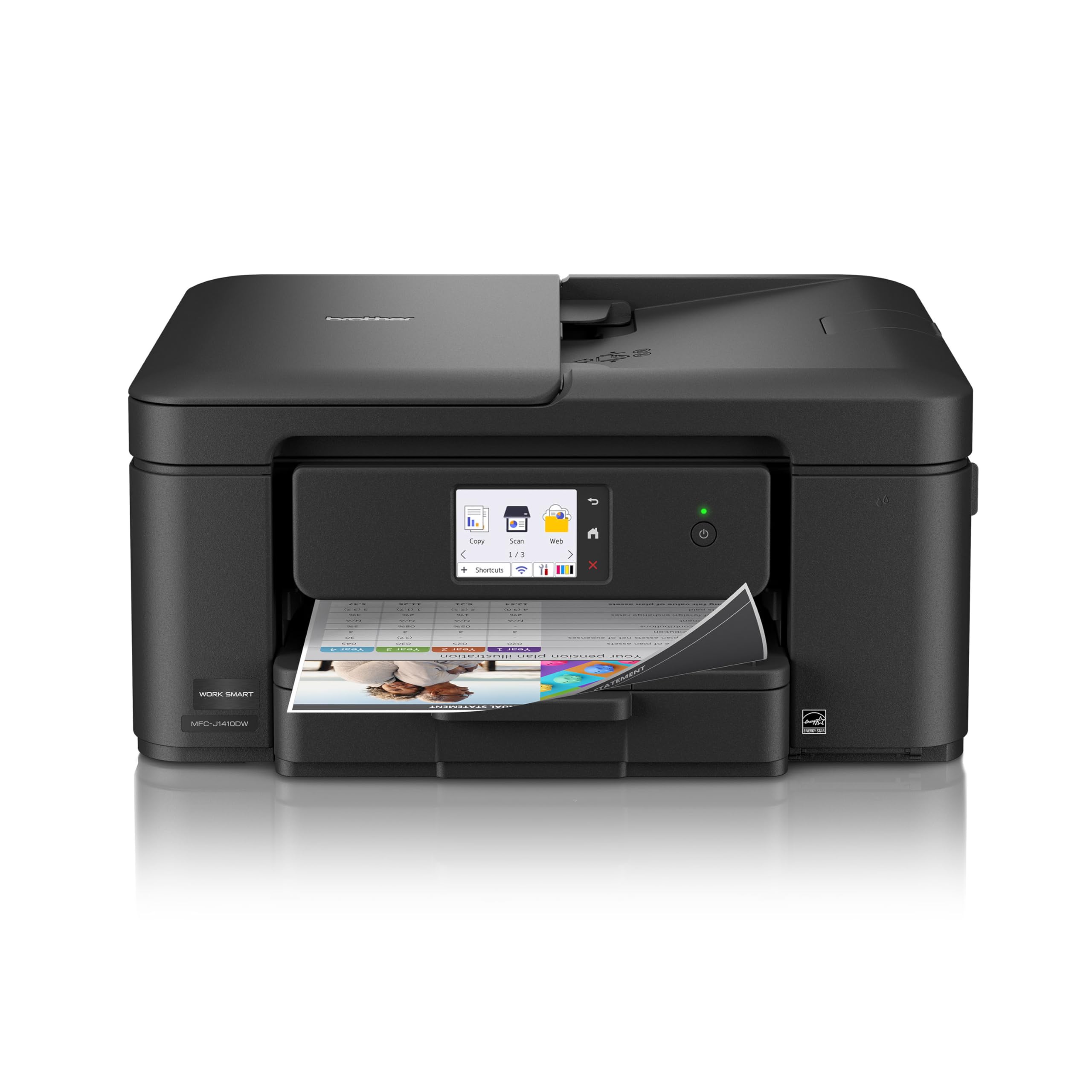
The Brother Work Smart 1410 is the feature-packed sibling of the 1360, adding a 2.7-inch color touchscreen, fax capability, and a larger overall feature set aimed at the small office. It shares the same print engine (16 ppm black, 9 ppm color) and LC501 ink platform, but the upgraded display makes cloud app navigation and on-screen menu adjustments far more pleasant. The automatic duplex and 20-sheet ADF are retained, making it a capable all-in-one for light business use.
Brother’s Refresh Subscription trial is included, providing a low-commitment way to let the printer reorder ink automatically. The wireless setup is reliable once completed, and the Brother Mobile Connect app gives comprehensive control over scanning, copying, and device management from a phone. Owners consistently note the quiet operation and the fact that it doesn’t generate the mechanical racket typical of budget inkjets during printing.
The main concern reported across multiple units is declining reliability — some owners have experienced paper jams, print quality degradation, or complete failure within weeks. The inexpensive ink and excellent feature set make the 1410 a tempting pick, but the quality-control variance means it’s a slightly riskier recommendation than the simpler 1360.
Why it’s great
- Large touchscreen simplifies cloud printing
- Includes fax for traditional office needs
- Quiet operation compared to rivals
Good to know
- Reliability issues reported by some users
- Starter ink runs out quickly
- Customer support response can be slow
7. Epson EcoTank ET-2803

The Epson EcoTank ET-2803 fundamentally rewrites the economics of home color printing. Instead of cartridges, it uses refillable ink tanks that come with bundled bottles yielding up to 4,500 black pages and 7,500 color pages — equivalent to roughly 80 individual cartridges. This drops the cost-per-page to fractions of a cent for black and around one cent for color, making it by far the cheapest option in this guide over the printer’s lifetime.
Print quality is surprisingly good for a supertank: Epson’s Micro Piezo heat-free technology produces sharp black text and vibrant, smudge-free photos on glossy paper. The flatbed scanner works well for documents and photos, and the color LCD display, while small, is sufficient for basic navigation. Wireless connectivity and AirPrint support mean mobile printing is straightforward once the initial setup is completed.
The major trade-offs are the high upfront cost — double that of the other budget inkjets here — and the lack of automatic duplex printing. The slow print speed of 10 ppm black and 5 ppm color also means large jobs take noticeably longer. The Epson software has a reputation for being clunky, with some users reporting persistent Wi-Fi connection drops that require manual IP configuration to resolve. For the household that prints frequently in color or runs a small home business, the EcoTank’s per-page savings can offset its higher purchase price within a few months.
Why it’s great
- Dramatically lower cost-per-page than cartridges
- Excellent photo print quality for the price
- Bundled ink bottles last a year or more
Good to know
- Higher upfront cost than standard inkjets
- No automatic duplex printing
- Epson software can be unreliable for Wi-Fi
FAQ
How do I calculate the true cost of an economical printer?
Is a laser printer always more economical than an inkjet?
Do subscription ink services like HP Instant Ink save money?
What does page yield mean and why does it matter?
Final Thoughts: The Verdict
For most users, the economical printer winner is the Brother Work Smart 1360 because it combines automatic duplex, a useful ADF, and a reasonable cost-per-page with Brother’s reliably good wireless setup at a very competitive upfront price. If you want the lowest possible ongoing ink costs and print enough color to justify the higher initial spend, grab the Epson EcoTank ET-2803. And for high-volume text-only printing with zero maintenance headaches, nothing beats the HP LaserJet M209d.