
Our readers keep the lights on and the weekend projects moving. As an Amazon Associate, I earn from qualifying purchases.
Specs are compiled from manufacturer listings and verified buyer reviews and can change over time — please confirm the key details on the product page before buying.
Finding an exercise bike that actually fits your home, your body, and your joints without rattling the whole house is the core challenge — and the reason this guide cuts straight to the specs that separate a silent, supportive ride from a creaky floor-shaker you will regret. Whether you are recovering from knee surgery, managing arthritis, or just want a low-impact way to build stamina indoors, the choice between recumbent (a bike with a chair-like seat and pedals in front) and upright (a bike with a small saddle and pedals below) matters, as does the weight capacity, the resistance range, and the noise level.
I’m Rikta — the founder and writer behind FitlyFast. This guide is built by comparing the manufacturers’ published specifications and the patterns across verified customer reviews, so you get each pick’s real strengths and trade-offs instead of marketing spin.
Here is a breakdown of the best exercise bikes for home, built around real numbers and honest owner feedback to help you find a bike that is quiet, stable, and easy on your body.
Quick Picks
- Recumbent Exercise Bike for Seniors — Best Overall
- 3G Cardio Elite RB X Recumbent Exercise Bike — Pro Grade Compact
- VANSWE RB405 Recumbent Exercise Bike — Best Value Heavy-Duty
- MERACH S19 Recumbent Exercise Bike — Quiet Compact Pro
- Xterra Fitness SB4500 Recumbent Bike — Touchscreen Powerhouse
- JOROTO JH50 Recumbent Exercise Bike — Premium Feature Rich
- Sole LCR Recumbent Bike — 40-Level EMS Beast
- Schwinn Fitness 130 Upright Bike — Upright App Hub
- Marcy NS-1201R Recumbent Exercise Bike — Budget Recumbent Rehab
How To Choose The Best Exercise Bikes for Home
The right bike for your home depends on which part of your body needs the most support. If your lower back or hips hurt after a few minutes on a standard seat, get a recumbent bike with a high backrest and a thick padded seat. If you want something compact and closer to a traditional cycling posture, an upright bike saves floor space and works your core more. The two numbers that matter most are the weight capacity — which tells you how solid the frame really is — and the resistance levels, which determine whether you can start gently and still have room to progress.
Recumbent vs. Upright: Which seat fits your body?
A recumbent bike puts you in a laid-back, chair-like position with your legs reaching forward to the pedals. That posture takes all the pressure off your lower back and wrists, making it the top choice for seniors, rehab patients, and anyone with back pain or limited mobility. An upright bike places you directly over the pedals, which mimics road cycling. It uses less floor space and recruits your core and upper body more, but the small saddle can become uncomfortable on longer rides. If comfort is your biggest priority, go recumbent; if space and a more athletic feel matter most, go upright.
Resistance type: Magnetic vs. Friction
Magnetic resistance uses magnets to create drag on a metal flywheel (the spinning wheel that stores momentum), so there is no physical contact and almost zero noise. It delivers a smooth, consistent feel at every level and requires almost no maintenance. Friction resistance uses felt pads or wool pads that press against the flywheel, which wears down over time and creates more noise. For a home environment where you might ride early in the morning or while others watch TV, a magnetic resistance system is the quiet winner. Every bike on this list uses magnetic resistance, so you are getting a whisper-quiet ride regardless of which model you pick.
Weight capacity and frame weight: Stability you can trust
The maximum weight recommendation tells you the absolute load the bike can handle safely, but a higher number also usually means a heavier, more substantial frame that does not wobble when you pedal hard. A bike rated for 400 pounds, for example, will feel more planted than one rated for 300 pounds, even if you weigh less than both limits. The bike’s own weight matters too — a heavier bike is harder to move but stays put during intense sessions. Look for built-in transport wheels if you need to roll it out of the way, and check the footprint dimensions (length, width, and height) to make sure it fits your space.
Quick Comparison
| Model | Best For | Resistance Levels | Weight Capacity | Item Weight | Amazon |
|---|---|---|---|---|---|
| Marcy NS-1201R | Budget Recumbent Rehab | 8 | 300 lbs | 70 lbs | Amazon |
| Kawnina USNC-CBK2410 | Heavy-Duty Recumbent Comfort | 16 | 420 lbs | 62 lbs | Amazon |
| VANSWE RB405 | Heavy Rider Stability | 8 | 400 lbs | 73 lbs | Amazon |
| MERACH S19 | Quiet Compact Recumbent | 8 | 330 lbs | 84.9 lbs | Amazon |
| Schwinn 130 | Upright App Integration | 16 | 300 lbs | 57.3 lbs | Amazon |
| JOROTO JH50 | Premium Recumbent Value | 16 | 400 lbs | 83 lbs | Amazon |
| Xterra SB4500 | Touchscreen Interactive Workouts | 24 | 265 lbs | 82 lbs | Amazon |
| Sole LCR | Pro-Level EMS Resistance | 40 | 350 lbs | 173 lbs | Amazon |
| 3G Cardio Elite RB X | Commercial-Grade Compact Recumbent | 16 | 350 lbs | 115 lbs | Amazon |
In‑Depth Reviews
1. Recumbent Exercise Bike for Seniors — Kawnina USNC-CBK2410
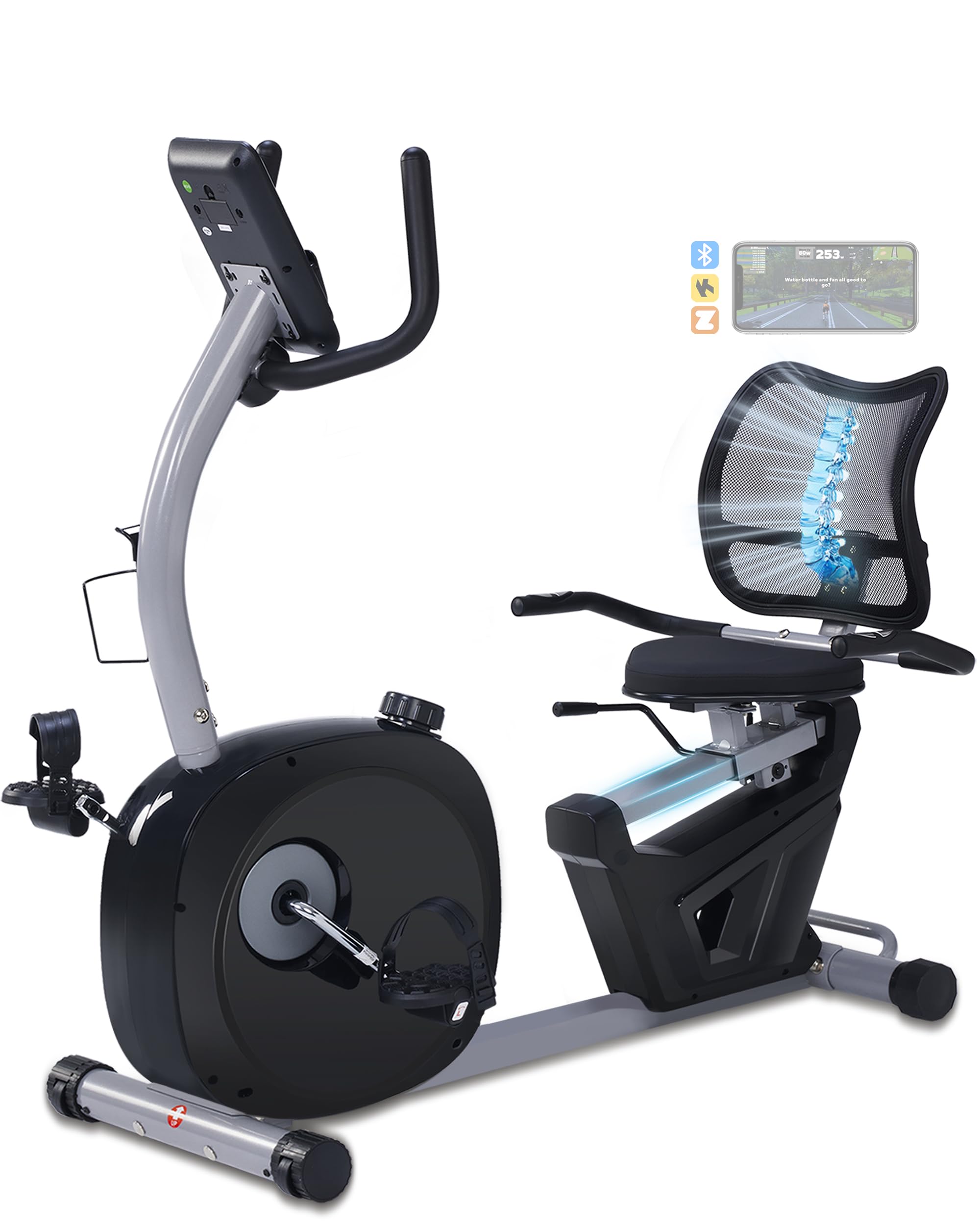
A heavy-duty recumbent that feels more like physical therapy gear than a home gadget.
You get a weight capacity of 420 pounds — the highest in this roundup — and 16 levels of magnetic resistance (magnets that create smooth, quiet drag). 16 levels — compared to 8 levels on the Marcy NS-1201R — so you have far more room to start gently and gradually increase the challenge. The step-through frame (no crossbar to step over) makes mounting easy, and the ergonomic mesh backrest keeps your lower back cool and supported. Buyers report “low-impact, comfortable 45-min rides with back support, no lower back pain,” which directly addresses the main reason most people abandon their exercise bike. The Bluetooth connectivity (a wireless link) to Kinomap and Zwift adds app-based tracking, and the backlit LCD monitor shows time, distance, speed, calories, and heart rate. At 62 pounds, versus the VANSWE RB405 at 73 pounds, it is easier to move with the built-in transport wheels. The trade-off is that some riders find the seat cushion a bit firm — one reviewer noted “the seat could use a little more cushion.” But for stability, capacity, and smooth progression, this is the most balanced pick for a family with diverse needs.
Who this fits best: Households where multiple riders of different sizes will use the bike, especially anyone with back concerns who wants a stable, high-capacity platform with plenty of resistance range to grow into.
One honest catch: The seat padding is decent but not plush — plan to add a gel seat cover for longer sessions if you are on the lighter side.
2. 3G Cardio Elite RB X Recumbent Exercise Bike

A commercial-grade recumbent that squeezes into a compact footprint without sacrificing an ounce of stability.
The 3G Cardio Elite RB X is the shortest recumbent on this list at 49 inches long, which is about a foot shorter than the Kawnina — critical if your home gym space is tight. Despite the small size, it supports up to 350 pounds and the frame itself weighs 115 pounds, giving it a planted, wobble-free feel that buyers describe as commercial quality. The oversized cushioned seat adjusts 25 positions forward and back and tilts through 5 angles, and the airflow mesh backrest also tilts to conform to your body. An Arizona-based company with a combined 50 years in the fitness industry, 3G Cardio backs it with a lifetime frame warranty, a 7-year parts warranty, and 1-year in-home labor. A tall reviewer at 6’6″ with a 36/37 inch inseam reported it fit perfectly — rare for a compact frame. It includes 16 levels of magnetic resistance, 12 preprogrammed workouts, 3 heart rate workouts, and FreeSync FTMS Bluetooth for third-party apps. The narrow Q factor (the distance between pedals) keeps your legs in a natural alignment, which one reviewer called “perfectly aligned from foot to hip.” The trade-off is the price: this is a premium investment. If you just want a basic cardio machine for light use, you are paying for durability you may not need. But for heavy daily use or rehab that demands a rock-solid, ergonomic ride, it is tough to top.
The real strength: The combination of a lifetime frame warranty and a compact 49-inch length means you get long-term durability without sacrificing precious floor space — a rare pairing.
What you give up: There is no large touchscreen or app subscription included, just a tablet shelf, so if you need built-in entertainment, you will need to bring your own device.
3. VANSWE RB405 Recumbent Exercise Bike
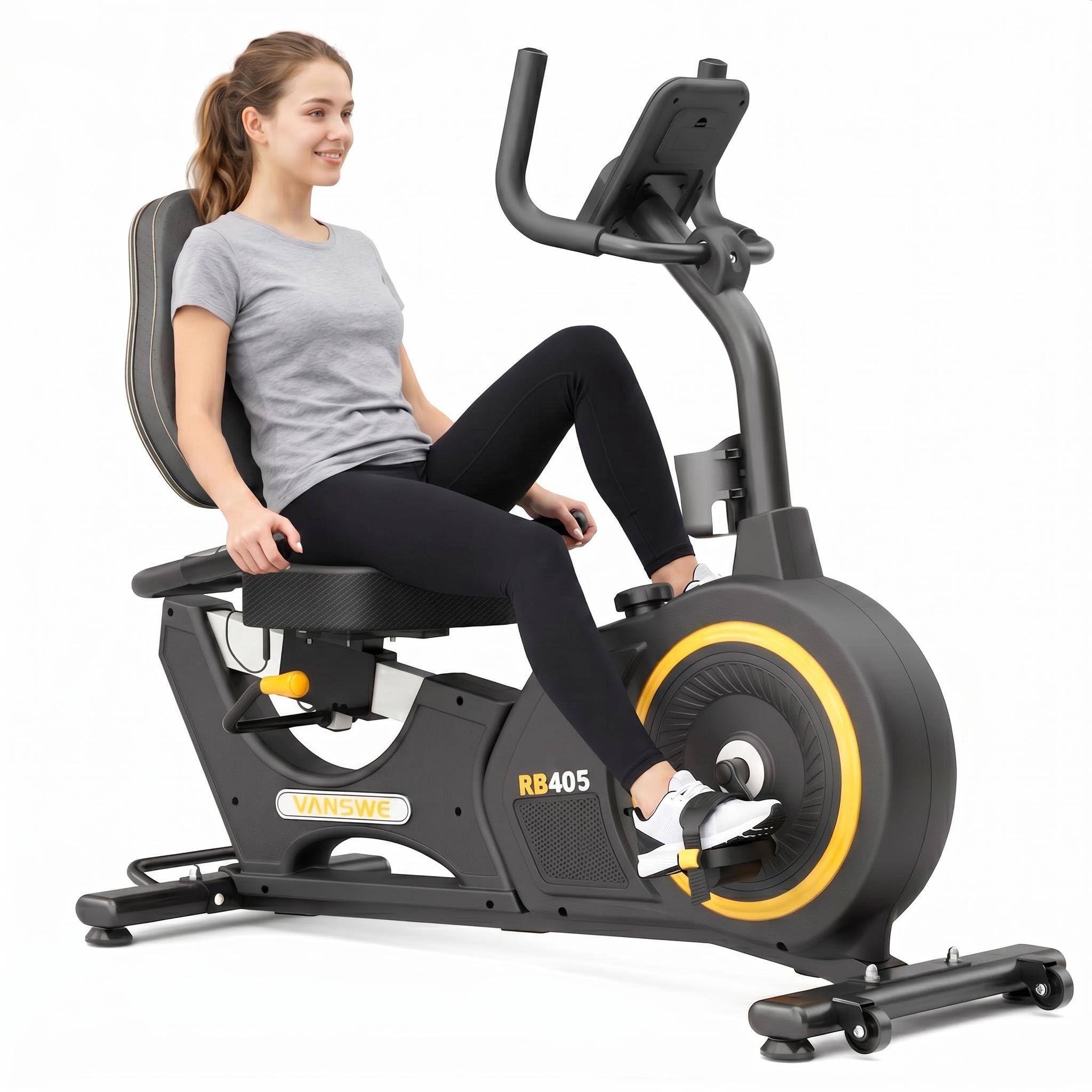
A wobble-free heavyweight frame that prioritizes stability for larger riders without breaking the budget.
The VANSWE RB405 is built around a commercial-grade steel frame that weighs 73 pounds — 11 pounds heavier than the Kawnina bike — and supports up to 400 pounds. That extra heft creates a “rock-solid, wobble-free riding experience,” according to the maker, and buyers confirm it feels gym-quality. The 3.4-inch extra-thick padded seat cushion is the thickest in this group, and the contoured backrest provides serious spinal support. That said, the resistance stops at 8 levels, which is half the range of the Kawnina or JOROTO bikes — fine for gentle rehab and steady-state cardio, but limiting if you want to push into higher-intensity intervals over time. It arrives 90% pre-assembled, and owners mention assembly is straightforward with a second person. The Infinite Slider Seat System (a seat track that adjusts down to the millimeter) fits leg lengths from 29 to 40 inches (roughly 5’1″ to 6’4″). One thing to note: some buyers mention the grip bars sit a bit close to the body and the pedal straps are small for larger feet. The Bluetooth app connection (a wireless link) to Kinomap and Zwift works but a few users reported connectivity hiccups. For the price, you get a very stable, very comfortable recumbent that is quieter than most — just know the resistance ceiling is lower than some alternatives.
What stands out
- Heaviest frame in the mid-range (73 lbs) for maximum stability at 400 lb capacity
- 3.4-inch extra-thick seat cushion is the most padded in this group
- Infinite Slider Seat adjusts by the millimeter for a custom leg fit
Where it falls short
- Only 8 resistance levels, limiting long-term intensity progression
- Pedal clips are small for larger feet, per buyer feedback
- Grip bars feel too close for some riders
4. MERACH S19 Recumbent Exercise Bike
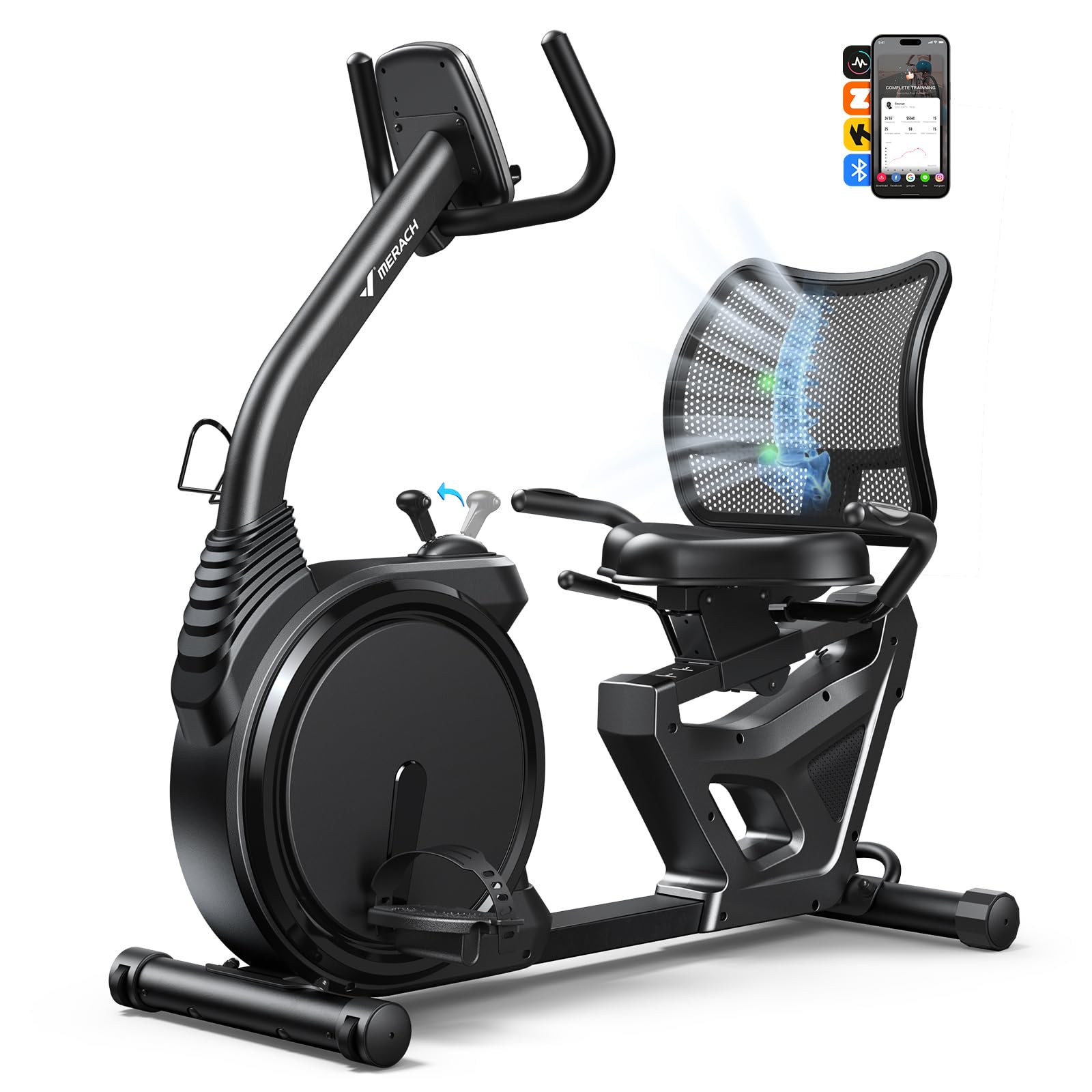
A dense, whisper-quiet recumbent that packs a heavier frame than most competitors into a compact shape.
The MERACH S19 weighs 84.9 pounds — compared to the VANSWE RB405’s 73 pounds — making it among the most solid-feeling recumbents in the mid-range, but its dimensions are compact at 48.03 x 23.62 x 46.46 inches. That weight comes from the alloy steel frame and a 6.6-pound perimeter-weighted flywheel (a spinning wheel that stores momentum for a smoother pedal stroke) with a dual-belt drive system that reviewers consistently call “very quiet.” The 8-level car-style lever resistance (a lever you push or pull to change difficulty, like a gear shifter in a car) is simple to shift mid-ride. The seat adjusts through 8 positions and features a breathable mesh backrest. One nice touch is the frosted handlebar that stays grippy even when you sweat, unlike standard plastic handles. The MERACH self-developed app tracks real-time stats via Bluetooth and the FantomFite app adds a game-like element. Buyers praise the smooth pedaling and simple operation, with one long-term user noting it replaced a previous model that could not keep up with 300 miles per week of use — they found the S19 well-built by comparison. The recommended height range is 5’2″ to 5’10”, so taller riders may feel cramped. And at 8 resistance levels, it shares the same ceiling as the VANSWE — fine for steady cardio, but you will max out the resistance sooner than you would on a 16-level bike. At this weight and price, you are getting a lot of solid metal for the money.
The edge it has: At 84.9 pounds, it is the heaviest recumbent in its price class, which means less vibration and a more solid pedal stroke than lighter bikes.
The limit to watch: The resistance tops out at 8 levels, so if you are a former gym-goer who needs high-resistance intervals, you will want a 16-level or 24-level machine instead.
5. Xterra Fitness SB4500 Recumbent Bike
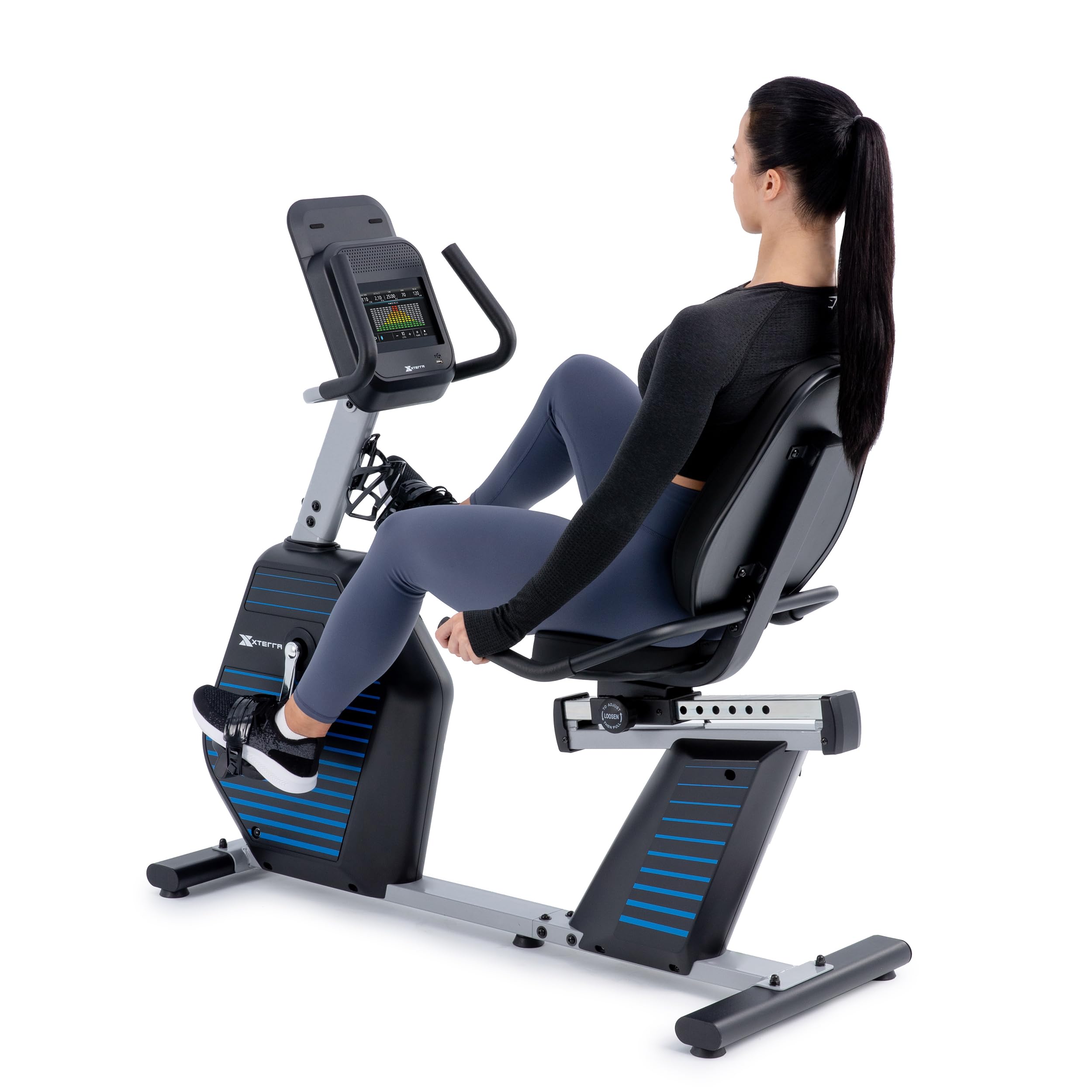
A recumbent that trades raw capacity for a premium interactive screen experience and a wide resistance range.
The Xterra SB4500 is the only bike in this lineup with an intuitive 7-inch touchscreen display, which makes navigating 24 levels of resistance and 11 workout programs feel intuitive rather than like pressing a menu button a dozen times. The 24 resistance levels — compared to the 12 often found at this price — give you fine-grained control from gentle recovery to challenging hill climbs. The step-through frame design (no crossbar to step over) makes it easy to mount, and buyers at 6’2″ and 290 pounds report excellent legroom and a smooth, quiet ride. It is Bluetooth FTMS (Fitness Machine Service, a standard wireless protocol) compatible for third-party app connectivity, so you can pair it with Zwift or other platforms. The 82-pound frame is substantial enough for stability. The catch is the weight capacity: at 265 pounds, it is the lowest in this guide, so heavier riders will need to look at the Kawnina or JOROTO options. Also, some buyers received units with cosmetic damage due to packaging issues, and there is no built-in cup holder or tablet ledge. But if you are within the weight limit and value a proper touchscreen interface with plenty of program variety, this is a standout pick. One 6-foot, 225-pound reviewer called it “amazing value for money” and praised the solid, silent operation.
Best use case: Riders under 265 pounds who want a big, clear touchscreen and the widest resistance range (24 levels) for structured workout programs without needing a separate tablet.
What you should know: The weight capacity is the lowest here, and packaging quality has been inconsistent in buyer reports — inspect the box carefully on arrival.
6. JOROTO JH50 Recumbent Exercise Bike
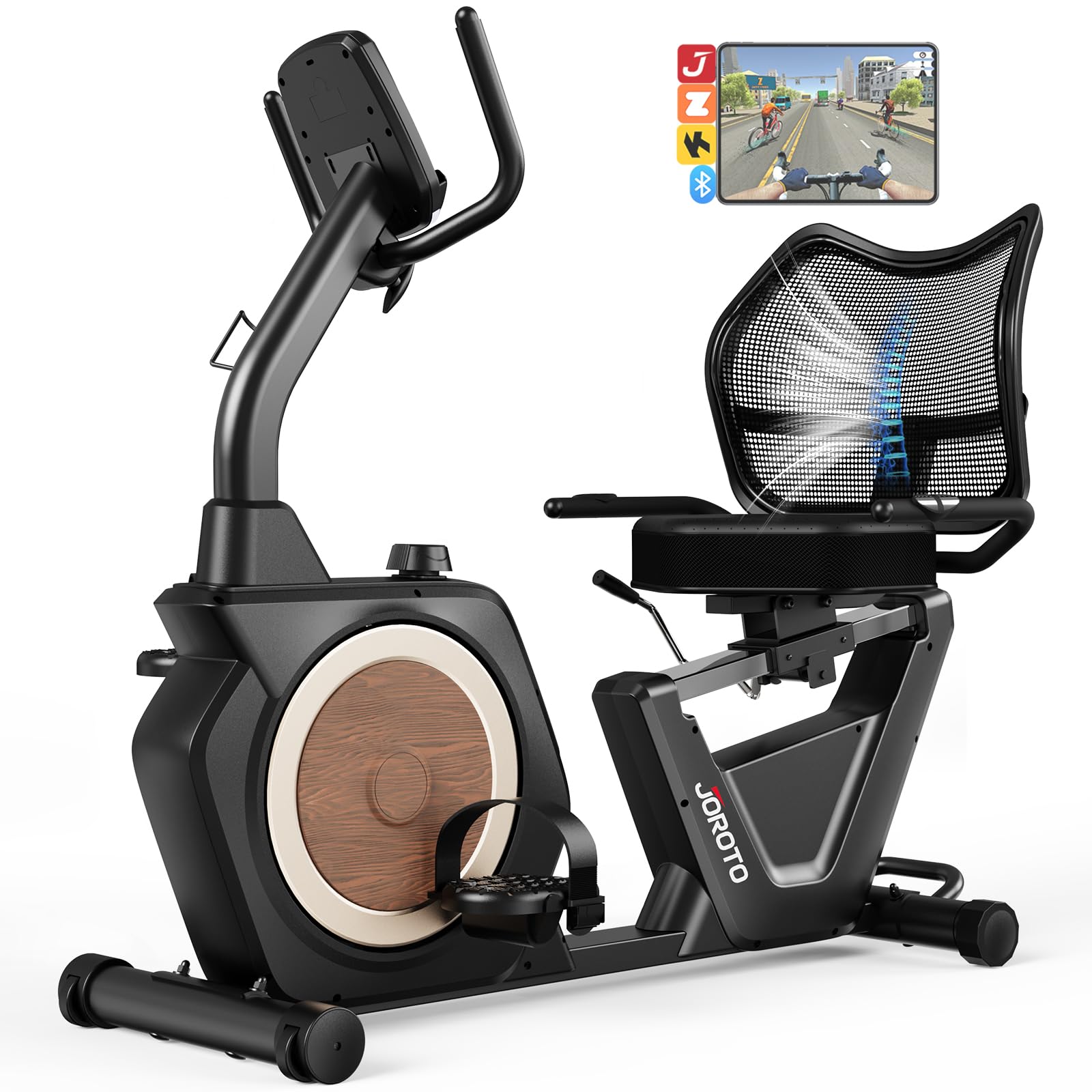
A heavy, feature-packed recumbent that brings 16-level resistance and app connectivity at a mid-premium price.
The JOROTO JH50 weighs 83 pounds and supports up to 400 pounds, which puts it in the same stability league as the Kawnina but adds a few extras: it arrives 95% pre-assembled (the highest pre-assembly rate in this guide), includes a protective dust cover, and comes with a 2-year warranty. The 16-level magnetic resistance is controlled by a knob switch on the frame, which buyers find simple to adjust mid-ride. The backlit LCD monitor tracks time, speed, distance, calories, and pulse, and the device holder keeps your phone or tablet at eye level. Bluetooth connectivity works with the JOROTO app, Kinomap, and Zwift for interactive training. The seat is thick and padded, and the ergonomic backrest reduces pressure on your hips and lower back. Customers note that it is “quiet” and can “handle an intense workout,” with one buyer assembling it in about 45 minutes. The 11-pound magnetic flywheel (a spinning wheel that adds momentum for a smoother pedal stroke) adds a smoother feel. A minor complaint: some users found the handlebar mounting a bit finicky during assembly. The JH50 shares the 400-pound capacity with the Kawnina but at a higher price, so you are paying extra for the faster assembly, the dust cover, and the longer warranty — worth it if those conveniences matter to you.
Why you might choose it
- 95% pre-assembled — the easiest setup of any bike in this guide
- 16 resistance levels match the Kawnina, with a smooth knob adjustment
- Comes with a dust cover and a 2-year warranty for long-term confidence
Why you might skip it
- Higher price than the Kawnina despite similar capacity and resistance
- Handlebar mounting can be tricky during assembly
7. Sole LCR Recumbent Bike
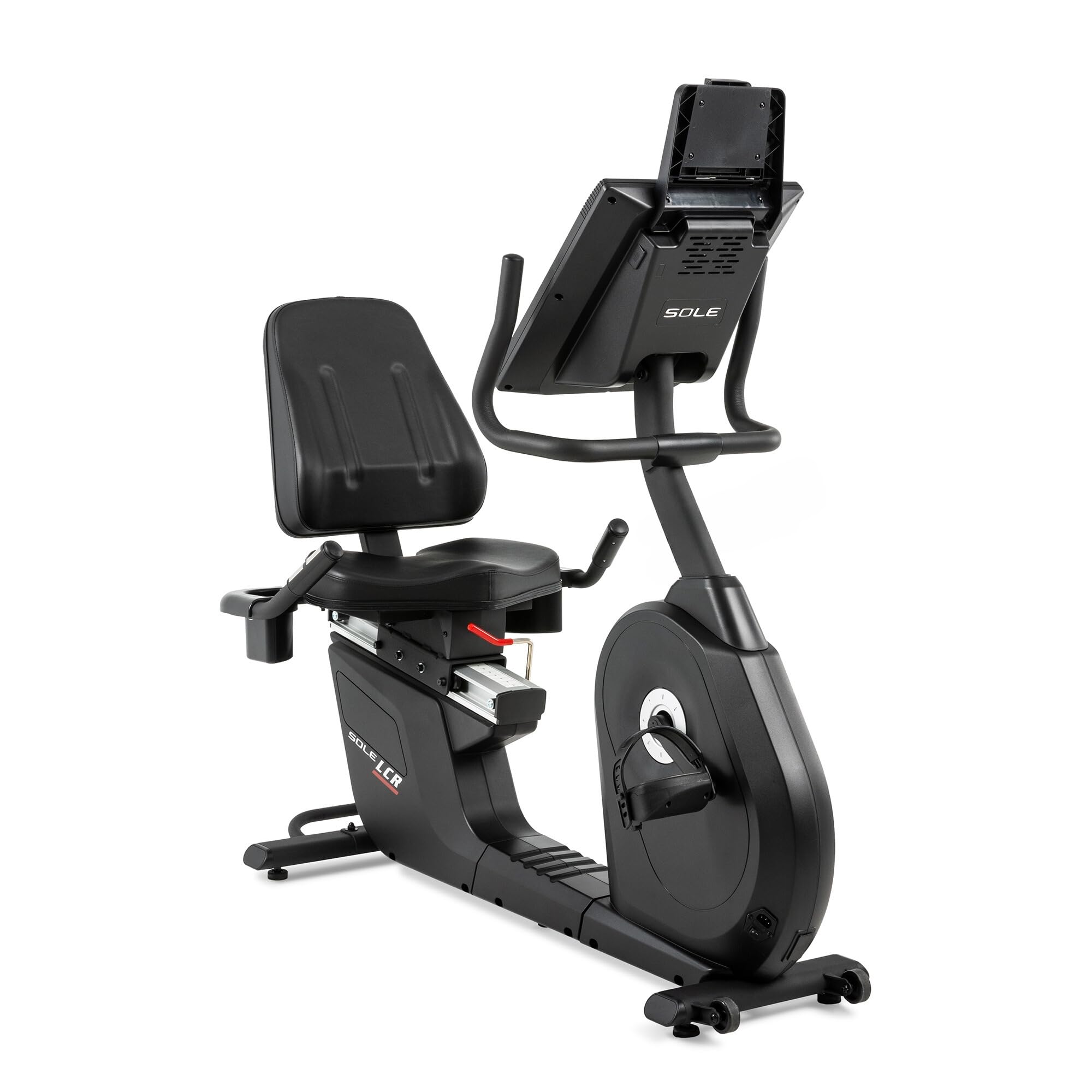
An absolute beast of a recumbent that offers 40 levels of EMS resistance in a 173-pound frame built for the long haul.
The Sole LCR is in a different league. It uses EMS (electromagnetic resistance, or magnets controlled by electricity for precise drag) technology to give you 40 adjustable levels — the highest number in this guide — so you can dial in the exact load for anything from gentle rehab to punishing hill climbs. The massive 10.1-inch touchscreen and built-in Bluetooth speakers turn your workout into an entertainment experience, and the 24 computer fitness programs (including Manual, Hill, Fat Burn, Cardio, Strength, HIIT, Custom, and 12 templates) give you structured variety without needing a subscription. The frame is made of alloy steel and weighs 173 pounds — more than double the weight of the Kawnina — so it is extremely stable but also difficult to move. The seat adjusts both fore-aft (forward and backward) and up-down for a personalized fit. It supports up to 350 pounds. The trade-off is that this ships via freight with curbside service, meaning the box is left at your curb, not brought inside — you will need help moving it. There are no customer reviews provided in the data to draw on, so buyer-reported insights are not available. If you need a commercial-tier machine with the widest resistance range possible and a large touchscreen display, the Sole LCR is the most capable option here, but be prepared for the logistics of delivery and moving a 173-pound unit.
Who should consider it: Serious home athletes or physical therapy settings where 40 resistance levels and a large touchscreen justify the investment and the delivery logistics.
Who should think twice: Anyone with limited mobility for moving heavy objects — this bike arrives at your curb and requires significant effort to get inside.
8. Schwinn Fitness 130 Upright Bike
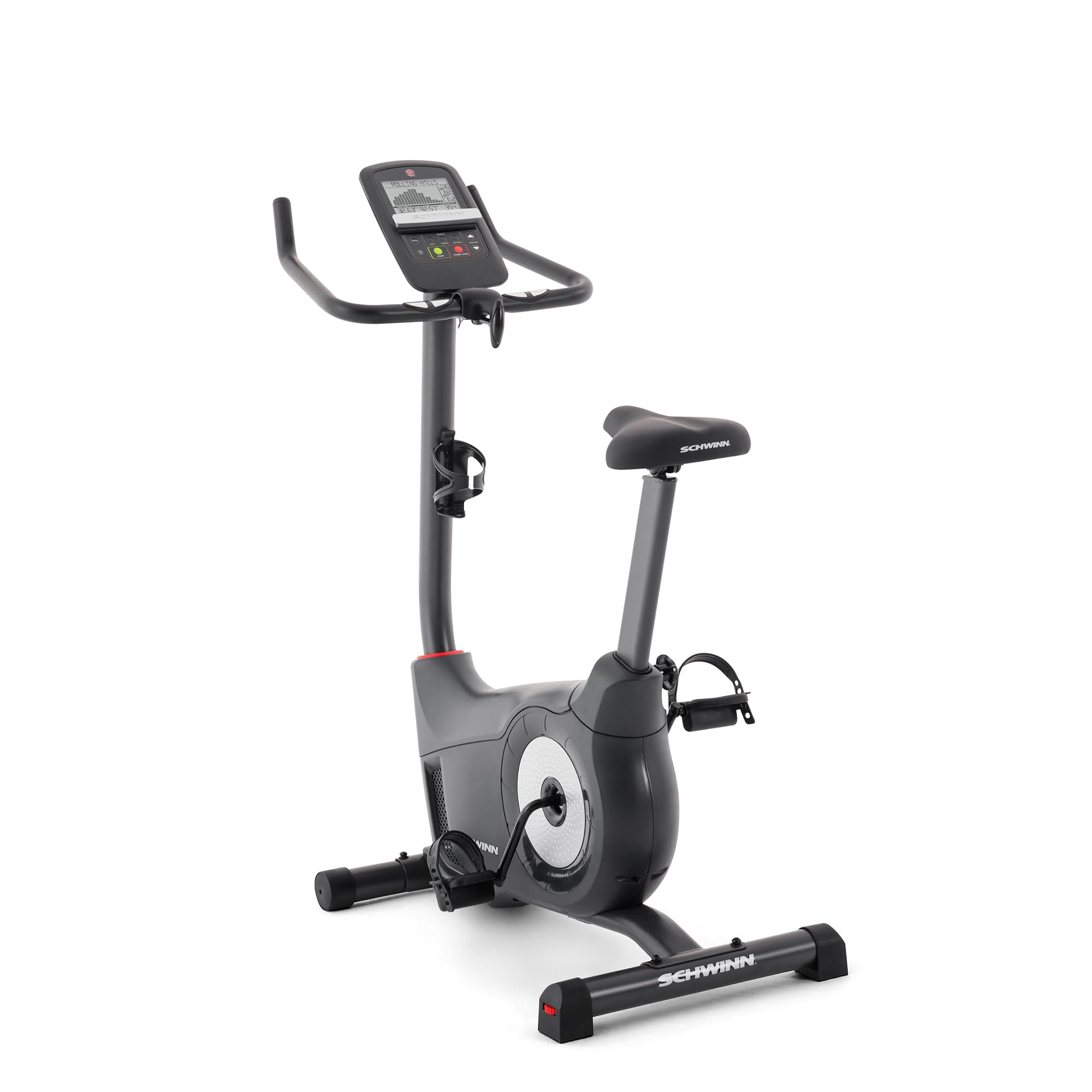
An upright bike built for app-driven riders who want Zwift integration without a subscription lock-in.
The Schwinn 130 is the only upright bike in this guide, so if you prefer a traditional cycling posture over a recumbent’s laid-back position, this is your pick. It offers 16 levels of magnetic resistance — matching the Kawnina and JOROTO — and a 5.5-inch LCD screen with 13 workout programs. The standout feature is the enhanced Bluetooth connectivity: it pairs with Zwift for over 1,000 structured workouts and 80-plus virtual routes, and with Explore the World for 40-plus global routes that auto-adjust resistance to the terrain. Buyers confirm it connects easily to Zwift and Fulgaz, calling it “Peloton for the less intense” at a fraction of the subscription cost. The high-speed, high-inertia perimeter-weighted flywheel (a spinning wheel that stores momentum for a smooth ride) delivers a smooth, quiet ride. At 57.3 pounds, it is relatively light and easy to move, but the 300-pound weight capacity limits it to standard builds. The foam comfort seat is better than a racing saddle but may still feel firm on rides over 30 minutes. One buyer mentioned the display brightness is hard to see at night. If you want a compact, app-connected upright bike that gives you the Peloton-style experience without the monthly fee, this is a smart choice — just know the seat is less forgiving than a recumbent’s.
The strongest reason to buy it: It gives you access to Zwift’s huge library of virtual routes and structured workouts without requiring a pricey subscription bike — just bring your own tablet.
The honest trade-off: The upright seat is firm, so if you have back pain or want to ride for over 30 minutes comfortably, a recumbent will serve you better.
9. Marcy NS-1201R Recumbent Exercise Bike

A no-frills entry-level recumbent that gets the job done for gentle rehab without a big investment.
The Marcy NS-1201R uses a basic manual magnetic resistance system with an LCD screen that tracks distance, speed, time, and calories. The padded seat adjusts with a quick-release lever, and the counterbalanced pedals (pedals designed to spin evenly) have adjustable straps. This bike works best for gentle, low-impact rehab — one buyer, a 60-year-old woman with arthritis weighing 280 pounds, wrote that it helped her “build up stamina in my knees” and called it “good value for the price.” Another used it after knee replacement surgery with no issues. The catch is consistency: multiple reviews mention a seat wobble that develops over time, and one owner reported a pedal that would not stay on despite careful assembly. The seat range also may not fit shorter users perfectly — a 5’3″ reviewer with a 27-inch inseam wished the seat could move closer. If your budget is tight and you need a basic recumbent for light cardio and rehab, this will work, but be prepared for potential longevity issues that the heavier, more expensive options avoid.
What works well
- Price makes it accessible for a starter recumbent bike
- Low-impact pedaling is effective for knee rehab and arthritis management
- Step-through design and adjustable seat are beginner-friendly
What is disappointing
- Seat wobble is a common complaint after some use
- Pedal attachment issues reported by several buyers
- Only 8 resistance levels limit progression
Understanding the Specs
Resistance Levels
This number tells you how many separate intensity settings the bike offers. A lower count like 8 levels is fine for light cardio and rehab, but you will quickly outgrow it if you want to push harder. A 16-level system gives you a gentler transition between each step, making it easier to find your perfect challenge. The Xterra SB4500 offers 24 levels, and the Sole LCR tops out at 40 — these are for serious trainees who want micro-adjustments from very easy to very hard. For most home users, 16 levels hits the balance between simplicity and range.
Weight Capacity and Frame Weight
The maximum weight recommendation is not just about safety — it is a proxy for overall build quality. A bike rated for 420 pounds typically uses thicker steel and stronger welds than one rated for 300 pounds, so it will feel more stable even for lighter riders. The bike’s own weight also matters: a heavier frame absorbs vibration and resists tipping during hard pedaling. But heavier bikes are harder to move, so look for built-in transport wheels if you need to store it out of the way. A 70-pound bike is manageable for one person to roll; a 173-pound machine like the Sole LCR requires serious effort.
Magnetic vs. Friction Resistance
All the bikes in this guide use magnetic resistance, which is the gold standard for home use. Magnets create drag without touching the flywheel (the spinning metal wheel), so there is no friction, no noise, and no parts that wear out over time. A friction resistance system uses pads that press against the wheel — it is cheaper but gets louder and less smooth as the pads degrade. For a quiet, maintenance-free experience at home, always choose magnetic. The 11-pound flywheel on the JOROTO and the 6.6-pound flywheel on the MERACH both deliver the smooth, silent ride you want.
Flywheel Weight and Pedal Feel
The flywheel stores momentum as you pedal, and a heavier flywheel creates a smoother, more realistic cycling motion because it evens out the natural surges in your pedal stroke. An 11-pound flywheel feels significantly more fluid than a 6.6-pound one, especially at lower speeds. The “Q factor” — the distance between the two pedals — also affects comfort. A narrower Q factor, like the one on the 3G Cardio Elite RB X, keeps your feet in a more natural hip-width alignment, reducing knee strain over long rides.
FAQ
How much space do I need for a recumbent exercise bike at home?
Is a recumbent bike better for lower back pain than an upright bike?
What does the resistance level number actually mean for my workout?
Can I use an exercise bike if I have had knee replacement surgery?
How do I connect my exercise bike to Zwift or Kinomap?
What weight capacity do I need for a safe and stable ride?
How much noise does a magnetic resistance exercise bike make?
Can two people of different heights use the same recumbent bike comfortably?
What is the difference between a belt drive and a chain drive on an exercise bike?
How long does it take to assemble a recumbent exercise bike?
Final Thoughts: The Verdict
If you want one dependable pick, the best exercise bikes for home is the Kawnina Recumbent Exercise Bike because it pairs a 420-pound weight capacity with 16 resistance levels and a comfortable ergonomic backrest at a price that undercuts many lower-spec competitors. If you want the most compact commercial-grade build and are investing for the long haul, grab the 3G Cardio Elite RB X. And for a budget-friendly entry point for gentle knee rehab or light cardio, the Marcy NS-1201R gets the job done without a big financial commitment.
How We Picked
We do not accept paid placement. Every pick is matched to a real buyer and a real use-case; we do not hands-on test units.
Sources & Methodology
Specifications: manufacturer listings and product documentation. Review insights: verified customer reviews, as of July 2026. Pricing: not shown on this page (it changes often); check the current price via the retailer link.
As an Amazon Associate, FitlyFast earns from qualifying purchases. This does not affect which products we feature.