
Our readers keep the lights on and the weekend projects moving. As an Amazon Associate, I earn from qualifying purchases.
That nagging knot between your shoulder blades, the achiness in your hip after sitting all day, or the deep soreness in your arch when you first stand up — these aren’t issues that require a weekly appointment. A well-chosen massage ball brings the release you need directly under your own pressure, applied exactly to the spot that hurts.
I’m Rikta — the co-founder and writer behind FitlyFast. Through countless hours of cross-referencing materials, densities, and vibration motor performance, I have assembled a guide that highlights the specific trade-offs between firmness levels, shapes, and built-in features so you can target your specific muscle groups without guesswork.
Whether you need a simple foam sphere for your glutes or a vibrating peanut design for your spine, this guide to the best massage ball will break down the exact tools that match the deep, localized relief your body demands.
How To Choose The Best Massage Ball
A massage ball is a deceptively simple tool, but picking the wrong one often means it sits in a drawer. The decision hinges on where you hurt, how much pressure you can tolerate, and whether you want vibration to do some of the work.
Material Density and Surface Feel
The ball’s material is the single biggest factor in how much force reaches your muscle. Solid rubber or extra-firm EVA delivers deep, intense compression that mimics a therapist’s elbow, making it ideal for the glutes, piriformis, and dense knots in the upper back. Silicone and medium-density foam offer more give, which is safer for bony areas like the spine, ribs, and feet. Smooth surfaces glide over skin, while spiky textures add acupressure-style stimulation that helps increase blood flow to the surface tissue.
Shape: Single, Peanut, or Multi-Ball Set
A single round ball is excellent for broad regions like the glutes, hamstrings, and chest, but it can press too aggressively into the spine. The peanut or double-ball design splits the load to bracket the vertebrae, making it the superior choice for the neck, thoracic spine, and paraspinal muscles. Multi-ball sets give you both options in one purchase, which is useful if you treat different body parts or travel and want a compact option for the gym bag.
Vibration vs. Manual Pressure
Manual balls put all the force under your control — you lean or press to your tolerance level. Vibration adds a percussive element that helps separate fascia and desensitize nerve endings, which can be more effective for chronic conditions like fibromyalgia or sciatica. The trade-off is weight, noise, and the need to charge the unit. If your pain is stubborn and localized to small spots, a vibrating peanut ball often provides relief that a static ball cannot match.
Quick Comparison
On smaller screens, swipe sideways to see the full table.
| Model | Category | Best For | Key Spec | Amazon |
|---|---|---|---|---|
| Fitballz 6‑Pack Set | Set | Full‑body variety | 3 foam, 1 peanut, 2 spiky balls | Amazon |
| RAD Original Peanut | Peanut | Spine & neck precision | Medium‑density silicone 6×2.5 in | Amazon |
| RAD Neuro Ball | Single | Feet & face targeted relief | 2.5‑in silicone with inner ball | Amazon |
| TriggerPoint MBX Extra Firm | Single | Deep glute & piriformis work | 2.6‑in extra‑firm foam | Amazon |
| Plyopic Set of 4 | Set | Precision with lacrosse ball core | Rubber, PVC & silicone mix | Amazon |
| LifePro Vibrating Peanut | Vibrating | Chronic pain & active recovery | 4‑speed motor, up to 4‑hr battery | Amazon |
| Rolling With It Vibrating Peanut | Vibrating | Deep vibration for hard‑to‑reach spots | 4‑speed motor, ribbed silicone surface | Amazon |
In‑Depth Reviews
1. Fitballz 6‑Pack Trigger Point Set

This kit covers virtually every self-massage scenario without forcing you to buy a single ball first and then a second shape later. You get three densities of foam ball (small, medium, large), a peanut-shaped double ball, a firm spiky ball, and a soft spiky ball — all packed into a mesh carry bag. The foam is latex-free and non-toxic, with enough friction to grab the skin during circular pressure but not so much that it drags uncomfortably.
The peanut ball brackets the spine while the spiky balls dig into the soles of the feet, so you can treat both your back and your plantar fascia in one session. The large foam ball works well for the glutes and IT band, while the small ball targets the hands and forearms. Users with petite frames note the peanut is wide, but its 3.5-inch length still fits most neck curves without causing strain.
The dense foam holds up to repeated use — even after months of leaning 150-plus pounds against it against a wall, the material doesn’t permanently flatten. If you want a single purchase that lets you test which shape and firmness suit your body best, this set removes all the guesswork.
Why it’s great
- Six pieces cover every muscle group and density preference
- EVA foam is durable, lightweight, and easy to sanitize with soap
- Carry bag makes it gym- or travel-ready instantly
Good to know
- Foam peanut has very little give — users with active trigger points may find it painful against bone
- Soft spiky ball can feel too flat for deep foot work
2. RAD Original Peanut Massage Ball

The RAD Original Peanut is the design that convinced many fitness enthusiasts to ditch the tennis-ball-in-a-sock trick. Its twin lobes create a 6-inch-wide cradle that keeps the spinous processes free while the silicone surface grips the paraspinal muscles on either side. This is the ball you reach for when your thoracic spine feels stiff from desk work or when a deep knot sits right beside a vertebra.
The silicone material offers a medium density — firm enough to reach the deeper layers of the rotator cuff and psoas, but with enough surface flex that it doesn’t feel like a rock against the ribs. Users report applying it against a doorframe for extra leverage on the pec minor and suboccipital area, which is hard to reach with a standard round ball. The 12-ounce weight makes it easy to pack, and the non-porous silicone rinses clean under running water.
One recurring note: the blue hue picks up lint, pet hair, and dust easily between uses, so storing it in the included bag is worthwhile. The construction is molded as a single piece without seams, so there is no risk of the halves separating under pressure. For anyone whose primary pain lives along the spine, this peanut shape is the most targeted tool on this list.
Why it’s great
- Peanut design perfectly clears the vertebrae for safe spinal work
- Medium-density silicone provides deep penetration without bruising
- Wipes clean instantly — no absorbent foam to degrade
Good to know
- Silicone attracts dust and hair; needs a quick rinse before each use
- May be too small for broad muscles on larger, more muscular frames
3. RAD The Original Neuro Ball

RAD designed the Neuro Ball specifically for smaller, more sensitive zones that a larger sphere cannot isolate — the arch of the foot, the masseter muscle in the jaw, the occipital ridge at the base of the skull, and the palm. Its 2.5-inch silicone shell is smooth and glide-friendly, so it moves across your skin rather than dragging, which is crucial for facial massage and lymphedema management.
The thoughtful construction includes a smaller inner ball that can be removed and used for pinpoint trigger point work. Pilates instructors and bodyworkers often keep one on hand to quickly release a cramping calf or overworked hand during a session. The silicone is BPA- and latex-free, and the 6-ounce weight means you can toss it into a purse or desk drawer without thinking about bulk.
For plantar fasciitis, the Neuro Ball can be rolled while standing, allowing you to control the exact pressure through your body weight. The smooth surface doesn’t abrade the skin the way spiky rubber balls sometimes do. If you deal with tension headaches, jaw clenching, or chronic foot tightness, this ball brings relief to places that a standard foam sphere cannot reach.
Why it’s great
- Removable inner ball allows micro-targeting of small trigger points
- Smooth silicone is ideal for face, neck, and sensitive feet
- Very compact and easy to carry everywhere
Good to know
- Not suitable for large muscle groups like glutes or quads
- Some users find the price high for a single small ball
4. TriggerPoint MBX Extra Firm

If you know exactly where a knot lives and you need to sink into it with authority, the TriggerPoint MBX Extra Firm delivers the most aggressive compression of any foam ball on this list. The 2.62-inch diameter is roughly the size of a lacrosse ball, but the proprietary foam surface provides more grip than a lacrosse ball’s hard plastic, so it stays put against the wall when you lean into a piriformis or subscapularis knot.
This ball is specifically designed for small, dense areas — the calves, the pec minor near the shoulder, and the deep lateral rotators of the hip. Users with chronic piriformis syndrome report that this ball replicates the sensation of a therapist’s thumb driving into the belly of the muscle. Because the foam is closed-cell, it also resists moisture and cleans easily compared to cloth-covered rollers.
One caution: “extra-firm” is not hyperbolic. Some users find it rock-hard, especially on the ribs or the top of the shoulder, where little soft tissue sits between the ball and bone. If you are new to self-myofascial release, the medium-density option from the same brand or a silicone ball will be a gentler starting point. For seasoned users who want the most intense pressure possible without buying a steel ball, this is the tool.
Why it’s great
- Extra-firm foam penetrates deep into glutes, piriformis, and calves
- Grippy foam surface stays in place against walls and floors
- Hygienic closed-cell material does not absorb sweat or oils
Good to know
- Too firm for beginners or for use over bony prominences
- Small size requires precise placement, not forgiving for broad work
5. Plyopic Deep Tissue Massage Ball Set

Plyopic’s four-ball kit focuses on quality over quantity, using three different material types so you can dial in exactly the right amount of give. The 5-inch ball is a high-density foam that works as a mini foam roller for the quads and back. The 3.5-inch ball is a solid rubber sphere that replicates the feel of a lacrosse ball. The 2-inch hard ball and the 3-inch double peanut ball are made from a silicone-PVC blend that gives slightly more than pure rubber.
Physiotherapists often recommend this set for patients with fibromyalgia or hypermobility because the variety lets you start soft and work up to deeper pressure. The solid rubber ball is especially effective for releasing the hamstring origin at the sit bone and the glute medius. All of the balls come in a mesh bag, and the 450-gram total weight is manageable for a gym duffel.
The silicone peanut ball, while functional, has a slightly tackier feel than the RAD peanut and may require a thin shirt or towel between it and the skin for some users. The set also includes a digital user guide with specific routines for each ball. If you prefer a curated, small collection over a large variety pack, the Plyopic set gives you high material quality without redundancy.
Why it’s great
- Three distinct materials allow progressive pressure from soft to rock-hard
- Solid rubber ball replicates the effectiveness of a lacrosse ball
- Carry bag and digital guide included for structured use
Good to know
- Silicone peanut ball can feel sticky against bare skin
- No firm spiky ball option for acupressure fans
6. LifePro 4-Speed Vibrating Peanut Ball
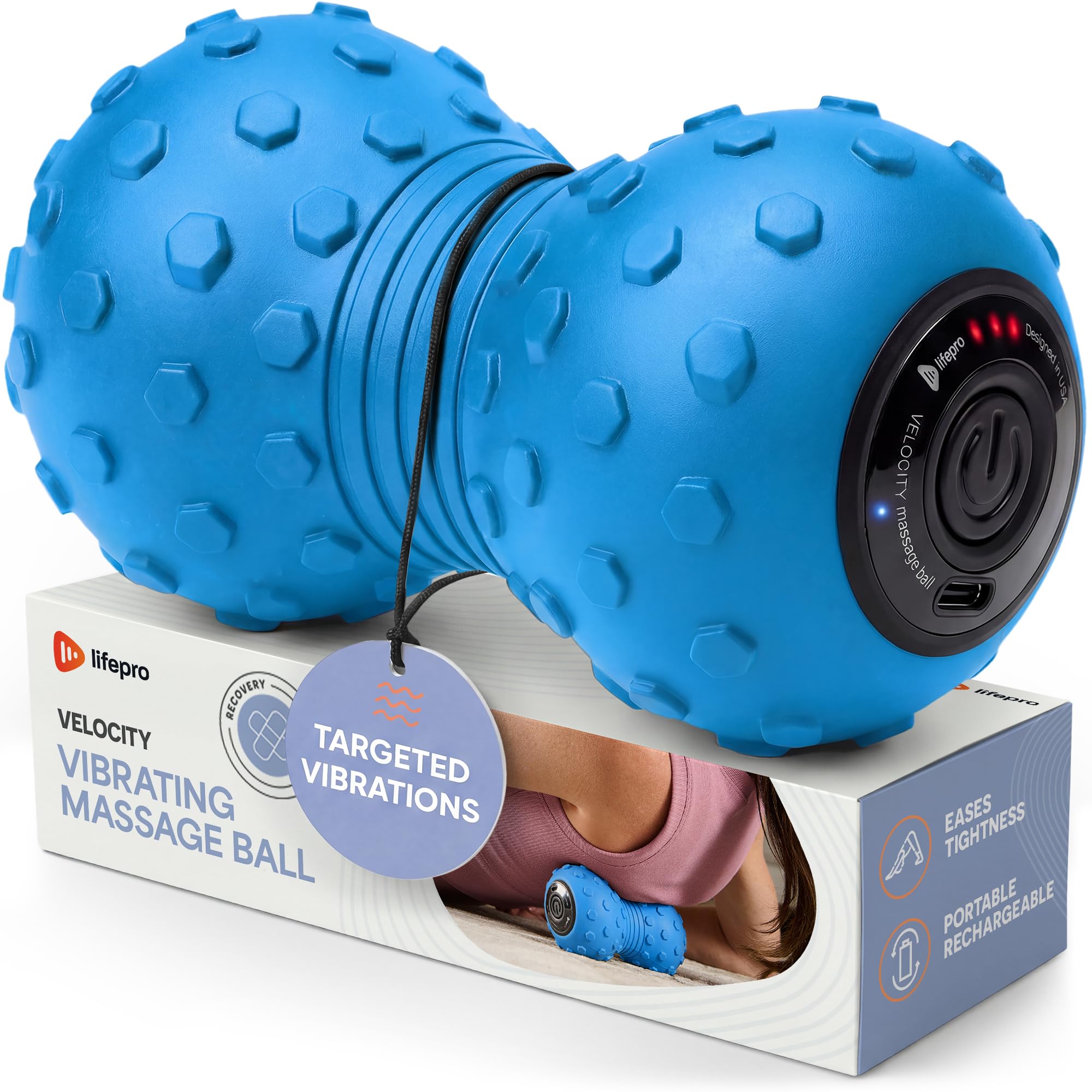
The LifePro Velocity adds a 4-speed vibration motor to a peanut-shaped body, turning passive compression into active treatment. Pulse, low, medium, and high modes let you choose between a gentle tapping sensation and a deep, rumbling thud that penetrates the fascia. For conditions like sciatica, fibromyalgia, and general post-workout soreness, the vibration helps desensitize the nerve endings so you can tolerate longer pressure on the tightest spots.
The peanut contour is covered in ridged silicone nodules that increase surface friction, reducing the need to pin the ball between your body and a wall. The unit weighs 1.5 pounds, which is noticeably heavier than a manual ball but still portable. On a full charge, the battery lasts between 2 and 4 hours depending on the speed setting — enough for a week of daily 15-minute sessions.
LifePro backs the Velocity with a lifetime warranty, which suggests confidence in the build quality. The motor is quiet at low settings, though the high setting produces a noticeable hum. A small percentage of users have reported motor defects in second units, but the brand’s customer service is consistently described as responsive. For anyone with chronic pain that does not respond to static pressure alone, the vibration is a genuine game-changer.
Why it’s great
- Four vibration modes add active release that manual balls cannot match
- Peanut design safely targets the spine, neck, and feet
- Lifetime warranty provides long-term peace of mind
Good to know
- Heavier than manual balls at 1.5 pounds
- Battery life at high speed is closer to 2 hours than 4
7. Rolling With It Vibrating Peanut Massage Ball

Rolling With It’s vibrating peanut focuses on battery endurance and motor reliability, boasting up to 6-plus hours of run time on a single charge. That capacity makes it a realistic option for frequent travelers or for daily use in a clinic or gym setting where you cannot plug in between sessions. The dual spheres vibrate independently of each other, creating a localized shiatsu-style oscillation that feels distinctly different from a single motor.
The surface is ribbed rubber rather than smooth silicone — the raised ridges add traction that mimics the feel of a therapist’s knuckles pressing into the muscle belly. Users who tested both the LifePro and this unit note that the ribbed texture feels more therapeutic on the IT band and the soles of the feet. The 2-pound weight is substantial, and the 10-minute auto shut-off prevents battery drain if you fall asleep while using it.
The build quality is robust; the unit can support at least 145 pounds of body weight without flexing. Some users find the ribbed surface too aggressive for the neck and prefer a silicone cover, but for deep work on legs and hips, the traction is an asset. The company offers lifetime customer support and a refund policy that extends indefinitely, which speaks to their confidence in the motor and battery.
Why it’s great
- Very long battery life — over 6 hours on lower speed settings
- Ribbed rubber surface provides excellent grip and deep texture therapy
- Sturdy build supports heavy body pressure without flexing
Good to know
- Ribbed texture can feel too rough for neck and face work
- No removable inner ball for pinpoint micro-release
FAQ
How do I know if I should get a firm or a soft massage ball?
Can a vibrating massage ball help with sciatica pain?
How often should I use a massage ball for trigger points?
Are spiky massage balls better than smooth ones for plantar fasciitis?
Can I use a peanut massage ball on my neck, or is it too risky?
Final Thoughts: The Verdict
For most users, the best massage ball winner is the Fitballz 6‑Pack Set because it provides every shape and density you need to experiment with and find what works for your body — all at a price that undercuts buying individual balls. If you want a targeted, spine-safe peanut ball that travels effortlessly, grab the RAD Original Peanut. And for chronic pain sufferers who need vibration to break up deep fascial adhesions, the LifePro Vibrating Peanut Ball delivers motorized relief that static tools cannot replicate.