
Our readers keep the lights on and the weekend projects moving. As an Amazon Associate, I earn from qualifying purchases.
You buy a dedicated portable music player for one reason: to cut the cord on notifications, pings, and battery anxiety so you can fall back into a full album without interruption. It is a device built for the single-minded pursuit of listening — not multitasking. The market has changed drastically in the last few years, with Android-based players, quad-DAC architectures, and high-power balanced outputs filtering down from the thousand-dollar flagship tier into sub- entry-level models. The decision is no longer about choosing between an iPod and a cheap MP3 player; it is about understanding DAC chip topology, output power in milliwatts, and whether a device can drive your 300-ohm headphones or simply power your commuting IEMs.
I’m Rikta — the co-founder and writer behind FitlyFast. I’ve spent hundreds of hours combing through the electrical schematics and customer feedback on audio players ranging from budget-friendly DAPs to high-end reference-grade Walkmans to map out the real differences that affect your listening experience.
Whether you are an audiophile building a pristine local library or a commuter wanting a separate device for the gym and train, finding the best portable audio player comes down to understanding which combination of DAC chips, output power, battery life, and OS support matches your headphones and listening habits.
How To Choose The Best Portable Audio Player
The perfect player for you hinges on three interconnected specs: your headphone’s impedance and sensitivity, the DAC quality inside the player, and the operating system’s appetite for battery power. Beginners often fixate on storage capacity while ignoring output power — a player that cannot drive your headphones will sound anemic regardless of how many gigabytes it holds. We break down the real decision points below.
DAC Architecture and Chip Selection
The digital-to-analog converter is the heart of any player. A single DAC chip like the ESS ES9069Q in the SHANLING M1 Plus offers excellent dynamic range and low noise for most listeners. Dual DAC configurations, such as the dual CS43198 in the FiiO JM21, improve channel separation by assigning a dedicated DAC to each audio channel. Quad-DAC setups, like the four CS43198 chips inside the FiiO M21, drive a fully differential balanced output that reduces crosstalk and noise floor further — a meaningful upgrade if you own sensitive multi-driver IEMs. For standard single-ended listening, a good dual-DAC design often delivers 95% of the benefit at half the cost.
Output Power and Balanced Jacks
Output power is measured in milliwatts (mW) referenced to a specific impedance, usually 32 ohms. A player with 80 mW into 32 ohms easily drives most in-ear monitors. To properly drive high-impedance over-ear headphones — think Sennheiser HD 600 series at 300 ohms — you need at least 200 mW into 32 ohms, delivered via a 4.4mm balanced output. The 4.4mm balanced jack doubles the voltage swing compared to the standard 3.5mm single-ended jack, making it essential for full-size cans. If you primarily use IEMs, a good 3.5mm output is sufficient; if you rotate between IEMs and full-size headphones, prioritize a player with both jacks and at least 500 mW balanced output.
Operating System and Streaming Support
Players running a full Android OS give you access to the Google Play Store, Tidal, Qobuz, and Apple Music directly on the device. This flexibility comes at the cost of battery drain, background app activity, and occasional lag from the Android layer. Players with a custom or minimalist OS, like the SHANLING’s MTouch or the MECHEN M30’s proprietary UI, boot faster, last longer on a charge, and eliminate the distraction of app notifications. If you stream most of your music, Android is essential; if you maintain a curated local library of FLAC and DSD files, a minimalist OS delivers a cleaner, more reliable listening experience.
Quick Comparison
On smaller screens, swipe sideways to see the full table.
| Model | Category | Best For | Key Spec | Amazon |
|---|---|---|---|---|
| FiiO M21 | Premium Android DAP | Audiophiles with 300-ohm headphones | Quad CS43198 DAC, 950mW balanced | Amazon |
| Sony NW-A306 Walkman | Mid-Range Android DAP | Commuters wanting compact size + long battery | 36 hours FLAC playback, aluminum frame | Amazon |
| HiBy R6III 2025 | Premium Android DAP | Home/desktop use driving large headphones | Quad CS43198 DAC, Class A/AB amp | Amazon |
| Sony NW-WM1AM2 | Flagship Reference DAP | Critical listening with reference IEMs | S-Master HX amp, 128GB + 1TB microSD | Amazon |
| JadeAudio/FiiO JM21 | Entry-Level Android DAP | First-time DAP buyers on a budget | Snapdragon 680, dual CS43198 DAC | Amazon |
| SHANLING M1 Plus | Compact Hi-Fi DAP | Everyday carry with IEMs | ES9069Q DAC, 660mW balanced, 116g | Amazon |
| HIFI WALKER H20 Pro | Budget-Friendly DAP | Entry-level Hi-Res listening | Dual DAC, 4.4mm balanced, touchscreen | Amazon |
| Globluum SU9 | Android Streaming Player | Streaming apps on the go | 160GB storage, Android, touchscreen | Amazon |
| MECHEN M30 | Budget Offline Player | Long battery life for audiobooks/MP3 | 25 hours playback, 64GB microSD | Amazon |
In‑Depth Reviews
1. FiiO M21
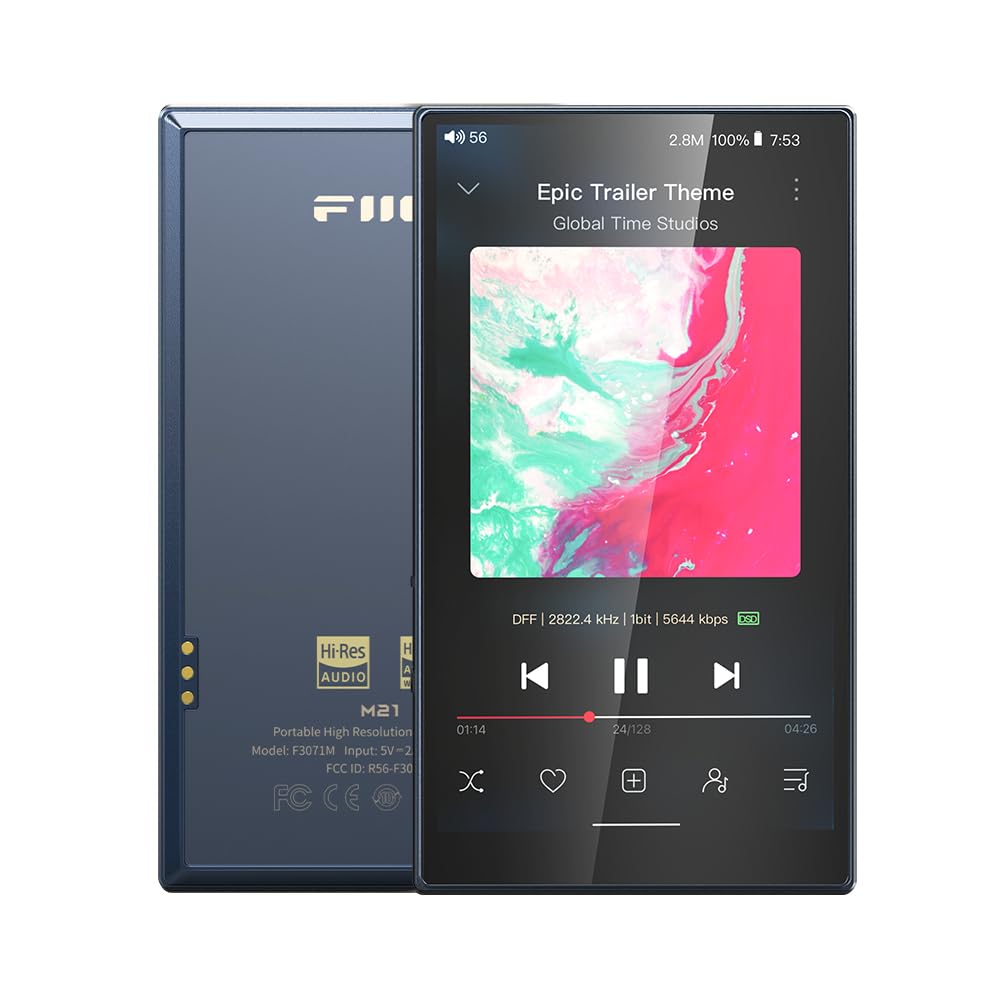
The FiiO M21 sits in the sweet spot where quad-DAC architecture meets practical portability. Four CS43198 DAC chips drive a fully differential 2-stage amplification circuit that delivers 950 mW balanced into 32 ohms — enough to drive demanding 300-ohm headphones like the Sennheiser HD 600 without breaking a sweat. The Snapdragon 680 processor and Android 13 keep the OS snappy, and the 4.7-inch display makes album browsing comfortable without being bulky.
A genuine differentiator here is the Desktop Mode, which bypasses the internal battery when the player is plugged into external power. This prevents the battery from cycling while you use it for extended listening sessions at home — a feature normally found on players that cost twice as much. The parametric EQ (PEQ) is also one of the most flexible implementations in this price tier, giving you 10-band control over the sound signature.
Reviewers consistently praise its warm, detailed sound and the ability to pair with high-end IEMs like the Xenns Mangird Tea Pro, and the included case and pre-installed screen protector add real value. The FiiO Music app lacks a proper shuffle play function, so power users will want to install UAPP or Poweramp. For the audiophile who wants one device that works for both commuting and critical listening at the desk, this is the clear winner.
Why it’s great
- Quad CS43198 DAC architecture delivers industry-leading channel separation and noise floor.
- Desktop Mode extends battery lifespan by bypassing charging during stationary use.
- 950mW balanced output drives any headphone from IEMs to full-size planars.
Good to know
- FiiO Music app lacks a native shuffle feature, requiring third-party players.
- Bass response is neutral out of the box; PEQ adjustment recommended for bass-heavy genres.
2. Sony NW-A306 Walkman

The NW-A306 is the most compact Android-based DAP in this roundup, roughly the size of a credit card at 113 grams. Sony uses a rigid machined aluminum frame with gold solder on the internal chassis to reduce electrical noise — a construction technique borrowed from their flagship NW-WM1 series. Battery life reaches 36 hours for 44.1kHz FLAC playback, which is exceptional for an Android device and competitive with many minimalist-OS players.
Sound quality is smooth and slightly warm, with Sony’s DSEE Ultimate upscaling compressed files in real time. The vinyl processor effect adds a subtle harmonic distortion that can make digital files sound richer — a nice touch if you listen to older recordings. The single 3.5mm output is adequate for IEMs but underpowered for demanding over-ear headphones; most users will pair this with sensitive IEMs or Bluetooth LDAC headphones.
Longtime Sony Walkman fans appreciate the build quality and battery longevity, but the Android implementation feels heavier than it needs to be. The Sony Music app is sluggish to load, and Google account setup is mandatory, which adds friction for users who simply want drag-and-drop music playback. File transfer via the provided Sony software is extremely slow compared to direct card reading. For the commuter who values battery life and pocketability above all else, this remains a top choice.
Why it’s great
- 36-hour FLAC battery life leads the Android DAP segment by a wide margin.
- Compact 113g aluminum frame is genuinely pocket-friendly for daily carry.
- DSEE Ultimate and vinyl processor add character to compressed and digital files.
Good to know
- US and EU models have a volume cap (Max 120) that may be insufficient for high-impedance headphones.
- Sony Music Center for PC software is buggy and slow; file transfer via card reader is much faster.
3. HiBy R6III 2025

The HiBy R6III 2025 takes the quad-DAC approach and adds a switchable Class A / Class AB amplifier stage — a feature that allows you to choose between pure, high-power Class A performance (ideal for critical listening) and the more battery-efficient Class AB mode (for daily use). With four CS43198 DAC chips running in an 8-channel monoblock configuration, the R6III supports DSD512 native and MQA 16x decoding natively.
The 5-inch display and Android 12 interface with Snapdragon 665 make it comfortable for browsing streaming apps, and the parametric EQ implementation is one of the most intuitive in this class. The 4.4mm balanced output produces clean, authoritative power that drives 300-ohm headphones like the Sennheiser HD 600 and Focal Elex with control. Reviewers using it with 1TB microSD cards report smooth playback at 2TB capacity as well.
The biggest trade-off is battery life: in Class A mode, the R6III lasts roughly 8 hours, and the amplifier runs warm to the touch. In Class AB mode, you get about 14 hours, which is still below the Sony NW-A306. Some users report firmware update issues that break PC connectivity, though this appears to be a software fix rather than a hardware flaw. For the home listener who wants desktop-grade amplification in a portable package, this is the most musical option.
Why it’s great
- Switchable Class A/AB amplifier gives you both pure sound quality and battery-saving options.
- Quad CS43198 DAC array handles DSD512 native and MQA 16x without compatibility issues.
- Excellent parametric EQ implementation with headphone-specific profiles.
Good to know
- Class A mode runs warm and drains battery in about 8 hours.
- Occasional firmware-related PC connectivity issues reported after updates.
4. Sony NW-WM1AM2

The Sony NW-WM1AM2 is the reference-class Walkman in Sony’s lineup, built around Sony’s proprietary S-Master HX digital amplifier architecture. Instead of a traditional DAC chip producing a voltage signal that gets amplified, S-Master HX processes the digital signal directly and converts it to a power output with minimal stages — theoretically reducing noise and distortion. The unit also features a large solid polymer capacitor for stable power delivery during dynamic peaks.
Sound quality is warm, smooth, and deeply musical with a soundstage that extends well beyond the earpieces. The balanced 4.4mm output reveals micro-details in recordings you may never have noticed — instrument textures, hall ambiance, and decay tails on cymbals. The 128GB internal storage plus a microSD slot (accepts up to 1TB) gives you room for a massive local library of DSD, FLAC, and MQA files.
The Achilles’ heel is the software. The NW-WM1AM2 ships with Android 11 with no upgrade path, and Sony’s Music Center for PC application is widely described as unreliable. The processor is underpowered by modern standards, causing stuttering with large lossless files and sluggish album art scrolling. Battery life in real-world use is closer to 8 hours with streaming and high-res playback, not the 40 hours advertised. This player is for the listener who prioritizes pure sonic fidelity over software convenience — and has the budget to match that priority.
Why it’s great
- S-Master HX digital amplifier delivers a smooth, analog-like sound with realistic timbres.
- Excellent instrument separation and soundstage width for critical listening.
- 128GB internal storage plus expandable microSD support for massive local libraries.
Good to know
- Android 11 is locked with no update path; processor is underpowered for smooth UI navigation.
- Real-world battery life is around 6-8 hours with heavy use, far below the advertised figure.
5. JadeAudio/FiiO JM21

The JM21 is FiiO’s entry-level Android DAP, but calling it “entry-level” undersells what you get. The Snapdragon 680 chipset is the same power-efficient silicon found in many mid-range smartphones, and here it runs Android 13 smoothly without the lag that plagues older budget DAPs. The dual CS43198 DAC chips drive a balanced 4.4mm output that reaches 700 mW into 32 ohms — enough to drive some full-size headphones, though it shines most brightly with IEMs.
At only 156 grams and 13mm thin, the JM21 is one of the most pocketable Android DAPs on the market. The 12.5-hour battery life is respectable for an Android player, and the audio-only mode strips out non-essential notifications for a cleaner listening experience. LDAC Bluetooth support means you can pair it with high-quality wireless headphones without losing the high-res signal chain.
Build quality is solid metal, though some reviewers note the matte finish may start flaking after a couple of months. The 4.4mm balanced port durability has been questioned in a small number of long-term reviews. The documentation is also lacking — the user manual is unhelpful, and setting up playlists requires some trial and error. For the first-time DAP buyer who wants Android app compatibility and balanced output without spending premium-tier money, the JM21 is the most balanced entry point today.
Why it’s great
- Snapdragon 680 processor with Android 13 provides smooth app performance and future-proofing.
- Dual CS43198 DAC and 700mW balanced output at a budget-friendly entry price.
- Lightweight 156g design is genuinely pocket-friendly for daily carry.
Good to know
- Matte finish may show wear and flaking after extended use.
- User manual is sparse; playlist organization and file management require patience.
6. SHANLING M1 Plus
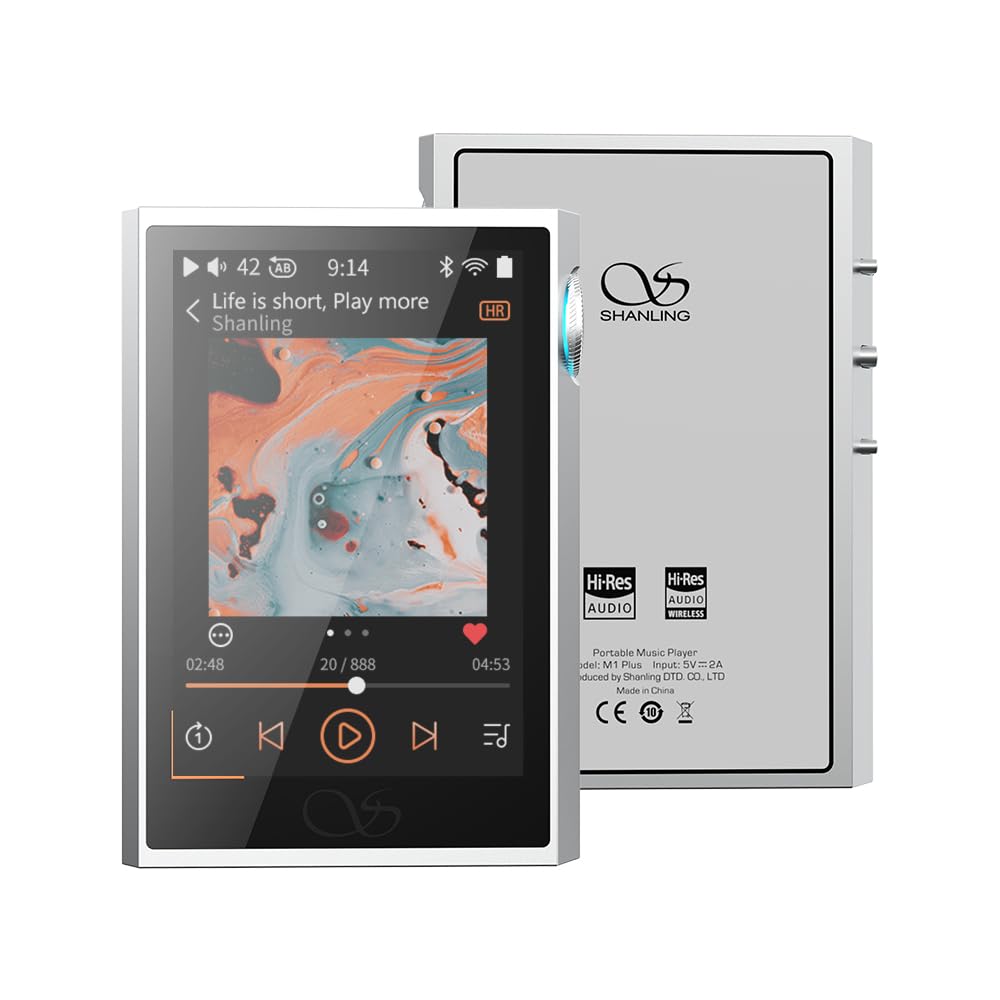
The SHANLING M1 Plus packs an ESS ES9069Q DAC, dual SGM8262 amplifiers, and a 4.4mm balanced output into a chassis that weighs just 116 grams. The aluminum-and-glass construction measures 86 x 61 x 17mm — smaller than a credit card — making it the most compact high-resolution DAP in this lineup. The 3.2-inch touchscreen uses SHANLING’s MTouch OS, a custom Linux-based interface that boots quickly and avoids the overhead of Android.
Audio performance is clean and transparent, with the ES9069Q DAC delivering 124 dB dynamic range and the dual amplifiers producing 660 mW balanced into 32 ohms. The 3.5mm coaxial SPDIF output is an unusual addition at this size, allowing the M1 Plus to act as a digital transport for desktop DACs. Wireless options include Bluetooth 5.2 with LDAC, plus Wi-Fi for DLNA and AirPlay streaming from a home network.
The interface is designed entirely around music playback — no notifications, no app store, no distractions. This simplicity means a steep learning curve if you are used to Android navigation, but once you learn the gestures, it becomes second nature. Some reviewers note the display quality is more TFT-like than true AMOLED, leading to slightly washed-out colors. If you value extreme portability and a pure listening experience without app clutter, the M1 Plus is a top contender.
Why it’s great
- Incredibly compact 116g chassis with ESS ES9069Q DAC and 660mW balanced output.
- MTouch OS boots fast and eliminates app notifications for distraction-free listening.
- USB DAC function and SPDIF coaxial output allow desktop system integration.
Good to know
- Cannot use Bluetooth and Wi-Fi simultaneously; requires manual switching.
- Display quality is closer to TFT than the advertised AMOLED; colors may appear less vibrant.
7. HIFI WALKER H20 Pro
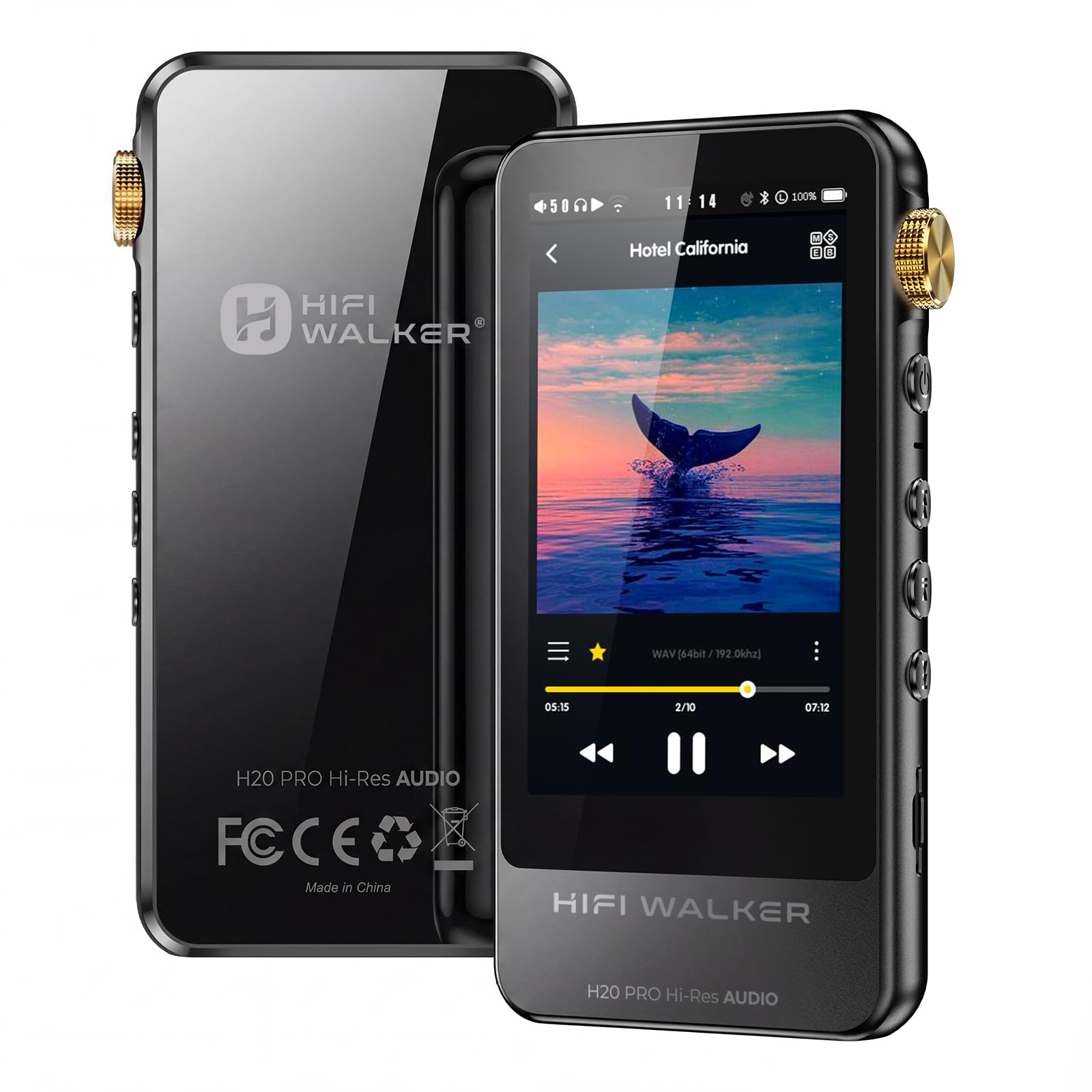
The H20 Pro is the most affordable player in this lineup that offers both a 3.5mm single-ended and a 4.4mm balanced output. It uses a dual-DAC architecture — though HIFI WALKER does not specify which chips — that supports DSD256 and PCM up to 384kHz. The included 64GB microSD card means you can start loading music immediately without a separate purchase, and the touchscreen interface makes navigation intuitive for first-time users.
Sound quality is clean and detailed for the price, with the balanced output providing enough current to drive 250-ohm headphones without noticeable distortion. The USB DAC function lets the H20 Pro double as a desktop sound card, adding versatility for home listening. The 3.2-inch touchscreen is responsive, and physical playback buttons give you tactile control when the device is in a pocket.
The firmware has some quirks: Bluetooth occasionally switches to a higher pitch or becomes choppy until the player is reset, and EQ settings reset after the device goes to sleep. The aluminum body scratches fairly easily, though this does not affect audio performance. For the listener on a tight budget who wants balanced output and headphone-driving capability, the H20 Pro delivers where many similarly priced players cut corners.
Why it’s great
- Includes both 3.5mm and 4.4mm outputs at a very accessible entry price point.
- Comes with a 64GB microSD card pre-installed, reducing initial setup friction.
- USB DAC functionality adds desktop sound card versatility.
Good to know
- Occasional Bluetooth pitch fluctuation requires a reset to resolve.
- EQ and max volume settings reset after the device enters sleep mode.
8. Globluum SU9

The Globluum SU9 leans fully into the streaming use case. It runs Android 14 AOSP with Google Play Store access, preloaded with Spotify, Amazon Music, Pandora, Tidal, YouTube Music, and Audible. The combined 160GB storage (32GB built-in + 128GB microSD card included) provides ample space for offline playlists, and the 3GB of RAM keeps multitasking between apps responsive. At 98 grams, it is one of the lightest options in this lineup.
Sound quality is adequate for the price point, with the HiBy Music app providing some EQ flexibility. The wired 3.5mm output is fine for the included earbuds and general commuting use, though audiophiles will want to upgrade the earbuds immediately. Bluetooth 5.0 and dual-band Wi-Fi provide stable connections for wireless listening.
The hardware is clearly optimized for ease of use rather than absolute fidelity. Windows file management can be finicky when copying large music folders — copying 25 folders at a time is a suggested workaround. The default Music app had issues with large libraries in some reviews. For the student, commuter, or casual listener who wants a single device for Spotify, audiobooks, and YouTube without draining their phone battery, the SU9 delivers the most complete streaming experience at this price level.
Why it’s great
- Android 14 with Play Store access provides full compatibility with all major streaming apps.
- 160GB combined storage out of the box allows massive offline music libraries.
- Ultra-light 98g design with included protective case for daily carry.
Good to know
- Windows file management times out when transferring large batches of music files.
- Sound quality with included earbuds is limited; upgrading to better IEMs is recommended for Hi-Res listening.
9. MECHEN M30

The MECHEN M30 strips away everything except pure local music playback. There is no Bluetooth, no Wi-Fi, no touchscreen — just a 2.0-inch LCD, a scroll wheel, and a 7-band EQ. The DSP audio IC + WM8965 DAC combination delivers surprisingly detailed sound for the price, supporting DSD128, FLAC up to 192kHz, and APE high compression. The included 64GB microSD card gives immediate storage, and the 1500 mAh battery lasts a full 25 hours on a single charge.
The build is solid CNC aluminum with no creaks or flex, and the scroll wheel provides tactile feedback that makes track selection easy without looking at the screen. At 2.2 x 0.6 x 3.5 inches and 176 grams, it fits easily into any pocket. The user interface is simple and boot time is fast — about 3 seconds from power-on to music playback.
The lack of wireless connectivity is the biggest limitation. There is no way to connect Bluetooth headphones, and file transfer requires a USB cable to a computer. Some users report that gapless playback is not supported; tracks with continuous transitions will have a brief silence between them. The short 6-inch USB cable is also a minor frustration. If you want a no-frills player for long runs, audiobooks, or gym sessions where you do not want to risk a more expensive device, the M30 gets the basics right.
Why it’s great
- Excellent 25-hour battery life for extended use without charging.
- CNC aluminum build feels premium at a budget-friendly price point.
- Scroll wheel control allows quick track selection without looking at the screen.
Good to know
- No Bluetooth or wireless connectivity — wired headphones only.
- No gapless playback support, which affects live albums and classical works with continuous tracks.
FAQ
Can I use streaming apps like Tidal or Qobuz on a non-Android DAP?
What does a balanced 4.4mm output actually improve for my headphones?
Why does my Android music player have worse battery life than my old iPod?
Final Thoughts: The Verdict
For most users, the portable audio player winner is the FiiO M21 because it balances quad-DAC sound quality, 950mW balanced output, Android 13 app compatibility, and Desktop Mode innovation in a package that is comfortable to carry and use. If you value extreme portability and a distraction-free interface, grab the SHANLING M1 Plus. And for the commuter who needs the longest battery life in a compact Android body, nothing beats the Sony NW-A306.