
Our readers keep the lights on and the weekend projects moving. As an Amazon Associate, I earn from qualifying purchases.
A slow drain, a faint odor in the yard, or the dread of a backup are signs that your septic system’s bacterial colony has been compromised by household chemicals or simple time. Choosing the right bacterial and enzyme formula is the difference between a system that needs pumping every three years and one that requires expensive emergency repairs. This guide breaks down the live cultures, application methods, and treatment schedules that actually keep solids digesting and leach fields porous.
I’m Rikta — the co-founder and writer behind FitlyFast. I’ve spent countless hours analyzing lab reports, customer field data, and manufacturer specs to identify which bacterial strains and enzyme profiles deliver measurable waste reduction in real-world septic conditions.
Whether you are dealing with a sluggish drain field, persistent odors, or simply want a proactive maintenance routine, this guide evaluates the top contenders to help you find the best septic tank additive for your home and budget.
How To Choose The Best Septic Tank Additive
Not all septic additives are created equal. A product that works well for a young 500-gallon tank may be useless for a 25-year-old system with a failing leach field. Before you buy, focus on the bacterial delivery method, the specific strains used, and whether the formula targets your primary issue — routine maintenance or drain field recovery.
Bacterial CFU Count vs. Survivability
Many products advertise billions of colony-forming units (CFUs), but those numbers mean little if the bacteria cannot survive the transit through your toilet and into the tank. Look for spore-forming bacteria that stay dormant until they reach the anaerobic environment of your septic tank. Liquid suspensions with a high initial count are effective monthly, but concentrated tablets or pucks often deliver more resilient strains that break through the sludge layer.
Enzyme Specificity
Enzymes act as biological scissors, cutting large organic molecules into smaller pieces that bacteria can consume. A broad-spectrum enzyme complex that targets cellulose (toilet paper), lipase (fats, oils, grease), and protease (proteins) is far more effective than a single-enzyme formula. If your main issue is a clog from flushable wipes or paper, prioritize products high in cellulase.
Application Frequency and Convenience
Monthly liquid doses are the standard for ongoing maintenance, but they require you to remember a schedule. Tablet-based options and once-a-year concentrated kits offer more hands-off convenience, though they may distribute differently in the tank. For older or neglected systems, a shock treatment that you apply weekly for a month can rebuild bacterial levels faster than a monthly maintenance dose.
Quick Comparison
On smaller screens, swipe sideways to see the full table.
| Model | Category | Best For | Key Spec | Amazon |
|---|---|---|---|---|
| Down John | Once-a-Year Kit | Deep system revival | 3-part concentrate | Amazon |
| RID-X Platinum Liquid | Monthly Liquid | Trusted monthly care | 6-month supply, 2x waste reduction | Amazon |
| Septi-Flow Shock | Drain Field Cleaner | Leach field repair | 1 gal, biodegradable | Amazon |
| CCLS Gallon | Monthly Liquid | Long-term biology balance | 128 fl oz, enzyme-producing bacteria | Amazon |
| Organic Plumber Tabs | Monthly Tablets | Odor elimination & mess-free use | 60 billion CFU, 12 tablets | Amazon |
| Green Pig Pucks | Bi-Monthly Pucks | Set-and-forget maintenance | 6 pucks, 1-year supply | Amazon |
| Roebic K-37 | Quarterly Concentrate | Budget-friendly routine care | 32 oz, 1500 gal treatment | Amazon |
In‑Depth Reviews
1. Down John Once-A-Year Septic Tank Treatment

Down John takes a fundamentally different approach to septic maintenance by relying on a three-part concentrate system — live bacteria, a carbon-based odor neutralizer, and an enzyme complex — designed to be applied just once a year. This is a premium, proactive solution for homeowners who want deep, lasting biological restoration rather than monthly surface treatment. The live bacteria are spore-forming, meaning they remain dormant until flushed into the anaerobic tank environment, where they activate and begin digesting solids and breaking down the scum layer.
The three-part design tackles more than just waste breakdown. The carbon component binds and removes harmful toxins and nitrates that contribute to greenhouse gas emissions, while the enzyme complex focuses on leach line recovery. Real user reports on systems over 30 years old show that after 8-9 months of use, the product effectively eliminated solids in secondary tanks and cleaned lateral lines, avoiding costly aerobic system conversions. The manufacturer, a chemist, provides direct support for complex system issues.
The only catch is patience. On a heavily neglected system, results can take several months, and users with larger tanks (2,500 gallons) may need to double the dose. The charcoal powder component is best poured directly into the open septic lid to avoid staining toilet porcelain. For a hands-free, set-it-and-forget-it approach that delivers transformative long-term results, this is the most powerful option in this guide.
Why it’s great
- True once-a-year application saves monthly hassle
- Three-part system outpaces single-step products in reviving old systems
- Scientific support from the manufacturer for complex issues
Good to know
- Requires 2-3 months to see full results on neglected systems
- Charcoal powder can stain toilet if not applied directly to tank
2. RID-X Septic Tank Treatment Platinum Liquid
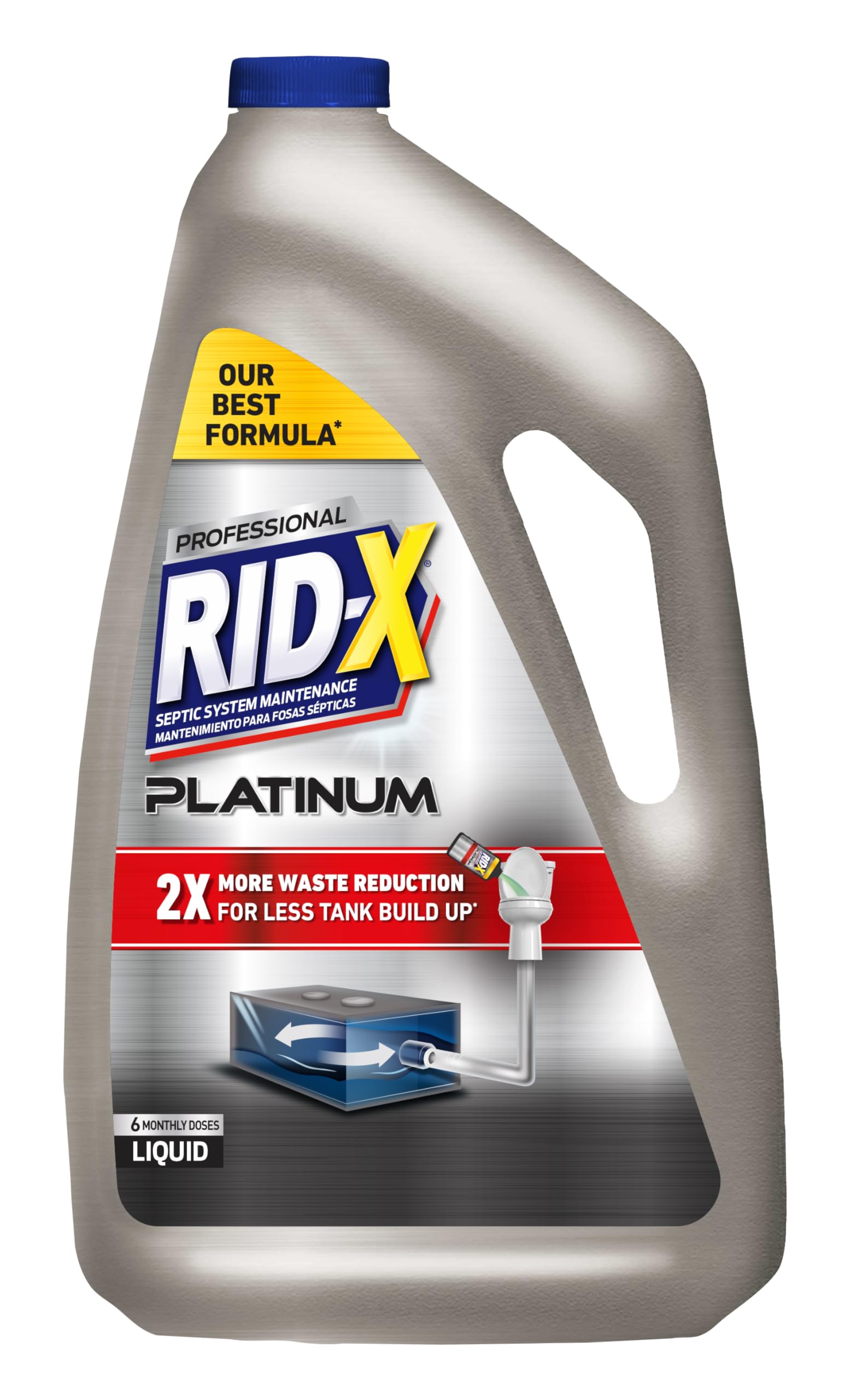
RID-X is arguably the most recognized name in septic treatment, and the Platinum Liquid formula represents the brand’s most powerful iteration. It claims 2x more waste reduction compared to standard formulations, targeting toilet paper, fats, oils, grease, sugar, starch, and proteins with a dual-action enzyme and bacteria blend. The liquid format requires no mixing or measuring — simply pour the recommended dose into a toilet and flush. The 6-month supply bottle is designed for monthly maintenance on tanks up to 1,500 gallons.
Long-term users — some spanning over 15 years — consistently report that the liquid formula is more effective and convenient than the powdered version, with the added benefit of avoiding pantry moth infestations that can occur with dry packets. The Platinum formula uses 100% natural ingredients and is safe for both aerobic and anaerobic systems, as well as RVs and boats. This versatility, combined with the brand’s widespread professional endorsement, makes it a safe bet for homeowners who want a proven, no-fuss monthly routine.
One user noted that the larger bottle size makes it significantly easier to handle than smaller monthly doses, and the formula itself has remained consistent through formula updates. While it may not be the most aggressive option for a failing drain field, for monthly maintenance to prevent sludge buildup and costly pump-outs, the RID-X Platinum Liquid is a benchmark product that simply works.
Why it’s great
- Most trusted brand with decades of real-world use
- Liquid form avoids moth issues common with powder packets
- Safe for all system types including aerobic
Good to know
- Monthly schedule requires consistent compliance for best results
- Not designed as an emergency drain field unclogger
3. Septi-Flow Shock Septic Drainfield Repair Solution
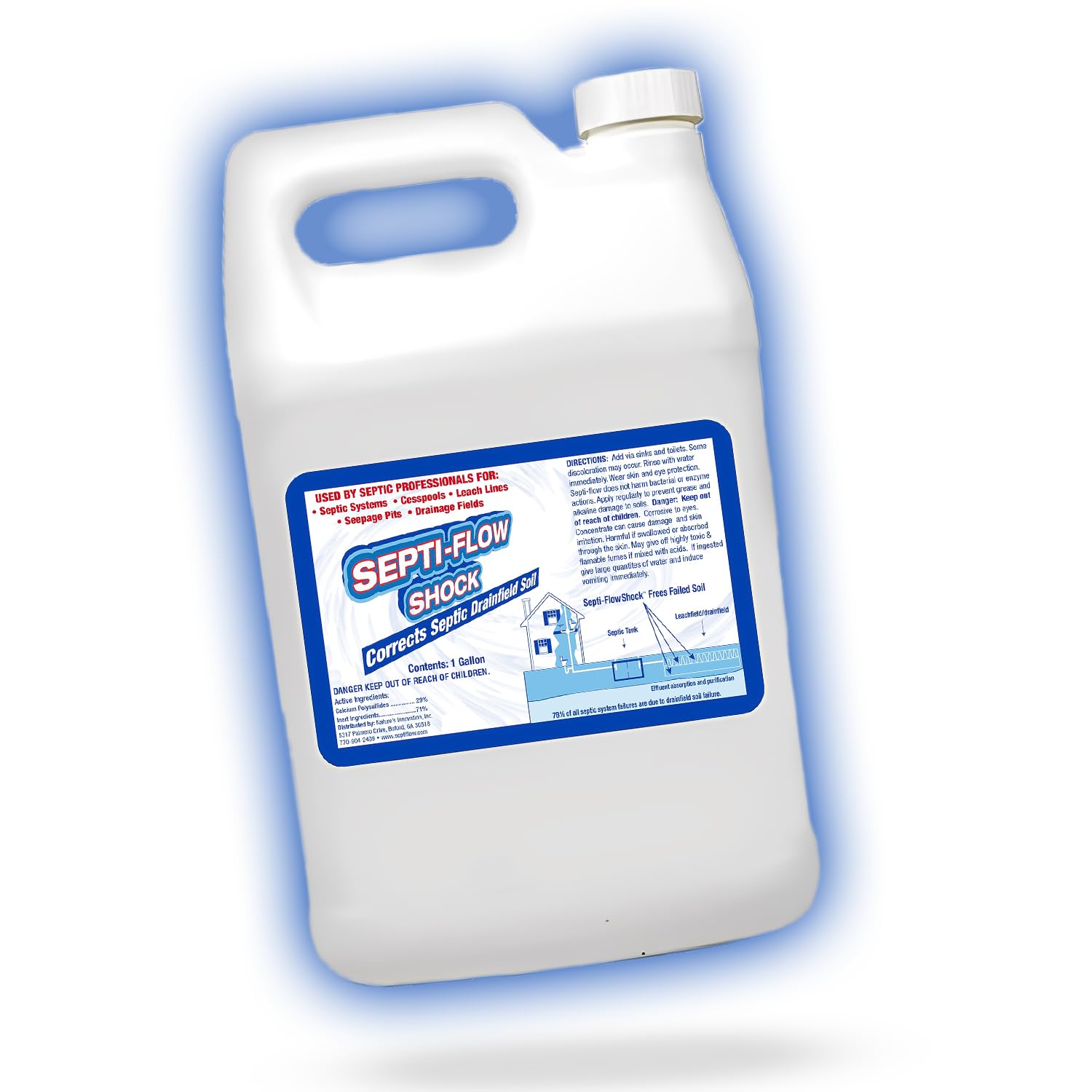
Septi-Flow Shock is not a routine maintenance additive — it is a heavy-duty drain field line cleaner specifically formulated to dissolve hardened, deadpan soil caused by salt, sodium, phosphate, and sulfate buildup from soaps, detergents, and water softeners. Unlike bacterial additives that digest organic matter, Septi-Flow uses a scientifically studied biodegradable solution that has been in use since 1950 to restore percolation in leach fields. A typical 1,500-gallon system requires an initial 4-gallon treatment, with 2 gallons poured in the first week and another 2 gallons a week later.
User reports spanning nearly a decade confirm that bi-annual application keeps leach fields clear even on aging systems. One user updated their review after nine years, stating their fields remained clear with consistent use after an initial jetting and soil fracking treatment. The product effectively addresses the specific problem of sodium-clogged soil from water softeners, and direct injection into the leach line yields the best results. For homeowners whose drain field is slow but not completely stopped, this product can save thousands of dollars in replacement costs.
It is critical to note that Septi-Flow Shock will NOT work on completely stopped septic leach field systems — there must be some flow for the solution to travel through the lines. Some users note the primary active ingredient is gypsum, and the price has increased over the years. Nevertheless, for a targeted, field-specific issue, this is the most effective chemical-free solution in this guide.
Why it’s great
- Proven track record with user reviews spanning 9+ years
- Specifically targets salt/sodium buildup from water softeners
- Biodegradable and safe for all plumbing
Good to know
- Requires multiple gallons for initial shock treatment
- Won’t work on fully blocked systems — flow must exist
4. CCLS Septic Tank and Cesspool Treatment (1-Gallon)

The CCLS treatment takes a holistic, three-step approach to septic health that acknowledges the limitations of additives: pumping and filter cleaning remain non-negotiable, and the biological support helps stabilize the tank between services. This formula uses beneficial bacteria that produce enzymes to break down solids, normalize COD and BOD levels, and produce healthier effluent for the drain field. Industry data cited by the manufacturer shows that 80-90% of homes suppress septic biology through everyday antibacterial soaps, bleach, and disinfectants, making this a necessary corrective measure.
Users who have relied on CCLS for over 20 years report that a consistent monthly dose of 32 oz combined with yearly or bi-yearly pumping keeps drain fields in excellent condition. The product has a neutral smell and is easy to administer—just pour down the toilet. Some long-term users note that the price per gallon has risen, and they are exploring cheaper alternatives, but the results are undeniable: pumpers consistently confirm the system is healthy, and pumping intervals have stretched from 5 years to potentially 8 years with reduced household occupancy.
One notable advantage is the manufacturer’s emphasis on education. The product listing clearly states that no additive can replace pumping, which builds trust. The formula contains no acids, caustics, or volatile organic compounds, making it fully biodegradable and safe for the environment. For homeowners who want a transparent, scientifically-grounded monthly maintenance product that prioritizes long-term biological balance, this is a solid choice.
Why it’s great
- Honest, education-first approach about the limits of additives
- Proven to extend pumping intervals over decades of use
- Neutral odor and easy pour application
Good to know
- Price per gallon feels high for the volume delivered
- Monthly application required for consistent results
5. Organic Plumber Septic Tank Cleaner Enzyme Bio Tabs

Organic Plumber offers a tablet-based alternative to liquid doses, with each tablet containing 60 billion CFU of live bacteria cultures. One tablet flushed per month delivers the biological firepower needed to break down fats, oils, fiber, and dense solids. The tablets are designed to dissolve quickly and, unlike some pods or liquids that sit on top of the sludge, they are formulated to break through the sludge layer to digest organic matter at the bottom of the tank.
The most compelling user story comes from a homeowner who struggled with persistent sewer-gas odors in bathrooms. After trying multiple products without success, a single application of the Organic Plumber tabs eliminated the gas buildup immediately, and a second application provided lasting relief. For odor-related septic issues, this product appears to be far more effective than liquid treatments, likely because the concentrated tablet format delivers a higher localized bacterial dose when it hits the water.
The tablets are chemical-free and environmentally friendly, safe for boats and RVs, and won’t contaminate groundwater. The packaging is compact and the tablets resist melting under hot conditions, making them ideal for storage in unconditioned spaces. The only downside is that the effectiveness can vary depending on whether the tablet lands in a dry area of the tank vs. a wet area where dissolution is faster. For a mess-free, easy-to-store monthly treatment that excels at odor control, this is a top-tier pick.
Why it’s great
- Immediate odor elimination in user tests
- High CFU count in a compact, non-melting tablet
- Environmentally friendly with no harsh chemicals
Good to know
- Tablet placement in the tank affects dissolution rate
- May require an initial double dose for neglected systems
6. Green Pig Septic Tank Treatment Pucks

Green Pig pucks are designed for the homeowner who wants the simplest possible maintenance schedule. Each puck is a solid, dissolvable treatment that you drop into the toilet and flush every other month. The six-puck supply covers a full year of care for tanks up to 1,500 gallons. The formula relies on enzymes and beneficial bacteria to help digest organic waste, fats, and grease, with the goal of supporting natural breakdown over time rather than providing an emergency fix.
Users who have adopted this product for many years report reliable performance. One reviewer noted that using Green Pig pucks allowed them to avoid pumping their cesspool for six years, based on inspection results. Another long-term user (17 years) confirmed that the system remained issue-free, and when Amazon lost a shipment, the owner personally shipped a replacement, highlighting exceptional customer service. The pucks are unscented and solid-state, making them easy to store and handle.
The main trade-off is that this is a preventative maintenance product, not a cure for an existing clog or odor issue. If your system already has a backup, you will need a more aggressive emergency treatment. The bi-monthly schedule is less frequent than monthly liquids, but the puck design means it may take longer to distribute fully through the tank compared to a liquid pour. For consistent, low-effort maintenance, Green Pig delivers reliable results.
Why it’s great
- Bi-monthly schedule is the most convenient in this guide
- Excellent customer support from the owner
- Proven track record of extending pumping intervals
Good to know
- Preventative only — not for emergency clogs
- Solid puck may distribute slower than liquid treatments
7. Roebic K-37-Q-C1500 Septic Tank Treatment
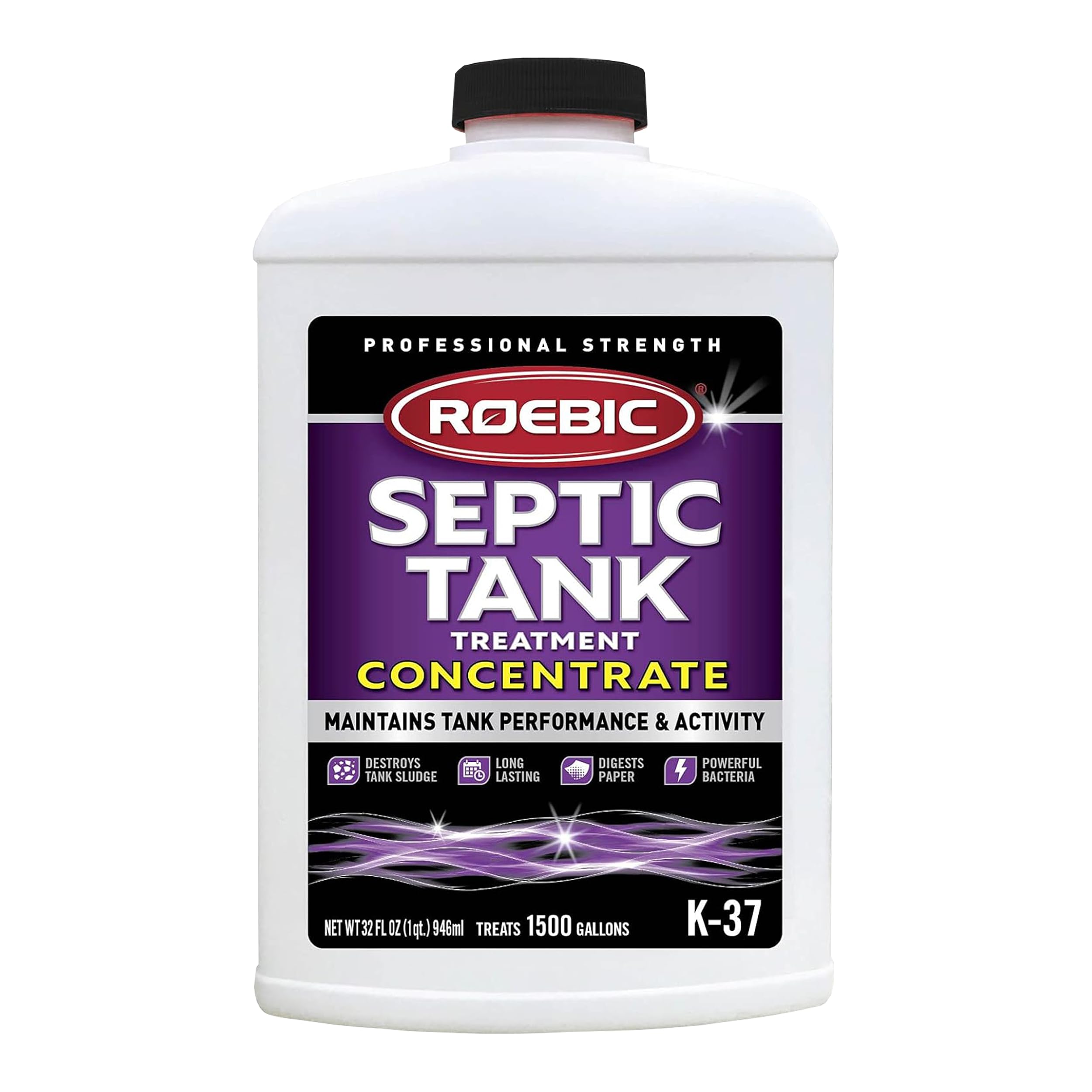
Roebic K-37 is a long-standing, budget-friendly concentrate that treats up to 1,500 gallons per bottle. The formula relies on Roebic’s proprietary Roetech bacteria to break down solids, reduce sludge and scum levels, and prevent common septic problems like clogging and odors. The application schedule is quarterly (every three months), making it less frequent than monthly options but more frequent than the bi-monthly pucks. The colorless formula is safe for all plumbing systems, including those with pipes.
A compelling real-world test came from a user whose septic system was clogged by Charmin toilet paper. After other treatments failed, a single dose of Roebic K-37 cleared the toilet paper clog overnight, restoring full flow to a 24-year-old system. This underscores the product’s effectiveness at digesting cellulose-based clogs. Long-term users report using it for years without memorable smells or issues, and the quarterly schedule is easy to manage.
The main drawbacks are packaging-related. Some users have reported that the bottle is not properly sealed for shipping, leading to leaks that can damage other items in the same box. Additionally, recent batches have had a reduced odor compared to older bottles — a Roebic biologist confirmed this is a harmless variation in bacteria strains. For a cost-effective quarterly treatment that handles toilet paper clogs with proven reliability, this is the best entry-level choice.
Why it’s great
- Proven overnight results on toilet paper clogs
- Quarterly schedule is easy to maintain
- Budget-friendly price for 1,500-gallon coverage
Good to know
- Shipping seal needs improvement — risk of leaks
- Bacteria odor varies between batches
FAQ
How often should I add a septic tank additive?
Can a septic additive fix a slow drain field?
Are tablet or liquid additives better for septic tanks?
Will a septic additive eliminate all smells from my tank?
Final Thoughts: The Verdict
For most users, the best septic tank additive winner is the Down John Once-A-Year Treatment because its three-part system delivers unmatched depth of cleaning and long-term leach field recovery with the lowest annual effort. If you want a trusted monthly liquid with proven brand reliability, grab the RID-X Platinum Liquid. And for a targeted drain field repair when sodium or soap buildup is slowing your system, nothing beats the Septi-Flow Shock.