
Our readers keep the lights on and the weekend projects moving. As an Amazon Associate, I earn from qualifying purchases.
Wrist blood pressure monitors have earned a reputation for convenience, but their real challenge is accuracy — the smallest positioning error during a reading can throw off your numbers by a clinically significant margin. A monitor that compensates for this flaw separates a useful daily tool from a source of confusing data.
I’m Rikta — the co-founder and writer behind FitlyFast. For this guide, I’ve compared seven wrist cuff models against real-world accuracy benchmarks, battery endurance, and cuff fit ranges to find the units that actually deliver trustable readings.
Whether you need voice prompts for low vision, dual-user memory for a partner, or Bluetooth tracking for your doctor, this guide helps you pick the best wrist blood pressure cuff for your daily routine.
How To Choose The Best Wrist Blood Pressure Cuff
Wrist cuffs are more sensitive than upper-arm models — your reading changes if your wrist isn’t at heart level. When shopping, focus on features that mitigate this inherent weakness rather than just screen size or color options.
Positioning Assistance & Accuracy
Look for a monitor that either includes a positioning guide or has enough sensor sensitivity to deliver consistent readings across slight height variations. Without this, a wrist cuff is prone to wild swings between measurements taken minutes apart.
Cuff Size Range & Comfort
Wrist cuffs must fit snugly but not tightly. Check the stated circumference range — most adjust from 5.3 to 8.5 inches, but some models stretch to 9.3 inches, and others won’t tighten small enough for very slender wrists. A poor fit directly corrupts the reading.
Memory Capacity & Multi-User Support
If you’re tracking trends for yourself and a partner, dual-user memory with at least 100 slots per person prevents data overwrite. Models with date/time stamps let you map readings to specific days, which is critical for sharing logs with a doctor.
Quick Comparison
On smaller screens, swipe sideways to see the full table.
| Model | Category | Best For | Key Spec | Amazon |
|---|---|---|---|---|
| OMRON Gold Wireless | Premium | Clinical accuracy + app sync | 200 readings x 2 users, Bluetooth | Amazon |
| Oklar Rechargeable | Mid-Range | Rechargeable convenience + voice | 240 total readings, USB-C charge | Amazon |
| LotFancy Voice Broadcast | Value | Voice guidance for seniors | 120 readings, adjustable 5.3–8.5 in | Amazon |
| Windray Automatic Digital | Mid-Range | Portability + color indicator | 120 x 2 memory, lightweight 4.2 oz | Amazon |
| Double Love Orange LED | Mid-Range | Bright color-coded display | 240 memories, 300mAh rechargeable | Amazon |
| GUAEVER Pink Curved | Budget | Compact style + voice | 150 uses per charge, 5.3–9.25 in | Amazon |
| Cunkun Tech Color Backlight | Budget | Family budget pick with arrhythmia | 99×2 memory, 300mAh rechargeable | Amazon |
In‑Depth Reviews
1. OMRON Gold Wireless Wrist Blood Pressure Monitor
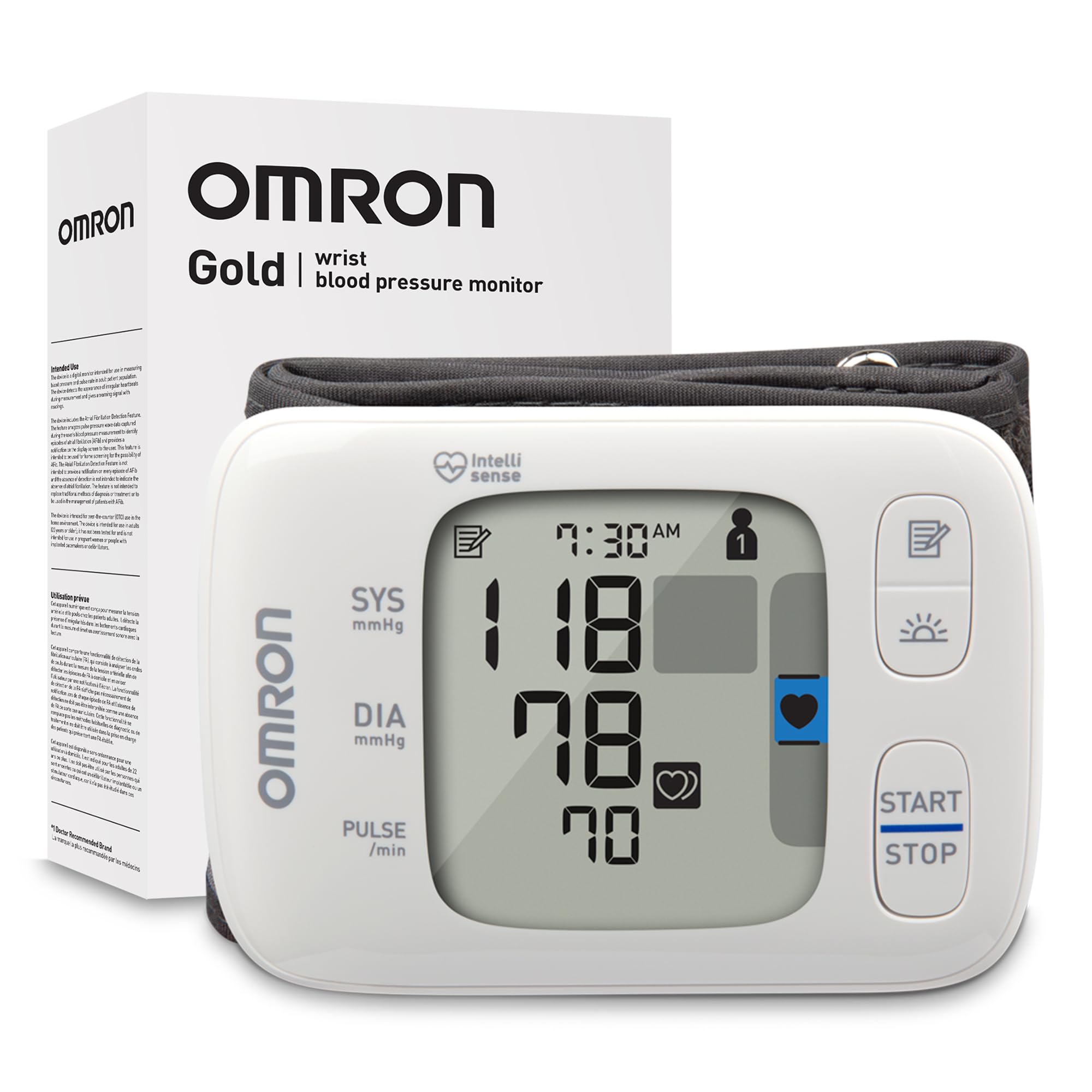
The OMRON Gold is the only monitor in this roundup with clinical validation and the #1 doctor-recommended brand backing. It stores 200 readings per user for two people, tracks morning averages to catch dangerous spikes, and detects irregular heartbeats during each measurement — a feature that can flag potential arrhythmia before symptoms appear.
Bluetooth connectivity pairs with the OMRON connect app, letting you share trend reports directly with your physician. The attached cuff fits 5.3 to 8.5 inches and inflates more slowly than most wrist models, which reduces startle-related blood pressure jumps. The two-user slide switch is tucked under the strap, which can be awkward to reach, but the overall build quality and sensor consistency justify the premium placement.
Some users report the unit reads slightly lower than a manual upper-arm cuff, so bring it to your next checkup for a cross-reference. For reliable data you can actually share with a cardiologist, this is the most trustworthy wrist option available.
Why it’s great
- Clinically validated and doctor recommended
- Irregular heartbeat detection during each reading
- High morning average indicator for risk awareness
Good to know
- Two-user switch location is under the strap
- Slow inflation may feel like it’s not starting
2. Oklar Blood Pressure Monitor Rechargeable

The Oklar balances clinical-grade features with everyday usability at a mid-range price point. It stores up to 240 readings for two users and measures in roughly 35 seconds — faster than many competitors. The large LED backlit display is legible in dim light, and the voice broadcast can be toggled on or off, making this a strong choice for those who want audible confirmation without the robotic tone of cheaper models.
The built-in lithium battery lasts over a month on a single charge, and the Type-C charging cable means you don’t need proprietary adapters. The adjustable cuff spans 4.92 to 8.46 inches, though some users with very slender wrists found it couldn’t tighten small enough for a snug fit. Nursing staff in clinical settings have adopted this model for its consistent readings and travel case.
Accuracy reviews are overwhelmingly positive, with multiple users confirming readings matched their doctor’s office monitor. The auto-shutoff after 60 seconds of inactivity preserves battery life, and the device prompts you to stop talking and relax — a thoughtful nudge that improves measurement quality.
Why it’s great
- Month-long battery life on single charge
- Large LED screen readable in low light
- Voice broadcast with volume control
Good to know
- Cuff may not fit extremely small wrists
- Charging adapter not included in the box
3. LotFancy Wrist Blood Pressure Monitor with Voice
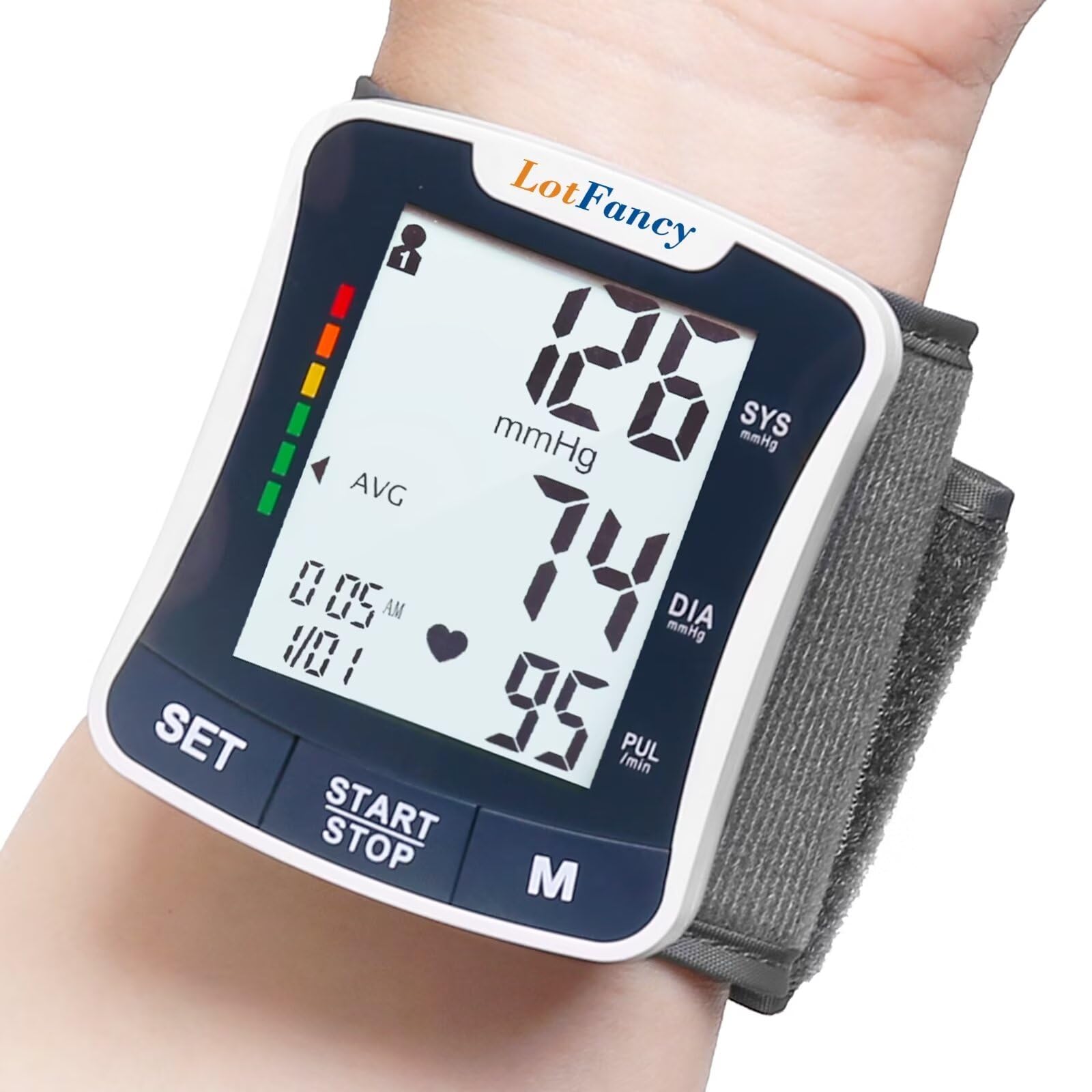
The LotFancy earns its reputation as a senior-friendly device thanks to clear voice broadcast that reads systolic, diastolic, and pulse values aloud — no squinting at a screen required. It stores 120 readings with date and time stamps across two users, which is enough for a couple to track weekly trends without data overlap. The one-touch automatic inflation and deflation makes operation intuitive for users who aren’t comfortable with technology.
At only 0.8 ounces, this is the lightest unit in the comparison, and the included carrying case makes it easy to toss into a bag for travel. The adjustable cuff fits 5.3 to 8.5 inches, and users report it’s comfortable enough for repeated daily use. Accuracy checked against a standard upper-arm cuff has been confirmed positive in multiple reviews, including one from a visually impaired user who relies on the audio output exclusively.
The catch: it runs on two AAA batteries rather than a rechargeable pack, so you’ll need to keep spares handy. The LCD screen is clear but lacks the color-coded backlight that some newer models offer. For seniors who prioritize audible readings and proven accuracy over fancy visuals, this remains a solid value pick.
Why it’s great
- Audible readings for visually impaired users
- Ultra-lightweight at 0.8 ounces
- Accurate when cross-checked with arm cuff
Good to know
- Requires AAA batteries (not included)
- No color-coded backlight
4. Windray Automatic Digital BP Machine

The Windray stands out for its color classification indicator — green for normal, yellow for light hypertension, and orange or red for moderate to high readings — giving instant visual feedback without needing to interpret raw numbers. It stores 120 readings per user for two people, and the one-button operation is about as simple as it gets. The compact 3.15 x 2.76 x 1.22-inch body weighs just 4.2 ounces, making it one of the most portable options here.
Accuracy reviews are strong, with multiple users confirming readings matched their doctor’s monitor. The adjustable cuff is designed for most wrist sizes, but the battery compartment uses two AAA batteries (not included), which adds long-term consumable costs. Some users reported that after several months, the unit started showing a low battery symbol prematurely, suggesting inconsistent power management.
Positioning is critical with this model — several reviews note that readings drift when the wrist isn’t held at heart level, which is true for all wrist cuffs but seems more pronounced here. For travel or as a backup monitor, the portability and visual indicator make it a reasonable choice, but don’t rely on it as your primary clinical device without cross-verifying.
Why it’s great
- Color-coded hypertension indicator
- Very lightweight and compact
- One-button operation for simplicity
Good to know
- AAA batteries not included
- Some users report battery drain issues over time
5. Double Love Upgraded Large LED Screen
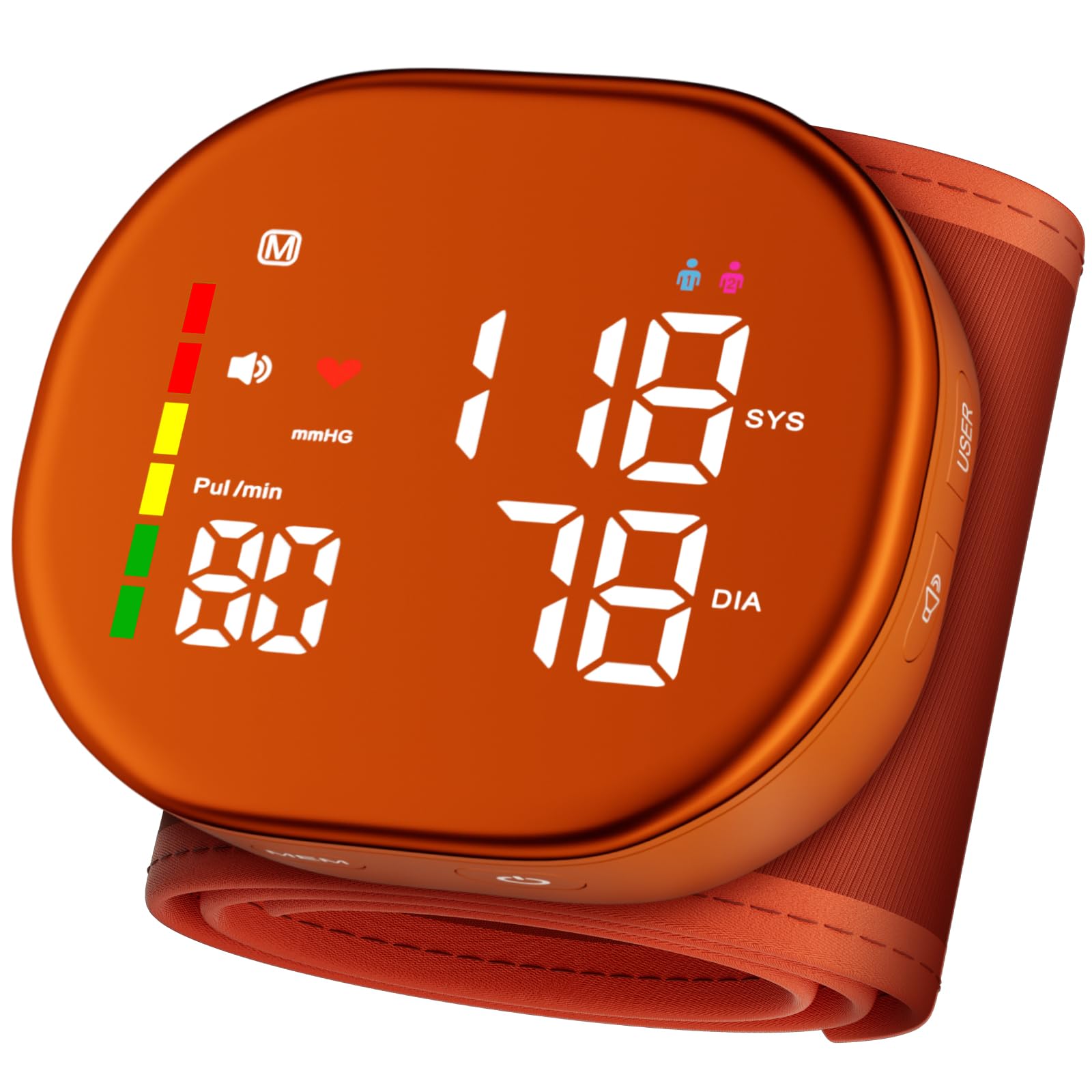
The Double Love delivers a bright, easy-to-read LED display with a three-color light that instantly categorizes your reading: green for normal, yellow for elevated, and red for high. This visual shorthand is especially useful for anyone who doesn’t want to parse exact numbers in a rush. It supports two users with 120 memories each, and the bundled Type-C rechargeable battery lasts up to a month per charge.
Irregular heartbeat detection and high-pressure warnings add clinical utility beyond basic measurement. The voice function can be muted, which is appreciated in quiet settings. Reviews are split on consistency — some users report accurate readings that match their doctor’s monitor, while others note significant variation between successive measurements taken without moving. This inconsistency is the unit’s most prominent weakness.
The adjustable cuff fits 5.3 to 7.6 inches, which is narrower than some competitors — users with larger wrists may find the range limiting. The orange color scheme is distinctive but won’t appeal to everyone. For the price, the feature set is generous, but the measurement stability concerns mean you should verify readings against a known accurate device before relying on this as your primary monitor.
Why it’s great
- Instant three-color health indicator
- Rechargeable battery with Type-C cable
- Includes irregular heartbeat detection
Good to know
- Some reports of inconsistent readings
- Cuff size limited to 7.6 inches max
6. Cunkun Tech Color Backlight Wrist BP Monitor
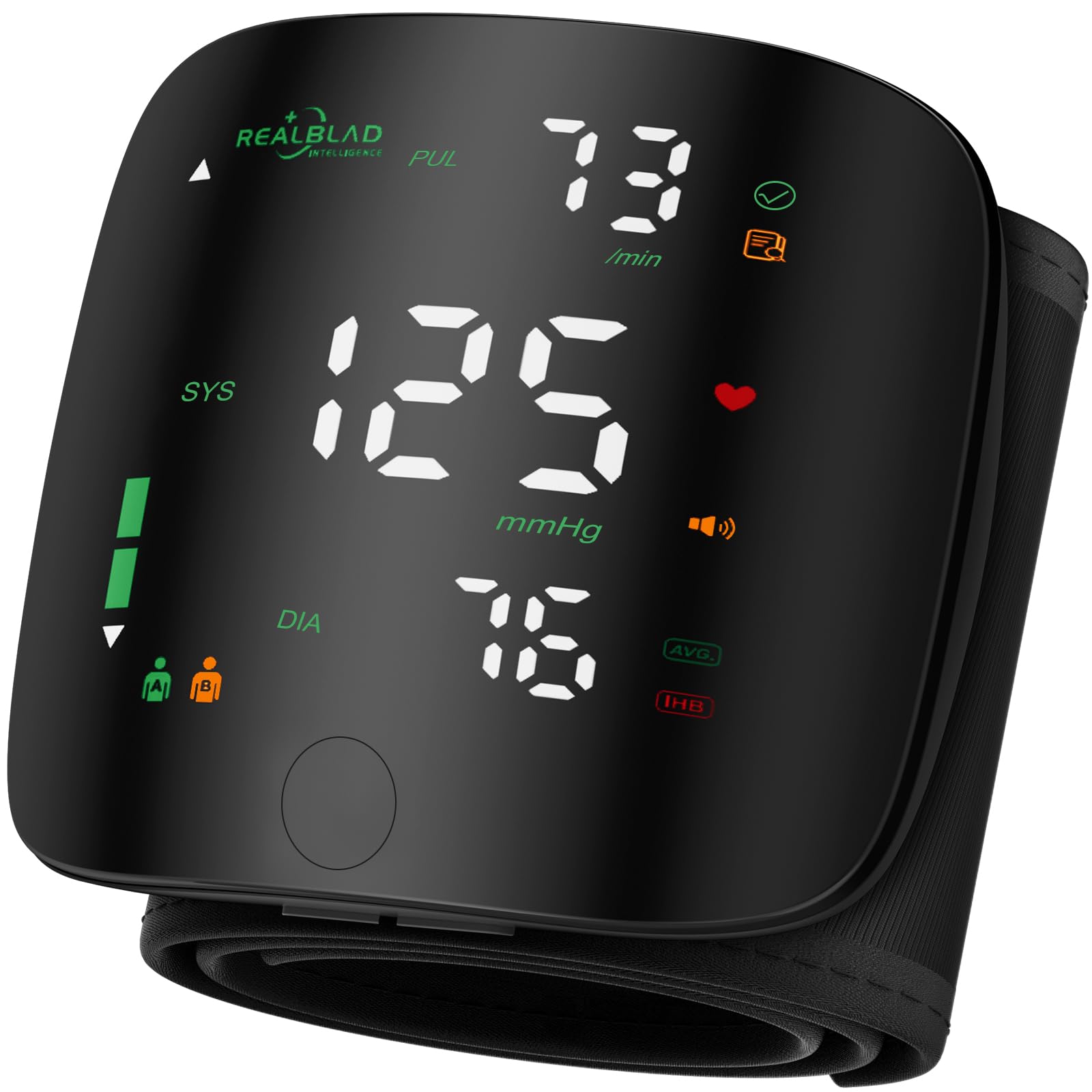
This budget-friendly option packs surprising clinical features into a lightweight 4.23-ounce package. The large LED display uses a three-color backlight — green, yellow, and red — to classify readings, and the built-in arrhythmia detection adds a layer of safety typically reserved for pricier models. It stores 99 readings per user for two people, which is less than some competitors but still ample for monthly trend tracking.
The adjustable cuff spans 5.3 to 9.3 inches, accommodating a wider range of wrist sizes than most monitors in this comparison. The 300mAh rechargeable battery claims roughly one month of use per charge, and the voice broadcast can be muted. Reviews are polarized — some users praise its accuracy against doctor’s office readings, while others report erratic behavior, including the unit refusing to start or needing multiple attempts to complete a measurement.
The included carrying case has a latch that some users found doesn’t stay shut reliably, which is a minor but annoying quality issue. For families on a tight budget who want arrhythmia detection and a wide cuff range, this monitor offers good value — but be prepared for potential reliability quirks.
Why it’s great
- Arrhythmia detection at a budget price
- Wide cuff range up to 9.3 inches
- Color-coded backlight for instant classification
Good to know
- Some units have startup reliability issues
- Carrying case latch may not stay closed
7. GUAEVER Curved Screen Pink Wrist BP Monitor

The GUAEVER stands out visually with its curved screen and pink color scheme, but its real differentiator is the improved cuff design — the wristband is thicker and longer than typical models, fitting 5.3 to 9.25 inches while making self-tightening easier. The LED touch screen is responsive, though the start button is capacitive and can trigger accidentally if the unit is jostled in a bag, so you must slide the power switch to OFF between uses.
Voice broadcast is clear and can be toggled on or off, and the built-in lithium battery claims 150 uses per charge. The storage case included is sturdy, and the instruction manual is genuinely easier to follow than most — important for a device where positioning errors lead to inaccurate readings.
Accuracy is a split decision: some reviewers report consistent results, while others describe readings varying widely within minutes and unexplained error messages. The cuff is more comfortable than most, but the inconsistent measurement reliability undermines confidence. At this entry-level price, you’re getting style and comfort — but verify any critical readings against a more reliable monitor before making health decisions.
Why it’s great
- Thicker, longer cuff for easier self-tightening
- Distinctive curved screen design
- Clear voice broadcast with on/off toggle
Good to know
- Battery life shorter than advertised
- Touch-sensitive button may activate accidentally
FAQ
Why do wrist blood pressure monitors sometimes give different readings back to back?
Can I use a wrist cuff if I have arrhythmia?
How do I know if my wrist cuff is positioned correctly?
Final Thoughts: The Verdict
For most users, the best wrist blood pressure cuff winner is the OMRON Gold Wireless because of its clinical validation, irregular heartbeat detection, and Bluetooth data sharing with your doctor. If you want long battery life and a rechargeable design, grab the Oklar Rechargeable. And for a voice-guided, senior-friendly option, nothing beats the LotFancy Voice Broadcast.