
Our readers keep the lights on and the weekend projects moving. As an Amazon Associate, I earn from qualifying purchases.
Nothing kills the warmth of a newly refinished hardwood floor faster than the hollow pop of a loose plank underfoot. For homeowners and DIYers, the hunt for an adhesive that bonds aggressively, sets fast, and tolerates wood’s natural expansion without cracking is what separates a lasting fix from a recurring headache.
I’m Rikta — the founder and writer behind FitlyFast. I study material specifications and flooring chemistry to find the bond that holds through seasonal humidity swings and heavy foot traffic.
After weighing seven formulas by bond strength, cure time, VOC content, and substrate compatibility, you’ll know exactly which adhesive for hardwood flooring deserves a place in your toolbox.
How To Choose The Best Adhesive For Hardwood Flooring
Hardwood flooring adhesives aren’t one-size-fits-all. You need to match the formula to the type of wood, the subfloor material, and the repair scenario — whether you’re gluing down a full engineered floor or injecting a single hollow plank.
Formula Type and Water Resistance
Acrylic latex and PVA (polyvinyl acetate) are the two dominant chemistries. Acrylic latex, like the pressure-sensitive kind, stays flexible and grabs vinyl or engineered wood over concrete. PVA, like the Titebond variety, sets in minutes and passes Type II water resistance, making it ideal for tongue-and-groove joints where moisture from cleaning or humidity might seep in. If you’re gluing solid hardwood directly to a subfloor, a urethane-based moisture-cure adhesive provides the strongest bond, but off-gassing is higher during application.
VOC Levels and Indoor Safety
Solvent-free and low-VOC formulas protect indoor air quality during and after installation. Products like the Roberts resin and the Sika DriTac carry a zero-VOC or low-VOC label, meaning you can work in a living space without needing heavy respiratory gear. If you’re tackling a whole-room glue-down in a home with kids or pets, prioritize adhesives that explicitly say “solvent-free” or “no VOCs.”
Application Method and Working Time
For full-floor installations, a trowel-applied pail adhesive gives you a longer working time (30 minutes to an hour) so you can adjust each plank. For targeted repairs — fixing hollow sounds or squeaks — a bottled liquid that you inject through small drilled holes is the smarter play. The DriTac and the Floor-Fix-Pro come as thin liquids that flow into gaps and cure in 1 to 24 hours. Always check the full cure time: some fast-setting PVAs set in five minutes but shouldn’t bear weight for 24 hours.
Quick Comparison
On smaller screens, swipe sideways to see the full table.
| Model | Category | Best For | Key Spec | Amazon |
|---|---|---|---|---|
| Sika DriTac RS-2 | Injection Repair | Fixing hollow/pop sounds in engineered wood | Low VOCs; 1-hour cure time | Amazon |
| Titebond Tongue & Groove Glue 2104 | PVA Joint Glue | Floating engineered wood & laminate installs | Type II water resistance; 4-min set | Amazon |
| Floor-Fix-Pro FFPROJUG | Injection Repair | Re-bonding loose tile, stone, and wood | Flexible copolymer; 24-hour cure | Amazon |
| Roberts 7350 Universal | Pressure-Sensitive | Luxury vinyl plank & carpet tile over concrete | Acrylic latex; Microban protection | Amazon |
| Roberts 3085 Multipurpose | Solvent-Free | Bonding carpet, vinyl, and cork underlayment | SBR latex; 30-min set time | Amazon |
| Alpha Systems 8011 | Water-Based | Attaching wood or roof membrane to decking | Zero odor; moderate dry time | Amazon |
| DAP Weldwood Landau | High-Heat Contact | Automotive upholstery & trim bonding | Solvent-type; 24-hour full cure | Amazon |
In‑Depth Reviews
1. Sika DriTac RS-2 Professional Wood Floor Repair Adhesive
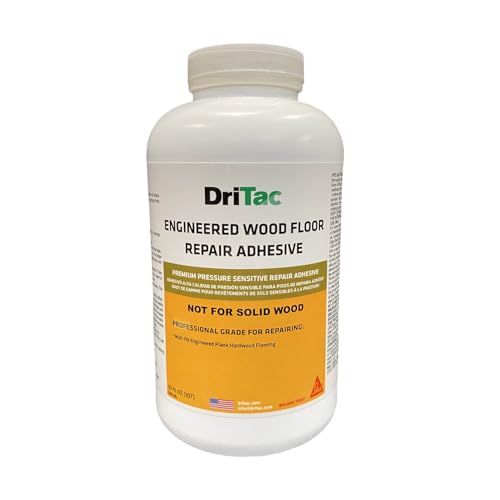
The Sika DriTac RS-2 is the mid-range injection adhesive that professionals reach for when engineered wood floors start popping or sounding hollow. Its thin, fluent viscosity lets it flow deep into the gap between the plank and the subfloor without requiring heavy weights or clamps. The formula is certified low-VOC, so you can work in a closed room without solvent fumes building up.
Customers report that warming the bottle in warm water improves flow, and that a single quart fills roughly 12 to 14 injection holes. The syringe, drill bits, and dowels are sold separately in a kit, but the adhesive alone works perfectly if you already own a large veterinary syringe. The 1-hour cure time means you can walk on the floor the same day, though waiting the full 24 hours before moving furniture yields the strongest hold.
One caveat: the adhesive has a short shelf life once opened — use it within two weeks or it thickens and becomes unworkable. A small fraction of users report that the bond failed on severely cupped planks, but for most hollow-spot and squeak repairs, this is the most reliable option on the market.
Why it’s great
- Thin formula penetrates deep gaps without needing pressure
- Low-VOC and solvent-free for indoor safety
- Sets in one hour; full cure in 24 hours
Good to know
- Short usable life after opening — use within two weeks
- Syringe and tips sold separately
2. Titebond Tongue & Groove Flooring Glue #2104 (6 bottles)

The Titebond 2104 is the reigning champion for floating engineered wood and laminate installations. This PVA-based glue spreads smoothly, sets in 4 to 5 minutes, and passes Type II water resistance — meaning it won’t break down from damp mop water or seasonal humidity. The six-bottle pack covers roughly 1,200 linear feet at a 1/8-inch bead, which is enough for a typical living room.
Customers who used it on solid oak and white oak report the bond has held tight for five years with zero gapping. The fast set time forces you to dry-lay the entire floor first and glue only one row at a time, but the trade-off is a stiff, immovable joint that prevents the planking from shifting. One user covered 1,100 square feet of engineered hardwood using five bottles and had no issues with water seepage through the joints.
Be aware that the glue thickens in the bottom of the bottle as it sits during installation, so roll the bottle occasionally or combine leftovers from multiple bottles to avoid waste. Some users note the cost per bottle is higher than multi-purpose construction adhesives, but the specialized PVA chemistry justifies the premium for a permanent tongue-and-groove bond.
Why it’s great
- Sets in minutes for fast, efficient floor installation
- Type II water resistant for damp environments
- Strong bond that prevents joint gapping over years
Good to know
- Fast set time requires dry-laying before gluing
- Thickens at bottle bottom during use
3. The Original Floor-Fix-Pro Loose Tile Repair Adhesive (1 Gallon)

The Floor-Fix-Pro is a premium copolymer adhesive designed to re-bond loose tiles, stone, marble, and creaky wood floors without pulling them up. Its extra-strength formula stays flexible after curing, so it accommodates the natural expansion and contraction of wood subfloors without cracking. The gallon jug works with a caulking gun and a large syringe — many users drill 3/16-inch holes in the grout lines and inject until the adhesive oozes from the joint.
In a 100-year-old house with constantly squeaking floorboards, one customer used two gallons to inject every joist intersection and reported zero return noise after four years. For ceramic tile repairs, the product successfully re-secured dozens of loose 18-inch tiles, saving thousands in replacement costs. The cure time is 24 hours, so you’ll need to stay off the floor overnight.
The main drawback is viscosity: the included syringe is too small for good leverage. Buy a 150 ml or larger veterinary syringe separately. Some users found that in very large areas, a few hollow spots remained after the first pass, requiring a second injection round. Despite that, the long-term resilience makes it worth the premium for anyone dealing with widespread loose flooring.
Why it’s great
- Flexible bond that moves with wood subfloors
- Works on tile, stone, marble, and engineered wood
- DIY-friendly injection method saves on removal cost
Good to know
- Needs 24-hour cure before foot traffic
- Included syringe too small — buy a larger one
4. Roberts 7350 Universal Resilient Flooring & Vinyl-Backed Carpet Tile Adhesive

The Roberts 7350 is a pressure-sensitive acrylic latex adhesive purpose-built for luxury vinyl plank, vinyl composition tile, and vinyl-backed carpet tiles. Its Microban protection fights microbial growth that can stain and break down the adhesive over time, which is a real advantage in kitchens or basements with occasional moisture. The solvent-free formula means no harsh fumes during a multi-hour installation.
DIYers who used it on RV vinyl flooring and rubber mats in trailers praise its long working time — about 6 hours before drying clear — which gives plenty of room to align planks. The bond holds strong even after months of exposure to rain, mud, and sand tracked in from outdoors. It also shows chalk lines through the clear film, making layout lines easy to follow.
Like many pail adhesives, the lid can leak during shipping if the seal is compromised; taping the lid before storage is a smart precaution. Cleanup requires wet wiping immediately — once dry, the acrylic latex is stubborn. For the price, it’s a solid mid-range workhorse for resilient flooring over concrete or plywood.
Why it’s great
- Microban protection prevents adhesive degradation
- Dries clear to show layout chalk lines
- Long working time for plank alignment
Good to know
- Lid can leak during shipping — tape it closed
- Cleanup must happen immediately before drying
5. Roberts 3085 Multipurpose Adhesive (1 Gal)
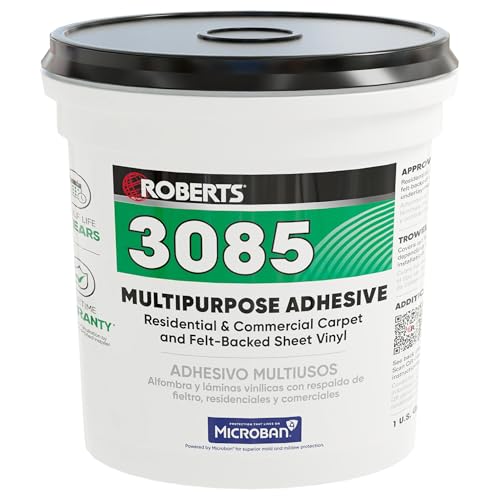
The Roberts 3085 is a solvent-free SBR latex adhesive that covers roughly 92 square feet per gallon at a thin spread. It is formulated for carpet, felt-back sheet vinyl, and acoustical cork underlayment, making it an entry-level multipurpose option rather than a dedicated hardwood glue. The fast-setting formula allows you to lay flooring within 30 minutes of application.
Customers who used it for vinyl flooring in kitchens report no lifting after two years, and the low odor makes it suitable for indoor work. The adhesive spreads easily with a notched trowel and cleans up with water while wet. A few buyers mentioned that the seal can arrive broken, leading to leaking during transit.
For anyone on a tight budget who needs a reliable grab for carpet or vinyl over concrete or plywood, this is a capable choice. Just keep in mind that it’s not formulated for tongue-and-groove hardwood installations or injection repairs — it works best as a broad-coverage trowel adhesive for resilient materials.
Why it’s great
- Fast set — floors are ready in 30 minutes
- Solvent-free with minimal odor
- Covers roughly 92 sq. ft per gallon
Good to know
- Not for tongue-and-groove hardwood joints
- Seal may arrive broken; check packaging
6. Alpha Systems 8011 Acrylic Water Based Bonding Adhesive (1 Gallon)

The Alpha Systems 8011 is a water-based acrylic adhesive that bonds wood, plywood, fiberboard, and concrete decking. Its zero-odor, low-VOC profile makes it appealing for indoor repairs where you can’t ventilate heavily. The bond is flexible, so it handles slight movements between the adhesive and the wood without cracking.
Users primarily reach for this to attach roof membranes to RV decks, but it works as a general wood-to-subfloor adhesive for small patching jobs. It has a moderate dry time — neither rapid nor slow — which gives some working window but requires patience before the bond reaches full tensile strength. One customer found that applying it to both surfaces (subfloor and membrane) caused the adhesive to stay tacky for days; the best method is to apply it to only one surface and press immediately.
This adhesive shines when you need a safe, odor-free formula for indoor work, but its strength is optimized for sheet goods and membranes rather than locking tongue-and-groove planks together. If your project is a full hardwood floor installation, choose a PVA or urethane alternative instead.
Why it’s great
- Zero odor and very low VOCs for indoor use
- Flexible bond accommodates movement
- Works on wood, plywood, concrete, and membrane
Good to know
- Not designed for tongue-and-groove hardwood joints
- Moderate dry time requires patience
7. DAP Weldwood Landau Top & Trim HHR Solvent Contact Adhesive (1 Gal)
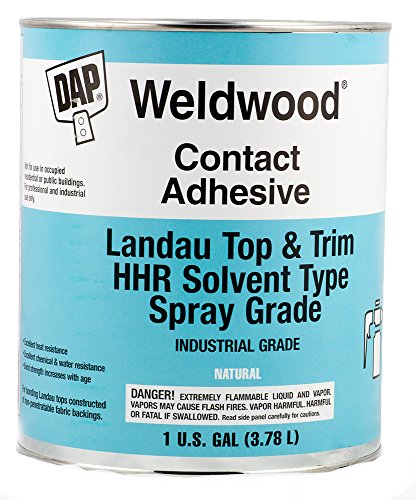
The DAP Weldwood Landau is a solvent-type contact adhesive formulated for automotive upholstery, foam, and vinyl trim. It creates a permanent, high-heat-resistant bond that stays intact even in sun-baked car interiors. For hardwood flooring, this adhesive is not a primary choice — its strength lies in bonding fabric-backed materials to metal and plastic surfaces.
Users apply it with a siphoning paint gun at 45 psi for even coverage on large panels. The contact bond is instant, so you get one chance to position the material correctly. It is highly flammable and requires ventilation or an air compressor placed outside the work area. The 24-hour full cure ensures the joint is permanent.
If your flooring project involves reupholstering a bench seat or gluing vinyl trim to a wood subfloor, this contact cement will hold permanently. But for gluing down hardwood planks, the solvent smell, flammability, and lack of wood-specific formulation make it better suited to the garage than the living room.
Why it’s great
- Permanent bond withstands high heat
- Water resistant for exterior or garage use
- Ideal for automotive upholstery repairs
Good to know
- Highly flammable — requires ventilation
- Not formulated for hardwood flooring installations
FAQ
Can I use standard construction adhesive for hardwood flooring?
How do I fix a hollow spot in engineered wood without removing the plank?
What is the difference between PVA and acrylic latex flooring adhesive?
Final Thoughts: The Verdict
For most users, the adhesive for hardwood flooring winner is the Sika DriTac RS-2 because it targets the two most common hardwood floor headaches — hollow spots and popping sounds — with a low-VOC, fast-curing injection formula. If you want a PVA joint glue for a new floating install, grab the Titebond Tongue & Groove 2104. And for a flexible injection adhesive that repairs tile, stone, and wood equally well, nothing beats the Floor-Fix-Pro.