
Our readers keep the lights on and the weekend projects moving. As an Amazon Associate, I earn from qualifying purchases.
A vinyl floor that bubbles or peels at the seam doesn’t just look unfinished — it turns a weekend project into a chronic headache. Selecting the right adhesive for vinyl determines whether your installation stays locked down through seasonal humidity shifts, heavy foot traffic, and the occasional spill. The wrong formula leaves you with peeling edges, failed bonds, and a second trip to the hardware store.
I’m Rikta — the founder and writer behind FitlyFast. I’ve spent years analyzing flooring adhesives, comparing open times, chemical compositions, and real-world bond strength across residential and commercial formulations.
Whether you’re laying sheet vinyl in a bathroom or click-lock planks across a basement, choosing the right adhesive for vinyl means matching the formula to your backing type, subfloor condition, and how much footfall the surface will take.
How To Choose The Best Adhesive For Vinyl
Not all adhesives interact the same way with vinyl backing materials. Felt-backed sheet vinyl behaves differently than loose-lay LVP, and both react differently to fiberglass-reinforced backing. Start by reading the manufacturer’s recommendation for your specific vinyl product, then match the adhesive’s open time, curing mechanism, and chemical base to your subfloor and installation environment.
Backing Type Compatibility
Felt-backed vinyl requires a wet-set adhesive that soaks into the fibrous layer to form a mechanical bond. Vinyl-backed sheet goods and LVT with a smooth, non-absorbent back typically call for a pressure-sensitive adhesive that remains tacky after drying, allowing future removal without tearing the subfloor. Fiberglass-reinforced vinyl needs an adhesive formulated to adhere to non-porous surfaces — standard multi-purpose flooring glues often fail here.
Open Time and Working Window
Open time refers to how long the adhesive stays wet enough to accept the vinyl after troweling. A 30-minute open time suits small bathrooms; an hour or more helps when laying large sheets or complex patterns. Pressure-sensitive adhesives, which form a tacky film before the vinyl is placed, allow repositioning for hours after application — critical for DIY installation where perfect alignment takes trial and error.
Environmental and Health Considerations
Solvent-based adhesives emit strong fumes that require cross-ventilation and respirator use during application and curing. Water-based, solvent-free formulas drastically reduce odor and VOC levels, making them suitable for occupied homes, bedrooms, and commercial spaces where tenants remain nearby. Zero-VOC adhesives also comply with LEED requirements and are preferred for sensitive individuals or spaces with limited airflow.
Quick Comparison
On smaller screens, swipe sideways to see the full table.
| Model | Category | Best For | Key Spec | Amazon |
|---|---|---|---|---|
| Henry 695 | Premium | Rolled sheet vinyl in basements | Water-resistant, 4-hour cure | Amazon |
| ROMAN PRO-690 | Premium | Zero-VOC, occupied spaces | 0 g/L VOC, pressure-sensitive | Amazon |
| ROBERTS 7350 | Premium | Heavy-traffic LVT & LVP | Microban protection, acrylic latex | Amazon |
| Henry 430 | Mid-Range | Laminate & loose-lay vinyl planks | Clears to invisible, 8 lb pail | Amazon |
| Lucida CoreBond | Mid-Range | RV and tight-space repairs | 1 qt, 40 sq ft coverage | Amazon |
| ARDEX LP 12073 | Budget | Felt-backed sheet vinyl | 16 oz paste, liquid form | Amazon |
| ROBERTS Unison 70-025 | Budget | Underlayment for floating floors | 3/16″ thick, moisture barrier | Amazon |
In‑Depth Reviews
1. Henry 32079 695 Vinyl Flooring Adhesive
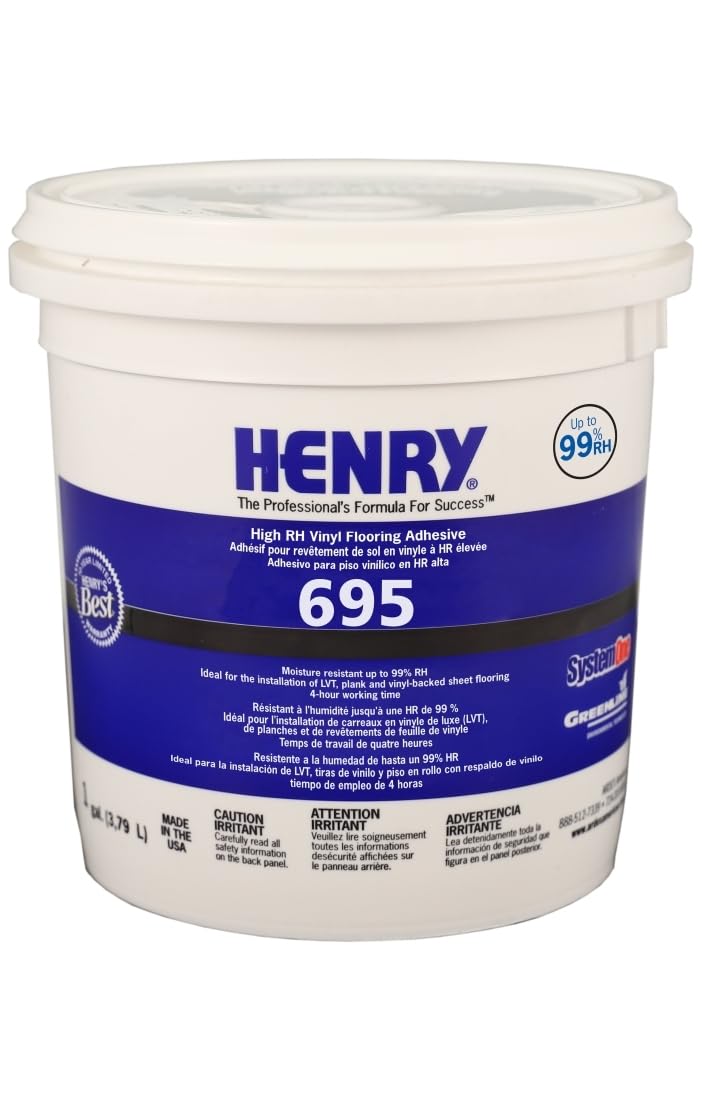
The Henry 695 is a standout for rolled sheet vinyl installations where water resistance and controlled grab matter most. Its off-white paste trowels smoothly and stays workable long enough to align large sheets, then cures to a firm bond that resists moisture seepage from the subfloor. This is the adhesive professional floor layers reach for when the job demands reliability over generic multi-purpose glue.
Users report that the 4-hour cure window provides sufficient time to reposition vinyl and roll out air pockets without rushing. The water-resistant property makes it particularly suitable for basements, laundry rooms, and bathrooms where humidity swings can test a standard adhesive’s integrity. Reviewers note that it fills small cracks and low spots effectively, creating a leveling effect that improves finished appearance.
The main trade-off is the moderate odor during application — cross-ventilation is advised. The premium cost reflects the specialized formulation rather than commodity pricing, but for a room where failure would mean tearing up the entire floor, the investment is justified by the bond strength and moisture resilience.
Why it’s great
- Water-resistant bond ideal for damp basements and laundry rooms
- 4-hour cure offers forgiving working time for large sheets
- Fills minor subfloor imperfections for a smoother final surface
Good to know
- Moderate odor during application requires ventilation
- Premium pricing compared to entry-level general-purpose adhesives
2. ROMAN PRO-690 Pressure Sensitive Flooring Adhesive
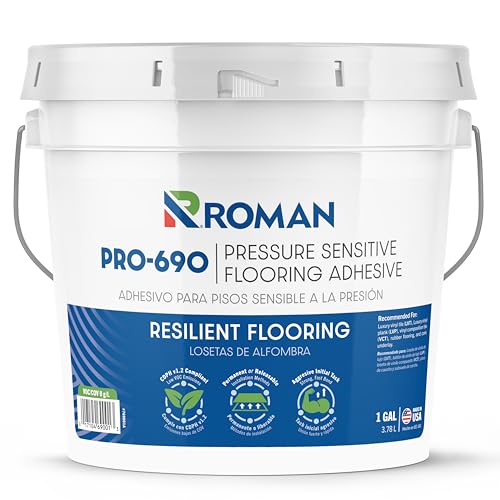
The ROMAN PRO-690 is engineered for installations where air quality and installation flexibility are non-negotiable. With a 0 g/L VOC rating and CDPH v1.2 compliance, this water-based adhesive allows flooring work in occupied residential spaces and commercial environments without forcing tenants to relocate. Its bright white formula dries clear, making overflow visible during application while remaining invisible after curing.
A key advantage is the dual-install method: apply wet for a permanent bond or allow it to tack up for 15-20 minutes to create a pressure-sensitive, releasable installation that permits future plank replacement without subfloor damage. Reviewers confirm the high initial tack holds vinyl in place immediately, while the 8-hour cure time ensures the bond strengthens progressively. One reviewer noted waiting 24 hours before walking on planks, which suggests conservative planning for traffic.
The paste consistency requires a 1/16-inch notched trowel for proper coverage. Users should wear gloves during application, as the tackiness transfers readily to skin. The lack of strong fumes is a genuine benefit for asthma-sensitive households and projects in tight quarters.
Why it’s great
- Zero-VOC formula allows safe use in occupied indoor spaces
- Flexible as either permanent (wet) or releasable (pressure-sensitive)
- Dries clear for invisible finish under translucent vinyl
Good to know
- Requires specific trowel notch size for proper coverage
- Pressure-sensitive technique demands learning the 15-20 minute tack window
3. ROBERTS Universal Resilient Flooring & Vinyl-Backed Carpet Tile Adhesive

The ROBERTS 7350 delivers a solvent-free acrylic latex formula with Microban antimicrobial protection integrated directly into the adhesive. This feature helps fight stain-causing microorganisms that can degrade the bond over time — a practical advantage in high-moisture environments like mudrooms and entryways where organic debris accumulates. The pressure-sensitive bond allows vinyl to be repositioned within a long working window of up to 6 hours.
Users report exceptional durability in demanding conditions: one reviewer noted no lifting after six months of exposure to snow, mud, and rain under rubber flooring in a trailer. The off-white color blends with standard subfloors, and the adhesive spreads easily with a notched trowel. The long working time is a genuine help for complex layouts where multiple planks or tiles must be aligned before the adhesive sets.
The odor is medium-strength compared to zero-VOC alternatives, so ventilation remains important. Cleanup requires immediate attention — dried adhesive demands mineral spirits rather than soap and water. The Microban additive does not eliminate the need for proper subfloor preparation but adds an extra layer of protection in high-use areas.
Why it’s great
- Microban protection fights stain-causing microbes for extended bond life
- Up to 6-hour working time for complex layouts and large areas
- Solvent-free with strong initial tack for LVT, LVP, and VCT
Good to know
- Medium odor during application requires ventilation
- Dried adhesive cleanup needs mineral spirits, not water
4. Henry 12098 GAL #430 Vinyl Adhesive

The Henry 430 is a tried-and-true clear-drying adhesive that has served DIY floor layers for years. Its liquid form spreads thinly with a putty knife or trowel, and the translucent finish means any squeeze-out remains invisible against vinyl edges. This is a wet-set adhesive that requires a drying period before laying the flooring — typically 30-60 minutes depending on humidity — which is clearly stated in the instructions but sometimes overlooked by rushed users.
Positive reviews highlight how a thin layer applied with a putty knife delivers excellent adhesion across multiple rooms. However, the set time is unusually long — some users report the bond still not fully set after 18 hours to 5 days, which may indicate variability in batch consistency or subfloor moisture conditions. The strong odor is another consistent complaint; one reviewer described being driven out of the house during application.
The 8-pound pail provides generous coverage for multiple rooms at a mid-range cost, making it an economical choice for homeowners tackling several spaces. The smell issue can be managed with open windows and fans, but it disqualifies the product for occupied spaces where tenants cannot relocate.
Why it’s great
- Dries clear for invisible finish under vinyl edges
- Thin application with putty knife reduces waste
- Large 8-pound pail offers broad coverage for multiple rooms
Good to know
- Very strong odor that requires significant ventilation
- Set time can be inconsistent, sometimes exceeding 18 hours
5. Lucida Surfaces CoreBond Pro-Grade Solvent Free Vinyl Flooring Adhesive
The Lucida CoreBond is a solvent-free pressure-sensitive adhesive packed into a compact 1-quart container, making it ideal for small repair jobs, RV renovations, and single-room projects where a full gallon would go to waste. It covers approximately 40 square feet — enough for a small bathroom entryway or a patch repair on a damaged plank. The clear, liquid form applies easily with a small trowel or roller.
Customers report excellent results in motorhome vinyl tile replacement, noting that the adhesive is easy to spread and excess wipes up with a damp cloth before curing. The pressure-sensitive nature means the glue remains tacky even after a week uncovered, which provides extraordinary flexibility for multi-day installation schedules. It bonds effectively with LVT, vinyl plank, VCT, and fiberglass-backed sheet flooring across both porous and non-porous subfloors.
The solvent-free formulation minimizes odor, making it suitable for enclosed spaces where ventilation is limited. The 30-minute to 1-hour working time is shorter than some full-gallon competitors, so users should plan for efficient placement. The small container size, while convenient for portability, means larger rooms will require multiple quarts.
Why it’s great
- Compact quart format perfect for RV repairs and small patch jobs
- Solvent-free with minimal odor for enclosed spaces
- Remains tacky uncovered for over a week for flexible scheduling
Good to know
- Short working window (30-60 minutes) requires efficient placement
- 40 sq ft coverage means multiple quarts needed for larger rooms
6. ARDEX LP 12073 GAL #356 FLR Adhesive

The Henry #356 (ARDEX LP 12073) is a paste-form adhesive specifically formulated for felt-backed vinyl flooring, where the fibrous underside absorbs the glue to form a mechanical lock. Professionals recommend it for its compatibility with the absorbent backing material, which prevents the peeling that occurs when multi-purpose adhesives fail to penetrate felt. The 16-ounce container keeps the purchase small and manageable for single-room projects.
Positive reviews highlight its performance on cork board and MDO panels, suggesting decent versatility despite the specific primary application. One satisfied user, a flooring installer, called it one of the best glues for felt-backed vinyl he had ever used. However, reports of shipping leaks and the occasional total bond failure — even with proper surface preparation — indicate batch inconsistency or sensitivity to subfloor conditions.
The paste consistency makes spreading straightforward, but users must follow the specific application guidelines for felt-backed flooring. The failures reported involved the adhesive sticking to the carpet top and the installer’s fingers rather than the subfloor, suggesting that proper trowel technique and pressure during installation are critical to success.
Why it’s great
- Specifically formulated for felt-backed vinyl for mechanical bonding
- Small 16-ounce format ideal for single-room or repair projects
- Paste consistency spreads easily and cleanly
Good to know
- Bond failure reported in some cases; proper trowel technique critical
- Shipping container leaks reported due to thin pail material
7. ROBERTS 100 sq. ft. Unison Premium 2-in-1 Underlayment

The ROBERTS Unison is not an adhesive — it is a 3/16-inch thick polyethylene foam underlayment with an integrated moisture barrier, intended for floating vinyl plank and laminate floors where adhesive is not used between the planks and subfloor. The closed-cell structure resists moisture, mold, and mildew, while the foam layer cushions footsteps and reduces sound transmission. It is designed for on-grade and above-grade concrete subfloors.
Users consistently praise the included tape strips for seam attachment, making installation faster than cutting and taping separate rolls. The 100-square-foot roll covers a standard room at a competitive price compared to big-box retailers. The 3/16-inch thickness is thin enough to maintain headroom in basements while still providing adequate cushioning and moisture protection against concrete slabs.
Some reviewers note that the adhesive strips are narrow and can peel off the foam if not pressed firmly during unrolling. The foam is also slightly compressible, which absorbs minor subfloor imperfections but will not correct significant unevenness. For floating floor installations that require sound dampening and moisture protection rather than glue-down adhesion, this underlayment performs reliably at a budget-friendly price.
Why it’s great
- Integrated moisture barrier protects floating vinyl from concrete subfloors
- Tape strips simplify seam attachment during installation
- Cushioning reduces sound transmission in multi-level homes
Good to know
- Narrow tape strips can detach if not pressed firmly
- Foam compressibility does not correct uneven subfloors
FAQ
Can I use the same adhesive for felt-backed and vinyl-backed flooring?
How long should I wait before walking on vinyl after applying adhesive?
What does pressure-sensitive mean in a flooring adhesive context?
Can I apply adhesive over existing vinyl tile without removing it?
Final Thoughts: The Verdict
For most users, the adhesive for vinyl winner is the Henry 695 because its water-resistant, 4-hour cure formula balances forgiving working time with a strong bond suited for basement and main-floor sheet vinyl installations. If you need a zero-VOC adhesive for occupied indoor spaces with flexible permanent or releasable installation, grab the ROMAN PRO-690. And for small patch repairs and RV projects where portability and minimal odor matter most, nothing beats the Lucida CoreBond.