
Our readers keep the lights on and the weekend projects moving. As an Amazon Associate, I earn from qualifying purchases.
Your azaleas are telling you something when their leaves turn yellow between the veins and the flower buds refuse to set. That’s an iron deficiency locked in alkaline soil — a direct sign your current feeding schedule isn’t delivering the acidifying punch these ericaceous shrubs demand. Shifting to a properly formulated, low-pH plant food is the single fastest way to restore deep green foliage and a full canopy of spring blooms.
I’m Rikta — the founder and writer behind FitlyFast. I spend my time cross-referencing OMRI listings, sulfur percentages, and NPK ratios to separate the true acid-loving plant foods from general-purpose mixes that won’t move your soil pH needle.
Decoding the nitrogen source and sulfur content is the real shortcut to healthier shrubs. After reviewing dozens of formulas, this guide will walk you through the essential details you need to find the very best azalea fertilizer for your garden’s specific soil conditions and your personal gardening style.
How To Choose The Best Azalea Fertilizer
Choosing the right formula comes down to three interconnected factors: the nitrogen source, the sulfur content, and the release speed. Get these right, and your azaleas will reward you with dark green leaves and a dense flush of flowers. Get them wrong, and you’ll be fighting yellowing foliage all season.
Nitrogen Source: The Key to Acidification
Azaleas thrive on ammoniacal nitrogen (NH₄⁺) because the plant roots release hydrogen ions as they take it up, naturally acidifying the rhizosphere. Products that rely on nitrate nitrogen (NO₃⁻) actually raise the pH around the root zone, worsening iron lockout. Always check the label for ammonium sulfate, urea, or other ammoniacal sources — these are the workhorses of any effective acid-loving plant food.
Sulfur Content for Long-Term pH Control
Sulfur is the slow-release acidifier that keeps your soil pH in the ideal 4.5–5.5 range. A fertilizer with at least 5% sulfur ensures ongoing acidification between feedings. If you’re dealing with heavy clay soil or alkaline tap water, look for a formula that includes elemental sulfur or sulfate compounds to keep the pH trending downward.
Release Speed: Fast Liquid vs. Slow Granules
Water-soluble powders like Jack’s Classic deliver a rapid green-up within days and are perfect for container plants or a quick correction. Organic granules like Espoma’s Holly-Tone break down over weeks, feeding the soil microbes and providing a steady nutrient stream. Your choice depends on how often you want to apply — liquid can be done every 7–14 days, while granules need only two applications per year.
Quick Comparison
On smaller screens, swipe sideways to see the full table.
| Model | Category | Best For | Key Spec | Amazon |
|---|---|---|---|---|
| FoxFarm Happy Frog | Organic/Slow | Soil biology + long-term health | Mycorrhizal fungi & soil microbes | Amazon |
| Espoma Holly-Tone 18 lb | Organic/Granule | Large gardens, heavy feeders | 5% sulfur + Bio-tone microbes | Amazon |
| Jack’s Classic Acid Special | Synthetic/Water-Soluble | Fast green-up & container plants | 17-6-6 NPK + micronutrients | Amazon |
| Miracle-Gro Water Soluble | Synthetic/Water-Soluble | Budget-friendly quick feed | Instant feeding for 7-14 day cycle | Amazon |
| True Organic Azalea Food | Organic/Granule | Natural pH lowering + large coverage | 12 lb bag, seabird guano base | Amazon |
| Espoma Azalea-Tone 4-3-4 | Organic/Granule | Targeted azalea feeding | No mixing required, dual pack | Amazon |
| TPS Nutrients Azalea Liquid | Liquid/Ready-to-Use | Quick rescue & small gardens | Ready-to-mix 32 oz concentrate | Amazon |
In‑Depth Reviews
1. FoxFarm Happy Frog Acid Loving Plants Fertilizer

The Happy Frog formula pairs a 4-pound bag of organic, slow-release granules with a proprietary cocktail of mycorrhizal fungi and beneficial soil microbes. This isn’t just a nutrient source — it’s a soil-building biology boost that improves water and nutrient uptake over the entire root zone. The low pH formulation is purpose-built for azaleas, rhododendrons, blueberries, and every other ericaceous plant in your garden.
Each feeding uses a modest 1/16 cup per gallon of soil, making the bag last across multiple mature shrubs or a bed of acid-loving ornamentals. The granular form means you broadcast it around the drip line and water it in — no mixing, no measuring spoons for large areas. Users consistently report visible results within weeks, with darker leaves and improved vigor.
The medium coverage rating and OMRI listing make it a safe choice for edible beds, though it’s marketed primarily for ornamentals. If you’re managing a garden with mixed acid-loving plants, Happy Frog is the most versatile biological option on this list. It delivers gentle, sustained nutrition without the risk of synthetic salt burn.
Why it’s great
- Includes living soil microbes and mycorrhizal fungi
- OMRI Listed for organic gardening confidence
- Gentle slow-release won’t burn roots
Good to know
- 4 lb bag may be small for large landscapes
- Must be watered in after application to activate
2. Espoma Organic Holly-Tone 18 lb

Holly-Tone is the benchmark organic fertilizer for acid-loving plants, and the 18-pound bag is the clear choice for anyone managing a sizable landscape. The 4-3-4 NPK analysis is paired with 5% sulfur — a deliberate ratio designed to gradually lower soil pH while feeding the plant. The exclusive Bio-tone microbes further enhance root development and nutrient cycling in the soil.
Because it’s a dry granule, you simply broadcast it around the drip line of each shrub in spring and fall. No mixing, no measuring for timing — two applications a year cover the entire feeding season. The coverage of 2,500 sq. ft. means a single bag services dozens of azaleas, hydrangeas, and rhododendrons across a large property.
Customer reports confirm that Holly-Tone can revive a non-flowering rhododendron that hasn’t bloomed in years — just apply according to the label and water in thoroughly. The strong organic smell (seabird guano and feather meal) is a sign of active biological material, not a defect. If you want a set-it-and-forget-it approach for a large garden, Holly-Tone is the most cost-effective premium choice.
Why it’s great
- Huge 18 lb bag covers 2,500 sq. ft.
- Only two applications per year needed
- Proven track record reviving oldest shrubs
Good to know
- Strong barnyard odor for first few days
- Over-application can lead to salt buildup
3. Jack’s Classic 17-6-6 Acid Special

Jack’s Classic Acid Special is the synthetic water-soluble powerhouse for growers who need immediate results. The 17-6-6 analysis delivers a high-nitrogen punch with elevated iron and sulfur levels, specifically targeting the chlorosis (yellowing between leaf veins) that plagues azaleas in neutral-pH soil. Mix 1 teaspoon per gallon of water and apply every 7-14 days for a fast green-up.
The included measuring spoon simplifies batch mixing, and the powder form yields multiple gallons of liquid fertilizer from a single 1.5-pound container. This product can be used as a foliar spray or root drench — foliar feeding gets micronutrients into the leaves within hours, which is critical for correcting an acute deficiency. Users switching from weaker organic blends report stronger bloom sets and denser foliage by mid-season.
The high NPK means you must follow dilution instructions precisely to avoid root burn, especially in container plants. But for container azaleas, raised bed blueberries, or any situation where you want visible improvement within a week, Jack’s Classic Acid Special is unmatched. It’s the fastest way to correct an iron lockout.
Why it’s great
- 17-6-6 NPK with elevated iron for fast chlorosis correction
- Can be used as foliar spray or root drench
- Comes with measuring spoon for precise mixing
Good to know
- Synthetic formula — can burn if over-applied
- Requires more frequent application (every 1-2 weeks)
4. Miracle-Gro Water Soluble Azalea, Camellia, Rhododendron Plant Food

Miracle-Gro’s water-soluble option for acid-loving plants is the entry-level workhorse that balances cost and performance. The 5-pound bag provides an 80-ounce unit count — far more volume than most competitors at this tier — and the powder mixes instantly with water for application via watering can or hose-end feeder. It’s designed for a 7-14 day feeding cycle on both indoor and outdoor acid lovers.
The formulation won’t burn foliage when used as directed, making it forgiving for beginners who are still calibrating their feeding schedule. Users report visible greening within a week, particularly on rhododendrons and holly bushes that were looking pale. The versatility to feed azaleas, camellias, hydrangeas, and even orchids from the same bag adds real value for a mixed garden.
Because it’s a synthetic salt-based fertilizer, it doesn’t build soil biology the way an organic granule does. You’ll need consistent reapplication through the growing season, and over-reliance can degrade soil structure over years. But for a budget-friendly entry point that delivers reliable, fast performance, this is the safest bet.
Why it’s great
- Large 5 lb bag at a very approachable price point
- Works with any watering can or hose-end feeder
- Won’t burn foliage when used correctly
Good to know
- Synthetic formula — doesn’t improve soil microbes
- Requires feeding every 7-14 days
5. True Organic Azalea, Camellia & Rhododendron Food
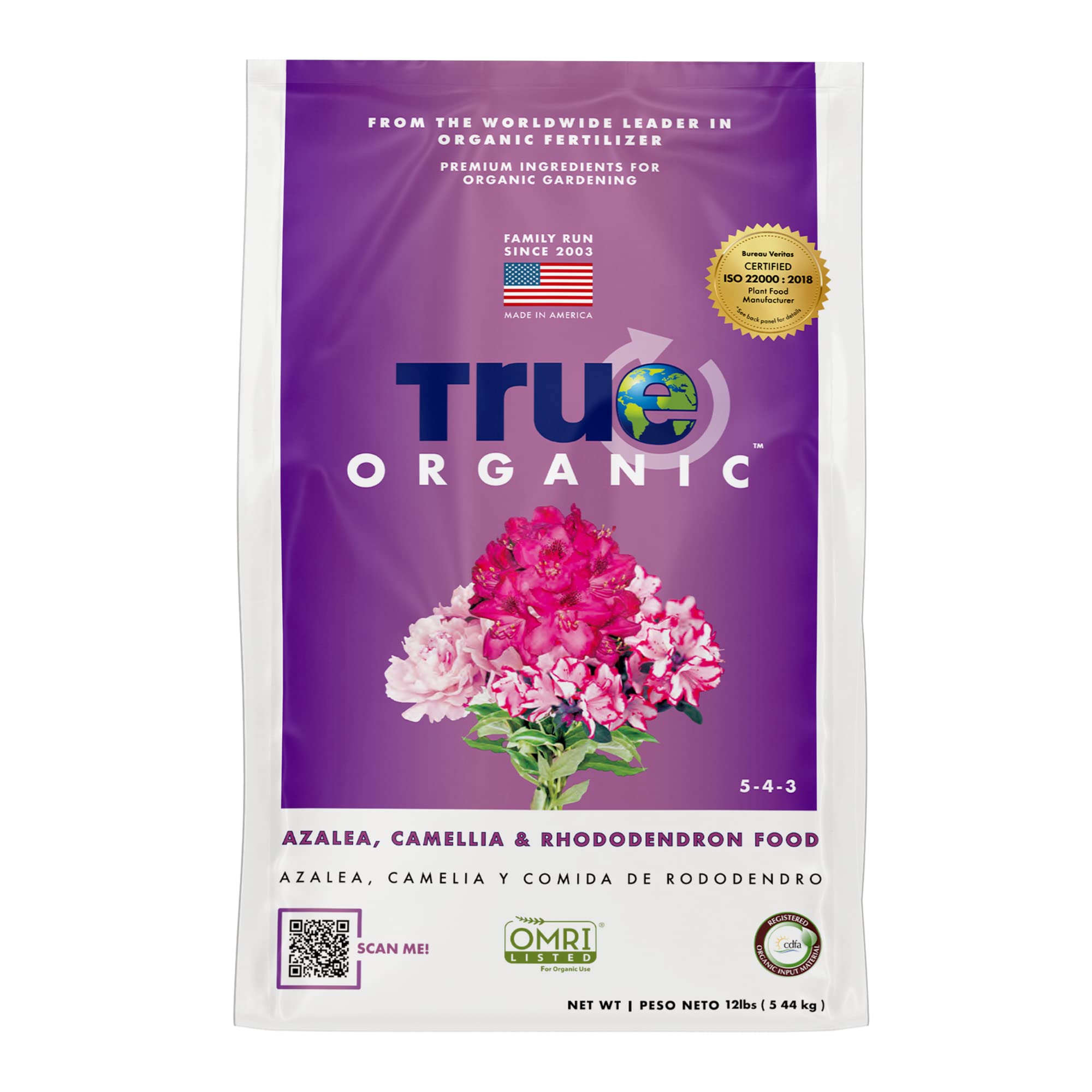
True Organic’s granule formula relies on seabird guano, shrimp and crab shell meal, and 5% soil sulfur to naturally acidify the root zone while feeding the plant. The 12-pound bag covers up to 261 sq. ft., making it a strong option for medium-to-large garden beds. The 5-4-3 NPK is lower than synthetic competitors, but the organic matter builds long-term soil fertility.
Twice-yearly application (spring and fall) simplifies the feeding schedule considerably. Users note that even after heavy rain or heat, the formula doesn’t produce the fishy odor common with liquid organic fertilizers. One reviewer reported a compact rose bush growing to 7 feet after a season with this product — a testament to the nutrient density of the shellfish-based ingredients.
While the granular form is easy to broadcast, it must be watered in to activate the sulfur and begin the pH-lowering process. The 12-pound bag is heavy, so storage and handling require a bit more space. If you’re committed to organic inputs and want a large-format bag that covers significant ground, True Organic delivers excellent value per square foot.
Why it’s great
- Large 12 lb bag with 261 sq. ft. coverage
- Seabird guano and shellfish meal for rich organics
- Only two applications per year needed
Good to know
- Strong organic smell for the first few days
- Must be watered in after application
6. Espoma Organic Azalea-Tone 4-3-4 (Pack of 2)

Azalea-Tone is Espoma’s species-specific formulation, optimized exclusively for flowering evergreens like azaleas, rhododendrons, camellias, and gardenias. This pack of two 4-pound bags gives you 8 pounds total — enough for multiple feeding cycles on a medium-sized bed. The 4-3-4 NPK with 5% sulfur targets the exact nutritional profile these shrubs need without the excess nitrogen that would push vegetative growth at the expense of blooms.
Because it’s a no-mix granule, you simply sprinkle it around the drip line and water in. Users report that mature azaleas in poor soil show improved bloom quantity and duration after just one semi-annual application. The Bio-tone microbial boosters help break down organic matter in the soil, releasing nutrients slowly over weeks. The earthy smell fades quickly after watering, a notable improvement over some other organic options.
For gardeners who want a fertilizer labeled specifically for azaleas — not a general acid blend — Azalea-Tone removes the guesswork. The dual-pack format also makes it easy to split between spring and fall feeding without opening a giant bag. Just be prepared for the initial poultry-litter aroma; it dissipates within a day.
Why it’s great
- Species-specific blend for azaleas and rhododendrons
- Dual 4 lb bags for easy seasonal use
- No mixing required — just sprinkle and water
Good to know
- Strong initial fertilizer odor
- Smaller bag size; two bags needed for large gardens
7. TPS Nutrients Azalea Fertilizer Liquid
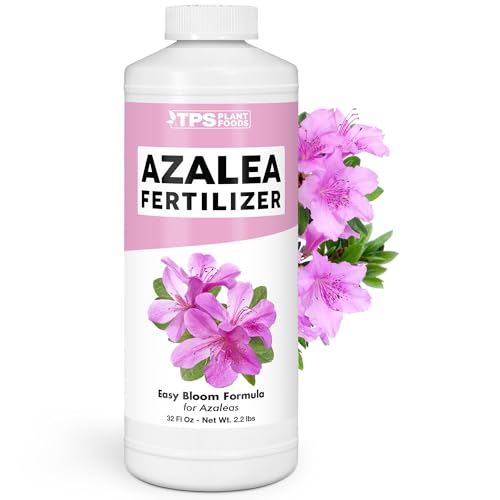
TPS Nutrients offers a ready-to-mix liquid concentrate formulated specifically for azaleas and similar acid-loving shrubs. The 32-ounce bottle mixes at a ratio of 1 tablespoon per gallon of water, and the liquid form means nutrients are immediately available to the roots — no waiting for granule dissolution or microbial breakdown. This is the product to reach for when your azaleas are showing acute yellowing or stunted growth.
Users in the Mid-Atlantic region reported that a single azalea that appeared dead after winter began pushing new green growth after just two weekly applications. The liquid formula is also ideal for container-grown azaleas, where granular fertilizers can be harder to evenly distribute. It’s made in the USA and targets the specific low-pH needs of azaleas, rhododendrons, and camellias.
The bottle is smaller than bagged options, so for large in-ground beds you’ll need multiple bottles for a full season. Liquid also requires more frequent application (every 7-14 days) compared to slow-release granules. But for targeted rescue feeding or small container gardens, TPS Nutrients delivers a precise, fast-acting solution that’s hard to beat in convenience.
Why it’s great
- Fast-acting liquid for quick chlorosis correction
- Easy 1 tablespoon per gallon mixing ratio
- Ideal for container plants and small gardens
Good to know
- Requires more frequent application than granules
- 32 oz bottle covers fewer plants than bagged options
FAQ
How often should I fertilize my azaleas?
What does it mean when azalea leaves turn yellow between the veins?
Can I use a general plant food on my azaleas?
Final Thoughts: The Verdict
For most users, the best azalea fertilizer winner is the FoxFarm Happy Frog Acid Loving Plants Fertilizer because it combines organic certification, mycorrhizal fungi, and a gentle slow-release formula that builds soil health while feeding the plant. If you want fast green-up and precise control, grab the Jack’s Classic Acid Special. And for large gardens requiring minimal effort, nothing beats the Espoma Organic Holly-Tone 18 lb for coverage and proven performance.