
Our readers keep the lights on and the weekend projects moving. As an Amazon Associate, I earn from qualifying purchases.
Choosing a backpacking lantern means balancing raw lumens against pack weight, battery longevity against charging convenience, and beam quality against durability when a storm rolls in. The wrong pick leaves you stumbling in the dark or hauling a brick you never needed.
I’m Rikta — the founder and writer behind FitlyFast. I’ve spent years analyzing outdoor lighting hardware, comparing lumen-per-ounce ratios, battery chemistries, and real-world durability data to separate genuine backcountry tools from car-camping gadgets.
This guide breaks down the seven best options for hikers who refuse to compromise on weight or performance, helping you find the ideal backpacking lantern for your specific trip style and terrain.
How To Choose The Best Backpacking Lantern
Every ounce matters when it’s on your back, and a lantern that can’t handle a drizzle or a drop is dead weight. Focus on these three factors to find a light that pulls its weight on the trail.
Lumen Output and Beam Pattern
A lantern for the backcountry doesn’t need to light up a football field. Look for 100-300 lumens for tent use and ambient camp light — anything above 500 lumens is excessive for most hikers and drains battery faster. Equally important is a 360-degree beam pattern so you don’t get a hotspot in one direction and darkness in another.
Battery System and Runtime
Built-in lithium-ion packs save weight but can’t be swapped mid-trip. Removable cells (18650 or AA) let you carry spares. Check runtime on medium, not max — most of your use will be at lower settings. Multi-day trips demand at least 15-20 hours on medium, or the ability to recharge from a power bank.
Durability and Portability
IPX4 is the minimum for splash resistance; IP66 is better for rain and dust. Impact resistance to 1 meter is critical for a device you’ll drop on rocks or packed dirt. Collapsible or compact designs (under 6 ounces) are essential for backpacking — a rigid 2-pound lantern belongs in the car.
Quick Comparison
On smaller screens, swipe sideways to see the full table.
| Model | Category | Best For | Key Spec | Amazon |
|---|---|---|---|---|
| Fenix CL26R Pro | Premium | Maximum versatility & power bank | 650 lumens, 360°, 5000mAh | Amazon |
| Sofirn BLF LT1 | Premium | Adjustable color temp, long runtime | 800 lumens, 24h medium, 4×21700 | Amazon |
| Ledlenser ML4 | Mid-Range | Ultra-compact, AA compatible | 300 lumens, IP66, 23h runtime | Amazon |
| Black Diamond Moji R+ | Mid-Range | Pocket-size, magnetic mount | 200 lumens, IPX4, 1500mAh | Amazon |
| Coleman Classic Rechargeable | Mid-Range | High output, budget pick for basecamp | 800 lumens, IPX4, 4800mAh | Amazon |
| LuminAID 2-in-1 Solar | Premium | Solar charging, emergency kit use | 300 lumens, IP67, 4000mAh | Amazon |
| Snow Peak Hozuki | Premium | Design, candle mode, lifetime warranty | 100 lumens, 80h low, 5.8 oz | Amazon |
In‑Depth Reviews
1. Fenix CL26R Pro Camping Lantern

The Fenix CL26R Pro packs 650 lumens into a body smaller than a soda can, with a 360-degree beam that also includes downward and directional forward modes — a rare trifecta for tent illumination. Its 5000mAh lithium-ion battery delivers up to 408 hours on the lowest setting, and the USB-C port fast-charges the unit while the USB-A port doubles as a power bank for your phone or GPS.
The rotary toggle and electronic switch give you seven white light modes and two red light modes, so you can dial in everything from a soft candle-like glow to a blaze that lights a 16-yard campsite. Red mode preserves night vision, and the power indicator lets you avoid surprises on multi-night trips.
At just over 7 ounces with the battery included, the CL26R Pro replaces bulkier setups without sacrificing output. The IP66 rating handles rain and dust, and the included LumenTac Organizer keeps it secure in your pack. It’s the most versatile single-lantern solution for serious backpackers.
Why it’s great
- Removable 5000mAh battery doubles as spare for compatible headlamps
- Directional bottom light with magnet for hands-free tasks
- USB-C fast charging plus USB-A phone charging
Good to know
- Premium investment for a go-anywhere lantern
- 500-lumen max is rarely needed but drains battery fast
2. Sofirn BLF LT1 Camping Lantern

The Sofirn BLF LT1 is a lantern built by flashlight enthusiasts for real-world users, combining 800 lumens of output with a variable color temperature that sweeps from warm 2700K amber to cool 5000K white. This tint control lets you match the light to your environment — campfire ambiance or task-level clarity — without packing multiple lights.
Powered by four included 21700 lithium-ion batteries, the LT1 runs over 24 hours on medium, and the USB-C port handles 5V 2A fast charging while also serving as a power bank for other devices. The Anduril II user interface offers stepped and smooth ramping plus a candle flicker mode that responds to wind or sound.
Weighing about 1.6 pounds with batteries, the LT1 is heavier than ultralight options, but its runtime and output make it ideal for basecamp or trips where weight isn’t the single constraint. The dual tripod mounts (top and bottom) add versatility for hanging or ground-level use.
Why it’s great
- Full color temperature adjustability from candle-warm to daylight-cool
- Long runtime on medium setting with four included cells
- Acts as a power bank and an 18650/21700 charger
Good to know
- Heavier than dedicated backpacking lanterns at 1.6 lbs
- Anduril II UI requires a short learning curve
3. Ledlenser ML4 Warm Light Camping Lantern

The Ledlenser ML4 crams 300 lumens into a 4-inch, 2.5-ounce body with IP66 dust and water resistance, making it one of the most trail-ready compact lanterns available. Its warm LED glow diffuses through ribbed plastic for soft, even tent lighting, and the red mode preserves night vision for midnight bathroom breaks.
A major advantage is its battery flexibility: the ML4 runs on the included rechargeable 14500 Li-ion cell, standard NiMH rechargeable AA, or alkaline AA. This means you can fall back on disposable batteries if you run out of juice on a long stretch without a charger.
The integrated clip and hanging hook let you attach it to a pack strap, tent loop, or branch, and the light remembers your last color setting when powered off. The proprietary magnetic charging cable is a minor friction point, but the AA compatibility largely mitigates it for backcountry use.
Why it’s great
- Accepts 14500 Li-ion, NiMH, or alkaline AA batteries
- IP66 rating handles heavy rain and dusty trails
- Ultra-light at 2.5 oz, clips onto pack straps
Good to know
- Proprietary magnetic charger instead of USB-C
- Plastic clip may wear over extended use
4. Black Diamond Moji R+ Rechargeable Lantern
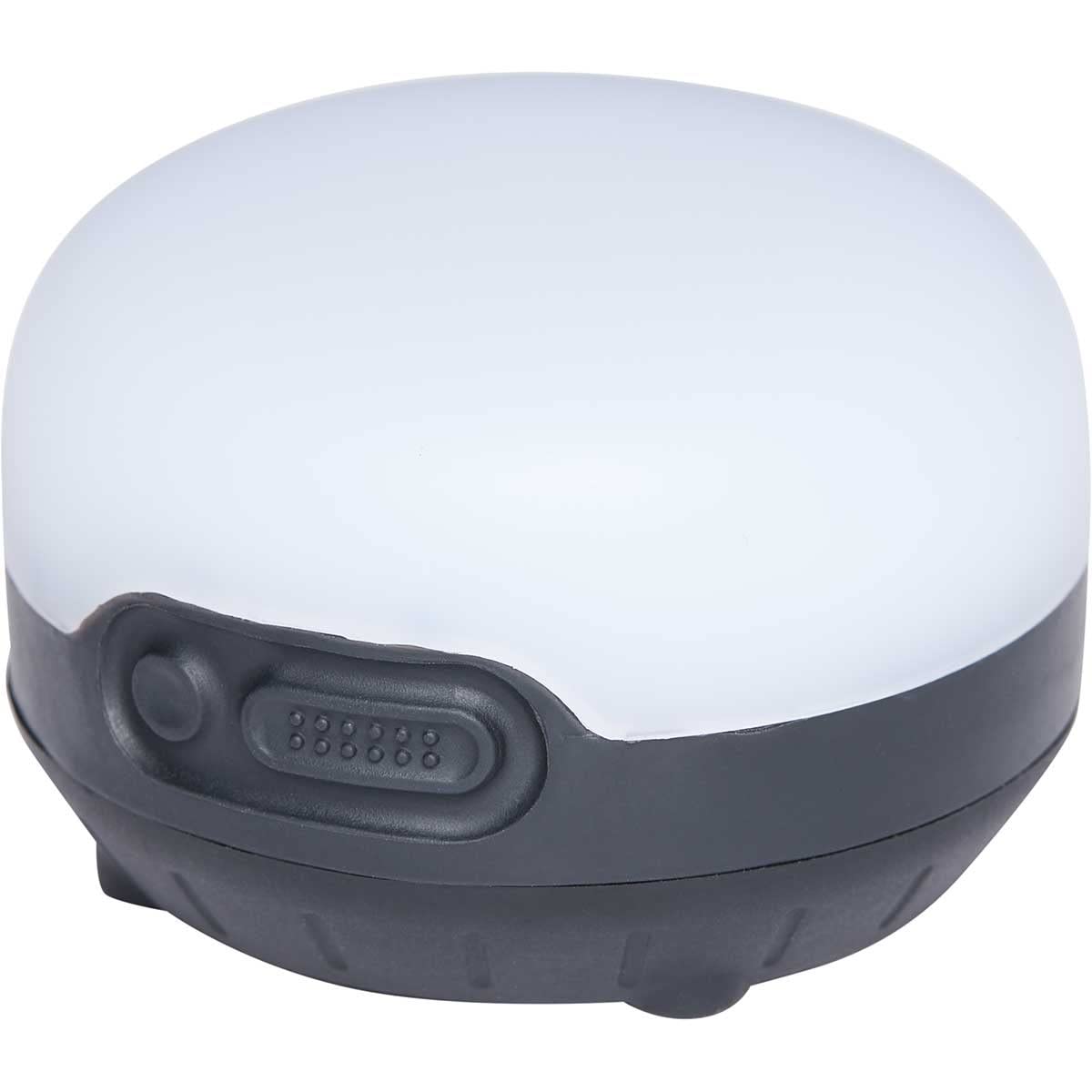
The Black Diamond Moji R+ is a featherweight 78-gram lantern that delivers 200 lumens of warm, even light with continuous dimming for tent or vestibule use. Its built-in 1500mAh lithium-ion battery recharges via micro-USB, and the IPX4 rating shrugs off splashes and light rain.
The standout feature is the strong magnet embedded in the base, letting you stick the Moji R+ to any metal surface inside a van, shelter frame, or even a fridge at basecamp. The collapsible double-hook loop also makes hanging from tent peaks or branches a one-second task.
With only a single-button interface for power and dimming, the Moji R+ is as simple as it gets — no modes to cycle through, just smooth brightness control. The micro-USB port feels dated compared to USB-C competitors, but the magnetic utility and tiny footprint keep it a top pick for minimalist packers.
Why it’s great
- Strong magnetic base for hands-free mounting on metal
- Continuous dimming without mode cycling
- Ultra-light at 78g, fits in any pocket
Good to know
- Micro-USB charging instead of USB-C
- Battery is built-in and not user-swappable
5. Coleman Classic Rechargeable LED Lantern

The Coleman Classic Rechargeable mixes nostalgic gas-lantern looks with modern LED tech, pushing up to 800 lumens from a built-in 4800mAh lithium battery. It lasts 5 hours on high, 15 on medium, and a massive 45 hours on low — enough for a multi-night basecamp stay without recharging.
A built-in USB-A port lets you charge a phone or headlamp directly from the lantern, and the bottom unscrews to store the included USB-C cord neatly inside. The carabiner on the bail handle makes hanging from a ridge line or tent frame quick, and the IPX4 rating plus 1-meter impact resistance give it real campsite durability.
At 2.16 pounds, the Classic is too heavy for an ultralight pack, but it’s a standout choice for car-accessed basecamps, family trips, or emergency kits where weight isn’t the primary concern. The three brightness levels cover everything from dim ambience to full flood.
Why it’s great
- High 800-lumen output with 45-hour low runtime
- USB-A port charges phones and other devices
- Built-in cord storage and carabiner handle
Good to know
- Heavy at 2.16 lbs, not for backpacking
- Charging time is moderate with the USB-C input
6. LuminAID 2-in-1 Solar Camping Lantern and Phone Charger

The LuminAID Titan 2-in-1 is a solar-rechargeable inflatable lantern that collapses flat to 1 inch thick and expands into a 6-inch cube for 300 lumens of diffused light. Its built-in 4000mAh battery recharges fully in 16-20 hours of direct sun or in 4 hours via USB, and it doubles as a phone charger with enough capacity for 2-3 phone top-offs.
The IP67 rating makes it 100% waterproof and dustproof — it even floats when inflated — so it’s a natural fit for kayak trips, beach camps, or emergency kits that might face flooding. Multiple brightness settings include a red light mode and a Turbo mode for extra output when needed.
At 12.5 ounces, the Titan is heavier than a small LED puck but lighter than a traditional gas lantern, and its solar capability means zero dependence on charging infrastructure for extended trips. The Twist-to-Inflate mechanism is quick and intuitive, though the trade-off is a less concentrated beam compared to lensed lanterns.
Why it’s great
- Solar charging for off-grid trip extension
- Fully waterproof and floats when inflated
- Collapses flat for minimal pack volume
Good to know
- Solar recharge requires 16-20 hours of direct sun
- Beam is diffused, not ideal for focused task lighting
7. Snow Peak Hozuki Lantern

The Snow Peak Hozuki (ES-070WH) is a design-forward lantern that prioritizes ambiance and craftsmanship over brute brightness. With a maximum of 100 lumens from three AA batteries, it’s not going to light up a large group camp, but its LED Candle Mode — which flickers realistically in response to wind or sound — creates a serene atmosphere inside a tent or on a picnic table.
Made in Japan with a powder-coated finish, the Hozuki weighs just 5.8 ounces and measures 4 inches in diameter when closed. Runtime stretches to 80 hours on low, 20 hours on mid, and 8 hours on high, making it a long-lasting companion for solo trips or couples. The included Snow Peak battery pack offers a rechargeable option via mini USB.
The lifetime product guarantee is rare in outdoor lighting and reflects Snow Peak’s confidence in the build quality. If your priorities are aesthetics, weight, and a warm, human-centric light rather than maximum lumens, the Hozuki is a tough lantern to beat.
Why it’s great
- Realistic LED Candle Mode for ambient mood lighting
- Lifetime product guarantee from Snow Peak
- Lightweight at 5.8 oz, compact design
Good to know
- 100-lumen max is low for large-group camp illumination
- Runs on AA batteries, requires separate purchase of rechargeable pack for USB
FAQ
Can I use a backpacking lantern to charge my phone on the trail?
Are solar lanterns reliable for multi-day backpacking trips?
What is the difference between warm and cool white light for camping?
Final Thoughts: The Verdict
For most users, the backpacking lantern winner is the Fenix CL26R Pro because it combines 650 lumens, a 360-degree beam, USB-C fast charging, and a phone-charging power bank in a 7-ounce package. If you want adjustable color temperature and marathon runtime for basecamp, grab the Sofirn BLF LT1. And for an ultra-compact, weather-proof companion that runs on disposable batteries in a pinch, nothing beats the Ledlenser ML4.