
Our readers keep the lights on and the weekend projects moving. As an Amazon Associate, I earn from qualifying purchases.
A great audio sound system doesn’t just play louder—it transforms your living room into a cinema, your gaming sessions into an immersive world, and your music into a live performance. The real challenge is cutting through the marketing noise to find a setup that actually delivers on clarity, depth, and placement accuracy for your specific space and content.
I’m Rikta — the co-founder and writer behind FitlyFast. I’ve spent countless hours analyzing DSP chips, driver materials, crossover schematics, and room-correction algorithms to separate genuine engineering from clever packaging in the home audio market.
This guide breaks down the most capable systems across power levels and budgets — from self-contained soundbars with true Dolby Atmos to separates that let you build a custom reference rig — so you can buy with confidence. Choose your audio sound system based on the specs that matter most for your room and listening habits.
How To Choose The Best Audio Sound System
Every room and listener is different, so the “best” system depends on your space size, content habits, and whether you value simplicity or maximum configurability. Start by matching the system architecture to your physical layout and willingness to run speaker wire.
Assess Your Room Volume and Layout
A 10-inch subwoofer and 100 watts per channel might pressurize a 12×12-foot den perfectly, but that same hardware will sound strained in a large open-concept living area. Measure your room’s cubic footage and look for a subwoofer that can reach down to at least 30Hz for convincing low-end authority. Larger spaces benefit from dual subwoofers or 12-inch+ drivers.
Decide on Channel Count and Atmos Capability
A 5.1 system provides discrete left, center, right, and rear surround channels. Adding height speakers (5.1.2 or 5.1.4) unlocks true Dolby Atmos overhead effects. For the most immersive bubble, a 7.1.4 layout with four ceiling or up-firing channels is the current home-theater gold standard. If you watch mostly stereo music and dialogue-driven content, a simpler 2.1 or 3.1 system may suffice.
Evaluate Room Correction and Calibration
Built-in room-correction software like Dirac Live or Audyssey measures your speakers’ response from multiple listening positions and applies filters to tame room modes and reflection issues. This single feature often has a larger impact on perceived sound quality than upgrading speaker wire or DACs. Systems with automatic calibration save hours of manual adjustment and deliver a balanced frequency curve regardless of your room’s acoustics.
Quick Comparison
On smaller screens, swipe sideways to see the full table.
| Model | Category | Best For | Key Spec | Amazon |
|---|---|---|---|---|
| Nakamichi Dragon 11.4.6 | Soundbar System | Cinema-grade immersion without receiver | 11.4.6 channels, Dual 8″ subs | Amazon |
| Sony BRAVIA Theater Quad | Wireless Surround | Flexible placement & phantom center | 16 drivers, 4 wireless modules | Amazon |
| Klipsch R-625FA Bundle | Tower + AVR | Full 5.1.2 Atmos with floorstanders | 6.5″ woofers, 12″ sub, Yamaha AVR | Amazon |
| Onkyo TX-RZ50 | AV Receiver | DIY builds & Dirac Live calibration | 9.2 channels, 120W per ch, Dirac Live | Amazon |
| SVS Prime Pinnacle Pair | Floorstanding Pair | Critical stereo listening & music | Triple 6.5″ woofers, 1″ dome tweeter | Amazon |
| ULTIMEA Skywave X70 | Soundbar | Wireless simplicity with 20Hz bass | 10″ sub, 980W, GaN amplifier | Amazon |
| Klipsch Cinema 5.1.4 | Satellite System | Starter Atmos on a mid-range budget | 5.25″ drivers, Tractrix horn tweeters | Amazon |
| Philips TAM8905/37 | Micro Stereo | Compact music & internet radio | 100W, 5.25″ woofers, CD & Wi-Fi | Amazon |
| Bobtot 5.1 System | Entry Surround | Budget 5.1 with karaoke & LED lights | 10″ sub, 1200W peak, 2 mic inputs | Amazon |
In‑Depth Reviews
1. Nakamichi Dragon 11.4.6-Ch Surround System
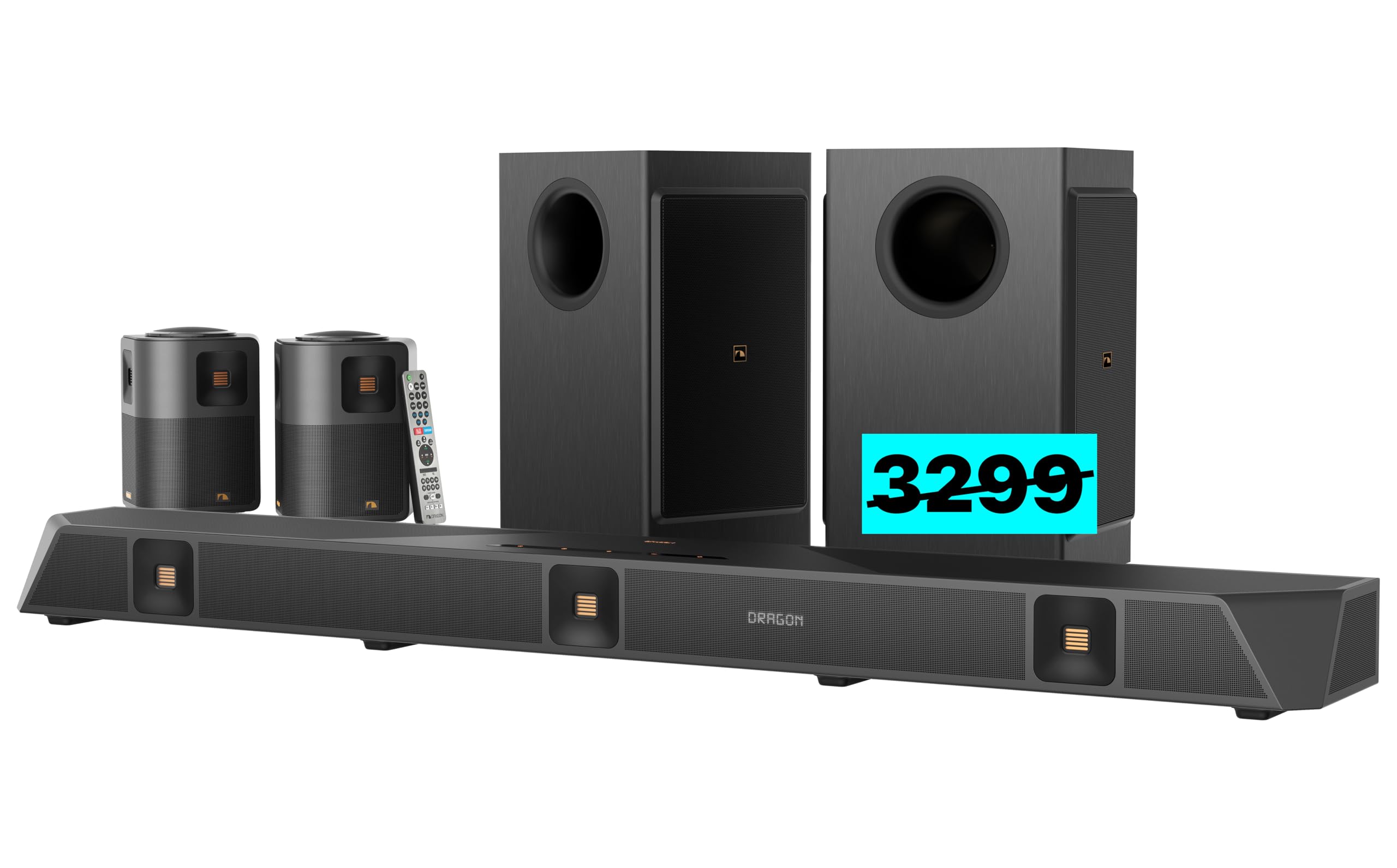
The Nakamichi Dragon is a complete endgame solution that delivers a 360-degree cinema field without a separate AV receiver. Its 58-inch soundbar houses seven HiFi Air Motion Tweeters for pristine highs, while the dual-opposing 8-inch subwoofers produce deep, controlled bass down to 20Hz with almost zero cabinet vibration. The Omni-Motion surround speakers feature a PerfectHeight mechanism that locks overhead effects to your sweet spot — a rare feature in an all-in-one package.
Setup is genuinely plug-and-play: the wireless subwoofers and surrounds link to the main unit out of the box, and the Pro-Cinema Engine processes Dolby Atmos and DTS:X Pro with up to 3000 watts of peak output. The 58-inch chassis and a combined subwoofer weight of nearly 70 pounds mean you need ample floor space and sturdy furniture, but the payoff is a soundstage that rivals separates costing three times as much. The included backlit remote and on-screen display simplify adjustments.
I have seen buyers replace entire 7.1.4 component stacks with this system and report equal or better immersion. The only genuine drawbacks are its physical footprint and the fact that advanced firmware updates occasionally require patience. For anyone who wants reference-grade home theater without wiring complications, the Dragon sets the bar.
Why it’s great
- True 11.4.6 channel count with discrete height processing
- Dual-opposing subwoofers deliver clean, distortion-free bass
- AMT tweeters produce exceptional clarity at all volume levels
Good to know
- Large cabinet and subwoofers require dedicated floor space
- No XLR analog inputs; auxiliary input via 3.5mm only
- Occasional HDMI handshake delays when switching sources
2. Sony BRAVIA Theater Quad 16-Speaker System

Sony’s BRAVIA Theater Quad takes a radically different approach: four wireless speaker modules use 360 Spatial Sound Mapping to create up to 12 phantom speakers, including a virtual center channel and ceiling height layers. Each module contains four driver units, totaling 16 individual drivers, and the system auto-calibrates using the built-in microphones and Sound Field Optimization. I was particularly impressed by how convincingly the phantom center handles dialogue — it rarely pulls toward left or right even when I sit off-axis.
The quad modules can be placed on stands or wall-mounted, and each has a slim profile that blends into most décor. The control box supports HDMI 2.1 with 4K120, VRR, and ALLM, making it an excellent partner for gaming. Dolby Atmos, DTS:X, and IMAX Enhanced are all supported. The BRAVIA Connect app gives you granular control over sound profiles, volume, and advanced settings without needing the remote.
One limitation is that the system relies on Sony’s optional wireless subwoofers for deep extension below 30Hz, and the software setup can be finicky on crowded Wi-Fi networks — a wired LAN connection to the hub solves most issues. The phantom channel technology works best in rooms with reflective surfaces; heavy drapes or acoustic panels can degrade the virtual imaging. For listeners who prioritize placement flexibility and a clean aesthetic, this is the most elegant solution available.
Why it’s great
- Phantom center and height channels are remarkably convincing
- Wireless modules offer near-total placement freedom
- HDMI 2.1 with 4K120, VRR, and ALLM for gaming
Good to know
- Requires Sony sub for low-end extension below 30Hz
- Software setup can be buggy on busy Wi-Fi networks
- Works best in rooms with reflective surfaces
3. Klipsch Reference Dolby Atmos Bundle with R-625FA & Yamaha RX-A2AB
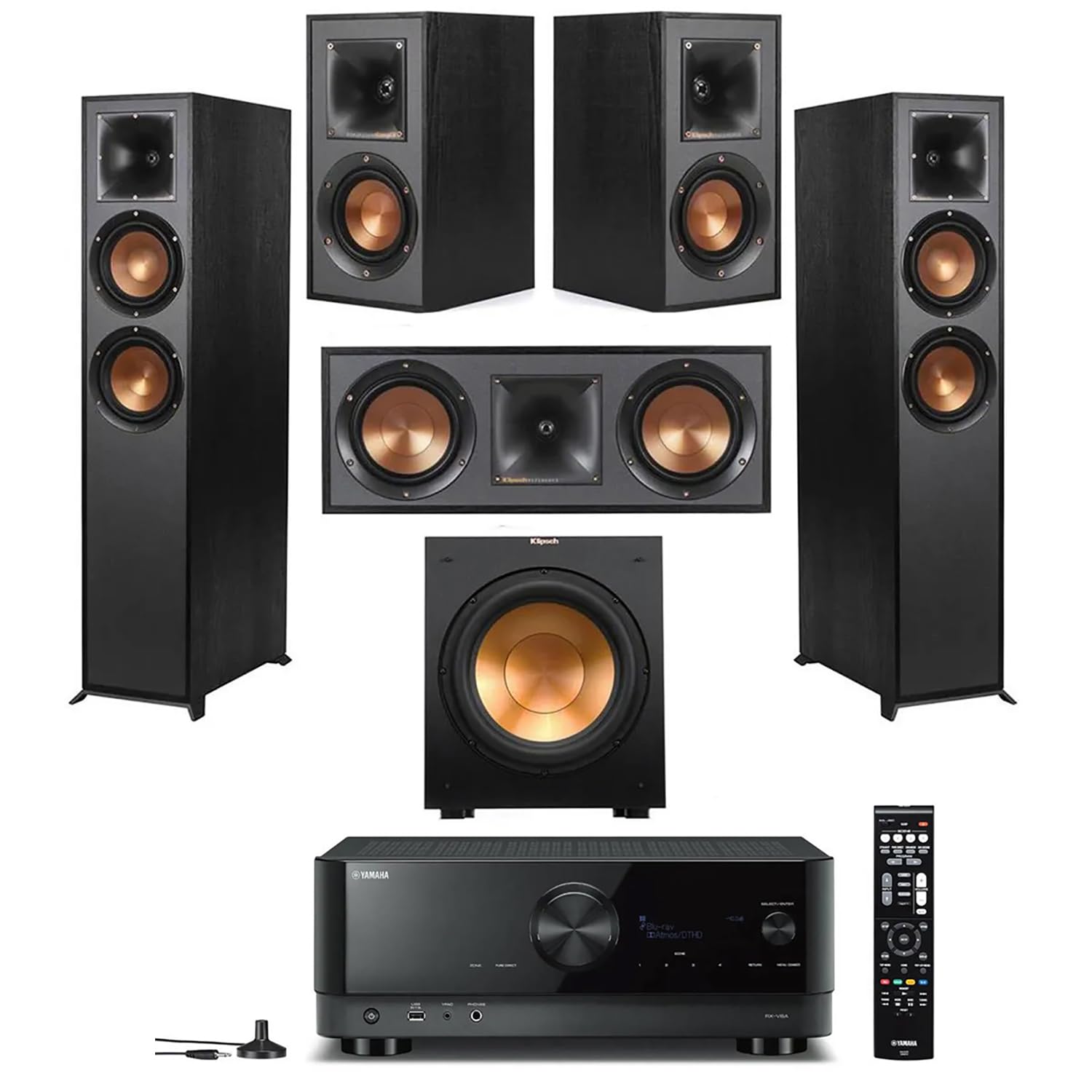
This Klipsch bundle packages a full 5.1.2 Dolby Atmos system with floorstanding speakers that feature built-in up-firing elevation drivers. The R-625FA towers use a 6.5-inch spun copper IMG woofer and a 1-inch aluminum LTS tweeter mated to a 90×90 Tractrix horn, delivering the bright, detailed Klipsch signature that excels at movie effects and dialogue clarity. The R-52C center channel and R-41M bookshelf surrounds complete the bed layer.
The included R-12SW subwoofer uses a 12-inch driver with a digital amplifier rated at 400 watts peak, producing deep low-frequency impact that pressurizes medium-sized rooms effectively. The Yamaha RX-V6 receiver offers 7.2-channel processing, Dolby Atmos and DTS:X decoding, 8K video passthrough, and HEOS wireless multi-room streaming. Automatic room calibration via Yamaha’s YPAO system fine-tunes speaker distances and EQ levels.
Some users report that the supplied floor-standing speaker feet use low-quality screws that strip easily — replacing them with standard 1/4-20 bolts solves the issue permanently. The system is wired, so you will need to run speaker cable to the surround positions. For the price, this bundle delivers the most complete component-grade Atmos experience without having to match individual pieces yourself.
Why it’s great
- True Atmos with built-in up-firing elevation channels
- Yamaha AVR with 8K support and HEOS streaming
- 12-inch subwoofer provides authoritative bass for medium rooms
Good to know
- Tower feet have low-quality screws that may strip
- Requires running speaker wire to surround positions
- Bundle ships in multiple boxes that may arrive separately
4. Onkyo TX-RZ50 9.2-Channel AV Receiver

The Onkyo TX-RZ50 is the centerpiece for anyone building a custom home theater. It delivers 120 watts per channel across nine amplified channels, with pre-outs for a full 7.1.4 layout if you add an external two-channel amplifier. The standout feature is included Dirac Live room correction — a system that measures your room’s acoustic response and applies precise filters to eliminate standing waves and ringing, resulting in a flat and accurate frequency curve that standard EQ cannot match.
The receiver supports Dolby Atmos, DTS:X, THX Certified audio, and HDMI 2.1 with 8K60 and 4K120 passthrough. It is Works with Sonos Certified, meaning you can integrate it into a Sonos multi-room system using a Sonos Port. The Onkyo Controller app handles basic adjustments, though it lacks deep customization for Zone 2 HDMI routing. Independent crossover settings per channel give you fine control over speaker-subwoofer integration.
A small but notable point: the HDMI switching takes about twelve seconds to handshake with sources, and the unit runs cool thanks to its robust heatsink design — atypical for a receiver pushing this much output. No printed manual or speaker cables are included, so budget for those separately. For the DIY enthusiast who wants room-calibrated, THX-certified performance, the TX-RZ50 is the reference choice.
Why it’s great
- Full Dirac Live room correction included, no license needed
- 9.2 amplified channels with pre-outs for 7.1.4 expandability
- THX Certified and HDMI 2.1 with 8K support
Good to know
- HDMI source switching can take 12+ seconds
- No printed manual or speaker cables included
- Zone 2 HDMI routing is not controllable via app
5. SVS Prime Pinnacle Floorstanding Speakers (Pair)

The SVS Prime Pinnacle is a floorstanding speaker built for high-fidelity stereo and multi-channel music reproduction. Its three 6.5-inch woofers are arranged in a vertical array to reduce floor-bounce reflections, while a dedicated 5.25-inch midrange driver and a 1-inch aluminum dome tweeter handle the critical vocal and treble range. The result is a balanced, non-fatiguing soundstage that remains clear and composed even at high listening levels.
Bass extension reaches down to 27Hz in-room, which is exceptional for a passive tower without a subwoofer, though the rear-firing port requires at least six inches of clearance from the wall. The speakers are moderately efficient at 88dB sensitivity and present a nominal 8-ohm load, so a quality amplifier with at least 50 watts per channel is recommended. SVS includes magnetic grilles and adjustable floor spikes for stable placement on carpet or hard flooring.
One design compromise is the single set of binding posts — there is no bi-amp or bi-wire option, which matters only to a small segment of purists. The Black Ash and Piano Gloss Black finishes look premium but show fingerprints easily on the gloss version. For critical music listening or as the front channels in a high-end surround rig, these speakers deliver studio-monitor neutrality with real-world bass authority.
Why it’s great
- Triple 6.5” woofers deliver deep, articulate bass down to 27Hz
- Dedicated midrange driver ensures natural vocals and instruments
- High build quality with magnetic grilles and adjustable spikes
Good to know
- Rear-firing ports need 6+ inches of wall clearance
- Single set of binding posts — no bi-wire capability
- Piano gloss finish attracts smudges and dust
6. ULTIMEA Skywave X70 7.1.4ch Soundbar System
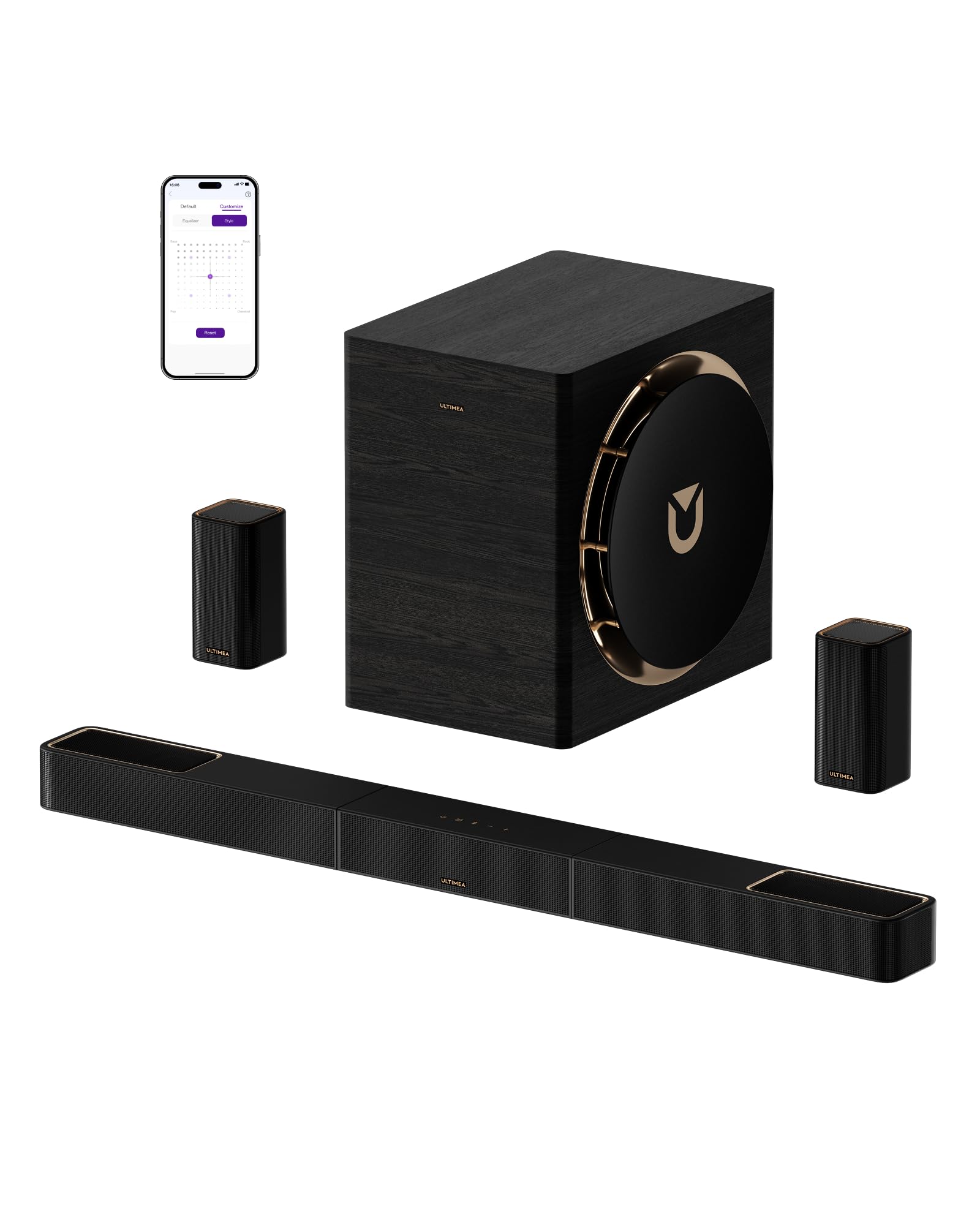
The ULTIMEA Skywave X70 is a soundbar system that redefines what an all-in-one can achieve. Its 10-inch wireless subwoofer reaches down to 20Hz — deeper than most standalone budget subs — and the GaN (gallium nitride) amplifier delivers 98% efficiency with eight times faster response than traditional silicon amps, resulting in cleaner transient reproduction and less heat generation. The three-piece soundbar snaps together to form a 7.1.4-channel array with dedicated upward-firing drivers for Atmos height effects.
The NEURACORE processing engine runs a triple-core DSP and dual-core MCU, supporting up to 17 channels of audio at 24-bit/192kHz with less than 0.5% total harmonic distortion. Dual 5GHz wireless links keep the surround speakers and subwoofer stable without dropouts. The ULTIMEA app provides a 10-band parametric EQ, 121 sound presets, and OTA firmware updates. HDMI eARC supports 4K HDR passthrough, and CEC sync lets you control the system with your TV remote.
I appreciate the wood-crafted subwoofer enclosure and rose gold accents — the system looks as premium as it sounds. The main limitation is the lack of auto-calibration; you have to fine-tune speaker distances and levels manually. The surround speakers connect wirelessly but require their own power outlets, so placement is not completely cord-free. For the money, the Skywave X70 offers bass extension and processing power that typically cost double.
Why it’s great
- 10-inch subwoofer with 20Hz extension for cinema-grade bass
- GaN amplifier provides ultra-low distortion and high efficiency
- App-based 10-band EQ and 121 sound presets for fine tuning
Good to know
- No automatic room calibration — manual adjustment required
- Surround speakers need separate power outlets
- Soundbar sections are heavy during assembly
7. Klipsch Reference Cinema Dolby Atmos 5.1.4 System

The Klipsch Reference Cinema system is a satellite-based 5.1.4 package that delivers a true Atmos experience at an entry-level price point. The four satellite speakers each include an upward-firing driver that reflects sound off the ceiling to create overhead effects — a design that works best with flat, non-textured ceilings between 8 and 10 feet high. The centaur channel and satellites use Klipsch’s signature 90×90 Tractrix horn-loaded 1-inch aluminum tweeters for crisp, efficient high-frequency reproduction.
The 8-inch powered subwoofer provides 200 watts of continuous power and gets the job done for medium rooms, though it lacks the deep extension of larger drivers. The system requires an external AV receiver with at least 7.1 processing to decode all channels; no receiver is included. Crossover settings benefit from adjustment: setting the center to 90Hz, satellites to 100Hz, and the upward-firing speakers to 120Hz yields the most seamless blend between the sub and the satellite array.
Speaker wire is not included, and the spring-clip terminals on the satellites are tight — 16-gauge wire is easier to fit than 14-gauge. The satellites are larger than typical lifestyle speakers, so be prepared for a visible presence in the room. For those building their first Dolby Atmos system on a budget, this kit represents the most affordable path to true discrete height channels without up-firing modules in towers.
Why it’s great
- Discrete 5.1.4 configuration with true height channels
- Tractrix horn tweeters deliver efficient, clean highs
- Satellites have strong bass response for their size
Good to know
- No speaker wire or AV receiver included
- Subwoofer lacks punch compared to larger drivers
- Satellites are visually larger than typical bookshelf speakers
8. Philips Bluetooth & Wi-Fi Stereo System with CD Player (TAM8905/37)

The Philips TAM8905/37 is a micro stereo system built for listeners who want a dedicated music source rather than a home theater setup. It combines a CD player, FM radio, internet radio, Bluetooth, and Wi-Fi streaming with Spotify Connect into a single compact chassis. The wooden cabinet speakers house 5.25-inch woofers and dome tweeters, delivering 100 watts of clean, room-filling sound that works well in kitchens, home offices, or bedrooms.
The matte aluminum central unit and wooden enclosures give it a classic hi-fi look that stands out from plastic all-in-one systems. A color display shows album art, artist info, and source metadata. The remote control provides full access to preset sound styles (rock, jazz, classical, etc.) and input selection. An AUX input and headphone jack expand its utility beyond streaming and radio.
Some users note that the system can sound slightly muddy on certain AM/FM frequencies, though this is typical of tabletop radios and the issue disappears with Bluetooth or CD playback. The system also lacks a subwoofer output, so bass extension is limited to what the 5.25-inch woofers can produce — about 50Hz. For its intended purpose as a compact, stylish music system with physical media support, this Philips punches well above its size class.
Why it’s great
- CD player, internet radio, and Spotify Connect in one unit
- Wooden cabinets and aluminum finish look premium
- Compact footprint fits on shelves or countertops
Good to know
- No subwoofer output limits low-frequency extension
- FM radio can sound slightly muddy on some frequencies
- Speakers are connected via wire, not fully wireless
9. Bobtot Home Theater System 5.1/2.1 Channel with 10″ Subwoofer
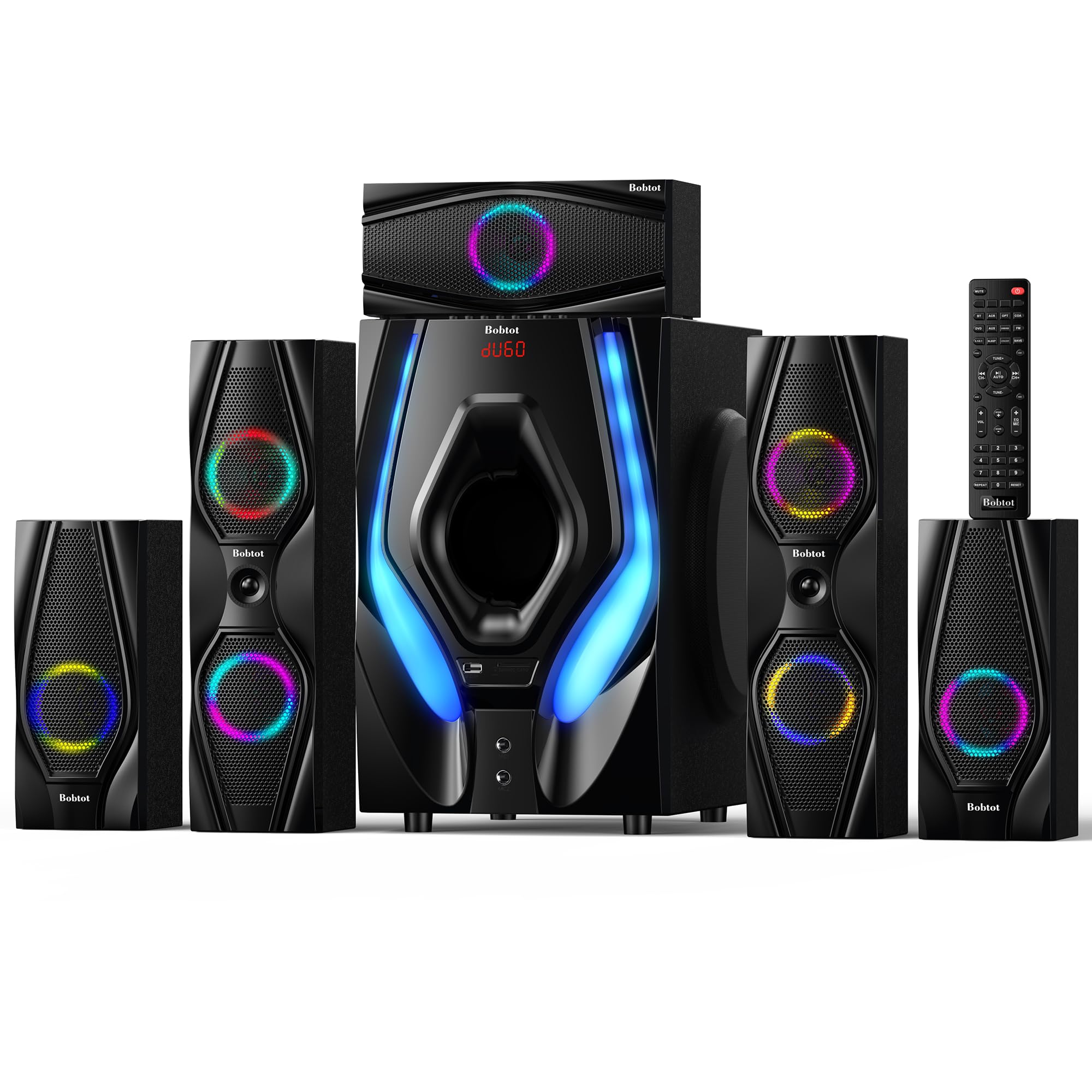
The Bobtot 5.1 system is an entry-level surround package designed for budget-conscious buyers who still want physical surround speakers and a powered subwoofer. Its 10-inch subwoofer houses the built-in receiver and delivers thumping bass, while the five satellite speakers (front left/right, center, rear left/right) provide a true surround configuration. The system includes two 1/4-inch microphone inputs with echo control for karaoke, making it a fun option for family parties and gatherings.
Bluetooth V5.3 allows wireless streaming from any smartphone, and the system supports ARC, optical, coaxial, AUX, USB, and SD card inputs — giving it broad compatibility with modern TVs, game consoles, and older sources. The remote control lets you adjust the volume of each speaker individually, and the LED lighting on the subwoofer offers four modes, including a spectrum EQ analyzer that responds to the beat. Speaker cables are built-in with generous lengths: 13 feet for the front channels, 31 feet for the rears, and 10 feet for the center.
Build quality and reliability are the main trade-offs at this price point. Some units have experienced subwoofer or satellite failures within the first year, though customer service has generally provided replacements. The highs and mids can distort at extreme volume levels, and the fixed cables mean you cannot swap them for higher-gauge wire. For a spare room, garage, or as a first-time surround setup where the budget cannot stretch further, the Bobtot delivers remarkable value and features.
Why it’s great
- True 5.1 surround with a large 10-inch subwoofer
- Two microphone inputs with echo for karaoke parties
- Long built-in speaker cables allow flexible rear placement
Good to know
- Build quality and reliability can vary between units
- Highs and mids distort at maximum volume
- Fixed speaker cables cannot be upgraded or customized
FAQ
What is the difference between a soundbar and a component audio system?
How many height channels do I need for good Dolby Atmos?
Can I mix different speaker brands in one system?
Final Thoughts: The Verdict
For most users, the audio sound system winner is the Nakamichi Dragon 11.4.6 because it delivers reference-grade cinema immersion with zero complication — no separate receiver, no wiring, and a soundstage that outperforms most component builds at the same cost. If you want flexible wireless placement and virtual surround magic, grab the Sony BRAVIA Theater Quad. And for component builders who demand Dirac Live room calibration and THX certification, nothing beats the Onkyo TX-RZ50 as the heart of a custom 7.1.4 system.