
Our readers keep the lights on and the weekend projects moving. As an Amazon Associate, I earn from qualifying purchases.
The first bike is a milestone, and choosing a model that builds confidence rather than frustration is the single biggest decision you can make. A poorly weighted frame or a seat that doesn’t adjust low enough can turn a fun learning experience into a wobbly ordeal. The right bike lets a toddler focus on gliding, not fighting the hardware.
I’m Rikta — the co-founder and writer behind FitlyFast. I’ve spent years analyzing child development product categories, comparing frame geometries, tire compounds, and weight distribution specs to find which builds actually accelerate a child’s balance learning curve.
After reviewing dozens of models, I’ve narrowed the field to the seven most capable contenders. This guide breaks down how to match a bike to your child’s height and skill level, and helps you find the best balance bike for kids without paying for features you don’t need.
How To Choose The Best Balance Bike For Kids
Selecting a balance bike is about predicting how fast your child outgrows it. The wrong choice leaves your child either struggling to reach the ground or cramped on a frame designed for a younger sibling. Focus on three metrics: the minimum seat height relative to your child’s inseam, the frame’s curb weight, and the tire’s intended surface.
Seat Height and Inseam Matching
A child’s feet must rest flat on the ground when seated. Measure your child’s inseam from crotch to floor, then compare it to the bike’s minimum seat height. Most bikes for ages two to five start around 14 inches. A bike that bottoms out above the inseam forces a tiptoe stance that erodes confidence.
Frame Weight and Material Density
Aluminum frames (roughly 6.4 to 7 pounds) are easier for a child to lift, steer, and stop. Steel and alloy steel frames offer better dent resistance but can exceed 10 pounds. For a two- or three-year-old, every pound of frame weight directly affects their control when turning and stopping.
Tire Construction and Rolling Resistance
Puncture-proof EVA foam tires work well on pavement and wood floors. Rubber pneumatic tires absorb bumps on grass and gravel but require occasional inflation. Airless models eliminate flat repairs entirely. For indoor use, choose smooth EVA tires; for mixed paths, a wider rubber tread reduces skidding.
Quick Comparison
On smaller screens, swipe sideways to see the full table.
| Model | Category | Best For | Key Spec | Amazon |
|---|---|---|---|---|
| Retrospec Cub | Premium | Long-term growth from 18 months | Seat height range 11–14.5 in | Amazon |
| Yvolution Y Velo Junior | Mid-Range | Transitioning from 3-wheel to 2-wheel | Dual rear wheel, max 44 lbs | Amazon |
| banana bike LT | Mid-Range | Ultra-light aluminum build | Frame weight 6.4 lbs | Amazon |
| Gotrax KS12 | Mid-Range | Added LED fun for evening rides | Max load 110 lbs | Amazon |
| Liberry Baby Balance Bike | Premium | Smallest riders 12-24 months | Seat height 9.7–11 in | Amazon |
| KRIDDO Toddler Balance Bike | Budget | Multi-terrain metal frame | Carbon steel, seat 14.17–18.5 in | Amazon |
| Bobike Toddler Balance Bike | Budget | Enclosed non-slip wheels for safety | 135° steering limit | Amazon |
In‑Depth Reviews
1. Retrospec Cub Toddler Balance Bike

The Retrospec Cub hits the sweet spot between longevity and maneuverability. Its alloy steel frame is sturdy enough to survive drops from a fast-moving toddler yet weighs under 10 pounds, so little arms can steer without straining. The airless, puncture-proof tires roll smoothly over pavement and grass, eliminating the hassle of checking air pressure before every ride.
The adjustable seat spans from 11 to 14.5 inches, which accommodates children as young as 18 months up to roughly three years old. The low center-of-gravity design keeps the bike stable when a child shifts weight to one side during turns. I found the rounded edges and non-slip grips reduce pinch hazards, a detail that matters when kids grab the frame instinctively.
Assembly takes about 10 minutes with the included hex tools. The lack of a brake is standard for this age bracket — children stop by planting their feet. Owners in reviews consistently report that the bike lasted over a year of daily use without any mechanical slop developing in the handlebar clamp or seat post.
Why it’s great
- Wide seat-height range fits a growing toddler over multiple seasons.
- Indestructible airless tires mean zero maintenance and no punctures.
- Low frame design lets even short toddlers mount independently.
Good to know
- No hand brake, so coasting downhill requires foot braking only.
- Solid tires can feel slightly rougher on bumpy dirt paths compared to pneumatic.
2. Yvolution Y Velo Junior 9″ Balance Bike

The Y Velo Junior solves the fear of tipping with its iconic dual rear wheel. The bike ships in a three-wheeled configuration that provides a wide base, then transitions to a single rear wheel once a child’s balance improves. This design lets parents skip the training-wheel phase entirely and instead build balance from the ground up.
At 7.7 pounds, the alloy steel frame stays light enough for a two-year-old to lift. The adjustable seat ranges from 11 to 14.2 inches, and the handlebars also adjust, which extends the usable age window. The larger wheels and higher ground clearance give better rollover capability on uneven grass compared to smaller 12-inch solid-tire bikes.
The bike lacks a brake, but the foot-placed stance works naturally for this age range. Owners consistently report that the bike feels stable even when a child leans aggressively. Switching between the dual and single-wheel mode requires removing two bolts — about two minutes of work.
Why it’s great
- Dual rear wheel eliminates tipping anxiety for absolute beginners.
- Adjustable seat and handlebars grow with the child from 18 months to 3 years.
- Higher ground clearance handles grassy hills without bottoming out.
Good to know
- The maximum weight limit of 44 pounds means taller kids will outgrow it quickly.
- Transitioning wheel modes requires a small tool and an extra step during assembly.
3. banana bike LT Balance Bike

At 6.4 pounds, the banana bike LT is one of the lightest production balance bikes in this price tier. The aluminum frame makes a tangible difference: a two-year-old can lift it to correct a wobble, turn it around, and carry it over a curb without help. The low center-of-gravity frame profile also simplifies stepping through, so kids mount independently sooner.
The adjustable seat uses a quick-release clamp, not a bolt, so caregivers can change height in seconds without tools. The seat span from 12.2 to 15.7 inches fits the typical two-to-four-year-old inseam range. The 11-inch EVA foam tires are puncture-proof and roll quietly on hardwood floors, making this a solid choice for indoor and sidewalk riding.
One trade-off for the low weight is that the steering uses a simple bushing instead of a bearing, which creates a slightly gritty feel. Owners note that the axles can be slightly undersized relative to the wheel holes, causing a small amount of lateral wheel play. For the short period a child uses a balance bike, this rarely affects function.
Why it’s great
- Extremely lightweight aluminum frame reduces fatigue and improves control.
- Quick-release seat clamp makes height adjustments tool-free and instant.
- Smooth indoor performance with puncture-proof EVA tires.
Good to know
- Non-bearing steering can feel gritty after several months of use.
- Some lateral wheel play reported due to axle-to-hub tolerance variance.
4. Gotrax KS12 Balance Bike
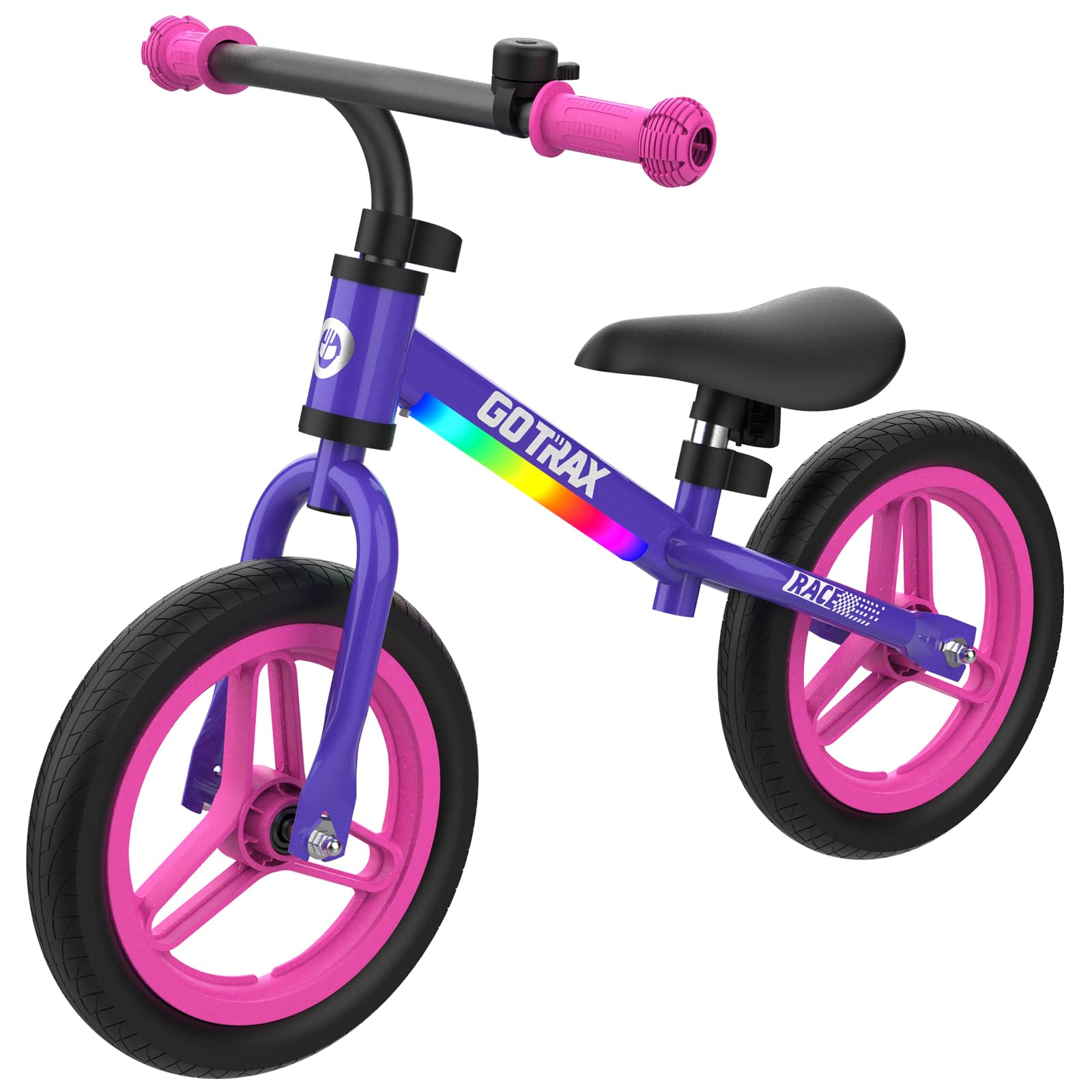
The Gotrax KS12 stands out because of its integrated LED lights mounted in the frame, which activate as the child moves. This feature turns the bike into a novelty that motivates toddlers to ride more often, especially in low-light conditions. The LED lights are bright enough to be seen from a distance, adding a visibility bonus during evening rides.
The frame is made from iron and weighs 8.6 pounds, which is heavier than the aluminum banana bike but still manageable for a three-year-old. The seat adjusts from 16.5 to 18.3 inches, and the handlebars from 22.8 to 26 inches, providing enough range for kids from about two to five years old. The 12-inch EVA wheels are flat-free and handle pavement, grass, and packed dirt well.
A small bell and thicker seat cushion add comfort that encourages longer sessions. The maximum weight rating of 110 pounds is significantly higher than most balance bikes, meaning it can handle a larger child if a younger sibling doesn’t command it. Some buyers note that the seat height at its lowest setting may still be too tall for a child under 25 months.
Why it’s great
- Frame-mounted LED lights create a self-powered night-time visual incentive.
- Generous weight limit of 110 pounds extends usability for larger kids.
- Included bell and padded seat improve the daily riding experience.
Good to know
- Lowest seat height may still be too tall for a 25-month-old with a short inseam.
- Iron frame is heavier than aluminum alternatives at 8.6 pounds.
5. Liberry Baby Balance Bike
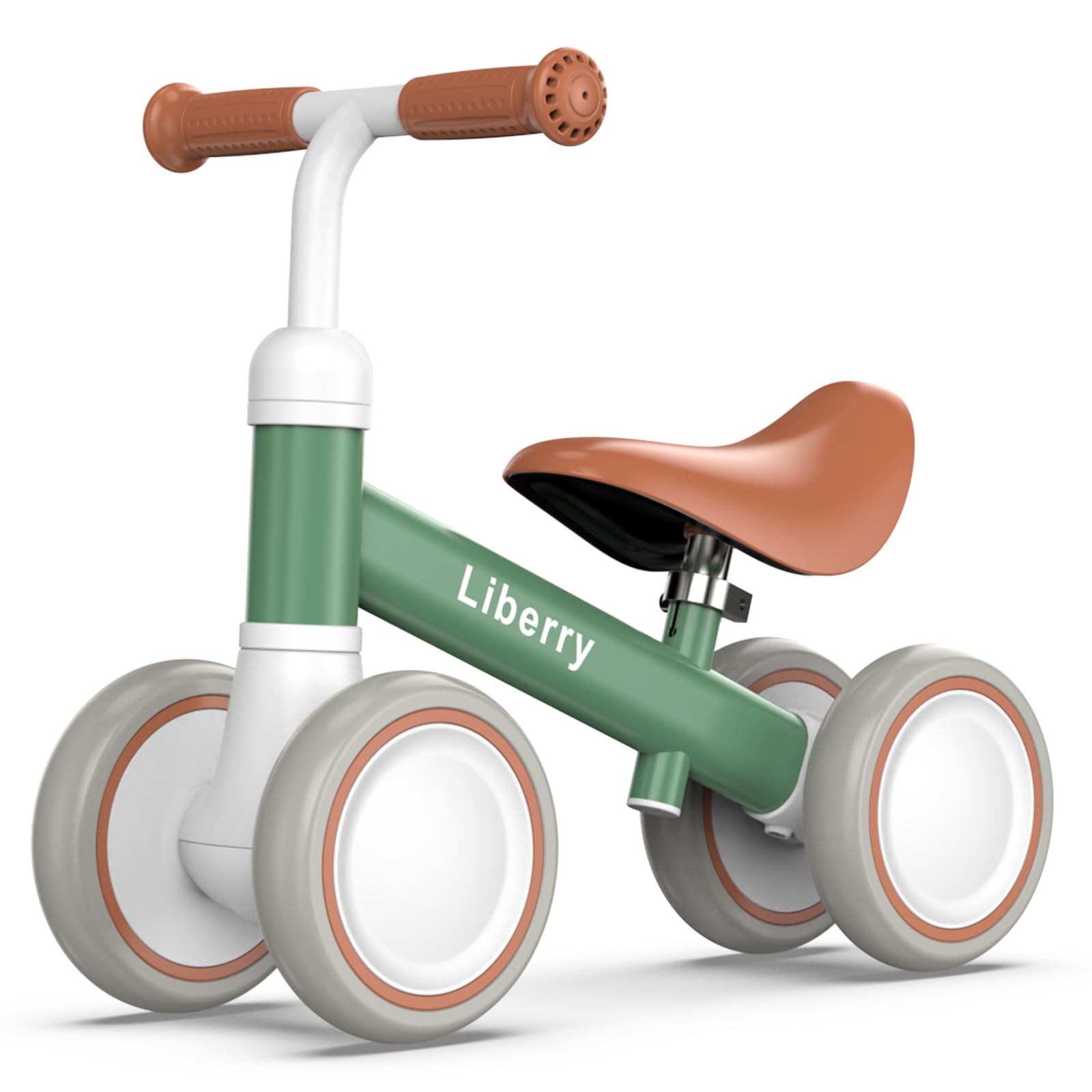
The Liberry Baby Balance Bike is designed specifically for children aged 12 to 24 months, which is earlier than most balance bikes. Its seat adjusts from 9.7 to 11 inches, low enough for a one-year-old to plant their entire foot flat. The four-wheel design increases lateral stability, so new walkers who are not yet steady on two wheels can ride without tipping.
The closed wheels prevent small fingers or loose clothing from getting caught, and the reinforced alloy steel frame handles up to 55 pounds. EVA foam tires provide a quiet, vibration-dampened ride on indoor floors. The handlebars are covered in rubber rather than the typical foam, avoiding the disintegration issue foam can suffer when exposed to sunlight or chewing.
A clever inclusion is the set of letter stickers for personalizing the frame with a child’s name. The bike is best suited for indoor use or very smooth paved surfaces; the manufacturer warns against riding on gravel or uneven terrain. For the youngest riders, this bike fills a gap that standard 12-inch models cannot.
Why it’s great
- Lowest seat height (9.7 inches) fits 12-month-olds with short inseams.
- Four-wheel base eliminates tipping for toddlers still mastering walking.
- Closed wheels and rubber grips improve safety over foam alternatives.
Good to know
- Not suitable for grass or gravel — limited to smooth indoor or paved surfaces.
- Non-adjustable handlebars may feel cramped for taller two-year-olds.
6. KRIDDO Toddler Balance Bike
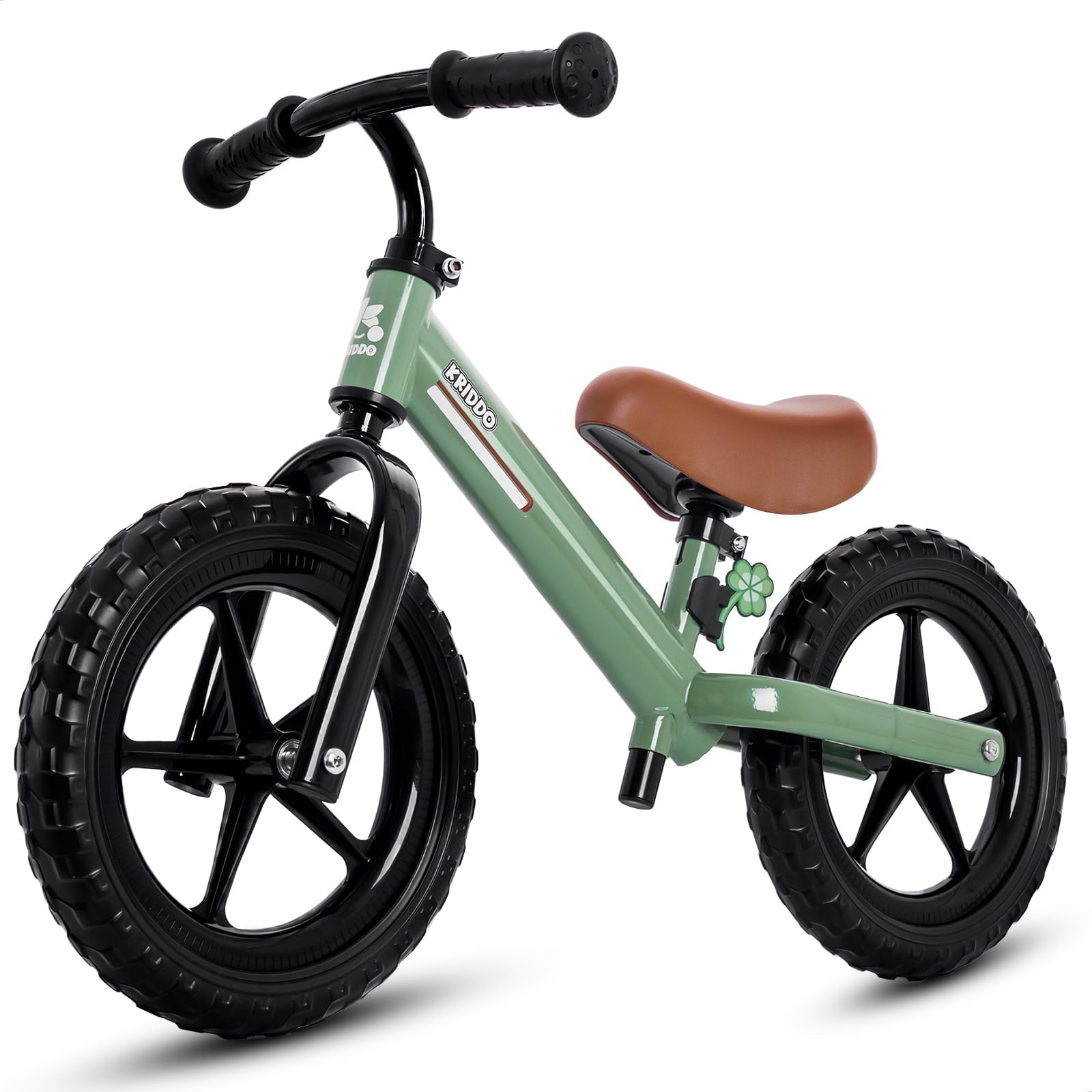
The KRIDDO uses a carbon steel frame that feels substantial without being clumsy. Its seat range of 14.17 to 18.5 inches covers the typical two-to-five-year-old growth path. The dual-bearing wheels reduce rolling resistance, allowing a child to glide with less effort per stride, which extends the time they are willing to practice before tiring.
The 12-inch puncture-proof tires handle multi-terrain use including grass, pavement, carpets, and wood floors. The included decorative flower and clover plates attach under the seat, offering a way for kids to personalize their bike without affecting balance or weight. Assembly is straightforward with standard Allen keys.
Customers consistently praise the sturdiness of the metal construction, noting that it survives multiple seasons and siblings. The gender-neutral green color works for both boys and girls. The trade-off is that carbon steel is heavier than aluminum, so very small riders may find it challenging to lift the bike over obstacles.
Why it’s great
- Dual-bearing wheels provide a low-resistance glide for longer play sessions.
- Multi-terrain puncture-proof tires work on grass, pavement, and indoor floors.
- Personalizable decorative plates add fun without increasing weight.
Good to know
- Carbon steel frame is heavier than aluminum or alloy steel alternatives.
- No included bell or additional accessories for play.
7. Bobike Toddler Balance Bike

The Bobike prioritizes safety through two specific engineering choices. The fully enclosed wheels prevent feet from slipping under the spokes, a common cause of ankle scrapes in open-spoke designs. The 135-degree steering limit stops the handlebars from turning a full 180 degrees, which prevents oversteering crashes that can throw a toddler forward.
The alloy steel frame supports up to 40 pounds, and the adjustable seat accommodates children up to about four years old. The non-slip wheel surface provides good grip on pavement and indoor floors. The bike meets ASTM F963-11 and EN71 safety standards, giving caregivers confidence about materials and structural integrity.
Assembly requires only a few minutes, and the included instructions are clear. The bike has a classic, vintage look that many parents find aesthetically pleasing. Some reviews note that the actual seller may differ from the brand name listed, so confirm the source before purchasing. The enclosed wheels and limited steering make this a strong choice for cautious parents.
Why it’s great
- Enclosed wheels eliminate the risk of foot entrapment under spokes.
- 135° steering limit prevents sharp oversteering and forward falls.
- Meets ASTM and EN71 standards for material safety and strength.
Good to know
- Seller origins may be unclear — confirm the source before purchase.
- Maximum weight limit of 40 pounds means larger children will outgrow it.
FAQ
At what age should I start my child on a balance bike?
How do I know if the seat height is correct for my toddler?
Are foam tires better than air-filled tires for a balance bike?
Final Thoughts: The Verdict
For most users, the best balance bike for kids winner is the Retrospec Cub because its combination of a puncture-proof tire, an alloy steel frame that’s both light and tough, and a wide 11-to-14.5-inch seat range covers the critical learning years with zero maintenance. If you want a bike that eliminates tipping anxiety for an absolute beginner, grab the Yvolution Y Velo Junior. And for the lightest aluminum frame that a two-year-old can lift and steer with no effort, nothing beats the banana bike LT.